February 26th, 2024 by Dave No comments »

Jesus’ Anger

Reflecting on Jesus’ cleansing of the temple in John’s Gospel (2:13–22), Father Richard explores the implications of Jesus’ anger and actions: 

Jesus’ actions in the temple are what finally get him killed. After this, religious leaders are dead set against him. Whenever law and order are based on interpretations of divine proclamation, what invariably happens is that the church and state, or religion and government, start working together and operating as one. It’s still true in many countries to this day. Government leaders like to have religion on their side so they can feel like everything they’re doing is blessed by God.

A few years ago, I was at a meeting in Washington, D.C. with nineteen representatives of various denominations. We wrote a statement that listed six different issues where we felt what Jesus teaches and what our government was doing are almost exact opposites. The issues revolved around racism, nationalism, classism that always favors the rich and the powerful, the terrible lack of truth in government, and our constant idealizing of money, war, and power. On every issue, the teaching of Jesus is in direct contradiction to the way our government has often operated.

Yet, if I’m honest, in many ways it’s always been that way; this is nothing new. It’s what’s playing out in this prophetic gospel reading (and in Matthew 21:12–17 also). The temple has become totally aligned with King Herod, with the collecting of taxes and money, and the selling of forgiveness.

Whenever religion gets into the business of the “buying and selling” of God, or of requiring sacrifices to earn God’s love, we have a problem. When Jesus said, “Get these birds out of here,” it’s a clue to the source of Jesus’ anger. The ordinary people had to sacrifice to be right with the priesthood and the temple. They sacrificed oxen and sheep, but the very poor were allowed to offer doves. Mary and Joseph had to give doves when they brought the infant Jesus to the temple (Luke 2:22–24). Jesus knows that his religion is not taking care of the poor; in fact, it’s stealing from the poor, and making them give even the little they have to feel they are right with God.

Jesus is angry about this, and many use this passage to justify violence because Jesus appears pretty violent here. But note that he’s violent toward things, not toward people. He’s liberating animals and trying to liberate the poor from their oppression. Of course, the religious leaders want to protect the building, the temple, but Jesus is redefining the temple. He identifies his body as the temple (John 2:21). The new temple is the human person; we are the body of Christ.

We see Jesus making this great revolution, transforming religion from a concern for sacrifice to earn God’s love to trust through which we know God’s love. And where does that trust happen? In the human heart.

Good and Necessary Anger

Dr. Barbara Holmes describes her felt experience of anger: 

Anger is intense. Often, there is a flash of heat and disorientation and the need to justify or retaliate. When I was a child, anger was my response to hurt feelings. When offended, I would lash out or run crying to my mom. In her arms, and with her reassurances, I could quell a heat of rage so intense that it threatened to overtake me. Anger is an emotion that consumes mind and body—but sometimes anger is necessary for survival. [1]

Richard explains how anger helps develop healthy individuals and communities: 

Anger is good and very necessary to protect appropriate boundaries of self and others. In men’s work, we call it the “good warrior” archetype. On the other hand, anger becomes self-defeating and egocentric when it hangs around too long after we have received its message. But conscious, visible, felt anger is a gift to consciousness and to community. We need it to know who we are and what boundaries must be defended, along with the depth of hurt and alienation in ourselves and in others with which we are dealing. [2]

Holmes continues: 

Many spiritual traditions warn us against anger. We are told that anger provides fertile ground for seeds of discontent, anxiety, and potential harm to self and others. This is true. However, when systems of injustice inflict generational abuses upon people and communities because of their ethnicity, race, sexuality, and/or gender, anger as righteous indignation is appropriate, healthy, and necessary for survival.

Jesus expressed righteous indignation when he encountered the unjust systems of religious and Roman authorities, yet Christian theologies shy away from the integration of anger into their canons. How can churches continue to ignore anger and still be relevant during this era when everyone is angry about everything? People of color are angry about police brutality, white supremacy, white privilege, and economic marginalization.…

A theology of anger [for communities under siege] assumes that anger as a response to injustice is spiritually healthy…. A theology of anger can help us to construct healthy boundaries … [and] the healthy expression of righteous anger can translate communal despair into compassionate action and justice-seeking.… The question is whether or not we will recognize our wounds and the source of our anger so that we can heal ourselves and others and awaken to our potential to embody the beloved community….

If we take a theology of anger seriously, first we come together, then we grieve together, then we consider where we are and where we are going. If there is opportunity, we engage in deep considerations of cause and effect, and we listen for the whispers of the Holy Spirit.… Our health and wholeness require that we take off our masks of Christian piety and do the difficult work of acknowledging our anger, our vulnerability, and our pain. It is this contemplative work that moves us toward forgiveness, for when we recognize our own human frailty, we can more easily forgive the fragility and failings of others. [3]

===================

FEB 23, 2024
A Greater Artist Than All Others
Vincent van Gogh’s struggles with mental illness are well known, and the accepted account of his death in 1890 is that he committed suicide during a particularly difficult lapse in his mental health after leaving the hospital in St. Remy. Numerous discrepancies in the narrative have led more recent biographers to question this account, postulating instead that Vincent was accidentally shot in the stomach by a group of drunk teenagers with whom he was acquainted.This alternative explanation may explain why Vincent while dying was concerned about others being blamed for his death. He told two officers, “Do not accuse anybody, it is I that wished to commit suicide.” His words echo those of Jesus who said, “No one takes [my life] from me, but I lay it down of my own accord” (John 10:18). Whether his death was an accident or caused by his illness, it is evident that his faith remained until the end.Van Gogh’s funeral was attended by many artists. One of them, Emile Bernard, described the setting:

“On the walls of the room where the body lay all his canvases were nailed, forming a sort of halo around him, and rendering his death all the more painful to the artists who were present by the splendor of the genius that radiated from them. On the coffin a simple white linen, masses of flowers, the sunflowers which he loved so much, yellow dahlias, yellow flowers everywhere. It was his favorite color….”

 
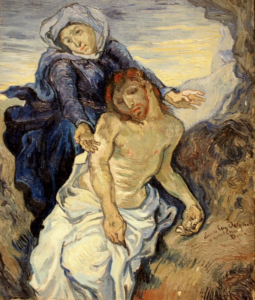
It was fitting that Vincent’s body was covered with yellow flowers—the symbol he so often used in his paintings to represent God’s presence and healing love. Directly above the casket hung a single painting—his Pietà showing the lifeless body of Jesus with Vincent’s own face and red hair awaiting the resurrection. Both the flowers and the painting were an affirmation that Vincent believed not even death could separate him from the love of God in Christ.It’s appropriate to conclude this series on the faith and art of Vincent van Gogh with his own words about Christ:
“Christ alone, of all the philosophers, magi, etc.—has affirmed as a principle of certainty, eternal life, the infinity of time, the nothingness of death… He lived serenely, as a greater artist than all other artists, despising marble and clay as well as color, working in living flesh. That is to say, this matchless artist, hardly to be conceived of by the obtuse instrument of our modern, nervous, stupefied brains, made neither statues nor pictures nor books; he loudly proclaimed that he made…living men, immortals.”

DAILY SCRIPTURE
ROMANS 8:31-39 
JOHN 10:1-18 


WEEKLY PRAYERFrom Henry Van Dyke (1852 – 1933)
O Christ, the brightness of God’s glory and express image of his person, whom death could not conquer, nor the tomb imprison; as you have shared our mortal frailty in the flesh, help us to share your immortal triumph in the spirit. Let no shadow of the grave frighten us and no fear of darkness turn our hearts from you. Reveal yourself to us as the first and the last, the Living One, our immortal Savior and Lord.
Amen.The post A Greater Artist Than All Others first appeared on With God Daily.

A New Liveliness

February 23rd, 2024 by JDVaughn No comments »

Depth psychologist Carol Pearson considers the gifts shared by those who have completed the hero’s journey of inner transformation:

At the beginning of the classic hero myth, the kingdom is a wasteland. Crops are not growing, illness is rampant, babies are not being born, and alienation and despair are pervasive. The fertility, the sense of life, has disappeared from the kingdom.…

A more youthful challenger goes on a journey … [which] transforms the challenger, whose treasure is the discovery of a new and life-affirming perspective. When the hero returns … fertility and abundance are restored. Rain falls, nourishing parched ground. Crops spring up, babies are born, the plague is cured, and people feel hopeful and alive once more.…

Heroes, then, are not only people who grow and change and take their journeys; they also are agents of change.… The hero’s task always has been to bring new life to an ailing culture.

In ancient times, societies were governed by kings and queens.… Today, however, we prize the achievement of democracy. Yet living in an egalitarian society carries with it responsibilities. Instead of only exceptional people going on the quest, we all need to be doing so. Heroism today requires us all to find the treasure of our true selves and to share that treasure with the community as a whole—through doing and being fully who we are. To the degree that we do so, our kingdoms are transformed. [1]

Richard locates the generativity of our spiritual journeys with our deeper connection to the Source of all life:

The hero “falls through” what is merely their life situation to discover their Real Life, which is always a much deeper river, hidden beneath the appearances. Most people confuse their life situation with their actual life, which is an underlying flow beneath everyday events. This deeper discovery is largely what religious people mean by “finding their soul.”

The hero returns to where they started and “knows the place for the first time” [2], but now with a gift or “boon” for their people or village. As the last step of Alcoholics Anonymous states, a person must pass the lessons learned on to others—or there has been no real gift at all. The hero’s journey is always an experience of an excess of life, a surplus of energy, with plenty left over for others. The hero has found eros, or life energy, and it is more than enough to undo thanatos, the energy of death.

Interestingly enough, this classic tradition of a true “hero” is not our present understanding at all. There is little social matrix to our present use of the word. A “hero” now is largely about being bold, attractive, rich, famous, talented, or “fantastic” by oneself, and often for oneself, whereas the classic hero is the one who “goes the distance,” whatever that takes, and then has plenty left over for others. True heroism serves the common good or it is not really heroism at all.

________________________________________________________

Sarah Young Jesus Calling

 Be on guard against the pit of self-pity. When you are weary or unwell, this demonic trap is the greatest danger you face. Don’t even go near the edge of the pit. Its edges crumble easily, and before you know it, you are on the way down. It is ever so much harder to get out of the pit than to keep a safe distance from it. That is why I tell you to be on guard.

    There are several ways to protect yourself from self-pity. When you are occupied with praising and thanking Me, it is impossible to feel sorry for yourself. Also, the closer you live to Me, the more distance there is between you and the pit. Live in the Light of My Presence by fixing your eyes on Me. Then you will be able to run with endurance the race that is set before you, without stumbling or falling. 

RELATED SCRIPTURE: 

Psalm 89:15-16 NLT

15 Happy are those who hear the joyful call to worship,

    for they will walk in the light of your presence, Lord.

16 They rejoice all day long in your wonderful reputation.

    They exult in your righteousness.

Additional insight regarding Psalm 89:14,15: Righteousness, justice, love, and truth are the foundation of God’s throne; they are central characteristics of the way God rules. They summarize his character. As God’s ambassadors, we can exhibit the same traits when we deal with people. Make sure your actions flow out of righteousness, justice, love, and faithfulness, because any unfair, unloving, or dishonest action cannot come from God.

Hebrews 12:1-2 NLT

God’s Discipline Proves His Love

12 Therefore, since we are surrounded by such a huge crowd of witnesses to the life of faith, let us strip off every weight that slows us down, especially the sin that so easily trips us up. And let us run with endurance the race God has set before us. 2 We do this by keeping our eyes on Jesus, the champion who initiates and perfects our faith. Because of the joy awaiting him, he endured the cross, disregarding its shame. Now he is seated in the place of honor beside God’s throne.

Additional insight regarding Hebrews 12:1: This “huge crowd of witnesses” is composed of the people described in Chapter 11. Their faithfulness is a constant encouragement for us. We do not struggle alone, and we are not the first to struggle with the problems we face. Others have run the race and won, and their witness stirs us to run and win also. What an inspiring heritage we have

Additional insight regarding Hebrews 12:1: Long-distance runners work hard to build endurance and strength. On race day, their clothes are lightweight and their bodies lean. To run the race that God has set before us, we must also strip off the excess weight that slows us down.

Following Jesus Is a Journey

February 22nd, 2024 by JDVaughn No comments »

Brian McLaren points to Jesus’ time in the wilderness as essential to his spiritual journey, one that he invites his disciples to engage in as well:

Jesus needed that time of preparation in the wilderness. He needed to get his mission clear in his own heart so that he wouldn’t be captivated by the expectations of adoring fans or intimidated by the threats of furious critics. If we dare to follow Jesus and proclaim the radical dimensions of God’s good news as he did, we will face the same twin dangers of domestication and intimidation.…

Soon he began inviting select individuals to become his followers…. To become disciples of a rabbi meant entering a rigorous program of transformation, learning a new way of life, a new set of values [and] skills. It meant … facing a new set of dangers on the road. Once they were thoroughly apprenticed as disciples, they would then be sent out as apostles to spread the rabbi’s controversial and challenging message everywhere. One did not say yes to discipleship lightly. [1]

Contemplative writer Joyce Rupp reflects upon Jesus’ difficult teaching for followers to “take up their cross and follow him”:

What did the crowd following Jesus think when he made that tough statement [Luke 14:27]? Did they wonder what carrying the cross meant? Did they have second thoughts about accompanying him? Jesus wanted his followers to know that the journey they would make involved knowing and enlivening the teachings he advocated. In other words, Jesus was cautioning them, “If you decide to give yourselves to what truly counts in this life, it will cost you. You will feel these teachings to be burdensome at times, like the weight of a cross.”

We can’t just sit on the roadside of life and call ourselves followers of Jesus. We are to do more than esteem him for his generous love and dedicated service. We do not hear Jesus grumbling about the challenges and demands of this way of life. We do not see him “talking a good talk” but doing nothing about it. He describes his vision and then encourages others to join him in moving those teachings into action. [2]

McLaren invites us to join an adventurous and unknown journey in the spirit of Jesus’ first disciples:  

The word Christian is more familiar to us today than the word disciple. These days, Christian often seems to apply more to the kinds of people who would push Jesus off a cliff than it does to his true followers. Perhaps the time has come to rediscover the power and challenge of that earlier, more primary word disciple [which] occurs over 250 times in the New Testament, in contrast to the word Christian, which occurs only three times. Maybe those statistics are trying to tell us something.

To be alive in the adventure of Jesus is to hear that challenging good news of today, and to receive that thrilling invitation to follow him … as a disciple. [3]

____________________________________________________________

Sarah Young Jesus Calling

Jesus Calling: February 22nd, 2024

Jesus Calling: February 22

    You need Me every moment. Your awareness of your constant need for Me is your greatest strength. Your neediness, properly handled, is a link to My Presence. However, there are pitfalls that you must be on guard against: self-pity, self-preoccupation, giving up. Your inadequacy presents you with a continual choice–deep dependence on Me, or despair. The emptiness you feel within will be filled either with problems or with My presence. Make Me central in your consciousness by praying continually simple, short prayers flowing out of the present moment. Use My Name liberally, to remind you of My Presence. Keep on asking and you will receive, so that your gladness may be full and complete.

RELATED SCRIPTURE: 

1st Thessalonians 5:17 (NLT)

17 Never stop praying.

Additional insight regarding 1st Thessalonians 5:17: We cannot spend all our time on our knees, but it is possible to have a prayerful attitude at all times. This attitude is built upon acknowledging our dependence on God, realizing his presence within us, and determining to obey him fully. Then we will find it natural to pray frequent, spontaneous, short prayers. A prayerful attitude is not a substitute for regular times of prayer but should be an outgrowth of those times.

Have you ever grown tired of praying for something or someone? Paul said that believers should never stop praying. A Christian’s persistence is an expression of faith that God answers prayer. Faith shouldn’t die if the answers come slowly, for the delay may be God’s way of working his will. When you feel tired of praying, know that God is present, always listening, always answering – in ways that he knows are best.

John 16:24

24 You haven’t done this before. Ask, using my name, and you will receive, and you will have abundant joy.

Additional insight regarding John 16:24: Jesus is talking about a new relationship between the believer and God. Previously, people approached God through priests. After Jesus’ resurrection, any believer could approach God directly. We approach God, not because of our own merit, but because Jesus, our great High Priest, has made us acceptable to God.

Shifting Priorities

February 21st, 2024 by Dave No comments »

Sometimes in the stillness of the quiet, if we listen, / We can hear the whisper in the heart / Giving strength to weakness, courage to fear, hope to despair.
—Howard Thurman, Meditations of the Heart

CAC teacher Rev. Dr. Barbara A. Holmes shares how contemplative times of stillness and quiet are an integral part of the spiritual journey:

The journey of life is absolutely a sacred journey, but we don’t know that when we’re younger. We often don’t want to think about life in terms of a sacred journey, because we don’t know for certain where we came from, and we don’t know for certain where we’re going. Depending on our faith traditions, we know this by faith. We have traditions about who we are, how we got here, and where we will end up.

In the everyday maelstrom of life, however, people don’t want to think about any of that. They just want to get through their day. They want to accomplish things. They want to own things—and there’s nothing wrong with that. But when we get to the halfway point in our lives, we begin to realize that all the things that we have accumulated don’t mean a whole lot. We can’t take them with us when we die. As we age, we begin to take into account what really matters in life. Things like family, relationships, love, commitment, and service to others are what matters. When we start focusing on those things, it no longer becomes just a church phrase to say or something to do. Working with others really warms our hearts. Leading with love changes who we are.

The journey is absolutely sacred because we are not just flesh and blood. We are also spirit beings. And what other kind of journey could a spirit being take except for a spiritual journey?… I’m on the other side of fifty now, and all of my priorities have shifted. The ambition and all of the things that I was striving for don’t make a lot of sense at this point. The fulfillment comes in doing what you are led to do. In the Christian tradition, the Holy Spirit is supposed to lead you into all truth. I see the Holy Spirit as a guiding light—we’re walking by the path and there’s a lamp unto our feet that helps us to know what to do, how to do it, and to be still.  

This is where contemplation comes in. It is impossible to shift priorities if we are in a constant, busy, frenetic lifestyle. There has to be that pause, that breath, that waiting, that willingness to be still until we know. Be still and know—but the stillness doesn’t immediately lead to knowing. At first, we have to be still, and then we have to be patient until the knowing comes about.

===========

From Skye Jethani. With God Daily

FEB 21, 2024
A New Family
Fifty days after Jesus’ resurrection, his followers were gathered together in the upper room of a house in Jerusalem when the Holy Spirit came upon them. Tradition recognizes that day, called Pentecost, as the birthday of the Church because that was when Jesus’ previously frightened disciples were empowered to boldly proclaim the gospel to the crowds in Jerusalem and thousands believed and were baptized. While Pentecost was certainly the launch of the Church’s mission, we may need to expand our vision of the Church beyond its mission if we are to see the role of Jesus’ cross in its birth.

Amid his excruciating suffering, Jesus looked down from the cross to see his mother, Mary, and near her was his disciple, John, who was likely just a teenager at the time. Throughout his ministry, Jesus’ compassion moved him toward the hurting and the suffering. He touched them, embraced them, and even cried with them. But here, nailed to the cross, he could not embrace his grieving mother. Neither could he have John tenderly recline on his chest, as he did at the Last Supper.

Unable to comfort them himself, Jesus instead called them to comfort one another. Looking to Mary he said, “Woman, this is your son.” And looking to John he said, “Son, this is your mother.” He bound these two people he loved together so they would not be alone in their pain. Remarkably, even as he experienced the most terrible suffering imaginable, Jesus was still sympathizing with the pain of others and doing all he could to alleviate it.But there is something more at work in this merciful moment. The language Jesus used was formal and common during adoption proceedings in the first century. He was legally binding Mary to John, and it’s clear his disciple understood this responsibility because we are told that from that moment John took Mary into his home. Jesus, from his cross, redefined their relationship forever.

And the cross redefines our relationships as well. Through his death, Jesus has brought together separate, even hostile, people and bound us together into a new family called the Church. He shows that what ultimately unites the Church is not genetics, culture, nationality, politics, a family name, ancestry, or even a particular worship style, theology, or approach to mission. What gives birth to the Church and unites us is the cross.This vision of the Church is very different from what we see so often today where congregations are defined by a shared interest or mission. As Fleming Rutledge wrote, “The Christian community comes into being without regard to differences. Personal likes and dislikes have nothing to do with the body of Christ.” She’s right. We are united, like Mary and John, by the simple but incomprehensible truth that Jesus loves us, and from his cross he calls us to love one another.

DAILY SCRIPTURE
MATTHEW 12:46-50 
EPHESIANS 2:11-22 
JOHN 19:23-27


WEEKLY PRAYER
From Henry Van Dyke (1852 – 1933)
O Christ, the brightness of God’s glory and express image of his person, whom death could not conquer, nor the tomb imprison; as you have shared our mortal frailty in the flesh, help us to share your immortal triumph in the spirit. Let no shadow of the grave frighten us and no fear of darkness turn our hearts from you. Reveal yourself to us as the first and the last, the Living One, our immortal Savior and Lord.
Amen.

Reclaimed by Something Deeper

February 20th, 2024 by JDVaughn No comments »

Richard Rohr connects the spiritual journey to how we respond to our suffering.

I believe that only people who have suffered in some way can save one another—exactly as Twelve Step programs have discovered. Deep communion and dear compassion are formed much more by shared pain than by shared pleasure. I do not know why that is true. We’re not saved by any formulas or theologies or any priesthood extraneous to the human journey itself. Jesus says to Peter, “You must be ground like wheat, and once you have recovered, then you can turn and help the brothers” (Luke 22:31–32). [1]

Pixie Lighthorse describes the healing process at work in our wounds:

Your wounds are hard at work making their sacred medicine in the hidden spaces below the scars. With loss, there may be nothing satisfying for you to reclaim. If a special person has died, or love went away, what we yearn for most is an impossible return. The sacred task at hand is to let yourself be reclaimed by something deeper than the immediacy of struggle and pain. This something need not be identified or fixated upon, but surrendered to. [2]

Richard continues:

Only those who have tried to breathe under water know how important breathing really is, and will never take it for granted again. They are the ones who do not take shipwreck or drowning lightly. They’re the ones who can name “healing” correctly, the ones who know what they have been saved from, and the only ones who develop the patience and humility to ask the right questions of God and of themselves.

Only the survivors know the full terror of the passage, the arms that held them through it all, and the power of the obstacles that were overcome. All they can do is thank God they made it through! For the rest of us it is mere speculation, salvation theories, and “theology.”

Theirs are no longer the premature requests for mere physical healing, or purely medical cures, as the lepers and the blind in the Gospels first imagined. Those who have passed over are now inside a much bigger picture. People in Twelve Step programs know they are still and forever alcoholics or addicts, but something better has been revealed—and given to them—in the very process of passing over, which they can only know from the other side.

Those who have passed over eventually find a much bigger world of endurance, meaning, hope, self-esteem, deeper and true desire, and, most especially, a bottomless pool of love both within and without. Their treasure hunt is over; they are home, and home free! This deep transformation isn’t achieved by magic or miracles or priestcraft but by a vital spiritual experience that is available to all human beings. It leads to an emotional sobriety, an immense freedom, a natural compassion, and a sense of divine union that is the deepest and most universal meaning of that much-used word salvation. [3]

_____________________________________________

Sarah Young Jesus Calling

Jesus Calling: February 20
    Learn to live from your true Center in Me. I reside in the deepest depths of your being, in eternal union with your spirit. It is at this deep level that My Peace reigns continually. You will not find lasting peace in the world around you, in circumstances, or in human relationships. The external world is always in flux–under the curse of death and decay. But there is a gold mine of Peace deep within you, waiting to be tapped. Take time to delve into the riches of My residing Presence. I want you to live increasingly from your real Center, where My Love has an eternal grip on you. I am Christ in you, the hope of Glory. 

RELATED SCRIPTURE: 

Colossians 3:15 NLT

15 And let the peace that comes from Christ rule in your hearts. For as members of one body you are called to live in peace. And always be thankful.

Colossians 1:27

27 For God wanted them to know that the riches and glory of Christ are for you Gentiles, too. And this is the secret: Christ lives in you. This gives you assurance of sharing his glory.

Philippians 4:6-7

6 Don’t worry about anything; instead, pray about everything. Tell God what you need, and thank him for all he has done. 7 Then you will experience God’s peace, which exceeds anything we can understand. His peace will guard your hearts and minds as you live in Christ Jesus.

February 18th, 2024 by Dave No comments »

The Hero’s Journey

Richard Rohr uses the framework of the “hero’s journey” to describe the path of spiritual transformation. He points to The Odyssey as a powerful metaphor: 

The universe story and the human story are a play of forces rational and nonrational, conscious and unconscious, involving fate and fortune, nature and nurture. Forces of good and evil play out their tragedies and their graces—leading us to catastrophes, backtracking, mutations, transgressions, regroupings, enmities, failures, mistakes, and impossible dilemmas. The Greek word for tragedy means “goat story.” The Odyssey is a primal goat story, where poor Odysseus keeps going forward and backward, up and down—but mostly down—all the way home to Ithaca.  [1]

The hero’s journey is a key myth that keeps repeating in different cultures. I learned about it from mythologist Joseph Campbell. The hero or heroine—the gender really doesn’t matter—must leave home or business as usual. They have to leave what feels like sufficiency or enoughness. There is a sense of necessity in discovering the bigger world. We’ve got to know there’s a bigger world than my home state of Kansas, or wherever we’re from. In The Wizard of Oz, Dorothy has to leave Kansas—and she’s taken away by a tornado. We usually don’t leave home willingly. More often than not, we’re taken there by some circumstance, shipwreck, accident, death, or suffering of some sort. That’s called theDEPARTURE The hero has to lose or walk away from their sense of order and enter some kind of disorder. 

Then there’s the ENCOUNTER. After the hero leaves their castle or their stable home, they have to experience something bigger, something better, something that is more real and more demanding of their real energies. Of course, that takes different forms. In the Gospels, after his baptism, Jesus goes into the desert for forty days.

Surprisingly, the third stage of the hero’s journey is the RETURN. The hero’s journey is not to just keep going to new places, making the trip a vacation or travelogue. We have to return to where we started and know it in a new way and do life in a new way. We are not somehow “beyond” the order and disorder of our lives; we’ve learned how to integrate both of them. This stage of return is so rarely taught. What is good about the order, what is good about the disorder, and how do we put them together? That is the “reorder” or the return.

We have the departure, then we have the encounter, which will always lead to some kind of descent away from status, away from security, away from ascent. Eventually something happens, something gets transformed, and then there’s the return. [2]

Falling Down and Moving Up

Father Richard identifies the heroic journey as a type of “falling upward” into a new way of being: 

A down-and-then-up perspective doesn’t fit into our Western philosophy of progress, nor into our desire for upward mobility, nor into our religious notions of perfection or holiness. “Let’s hope it is not true, at least for me,” we all say. Yet the Perennial Tradition, sometimes called the wisdom tradition, says it is and will always be true. St. Augustine called it the passing-over mystery (or the “paschal mystery,” from the Hebrew word for Passover, Pesach).

Today we might use a variety of metaphors: reversing engines, a change in game plan, a falling off the very wagon that we constructed. No one would choose such upheaval consciously. We must somehow “fall” into it. Those who are too carefully engineering their own superiority systems will usually not allow it at all. It is much more done to us than anything we do ourselves, and sometimes nonreligious people are more open to this change in strategy than are religious folks who have their private salvation project all worked out. This is how I interpret Jesus’ enigmatic words, “The children of this world are wiser in their ways than the children of light” (Luke 16:8). I’ve met too many rigid and angry Christians and clergy to deny this sad truth, but it seems to be true in all religions until and unless they lead persons to the actual journey of spiritual transformation.

Falling down and moving up is the most counter-intuitive message in most of the world’s religions, including Christianity. We grow spiritually much more by doing it wrong than by doing it right. That just might be the central message of how spiritual growth happens, yet nothing in us wants to believe it. I actually think it’s the only workable meaning of any remaining notion of “original sin.” There seems to have been a fly in the ointment from the beginning, but the key is recognizing and dealing with the fly rather than throwing out the whole ointment!

By denying their pain and avoiding the necessary falling, many have kept themselves from their own spiritual journeys and depths—and therefore have been kept from their own spiritual heights. Because none of us desire, seek, or even suspect a downward path to growth, we have to get the message with the authority of a “divine revelation.” So, Jesus makes it into a central axiom: The “last” really do have a head start in moving toward “first,” and those who spend too much time trying to be “first” will never get there (Matthew 19:30). Jesus says this clearly in several places and in numerous parables, although those of us still on the first journey just cannot hear this. It has been considered mere religious fluff, as much of Western history has made rather clear. Our resistance to the message is so great that it could be called outright denial, even among sincere Christians.

====================

Sorrowful Yet Always Rejoicing
Click Here for Audio
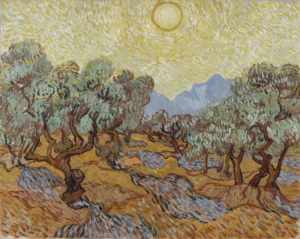
Van Gogh’s painting of olive trees was intended to represent Jesus’ suffering in Gethsemane. He gave the trees a vaguely human form in order to “make people think” more than if he had depicted Jesus explicitly. Another noticeable difference from traditional depictions of Gethsemane is the brightness of Vincent’s painting. He did not paint the shadows of a garden at night, which would fit what the gospel writers tell us. Instead, his garden of olive trees is under a blazing golden sun. Like so many of his paintings, this one is dominated by yellow, van Gogh’s color for divine love. The trees writhing in pain appear to be stretching upward toward the infinite joy of God.The simultaneous mixing of joy and sorrow is a common theme in Vincent’s paintings and in his life. He said, “It is true that I am often in the greatest misery, but still there is a calm pure harmony and music inside me.” This paradox should be familiar to anyone who belongs to Christ. The Apostle Paul described himself as a common jar of clay that nonetheless contained a priceless treasure. He said he is afflicted, perplexed, persecuted, and wasting away—and yet, he saw these momentary troubles as nothing compared to the eternal glory that awaits him. Later, he described himself as “sorrowful yet always rejoicing” (2 Corinthians 6:10).
This paradox captured van Gogh’s imagination as a young man. In 1876, he preached an English sermon on the topic. He said:“Sorrow is better than joy…for by the sadness of the countenance, the heart is made better. Our nature is sorrowful, but for those who have learnt and are learning to look at Jesus Christ, there is always reason to rejoice. It is a good word, that of St. Paul: as being sorrowful yet always rejoicing. For those who believe in Jesus Christ, there is no death or sorrow that is not mixed with hope—no despair—there is only a constant being born again, a constantly going from darkness into light.”Perhaps this explains why he painted his version of Gethsemane in bright sunlight. The terrible suffering of Jesus in the garden was not the full story. Through his suffering, there would also be resurrection, new birth, the defeat of evil, and the reconciliation of all things to God. This is what Vincent tried to capture with his painting. The contorted olive trees reaching up to the sun represent Jesus’ journey and ours from darkness to light. There is pain, but there is also hope. There is sorrow, but there is also joy.
Good Friday contains the mystery of our faith. The cross is a paradox we are invited to embrace even as we fail to comprehend it. It is a moment of unimaginable sorrow and pain; of injustice and cruelty. It represents, as Jesus said when he was arrested, the “hour when darkness reigns” (Luke 22:53). And yet, it is simultaneously the moment when darkness is defeated, when injustice is disarmed, and when our sorrow turns to joy. In these uncertain times, when there is so much fear and suffering, the cross reminds us as van Gogh preached, “there is no death or sorrow that is not mixed with hope.

”DAILY SCRIPTURE

ISAIAH 61:1-4 
2 CORINTHIANS 4:7-18 
MARK 15:33-39


WEEKLY PRAYER From Bernard of Clairvaux (1090 – 1153)

You taught us, Lord, that the greatest love a man can show is to lay down his life for his friends. But your love was greater still, because you laid down your life for your enemies. It was while we were still enemies that you reconciled us to yourself by your death. What other love has ever been, or could ever be, like yours? You suffered unjustly for the sake of the unjust. You died at the hands of sinners for the sake of the sinful. You became a slave to tyrants, to set the oppressed free.
Amen.

The post Sorrowful Yet Always Rejoicing first appeared on With God Daily.

Authentic and Humble Fire

February 16th, 2024 by JDVaughn No comments »

Mystics and sages of all traditions speak of the inner fire, the divine spark hidden in our very cells and in all that lives. This flame of love is the pure presence of God.
—Paula D’Arcy, “A Surrender to Love,” Oneing, Spring 2017

Richard Rohr points to the inner authority and universal wisdom that characterize the writings of the mystics:

What characterizes the mystics is an amazing, calm clarity because their own agenda, fear, smallness, pettiness, and false self are out of the way. They are able to exist calmly inside of a larger connectivity, and from that place they speak with a kind of authority. That’s part of the reason they’ve always been kept at arm’s length by organized religion. Often, they’re only canonized centuries after they die—if they’re canonized at all. They weren’t quoting our familiar sources, the Scriptures, or systematic theology that make our coherent religious system fit together. Their vocabulary is often very creative, and even idiosyncratic. It’s their own experience, but their experience has become so grounded in an inner certitude that they don’t feel the need to justify it by using the language that the rest of us use. Yet, if we sit with their words and allow them to work upon us, we often find a kind of supreme orthodoxy. [1]

Father Richard praises the inherent humility of the mystics and others who have encountered God:

All the truly great persons I have ever met are characterized by what I would call “radical humility.” They are deeply convinced that they are drawing from another source; they are instruments. Their genius is not their own; it is borrowed. They understand that we are moons, not suns, except in our ability to pass on the light. Our life is not our own, yet, at some level, enlightened people know their life has been given to them as a sacred trust. They live in gratitude and confidence, and they try to let the flow continue through them. They know that love is repaid by love alone, as both St. Francis of Assisi and St. Thérèse of Lisieux taught.

God’s desire and our destinies are already written in our genes, our upbringing, and our natural gifts. To accept that each of us is just ourself is probably the most courageous thing we will ever do. Only the original manufacturer can declare what the product—each one of us—should be; nobody else. “Even every hair of your head has been counted,” as Jesus states (Matthew 10:30). God chooses us into existence, and continues that choice of us every successive moment, or we would fall into non-being. We are interrelated with Essential Being, participating in the very life of God, while living out one little part of that life in our own exquisite form.

Paradoxically, we can say our life is precisely about us, but once we know who we really are, we can hold this exquisite fire without burning up and burning out. [2]

_____________________________________________________

Five for Friday John Chaffee

“Hope for the best.  Expect the worst.  Life is a play.  We are unrehearsed.”

  • Mel Brooks, Comedian and Director
     
    You almost wonder if Mel Brooks recently had in mind Shakespeare’s, “All the world’s a stage, and all the men and women merely players. They have their exits and their entrances; And one man in his time plays many parts.”

Either way, the comment about all of us being “unrehearsed” grabs my attention most.

2.
“To gain your own voice, you have to forget about having it heard.”

  • Allen Ginsberg, Poet
     
    One thing that I have learned in self-publishing 3 books (so far) is that a writer/creator must be detached from any expectation of how it is received.  The instant that we begin to care about the outcome is the very instant that a creative endeavor begins to lose its vitality/edge/honesty.

It is almost as if to say that we speak from our own unique voice when we believe no one is listening.  You know, “dance as if no one is watching”?  Say something truthfully, even if you doubt anyone will pay it any attention.

I can’t help but also think about this within the context of preaching.  How many times have I given a sermon that was not fully from my own voice but rather from a false one that was expecting or hoping for how it would be heard?

How often do we avoid speaking from our own voice because we know who might be listening?  Just a thought.

3.
I love the pure, peaceable, and impartial Christianity of Christ; I therefore hate the corrupt, slaveholding, women-whipping, cradle-plundering, partial, and hypocritical Christianity of this land. Indeed, I can see no reason, but the most deceitful one, for calling the religion of this land Christianity. I look upon it as the climax of all misnomers, the boldest of all frauds, and the grossest of all libels.”

  • Frederick Douglass, African-American Abolitionist
     
    Christianity has a complicated history in America, to say the least.

In the same vein as Frederick Douglass, theologian David Bentley Hart jokingly asks, “When will Christianity finally make it to America?”  Can we even say that what presents itself as Christianity is authentic Christianity?

In all my years of ministry, I found myself becoming fascinated by the early Church and its rich theology, ethics, and sense of community.  And, surprisingly, I was sometimes reprimanded for talking about how the early Church took stances against racism, classism, sexism.

For me, and I believe for the early Church, the faith does not affirm or celebrate the status quo, it critiques it and challenges it to be better.

Frederick Douglass was correct to denounce a corrupt, slaveholding, women-whipping, cradle-plundering, partial, and hypocritical “Christianity” and his prophetic critique is something that we should emulate.

4.
The Gospel is a very dangerous idea. We have to see how much of that idea we can perform in our own lives. There is nothing innocuous or safe about the Gospel. Jesus did not get crucified because he was a nice man.”

  • Walter Brueggemann, Old Testament Scholar
     
    I have nothing to add to this.  Brueggemann has been on my mind since finishing his biography this week.  You can check it out here.

5.
“He must increase; I must decrease.”

  • John 3:30
     
    John the Baptist has been capturing my imagination for a few months now.  A while back I read a paragraph or two about him from Richard Rohr in From Wild Man to Wise Man that struck me.

In the Gospels, John the Baptist is Jesus’ cousin and is called the Forerunner and the Friend of the Bridegroom.  He was a wild prophetic voice on the edge of society and likely a member of the Essenes (a mystical Jewish sect that critiqued the Temple of its day).

But what stands out about John the Baptist is how he is a summation or the embodiment of the Prophets from the Hebrew Scriptures.  In his person, he is something of a bridge between the Old and the New.  He is so deeply grounded in his tradition that he can look forward to the future without any ego.

I will have to explore this further in my journals, but something about John the Baptist calls to me, archetypically.  He is, in some manner or another, a mold to follow or an example to learn from.

There is some magic to the fact that John the Baptist existed outside the Temple, stood deeply within his tradition, and yet was not accepted by the formal institutions of his day…

I guess that is some of how I feel.  Unwanted by the formal institutions and yet continuing to exist outside of them, a little bit like a free spirit saying, “Make straight the way of the Lord.”  Maybe that’s why John the Baptist resonates with me.

Over the past two years, some of you have taken the time to send an email reply of encouragement, to which I try to always express appreciation.

So, to all of you who took the time to read this…  Thank you.

I hope that through these newsletters I connect you to the best of the tradition, perhaps that you did not know existed, and that it helps to level the way for you to have some kind of Divine encounter.

Cooked by Love

February 15th, 2024 by JDVaughn No comments »

Author and educator Belden Lane recounts backpacking in the Ozark Mountains and finding inspiration in the work of Sufi mystic Jalal al-Din Rumi (1207–1273).

I’ve brought along an intriguing companion on this trip, the thirteenth-century Persian poet Jalaluddin Rumi. One couldn’t ask for a more down-to-earth, exuberant, God-intoxicated hiking partner. Conversations with him under the stars at night can be …  peppered with earthy imagery and raucous laughter. He talks of God in relation to chickpeas cooking on an open fire, the moon reflected on a pond’s surface, the scent of willow trees, or the longing of Potiphar’s wife for Joseph’s striking beauty. For Rumi, the encounter with the holy is always anchored in earthy human experience. Knowing the Great Mystery—discerning the will of Allah—is, for him, more like falling in love than like receiving instruction from a written text.…

The heart of Rumi’s teaching lies in the Sufi concept of tawhid (or “oneness”). This is a longing for mystical union with the Beloved, with the divine lover from whom one has been separated. In the opening lines of his most famous work, the Masnavi (his “flute songs”), Rumi portrays the soul as a reed cut from the damp reed-bed of God’s own heart. It yearns to return to its source, finding a transient joy in becoming a reed flute through which the divine breath of love’s fire passes. [1] Like a drunken fool, Rumi is smitten by love. He can think of nothing else.

The core of discernment for him, therefore, isn’t a question of “What should I do?” or “What is expected of me?” It is rather “What do I love? What arises now most naturally from my heart?” For this thirteenth-century Persian poet, religion isn’t primarily what you think, or even the actions you perform. It is what you desire.

Belden mentions “the shepherd,” a frequent stand-in for a regular person in Rumi’s poetry:

To borrow another of Rumi’s metaphors, the shepherd has been “cooked” and softened—roasted over a fire so as to be transformed at last into the shape of love. This radical change can be excruciating. The chickpea screams when the cook throws it into the boiling water: “Why are you doing this to me?” But when he understands that the cooking is meant to give him flavor, vitality, and an altogether new life, the bean stops resisting and welcomes the process of conversion. “Boil me some more,” he cries. “Hit me with the skimming spoon. I can’t do this by myself.” [2]

Discipline is necessary to transition from the raw to the cooked. Only over time is the lover transformed into the image of the beloved…. Love is a school of fire, Rumi teaches. You embrace its mystery only in losing yourself, in finally becoming what you love. In the process, you discover that what you had thought to be entirely outside had been within you all along.

______________________________________________________

Sarah Young Jesus Calling

Jesus Calling: February 15th, 2024

Jesus Calling: February 15

    Come to Me with all your weaknesses: physical, emotional, and spiritual. Rest in the comfort of My Presence, remembering that nothing is impossible with Me. 

    Pry your mind away from your problems so you can focus your attention on Me. Recall that I am able to do immeasurably more than all you ask or imagine. Instead of trying to direct Me to do this and that, seek to attune yourself to what I am already doing.

    When anxiety attempts to wedge its way into your thoughts, remind yourself that I am your Shepherd. The bottom line is that I am taking care of you; therefore, you needn’t be afraid of anything. Rather than trying to maintain control over your life, abandon yourself to My will. Though this may feel frightening–even dangerous, the safest place to be is in My will.

RELATED SCRIPTURE: 

Luke 1:37 NLT

37 For the word of God will never fail.”

Ephesians 3:20-21 (NLT)

20 Now all glory to God, who is able, through his mighty power at work within us, to accomplish infinitely more than we might ask or think. 21 Glory to him in the church and in Christ Jesus through all generations forever and ever! Amen.

Additional insight regarding Ephesians 3:20-21: This doxology – prayer of praise to God – ends Part 1 of Ephesians. In the first section, Paul describes the timeless role of the church. In Part 2 (chapters 4-6), he will explain how church members should live in order to bring about the unity God wants. As in most of his books, Paul first lays a doctrinal foundation and then makes practical applications of the truths he has presented.

Psalm 23:1-4 NLT

Psalm 23

A psalm of David.

1 The Lord is my shepherd;

    I have all that I need.

2 He lets me rest in green meadows;

    he leads me beside peaceful streams.

3     He renews my strength.

He guides me along right paths,

    bringing honor to his name.

4 Even when I walk

    through the darkest valley,

I will not be afraid,

    for you are close beside me.

Your rod and your staff

    protect and comfort me.

Additional insight regarding Psalm 23:1: In describing the Lord as a shepherd, David wrote out of his own experience because he had spent his early years caring for sheep (1st Samuel 16:11,11). Sheep are completely dependent on the shepherd for provision, guidance, and protection. The New Testament calls Jesus the good shepherd (John 10:11), the great Shepherd (Hebrews 13:20), and the Great Shepherd (1st Peter 5:4). As the Lord is the good shepherd, so we are his sheep – not frightened, passive animals, but obedient followers, wise enough to follow one who will lead us in the right places and in the right ways. This psalm does not focus on the animal-like qualities of sheep but on the discipleship qualities of those who follow. When you recognize the good shepherd, follow him!

Additional insight regarding Psalm 23:2-3: When we allow God, our shepherd, to guide us, we have contentment. When we choose to sin and go on our own way, however, we cannot blame God for the environment we create for ourselves. Our shepherd knows the “green meadows” and “peaceful streams” that will restore us. We will reach these places only by following him obediently. Rebelling against the shepherd’s leading is actually rebelling against our own best interests. We must remember this the next time we are tempted to go our own way rather than the shepherd’s way.

February 14th, 2024 by Dave No comments »

A Sacred Heart of Fire

Throughout my life, through my life, the world has little by little caught fire in my sight until, aflame all around me, it has become almost completely luminous from within.
—Teilhard de Chardin, The Divine Milieu

Mystic and scientist Teilhard de Chardin (1881–1955) found cosmic meaning in the image of the fiery Sacred Heart of Jesus. David Richo writes:

The fire image of the mystics was expanded and enriched by Teilhard within his new cosmology.… There are indeed many precedents for this metaphor. The [apocryphal] Gospel of St. Thomas presents Jesus as saying: “He who nears me nears the heart of the fire.” [1] In the Litany of the Sacred Heart is the invocation “Glowing furnace of love.” Images of the Sacred Heart show a perpetual flame arising from its center. Fire burns away the selfish ego so that our basic goodness, our true nature as love, can shine through…. The fire in the heart of God is the same fire that burns in us once we have the interior vision that lets us acknowledge divinity within ourselves….

When St. Paul says that “our God is a consuming fire” [Hebrews 12:29], we see again a metaphor for the dismantling of ego-centeredness. Christ’s heart can become the fiery center of ourselves, and in that alchemical blaze the ego is transformed to the gold of humility and generosity. Our spiritual practice is thus to turn our ego energy into compassion for others, not at the cost of personal esteem, but as a fruit of it.… Fire is associated with hell but in the context of mystical revelations, fire is about love. The Sacred Heart is a divine pledge that the world will not end by fire but be reborn in it.

For the ancient Greeks and Egyptians healing was caused by light and fire. This may best resemble Teilhard’s mystical sense of the fire of the Sacred Heart that brings light and healing to the world. [2]

Theologian Wendy Wright identifies love as the essence of the Sacred Heart:

There is something in God and something in us that correspond. We come from, have our being in, and return to God. In the tradition of the heart, that correspondence is love. Love, not merely as sentiment or feeling, but love as the inner dynamism of God in God’s triune self. Love as the generative power that overcomes death. Love as self-donation. Love as the welcome of the “other” as another self. Love as the gravitational force that binds all disparate things together. Love as the fire that burns clean and as the balm that heals. Love as the vision that sees the integrity of both parts and whole. Love as source and end and the path between.

The tradition of the heart does not say merely that God loves us “because,” or that God’s love can be seen “in,” but that God is Love. And that God’s very essence truly in some small way might be encountered here and now. [3]

==============================

In her poem “The Summer Day,” Mary Oliver wrote perhaps her most famous line:

Tell me, what is it you plan to do

with your one wild and precious life?

If you’ve ever heard this quoted by someone before, I invite you to think back to the context of that moment.

For me, I’ve mostly heard this quote used by others to be inspirational – something akin to Robin Williams’ carpe diem monologue from Dead Poets Society. And this is great: when used at the right moment, it can be extremely hopeful and lead us to envision the future we want for ourselves. It can embolden us to “seize the day.”

But it’s worth noting Mary Oliver’s own answer to this question wasn’t to “seize the day” – at least in the way we usually think of.

It wasn’t to achieve more, produce more, take control, or create some big and elaborate strategic plan for fixing the world. Her answer to what she would do with her one wild and precious life was, as Jessica Kantrowitz says, to “stroll idly through the fields noticing things.”

Here’s Mary Oliver’s famous quote in fuller context:

I don’t know exactly what a prayer is. 

I do know how to pay attention, how to fall down 

into the grass, how to kneel down in the grass, 

how to be idle and blessed, how to stroll through the fields, 

which is what I have been doing all day.

Tell me, what else should I have done?

Doesn’t everything die at last, and too soon?

Tell me, what is it you plan to do

with your one wild and precious life?

2. Questions

  1. How has your answer to this question changed over the course of your life? What might it have been when you were 16; 28; 35; 50; now?
  2. When you think of your life, how has “wildness” been present? What has your posture been toward that wildness?

February 13th, 2024 by Dave No comments »

Love: The Fire of Transformation

Scientist and theologian Ilia Delio presents images of fire to describe God’s presence in her life: 

As a Franciscan on the edge of religious life, my experience of human love and divine love revealed to me a deep passion of life at the heart of life, a passion that enkindled my heart; in truth, I wanted to love God without measure.

Love is a fire of transformation that constantly needs wood to keep the fire alive. Real fire is destructive; throw yourself into a fire and you will be destroyed. God’s fire is destructive too because it can swiftly eliminate all self-illusions, grandiose ideas, ego-inflation, and self-centeredness. Throw yourself into the spiritual fire of divine love and everything you grasp for yourself will be destroyed until there is nothing left but the pure truth of yourself. [1] …

Deep within the cave of my heart, a depth that belongs to me alone, I recognize a fire that burns brilliantly and glows with warmth. Through that glowing fire I see the outline of a face, the face of Christ, but I also see my face, and then I begin to see Christ’s face as my face. Sometimes I cannot tell Christ’s face from my own face, and all at once I recognize a single face whose eyes are looking inward and outward. The word “God” simply doesn’t capture this infinite depth of my soul that stretches toward an endless horizon. By its sheer unlimited being I know it must be divine life, because it is life other than my own and yet entangled with my own life. [2]

Delio witnesses the fire in her heart as a universal invitation for each of us to be transformed: 

Every human life is the cosmos winding its way into the future. Every life makes a difference to the life of the whole. I have come to know that the fire in my heart is the fire in the heart of the universe and that its flames will not be extinguished. This fire will destroy that which is not God and forge what is God into an ever-radiant new presence of God because God is forever being born within us. In this life, at this moment, I allow all that has shaped my life to be summed up in this seamless mysterious breath of life. I let go over and over again and jump into the lap of God’s loving embrace. Every moment I am falling in love with God. For God knows me in a deep way, a way that I still hardly know myself; and it is this endless inscrutable depth where love burns brightly that I learn to trust my thoughts, my words, my actions…. I have a mission because every person has a mission—to be the truth of who they are so that God can be God in them. The path to truth demands patience and trust, and this path is an open road within every human heart. [3]

FEB 13, 2024
Loss & Laughter
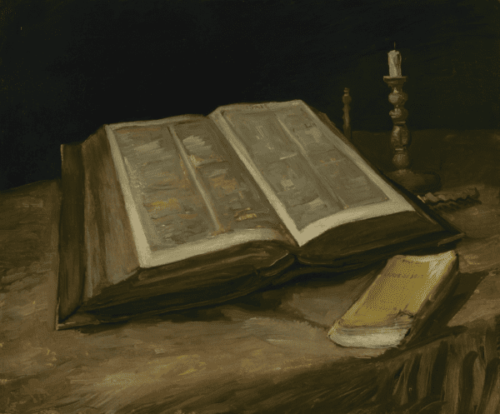
Van Gogh’s painting of a large Bible open to Isaiah 53, the prophetic chapter about the Messiah’s suffering, and a small French novel by Emile Zola, The Joy of Living, appears to be a contrast between tradition and modernity. In fact, Vincent saw Zola’s novel about the sacrificial love of a mistreated servant girl as a contemporary retelling of Jesus’ self-sacrifice. Far from a rejection of faith, the painting was van Gogh’s way of showing how the example of Christ’s love can still be found in the world today.But the painting also celebrates a central paradox of Christian faith—that through experiencing loss the servant of God actually discovers a greater joy. The final sentence in The Joy of Living reads, “She had stripped herself of everything but happiness rang out in her clear laugh.” Likewise, Isaiah 53 vividly describes the sorrow and suffering of Jesus, but van Gogh understood that on the other side of his suffering was elation. This, according to the writer of Hebrews, is why Jesus accepted his destiny. He endured the cross, despising the shame, “for the joy that was set before him” (Hebrews 12:2). Even as Jesus was betrayed, humiliated, and tortured, somehow he remained focused on the glory that awaited him. He knew he would be exalted to the right hand of the Father and given the name above all names.


During Holy Week we rightly focus on the suffering and humiliation of Jesus, but we must not overlook what the Bible clearly says motivated Jesus. He persevered through it all because he knew a greater delight awaited him. Jesus accepted suffering not because he suppressed his desires but because he sought to maximize them. This week is about sorrow, yes, but it is a sorrow pregnant with joy. That’s a paradox Vincent learned from studying Scripture, recognized in French literature, and one he would hold to throughout his life.After being dismissed as a missionary and losing his dream of becoming a pastor, van Gogh described the painful season to his brother in a letter: “As molting time—when they change their feathers—is for birds, so adversity or misfortune is the difficult time for us human beings. One can stay in it—in that time of molting—one can also emerge renewed.” Vincent recognized that suffering was not an abnormality to be avoided, but a part of God’s grace to be accepted. It’s how transformation happens and new life is created. Like Jesus, it’s when we surrender our immediate desires for comfort, safety, or acceptance that we discover the secret to attaining our ultimate desire—union with God himself.