Sunday, August 30, 2026
Jesus told his disciples, “If any wish to come after me, let them deny themselves and take up their cross and follow me. For those who want to save their life will lose it, and those who lose their life for my sake will find it.” — Matthew 16:24–25
Father Richard Rohr reflects on how discipleship ultimately leads to the cross and identifying with the pain of the world:
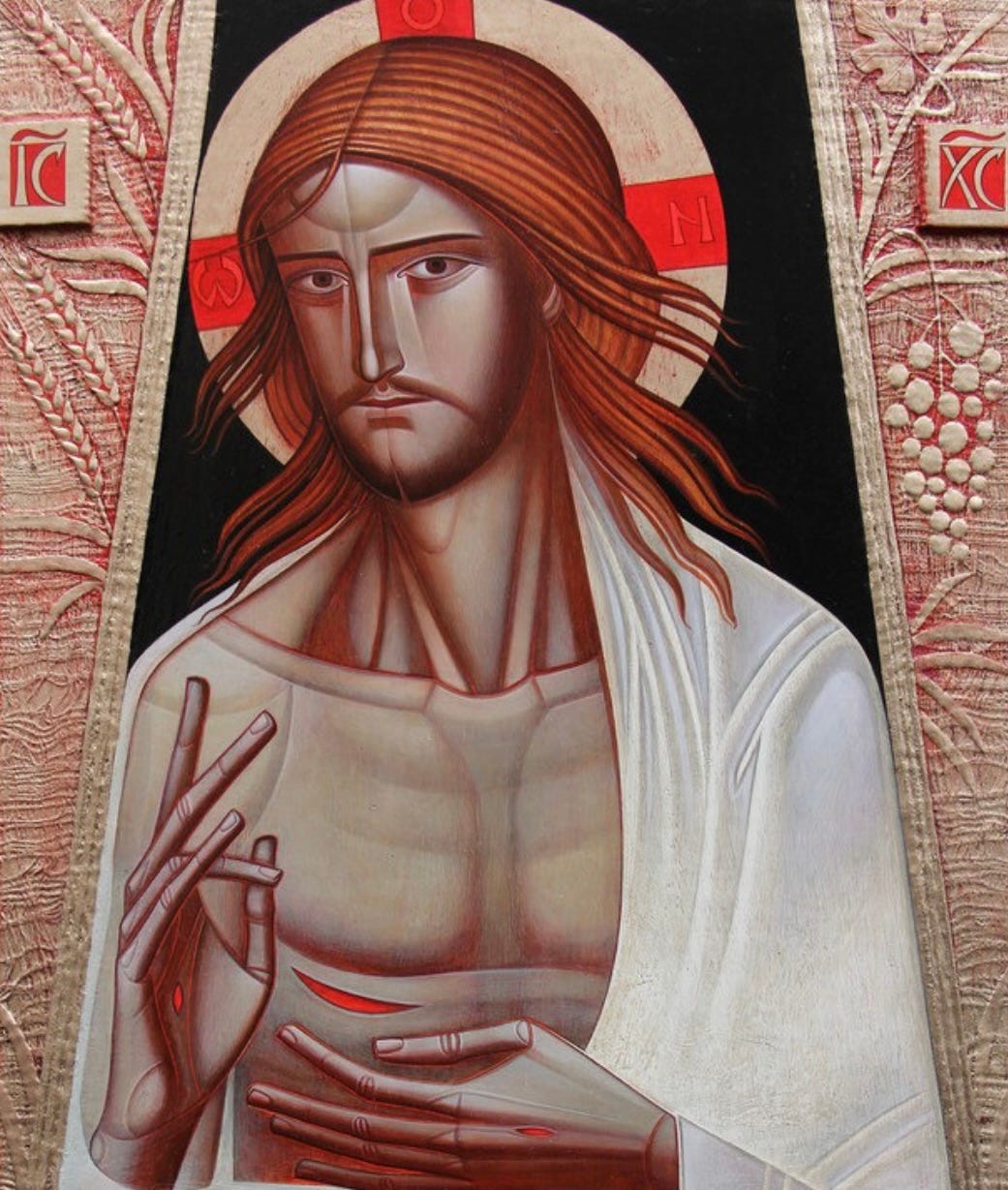
My assumption is that Jesus’s totally counterintuitive message of the “cross” had to be sent to earth as a dramatic and divine zinger, because God knew we would do everything we could to deny it, avoid it, soften it, or make it into a theory (which is exactly what we did anyway). Yet this is the message of Jesus that cannot, and must not, be allowed to be pushed into the background. We believe in a Jesus-kind-of-Christ—a God who is going to the mat with humanity and not just presenting us with a heavenly, cosmic vision. If Christ represents the resurrected state, then Jesus represents the crucified/ resurrecting path of getting there.
It is not insignificant that Christians chose the cross or crucifix as their central symbol. At least unconsciously, we recognized that Jesus talked often about “losing your life.” Perhaps the philosopher Ken Wilber’s distinction between “ascending religions” and “descending religions” is helpful here. He and I both trust descending religion much more, and I think Jesus did too. The primary language is unlearning, letting go, surrendering, serving others, and not the language of self-development—which often lurks behind our popular notions of “salvation.” Unless we’re careful, we will again make Jesus’s descending religion into a new form of climbing religion, as we have done so often before.
Although Jesus made this quite clear throughout his life, we still largely turned Christianity into a religion where the operative agenda was some personal moral perfection, our attaining some kind of salvation, “going to heaven,” converting others rather than ourselves, and acquiring more health, wealth, and success in this world. In that pursuit, we ended up largely aligning with empires, wars, and colonization of our planet, instead of with Jesus or the powerless. It has all caught up with us in the twenty-first century. [1]
A spirituality of descent frees us to surrender our often messy lives to God. It is about honoring the human journey, loving it, and living it in all its wonder and tragedy. There is nothing really supernatural about love and suffering. It is completely natural, taking us through the deep interplay of death and life, surrender and forgiveness, in all their basic and foundational manifestations.
Authentic Christianity is not so much a belief system as a life-and-death system that shows us how to give away our life, how to give away our love, and eventually how to give away our death. Basically, how to give away—and in doing so, to connect with the world, with all other creatures, and with God. [2]
===================
Standing in Solidarity
Monday, August 31, 2026
Father Richard considers how Jesus’s choice to go to the cross reveals God’s solidarity with suffering:
When we try to live in solidarity with the pain of the world—and don’t spend our lives running from necessary suffering—we will encounter various “crucifixions.” Many say pain is physical discomfort, but suffering comes from our resistance, denial, and sense of injustice or wrongness about that pain. I know that is very true for me. This is the core meaning of suffering on one level or another, and we all learn it the hard way. Pain is the rent we pay for being human, it seems, but suffering is usually optional. The cross was Jesus’s voluntary acceptance of undeserved suffering as an act of total solidarity with the pain of the world. Reflecting on this mystery of love can change our lives.
I think the acceptance of that invitation to solidarity with the larger pain of the world is what it means to be “a Christian.” It takes great inner freedom to be a follower of Jesus. His life is an option, a choice, a call, a vocation for us, and we are totally free to say yes or no or maybe. We do not have to do this to make God love us. That is already taken care of. We do it to love God back and to love what God loves and how God loves! We either are baptized “into his death” and “resurrection” (Romans 6:3; Philippians 3:10–12), or Christianity is largely a mere belonging system, not a transformational system that will change the world.
The “crucified God” as personified in Jesus revealed that God is always on the side of suffering wherever it is found, including the wounded and dying troops on both sides in every kind of war, and both the victims and the oppressors of this world; frankly, this pleases very few people. Our resistance to suffering is an entire industry now, perhaps symbolized by the total power of the gun lobby and the permanent war economy in the United States, the fear of any profit sharing with the poor, or the need to be constantly entertained. Maybe that is why some have said that the foundational virtue underlying all others is courage (cor-agere, an action of the heart). It takes immense courage to walk in solidarity with the suffering of others, and even our own. [1]
If God is somehow participating in human suffering, instead of just passively tolerating it and observing it, that changes everything—at least for those who are willing to “gaze” contemplatively. All humble, suffering souls learn this from God, but the Christian Scriptures named it and revealed it publicly and dramatically in Jesus.
We can’t do it alone at all, but only by a deep identification with the Crucified One and crucified humanity. Jesus then does it in us, through us, with us, and for us. Then we have become a “new creation” (Galatians 6:15), a true disciple of Jesus, and a very different kind of human being
Friday Five from John Chaffee
1.
“You’re only given a little spark of madness. You mustn’t lose it.”
– Robin Williams, American Comedian and Actor
I think we can all agree that Robin Williams was a genius. Not only was he a comedic genius, but he also seemed to be closely attuned to what it means to be human. His constant battles with depression and addiction likely kept him humble, vulnerable, and approachable. My guess is that his entire life was a pursuit of protecting the little divine spark of madness that he was gifted.
This means the quote above was a lived wisdom, and not some trite statement he made. I don’t know what madness I have, or what you have, but I agree that we must protect it.
2.
“As I teach, I project the condition of my soul onto my students, my subject, and our way of being together.”
– Parker Palmer, Educator and Activist
This coming week begins a new teaching semester at Eastern University, where I am an adjunct professor.
Over the summer, I had the chance to teach a few times, and it reminded me how much I enjoy being in the classroom, sharing ideas, and having thoughtful conversations with students. I am not much the lecturing type, as much as I enjoy the task of moderating a conversation that I only loosely know where it might go.
Teaching is not simply the transmission of information to a student; it is about the transformation of the student. This transformation can only happen when the teacher shows up as their full self, having already been transformed by the topic they are sharing.
There is something mystical about education, something wild and deeply connected to presence. It is interesting how I keep finding my way back into the classroom year after year.
3.
“Shalom is communal, holistic, and tangible. There is no private or partial shalom. The whole community must have shalom or no one has shalom. As long as there are hungry people in a community that is well fed, there can be no shalom. . . . Shalom is not for the many, while a few suffer; nor is it for the few while many suffer. It must be available for everyone.”
– Randy Woodley, First Nations Author and Theologian
I’m currently reading How Western Christianity Got It Wrong. So far, it is a great book.
Randy Woodley is an ordained Baptist pastor, doctor of theology, and the cofounder of Eloheh Indigenous Center for Earth Justice and Eloheh Farm & Seeds.
As a First Nations person, his work gives me a fresh angle on Biblical stories, overlooked themes in Western Christianity, and a heightened appreciation for the sacredness of the earth. One fascinating thing is that he posits that the Bible was written by Indigenous people, who were largely hunter/gatherer types and agrarian folk. The Bible was written less by city folk than by a tribal culture attuned to the earth and natural rhythms. Randy’s work reminds me of the importance of a holistic, grounded understanding of Shalom.
4.
“Nothing awakens religious consciousness like suffering.”
– DT Suzuki, Japanese Zen Master
Pain and suffering have the greatest potential energy for transformation. I fully believe that the Crucifixion story of Jesus is an example of this, and that it teaches us to carry our own pain and suffering with as much dignity and purpose as possible.
5.
“Stupidity is sufficient unto itself. Wisdom can never learn enough.”
– Mechthild of Magdeburg, German Beguine Nun
In our modern world, we consider stupidity to be the antithesis or foil to being smart or intelligent.
However, for Mechthild, a lay nun in Germany, stupidity is the other end of the pole from wisdom.
As an Enneagram 5, I love learning. I truly enjoy finding out new perspectives and am always looking for the next paradigm shift. The Enneagram, though, reminds me that I want wisdom but too often settle for information…
How interesting that, over the years, I am reading more about wisdom and virtue than random factoids that don’t actually help me live a good life! Perhaps that is a signal that I am heading in the right direction? At least wisdom has “no ceiling,” and you and I can both always benefit from gaining a little more of it!
This interview was included at the end of today’s daily devotion. … And the book Chaffee mentioned in #3. Check it out if you have time.