August 23rd, 2023 by Dave No comments »

Communal Restoration

Author and minister Dominique DuBois Gilliard identifies the relational emphasis of God’s justice: 

Restorative justice aligns with the heart of God. It supports that justice is primarily relational rather than individual. In the Old Testament, justice and sin were both relational realities, and justice was not about upholding individual rights but protecting the well-being of communities.…  

This rightness of relationships on every level is known as shalom, which is juxtaposed to the state’s understanding of justice. Shalom calls Christians to view and pursue justice in light of God’s original intent. It summons us to live within the confines of covenantal community, where we actively pursue communal flourishing, consider the interests of others (particularly “the least of these”), and prioritize the restoration of righteous relationships in the face of harm. Crime is never merely an individual breaking the law; it is always a communal transgression that fractures shalom 

God’s justice is restorative and reconciling as opposed to retributive and isolating. Our criminal justice system quarantines people who cause harm, which subsequently harms them through punitive measures and dehumanizing conditions. Theologically, restorative justice acknowledges that divine justice entails people being reconciled to God, each other, the community, and themselves.… 

God’s justice moves toward restoration, reintegration, and redemption. God’s justice is inherently connected to healing the harmed, restoring what has been lost, and reconciling those who are estranged from God and community. God’s heart and justice are inherently restorative.  

Restorative justice gives shape to a communal ethic that is conciliatory in spirit and just in nature. It provides a structure for conflict resolution that facilitates truth telling, accountability, forgiveness, and restitution. The restorative nature of God’s justice is woven throughout Scripture. Divine justice induces relational rightness between hostile parties, the holistic reintegration of exiled individuals, and economic and systemic restitution in the face of harm. Throughout Scripture, God works amid brokenness, restoring victims, communities, and offenders. [1]  

Biblical scholar Christopher Marshall, a practitioner of restorative justice, writes:  

Biblical justice is a complex, multi-faceted reality. It relates to every dimension of human experience, and it has many different applications. But arguably the term that best captures the spirit and direction of biblical justice, both social justice and criminal justice, is the word restoration. Justice flows from God’s own being and designates the way God intends the world to be. But things have fallen into disorder; the shalom of creation has been ruptured. God responds by seeking to restore the world to the way it ought to be.  

Biblical justice seeks to restore dignity and autonomy to those who have been unjustly deprived of access to sufficient resources in order to meet their own basic needs for physical survival and human fulfillment. God acts to reconstruct shalom by overthrowing oppressive powers and setting victims free, and by healing the destructive legacy of sin and death. To know this God is to learn about the meaning of justice. To love this God is to join in God’s great campaign to restore justice to the world. [2

August 22nd, 2023 by Dave No comments »

Truth and Reconciliation

Richard Rohr teaches that restorative justice is not about denying harm, but about speaking truth in the service of forgiveness:  

Almost all religions and cultures that I know of have believed in one way or another that sin and evil are to be punished and retribution is to be demanded of the sinner in this world—and usually the next world, too. Such retributive justice is a dualistic system of reward and punishment, good folks and bad folks, and makes perfect sense to the ego. I call it the economy of merit or “meritocracy.” This system seems to be the best that prisons, courtrooms, wars, and even most of the church (which should know better) appear equipped to do.  

Jesus, many mystics, and other wisdom traditions—such as the Twelve Steps of Alcoholics Anonymous—show that sin and failure are, in fact, an opportunity for the transformation and enlightenment of the offender.  

Mere counting and ledger-keeping are not the way of the Gospel. Our best self wants to restore relationships, and not blame or punish. This is the “economy of grace.” (The trouble is that we defined God as “punisher-in-chief” instead of Healer, Forgiver, and Reconciler and so the retribution model was legitimized all the way down!)  

What humanity really needs is an honest exposure of the truth and accountability for what has happened. Only then can human beings move ahead with dignity. Hurt needs to be spoken and heard. It does not just go away on its own. This can then lead to “restorative justice,” which is what the prophets invariably promise to the people of Israel (see Ezekiel 16:53; Isaiah 57:17–19) and is exemplified in Jesus’ story of the Prodigal Son (Luke 15:11–32) and throughout his healing ministry. We lose that and we lose the Gospel itself. 

As any good therapist knows, we cannot heal what we do not acknowledge. What we do not consciously acknowledge will remain in control from within, festering and destroying us and those around us. In the Gospel of Thomas, Jesus teaches, “If you bring forth that which is within you, it will save you. If you do not bring it forth, it will destroy you.” [1]  

Only mutual apology, healing, and forgiveness offer a sustainable future for humanity. Otherwise, we are controlled by the past, individually and corporately. We all need to apologize and we all need to forgive or this human project will surely self-destruct. No wonder almost two-thirds of Jesus’ teaching is directly or indirectly about forgiveness. Otherwise, history devolves into taking sides, bitterness, holding grudges, and the violence that inevitably follows. As others have said, “Forgiveness is to let go of our hope for a different past.” Reality is what it is, and such acceptance leads to great freedom, as long as there is also both accountability and healing forgiveness. 

August 21st, 2023 by Dave No comments »

Divine Love Restores

Father Richard Rohr is convinced that God’s justice in the Bible is fundamentally loving and restorative rather than punitive. 

As we read the Bible, God does not change as much as our knowledge of God evolves. I certainly recognize there are many biblical passages that present God as punitive and retributive, but we must stay with the text—and observe how we gradually let God grow up. Focusing on divine retribution leads to an ego-satisfying and eventually unworkable image of God which situates us inside of a very unsafe and dangerous universe. Both Jesus and Paul observed the human tendency toward retribution and spoke strongly about the limitations of the law. 

The biblical notion of justice, beginning in the Hebrew Scriptures with the Jewish prophets—especially Moses, Isaiah, Jeremiah, Ezekiel, and Hosea—is quite different. If we read carefully and honestly, we will see that God’s justice is restorative. In each case, after the prophet chastises the Israelites for their transgressions against YHWH, the prophet continues by saying, in effect, “And here’s what YHWH will do for you: God will now love you more than ever! God will love you into wholeness. God will pour upon you a gratuitous, unbelievable, unaccountable, irrefutable love that you will finally be unable to resist.” 

God “punishes” us by loving us more! How else could divine love be supreme and victorious? Check out this theme for yourself: Read passages such as Isaiah 29:13–24, Hosea 6:1–6, Ezekiel 16 (especially verses 59–63), and so many of the Psalms. God’s justice is fully successful when God can legitimate and validate human beings in their original and total identity! God wins by making sure we win—just as any loving human parent does.  

Love is the only thing that transforms the human heart. In the Gospels, we see Jesus fully revealing this divine wisdom. Love takes the shape and symbolism of healing and radical forgiveness—which is just about all that Jesus does. Jesus, who represents God, usually transforms people at the moments when they most hate themselves, when they most feel shame or guilt, or want to punish themselves. Look at Jesus’ interaction with the tax collector Zacchaeus (Luke 19:1–10). He doesn’t belittle or punish Zacchaeus; instead, Jesus goes to his home, shares a meal with him, and treats him like a friend. Zacchaeus’ heart is opened and transformed. Only then does Zacchaeus commit to making reparations for the harm he has done.  

As Isaiah says of God, “My thoughts are not your thoughts, nor are your ways my ways” (Isaiah 55:8). Yet I am afraid we largely pulled God down into “our thoughts.” We think fear, anger, divine intimidation, threat, and punishment are going to lead people to love. We cannot lead people to the highest level of motivation by teaching them the lowest. God always and forever models the highest, and our task is merely to “imitate God” (Ephesians 5:1). 

Jesus’ Work of Shalom

Author and activist Shane Claiborne connects biblical justice with righteousness:   

The word “justice” gets abused and misused. People demand “justice” all the time but have very different things in mind as they call for it. It has been so misrepresented that justice itself might do well to find some new lawyers; it needs better representation.  

For starters, the word for “justice” in the Bible is the same word as “righteousness.” This overlap shows that the central concern of biblical justice was not “getting what you deserve”; rather, it was making right what was done wrong, restoring what had been destroyed, healing the wounds of an offensive act. It was about bringing balance and wholeness back to the community, which is why you often see scales as an icon for justice.  

But the scales can be misleading, since it is not just about balance or even “eye for an eye” justice. Real justice goes much deeper. One of my friends who is a biblical scholar says the best contemporary translation for the ancient notion of “justice/righteousness” is “restorative justice.” [1] 

Sister Mary Katherine Birge offers examples of ways Jesus enacted restorative justice: 

The kingdom of God that Jesus taught, preached, and enacted during his ministry … begins from a conviction that God’s deepest hope for humanity—that we live with God and with one another in relationships that are just—is possible.… 

Jesus lives, teaches, preaches, and demonstrates to all who are willing to listen to him this same kingdom of God, the image of shalom [wholeness, harmony, and peace]. He makes the kingdom of God present every time he performs a miracle of healing (see Mark 1:29–31), drives out evil spirits from someone they possess (see Matthew 9:32–34), and brings back to this life a person who has died (Mark 5:21–24, 35–43; Luke 7:11–17; John 11:1–44). Through his own hospitality and openness to the alien and the enemy … [and] to those who would put him to death …, [Jesus] makes it possible for others to join him in building the kingdom of God, building shalom, in the present age.… 

This is the task of those who would follow Jesus: to live in just relationships with one another, to work at restoring to wholeness those people and relationships that they and others have broken, and to repair as best they can what cannot be restored. This practice of restoring and repairing relationships between people and God and among people themselves is not unlike that in which the contemporary practice of restorative justice engages. Like Jesus’ own work … to bring about the fullness of shalom, through the practice of right relationships and the healing of those people who are “broken,” restorative justice focuses on the present and future needs of the victim, the perpetrator, and society in order to repair what has been broken or stolen from the victim, to bring the perpetrator to acceptance of responsibility, and to mend the threads that hold society together. [2] 

The Prophetic Call to Life

August 18th, 2023 by JDVaughn No comments »

Richard Rohr describes how God shaped the prophets’ hearts, and how our hearts are changed through their ministry:  

At the center of the prophets’ ministry is their awareness of the transcendent God who is above all things and yet within all things. God’s presence cuts across all boundaries of space and time, and there is never any place or event from which God is absent. The prophets’ consciousness was filled with that awareness of God’s presence, a presence which was inescapable once they became attuned to it.  

What God was doing in their heart was loving them to life. God was loving them, calling them, and drawing them to God’s own heart. God had loved Israel to life when they were still enslaved. God invited them to life when God gave them the Torah to follow. God drew them to life when they had given up on life, in exile. In the prophets’ own experience of the call to divine life, they could see that same pattern repeated over and over in the history of their people. 

God’s call to life was, at the same time, a call to love. Drawn into the love of God, the prophets loved YHWH with all their heart and soul. They loved their own people and with clear insight saw that living in the love that is God implies hospitality to strangers, charity to the poor, justice for the oppressed. [1]  

The biblical text mirrors our own human consciousness and journey. Life itself—and the Scriptures, including the prophets—is always three steps forward and two steps backward. It gets the point and then loses it or doubts it. Our job is to see where the three-steps-forward texts are heading (invariably toward mercy, forgiveness, inclusion, nonviolence, and trust), which gives us the ability to clearly recognize and understand the two-steps-backward texts (which are usually about vengeance, divine pettiness, law over grace, form over substance, and technique over relationship). [2]  

The amazing thing about the prophets’ message is that it’s so simple. When we first read through the prophetic books of the Bible, it looks like we are taking two steps backward: pages and pages of prophecies about this, that, and the other thing. The prophets rail against idol worship and speak about death and destruction. But when we read the prophets again and again, we are struck by their “three steps forward” direction of justice, mercy, consolation, and love. We begin to see the central insight which arranges the parts into a single whole. The insight is the love of God, experienced and lived.  

The experience of God’s love is an experience of grace, overwhelming beauty, and unbelievable mercy. It is a gift of forgiveness, approval, and acceptance. To live in that love means to live in grace, to be gracious and merciful to others. It means extending to them forgiveness and approval and acceptance. As Jesus said, it even means loving our enemies. The prophets stood in the heart of that experience. [3] 

________________________________________________

Sarah Young Jesus Listens

Awesome God, Help me to trust You and not be afraid. Sometimes I am frightened by world events and news reports. But I realize that these reports are biased—presented as if You do not exist. News clips show tiny bits of current events from which the most important factor has been carefully removed: Your Presence in the world! As journalists sift through massive amounts of information, they tend to strain out everything about You and what You’re accomplishing on this planet. Whenever my world is feeling like a scary place, I need to turn to You and find encouragement in Your Presence. I’m inspired by the example of David, who strengthened himself in the Lord when his men were threatening to stone him. Like David, I can find courage through remembering who You are—pondering Your awesome Power and Glory, delighting in Your unfailing Love. I rejoice in knowing I’m on an adventurous journey with You and my ultimate destination is heaven! As I keep focusing on You and enjoying the rich relationship You offer, my fear gradually subsides. I will trust and not be afraid, for You are my Strength and my Song. In Your matchless Name, Jesus, Amen

ISAIAH 12:2 NASB; Behold, God is my salvation, I will trust and not be afraid; For the Lord God is my strength and song, And He has become my salvation.”

1 SAMUEL 30:6 NKJV; Now David was greatly distressed, for the people spoke of stoning him, because the soul of all the people was [ a]grieved, every man for his sons and his daughters. But David strengthened himself in the Lord his God

PSALM 33:5; The Lord loves righteousness and justice; the earth is full of his unfailing love. 

Young, Sarah. Jesus Listens (p. 241). Thomas Nelson. Kindle Edition.

A Legacy of Liberation

August 17th, 2023 by JDVaughn No comments »

Author and spiritual director Therese Taylor-Stinson describes Harriet Tubman (1822–1913) as a public mystic and freedom fighter:  

[After] freeing approximately seventy enslaved family members and friends … she also helped liberate approximately three hundred other enslaved people while conducting raids on Confederate plantations during her service in the [U.S.] Civil War. She never lost a person. Moses, as she was later called by slave catchers and ultimately by those whom she liberated, was leading the way to the promised outcome.… [1]

There was an active Underground Railroad conducted by Quakers and other religious objectors in the region, and there were also familial connections and friendships among the enslaved and free Blacks who cooperated with the Underground Railroad. These networks and their resources, combined with Harriet’s ingrained internal freedom, made it possible for her to mentally and emotionally overcome any physical threat from land or person. Minty’s [from Araminta, Tubman’s original name] ancestral connections to Africa were only one or two generations removed. She more than likely inherited her ancestors’ deep connection to the land and cultivated the necessary skills for identifying needed crops and resources on the land to nourish, to heal, and to soothe discomfort, among other talents….  

Minty, soon to be called Moses by the slave catchers and Harriet Tubman in her newly found freedom, had a deep connection with a Supreme Being and a deep conviction that she was called to her freedom in order to lead others to the same. Through the many strains of her service to free the enslaved within her reach, she can be firmly seen as a public mystic. Though her narcolepsy was a lifelong disability, Minty used those moments of unscheduled sleep to hear from a God who had no boundaries. She even used her brain injury to discern her path to freedom and to trust Divine leading. Harriet Tubman had a strong conviction to make her life and actions matter for the larger community. [2] 

Author and meditation teacher Spring Washam views Tubman’s prophetic witness as a “stream of liberation” speaking to us today.  

Harriet says, “Child, there is a stream of liberation, great compassion, and spiritual power that flows down through the Black church. Many heroes, heroines, and great beings come through that stream. The movement for Black liberation started in the church, we organized in the church, we prayed in the church, and that stream now flows down through you.”… 

[Harriet] restored and renewed a part of my root system that had been damaged and severed. I made another vow that I would never give up on our ancestor’s “dream” of a better world. If my task is to carry a piece of the movement forward, and to help build something new, then I humbly accept it. I too want a kinder world, a more loving world, a world in which justice and compassion include everyone. Through Harriet, you, me, and the spirited songs sung on Sunday mornings in Black churches, Moses is rising again. [3]  

_________________________________

Sarah Young Jesus Listens

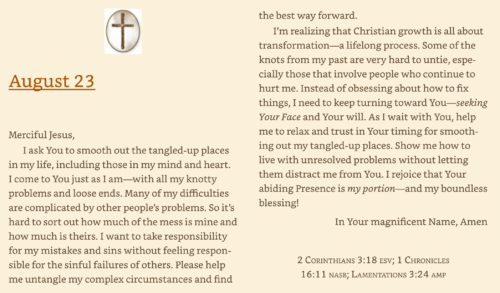
Gentle Jesus, When I’m feeling overwhelmed by my circumstances, please remind me to spend time focusing on You and listening to You. I love to hear You saying to me, “Take courage! It is I. Don’t be afraid.” Listening to You while I’m feeling stressed requires a lot of discipline and trust. My racing thoughts make it hard to hear Your gentle whisper. So I’m thankful for the help of Your Spirit, who calms my mind when I ask. I rejoice that You—the Prince of Peace—are with me at all times. Not only are You with me, but You are also in my circumstances. You’re in control of everything that happens to me! I know that You are never the author of evil, yet You’re able to take bad things and use them for good. This doesn’t always remove my suffering, but it does redeem it—infusing it with meaning. So whenever I’m in a storm of difficulties, I’ll listen for Your voice saying, “Take courage! It is I.” And I’ll search for signs of Your abiding Presence in the storm. Your Word assures me that I will seek You and find You when I search for You with all my heart. In Your calming Name, Amen

MATTHEW 14:27; But Jesus immediately said to them: “Take courage! It is I. Don’t be afraid.”.

1 KINGS 19:12; 12 After the earthquake came a fire, but the Lord was not in the fire. And after the fire came a gentle whisper.

ISAIAH 9:6 NASB; For a Child will be born to us, a Son will be given to us; And the government will [ a]rest on His shoulders; And His name will be called Wonderful Counselor, Mighty God, Eternal Father, Prince of Peace.

JEREMIAH 29:13 NKJV; And you will seek Me and find Me, when you search for Me with all your heart. 

Young, Sarah. Jesus Listens (p. 240). Thomas Nelson. Kindle Edition.

August 16th, 2023 by Dave No comments »


A Female Prophet to the Church

The mystic Catherine of Siena (1347–1380) models the radical traditionalism identified by Father Richard as central to the prophet. Joan Chittister describes Catherine’s powerful witness:  

When mysticism was veiled in mystery and wrapped in private ecstasies and personal devotions, Catherine’s mysticism plagued her with the worries of the world and plunged her into the very center of life.… 

When everything in the world around her was in chaos, in both church and state, Catherine refused to buy for herself an easy reprieve…. She would not call what was wrong right, what was intolerable acceptable, what was bad good, what was oppressive God’s will…. No, Catherine of Siena called the terrible terrible and the ungodly ungodly and in that act calls every century after her yet, still, and always, to do the same. Today, still, Catherine of Siena pours fire and ice into the human soul. She confronts us with what we dearly need even now if this church is to prosper and this world is to survive.  

The earliest biography of Catherine of Siena records her vision of Jesus’ call to instruct the “learned men” of her time:  

“How can I be of any use in the work of saving souls,” she asked the Christ who called her in visions, “for I am a woman, and it is not seemly for my sex to try to teach men, or even to speak with them. Besides, they take no notice of what we say.” … It was the Jesus of her vision who responded:  

All things are possible for God who has created everything from nothing. I know that you say this from humility, but you must know that in these days pride has grown monstrously among men, and chiefly among those who are learned and think they understand everything…. I have chosen unschooled women, fearful and weak by nature, but trained by Me in the knowledge of the divine, so that they may put vanity and pride to shame.…  [1]

Because of those heretical words of Jesus [to the society of her day], Catherine of Siena became spiritual mother, public figure, political prophet, Doctor of the Church. She read souls, guided priests, negotiated between city-states, chastised two popes, and became an emissary to the state from the Vatican….  

She calls men to recognize the God-given mission of women affirmed by Jesus, enshrined in the Gospels, and confirmed by the history of women in the church. She calls women to refuse rejections, to demand equality, to speak their spirituality, to give their God-given gifts, whether these gifts are called for or not, called holy or not, legitimated or not because no one, not even the church, has the right to deny the gifts of God or the God who works through the gifts of women….  

Personal sacrifice, Gospel insight, Christian feminism, and patient prophetism is the legacy of Catherine of Siena to the twenty-first century.  

From Sarah……

Marvelous Savior, Help me to find Joy in You—for You are my Strength. I know that keeping Joy alive is crucial, especially when I’m in the throes of adversity. Whenever I’m struggling with difficulties, I need to guard my thoughts and words very carefully. If I focus too much on all the things that are wrong, I become increasingly discouraged—and my strength is sapped. As soon as I realize what’s happening, I must stop this hurtful process immediately. You’ve been training me to turn to You quickly and ask You to show me the way I should go. When I’m struggling, I need to take time to praise You—speaking or singing words of worship, reading promises and praises in Scripture. O my Strength, I sing praise to You. I sing the Glory of Your Name! It’s essential for me to remember that my problems are temporary but You are eternal—and so is my relationship with You. As I find Joy in You, delighting in Your unfailing Love, my strength invariably increases. In Your glorious Name, Jesus, Amen

August 15th, 2023 by Dave No comments »

Prophets Are Radicals and Traditionalists

Father Richard considers the “both/and” nature of the prophetic charism and call:  

The prophets were both radicals and traditionalists. They were radical believers in God and radical lovers of God’s people. We can even say they were radical traditionalists. Their penetrating insight saw into the heart of their own tradition, the tradition that went back to YHWH’s covenant with Israel, the tradition that went further back than their recent religious institutions. They reminded their people of God’s faithfulness to that covenant, and they called them to be faithful to the God who gave it to them. [1]  

The prophetic gift or “charism” is rare, I believe, because it demands two seemingly opposite things—radical traditionalism and shocking iconoclasm at the same time. Normally, we would think these two things would cancel each other out. Most people cannot imagine that both can coexist, tame, and educate one another.  

The “radical traditionalism” we see in the prophets is very different from what we see today in many social activists, who are often embarrassed to use words like God, faith, surrender, or trust. To put together opposites such as radical and traditional demands a level of human maturity, groundedness, spiritual intelligence, a readiness not to be liked, and a willingness to be persecuted. [2] 

The Hebrew prophets did not care if others looked on them as conservative or liberal. They only cared about being faithful to God. To some, they looked like “conservatives” preaching old-time religion. To others, they looked like “liberals” questioning the status quo. The same is true of prophets in our day. Many people turned against Martin Luther King Jr. (1929–1968) when he spoke out against racism, poverty, and war; yet he was only being faithful to the call God had given him to preach the gospel of freedom. Antiwar prophets are labeled as radicals even when they call us back to the ancient tradition of Christian pacifism. Mother Teresa of Calcutta (1910–1997) was admired by many conservatives, and yet her radical care for the poor is rooted in the same love of Christ as the gospel poverty of Dorothy Day (1897–1980), who was hated by conservatives.  

The prophets, past and present, first call us into that experience of God’s love which radically alters our vision of ourselves and our outlook on life. Too often we are concerned about petty things that in the end do not really matter. What the prophets are saying is this: Let God do something good for us. Let God lead. Enter into the experience of God’s presence and love. We shouldn’t be surprised if we find ourselves falling in love with our tradition and wanting to radically change the way things are. Entering into the vision and love of God alters our perception of reality. [3]  

August 14th, 2023 by Dave No comments »

Forthtelling, Not Foretelling

For Richard Rohr, prophets do not foretell the future, but they do seem to anticipate futures that are shocking to the rest of us:   

Most of the prophets seem to be ordinary people who find themselves with a gift. Prophecy in the Bible is not a matter of foretelling, but—to play with the English language a bit—it’s forthtelling. Prophecy is speaking with such a forwardness of truth, direction, and passion that, after the fact, we say the prophet foretold it. It’s not that they’re really predicting something, it’s just that they have immense spiritual insight. The original Hebrew word for a prophet meant simply that: one who sees. A prophet is a seer who sees all the way through.  

The reason prophets can speak so clearly and strongly in the now is because they judge the now from, of all places, the future. Prophets have seen the future. In other words, they have seen where God is leading humanity. They have seen and drawn close to the heart of God and they know God is leading us somewhere good. Since they know the conclusion and where it is that we’re heading, they become impatient and angry at the present state of things. If we know where history is going and what God is leading us toward; if we know what our lives could and should be, why are we wasting time with all this violence and all this stupidity?  

The prophets judge the present by the perspective of the future. Perhaps that’s how we began to think that prophets foretold the future—because they forthtold the future. They were the original futurists. The fancy, theological word for this is eschatology. The prophets live out of this futuristic vision of God’s dream for the world, where God is leading history, and where it’s all headed. Prophets become so infatuated with that final ideal goal and vision that they become passionately sad and angry about what we’re doing now. Once we experience the universal being of God, the present becomes so dissatisfying and disappointing. We wonder how people can be satisfied with so little and content with such tawdry lives. [1] 

Another way to say it is that the prophet gives us a direction and vision of the whole. For most people, history was circular; it wasn’t going any place in particular. But the prophet gives history a goal, aim, and direction and calls history forward. This is essential because if we don’t have a sense that history is going somewhere, we will go in circles and our lives will become meaningless. We enter a kind of existential absurdity with no direction in which many people become caught. Without an eschatological sense of time, we become trapped in the now. Without the word of the prophet, religion becomes no more than a legitimation of the status quo. [2]  

A Prophet Celebrates Freedom

Miriam, the sister of Moses and Aaron, is the first female prophet named in the Hebrew Scriptures. Storyteller Kelley Nikondeha offers her imaginative interpretation of the scene near the Red Sea from Exodus 14–15:  

What a mighty mystery! The waters rose up in translucent walls, fish dangled in upturned currents as Leviathan was effectively cut in two, and Miriam’s kin walked on dry land right through the middle as if they were cutting a new covenant with YHWH. She found herself chanting lines from her mother’s lullabies—The horse and rider will fall into the sea—and the people echoed her back in a voluminous unison: The horse and rider will fall into the sea! She twirled like her younger self: Who is like you, O Lord, among the gods? The throngs in transit responded: No one is like our Lord among the gods! And when the last Hebrew heel lifted off the dried seabed, the towering barriers released like twin tsunamis, sending the Egyptian chariots crashing into the dark sea. Miriam stood by her brothers in shock, in unspoken awe…. 

Miriam, prophet, stood over the sea aching. A few widows came alongside her, sharing in her lament for the dead. “There will be empty places at their tables now,” she spoke in a plaintive tone. “We know what that does to a heart.” … “I will remember your son always,” Miriam whispered like a prayer and a promise. The prophet, heavy with jewelry and tears, swore she heard God weeping over her shoulder. She turned to the small band of women. “Let’s go down to the shore and mourn the dead, lest our own hearts calcify and become hard like Pharaoh’s.” And so while the Hebrews broke out their unleavened bread in the cool of that first free night, the women wept with God and the angels.  

After honoring the compassion welling up within her, Miriam leads her people as they celebrate their liberation:  

The night crackled with campfire alchemy, an intoxicating mix of gyrating flames, smoke snaking toward the sky, the pop and hiss of golden sparks. Then the drum line sounded across the camp. Miriam pounded out a cadence unlike any other, unfettered and free. Women reached for their own drums and joined the song. The prophet started singing, harmonies building and volume increasing as her women got into formation. The prophet, yoked with wisdom, composed liberation lyrics. Over the decades, her mother’s lullabies had matured into anthems of freedom inside her, now finding their fullest, truest expression. It was the longing of all the midwives and mothers together, past and present, crying out for shalom that saturated each stanza.  

Miriam sang of the reversal—grown men tossed into the sea instead of infant sons. Of God’s mighty arm strong to save (if a bit slow for her liking). According to some scholars, Miriam composed the earliest Hebrew freedom songs, the ones that became the liberation litany her own brother, Moses, would sing.  

Awakening to Our True Self

August 10th, 2023 by JDVaughn No comments »

Richard Rohr reflects on our responsibility to awaken and live from our True Self: 

I believe God gives us our soul, our deepest identity, our True Self, our unique blueprint, at our own conception. Our unique little bit of heaven is installed within the product by the Manufacturer at the beginning! We are given a span of years to discover it, choose it, and live our destiny to the full. If we do not, our True Self will never be offered again in our own unique form.  

Our soul’s discovery is utterly crucial, momentous, and of pressing importance for each of us and for the world. We do not “make” or “create” our souls; we just “grow” them up. We are the clumsy stewards of our own souls. We are charged to awaken; much of the work of spirituality is learning how to stay out of the way of this natural growing and awakening. We need to unlearn a lot, it seems, to get back to that foundational life which is “hidden in God” (Colossians 3:3). Yes, transformation is often more about unlearning than learning, which is why religious traditions call it “conversion” or “repentance.”  

For me, no poet says this quite so perfectly as the inimitable Gerard Manley Hopkins in his Duns Scotus-inspired poem “As Kingfishers Catch Fire.”  

Each mortal thing does one thing and the same:
Deals out that being indoors each one dwells; 
Selves—goes its self; myself it speaks and spells, 
Crying What I do is me: for that I came. [1]  

All we can give back and all God wants from any of us is to humbly and proudly return the product that we have been given—which is ourselves! If I am to believe the saints and mystics, this finished product is more valuable to God than it seemingly is to us. Whatever this Mystery is, we are definitely in on the deal. True religion always has a deep intuition that we are already participating in something very good, in spite of our best efforts to deny it or avoid it.  

In fact, the best of modern theology reveals a strong turn toward participation, “an enactive understanding of the sacred,” [2] as opposed to religion as mere observation, affirmation, moralism, or group belonging. There’s nothing to join, only something to recognize, suffer, and enjoy as a participant. We are already in the eternal flow that Christians would call the divine life of the Trinity.    Whether we find our True Self depends in large part on the moments of time we are each allotted, and the moments of freedom that we each receive and choose during that time. Life is indeed “momentous,” created by accumulated moments in which the deeper “I” is slowly revealed if we are ready to see it. Holding our inner blueprint, which is a good description of our soul, and returning it humbly to the world and to God by love and service is indeed of ultimate concern.  

________________________________________________

Sarah Young Jesus Listens

Cherished Jesus, This world abounds with negative things for me to think about. Sometimes problems—mine and others’—seem to shout for my attention. The difficulties can occupy more and more of my thinking, causing me to grow weary and lose heart. When this happens, please remind me that I can choose the subject of my thoughts. Instead of wallowing in the darkness of discouragement, I can turn toward You and let Your Light shine upon me. Help me not to be defeated by wrong choices I have made in the past. And don’t let me define who I am now on the basis of past decisions that were hurtful. Each moment provides a fresh opportunity to draw near You and enjoy Your Presence. Even when I’m struggling, I can choose to seek You in the midst of my problems instead of just focusing on the difficulties. I love hearing Your words of encouragement: “In Me you may have Peace. In this world you will have trouble. But take heart! I have overcome the world.” In Your triumphant Name, Amen

HEBREWS 12:3 NASB; For consider Him who has endured such hostility by sinners against Himself, so that you will not grow weary [ a]and lose heart.

PSALM 34:6–7 NKJV; This poor man cried out, and the Lord heard him, And saved him out of all his troubles. 7 The angel of the Lord encamps all around those who fear Him, And delivers them.

JOHN 16:33; I have overcome the world. In this world his disciples would be persecuted and have sorrow, but he bids them Be of good cheer. The world can only afflict for a season; it is a conquered world; Christ has overcome it.

Young, Sarah. Jesus Listens (p. 233). Thomas Nelson. Kindle Edition.

August 9th, 2023 by Dave No comments »

Letting Go of the False Self

Father Richard further clarifies what he means by the false self: 

Our false self is not our bad self, our inherently deceitful self, the self that God does not like, or we should not like. Actually, our false self is good and necessary as far as it goes. It just doesn’t go far enough, and it often poses and thus substitutes for the real thing. That is its only problem, and that is why it’s called “false.”  

Various false selves (temporary costumes) are necessary to get us all started, and they show their limitations when they stay around too long. If a person keeps growing, their various false selves usually die in exposure to greater light. 

Our false self, which we might also call our “small self” or “separate self,” is our launching pad: our body image, our job, our education, our clothes, our money, our car, our success, and so on. These are the functional trappings of ego that we all use to get through an ordinary day. They are largely projections of our self-image and our attachment to it. [1] 

Contemplation teaches us how to detach from this self-image. For example, I’m happy to dress as a priest at the appropriate time and place, but I don’t do it all the time, because then I get too attached to that image. Any self-image, positive or negative, held too tightly, reinforces our attachment to the false self. We don’t need to think of ourselves as better or worse than each other. I am who I am as the image of God and that levels the playing field. [2] 

When we are able to move beyond our separate or false self—as we are invited to do over the course of our lives—it will eventually feel as if we have lost nothing. In fact, it will feel like freedom and liberation. When we are connected to the Whole, we no longer need to protect or defend the mere part. We no longer need to compare and compete. We are now connected to something inexhaustible.   

To not let go of our false self at the right time and in the right way is precisely what it means to be stuck, trapped, and addicted to our self. (The traditional word for that was sin, the result of feeling separate from the Whole.) Discovering our True Self is not just a matter of chronological age. Some spiritually precocious children see through the false self rather early. Some old men and old women are still dressing it up. If all we have at the end of our life is our separate or false self, there will not be much to eternalize. It is transitory and impermanent. These costumes are largely created by the mental ego. They were useful to us in our development. Our false self is what changes, passes, and dies when we die. Only our True Self lives forever. [3]