May 9th, 2023 by Dave No comments »

A Mysterious Gratitude.

Dear David,

On a chilly desert night this past December, we hosted a gathering of Center for Action and Contemplation (CAC) staff, Board, and Faculty at the Norbertine Abbey on the outskirts of Albuquerque. Our gathering was called to review and confirm the big and exciting plans we have for the future of our mission. With what is happening in the world today, we believe that sharing the wisdom and practices of the Christian contemplative traditions is more important now than ever before. 

That night, we also ritually recognized my stepping back from active leadership at the CAC to become Core Faculty Emeritus. To symbolize the crossing of this threshold, I stepped over a smooth piece of piñon pine — leaving behind titles, obligations, and many duties that have kept me so busy for the past 35 years. And on the other side, I stepped into a new phase of life, one filled with trust and acceptance for what is and what will be. There was no magic to this ritual, but the key was to really mean it, and expect that things would be different on the other side.

Line drawing of Richard Rohr stepping over the threshold with Opie by his side

And now, writing this letter to you five months later, I must tell you that things are truly delightful! All feels right and good. I feel a great peace that is run through with what I can only describe as a “mysterious gratitude” — for where I have been, the opportunity before us, and this incredible community. My lymphoma cancer is now in full remission, and it seems God may be giving me more time. I didn’t ask to live longer; I was truly ready to go. I can only imagine there must be something more for me to do. Pray that I listen well. 

Thank you for being on this journey of transition with me, and with us. The entire CAC has crossed an important threshold, and that would not have been possible without your collective support, generosity, and partnership. Our vision of transformed people helping to transform the world is much more than any one person can take on by themselves. But together, I know that we can become a loving force for change of consciousness within each of our communities. We are part of a living tradition of action and contemplation, people who have gone beyond the theoretical and are living out this wisdom in their daily lives. Truly, it will take a movement of such people to create a world where everything belongs.

Twice per year, we pause the Daily Meditations to ask for your support to help continue this work. If you have been impacted by the CAC’s programs (including these Daily Meditations) and are financially able, please consider donating. The CAC is not funded by any large institution or big foundation but by thousands of people who have been impacted by this work — people just like you. We appreciate every gift, regardless of the amount.

Please take a moment to read our Executive Director Michael’s note below about the mission we are all working towards. Tomorrow the Daily Meditations will continue exploring the theme of “Freedom from Shame.”

Peace and Every Good,

Fr. Richard Rohr, O.F.M.

Dear David,

Thirty-five years ago, Fr. Richard concluded a letter to the CAC’s first donors and supporters with this invitation:

Come, build with us in “action and contemplation.” Like Jesus, we know that we have a lot of temples to confront, a lot of desert to walk in. But we also know that “grace is everywhere,” that grace is abundant (Romans 5:21), and that only grace is radical enough to call forth the good, the true, and the beautiful (Ephesians 2:6-10). “Be brave,” He says, “I have overcome the world.” (John 16:33).
—Fr. Richard Rohr (1987)

Thank you for being brave and joining with us to build a world where everything belongs! Everything that you do as a reader, contributor, and financial supporter is part of a collective effort to expand the reach and worldwide impact of the Christian contemplation traditions. This work is not easy, simple, or straightforward. But the trust and partnership that so many of you have shown during this time of transition are truly and deeply appreciated.

Since I joined the team in 2014, our primary task has been to lead a multi-year strategy to transform the CAC into a 21st-century global platform for transformative spiritual teaching that builds upon Fr. Richard’s lifetime of work and carries it forward into the future. The only thing more exciting than our progress so far is the potential we see before us. I believe we are entering a new era of spiritual renewal, and we are moving forward with a mysterious gratitude, knowing that there are hundreds of thousands of people like you who are shoulder-to-shoulder with us in this mission. 

Your financial support and generosity make all this possible. If you are financially able, we ask you to give to support the expansion of CAC’s work. Please consider making your donation a monthly one. Recurring support helps us consistently invest in new and improved offerings, many at no cost. When you give on a recurring basis, you join a community of people committed to supporting the contemplative path by making a meaningful monthly commitment in service to the healing of our world. 

In gratitude for a donation of any size, we will send you a digital version of our new issue of CAC’s biannual journal ONEING with the theme of “Transitions,” featuring a lead article from CAC Faculty Brian McLaren alongside other scholars, teachers, and poets sharing about this timely topic.

Thirty-five years after Father Richard founded the CAC and five months after he crossed the threshold, we say to all of you:

Come, build with us in “action and contemplation.” There is much more sacred work to be done.

In loving gratitude,

Michael Poffenberger, CAC Executive Director

Michael Poffenberger
Executive Director
Center for Action and Contemplation

[18] The Secrets in God

There is a chamber also (O God, humble and accept my speech)—a chamber in God Himself, into which none can enter but the one, the individual, the peculiar man—out of which chamber that man has to bring revelation and strength for his brethren. This is that for which he was made—to reveal the secret things of the Father.

Lewis, C. S.. George MacDonald (pp. 10-11). HarperCollins. Kindle Edition.
Our Original Shame

May 8th, 2023 by Dave No comments »

Father Richard speaks to the pervasive sense of shame that has taken root in our society:   

What we call Original Sin in Genesis perhaps could be better called Original Shame, because Adam and Eve describe themselves as feeling naked. Some of the first words of God to these newly created people are “Who told you that you were naked?” (Genesis 3:11). Next, in a lovely maternal image, God as seamstress sews leather garments for them (3:21). The first thing God does after creation itself is cover the shame of these new creatures.  

This must name something that is fundamental within us. We live, not just in an age of anxiety, but also in a time of significant shame. I find very few people who do not feel inadequate, stupid, dirty, or unworthy. When people come to me for counseling or confession, they always express in one way or another, “If people only knew the things I think, the things I’ve done, the things I’ve said, the things I want to do, who would love me?” We all have that terrible feeling of a fundamental unworthiness. It takes many different forms, but somehow it appears in each of our lives, even if we do not acknowledge it.  

Guilt, I am told, is about things we have done or not done, but our shame is about the primal emptiness of our very being. Shame is not about what we have done, but about who we are and who we are not. Guilt is a moral question. Shame—foundational shame, at least—has to do with our very being itself. It is not resolved by changing behavior as much as by changing our very self-image, our alignment with the universe. Shame is not about what we do, but where we abide.   

God is always the initiator. God is always the Hound of Heaven [1] who goes out after us because God knows our primordial shame. God is always sewing garments of love and protection to cover our immense and intense sense of unworthiness. Our very movements toward God are only because God has first moved toward us.  

People often seem to start with this premise: “If I behave correctly, I will one day see God clearly.” Yet the biblical tradition says the exact opposite: If we see God clearly, we will behave in a good and human way. Our right behavior does not cumulatively lead to our true being; our true being leads to eventual right behavior. Many of us think that good morality will lead to mystical union, but in fact, mystical union produces correct morality—along with a lot of joy left over. The greatest surprise is that sometimes a bad moral response results in the very collapsing of the ego that leads to our falling into the hands of the living God (see Hebrews 10:31).  

Upending the Social Order

Father Richard points out how Jesus upended the social norms of his time by honoring people’s identity as beloved children of God:  

A telling phrase used in the Acts of the Apostles describes the new sect of Judaism that upsets the old-world order in Thessalonica. Christians there were dragged before the city council and referred to as the people who have been turning the whole world upside down…. They have broken Caesar’s edicts” (Acts 17:6–7). No one is called before the city council for mere inner beliefs or new attitudes unless they are also upsetting the social order. The import of Jesus’ teaching and almost all his healing was a rearranging of social relationships and therefore of social order. He could not have gone around eating with the underclass, touching the untouchables, healing on the Sabbath, and collaborating with upstarts like John the Baptist down at the river without turning traditional societies upside down.  

Jesus refuses to abide by the honor/shame system that dominated the Mediterranean culture of his time. He refuses to live up to what is considered honorable and refuses to shame what people consider shameful. (If that is not apparent in our reading of the Gospels, we need to read them again.) This does not gain him many friends. It’s perhaps the thing that most bothers the priests and the elders. In response to his ignoring the debt codes and purity codes, they decided to kill him (see Mark 3:6, 11:18; Matthew 12:14; Luke 19:47; John 11:53).  

In New Testament times, shame and honor were the basis of moral values that people felt compelled to follow. If a situation called for retaliation, people were expected to retaliate. Not to retaliate would have been considered immoral, because they would have abandoned their honor. People were bound to be true to the honor of their village, their family, and themselves. For Jesus to walk into the midst of that cultural system and say, “Do not retaliate” and “Love your enemies” was to subvert the whole honor/shame system itself.  

Once challenged, Jesus’ listeners were given a new place to find their identity: not in their social positions of honor or shame but in God. Who we are in God is who we are. That’s the end of ups and downs. Our value no longer depends upon whether our family or village likes us, or whether we’re good-looking, wealthy, or obedient to the laws. Jesus’ message is incredibly subversive in any honor/shame society. As he takes away old foundations, he offers a new, more solid one: neither shame-based nor guilt-based but based in who we are in God.  

Who we are in God is a beloved child. Our identity is no longer dependent on the estimation of our culture or even on our own estimation of ourselves. Through prayer, and the awareness of God within us, we continually discover our true identity, “life … hidden with Christ in God” (Colossians 3:3).  

[15] The White Stone (Revelations 2:17)

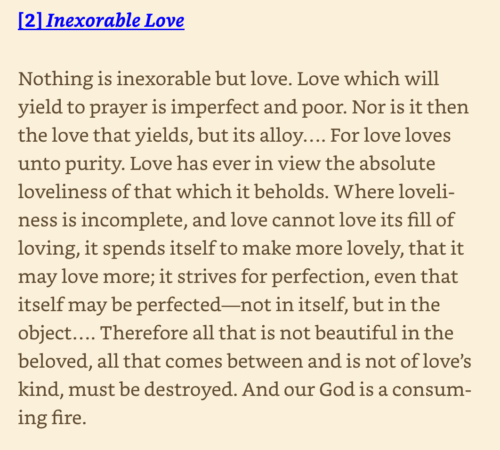
The giving of the white stone with the new name is the communication of what God thinks about the man to the man. It is the divine judgment, the solemn holy doom of the righteous man, the “Come, thou blessed,” spoken to the individual…. The true name is one which expresses the character, the nature, the meaning of the person who bears it. It is the man’s own symbol—his soul’s picture, in a word—the sign which belongs to him and to no one else. Who can give a man this, his own name? God alone. For no one but God sees what the man is…. It is only when the man has become his name that God gives him the stone with the name upon it, for then first can he understand what his name signifies. It is the blossom, the perfection, the completeness, that determines the name: and God foresees that from the first because He made it so: but the tree of the soul, before its blossom comes, cannot understand what blossom it is to bear and could not know what the word meant, which, in representing its own unarrived completeness, named itself. Such a name cannot be given until the man is the name. God’s name for a man must be the expression of His own idea of the man, that being whom He had in His thought when he began to make the child, and whom He kept in His thought through the long process of creation that went to realize the idea. To tell the name is to seal the success—to say “In thee also I am well pleased.”

Lewis, C. S.. George MacDonald (pp. 8-10). HarperCollins. Kindle Edition.

Fly Loose

May 5th, 2023 by JDVaughn No comments »

The Rev. Cameron Trimble is an author, pastor, and leader in the United Church of Christ. As a pilot, she honed her wisdom for navigating the turbulence of transitional times:   

“We are going to hit some turbulence ahead,” [my flying instructor] went on, “and you will learn something about your airplane…. If you tighten your grip on the yoke, you reduce the aerodynamics of your aircraft. You, as the pilot, actually make the flight less safe, steady, and stable. So, remember: When the going gets rough, fly loose….” 

Our world today is nothing if not swirling, turbulent wind tossing us around. [Recently], we have experienced economic meltdown, climate countdown, racial throwdown, political breakdown, technology showdown, and religious letdown. We are living through the breakdown and breaking open of much that has defined modern life.  

In the face of such extraordinary transition, it’s natural to look for solutions to our problems…. We tightly grip the yoke of our families, businesses, government, and communities, trying to regain control of people and systems that feel broken and dangerous to our safety and survival. Of course, no amount of control will create the conditions needed to traverse these rough winds of change. 

Trimble offers challenging yet hopeful advice:  

We must resist looking to the frameworks of the past to lead us into the future. Doing so is a way to pretend to control, to tighten our grip and reduce our cultural aerodynamic flexibility. Instead, perhaps we turn to ways of wisdom that cultivate intuition, patience, and ingenuity. We embrace the ways of a Mystic Wayfinder, one who purposefully gets lost in order to chart new ways forward. By getting lost and welcoming the reality that we do not have the answers or know the way forward, we enter a space of liminality and emergence. We are not attempting to fix “broken systems” but are, instead, summoning entirely new worlds….  

We do not have the answers today. We have the wondering. We have the gifts of being lost to guide us. We must now use the wisdom of our wounds, both caused and carried, as portals into new ways of becoming….  

[Author and public intellectual] Bayo Akomolafe often begins his presentations with this call:  

The times are urgent; let us slow down. Slowing down is losing our way. Losing our way is not a human capacity or human capability. It is about the tensions, the invitations that are now in the world-at-large, inviting us to listen deeply, to be keen and to be fresh and to be quick with our heels, to follow the sights and sounds and smells of the world. [1]   His is an invitation to become fully present to the unfolding wonder of the world around us, to let go of our need to control the narrative and be swept up in the possibility of a more just and generous future ahead…. I hear in these words the invitation to fly loose on the yoke and enjoy the ride.

________________________________

Sarah Young Jesus Listens

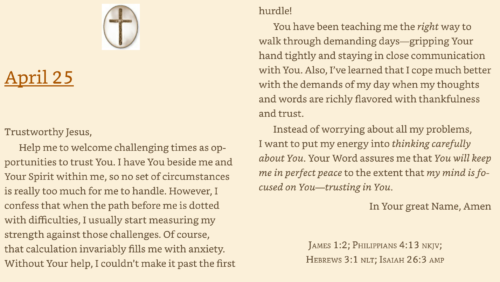
Glorious Savior, Help me to live in the present, giving my entire attention to what You are doing right now. I don’t want to get worked up about what may or may not happen tomorrow. Yet I confess that entrusting my tomorrows to You goes against the grain of my human nature—against my strong desire to feel in control. The truth is, I waste a lot of time thinking about the future. I’ve found that trying not to think about something is usually ineffective and counterproductive. My effort to stop thinking about the matter keeps me chained to those thoughts. However, I can break free by focusing my attention on You and on what You’re doing in my life. You are my living Lord, and You’re always doing new things. The main thing that keeps me chained to future thoughts is my fear of what tomorrow may bring—wondering whether or not I’ll be able to cope with it. But Your Word reassures me: You will help me deal with whatever hard things come up—when the time comes. In Your merciful Name, Jesus, Amen

MATTHEW 6:34 THE MESSAGE; “Give your entire attention to what God is doing right now, and don’t get worked up about what may or may not happen tomorrow. God will help you deal with whatever hard things come up when the time comes.

HEBREWS 12:2; Looking unto Jesus the author and finisher of our faith; who for the joy that was set before him endured the cross, despising the shame, and is set down at the right hand of the throne of God.” 

ISAIAH 42:9; See, the former things have taken place, and new things I declare; before they spring into being I announce them to you.”

Young, Sarah. Jesus Listens (p. 132). Thomas Nelson. Kindle Edition.

Holy Transitions

May 3rd, 2023 by Dave No comments »

For Father Richard, liminal space transforms us when we are attentive to the presence of God in times of change: 

The Latin word limen means “threshold.” Liminal space is an inner state and sometimes an outer situation where we can begin to think and act in new ways. It is where we are betwixt and between, in transition, having left one room or stage of life but not yet entered the next. We usually enter liminal space when our former way of being is challenged or changed—perhaps when we lose a job or a loved one, during illness, at the birth of a child, or a major relocation. It is a graced time, but often does not feel “graced” in any way. In such space, we are not certain or in control.  

The very vulnerability and openness of liminal space allows room for something genuinely new to happen. We are empty and receptive—blank tablets waiting for new words. Liminal space is where we are most teachable, often because we are most humbled. Liminality keeps us in an ongoing state of shadowboxing instead of ego-confirmation, struggling with the hidden side of things, and calling so-called normalcy into creative question. 

It’s no surprise then that we generally avoid liminal space. Much of the work of authentic spirituality and human development is to get people into liminal space and to keep them there long enough that they can learn something essential and new. [1] 

We all need to consciously spend time at the thresholds of our lives, and we need wise elders to create and hold such spaces for us. Liminality is a form of holding the tension between one space and another. It is in these transitional moments of our lives that authentic transformation can happen. Otherwise, it is just business as usual and an eternally boring, status quo existence.  

Over the decades, I’ve seen the need for such liminal spaces again and again. Without some sort of guidance and reframing, we don’t understand the necessary ebb and flow of life, the ascents and descents, and the need to embrace our tears and our letting go as well as our successes and our triumphs. Without standing on the threshold for much longer than we’re comfortable, we won’t be able to see beyond ourselves to the broader and more inclusive world that lies before us.  

Revelation 3:20 tells us that Christ stands at the door and knocks. Too many of us want to show up at the doorway looking prim and proper and perfect. We stuff our egos and anxieties in the front hall closet so Christ won’t see them when we open the door. But Christ isn’t showing up to see our perfect selves. Instead, we are invited into a real, deep, transformative conversation, there on the threshold between who we are and who we can become, if we are willing to let go of what holds us back. [2] 

The following is from an anthology composed by CS Lewis of daily snippets from his hero and mentor, George MacDonald.

May 2nd, 2023 by Dave No comments »

Embracing Change

Benedictine and Celtic scholar Esther de Waal finds inspiration to manage life’s transitions in the Scriptures: 

If we are going to see life as a succession of thresholds to be crossed, we are reminded of the journeys of the people of Israel in the desert, and we then find symbols and images that we can apply to our own experience. The very words passover and exodus carry a fullness of meaning as a journey from bondage into freedom. It is important to remember that the Passover was a yearly ritual, so that its memory was kept alive and the cycle lived through time and time again….  

The psalms are the journey songs of the people who made that passage. Time and again they raised a fist to God and shouted angrily at him…. They are the songs of a people who were moving away from a known situation into the unknown, and they were often angry with a God who removed all those certainties, who instead seemed to be leading them along an apparently precarious path. They did not sit down for long beside gently flowing streams or linger in lush meadows….  

In the Gospels we watch a Christ who, in dismissing certainties, shows us what freedom might mean. We watch the way in which he enters into people’s lives and dissolves an existing situation, whatever it might be. The likelihood was that the condition had promised security, safety, but now Christ challenges the people to leave their nets, or to leave a nice safe booth, and follow him. He says to Peter, James, and John, “Come,” and to Matthew, “Stand up, move, walk, come with me.” Our God is a God who moves and he invites us to move with him. [God] wants to pry us away from anything that might hold us too securely: our careers, our family systems, our money making. We must be ready to disconnect. There comes a time when the things that were undoubtedly good and right in the past must be left behind, for there is always the danger that they might hinder us from moving forward and connecting with the one necessary thing, Christ himself.  

De Waal shares how we might navigate the resistance we feel as we stand on the threshold of something unknown:  

Of course there is loss and it is right to grieve and not to pretend otherwise. Insecurity makes certitude attractive, and it is in times like these that I want to harness God to my preferred scheme of things, for it is risky to be so vulnerable. Yet it is this vulnerability that asks for trust and hope in God’s plans, not mine. So I try to learn each time that I am called upon to move forward to hand over the past freely, putting it behind me, and moving on with hands open and ready for the new.  

New Beginnings

May 1st, 2023 by Dave No comments »


Richard Rohr honors how painful transformation can be and reminds us to be patient with ourselves and the process: 

The word change normally refers to new beginnings. But the mystery of transformation more often happens not when something new beginsbut when something old falls apart. The pain and chaos of something old falling apart invite the soul to listen at a deeper level, and sometimes force the soul to go to a new place. Most of us would never go to new places in any other way. The mystics use many words to describe this chaos: fire, dark night, death, emptiness, abandonment, trial, the Evil One. Whatever it is called, it does not feel good, and it does not feel like God. 

We will normally do anything to keep the old thing from falling apart, yet this is when we need patience and guidance, and the freedom to let go instead of tightening our controls and certitudes. Perhaps Jesus is describing just this phenomenon when he says, “It is a narrow gate and a hard road that leads to life, and only a few find it” (Matthew 7:14). Not accidentally, he mentions this narrow gate and hard road right after teaching the Golden Rule. He knows how much “letting go” it takes to “treat others as you would like them to treat you” (Matthew 7:12). 

Spiritual transformation always includes a disconcerting reorientation. It can either help people to find new meaning or it can cause people to close down and slowly turn bitter. The difference is determined precisely by the quality of our inner life, our practices, and our spirituality. Change happens, but transformation is always a process of letting go, and living in the confusing, shadowy, transitional space for a while. Eventually, we are spit up on a new and unexpected shore. We can see why Jonah in the belly of the whale is such an important figure for Jews, Christians, and Muslims. 

In moments of insecurity and crisis, shoulds and oughts don’t really help. They just increase the shame, guilt, pressure, and likelihood of backsliding into unhealthy patterns. It’s the deep yeses that carry us through to the other side. It’s those deeper values we strongly support—such as equality and dignity for all—that allow us to wait it out. Or it’s someone in whom we absolutely believe and to whom we commit. In plain language, love wins out over guilt any day. 

It is sad that we settle for the short-term effectiveness of shaming people and shutting them down, instead of the long-term life benefits of true transformation. But then, we are a culture of productivity and efficiency, not terribly patient or even open to growth. God is clearly much more patient—and, finally, much more effective, patiently supporting our inner transformation through all of life’s transitions.  

God’s Goodness Is Dynamic

I used to think that things were real, and change was something that happened to them over time. Now I think that change is real, and things are events that happen over time. Change is the constant and things come and go, appear and disappear.
—Brian McLaren, Do I Stay Christian?  

CAC teacher Brian McLaren locates resistance to change in our misunderstanding of God and encourages us to embrace reality’s dynamism: 

Richard Rohr often recounts a story from seminary, when a professor ended … the semester by saying that Christian theology has in many ways been more influenced by the thought of Greek philosophers than by Jesus’ thinking. A case in point is the Greek idea of absolute perfection, the idea that if something is transcendent, it is unchangeable, immovable, absolute, and incapable of transition.  

Because we want to lift God to the highest level possible, many of us were taught to conceive of God in this Greek category of perfection. After all, what’s the alternative—imperfection? 

McLaren reflects on his own study of Genesis:  

I had been preaching through the creation story of Genesis, and I realized that the universe described there didn’t fit with the categories of Greek philosophy. The universe fashioned by the word and creative character of God was not immovable. It was not absolute and incapable of change. It was not immutable or static or, in the Greek sense, perfect….  

In the Hebrew poetry of Genesis 1, God’s creation was, simply put, in process. It started simple and grew more complex. It started in chaos, and order took shape. It started without life, and life “sprang forth” and “multiplied.” A sentence formed in my head that day … : “Hebrew good is better than Greek perfect.” 

In other words, Greek perfect is static, but Hebrew good is dynamic. Greek perfect is sterile and changeless, but Hebrew good is fertile and fruitful….  

Could this deep-seated understanding help explain why so many Christians today remain chained to the past, unable to imagine that change could be for the better, unable to accept that the present order, while superior to the past for some, is still deeply unjust for many and therefore deserves to be challenged and changed? Could sin be better understood as a refusal to accept needed change, a refusal to grow, a resistance to the arc of transition that bends toward justice?  

Sometime soon, I hope you can take a walk outdoors or find a place to sit and observe the created world. Seasons change. Trees grow. Rivers flow. Rocks roll downstream and go from rough and sharp to smooth and round. You can look in the mirror and sense the same reality in your own face: new wrinkles, new wisdom.  

Perhaps you can look at this world in transition and dare to echo God in Genesis [1:31]: behold, it is good … it is very good. Perhaps you can see transition as an essential part of that goodness that is better than perfection.  

When troubles of any kind come your way, consider it an opportunity for great joy. For you know that when your faith is tested, your endurance has a chance to grow. ”

fixing our eyes on Jesus, the pioneer and perfecter of faith. For the joy set before him he endured the cross, scorning its shame, and sat down at the right hand of the throne of God.

In all this you greatly rejoice, though now for a little while you may have had to suffer grief in all kinds of trials. These have come so that the proven genuineness of your faith—of greater worth than gold, which perishes even though refined by fire—may result in praise, glory and honor when Jesus Christ is revealed.

10 In bringing many sons and daughters to glory, it was fitting that God, for whom and through whom everything exists, should make the pioneer of their salvation perfect through what he suffered.

Letting Go with Ease

April 28th, 2023 by JDVaughn No comments »

Buddhist teacher angel Kyodo williams emphasizes how human it is to have desires—and how we can lessen our attachment to them:  

It can give you a headache just thinking about how many times a day your mind goes chasing after some real or imagined desire….  

A desire can appear instantly: BANG! There it is! When we think of not having desires, we’re afraid we will disappear. Why is that?… Because our desires are so persistent and so constant, we think we are our desires. And that shows how really, really attached to them we are….  

None of us escapes desire, and we don’t want to escape. That is not the point. We would just like to stop holding on to them for dear life. We want to see them for what they are. They are cravings. They are desires. They do not own us. They do not need to force us in every possible direction, contorting our bodies to chase down the next thing. I won’t be a captive to my desires, helpless in their power. More important, I won’t make myself miserable because of my attachment to my wants... [1] 

Williams offers instructions on the practice of “letting go” of our thoughts, desires, and judgments through mindfulness meditation:  

Letting go means simply releasing the thoughts and ideas that our minds get in the habit of attaching themselves to, including the ideas of yesterday and tomorrow. Letting go is not hard or harsh. We should let it be easy and gradual. Our habitual way of reacting makes us feel as if we have to go on a journey with every thought that comes, or that we have to wrestle them to the ground to control them. That isn’t true at all. None of our actions will be forced or contrived if we keep from grasping at everything that appears in front of us….  

We can see the thoughts that come up in our minds the same way a mirror “sees” things. A mirror just notices. It registers whatever passes in front of it without holding on to it in any way. It just lets go. It doesn’t think about it or have a long conversation about it. Since the mirror doesn’t cling to the object that it is reflecting, when the object goes, so does the reflection. It’s the same way with your mind. We don’t hold on to the random thoughts that arise over and over again in our minds and that can take us away from the full experience of now. We want to be aware only of our breath and nothing else. The moment that we become aware that a thought has taken form, we just relax and allow it to pass. We just notice the thoughts and we return to our breath. If nothing grabs onto the thoughts as they arise, they will keep on moving on, leaving no trace that they were ever there. Let your mind be like the mirror. Clear mirror, clear mind. [2] 

_______________________________________________

Sarah Young; Jesus Listens

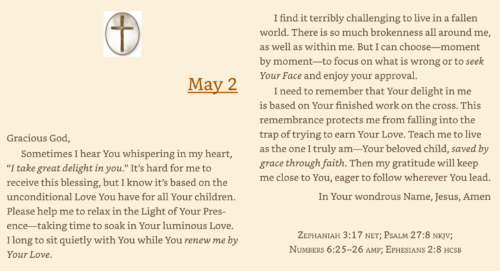
Supreme Savior, Help me to give up the illusion that I deserve a problem-free life. Part of me still hungers for the resolution of all my difficulties, but I realize this is a false hope. Your Word states clearly that in this world I will have trouble. I must link my hope not to problem solving in this life but to the promise of an eternity of trouble-free life with You in heaven. Instead of seeking perfection in this fallen world, I want to pour my energy into seeking You—the Perfect One. You’ve shown me that it’s possible to glorify You in the midst of adverse circumstances. Your Light shines brightly through believers who trust You in the dark. This is supernatural trust, produced by Your indwelling Spirit. Lord, I invite You to transform me more and more into the one You designed me to be. I want to yield to Your creative work in me, neither resisting it nor trying to speed it up. I long to enjoy the tempo of a God-breathed life—with You setting the pace. I’m grateful that You hold me by my right hand, You guide me with Your counsel, and afterward You will take me into Glory. In Your triumphant Name, Jesus, Amen

JOHN 16:33; I have overcome the world. In this world his disciples would be persecuted and have sorrow, but he bids them Be of good cheer. The world can only afflict for a season; it is a conquered world; Christ has overcome it.

2 CORINTHIANS 3:18 ESV; And we all, with unveiled face, beholding the glory of the Lord,[ a]are being transformed into the same image from one degree of glory to another.[ b] For this comes from the Lord who is the Spirit.

PSALM 73:23–24; Nevertheless, I am continually with you; you hold my right hand. 24 You guide me with your counsel, and afterward you will receive me to glory.

Young, Sarah. Jesus Listens (p. 123). Thomas Nelson. Kindle Edition.

The Art of Detachment

April 27th, 2023 by JDVaughn No comments »

Richard Rohr calls for contemplative prayer to teach us the “art of detachment.” He stresses that in such prayer we don’t deny our feelings, but simply let go of their ultimacy:  

We need forms of prayer that free us from fixating on our own conscious thoughts and feelings and from identifying with them, as if we are our thinking. Who are we before we have our thoughts and feelings? That is our naked being. We have to learn to be spiritually empty, or, as Jesus says in his first beatitude, “How blessed are the poor in spirit” (Matthew 5:3). If we are filled with ourselves, there is no room for another, and certainly not for God. We need contemplative prayer, in which we simply let go of our constantly changing ego needs, so Something Eternal can take over.  

This may sound simple, but it’s not easy! Because we’ve lost the art of detachment, we’ve become almost fully identified with our stream of consciousness and our feelings. Don’t misunderstand me; I’m not saying we should repress or deny our feelings. I’m challenging us to name them and observe them, but not to directly fight them, identify with them, or attach to them. Unless we learn to let go of our feelings, we don’t have our feelings; our feelings have us.  

We might ask: “What does this have to do with God? I thought prayer was supposed to be talking to God or searching for God. This seems to be saying prayer is about getting myself out of the way.” That is exactly what I am saying. As John the Baptist put it, “I must grow smaller so he can grow greater” (John 3:30). [1] 

To any of us comfortable people, detachment sounds like losing, but it is actually about accessing a deeper, broader sense of the self, which is already whole, already content, already filled with abundant life. This is the part of us that has always loved God and has always said “yes” to God. It’s the part of us that is Love, and all we have to do is let go and fall into it. It’s already there. Once we move our identity to that level of deep inner contentment and compassion, we realize that we’re drawing upon a Life that is larger than our own and from a deeper Abundance. Once we learn to do that, why would we ever again settle for some scarcity model for life? [2]   God is already present. God’s Spirit is dwelling within us. We cannot search for what we already have. We cannot talk God into coming “to” us by longer and more urgent prayers. All we can do is become quieter, smaller, and less filled with our own self and our constant flurry of ideas and feelings. Then God will be obvious in the very now of things, and in the simplicity of things. To sum it all up, we can never get there, we can only be there.

_________________________________

Sarag Young Jesus Listens……

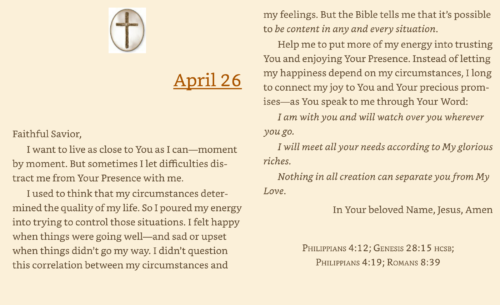
Merciful Jesus, I come gladly into Your Presence—basking in the luxury of being fully understood and perfectly loved. Help me to see myself as You see me: radiant in Your righteousness, cleansed by Your blood. I’m grateful that You view me as the one You created me to be, the one I will actually be when heaven becomes my home. It is Your Life within me that is changing me from Glory to Glory! I rejoice in this mysterious miracle. As I sit quietly in Your Presence, my awareness of Your Life within me is heightened. You are Christ in me, the hope of Glory. I’m grateful that You—the One who walks beside me, holding me by my hand—are the same One who lives within me. This is a glorious, unfathomable mystery. The Light of Your Presence shines within me as well as upon me. You and I are intertwined in an intimacy that involves every fiber of my being. You are in me, and I am in You. This means that nothing in heaven or on earth can separate me from You. Hallelujah! In Your magnificent Name, Amen

PSALM 34:5; Those who look to Him are radiant with joy; their faces shall never be ashamed. 

2 CORINTHIANS 5:21 HCSB; He made the One who did not know sin to be sin for us, so that we might become the righteousness of God in Him.

2 CORINTHIANS 3:18 NKJV; But we all, with unveiled face, beholding as in a mirror the glory of the Lord, are being transformed into the same image from glory to glory, just as by the Spirit of the Lord.

COLOSSIANS 1:27 ESV; To them God chose to make known how great among the Gentiles are the riches of the glory of this mystery, which is Christ in you, the hope of glory. 28 Him we proclaim, warning everyone and teaching everyone with all wisdom, that we may present everyone mature in Christ.

Young, Sarah. Jesus Listens (p. 122). Thomas Nelson. Kindle Edition.

April 26th, 2023 by Dave No comments »

Don’t Make Much of It

In whatever state we may find ourselves, whether in strength or in weakness, in joy or in sorrow, to whatever we may feel attached, we must renounce it.
—Meister Eckhart, sermon on Luke 1:57  

For CAC teacher James Finley, practicing contemplative detachment helps us recognize that our feelings, real as they are, do not ultimately determine who we are. From his work as a psychotherapist and spiritual director, Finley offers a gentle way of understanding this teaching:  

Do not become attached. If you’re in sorrow and utter loss, don’t become attached to the experience of yourself in moments of utter loss. Rather, be detached from your loss. It’s real—but know that the loss doesn’t have the authority to name who you are, for only the infinite generosity of God giving itself to you in this very moment has the authority to name who you are. So, the loss is real. Feel it; it’s real. But don’t yield to its claim to carry you off, as if the sorrow that you’re in has the authority to name who you are and what’s possible for you. Because only the infinite love of God has the authority. 

Likewise, if you’re in a moment of joy, like real joy over something, be joyful, but be detached from your joy. Because the joy is finite, the joy is ephemeral, the joy is passing away. Enjoy it but realize that compared to the eternal joy—“the joy that death does not have the power to destroy”—this joy that you’re experiencing is fleeting. Don’t get hung up over your joy. Be detached from joy. 

Finley offers wisdom he learned from Thomas Merton (1915–1968), who was his novice master when Finley was a young monk: 

Often, when I’d go in to see Thomas Merton for spiritual direction, he’d say, “How’s it going?” 

And I’d say, “I’m doing well!” 

And he’d say, “Don’t make much of it; it’ll get worse.” 

And other times I would go in really down about something. And he’d say, “Don’t make much of it; it’ll get better.” 

It ebbs and flows, it ebbs and flows. But what is the infinite love that unwaveringly permeates the wavering ways of our heart? And how can we reserve this inner core place within ourself that cannot be accessed by the finite because it belongs completely to God?  

By the way, we should even be detached from that by also being aware of our inability to practice that, because we’re just a human being. We know that when we’re down, we’re really down. And when we’re joyful, we’re joyful. So we have to be very careful not to become attached to the goal of becoming detached! 

We have to take a deep breath, and roll with the waves of the unfoldings of ourselves.  

The Freedom of Detachment

April 25th, 2023 by Dave No comments »

We are to sink eternally from letting go to letting go into God.
—Matthew Fox, Meditations with Meister Eckhart 

The Desert Fathers and Mothers understood detachment as the practice of letting go of everything that draws us away from God. Laura Swan explains:  

Yearning for complete union with God, desert ascetics sought to remove all obstacles to the deepening of this relationship. Obstacles included unhelpful attitudes and motives, thoughts that stalled their pursuit of God, and emotional ties that complicated their inner journeys.  

The desert ascetics’ relationships were non-possessive: They cared for others while leaving them free. Concern for reputation was discarded. Feelings were acknowledged and listened to for their wisdom but were subjected to the discipline of the heart’s goal to seek God. The desert ascetics sought to [discipline] disordered passions that distracted them from their deepening relationship with God and actively to cultivate a burning love for God.  

Although the journey began with giving away possessions, desert ascetics understood that what possessed them was greater than the sum of goods owned. All that owned them [italics added], all that possessed their minds and hearts, their attachments and compulsions, must be healed and reconciled. Desert ascetics called this process of moving toward inner freedom detachment. Detachment allows for greater direct experience of the Divine Presence as the seeker is attached to fewer distractions.  

Desert ascetics understood that the cultivation of inner freedom was vital to the deepening of their experience of God. As they deepened their interior freedom, all aspects of their false self [were] removed and a clearer understanding of their truest self emerged. It is this true self that dwells deeply with God. In the abundant simplicity of our true self, we experience deepest joy. 

Swan explores the goal of “apatheia” (mindfulness or equanimity) in the teachings of the desert mystics:    

Apatheia is a mature mindfulness, a grounded sensitivity, and a keen attention to one’s inner world as well as to the world in which one has journeyed. Strong emotions such as anger, fear, or anxiety did not dominate or control the ascetic’s inner world—they were disciplined to serve the inner journey rather than disrupt it.  

Apatheia is purity of heart. The ammas [desert mothers] teach us to intentionally let go of all that keeps us from the single-minded pursuit of God: feelings and thoughts that bind us, cravings and addictions that diminish our sense of worth, and attachments to self-imposed perfectionism. Apatheia is nourished by simplicity grounded in abundance of the soul. This simplicity is in balance and harmony with the human community and the created world. To cultivate apatheia, we must be uncluttered in mind and heart and continue to be watchful and vigilant about those “seeping boundaries” where we can be deceived out of simplicity and into complexity under the guise of a “good.”