Violence encourages the wrong kind of world, a world that creates conditions for violence against bodies instead of one that seeks to suture the cultural pain and create conditions for bodies to exist without the threat of violence. —Robyn Henderson-Espinoza, Body Becoming
Activist theologian Robyn Henderson-Espinoza affirms our collective capacity to build a world in which bodies do not suffer violence. They write about joining Christian leaders in opposition to racial hatred in Charlottesville, Virginia in 2017:
Soon after I returned home [from Charlottesville], I began receiving Twitter messages and emails, and unmarked packages slowly began arriving at my doorstep. Someone had my address and was mailing packages in an effort to scare and harass me. . . .
As I waded through hate mail and packages sent to my home, I began to think about the kind of world we want to build. . . .
What kind of humans do we want to become?
What kind of world are we seeking to inhabit? . . .
Our world and our culture promote and accelerate violence against bodies. Our embodiment is threatened by policies and politics that don’t have regard for the felt sense of the body or for the ways our feelings and emotions are impacted by all that is happening in the world. So the question about reclaiming our bodies and leaning into the work of becoming embodied is also about how we care for ourselves and learn to care for another.
With manifold violence occurring at our borders and with a global pandemic creating the violence of cascading grief, it is important to think through and feel through how to be as present with our selves and with one another as best as we can, asking the following questions: What are our practices of being present? Are we breathing with our collective body, or is our collective body so broken and in pain that we cannot access the collective nature of our body? Presence first begins with us, with me. And after me, it begins with the I connected to the we . . . . [1]
Buddhist teachers Pamela Ayo Yetunde and Cheryl Giles write about conscious breathing as a practice of being present, which is an integral part of their resistance to racial violence:
Recognizing our deepest feelings, we know we cannot live fully with suffering, invisibility, and dehumanization. Our resistance to oppression is our right to breathe freely, without the force of a hand or foot or knee on our throats constantly draining the life out of us. By watching Black and brown bodies die by police violence without resistance, we slowly die too. . . . And perhaps by not resisting, we unwittingly make a choice to allow ourselves to be silenced because we are too afraid to claim and honor the most precious gift we hold: the breath. But as Black Buddhist practitioners, we intimately know the breath through mindfulness of the breath. In honor of George Floyd and countless others, we vow to breathe. We breathe for the well-being of all sentient beings. [2]
In 1977,
Catholic bishops in Latin America gathered to name their situation of shared
violence and to commit themselves anew to the gospel of peace:
We live in a whole climate of violence. There is violence
in the area of economics by reason of acute fiscal crises, the repeated
devaluation of our currencies, unemployment, and soaring taxes—the burden of
which ultimately falls on the poor and helpless. There is violence at the
political level, as our people in varying degrees are deprived of their right of
self-expression and self-determination and of the exercise of their civil
rights. Still more grave in many countries are human-rights violations in the
form of torture, kidnappings, and murder. Violence also makes its appearance in
various forms of delinquency, in drug abuse as an escape from reality, in the
mistreatment of women—all tragic expressions of frustration and of the
spiritual and cultural decadence of a people losing their hope in tomorrow.
Here we may not scurry for cover to empty theories or hide
behind condemnations of one group by another group. The violence is here; it is
a fact. Injustice exists; this is reality. As Christians we may not abide this.
We may not allow ourselves to grow accustomed to evil, least of all to an evil
that is daily and constant. [1]
In a series of sermons,
radio addresses, newspaper articles, and public speeches, Archbishop Óscar
Romero (1917–1980) of El Salvador called the people of his church and his
nation to return to gospel values, particularly those of justice and love as a
way to end violence.
I will not tire of declaring that if we really want an
effective end to violence we must remove the violence that lies at the root of
all violence: structural violence, social injustice, exclusion of citizens from
the management of the country, repression. All this is what constitutes the
primal cause, from which the rest flows naturally. [2]
When the church decries revolutionary violence, it cannot
forget that institutionalized violence also exists, and that the desperate
violence of oppressed persons is not overcome with one-sided laws, with
weapons, or with superior force. . . . As long as there is not greater justice
among us, there will always be outbreaks of revolution. [3]
Reminding listeners of the
commandment to love our neighbors as ourselves, Romero preached:
If there were love of neighbor, there would be no terrorism, no repression, no selfishness, none of such cruel inequalities in society, no abductions, no crimes. Love sums up the law. Not only that, it gives a Christian meaning to all human relations. . . . Love gives plentitude to all human duties, and without love justice is only the sword. With love, justice becomes a brother’s embrace. Without love, laws are arduous, repressive, cruel. . . But when there is love—security forces would be superfluous, there would be no jail or tortures, no will to beat anyone. [4]
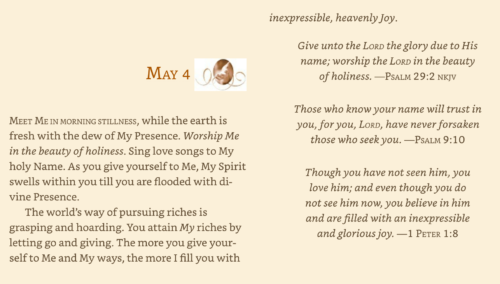
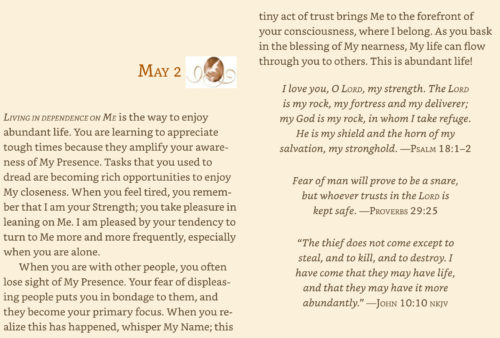
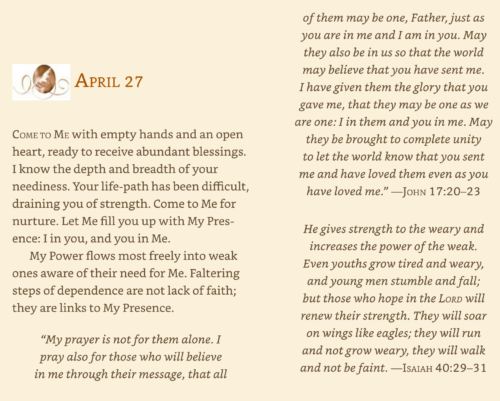
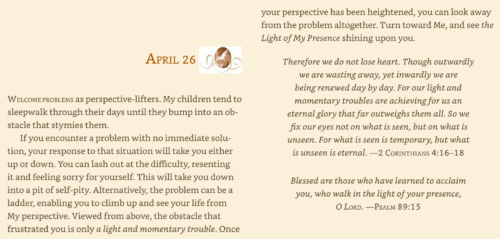
Sarah Young….
You cannot serve two masters.
Revelation 2:4: 4Yet I hold this against you: You have forsaken the love you had at first.
Ephesians 3:16-17: I pray that from his glorious, unlimited resources he will empower you with inner strength through his Spirit. 17 Then Christ will make his home in your hearts as you trust in him. Your roots will grow down into God’s love and keep you strong.
Psalm16:11; You make known to me the path of life; you will fill me with joy in your presence, with eternal pleasures at your right hand.
In a conference with Trappist monk Thomas Keating, Father Richard Rohr considered how contemplation is an antidote to violence:
The root of violence is the illusion of separation—from God, from Being itself, and from being one with everyone and everything. When we don’t know we are connected, we will invariably resort to some form of violence to get the dignity and power we lack. Contemplation of the gospel message gradually trains us not to make so much of differences, but to return to who we are—our True Selves in God—which is always beyond any nationality, religion, skin color, gender, sexuality, or any other possible labels. In fact, we finally can see that those are always and only commercial labels, covering the rich product underneath.
When we can become little enough, naked enough, and honest enough, then we will ironically find that we are more than enough. At this place of poverty and freedom, we have nothing to prove and nothing to protect. Here we can connect with everything and everyone. Everything belongs. This cuts violence at its very roots, before there is even a basis for fear or greed—the things that usually cause us to be angry, suspicious, and violent.
To be clear, it is inconceivable that a true Christian would be racist, anti-Semitic, xenophobic, homophobic, or bigoted toward any group or individual, especially toward the poor and vulnerable, which seems to be an acceptable American prejudice. To end the cycle of violence, our actions must flow from our authentic identity as Love.
One of the reasons I founded the Center for Action and Contemplation was to give activists some grounding in spirituality so they could continue working for social change, but from a stance much different than vengeance, ideology, or willpower pressing against willpower. Most activists I knew loved Gandhi’s and Martin Luther King, Jr.’s teachings on nonviolence. But it became clear to me that many of them had only an intellectual appreciation rather than a participation in the much deeper mystery. The ego was still in charge, and I often saw people creating victims of others who were not like them. It was still a power game, not the science of love that Jesus taught us.
When we begin by connecting with our inner experience of communion rather than separation, our actions can become pure, clear, and firm. This kind of action, rooted in one’s True Self, comes from a deeper knowing of what is real, good, true, and beautiful, beyond labels and dualistic judgments of right or wrong. From this place, our energy is positive and has the most potential to create change for the good. This stance is precisely what we mean by “being in prayer.” We must pray “unceasingly” to maintain this posture. It is a lifelong process.
We wait in prayer, but we don’t wait for absolutely perfect motivation or we will never act.Radical union with God and neighbor should be our starting place, not private perfection.
Week Eighteen: The Spiral of Violence
The Root of Violence
In a conference with Trappist monk Thomas Keating, Father Richard Rohr considered how contemplation is an antidote to violence:
The root of violence is the illusion of separation—from God, from Being itself, and from being one with everyone and everything. When we don’t know we are connected, we will invariably resort to some form of violence to get the dignity and power we lack. Contemplation of the gospel message gradually trains us not to make so much of differences, but to return to who we are—our True Selves in God—which is always beyond any nationality, religion, skin color, gender, sexuality, or any other possible labels. In fact, we finally can see that those are always and only commercial labels, covering the rich product underneath.
When we can become little enough, naked enough, and honest enough, then we will ironically find that we are more than enough. At this place of poverty and freedom, we have nothing to prove and nothing to protect. Here we can connect with everything and everyone. Everything belongs. This cuts violence at its very roots, before there is even a basis for fear or greed—the things that usually cause us to be angry, suspicious, and violent.
To be clear, it is inconceivable that a true Christian would be racist, anti-Semitic, xenophobic, homophobic, or bigoted toward any group or individual, especially toward the poor and vulnerable, which seems to be an acceptable American prejudice. To end the cycle of violence, our actions must flow from our authentic identity as Love.
One of the reasons I founded the Center for Action and Contemplation was to give activists some grounding in spirituality so they could continue working for social change, but from a stance much different than vengeance, ideology, or willpower pressing against willpower. Most activists I knew loved Gandhi’s and Martin Luther King, Jr.’s teachings on nonviolence. But it became clear to me that many of them had only an intellectual appreciation rather than a participation in the much deeper mystery. The ego was still in charge, and I often saw people creating victims of others who were not like them. It was still a power game, not the science of love that Jesus taught us.
When we begin by connecting with our inner experience of communion rather than separation, our actions can become pure, clear, and firm. This kind of action, rooted in one’s True Self, comes from a deeper knowing of what is real, good, true, and beautiful, beyond labels and dualistic judgments of right or wrong. From this place, our energy is positive and has the most potential to create change for the good. This stance is precisely what we mean by “being in prayer.” We must pray “unceasingly” to maintain this posture. It is a lifelong process.
We wait in prayer, but we don’t wait for absolutely perfect motivation or we will never act. Radical union with God and neighbor should be our starting place, not private perfection.
The World, the Flesh, and the Devil
For Father Richard, the cycle of violence mirrors the cycle of evil:
Brazilian archbishop Hélder Câmara (1909–1999) was a brilliant nonviolent activist who offered a model for understanding how structural injustice leads to greater violence. He wrote: “If violence is met by violence, the world will fall into a spiral of violence” (emphasis mine). [1] I overlay Dom Hélder’s teaching with traditional Catholic moral teaching which saw the three primary sources of evil as the world, the flesh, and the devil—in that order. When evil and institutionalized violence (“structural sin”) go unrecognized at the first level, the second and third levels of violence and evil are inevitable. If we don’t nip evil in the bud at the level where it is legitimated and disguised, we will have little power to fight it at the individual level.
By “world” we don’t mean creation or nature, but “the system”: how groups, cultures, institutions, and nations organize to protect themselves and maintain their power. This is the most hidden and denied level of evil and violence. We cannot see it because we’re all inside of it, and it is in our ego’s self-interest to protect this corporate deception.
Historically, organized religion has put most of its concern at the middle level of the spiral of violence, or what we called “the flesh.” Flesh in this context is individual sin, the personal mistakes that we make. Individual evil is certainly real, but the very word “flesh” has made us preoccupied with sexual sins, which Jesus rarely mentioned. When we punish or shame individuals for their sins, we are usually treating symptoms rather than the root problem or cause: the illusion of separation from God and others.
At the top of the spiral of violence sits “the devil.” This personification of evil is hard to describe because it’s so well disguised and even idealized. If “the world” is hidden structural violence, primarily through oppression and injustice, then “the devil” is sanctified, romanticized, and legitimated violence—violence deemed culturally necessary to control the other two levels: the angry flesh and the world run amuck. Any institution thought of as “too big to fail” or somehow above criticism has a strong possibility of diabolical misuse. Think of the military industrial complex, the penal system, the worldwide banking system, multinational corporations subject to no law, tax codes benefiting the wealthy, the healthcare and pharmaceutical establishments, the worldwide war economy led by my own country, or even organized religion. We need and admire these institutions all too much. Paul called this level of violence “powers, principalities, thrones, and dominions” (Ephesians 6:12).
If we do not recognize the roots of violence at the first structural level (“the world”), we will waste time focusing exclusively on the second and individual level (“the flesh”), and we will seldom see those real evils which disguise themselves as angels of light (“the devil”). Remember, Lucifer means “Light Bearer.”
As Thomas Aquinas (1225–1274) taught, Evil only succeeds by disguising itself as good. [2]
Contemplative author and artist Christine Valters Paintner honors the formal sacraments of the church while also inviting us to celebrate the sacramental nature of all life and all beings:
One of the classic definitions of a sacrament is something that is an outward, visible sign of an inward, invisible grace. In the Christian church there are different rituals that are considered to be sacraments. The Catholic Church has seven sacraments, while other denominations count fewer among their number. However, this idea of sacramentality extends beyond the formal sacraments such as Baptism, Matrimony, Communion, and the Anointing of the Sick. This sense of sacramentality, rooted in the Incarnation, extends our vision out to the world so that everything can be a sacrament, meaning every person, creature, plant, and object can be an opportunity to encounter something of the Divine Presence in the world. Sacramentality is a quality present in creation that opens us up to the Sacred Presence in all things. Sacraments reveal grace.
When viewed through this expansive lens, we discover that the more we cultivate intimacy with the natural world, the more we discover about God’s presence. All of our interactions with nature can be sacramental, and all the ways nature extends herself to us are sacramental as well. Sacramentality breaks through our surface obsessions in the world and plunges us into the depth of the Sacred at every turn. It is a spontaneous reminder of God’s creative upwelling and expansive love, calling us to love beyond boundaries. St. Isaac the Syrian [seventh century] defines a charitable heart as one “which is burning with love for the whole creation, for [humans], for the birds, for the beasts, for the demons—for all creatures.” [1]
Paintner talks about the
shift that takes place when we see life in this way:
This discovery that every creature and every created thing can be a window of revelation into the divine nature is an invitation to fall more and more in love with the world. To see that teachers of grace exist everywhere means to bring a sense of reverence to the way we walk in the world. When we encounter nature as sacrament, we can no longer objectify it. We can instead create the circumstances that nurture and nourish this kind of vision. . . . Sacramental vision means not only that we grow in our love of God’s ways in the world but also that we grow in our sense of kinship with creation. . . .
There is a sense of God’s incarnate presence in creation that shimmers forth to reveal the holiness of all things. Notice how your senses come alive when you walk out in the world aware of its sacramental nature. What do your eyes, ears, nose, mouth, and skin each reveal to you about how God is alive in the world around you?
Sarah Young…
Choice Points during the day.
Lamentations 3:22-26, Because of the LORD’s great love we are not
consumed, for his compassions never fail. They are new every morning; great is
your faithfulness. I say.
Proverbs 16:9, A man’s
heart plans his way, But the Lord directs his steps.
Psalm 34:8 NKJV, Oh, taste and see that the LORD is good;
Blessed is the man who trusts in Him!
Popular Christian author Rachel Held Evans (1981–2019) has an expansive understanding of how Christians, as the body of Christ, can celebrate the sacraments together:
Something about communion triggers our memory and helps us see things as they really are. Something about communion opens our eyes to Jesus at the table. . . .
“God works through life, through people, and through physical, tangible, and material reality to communicate [God’s] healing presence in our lives,” explains Robert E. Webber when describing the principle of sacrament. “God does not meet us outside of life in an esoteric manner. Rather, [God] meets us through life incidents, and particularly through the sacraments of the church. Sacrament, then, is a way of encountering the mystery.” [1]
This is the purpose of the sacraments, of the church—to help us see, to point to the bread and wine, the orchids and the food pantries, the post-funeral potlucks and the post-communion dance parties, and say: pay attention, this stuff matters; these things are holy. . . .
Enter one another’s joy, one another’s family, one another’s messes, one another’s suppers.
Evans also encourages us to recognize and celebrate the sacramental nature of Jesus’ ministry:
Indeed, the word sacrament is derived from a Latin phrase which means “to make holy.” When hit with the glint of love’s light, even ordinary things become holy. And when received with open hands in the spirit of eucharisteo, the signs and wonders of Jesus never cease. The 150-plus gallons of wine at Cana point to a generous God, a God who never runs out of holy things. This is the God who, much to the chagrin of Jonah, saved the rebellious city of Nineveh, the God who turned five loaves of bread and a couple of fish into a lunch to feed five thousand with baskets of leftovers to spare. This God is like a vineyard manager who pays a full day’s wage for just one hour of work, or like a shepherd who leaves his flock in search of a single lamb, or like a father who welcomes his prodigal son home with a robe, a ring, and a feast.
We have the choice, every day, to join in the revelry, to imbibe the sweet wine of undeserved grace, or to pout like Jonah, argue fairness like the vineyard employees, resent our own family like the prodigal’s older brother. At its best, the church administers the sacraments by feeding, healing, forgiving, comforting, and welcoming home the people God loves. At its worst, the church withholds the sacraments in an attempt to lock God in a theology, a list of rules, a doctrinal statement, a building.
But our God is in the business of transforming ordinary things into holy things, scraps of food into feasts and empty purification vessels into fountains of fine wine. This God knows his way around the world, so there’s no need to fear. . . . There’s always enough—just taste and see. There’s always and ever enough.
Father Richard continues to emphasize the centrality of the Eucharist in a Christian life:
The Eucharist—or what many Christians refer to as communion—becomes our ongoing touchstone for the Christian journey. It becomes a place to which we must repeatedly return in order to find our face, our name, our absolute identity, who we are in Christ, and thus who we are forever. We are not just humans having a God experience. The Eucharist tells us that, in some mysterious way, we are an ingested God having a human experience!
This continues in Romans 8:19–25 (as creation), 1 Corinthians 10:16–17, and 11:23–25 (as bread and wine), and in 12:12–13 (as people). In each of these Scriptures, and in an ever-expanding sense, Paul expresses his full belief that there is a real transfer of human and spiritual identity from Christ to Creation, to the elements of bread and wine, and through them to human beings.
Thus Eucharist, like Resurrection, is not a unique event or strange anomaly. Eucharist is the Incarnation of Christ taken to its final shape and end—the very elements of the earth itself. It is all one huge continuum of Incarnation. It is indeed one sacred universe, all things turning around one thing (uni versus), the divine. [1]
Vietnamese Buddhist monk Thich Nhat Hahn (1926–2022) wrote about “Jesus and Buddha as brothers.” On the Christian communion ritual, he writes:
The bread that Jesus handed to you, to us, is real bread, and if you can eat real bread you have real life. But we are not able to eat real bread. We only try to eat the word bread or the notion of bread. Even when we are celebrating the Eucharist, we are still eating notions and ideas. “Take, my friends, this is my flesh, this is my blood.” Can there be any more drastic language in order to wake you up? What could Jesus have said that is better than that? You have been eating ideas and notions, and I want you to eat real bread so that you become alive. If you come back to the present moment, fully alive, you will realize this is real bread, this piece of bread is the body of the whole cosmos.
If Christ is the body of God, which he is, then the bread he offers is also the body of the cosmos. Look deeply and you notice the sunshine in the bread, the blue sky in the bread, the cloud and the great earth in the bread. Can you tell me what is not in a piece of bread? The whole cosmos has come together in order to bring to you this piece of bread. You eat it in such a way that you become alive, truly alive. . . . Eat in such a way that the Holy Spirit becomes an energy within you and then the piece of bread that Jesus gives to you will stop being an idea, a notion. [2]
Father Richard Rohr introduces the heart of sacramental theology, that our particular and ordinary circumstances are the places where we meet the Universal Christ:
Every resurrection story found in the Gospels affirms an ambiguous—yet certain—presence of the Risen Christ in very ordinary settings, like walking on the road to Emmaus with a stranger, roasting fish on the beach, or looking like a gardener to Mary Magdalene. These moments from Scripture set a stage of expectation and desire that God’s Presence can be seen in the ordinary and the material, and we do not have to wait for supernatural apparitions. We Catholics call this a sacramental theology, where the visible and tactile are the primary doorway to the invisible. This is why each of the formal sacraments of the church insists on a material element like water, oil, bread, wine, the laying on of hands, or the physicality of marriage itself.
By the time Paul wrote the letters to Colossae (1:15–20) and Ephesus (1:3–14), some twenty years after Jesus’ era, he had already connected Jesus’ single body with the rest of the human species (1 Corinthians 12:12–31), with the individual elements symbolized by bread and wine (1 Corinthians 11:23–26), and with the entire Christ of cosmic history and nature itself (Romans 8:19–23). This connection is later articulated in the Prologue to John’s Gospel (written decades after Paul’s letters) when the author says, “In the beginning was the Logos, and the Logos was with God, and the Logos was God. He was in the beginning with God. All things came into being through him, and without him not one thing came into being. What has come into being in him was life, and the life was the light of humanity” (John 1:1–4), all grounded in the Logos becoming flesh (1:14).
The core message of the incarnation of God in Jesus is that the Divine Presence is here, in us and in all of creation, and not only “over there” in some far-off realm. The early Christians came to call this seemingly new and available Presence “both Lord and Christ” (Acts 2:36).
The sacramental principle is this: Begin with a concrete moment of encounter, based in this physical world, and the soul universalizes from there, so that what is true here becomes true everywhere else too. And so the spiritual journey proceeds with ever-greater circles of inclusion into the One Holy Mystery! But it always starts with what many wisely call the “scandal of the particular.” It is there that we must surrender, even if the object itself seems more than a bit unworthy of our awe, trust, or surrender. The purest form of spirituality is to find God in what is right in front of you—the ability to accept what the French Jesuit and mystic Jean Pierre de Caussade (1675–1751) called the sacrament of the present moment. [1]
Real Presence
In his book The Universal Christ, Father Richard shares that he wrote this teaching on the Eucharist on Easter Sunday 2017 with “great joy”:
When Jesus spoke the words “This is my Body,” I believe he was speaking not just about the bread right in front of him, but about the whole universe, about every thing that is physical, material, and yet also spirit-filled.
Seeing the Eucharist as a miracle is not really the message at all. I can see why we celebrate it so often. This message is such a shock to the psyche, such a challenge to our pride and individualism, that it takes a lifetime of practice and much vulnerability for it to sink in—as the pattern of every thing, and not just this thing.
The bread and the wine together are stand-ins for the very elements of the universe, which also enjoy and communicate the incarnate presence. Why did we resist this message so much? Authentically eucharistic churches should have been the first to recognize the corporate, universal, and physical nature of the “Christification” of matter. While Catholics rightly affirm the Real Presence of Jesus in these physical elements of the earth, most do not realize the implications of what they have affirmed. The bread and wine are largely understood as an exclusive presence, when in fact their full function is to communicate a truly inclusive—and always shocking—presence.
A true believer is eating what he or she is afraid to see and afraid to accept: The universe is the Body of God, both in its essence and in its suffering.
The Eucharist is an encounter of the heart when we recognize Presence through our own offered presence. In the Eucharist, we move beyond mere words or rational thought and go to that place where we don’t talk about the Mystery anymore; we begin to chew on it. Jesus did not say, “Think about this” or “Stare at this” or even “Worship this.” Instead he said, “Eat this!”
We must move our knowing to the bodily, cellular, participative, and thus unitive level. We must keep eating and drinking the Mystery, until one day it dawns on us, in an undefended moment, “My God, I really am what I eat! I also am the Body of Christ.” Then we can henceforth trust and allow what has been true since the first moment of our existence. The Eucharist should operate like a stun gun, not just a pretty ceremony. We have dignity and power flowing through us in our bare and naked existence—and everybody else does too, even though most do not know it. A body awareness of this sort is enough to steer and empower our entire faith life.
This is why I must hold to the orthodox belief that there is Real Presence in the bread and wine. For me, if we sacrifice Reality in the basic and universal elements, we end up sacrificing the same Reality in ourselves.
For Catholic
theologian Elizabeth Johnson, the resurrection of Jesus is a promise of new
life for all creation:
As the first fruit of an abundant harvest, the risen Jesus Christ pledges a future for all the dead, not only the dead of the human species but of all species. In Jesus crucified and risen, God who graciously gives life to the dead and brings into being the things that do not exist will redeem the whole cosmos. As Ambrose of Milan [d. 397] in the fourth century preached, “In Christ’s resurrection the earth itself arose.” [1]
The reasoning runs like this. This person, Jesus of Nazareth, Wisdom incarnate, was composed of star stuff and earth stuff; his life formed a genuine part of the historical and biological community of Earth; his body existed in a network of relationships drawing from and extending to the whole physical universe. As a child of the earth he died, and the earth claimed him back in a grave. In his resurrection his flesh was called to life again in transformed glory. Risen from the dead, Jesus has been reborn as a child of the earth, radiantly transfigured. . . . The evolving world of life, all of matter in its endless permutations, will not be left behind but will be transfigured by the resurrecting action of the Creator God. [2]
Writing at the beginning of
the pandemic, Franciscan theologian Ilia Delio reminds us that we can celebrate
the risen Christ in our lives and in the natural world:
Where is this risen Christ? Everywhere and all around us—in you, your neighbor, the dogwood tree outside, the budding grape vine, the ants popping up through the cracks. The whole world is filled with God, who is shining through even the darkest places of our lives. To “go to church” is to awaken to this divine presence in our midst and respond in love with a yes: Your life, O God, is my life and the life of the planet. . . . We have an invitation to go to church in a new way, by praying before the new leaves budding through dormant trees or the wobbly flowers by the side of the road pushing through the solid earth. . . [With Francis of Assisi], we too can sing with the air we breathe, the sun that shines upon us, the rain that pours down to water the earth. And we can cry with those who are mourning, with the forgotten, with those who are suffering from disease or illness, with the weak, with the imprisoned. We can mourn in the solidarity of compassion but we must live in the hope of new life. For we are Easter people, and we are called to celebrate the whole earth as the body of Christ. Every act done in love gives glory to God: a pause of thanksgiving, a laugh, a gaze at the sun, or just raising a toast to your friends at your virtual gathering. The good news? “He is not here!” Christ is everywhere, and love will make us whole.
Listen to Me Continually…….
Psalms 62:8 Trust
in Him at all times, you people; Pour out your heart before Him; God is a
refuge for us.
John 8:36 If therefore the Son
shall make you free, ye shall be free indeed.
Proverbs
19:21 Many are the plans in a person’s heart, but it is the Lord’s purpose that
prevails.
John
10:27 My sheep listen to my voice; I know them, and they follow me
Father Richard
shares how we can receive the miracle of new life by embracing our own
difficulties and “deaths” as Jesus did.
Death is not only physical dying. Death also means going to the full depths of things, hitting the bottom, going beyond where we’re in control. In that sense, we all go through many deaths in our lives, tipping points when we have to ask, “What am I going to do?” Many people turn bitter, look for someone to blame, and close down. Their “death” is indeed death for them because there is no room for growth after that. But when we go into the full depths and death of anything—even, ironically, the depths of our own sin—we can come out the other side transformed, more alive, more open, more forgiving of ourselves and others. And when we come out the other side, we know that we’ve been led there. We’re not holding on; we’re being held by a larger force, by a larger source that is not our own. That’s what it means to be saved! It means that we’ve walked through the mystery of transformation.
The miracle of it all—if we are to speak of miracles—is that God has found the most ingenious way to transform the human soul. God uses the very thing that would normally destroy us—the tragic, the sorrowful, the painful, the unjust deaths that lead us all to the bottom of our lives—to transform us. There it is, in one sentence. Are we prepared to trust that?
Jesus’ death and resurrection is a statement of how reality works all the time and everywhere. He teaches us that there’s a different way to live with our pain, our sadness, and our suffering. We can say, “Woe is me,” and feel sorry for ourselves, or we can say, “God is even in this.” And that’s what Jesus did on Good Friday.
None of us crosses over this gap from death to new life by our own effort, our own merit, our own purity, or our own perfection. Each of us—from pope to president, from princess to peasant—is carried across by unearned grace. Worthiness is never the ticket, only deep desire. With that desire the tomb is always, finally empty, as Mary Magdalene discovered on Easter morning. Death cannot win. We’re finally indestructible when we recognize that the thing which could destroy us is the very thing that could enlighten us.
Friends, the Easter feast is a reminder to all of us to open our eyes and our ears and to witness what is happening all around us, all the time, everywhere. God’s one and only job description is to turn death into life. That’s what God does with every new springtime, every new life, every new season, every new anything. God is the one who always turns death into life, and no one who trusts in this God will ever be put to shame (Psalm 25:3).
Romans 8:6. New International Version … The mind governed by the flesh is death, but the mind governed by the Spirit is life and peace.
Genesis 1:26-27 Then God said, “Let us make man in our image, after our likeness. And let them have dominion over the fish of the sea and over the birds of the heavens and over ..
Romans 8:6 The mind governed by the flesh is death, but the mind governed by the Spirit is life and peace. … So letting your sinful nature control your mind leads to death .
Theologian and Episcopal priest Kelly Brown Douglas compares the Risen Jesus’ instruction to his disciples to meet him in Galilee (Mark 16:6–8) and our own encounter with the risen Christ when we stand against injustice.
In asking his disciples to meet him in Galilee, Jesus was indeed calling them to imagine something different for the world. Jesus was asking them to imagine a world where life, not death, is centered. . . . The Resurrected Jesus resurrected his disciples by inviting them away from the despair of death that was the cross into the hope of new life that was the resurrection. A community that had given up on the possibilities for life, that had lost faith in the gospel that Jesus preached, was called back into life-giving ministry. This is what the invitation to Galilee was all about.
When I remembered this Galilean invitation, as I stood in my own existential despair of crucifying Black deaths, it was as if I was being invited to Galilee to meet the resurrected Jesus. . . .
Douglas participated in a protest in support of Black lives and was filled with unexpected joy and what she calls “resurrecting hope”:
As I stood there in what seemed like a sea of people, my [spontaneous] laughter was nothing less than a signal of transcendence pointing me to the resurrecting hope that had disrupted the seeming futility of crucifying Black death. . . .
Standing in that small space of Black Lives Matter Plaza in front of the White House was the most motley and diverse crew of God’s sacred creation that I had seen come together in protest. They reflected an “otherwise way of being in the world.” They were Black, white, brown, Asian and non-Asian, Latinx and non-Latinx, queer and non-queer, trans and non-trans, bi-gendered and non-bi-gendered. They were also young and old and everything in between. . . . People were there advocating, each in their own way, for a world that looked more like God’s just future: a future where all people were living in the peace that was justice. They were embodying that very future. [1]
CAC teacher Brian McLaren envisions much the same in a world saturated by the Risen Christ’s presence:
Resurrection has begun. We are part of something rare, something precious, something utterly revolutionary.
It feels like an uprising. An uprising of hope, not hate. An uprising armed with love, not weapons. An uprising that shouts a joyful promise of life and peace, not angry threats of hostility and death. It’s an uprising of outstretched hands, not clenched fists. It’s the “someday” we have always dreamed of, emerging in the present, rising up among us and within us. It’s so different from what we expected—so much better. This is what it means to be alive, truly alive. This is what it means to be en route, walking the road to a new and better day. Let’s tell the others: the Lord is risen! [2]
This CO2- (Church Of 2) is where two guys meet each day to tighten up our Connections with Jesus. We start by placing the daily “My Utmost For His Highest” in this WordPress blog. Then we prayerfully select some matching worship music and usually pick out a few lyrics that fit especially well. Then we just start praying and editing and Bolding and adding comments and see where the Spirit takes us.
It’s been a blessing for both of us.
If you’d like to start a CO2, we’d be glad to help you and your partner get started. Also click the link below to see how others are doing CO2.Odds Monkey
Steve Harvey Introduces Jesus To A Secular Audience
About
Change this text in the admin section of WordPress
You are currently browsing the CO2MannaToday blog archives.