Artist and author Christine Valters Paintner explores how we might reconsider traditional approaches to photography. Instead of “taking” pictures, she asks us to “receive” images similar to how we might welcome the presence of God in contemplation.
Contemplative practice is a receptive practice. We make ourselves available for grace to break in; we open ourselves to listen and ponder. . . .
We often use the word “take” to describe our relationship with photography. Our culture emphasizes taking time, taking what’s mine, and taking a break. What we are endeavoring to do in this process, however, is to receive (rather than take) the gifts around us, to be present enough so that, when the photographic moment arrives, we are able to receive it fully, with our whole hearts.
“Taking photos” is a common phrase, and changing that perception and process (especially if you use a smartphone, Lomo, or other disposable camera) may be hard to break, but I gently invite you to consider what reframing this process might be like for you and what it evokes in you. I invite you to bring a new awareness to how words and phrases can shape our experience and practices.
Rather than “taking” photos or “shooting” them or even “making” photos, we will practice “receiving” images as gift. The traditional words for photography are possessive and aggressive. Yet the actual mechanism of photography is that light is reflected off of a subject and received by the camera through the lens opening. We can create conditions for a “good” photo, but ultimately we must stand in a posture of receiving and see what actually shows up in the image.
The poet Rainer Maria Rilke [1875–1926] writes in one of his poems of “no forcing [and no] holding back.” [1] When we are receptive we let go of our agendas and expectations. We allow ourselves to see beneath preconceived ideas. Rather than going after what we want in life, or “forcing,” we cultivate a contentment with what actually is. Similarly, instead of “holding back” and merely observing life or falling asleep to it, we stay awake and alert, participating fully in its messiness and we keep our eyes open for the holy presence in its midst. Photographing in this way can become an act of revelation. One of the gifts of art in general, and photography in particular, is that the artist can offer others this vision of the graced ordinary moment.
“Leave her alone,” said Jesus. “Why are you bothering her? She has done a beautiful thing for me. . . . She poured perfume on my body beforehand to prepare for my burial.” (Mark 14:6, 8)
I am struck by the deep awe, reverence, and devotion that modern artist and Christian Makoto Fujimura brings to his creative process. In these touching passages, he describes how he takes inspiration from the Gospel story of the “woman with the alabaster jar,” who anoints Jesus’ head with oil (see Mark 14:3).
I experience God, my Maker, in the studio. I am immersed in the art of creating, and I have come to understand this dimension of life as the most profound way of grasping human experience and the nature of our existence in the world. I call it the “Theology of Making.”. . . It has become my point of reference for a lifetime of star-gazing into the infinite realities of beauty and the sacred—and then creating. . . .
In the slow process of preparing the pigments and glue, which one must learn to do with the handmade paint that I use, I realized that I was practicing a devotional liturgy of sorts, . . . Through this act, I begin to feel deeply the compassion of God for my own existence, and by extension for the existence of others. My works, therefore, have a life of their own, and I am listening to the voice of the Creator through my creation. I am drawn into prayer as I work.
The impulse toward Making seems embedded in us from “the beginning.” Such an impulse imbeds our vision in actual earthly materials. So our journey to “know” God requires not just ideas and information, but actual making, to translate our ideas into real objects and physical movements.
It is hard work to live into this generative love, and it is what we are made for: to paint light into darkness, to sing in co-creation, to take flight in abundance.
I consider my art to be a devotional act, a memorial in response to this woman’s act [in Mark 14]. I use precious materials such as azurite, malachite, and gold. I have done many paintings and installations based on this passage. . . . “Truly I tell you,” he said to the disciples, “wherever the gospel is preached throughout the world, what she has done will also be told, in memory of her” [Mark 14:9].
In Mary’s devotion, she expressed the beautiful to Jesus. What makes us truly beautiful? What makes us not just good, not just right, but beautiful? Can our churches be beautiful again, and not just promote goodness and truth? . . . Remember, what the disciples deemed a waste, Jesus called the most necessary. We have much to learn from Mary. What is our frivolous act of devotion today? What is our “art”? Mary’s act of extravagance is what it means to create in, and through, love.
Prayer For Our Community
Loving God, you fill all things with a fullness and hope that we can never comprehend. Thank you for leading us into a time where more of reality is being unveiled for us all to see. We pray that you will take away our natural temptation for cynicism, denial, fear and despair. Help us have the courage to awaken to greater truth, greater humility, and greater care for one another. May we place our hope in what matters and what lasts, trusting in your eternal presence and love. Listen to our hearts’ longings for the healing of our suffering world. Please add your own intentions . . . Knowing, good God, you are hearing us better than we are speaking, we offer these prayers in all the holy names of God. Amen.
Story From Our Community
One morning I prayed to live more aware of God’s presence. So many suggestions have come to me, but I didn’t recognize them as prayerful contemplation until I read Fr. Richard’s words. I danced as a girl and had begun ecstatic dance at home, without knowing what I was doing. I used singing as a way to heal and bless my being in union with God. I guess God has been speaking to me, and how happy does that make me? I am in awe and joyous. —Jessica K.
My friend Barbara Holmes describes the creation of blues music as an act of radical critique that can bring its listeners into a contemplative and holy space, far closer to God than we might be otherwise:
Some sacred spaces bear none of the expected characteristics. The fact that we prefer stained glass windows, pomp and circumstance, and pastors’ appreciation celebrations has nothing to do with the sacred. . . .
Like the familiar laments in the Psalms, blues artists forthrightly engaged the issues in life that the church would not discuss. . . The lyrics were straightforward and sometimes raunchy, but they captured the life experiences of the listeners. While gospel music promised peace in the hereafter and the promise of God’s presence, the blues became public theology, communal inquiry, and a critique of the church. . . .
Encounters with a skewed justice system inspired Blind Lemon Jefferson to sing “Hangman’s Blues.” Ma Rainey sings “Blues and Booze.” They sang about alcoholism, family support, and incarceration, issues that never came up in the weekly sermon, unless it was to rail against sin. The blues gave musicians an opportunity to sing their lived theology.
Finally, the critique of the church becomes evident as blues singers scat and hurl minor-key challenges toward the pious. Questions abound in the lyrics. Why is the preacher sleeping with the women in the congregation while the husbands are at work? What is happening to the money from the special collections? Why is God not alleviating the sorrows of an urban workforce . . . ?
The contemplative moment comes as the cause of the blues is considered within the broader context of God’s inexplicable absence or startling intervention. Under every stanza is the silent and unspoken question, “How long, oh Lord, how long will your people continue to suffer?” Suffering is no longer emerging from the crisis of the institution of slavery; it is coming from the angst of living with meager means and few skills to negotiate relationships. Although the words of blues songs became the focus of church opposition to “the Devil’s music,” the words did not become the portal to contemplation. Instead, instruments—not unlike the talking drum—called people to consider their condition. . . .
Art also carves pathways toward our inner isles of spirituality. When we decide to live in our heads only, we become isolated from the God who is closer than our next breath. To subject everything to rational analysis reduces the awe to ashes. The restoration of wonder is the beginning of the inward journey toward a God who people of faith aver is always waiting in the seeker’s heart. For some the call to worship comes as joy spurts from jazz riffs, wonder thunders from tappers’ feet. . . . Each artistic moment is just slightly beyond our horizon of understanding. What a gift it is, this lack of understanding. Perhaps we are confounded so that we might always have much to contemplate.
In her book The Wisdom Jesus, Cynthia Bourgeault describes how Jesus modeled the path of kenosis. Taken from the Greek word in Paul’s letter to the Philippians (2:5–9), it means to “let go” or “to empty oneself.” In Jesus, this self-emptying pattern revealed itself as “not love stored up but love utterly poured out.” [1] Episcopal priest and author Stephanie Spellers writes about how Christians in the United States can practice “kenosis” for the common good.
Jesus’s life on earth was a purely kenotic, downwardly mobile path. . . . Jesus could have been a prince on a throne, holding power, riches, and every kind of privilege. Instead, he denied it. He let it go. . . . He consciously chose a path that assured suffering, humiliation, desolation, and finally death on a cross. In response, God lifted him up and gave him glory.
None of this was an accident or coincidence. Jesus entered as he did, where he did, doing what he did, because God needed us to finally comprehend the truth: God is not a sky king who heads an empire; God is the love that gives itself away for the sake of more love. Jesus could only communicate that point by standing outside the power structures and inviting disciples to join him and discover new life with him on the margins. . . .
In Jesus, God shows us what it looks like to be this vulnerable, humble, and self-giving. In him, we see one who did not run from the things that broke his heart, nor did he first calculate what he could gain from a situation. Jesus sought instead to give away his life, so he and others might flourish as God intends. . . .
God invites us into a covenant, where by the power of the Spirit we can choose to allow our hearts to break, and then take the pieces—our lives, our goods, our love, and our privileges—and share it all like a broken loaf of communion bread.
Granted, this is a very non-American way of being. Think of the phrases that shape our national identity. We assert our “right” to “life, liberty, and the pursuit of happiness,” which means we are free—and even expected—to organize our lives around our own individual desires. So much of our American story consists of groups of people protecting themselves and what’s theirs, with a gun or a flag or the cloak of racial, class, or gender privilege.
Jesus’s story is exactly the opposite. In this moment, as we reckon with the limits and consequences of self-centrism, domination systems, and the church’s capitulation to empire, we could lean into the Jesus way. We could reclaim kenosis, or perhaps claim it for the first time. . . . When you take something you possess—your bread and power, your abilities and identities, your comfort and control, your treasured structures and even life itself—and release your attachment to it and make it useful to God’s movement, you are practicing kenosis.
The contemplative theologian Beatrice Bruteau explores how Jesus
took his intimate experience of Trinitarian love and empowerment into his
ministry. Of course, when we read the Gospels and the New Testament, we see how
difficult it was for even Jesus’ earliest followers to follow his example in
their treatment of others. However, that doesn’t mean we give up! Rather, I
hope we are encouraged to keep thinking in circles rather than pyramids.
Beatrice Bruteau writes:
Under the Domination Paradigm, people are encouraged to think of themselves as identified by their descriptions and to see themselves as real insofar as they are distinct from others. . . . “I am I by virtue of being not-you.” So defined, people feel the insufficiency of their being, which is always vulnerable, always at risk. Consequently, people are insecure and anxious. Strongly pressed to preserve and enhance what being they have, people are easily tempted to believe that helping others may hurt themselves and that hurting others may be the best way to help themselves. After all, the others are “others,” and our first priority is ourselves. “My” well-being has to take precedence over “yours.”
In the Jesus Movement, several things happen that undercut these views and feelings. First, Jesus offers people unconditional positive regard. He gives full attention, sympathetic support, respect, and something else. The something else is that he does not interact on the basis of one’s social description. In by-passing the description, he is going to something deeper and more real in the person. When he turns his unconditional positive regard on this deeper self beyond the descriptions, that self has the opportunity to wake up, to experience itself. When it does, it discovers itself as full of being; it no longer feels deficient. . . .
Second,
Jesus explains to people that each person is a child of God. . . . God does not
play favorites. God loves all equally. Children of God are supremely safe in
this love (but not protected in the world), and children of God are themselves
capable of this kind of loving. . . .
Third,
Jesus gathers people into communities in which . . . each person does the same
thing that Jesus originally did: loving another person on the level beyond any
description, beaming full attention (with all one’s heart, soul, mind,
strength) of positive regard. This can awaken the sense of selfhood in one who
has not yet known it, and in this way the community expands. . . . [In the
community] all people are absolutely equal and each is absolutely unique. The
sharing within the community is thus richly textured and very creative. Being
unified, loving, and creative, the community is the “outreach” of God, the very
Presence of God as world.
We now have what we may call a Communion Paradigm. . . . Here I am I by virtue of being in-you/with-you/for-you, not outside and not against—not even separate.
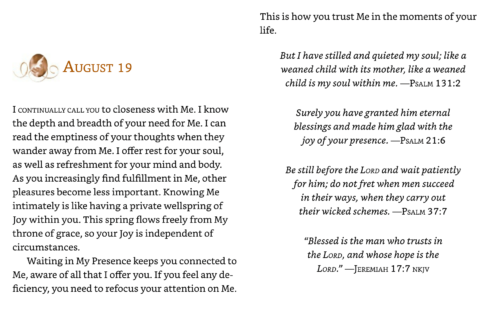
Sarah Young: Jesus Calling…
COME
TO ME. Come to Me. Come to Me. This is My continual invitation to you,
proclaimed in holy whispers. When your heart and mind are quiet, you can hear
Me inviting you to draw near. Coming close to Me requires no great effort on
your part; it is more like ceasing to resist the magnetic pull of My Love. Open
yourself to My loving Presence so that I may fill you with My fullness. I want
you to experience how wide and long and high and deep is My Love for you so
that you can know My Love that surpasses knowledge. This vast ocean of Love
cannot be measured or explained, but it can be experienced.
REVELATION
22:17; 17The Spirit and the bride say, “Come!” And let the
one who hears say, “Come!” Let the one who is thirsty come; and let
the one who wishes take the free gift of the water of life.
JOHN
6:37; Everyone the Father gives Me will come to Me, and the one who
comes to Me I will never drive away. All those the Father gives me will come to
me, and whoever comes to me I will never drive away. However, those the Father
has given me will come to me, and I will never reject them.
EPHESIANS
3:16–19; 16 I pray that out of his glorious riches he may strengthen
you with power through his Spirit in your inner being, 17 so that Christ may
dwell in your hearts through faith.
It is
precisely the parts of the body that seem to be the weakest which are the
indispensable ones. (1 Corinthians 12:22)
How
ingeniously you get around the commandment of God in order to preserve your own
traditions! (Mark 7:9)
The epigraphs above are two subtle scriptures
that I hope illustrate both good power and bad power. In the first, Paul
encourages his community to protect and honor those without power. In the
second, Jesus critiques the religious leaders for misusing tradition to enhance
their own power.
If we watch the news, work on a committee, or
observe some marriages, we see that issues of power have not been
well-addressed by most people. When we haven’t experienced or don’t trust our
God-given “power within,” we are either afraid of power or we exert too much of
it over others. Enduring structures of “power over,” like patriarchy, white
supremacy, and rigid capitalism, have limited most individuals’ power for so
long that it is difficult to imagine another way. Only very gradually does
human consciousness come to a selfless use of power, the sharing of power, or
even a benevolent use of power—in church, politics, or families.
Good power is revealed in what Ken Wilber calls “growth hierarchies,” [1] which are needed to protect children, the poor, the entire natural world, and all those without power. Bad power consists of “domination hierarchies” in which power is used merely to protect, maintain, and promote oneself and one’s group at the expense of others. Hierarchies in and of themselves are not inherently bad, but they are very dangerous for ourselves and others if we have not done our spiritual work. Martin Luther King Jr. defined power simply as “the ability to achieve purpose” and insisted that it be used towards the growth of love and justice. He wrote, “It is the strength required to bring about social, political or economic changes. In this sense power is not only desirable but necessary in order to implement the demands of love and justice.” [2]
A prime idea of the Bible, from Genesis to Revelation, is its very straightforward critique of misuses of power. From the very beginning, the Bible undercuts the power of domination and teaches us another kind of power: powerlessness itself. God is able to use unlikely figures who in one way or another are always inept, unprepared, and incapable—powerless in some way. In the Bible, the bottom, the edge, or the outside is the privileged spiritual position. This is why biblical revelation is revolutionary and even subversive. The so-called “little ones” (Matthew 18:6) or the “poor in spirit” (Matthew 5:3), as Jesus calls them, are the only teachable and “growable” ones according to him. Powerlessness, or as we call it, surrender, seems to be God’s starting place, as in Twelve-Step programs. Until we admit that “we are powerless,” Real Power will not be recognized, accepted, or even sought.
Good Power
Despite the many abuses of power documented
throughout history, power itself cannot be inherently bad. In the New
Testament, the Holy Spirit is described as dynamis,
which means power (Acts 10:38; 1 Corinthians 2:5). Jesus tells his disciples before
his Ascension that “You will receive power when the Holy Spirit comes upon you.
Then you will be my witnesses . . . to the very ends of the Earth” (Acts 1:8).
Once we come into contact with the Holy Spirit,
our Inner Source, we become living icons of true, humble, and confident power.
We no longer need to seek “power over” others, because we have discovered the
“power within” and know it is a dignity shared with all of life. [1] This is
ultimately what it means to be a well-grounded person.
Paul states the divine strategy well in Romans
8:16: “God’s Spirit and our spirit bear common witness that we are indeed
children of God.” The goal is a shared knowing and a common power, which is
initiated and given from God’s side, as we see dramatized in the Pentecost
event (Acts 2:1–13). To span the infinite gap between the divine and the human,
God’s agenda is to plant a little bit of God, the Holy Spirit, right inside of
us (John 14:16–17; Romans 8:9, 11; 1 Corinthians 3:16). Yet, as many have said,
the Holy Spirit is still the “lost” or undiscovered person of the Trinity. If
we have not made contact with our true power, the Indwelling Spirit, we will
seek power in all the wrong places.
I want to repeat that power, in and of itself, is not bad. It simply needs to be redefined as something larger than domination or force. If the Holy Spirit is power, then power has to be good, loving, and empowering, not something that is the result of ambition or greed. In fact, a truly spiritual woman, a truly whole man, is a very powerful person. If we do not name the good meaning of power, we will be content with the bad, or we will avoid claiming our own powerful vocations. What is needed, Martin Luther King Jr. wrote, “is a realization that power without love is reckless and abusive and that love without power is sentimental and anemic. Power at its best is love implementing the demands of justice.” [2]
King further wrote, “If we want to turn over a new leaf and really set a new humanity afoot, we must begin to turn humankind away from the long and desolate night of violence [caused bydomination and power over others]. May it not be that the new humanity the world needs is the nonviolent human? . . . This not only will make us new people, but will give us a new kind of power. . . . It will be power infused with love and justice, that will change dark yesterdays into bright tomorrows, and lift us from the fatigue of despair to the buoyancy of hope.” [3]
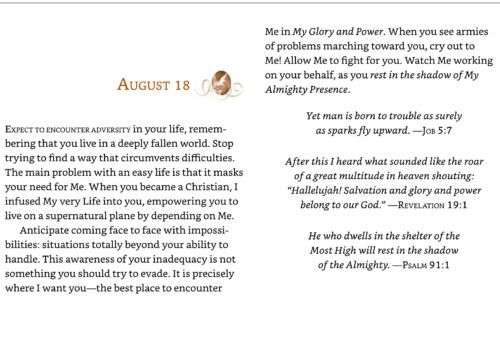
Sarah Young
WEAR MY ROBE OF RIGHTEOUSNESS with ease. I custom-made it
for you, to cover you from head to toe. The price I paid for this covering was
astronomical—My own blood. You could never purchase such a royal garment, no
matter how hard you worked. Sometimes you forget that My righteousness is a
gift, and you feel ill at ease in your regal robe. I weep when I see you
squirming under the velvety fabric, as if it were made of scratchy sackcloth. I
want you to trust Me enough to realize your privileged position in My kingdom.
Relax in the luxuriant folds of your magnificent robe. Keep your eyes on Me as
you practice walking in this garment of salvation. When your behavior is
unfitting for one in My kingdom, do not try to throw off your royal robe.
Instead, throw off the unrighteous behavior. Then you will be able to feel at
ease in this glorious garment, enjoying the gift I fashioned for you before the
foundation of the world.
ISAIAH 61:10; I delight greatly in the LORD; my soul
rejoices in my God. For he has clothed me with garments of salvation and
arrayed me in a robe of his righteousness, as a bridegroom adorns his head like
a priest, and as a bride adorns …
2 CORINTHIANS 5:21; God made him who had no sin to be sin
for us, so that in him we might become the righteousness of God.
EPHESIANS 4:22–24; that you () put off,
concerning your former conduct, the old man which grows corrupt according to
the deceitful lusts, 23 and () be renewed in the spirit of your mind, 24 and that you () put on the new man which was created …
Young, Sarah. Jesus Calling Morning
and Evening Devotional (Jesus Calling®) (p. 458). Thomas Nelson. Kindle
Edition.
When someone you love very much dies, the sky falls. And so you walk around under a fallen sky. —Mirabai Starr, Caravan of No Despair
My dear friend Mirabai Starr has suffered many losses in her life, including that of her fourteen-year-old daughter Jenny, which Mirabai writes about with profound vulnerability and wisdom.
There is no map for the landscape of loss, no established itinerary, no cosmic checklist, where each item ticked off gets you closer to success. You cannot succeed in mourning your loved ones. You cannot fail. Nor is grief a malady, like the flu. You will not get over it. You will only come to integrate your loss. . . . The death of a beloved is an amputation. You find a new center of gravity, but the limb does not grow back.
Richard here: Death cannot be dealt with through quick answers, religious platitudes, or a stiff upper lip. Grief is not a process that can be rushed but must be allowed to happen over time and in its own time. Mirabai recounts that the most important step she took was giving herself permission to mourn in the first place:
With reticence at first, and then with mounting courage, I dared to mourn my child. From the very beginning I suspected that something holy was happening and that if I were to push it away, I would regret it for the rest of my life. There was this sense of urgency, as if turning from death meant turning from my child. I wanted to offer Jenny the gift of my commitment to accompany her on her journey away from me, even if to do so simply meant dedicating my heartbeat and my breath to her and paying attention.
And so I showed up.
When a feeling I did not think I could survive would threaten to engulf me, I practiced turning toward it with the arms of my soul outstretched, and then my heart would unclench a little and make space for the pain. Years of contemplative practice had taught me just enough to know better than to believe everything I think—how to shift from regretting the past and fearing the future to abiding with what is. In this case, a totally [messed up] thing. The ultimate [messed up] thing. I sat with that.
I did not engage in this practice to prove something to myself or anyone else. I was not interested in flexing my spiritual muscles. I did it for Jenny. My willingness to stay present through this process was an act of devotion. By leaning into the horror and yielding to the sorrow, by standing in the fire of emptiness and saying yes to the mystery, I was honoring my child and expressing my ongoing love for her. It was not mere mindfulness practice; it was heartfulness practice.
Every individual has their own journey through grief and loss. Mirabai is an example of how we can courageously face and feel our grief in a way that honors the gift of life we have been given.
The human instinct is to block suffering and pain. This is especially true in the West where we have been influenced by the “rationalism” of the Enlightenment. As anyone who has experienced grief can attest, it isn’t rational. We really don’t know how to hurt! We simply do not know what to do with our pain.
The great wisdom traditions are trying to teach us that grief isn’t something from which to run. It’s a liminal space, a time of transformation. In fact, we can’t risk getting rid of the pain until we’ve learned what it has to teach us and it—grief, suffering, loss, pain—always has something to teach us! Unfortunately, most of us, men especially, have been taught that grief and sadness are something to repress, deny, or avoid. We would much rather be angry than sad.
Perhaps the simplest and most inclusive definition of grief is “unfinished hurt.” It feels like a demon spinning around inside of us and it hurts too much, so we immediately look for someone else to blame. We have to learn to remain open to our grief, to wait in patient expectation for what it has to teach us. When we close in too tightly around our sadness or our grief, when we try to fix it, control it, or understand it, we only deny ourselves its lessons.
Saint Ephrem the Syrian (303–373), a Doctor of the Church, considered tears to be sacramental signs of divine mercy. He instructs: “Give God weeping, and increase the tears in your eyes; through your tears and [God’s] goodness the soul which has been dead will be restored.” [1] What a different kind of human being than most of us! In the charismatic circles in which I participated in my early years of ministry, holy tears were a common experience. Saints Francis and Clare of Assisi reportedly wept all the time—for days on end!
The “weeping mode” really is a different way of being in the world. It’s different than the fixing, explaining, or controlling mode. We are finally free to feel the tragedy of things, the sadness of things. Tears cleanse the lens of the eyes so we can begin to see more clearly. Sometimes we have to cry for a very long time because our eyes are so dirty that we’re not seeing truthfully or well at all. Tears only come when we realize we can’t fix it and we can’t change it. The situation is absurd, it’s unjust, it’s wrong, it’s impossible. She should not have died; he should not have died. How could this happen?Only when we are led to the edges of our own resources are we finally free to move to the weeping mode.
The way we can tell our tears have cleansed us is that afterwards we don’t need to blame anybody, even ourselves. It’s an utter transformation and cleansing of the soul, and we know it came from God. It is what it is, and somehow God is in it.
In the Hebrew Scriptures, we find Job moving
through Elisabeth Kübler-Ross’s well-known stages of grief and dying: denial,
anger, bargaining, resignation, and acceptance. The first seven days of Job’s
time on the “dung heap” of pain are spent in silence, the immediate response
matching the first stage—denial. Then he reaches the anger stage, verses in the
Bible in which Job shouts and curses at God. He says, in effect, “This
so-called life I have is not really life, God, it’s death. So why should I be
happy?”
Perhaps some of us have been there—so hurt and
betrayed, so devastated by our losses that we echo Job’s cry about the day he
was born, “May that day be darkness. May God on high have no thought for it,
may no light shine on it. May murk and deep shadow claim it for their own” (Job
3:4–5). It’s beautiful, poetic imagery. He’s saying: “Uncreate the day. Make it
not a day of light, but darkness. Let clouds hang over it, eclipse swoop down
on it.” Where God in Genesis speaks “Let there be light,” Job insists “Let
there be darkness.” The day of uncreation, of anti-creation. We probably have
to have experienced true depression or betrayal to understand such a feeling.
W. H. Auden expressed his grief in much the
same way in his poem “Funeral Blues,” which ends with these lines:
The stars are
not wanted now: put out every one,
Pack up the moon and dismantle the sun,
Pour away the ocean and sweep up the woods;
For nothing now can ever come to any good. [1]
There’s a part of each of us that feels and
speaks that sadness. Not every day, thank goodness. But if we’re willing to
feel and participate in the pain of the world, part of us will suffer that kind
of despair. If we want to walk with Job, with Jesus, and in solidarity with
much of the world, we must allow grace to lead us there as the events of life
show themselves. I believe this is exactly what we mean by conformity to
Christ.
We must go through the stages of feeling, not
only the last death but all the earlier little (and not-so-little) deaths. If
we bypass these emotional stages by easy answers, all they do is take a deeper
form of disguise and come out in another way. Many people learn the hard way—by
getting ulcers, by all kinds of internal diseases, depression, addictions,
irritability, and misdirected anger—because they refuse to let their emotions
run their course or to find some appropriate place to share them.
I am convinced
that people who do not feel deeply finally do not know deeply
either. It is only because Job is willing to feel his emotions that he is able
to come to grips with the mystery in his head and heart and gut. He understands
holistically and therefore his experience of grief becomes both whole and holy.
Vulnerability: A Divine Condition
We live in a finite world where everything is
dying, shedding its strength. This is hard to accept, and all our lives we look
for exceptions to it. We look for something certain, strong, undying, and
infinite. Religion tells us that the “something” for which we search is God.
But many of us envisioned God as strong, complete, and all-powerful—a God
removed from suffering. In Jesus, God comes along to show us: “Even I suffer.
Even I participate in the finiteness of this world.”
After two thousand years, Jesus is still a
revolutionary symbol, revelation, and reality. He turned theology upside down
and taught, in effect: God is
not who you think God is. The enfleshment and suffering of Jesus
reveals that God is not apart from the trials of humanity. God is not aloof.
God is not a spectator. God is not merely tolerating human suffering or
instantly just healing it. God
is participating with us in it. Living it alongside us and with us.
That is what gives us eternal purpose and hope. Like Job, we sometimes feel as
if our flesh is being torn off and yet we do not die (Job 19:26). Through
encountering the Living God in our pain, we can experience another kind of
life, another kind of freedom.
Pain and beauty constitute the two faces of
God. On the one hand we are attracted to the unbelievable beauty of the divine
reflected in the beauty of human beings and the natural world. On the other
hand, brokenness and weakness also mysteriously pull us out of ourselves. We
feel them both together.
Only vulnerability forces us beyond ourselves.
Whenever we see true pain, most of us are drawn out of our own preoccupations
and want to take away the pain. For example, when we rush toward a hurting
child, we also rush toward the suffering God. We want to take the suffering in
our arms. That’s why so many saints wanted to get near suffering—because as
they said again and again, they meet Christ there. It “saved” them from their
smaller untrue self.
My friend the Rev. Dr. Jacqui Lewis preaches
about the gift of this two-fold path:
I think grief puts us in touch with our vulnerabilities. I think the feeling of grief lets us know the power of wounds to shape our stories. I think it lets us know how capable we are of having our hearts broken and our feelings hurt. I think it lets us know the link that we each have because we’re human. Because we’re human, we hurt. Because we’re human, we have tears to cry. Because we’re human, our hearts are broken. Because we’re human, we understand that loss is a universal language. Everybody grieves. All of humanity grieves. All of us have setbacks, broken dreams. All of us have broken relationships or unrealized possibilities. All of us have bodies that just don’t do what they used to do. Though grief is personal, every person grieves. [1]
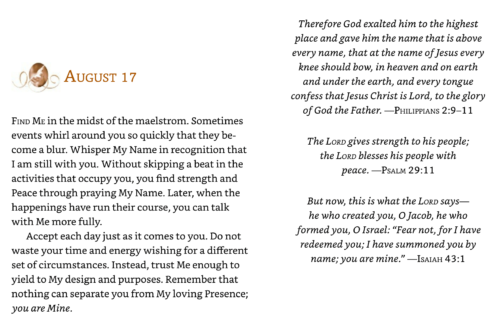
Sarah Young….
BRING ME THE SACRIFICE OF YOUR TIME: a most precious
commodity. In this action-addicted world, few of My children take time to sit
quietly in My Presence. But for those who do, blessings flow like streams of
living water. I, the One from whom all blessings flow, am also blessed by our
time together. This is a deep mystery; do not try to fathom it. Instead,
glorify Me by delighting in Me. Enjoy Me now and forever!
PSALM 21:6; For You grant him blessings forever; You
cheer him with joy in Your presence. Surely you have granted him unending
blessings and made him glad with the joy of your presence. You have endowed him
with eternal blessings and given him the joy of your presence.
JOHN 7:37–38; And let anyone drink 38 who believes in
me.” As Scripture has said, “Out of him (or them) will flow rivers of living
water.” New International Version (NIV)
PSALM 103:11; For as the heaven is high above the –
Bible Gateway For as the heaven is high above the earth, so great is his mercy
toward them that fear him. For as the heaven is high above the earth, so great
is his mercy toward them that fear him.
PSALM 34:3; O magnify the Lord with me The psalmist
invites the humble ones, who he knew would rejoice at the goodness of God to
him, to join with him in ascribing greatness to the Lord, which is meant by
magnifying him; for he cannot be made great by men, only declared how great he
is, and that can only be done in an imperfect manner;
Young, Sarah. Jesus Calling Morning and Evening
Devotional (Jesus Calling®) (p. 444). Thomas Nelson. Kindle Edition.
My fellow
Albuquerque resident Megan McKenna is an author, storyteller, and theologian
who challenges us to imitate Jesus. She writes of the importance of translation
when it comes to understanding the meaning of Jesus’ words:
The blessings and woes have
so much depth and latitude, so many layers of meaning that are unveiled
throughout the gospel of Luke, especially in the parables. Even the meaning of
the word beatitude is rich and complex when seen from different perspectives. .
. . [In Elias Chacour’s book We Belong to the Land] there is a marvelous
description of a beatitude that enhances our understanding of what Jesus means
when he says “blessed are you.”
Knowing Aramaic, the language of Jesus, has greatly enriched my understanding of Jesus’ teaching. Because the Bible as we know it is a translation of a translation, we sometimes get a wrong impression. For example, we are accustomed to hearing the Beatitudes expressed passively:
Blessed are those who hunger
and thirst for justice, for they shall be satisfied.
Blessed are the merciful,
for they shall obtain mercy.
Blessed are the pure in
heart, for they shall see God.
Blessed are the peacemakers,
for they shall be called children of God.
“Blessed” is
the translation of the word makarioi, used in the Greek New Testament. However,
when I look further back to Jesus’ Aramaic, I find that the original word was ashray,
from the verb yashar.
Ashray does not have this passive quality to it at all. Instead, it
means “to set yourself on the right way for the right goal; to turn around,
repent.”. . .
How could I go to a
persecuted young man in a Palestinian refugee camp, for instance, and say,
“Blessed are those who mourn, for they shall be comforted,” or “Blessed are
those who are persecuted for the sake of justice, for theirs is the kingdom of
heaven”? That man would revile me, saying neither I nor my God understood his
plight and he would be right.
When I understand Jesus’
words in Aramaic, I translate like this:
Get up, go ahead, do something, move, you who are hungry and thirsty for justice, for you shall be satisfied.
Get up, go ahead, do something, move, you peacemakers, for you shall be called children of God.
To me this reflects Jesus’
words and teachings much more accurately. I can hear him saying: “Get your
hands dirty to build a human society for human beings; otherwise, others will
torture and murder the poor, the voiceless, and the powerless.” Christianity is
not passive but active, energetic, alive, going beyond despair. . . .
“Get
up, go ahead, do something, move,” Jesus said to his disciples. [1]
Megan McKenna concludes:
The beatitudes mean deeper mercy for those who experience more divisive misery, deeper blessings for those whose hope is dimmest. They give an ultimate authority to certain people and their plight in the world. They signify not just a religious attitude, but a social attitude toward realities that should not exist among humans.
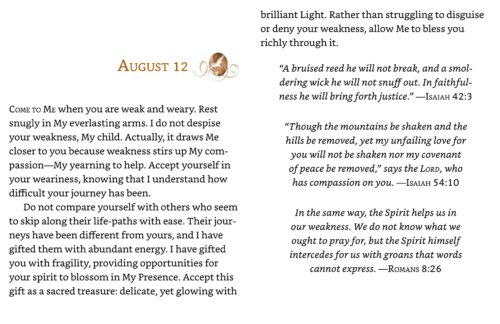
Sara Young
REST IN MY PRESENCE WHEN you need refreshment.
Resting is not necessarily idleness, as people often perceive it. When you
relax in My company, you are demonstrating trust in Me. Trust is a rich word,
laden with meaning and direction for your life. I want you to lean on, trust,
and be confident in Me. When you lean on Me for support, I delight in your
trusting confidence. Many people turn away from Me when they are exhausted.
They associate Me with duty and diligence, so they try to hide from My Presence
when they need a break from work. How this saddens Me! As I spoke through My
prophet Isaiah: In returning to Me and resting in Me you shall be saved; in
quietness and trust shall be your strength.
PSALM 91:1; He that dwelleth in the secret
place of the most High shall abide under the shadow of the Almighty.”
PROVERBS 3:5 AMP; Trust in and rely
confidently on the LORD with all your heart And do not rely on your own insight
or understanding.
ISAIAH 30:15 AMP; This is what the Sovereign
LORD, the Holy One of Israel, says: “In repentance and rest is your
salvation, in quietness and trust is your strength, but you would have none of
it.
Young,
Sarah. Jesus Calling Morning and Evening Devotional (Jesus Calling®) (p. 418).
Thomas Nelson. Kindle Edition.
This CO2- (Church Of 2) is where two guys meet each day to tighten up our Connections with Jesus. We start by placing the daily “My Utmost For His Highest” in this WordPress blog. Then we prayerfully select some matching worship music and usually pick out a few lyrics that fit especially well. Then we just start praying and editing and Bolding and adding comments and see where the Spirit takes us.
It’s been a blessing for both of us.
If you’d like to start a CO2, we’d be glad to help you and your partner get started. Also click the link below to see how others are doing CO2.Odds Monkey
Steve Harvey Introduces Jesus To A Secular Audience
About
Change this text in the admin section of WordPress
You are currently browsing the CO2MannaToday blog archives.