If we are granted this first stage of Order (and not all are),
we feel innocent and safe. Everything is basically good, it all means
something, and we feel a part of what looks normal and deserved. It is our
“first naïveté.” Everything has an explanation, and thus feels like it is
straight from God, solid, and forever. This is probably why we are so reluctant
to relinquish our innocence; it often feels like a loss of faith.
Most
worldviews have encouraged this perspective. We, in the United States, are a “first
half of life culture,” largely concerned about surviving successfully. Probably
most cultures and individuals across history have been situated in the first
half or “Order” stage, because it is all they had time for. We try to do what
seems like the task that life first hands us: establishing an identity, a home,
relationships, friends, community, security, and building a proper platform for
our only life.
But
this is only the first task! When we try to stay in this first satisfying
explanation of how things are, we tend to avoid any conflict, inconsistencies,
suffering, or darkness and therefore opportunities for transformation. The
familiar and habitual are so falsely reassuring, we make our homes there
permanently. The ego believes that disorder or change is always to be avoided,
so we hunker down and pretend that our
Order is entirely good, should be good for
everybody, and is always “true” and even the only truth. The new is always by
definition unfamiliar and untested, so God, life, destiny, suffering have to
give us a push—usually a big one—or we will not go. Even many Christians do not
like anything that looks like “carrying the cross,” no matter how piously they
use the phrase.
Most
of us are never told that we can set out from the known and familiar to take on
a further journey. Our institutions, including our churches, and our
expectations are almost entirely configured to encourage, support, reward, and
validate the tasks of the first half of life. We are more struggling to survive
than to thrive, more just “getting through” or trying to get to the top than
finding out what is really at the top or even at the bottom.
Most of us in the first half of life suspect that all is not fully working, and we are probably right! Many, if not most, will settle for first-stage survival, and never get to “the unified field” of life itself. As Bill Plotkin, a wise guide, puts it, many of us learn to do our “survival dance,” but we never get to our actual “sacred dance.”
A sense of wonder and awe is the foundation of religion. Too often we associate religion with belonging to a church or professing certain beliefs, but the religious instinct is so much broader than that. Sikh activist and human rights lawyer Valarie Kaur teaches us that awe and wonder can make us available to greater depths of compassion, union, and love.
Wonder is our birthright. It comes easily in childhood—the feeling of watching dust motes dancing in sunlight, or climbing a tree to touch the sky, or falling asleep thinking about where the universe ends. If we are safe and nurtured enough to develop our capacity to wonder, we start to wonder about the people in our lives, too—their thoughts and experiences, their pain and joy, their wants and needs. We begin to sense that they are to themselves as vast and complex as we are to ourselves, their inner world as infinite as our own. In other words, we are seeing them as our equal. We are gaining information about how to love them. Wonder is the wellspring for love. . . .
The call to love beyond our own flesh and blood is ancient. It echoes down to us on the lips of indigenous leaders, spiritual teachers, and social reformers through the centuries. [The founder of Sikhism] Guru Nanak called us to see no stranger, Buddha to practice unending compassion, Abraham to open our tent to all, Jesus to love our neighbors, Muhammad to take in the orphan, [Hindu mystic saint] Mirabai to love without limit. They all expanded the circle of who counts as one of us, and therefore who is worthy of our care and concern. These teachings were rooted in the linguistic, cultural, and spiritual contexts of their time, but they spoke of a common vision of our interconnectedness and interdependence. . . .
What has been an ancient spiritual truth is now increasingly verified by science: We are all indivisibly part of one another. We share a common ancestry with everyone and everything alive on earth. The air we breathe contains atoms that have passed through the lungs of ancestors long dead. Our bodies are composed of the same elements created deep inside the furnaces of long-dead stars. We can look upon the face of anyone or anything around us and say—as a moral declaration and a spiritual, cosmological, and biological fact: You are a part of me I do not yet know.
But you don’t have to be religious in order to open to wonder. You only have to reclaim a sliver of what you once knew as a child. If you remember how to wonder, then you already have what you need to learn how to love.
Matter
is the common, universal, tangible setting, infinitely shifting and varied, in
which we live. . . . By matter we are nourished, lifted up, linked to
everything else, invaded by life. —Teilhard de
Chardin
The physical
structure of the universe is love. —Teilhard de
Chardin
For Pierre
Teilhard de Chardin (1881–1955), a French Jesuit priest who trained as a
paleontologist and geologist, love is at the physical heart of the universe. He
viewed love as the attraction of all things toward all things. We could say
that love is the universalordering
principle. In this passage from Liberation and the Cosmos, CAC faculty member Dr. Barbara Holmes imagines a
conversation between Civil Rights lawyer and educator Barbara Jordan
(1936–1996) and Supreme Court Justice Thurgood Marshall (1908–1993). It
captures the essence of what is good and possible about Order—in both the laws
of cosmos and the land.
Marshall:
How about this, Barbara? Suppose, just for argument’s sake, that we consider
the law to be a reflection of the order of the cosmos? Although there is chaos
and synchronicity, there is also the potential for creative genesis.
Jordan:
I remember reading the work of Teilhard de Chardin, a Jesuit priest, mystic,
and paleontologist who did a good deal of work on consciousness and the laws of
the universe. . . .
The
laws of nations give clues as to the state of mind of a populace, and sometimes
they provide a history of our processive movement toward our highest good. That’s
all of the science that I know. But from what I understand, there are laws of
the universe as well as laws of nation-states. Matter and spirit are
intertwined so that the “quanta of matter and spirit that once permeated the
early universe become fibers of matter influenced by gravity and threads of
spirit drawn by love.” [1] . . .
Marshall:
Let me say a few cosmological things. While our laws are in place to prevent,
proscribe, and punish, the laws of the universe seem to be focused on
connection, attraction, and a cosmic holding mechanism. . . . Where was
Teilhard when I needed him? The idea that we are connected to a future good,
and moving toward something better, would have been a breath of fresh air . . .
. Now that I am on this side of the continuum, I’m certain that the trajectory
of human life is toward mutuality and care of self and neighbor. [2]
I wish more of us understood and accepted the “laws of the universe,” which include disruption, dynamism and evolution, instead of clinging so tightly to the “law and order” of church and country. Jesus himself indicated that “heavenly” and “human” laws are not on equal footing. He refused to enforce or even bother with what he considered secondary issues like ritual laws, purity codes, and membership requirements. He regarded them as human commandments, which far too often took the place of love (see Matthew 15:3, 6‒9).
From Innocence to Knowledge Tuesday, August 11, 2020
Many Christians look to the Garden of Eden as the ultimate example of Order. While we can certainly mourn the suffering, it doesn’t do us any good to regret “the Fall.” It had to happen; failure is part of the deal! If Christ is theLogos, the blueprint for all creation, then God has always had our growth and salvation in mind. In this passage, theologian and mystic Rev. Howard Thurman (1900–1981) explores the creative tension that exists between innocence and knowledge, each honoring the other.
The setting is the Garden of Eden. Adam and Eve are the central figures in an idyllic surrounding. All is peaceful. All is innocent. They are told by God that they are free to do anything except one thing. They are forbidden to eat the fruit of the tree of knowledge which grows in the midst of the garden [Genesis 2:16–17]. For if they eat of the fruit they shall be driven from the garden and from that day forward they shall be responsible for their own lives. They eat of the fruit; they are driven out of the garden; they become responsible for their own lives. With the coming of knowledge, they have lost their innocence.
The transition from innocence to knowledge is always perilous and fraught with hazard. There is something very comforting and reassuring about innocence. To dwell in innocence is to inhabit a region where storms do not come and where all the breezes are gentle and balmy. It is to live in the calm of the eye of the hurricane. It is to live in a static environment which makes upon the individual no demands other than to be. All else is cared for; is guaranteed.
But when knowledge comes, the whole world is turned upside down. The meaning of things begins to emerge. And more importantly, the relations between things are seen for the first time. Questions are asked and answers are sought. A strange restlessness comes over the spirit and the enormity of error moves over the horizon like a vast shadow. Struggle emerges as the way of life. An appetite is awakened that can never be satisfied. A person becomes conscious of himself; the urge to know, to understand, to find answers, turns inward. Every estimate of others becomes a question of self-estimate, every judgment upon life becomes a self-judgment. The question of the meaning of one’s self becomes one with the meaning of life.
This process of moving from innocence to knowledge is never finished. Always there is the realm of innocence, always there is some area of innocence untouched by knowledge. The more profound the growth of knowledge, the more aware the individual becomes of the dimensions of innocence. Pride in knowledge is always tempered by the dominion of innocence.
Thurman offers here a wonderful description of the first stage of Order and a poetic, accurate account of early forays into Disorder. Surely moving between these two polarities is part of the Divine Dance. my body? What is mine to do?
Story from Our Community: My husband has a diagnosis of “Moderate Cognitive Decline,” probably heading towards Alzheimer’s. Richard’s meditations have helped me rise above my personal grief, anger, and resentment. When I find myself feeling inconvenienced by all the things I now have to do because my husband no longer can, I am reminded of how strong and skilled God has made me. This must be one of the gates through which I am passing on my way to more closely aligning myself with the nature of the Universal Christ. —Linda F.
Law, tradition, and boundaries—what I call Order—seem to be necessary in any spiritual system both to
reveal and to limit our basic egocentricity. Such containers make at least some
community, family, and marriage possible. Boundaries seem to be the only way
that human beings can find a place to stand, a place to begin, a place from
which to move out. Even those who think they don’t have any boundaries usually
do. We discover them when we trespass against them. The human soul flourishes
on solid ground, especially in the first years of life.
As
Paul belabors in his Letter to the Romans (see especially chapters 2–7), the
law is given for the sake of information, education, and transformation, but is
not itself enlightenment. Even though allegiance to boundaries, limits, and
laws is almost universally confused with religion and even salvation itself,
“the law will not save anyone” (Galatians 3:11). Law has to do with the pattern
of how transformation happens—and that’s all. The struggle with boundaries and
law creates the wrestling ring, but is not, itself, the encounter or the
victory.
Human
beings seem to need to fight and engage with something before they can take it
seriously—and before they can discover what they really need or want. The
people who never fight religion, guilt, parents, injustice, friends, marriage
partners, and laws usually don’t respect their own power, importance, and
freedom. They remain content with the external values of the first “lawful”
container, instead of working to discover their own.
I
am trying to hold us inside a very creative tension, because both law and
freedom are necessary for spiritual growth, as Paul says in both Romans and
Galatians. He learned this from Jesus, who says seven times in a row, “The law
says . . . but I say” (Matthew 5:21–48), while also assuring us that he “has
not come to throw out the law but to bring it to completion” (5:17). Despite
having been directly taught to hold this creative tension, rare is the
Christian believer who holds it well.
The psyche
cannot live with everything changing every day, everything a matter of opinion,
everything relative. There must be a sound container holding us long enough so
we can move beyond survival mode. There has to be solid ground, trust, and
shared security, or we cannot move outward. There has to be a foundational
hope, and for hope to be a shared experience there must be agreed-upon meanings
and shared stories that excite and inspire us all. If there are truly stories
from the great patterns that are always true, they will catapult us into a
universal humanity and pluralistic society. We will both stand on solid ground
and, from that solid ground, create common ground. If it does not support our movement outward, then it is
not solid ground at all.
Order, Disorder, Reorder: Part One
The
Universal Pattern
Sunday, August 9, 2020
It seems quite clear that we grow by passing beyond some
perfect Order, through an often painful
and seemingly unnecessary Disorder, to an enlightened Reorder or resurrection.
This is the universal pattern that connects and solidifies our relationships
with everything around us. This week’s meditations focus on Order, the first in the sequence. We will take a closer look
at Disorder and Reorder in the following two weeks.
The
trajectory of transformation and growth, as I see the great religious and
philosophical traditions charting it, uses many metaphors for this pattern. We
could point to the classic “Hero’s Journey” charted by Joseph Campbell; the
Four Seasons or Four Directions of most Native religions; the epic accounts of
exodus, exile, and Promised Land of the Jewish people, followed by the cross,
death, and resurrection narrative of Christianity. Each of these deeply rooted
“myths,” in its own way, is saying that growth happens in this full sequence. To
grow toward love, union, salvation, or enlightenment, we must be moved from Order to Disorder and then
ultimately to Reorder.
A
sense of order is the easiest and most natural way to begin; it is a needed
first “container.” I cannot think of a culture in human history, before the
present postmodern era, that did not value law, tradition, custom, family
loyalties, authority, boundaries, and morality of some clear sort. While they
aren’t perfect, these containers give us the necessary security, predictability,
impulse control, and ego structure that we need, before the chaos of real life
shows up. As far as I can see it, healthily conservative people tend to grow up
more naturally and more happily than those who receive only freeform,
build-it-yourself worldviews.
We
need a very strong container to hold the contents and contradictions that
arrive later in life. We ironically need a very strong ego structure to let go
of our ego. We need to struggle with the rules more than a bit before we throw
them out. We only internalize values by butting up against external values for
a while. All this builds the strong self that can positively follow Jesus—and
“die to itself.” [1]
In our time,
many people are questioning and rejecting the institutions, churches, and
authority figures that have long provided stability. Looking to the perennial
tradition, which has held up over time, can help create a positive “container.”
We cannot each start at zero, entirely on our own. Life is far too short, and
there are plenty of mistakes we do not need to make—though, of course, there
are some that we need to make. We are parts of social and family ecosystems
that, when they are rightly structured, keep us from falling. More importantly,
these systems show us how to fall and how to learn from that very falling.
Matthew Fox has studied, written, and taught on theology
and the mystics for decades. In one of his books on Meister Eckhart, Fox
writes:
In the soul,
Eckhart maintains, there is “something like a spark of divine nature, a divine
light, a ray, an imprinted picture of the divine nature.” [1] . . . But we have
to make contact with this divine spark by emptying ourselves or letting go. And
then we will know the unity that already exists. [2]
Indian-born
teacher Eknath Easwaran (1910–1999) puts it in similar terms:
Life’s real and
highest goal . . . [is] to discover this spark of the divine that is in our
hearts. . . . When we realize this goal, we discover simultaneously that the
divinity within ourselves is one and the same in all—all individuals, all
creatures, all of life. [3]
Meister
Eckhart was frequently criticized by his contemporaries (and still is by some
people today) because his language was far too unitive. We like our
distinctions! We don’t want to hear that we have the same soul as our enemies,
not our personal ones and certainly not our cultural or global ones! We want to
hate them, don’t we? And far too often our religion seemingly gives us
permission to do so. But mystics don’t hate anyone. They simply can’t. They
pray, as Jesus does on the cross, “Father forgive them, they do not know what
they are doing” (Luke 23:34). The mystic knows the other person doesn’t know.
It’s not malice as much as ignorance and unawareness. And, of course, it’s a
burden to know; it’s a responsibility to know, because once we know that God
has inhabited all that God has created, then all of our distinctions are silly.
They are just ways to create self-importance and superiority for ourselves and
put down someone else. We’ve played this game since grade school!
Mysticism
begins when we start to make room for a completely new experience of God as
immanent, present here and now, with and within all of us. God isn’t only
transcendent, “out there,” and separate from me. Augustine of Hippo (354–430)
wrote that God is “more intimate to me than I am to myself.” [4] St. Catherine
of Genoa (1447–1510) said, “My me is God: nor do I know my selfhood except in
God.” [5] Like all mystics, they overcame the gap, and we can too. When God is
no longer out there or over there, we have begun the mystical journey. It’s not
simply that we have a new relationship with God. It’s as though we have a whole
new God!
That’s what Meister Eckhart meant when he said, “Let us pray to God that we may be free of God.” [6] That’s not sacrilege; that’s a beautifully humble prayer because we know that our present notion of God is never all God is. As Augustine boldly stated, “Si enim comprehendis, non est Deus” (“If we comprehend it, it is not God”). [7] Our present experience is never enough, but it is gratefully where we begin, and these mystics teach us that we grow with each experience of God.
An image is not of itself, nor is it for itself. It rather springs from the thing whose reflection it is and belongs to it with all its being. It owes nothing to a thing other than that whose image it is; nothing else is at its origin. An image takes its being immediately from that of which it is the image and has one sole being with it, and it is that same being. —Meister Eckhart
Sometimes it takes a mystic to translate another mystic for the rest of us. My dear friend, CAC faculty member, and modern mystic James Finley helps us understand Eckhart’s words. A slow, prayerful reading of this brilliant text will deepen your own insight:
[Meister Eckhart] says that the generosity of the Infinite is infinite and [that God] gives [God’s self] away as the reality of all things. And he says that our sorrow is that we do not know that we are the generosity of God. . . .
This is a paraphrase of Eckhart: Imagine you’re standing before a full-length mirror, and imagine the image of you is conscious, that it can think. And this image of you has been through a lot of therapy; it’s taken a lot of courses on being an insightful image. And it has come to a point in which it informs you that it doesn’t need you.
You say to the image of you, “Well, you know, this is going to be rough, really, since you’re an image of me.”
“No,” the image says, [after a pause], “I’ve worked on this; I’ve come to this point.”
And so, to gently help the image out, you step halfway off the side of the mirror; and half the image disappears. The image has a panic attack and goes back into therapy and says to the therapist, “I’m not real! I’m not real! I was working on my affirmations. I bolstered up my confidence, but I don’t know where I went. I buckled!”
Now, the image was real, but the image wasn’t real in the way that it thought it was real. It was real, but not real without you. It was real as an image of you. See?
Eckhart says, “The image owes no allegiances to anything except that of which it is the image.”. . . There is nothing that has the authority to say what it is except that of which it is the image. And so it is with us, Eckhart says, that we are the image of God. Without God, we are nothing, absolutely nothing. In being the image of God, we owe no allegiances to anything but the Infinite Love in whose image we are made. And the idolatry of diversions of the heart where we wander off into cul-de-sacs with the imagined authority of anything less or other than Infinite Love to name who we are: this is the problem.
Another of the Rhineland Mystics was
Meister Eckhart. His writings were probably the height of Western nondualism.
Carl McColman has written several accessible books on the Christian mystics
that broaden and deepen our notion of mysticism. He even makes a mystic like
Meister Eckhart understandable! Here McColman captures the essence of Eckhart:
Meister Eckhart stands alongside Bernard of Clairvaux and
John of the Cross as one of the most celebrated Christian mystics; he is also one
of the most controversial figures, having a number of his teachings declared as
heretical shortly after his death. Today, some scholars believe that the
censure of Eckhart’s ideas may have been politically motivated and have made
efforts to have his name formally cleared by the Vatican.
Eckhart entered the Dominican Order as a youth. After
spending some time in Paris, he returned to his native Germany, where he became
renowned as a preacher. [The
Dominicans are the Order of Preachers, and Meister Eckhart was a very popular
homilist in his day.] “Meister” is not his name, but a title,
referring to his receiving a master’s degree in theology. Eckhart’s impressive
body of work includes academic treatises in Latin, along with about one hundred
sermons in his native German. The German writings generally were his more
spiritually daring.
The problem with [reading] Eckhart seems to be that his
ideas were often expressed using language that could easily be misinterpreted.
[I, Richard, believe he was
misinterpreted because he was a nondual thinker, speaking to mostly dualistic
thinkers—just as Jesus was doing.] He has been accused of pantheism
(the belief that all things are God) or monism (the idea that there is
ultimately no distinction between God and creation). [Richard again: I believe Eckhart was
primarily teaching panentheism,
which means God in all
things.] He stressed God as a ground of being present throughout
creation—including in the human soul—and that each Christian is invited to give
birth to Christ within one’s soul. As a preacher, Eckhart saw his sermons as a
means of inspiring his listeners to recognize the divine presence within, and
in so doing to be “wonderfully united” to God. In his Sermon 5, he offers four
goals for his preaching:
When I preach, I
am accustomed to talk about detachment, saying that we should become free of
ourselves and of all things. Secondly, I say that we should be in-formed back
into the simple goodness, which is God. Thirdly, I say that we should be
mindful of the great nobility which God has given the soul in order that we
should become wonderfully united with [God]. Fourthly, I speak of the purity of
the divine nature, and of the radiance within it which is ineffable. God is a
word: an unspoken word. [1] [RR:
Unspoken, that is, until and unless we ourselves speak from the True Self!]
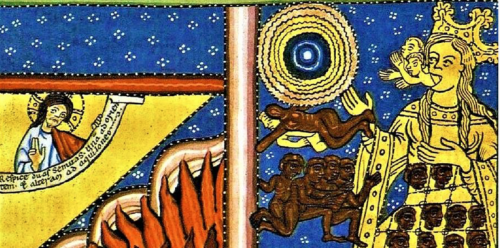
Author, spiritual teacher, friend, and fellow New Mexican Mirabai Starr offers us a bit of the story of Hildegard’s life with implications for our own lives today.
“Speak and write!” the voice from Heaven commanded.
But Hildegard of Bingen, medieval visionary nun, remained silent.
Hildegard was forty-three years old when her visions finally became so insistent that she could no longer contain the secret she had harbored since early childhood: the Holy One, identifying itself as “the Living Light,” spoke to her. It spoke to her regularly, its voice emerging from a swirl of spiraling light. . . .
“Oh mortal, who receives these things not in the turbulence of deception but in the purity of simplicity for making plain the things that are hidden,” the Holy One said that day in 1141, “write what you see and hear.”
It was not doubt that held her back, Hildegard assures us. The voice carried such authority that she was convinced its origin was divine. It was not a case of low self-esteem either, she says, nor a matter of worrying what other people might think. It was, she tells us, simple humility. Who was she, an uneducated woman, to proclaim God’s message to humanity? . . .
[But] the more she resisted, the more seriously ill she became. “Until at last,” she writes in her introduction to the Scivias, the first chronicle of her visions, “compelled by many infirmities . . . I set my hand to writing . . . and rose from my sickness with renewed strength.”. . .
We are not all prophets. It may not be our job to challenge authority and expose corruption. We may not be the ones to penetrate the code of sacred scriptures and feed the spiritually hungry. It may be up to others to sound the clarion call of impending doom, calling on humanity to change its ways.
Ours may be a modest awakening. We may simply refuse to participate for another moment in a life against which our hearts have been crying out for years.
It could be time to observe some version of the commandment to “keep the Sabbath holy” [Exodus 20:8] and begin to cultivate a daily contemplative practice. It could become imperative to curtail a pattern of overconsumption and make a concrete commitment to voluntary simplicity. It could be a matter of identifying the subtle and insidious ways in which we participate in a culture of war and take a vow of nonviolence in everything we do, in every relationship we forge and maintain. . . .
Speak out, Hildegard says. And when you do, when you recognize that inner voice as the voice of God and say what it has taught you, the sickness in your heart will melt away. The fatigue you have lived with for so long that you did not even notice how weary you were will lift. Your voice will ring out with such clarity and beauty that you will not be able to stop singing. To speak your truth, Hildegard teaches us, is to praise God.
Viriditas: The Greening of Things
Monday, August 3, 2020
Hildegard
is not only mystic; she is also prophet. . . . She disturbs the complacent,
deliberately provoking the privileged, be they emperors or popes, abbots or
archbishops, monks or princes to greater justice and deeper sensitivity to the
oppressed. . . . She can rightly be called the “Grandmother of the Rhineland
mystic movement” . . . [which] brought the powers of mysticism to bear not on
supporting the status quo, but on energizing the prophetic in society and
church. For Hildegard, justice plays a dominant role. —Matthew Fox
Throughout
the ages, mystics have kept alive the awareness of our union with God and thus
with everything. What some now call creation spirituality or the holistic
Gospel was voiced long ago by the Desert Fathers and Mothers in Africa, some
Eastern Orthodox Fathers, ancient Celts, many of the Rhineland mystics, and of
course Francis of Assisi. I am sorry to say that many women mystics were not
even noticed. Julian of Norwich (c. 1343–c. 1416) and Hildegard of Bingen
(1098–1179) would be two major exceptions, though even they have often been
overlooked.
Hildegard
wrote in her famous book Scivias: “You understand so little of what is around
you because you do not use what is within you.” [1] This is key to
understanding Hildegard. Without using the word, Hildegard recognized that the
human person is a microcosm with a natural affinity for or resonance with
the macrocosm, which many of us would
call God. We are each “whole” and yet part of a larger Whole. Our little world
reflects the big world. Resonance is the key word here, and contemplation is the key
practice. Contemplation is
the end of all loneliness because it erases the separateness between the
observer and the observed, allowing us to resonate with what is right
in front of us.
Hildegard
spoke often of viriditas, the greening of things from
within, analogous to what we now call photosynthesis. She saw that there was a
readiness in plants to receive the sun and to transform its light and warmth
into energy and life. She recognized that there is an inherent connection
between the Divine Presence and the physical world. This Creator-to-created
connection translates into inner energy that is the soul and seed of every
thing, an inner voice calling us to “become who you are; become all that you
are.” This is our life wish or “whole-making instinct.”
Hildegard is a
wonderful example of someone who lives safely inside an entirely integrated
cosmology. In her holistic understanding of the universe, the inner shows
itself in the outer, and the outer reflects the inner. The individual reflects
the cosmos, and the cosmos reflects the individual. Hildegard sings, “O Holy
Spirit, . . . you are the mighty way in which every thing that is in the
heavens, on the earth, and under the earth, is penetrated with connectedness,
is penetrated with relatedness.” [2] This
is a true, natural, and integrated Trinitarian metaphysics (what is) and
epistemology (how we know what is), both at the same time! Perhaps many Christians overlooked Hildegard’s
genius because we ourselves have not been very Trinitarian.
The Rhineland Mystics
The
Need for Mysticism
Sunday, August 2, 2020
We live in a time of both crisis and
opportunity. While there are many reasons to be anxious, I still have hope.
Westerners, including Christians, are rediscovering the value of nonduality: a
way of thinking, acting, reconciling, boundary-crossing, and bridge-building
based on inner experience of God and God’s Spirit moving in the world. We’re
not throwing out our rational mind, but we’re adding nondual, mystical,
contemplative consciousness. When we have both, we’re able to see more broadly,
deeply, wisely, and lovingly. We can collaborate on creative solutions to
today’s injustices.
I’m glad there’s renewed appreciation in the Christian
tradition for people who modeled such wholeness. This week I’ll turn toward my
own cultural roots in the Rhineland. These mystics were mostly German-speaking
spiritual writers, preachers, and teachers, who lived largely between the 11th
and 15th centuries.
You might already be familiar with the Benedictines,
Hildegard of Bingen (1098–1179) and Gertrude the Great (1256–1302); the Beguine
Mechtild of Magdeburg (c. 1212–c. 1282); the Dominicans, including Meister
Eckhart (c. 1260–1327), Johannes Tauler (c. 1300–1361), and Henry Suso
(1295–1366); and Cardinal Nicholas of Cusa (1401–1464), in what is now
Switzerland. Another Rhineland mystic in recent history who might surprise you
was psychiatrist Carl Gustav Jung (1875–1961). Jung admits to being influenced
by Hildegard, Eckhart, and Nicholas of Cusa—especially Nicholas’ fascination
with “the opposites.” [1]
After the Protestant Reformation, the mystical path was
largely mistrusted. Some would even say it was squelched because of Martin
Luther’s (1483-1546) emphasis on Scripture as the only source of knowledge
about God (sola Scriptura).
To be fair, Luther’s contributions led Christians to an early stage “rational”
use of the Scriptures as a corrective to Catholic over-spiritualization. Within
his own Lutheran tradition, profound mystics arose such as the German shoemaker
Jacob Boehme (1575–1624) and the inventor Emanuel Swedenborg (1688–1772).
In the following centuries, German academic theology
flourished, relying almost exclusively on Post-Reformation rationalism. While
theological study continues to be an immense gift to the world, one can easily
get trapped inside of endless discussions
about abstract ideas with little emphasis on experience or practice. In
contrast, mystics honor the experience of the essential mystery and
unknowability of God and invite us to do the same. The more you know, the more
you know you don’t know!
Over the next couple of days, we’ll focus on one Rhineland mystic in particular: Hildegard of Bingen. She was far ahead of her place and time, a Renaissance woman before the Renaissance, who led a monastery north of the Alps. Hildegard combined art, music, poetry, ecology, medicine, community, healing, and early feminism. She preached on her own, stood up to bishops, and was persecuted for it. No wonder it took a German Pope, Benedict XVI, over 800 years after her death to declare her a saint in May, 2012, and then name her a Doctor of the Church on October 7, 2012.
This CO2- (Church Of 2) is where two guys meet each day to tighten up our Connections with Jesus. We start by placing the daily “My Utmost For His Highest” in this WordPress blog. Then we prayerfully select some matching worship music and usually pick out a few lyrics that fit especially well. Then we just start praying and editing and Bolding and adding comments and see where the Spirit takes us.
It’s been a blessing for both of us.
If you’d like to start a CO2, we’d be glad to help you and your partner get started. Also click the link below to see how others are doing CO2.Odds Monkey
Steve Harvey Introduces Jesus To A Secular Audience
About
Change this text in the admin section of WordPress
You are currently browsing the CO2MannaToday blog archives.