November 22nd, 2022 by Dave No comments »

Gratitude and Generosity 

Lakota author and activist Doug Good Feather is committed to sharing Indigenous wisdom and practices with nonnative audiences as a way to help and to heal humanity. He writes that no matter what our circumstances, gratitude is available to us:  

Each and every morning offers us a chance to start anew, fresh, and to begin again. Each morning when we wake—should we choose to listen—is a message from the Creator to remember the privilege we were given of waking up. It’s a reminder to get up and prepare our self, to honor our self, to go out into the world, to connect with Mother Earth and the hearts of other beings, to inspire and encourage those who cross our paths, and most importantly, to enjoy life.  

Good Feather highlights the Indigenous virtues of gratitude and generosity:

Gratitude and generosity are similar virtues, but they differ in that gratitude is an internal characteristic and generosity is our external expression of our sense of gratitude. Basically, gratitude is how we feel, and generosity is how we express that feeling out in the world. . . .

When we engage with the world from a place of gratitude, it’s the difference between trying to make something happen and allowing something to happen. The defining difference between effort and effortlessness is the virtue of gratitude. We see the quotes and memes from the sages and gurus that talk about gratitude. But why is gratitude such a core concept of joy, contentment, and well-being in our life? The ancestors tell us there are two primary reasons. The first is that a person cannot exist in a place of fear and true gratitude at the same time. The second is that gratitude is the doorway to divine intuition, which allows us to be guided by our connection with the Creator.

Gratitude moves stagnant energy when we’re feeling stuck in life. The simple act of practicing gratitude disrupts negative thoughts and changes our mindset to see the world in a positive way. Not only are we more attractive to others when we live in gratitude, but the most ordinary things can become extraordinary, creating a fuller, more beautiful expression of our life.

You’ve probably heard the old saying, “Things don’t happen to us, they happen for us.” Gratitude is the foundation of that adage. It means that our mindset has to be that the universe is generally conspiring and working in our favor. Frequently, when something that we perceive as “bad” happens to us, we let it affect us in a highly negative way. But if we interact with the world from a place of gratitude, when something happens that others may perceive as “bad,” we just see that experience as “interesting.” We are curious about why something happens the way it does, and in expressing that curiosity, we’re actively seeking the part of the experience that we’re grateful for.
November 21st, 2022 by Dave No comments »

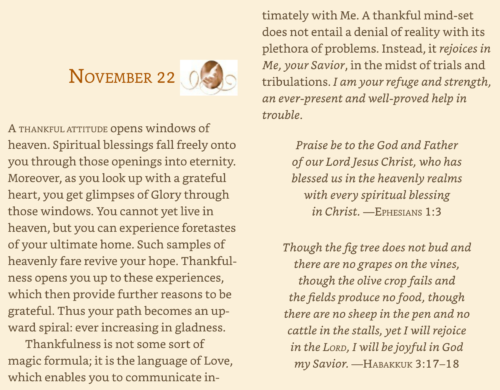
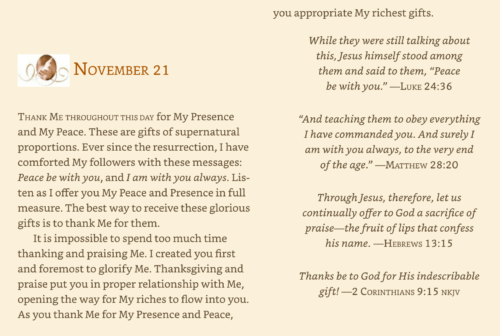
An Attitude of Gratitude 

Father Richard Rohr reminds us that when we receive everything as a gift, we can live gratefully, allowing the energies of life and love to flow through us to the benefit of the whole.

In Philippians 4:6–7, Paul sums up an entire theology of prayer practice in very concise form: “Pray with gratitude, and the peace of Christ, which is bigger than knowledge or understanding [that is, making distinctions—Richard], will guard both your mind and your heart in Christ Jesus.” Only a pre-existent attitude of gratitude, a deliberate choice of love over fear, a desire to be positive instead of negative, will allow us to live in the spacious place Paul describes as “the peace of Christ.” 

It is important that we ask, seek, and knock to keep ourselves in right relationship with Life Itself. Life is a gift, totally given to us without cost, every day of it, and every part of it. A daily and chosen attitude of gratitude will keep our hands open to expect that life, allow that life, and receive that life at ever-deeper levels of satisfaction—but never to think we deserve it. Those who live with such open and humble hands receive life’s “gifts, full measure, pressed down, shaken together, and running over into their lap” (Luke 6:38). In my experience, if we are not radically grateful every day, resentment always takes over. Moreover, to ask for “our daily bread” is to recognize that it is already being given. Not to ask is to take our own efforts, needs, and goals—and our selves—far too seriously. Consider if that is not true in your own life. 

All the truly great persons I have ever met are characterized by what I would call radical humility and gratitude. They are deeply convinced that they are drawing from another source; they are instruments. Their genius is not their own; it is borrowed. We are moons, not suns, except in our ability to pass on the light. Our life is not our own; yet, at some level, enlightened people know that their life has been given to them as a sacred trust. They live in gratitude and confidence, and they try to let the flow continue through them. They know that “love is repaid by love alone,” as both St. Francis of Assisi and St. Thérèse of Lisieux have said. 

In the end, it is not our own doing, or grace would not be grace. It is God’s gift, not a reward for work well done. It is nothing for us to be boastful about. We are God’s work of art, created in Christ Jesus. All we can do is be what God’s Spirit makes us to be, and be thankful to God for the riches God has bestowed on us. Humility, gratitude, and loving service to others are probably the most appropriate responses we can make. 

Sharing God’s Grace 

For author and historian Diana Butler Bass, gratitude begins with awareness of God’s grace:

The words “gratitude” and “grace” come from the same root word, gratia in Latin. . . . “Grace” is a theological word, one with profound spiritual meaning. Grace means “unmerited favor.” When I think of grace, I particularly like the image of God tossing gifts around—a sort of indiscriminate giver of sustenance, joy, love, and pleasure. Grace—gifts given without being earned and with no expectation of return—is, as the old hymn says, amazing. Because you can neither earn nor pay back the gift, your heart fills with gratitude. And the power of that emotion transforms the way you see the world and experience life. Grace begets gratitude, which, in turn, widens our hearts toward greater goodness and love.

Bass explores the liberating nature of gratitude:

Together grace and gratitude form a different moral “equation.” The standard model of gratitude is a closed cycle of gift and return bound by social obligation and indebtedness, whereby a “benefactor,” a superior of some sort (someone wealthier, more powerful), provides a benefit for another, a “beneficiary,” a person in a state of need or trouble. In the closed cycle, the beneficiary is dependent on the benefactor in a way that feels demeaning or signals indebtedness. . . . Few want to be on the receiving end of an unequal transaction. . . .

If we change a closed system to an open one, banishing transaction and substituting grace, the picture of gratitude shifts. In the closed cycle of debt and duty, the roles of benefactor and beneficiary are static, and gifts are commodities of exchange, based in transaction and control. . . . But in an open cycle of gratitude, gifts are not commodities. Gifts are the nature of the universe itself, given by God or the natural order. Grace reminds us that every good thing is a gift—that somehow the rising of the sun and being alive are indiscriminate daily offerings to us—and then we understand that all benefactors are also beneficiaries and all beneficiaries can be benefactors. All that we have was gifted to all of us. There would be no benefactors if they were not first the recipients of grace. In other words, gifts come before givers. We do not really give gifts. We recognize gifts, we receive them, and we pass them on. We all rely on these gifts. We all share them.

This is not a fulfillment of duty or a single act of kindness, but an infinite process of awareness and responsive action. The gift structure of the universe is that of an interdependent community of nature and neighbor that extends through the ages in which we care for what was handed to us and give gifts to others as a response. This is not a closed circle of exchange; it is more like the circles that ripple across a pond when pebbles are tossed into the water.


Find the Flow

November 18th, 2022 by JDVaughn No comments »

CAC teacher Brian McLaren invites us to participate in a spiritual movement of the future instead of one that tries to return to the past:

Since between 3000 and 4000 BCE, when the first human civilizations were born, we have been part of one meta-movement [DM Team: way of thinking or dominant consciousness] we might call the old humanity or imperial humanity. . . . [But] what happens when a meta-movement runs its course? . . .

What would it mean for us if we happen to live during the decline of the old humanity, when a new humanity is in the painful, fragile process of being born? . . . What if the growth of the new movement, the new humanity, the new social creation or construction depends on the old one losing its hegemony?

As I write those words, I can’t help but feel a flood of resonances with the Hebrew Scriptures. [1] I feel echoes of Isaiah, speaking of God doing a new thing, something fresh springing forth, so that there will be good news for the poor, recovery of sight for the blind, freedom for the incarcerated and oppressed. (Oppression of the poor is one of the hallmarks of the old humanity.) I hear the prophet imagining a promised time when weapons are recycled into farm equipment because nobody studies war any more. (War is one of the hallmarks of the old humanity.) I hear Ezekiel’s oracle about a new heart, a heart of flesh that replaces the heart of stone. (The hardening of hearts in the name of self-interest and in-group interest is a hallmark of the old humanity.) I hear Amos envisioning a time when a river of justice rolls down from the heights, filling the lowest places first. (A concentration of power and wealth at the top is a hallmark of the old humanity.) I hear Micah relativizing everything in his religion except doing justice, loving kindness, and walking humbly before God. (Hoarding power, loving money, and walking in racial, religious, or national pride are hallmarks of the old humanity.) . . .

And so I imagine: in the middle of the old meta-movement of empires, domination, extraction, and exploitation, what if a long succession of prophets, including Mary, John the Baptizer, Jesus, Paul, and others, were giving us a vision for a new movement being born? . . .

Whatever this new emerging meta-movement is, it is bigger than any single religion. In fact, it is bigger than religion as a whole. It issues an invitation, perhaps even an ultimatum, to all religions, all economies, all educational and political systems, all arts and trades, all sciences and technologies, everything. It is, we might say, a spiritual movement that encompasses everything. . . . Wherever you invest your life, I hope it will be in this larger movement laboring for the birth of something new. Embrace the long view and find the deep current, the infinite flow. 

_______________________________

Sarah Young

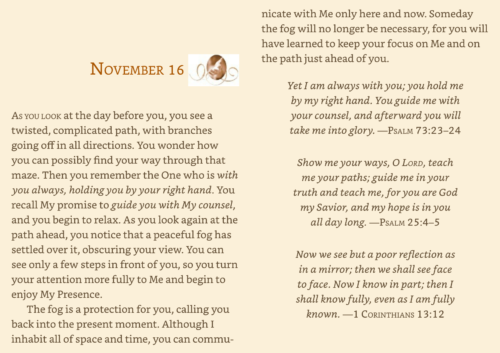
Instead of trying to figure things out yourself, you can relax in My presence. Surrender and feel peaceful and complete.

I designed you to live in close communion with Me. Do not be concerned about the approval of others, surrender and trust Me to guide you always.

Philippians 4:6-7
Do not be anxious about anything, but in every situation, by prayer and petition, with thanksgiving, present your requests to …

John 7:38
Whoever believes in me, as Scripture has said, rivers of living water will flow from within them.

Ephesians 5:18-20
Do not get drunk on wine, which leads to debauchery. Instead, be filled with the Spirit, speaking to one another with psalms, hymns, and songs from the Spirit.

A Movement of Devine Love

November 17th, 2022 by JDVaughn No comments »

For Father Richard, God’s unconditional love is itself a movement that transforms us:

This whole human project pivots around Divine Love. Because our available understanding of love is almost always conditioned on “I love you if” or “I love you when,” most people find it almost impossible—apart from real transformation—to comprehend or receive Divine Love. In fact, we cannot understand it in the least, unless we “stand under” it, like a cup beneath a waterfall. When we truly understand Divine Love, our politics, our anthropology, our economics, and our movements for justice will all change.

If we are to believe the biblical revelation, it seems that God does not love the people Israel if they change (as they first imagine), but so that they can change. Divine Love is not a reward for good behavior, as we first presume it to be; it is a larger Life, an energy and movement that we can participate in—and then, almost in spite of ourselves—we behave differently. It seems few of us go there willingly. For some reason, we’re afraid of what we most want.

The prophet Hosea tells the people of Israel poetically and succinctly, “I will love Unloved: I will say to No-People-of-Mine, ‘You are my people,’ and then you will answer back, ‘You are my God’” (Hosea 2:24). That is the divine pattern, although we almost always get it backwards. For some reason, we think that if we love God, God will love us. When, in reality, it is because God loves us that we can return the compliment. God does not love us because we are good; God loves us because God is good.

Up to the time of the Babylonian exile in the sixth century BCE, the Jewish people believed—as so many of us do today—in retributive justice. “Tit for tat,” we might say. It went something like this: mistake –> punishment ­–> conversion –> consolation/salvation. Most people accept that logic to this day because it makes God and the world feel fair and just. Reward and retribution are in our hardwiring. They are the plot line for almost everything—except for the evolving biblical story, beginning with the Torah and evolving through the prophets.

During and after the exile, the prophets started seeing a clearly different pattern at work in God’s dealing with people. The new pattern looks like this: mistake –> consolation/salvation –> conversion. It is a total turnaround of consciousness! As Isaiah is able to hear from God, “The shame of your youth you shall forget . . . My love shall never fall away from you” (Isaiah 54:4, 10). It seems that inside the Divine logic the answer to failure is, in fact, more love!

Divine Love is the interpretive key to everything. Unloved people do bad things. Loved people do good things. It is that simple.

___________________________

Sarah Young

There is no condemnation for those that are in Me. I died to set you free, live freely in Me. You live in Me when you surrender, connect and are living out of Me.

Psalm 23:1-2
The LORD is my shepherd, I lack nothing. He makes me lie down in green pastures, he leads me beside quiet waters

Isaiah 30:21
Your ears will hear a word behind you, “This is the way, walk in it,” whenever you turn to the right or to the left. And whether you turn to the right or to the left, your ears will hear this command behind you: “This is the way. Walk in it.

John 10:27
My sheep hear my voice, and I know them, and they follow me

Romans 8:1-2
Therefore, there is now no condemnation for those who are in Christ Jesus, 2 because through Christ Jesus the law of the Spirit who gives life …

November 16th, 2022 by Dave No comments »

The Spirit Moves Us to Justice

Community organizer Idalin Luz Montes Bobé draws inspiration from the Holy Spirit’s energy shared on the first Pentecost:  

In Acts 2, the Holy Spirit comes to—and into—the disciples of Jesus [and] enables the disciples to speak in such a way that others, no matter where they come from or what language they speak, can understand.

That same Spirit is at work today, and we can still feel the power and unity of that moment. That Spirit is the power that affirms for us the worthiness we are so often denied and reminds us that we are beloved. It gives us the power to cry justice in the face of oppression, and claim human rights as our inheritance, and grow our movement. When we cry out in protest, we hear, see, and feel the Spirit moving.

We read that when the Holy Spirit comes in this way to the disciples, they are mocked and called drunkards. . . . Yet they carry a life-affirming message, and through their unity, they are filled up with a spirit that sustains them. Peter steps forward to oppose the lies being told about this freedom movement. He reminds everyone there that the disciples are fulfilling what has been proclaimed: that in God’s kingdom, young and old, men and women, and especially the poor will prophesy.

To prophesy is to carry a message of the mind of God to a particular situation. God’s mind is always on justice, on the end of oppression, on fully living. This empowerment, carrying God’s unmistakable message, is exactly what happens when movements for liberation take root. . . .

Our systems try to shame us, silence us, and divide us, but the Holy Spirit unites us and imparts the ability to deliver a message. We will not be divided, ridiculed, or vilified. We all have messages about defending life—messages that God wants others to hear. The Holy Spirit is moving in our midst. [1]

Rev. Dr. Yvette Flunder describes the spiritual revival that joined people of different races in the Pentecostal movement: 

The greatest manifestation of the power of God comes when we work together to find ways to be together and do justice together and love together and stand together.

In 1906 in Los Angeles a revival broke out in a small mission on Azusa Street, led by Rev. William J. Seymour. This revival marked the beginning of the modern day Pentecostal movement. The event has been reduced over time to a group of people displaying external “signs and wonders” such as speaking in tongues, healings, and prophecy, with little meaning to most people today. But the power of that Pentecostal revival was not in the external manifestations of speaking in tongues and healings but in the miracle of black and white people worshipping together, men and women preaching together and decrying racism and sexism by their very presence in one place. The Spirit still moves when we move past our prejudices and differences. [2]


November 15th, 2022 by Dave No comments »

Carrying the Work Forward

Dear Dave,

I moved to New Mexico in 1986 in response to the call I felt to create a training ground for the contemplative mind in service to a transformed world. My intent was to start a “school for prophets” that would gather people who had a vision of service to the world, train them, and send them forth with the spiritual resources they need. And on October 12, 1987, the Center for Action and Contemplation (CAC) was born. In choosing this name, my hope was to remind us of what we were about. To hold action and contemplation together was a big vision where everything we did was rooted in love.

Thirty-five years later, it is still true that the most important word in our name is and. Without action, our spirituality can become lifeless and bear no authentic fruit. Without contemplation, our doing can come from ego — even if it looks selfless. But the fact that so many of you find the integration of action and contemplationhelpful and meaningful in your life is my greatest joy. Thank you for trusting us and, more than anything, for carrying the message forward in your own life and communities.

Earlier this fall, I learned that cancer has returned, this time in my lymph nodes. I am currently undergoing treatment, and at this point, all signs are positive. I am in good spirits and at peace with my state of being, both in my work and health. For several years now, I have been engaged in the gradual process of stepping back from public life, including reducing my speaking, responsibilities, and travel. Most recently, I have stepped back from my role as Dean of our Core Faculty and transitioned to Faculty Emeritus. I still expect to participate in some CAC programming as my energy permits, but I do not plan to take on any new or ongoing teaching commitments.

At this stage of my life, I feel a great need to create space for those who are carrying this work forward into the future — at the CAC and beyond. As I have shared many times over the years, I believe that only the contemplative mind can bring forward the new consciousness needed to awaken a more loving, just, and sustainable world. This is why the CAC’s mission is to introduce Christian contemplative wisdom and practices that support transformation and inspire loving action.

But the CAC is not enough on its own. The healing of our world requires transformed agents of love showing up in the world together. Each of us has a part to play in this work — a whole body, a whole community, a whole movement of people on the path of action and contemplation. It is your support, generosity, and daily partnership that will enable this transformation to take place.

Twice per year, we pause the Daily Meditations to ask for your support. If you have been impacted by the CAC’s programs (including these Daily Meditations) and are financially able, please consider donating. We appreciate every gift, regardless of the amount.

The CAC is not funded by any large institution or big foundation but by thousands of people who have been impacted by this work — people just like you. Through your support, we are able to introduce more people to the wisdom and practices of the Christian contemplative tradition, many for the very first time. 

Please take a moment to read our Executive Director Michael’s note below. Tomorrow the Daily Meditations will continue exploring the theme of “Movements of Justice and the Spirit.”

Peace and Every Good,

November 14th, 2022 by Dave No comments »

A Movement with the Excluded

On the CAC podcast The Cosmic We, Father Richard Rohr talks about the Franciscan tradition’s identification with those on society’s margins. This priority shaped major periods of Richard’s ministry:

Francis of Assisi always identified with the minority, with the excluded. I went to Assisi after Rome last [June], and the little church that he rebuilt was the church of the leper colony. He immediately went down to those excluded from uptown Assisi and identified with the lepers. So that’s always been a part of our tradition. We were really a subtext in terms of mainline Catholicism.

I was ordained a deacon in 1969—you were always a deacon for one year before you were a priest. In the first six months, they sent me out here to New Mexico to work with the Acoma Pueblo. And then the next six months was at a Black parish in Dayton, Ohio: Resurrection Parish. My start in ministry was outside the mainstream. And then I realized the mainstream isn’t really “main,” it’s just dominant. So that got me off to a great start!

Then the Pentecostal experience with the high school students happened the next year, after I had become a priest. Such beautiful, polyphonic singing in tongues! We’d sometimes go twenty minutes speaking in tongues; people would come peeking in the door of this high school gymnasium, and they’d say, “And they’re Catholics!” They couldn’t believe it! [DM Team: Such Spirit-filled experiences with young adults led Richard to found the New Jerusalem Community in Cincinnati, Ohio.] So that again, for me, legitimated the margins instead of the so-called center. [1]

Rev. Dr. William Barber, activist and co-director of the Poor People’s Campaign, finds scriptural support for those on the margins leading justice movements. Dr. Barber builds on Psalm 118:22–23, “The stone that the builders rejected has become the cornerstone! This is God’s work. And it is marvelous in our eyes!”:

The rejected must lead the revival for love and justice.

The cornerstone is that part of the foundation upon which the whole building stands. And the Psalmist says, speaking metaphorically of how we view human beings in society, that it is God’s intent that the stones that were once seen as unfit to be a part of the architecture—the stones that were once thrown away or kept in the quarry—have now been called to be the most important stones. The rejected stones make the best cornerstones. The rejected stones actually make the best foundation holders. And whenever you see rejected stones becoming the focus of society, it is the Lord’s doing. [2]

Jesus lived among the rejected. He ministered among the rejected. He died and was crucified as rejected, as somebody who was outside the political power structure. But early Sunday morning, from the grave he led a resurrection movement—a revival of love, a revival of justice, a revival of mercy, a revival of grace. [3]

Jesus Started a Movement

I really don’t think we can ever renew the church until we stop thinking of it as an institution and start thinking of it as a movement. —Clarence Jordan, letter, 1967

Michael Curry is the Presiding Bishop of the Episcopal Church and is passionate about the church rediscovering itself as a movement of Jesus: 

Jesus did not establish an institution, though institutions can serve his cause. He did not organize a political party, though his teachings have a profound impact on politics. Jesus did not even found a religion. No, Jesus began a movement, fueled by his Spirit, a movement whose purpose was and is to change the face of the earth from the nightmare it often is into the dream that God intends. . . .

That’s why his invitations to folk who joined him are filled with so many active verbs. In John 1:39 Jesus calls disciples with the words, “Come and see.” In Matthew, Mark, and Luke, he asks others to “Follow me.” And at the end of the Gospels, he sent his first disciples out with the word, “Go . . .” [. . .] As in, “Go into all the world and proclaim the good news to the whole creation” (Mark 16:15). . . .

If you look at the Bible, listen to it, and watch how the Spirit of God unfolds in the sacred story, I think you’ll notice a pattern. You cannot help but notice that there really is a movement of God in the world.

Curry identifies several characteristics of the Jesus movement [1]: 

First, the movement was Christ-centered—completely focused on Jesus and his way. . . . Long before Christianity was ever called the Church, or even Christianity, it was called “the Way” [see Acts 9:2]. The way of Jesus was the way. The Spirit of Jesus, the Spirit of God, that sweet, sweet Spirit, infused their spirits and took over. . . .

The second mark of the movement is this: following the way of Jesus, they abolished poverty and hunger in their community. Some might say they made poverty history. The Acts of the Apostles calls this abolition of poverty one of the “signs and wonders” which became an invitation to others to follow Jesus too, and change the world. . . . It didn’t take a miracle. The Bible says they simply shared everything they had [Acts 4:32–35]. The movement moved them in that particular way.

Third, they learned how to become more than a collection of individual self-interests. They found themselves becoming a countercultural community, one where Jews and Gentiles, circumcised and uncircumcised, had equal standing [see Acts 15:1–12].


Interfaith Nonviolence

November 11th, 2022 by JDVaughn No comments »

Almost twenty years ago, Jesuit peace activist Father John Dear wrote in the CAC’s journal Radical Grace about the nonviolent impact that interfaith cooperation can make:

At the heart of each major religion is the vision of peace, the ideal of a reconciled humanity, the way of compassion and love and justice, the fundamental truth of nonviolence.

Mahatma Gandhi [1869–1948] was the first to point toward interfaith nonviolence. . . . When he moved to India, and saw again the deep hostility between Hindus and Muslims, he made interfaith nonviolence the core of his daily worship. Each day when his community gathered for prayer, they read excerpts from the Hindu and Muslim scriptures, from the Sermon on the Mount and the Hebrew Bible. Then, they sat in silence for forty-five minutes. They concluded usually with a hymn about the all-inclusive love that reconciles everyone, the love even for one’s enemies. Forty years of interfaith, contemplative prayer transformed him into a universal spirit, as all the major religious scriptures hope for all of us. . . .

“Religions are different roads converging to the same point,” Gandhi once wrote. “What does it matter that we take different roads, so long as we reach the same goal?” [1] . . . [and] “There will be no lasting peace on earth unless we learn not merely to tolerate but even to respect the other faiths as our own.” [2]

As we learn from each other’s religion, Gandhi discovered, we can help each other deepen in the faith of our own personal tradition. His critique of organized Christianity—that it rejected the nonviolence of Jesus and has become an imperial religion based on the Roman empire—has helped innumerable Christians return to the core teachings of Jesus, beginning with the Sermon on the Mount. The Baptist Martin Luther King, Jr. testified that the Hindu Gandhi helped him more than anyone else to follow Christ.

Since the early 1980s, Dear has worked as an author, activist, and peacemaker, deeply influenced and inspired by interfaith friendships.

For the last twenty [now almost 40] years, I have experienced the deepest multicultural and interfaith connections through my work in the peace movement. I have developed many friendships across cultural and religious boundaries because of our shared vision of nonviolence. This interfaith peacemaking sprang from the Civil Rights Movement, when Dr. King called religious leaders to march with him to Selma. The friendship modeled between Dr. King, Rabbi Abraham Heschel and Thich Nhat Hanh still bears good fruit in our world and exemplifies the journey we must all make.

As the world hangs on the brink of nuclear and environmental destruction, as we wage war in the name of religion, we need to explore the religious roots of nonviolence, just as Gandhi did. Perhaps then, we will hear the call to disarm, to embrace one another as sisters and brothers, and welcome the gift of peace that has been already given.

Sarah Young…..

Do not let any set of circumstances intimidate you. The more challenges you face, the more of My power I give you. I empower you based on your challenges of the day. The degree to which I strengthen you depends on two things: 1) the difficulty of your circumstances and 2) Your willingness to surrender

Ephesians 1:18-20
I pray that the eyes of your heart may be enlightened in order that you may know the hope to which he has called you, the riches of his glorious inheritance in his holy people, 19 and his incomparably great power for us who believe. That power is the same as the mighty strength 20 he exerted when he raised Christ from the dead and seated him at his right hand in the heavenly realms,

Psalm 105:4
Look to the Lord and his strength; seek his face always.

Deuteronomy 33:25 NKJV
Your sandals shall be iron and bronze; As your days, so shall your strength be.

November 8th, 2022 by Dave No comments »

The Holy Water We Share

Author and preacher Barbara Brown Taylor writes about what she calls “holy envy,” befriending followers of different traditions, and allowing such friendships to enrich our own faith. She summarizes an insight taught by inter-spiritual theologian Raimon Panikkar (1918–2010): 

Raimon Panikkar . . . spent a lot of time thinking about what it might mean for Christians to focus on contributing to the world’s faiths instead of dominating them. Born in Spain to a Catholic mother and a Hindu father, he used the analogy of the world’s great rivers. The Jordan, the Tiber, and the Ganges all nourish the lives of those who live along their banks, he said. One flows through Israel, one flows through Rome, and one flows through India. If he were writing today he might have added the Tigris and Euphrates Rivers, which flow through Turkey, Syria, and Iraq.

None of these rivers meet on earth, Panikkar said, though they do meet in the heavens, where water from each of them condenses into clouds that rain down on all the mortals of the earth. In the same way, he said, the religions of the world remain distinct and unmixed on earth—but “they meet once transformed into vapor, once metamorphosized into Spirit, which then is poured down in innumerable tongues.” [1]

Eventually all people of faith must decide how they will think about and respond to people of other (and no) faiths. Otherwise they will be left at the mercy of their worst impulses when push comes to shove and their fear deadens them to the best teachings of their religions.

Taylor recalls a trip she took with her students to a local Islamic center, and the inspiration it provided: 

Once, at the end of a field trip to the Atlanta Masjid of Al-Islam, the imam ended his meeting with students by saying, “Our deepest desire is not that you become Muslim, but that you become the best Christian, the best Jew, the best person you can be. In the name of God, the Most Gracious, the Most Merciful. Thank you for coming.” Then he was gone, leaving me with a fresh case of holy envy.

I could do that, I thought. I could speak from the heart of my faith, wishing others well at the heart of theirs—including those who had no name for what got them through the night. It might mean taking down some fences, but turf was no longer the reigning metaphor. I was not imagining two separate yards with neighbors leaning over a shared boundary. I was imagining a single reservoir of living water, with two people looking into it. One might have been a Muslim and the other a Christian, but there was nothing in their faces to tell me that. All I saw were two human beings looking into deep waters that did not belong to either of them, reflecting back to them the truth that they were not alone.

November 7th, 2022 by Dave No comments »

 Only Love Is Absolute

This week’s Daily Meditations explore the fruitfulness of interfaith friendships. We begin with Father Richard reflecting on Jesus’ inclusivity, which has allowed Richard both to affirm and critique his own religious tradition—and invites us to do the same. 

In no other period of history have humans had such easy and immediate access to people of other cultures and other religions, often as friends. Once a person has developed any “discernment of the Spirit” it becomes clear that God’s holiness exists all over the place.

The Second Vatican Council gave Catholics some fine official guidelines and freedoms. Nostra Aetate, the 1965 Catholic document on non-Christian religions affirms, “For all peoples comprise a single community, and have a single origin . . . one also is their final goal: God. [God’s] providence, manifestations of goodness, and saving designs extend to all [people].” [1] Such an affirmation rightly places us all inside the same frame of history and allows no foundational distinction between us. We are clearly from the one God, tending toward the one God, and as the mystics of all religions teach, Reality itself is one. 

It is strange that it took us almost all of our two-thousand-year history to get back to the “ecumenical” attitude Jesus had at the very beginning! He goes out of his way to make non-Jews the heroes of many of his stories and teachings. He is quick to point out the failures and fallacies of his own religion, Judaism, while still remaining faithful to it. Jesus held a very critical stance toward his own religion, but for some reason few of us think we can do the same.

On the other hand, sadly, many people think that if they no longer believe in the absolute primacy of their own religion, then it has no absolute call on them and they often give up on it entirely. But I am convinced that the biblical tradition is saying that the only absolute available to us is the faithful love of God, and not any concept or structure—even our religious traditions themselves. God’s love itself is the center and the still point of the turning world. But if we have never actually experienced this love, we will most assuredly look for absolutes in other ways.

What is unique about Jesus is his inclusivity itself! He is so grounded in the absoluteness of the Divine relationship that he is quite free to relativize the Law, simplify the Prophets, and find God outside of his own tradition. He is constantly and consistently inclusive—without denying his Jewish foundation and faith. I believe we can only be inclusive when we have a deeply held and shared experience that we can include people “into.” We have to have a “home” to bring people home to.

What the world wants, and people need, are people who believe in Something—Something that will lead them to the good, the beautiful, the true, and the universal.

Learning from Others


If something is true, no matter who said it, it is always from the Holy Spirit. —Thomas Aquinas, De Veritate

Father Richard reflects on how his commitment to Christ and the inspiration of the Holy Spirit have continually helped him recognize God in other traditions:

In my own life, going deep in the Christian religion of my birth has enabled me to see the same Spirit and Love in other religions as well. It’s been quite a journey from growing up in a Catholic “ghetto” in Kansas, and hardly even knowing any Protestants. And yet, at age fourteen, I was sent to study with the Franciscans in Cincinnati, Ohio, and they gave me a very ecumenical theological education.

One of the best courses I had was on the Hebrew Scriptures, which gave me a great love for Judaism. It’s probably why I emphasize the prophets so much, because I realized the prophets really weren’t about what we call today retributive justice. They were about restorative justice. When we stay with their message, there will be these magnificent passages toward the end of their books that invariably point toward love. God eventually says through the prophets: “I’m going to love you anyway. I’m going to redeem you by my perfect love. I’m going to love you into wholeness” (see Isaiah 29:13–24 and Hosea 6:1–6).

In 1969, when I was sent as a deacon to the Acoma Pueblo in New Mexico, I had only a basic introduction to Indigenous religions. I observed how mothers in the pueblo would show their children how to silently wave the morning sunshine toward their faces, just as we learn to “bless” ourselves with the sign of the cross. Indigenous peoples here had contemplative prayer long before we Franciscans ever appeared.

The rediscovery of Christian contemplation opened my eyes to Buddhists and Sufis—their teachings and practitioners. Buddhism taught me the phenomenology of perception—what’s going on in our brains. Every world religion at the mature levels discovers some forms of practice to free us from our addictive mind, which we take as normal. Starting in the 1960s, our increased interaction with Eastern religions in general, and Buddhism in particular, helped us recognize and rediscover our own very ancient Christian contemplative tradition. The Sufis’ deep love of mysticism, especially as expressed by their poets Rumi and Hafiz, often captures the stirrings of my own heart.

My latest discovery was really Hinduism, which is considered the oldest world religion. In the early 1980s, I gave a retreat in Nepal; between talks I would just walk the old streets and walk into temples and try to remain invisible. I remember these lovely Indian women coming in wearing saris, so gracefully, and paying no attention to anything else except maybe the flame or the oil they were holding. With what reverence they would bow! What do we think they’re bowing to except God, the Mystery?

Like the wind, the Spirit blows where it will (see John 3:8).