Jesus’ life offered an example of humility and self-emptying, but he chose an additional model for his disciples: that of little children. Despite what we see depicted in so much religious art, it was not meant as a “cute” or sentimental gesture! As Albert Nolan shares, it was a radical revaluing of human dignity, based on nothing that society could see or quantify! Taken seriously, it is still a profound message for us today.
Jesus was uncompromising in his belief that all human beings were equal in dignity and worth. He treated the blind, the lame and the [sick], the outcasts and beggars with as much respect as that given to those of high rank and status. He refused to consider women and children unimportant or inferior. This turned a carefully ordered society of status and honor upside down—even more so when he advocated moving down the social ladder instead of striving to reach the top. [1]
When his disciples were arguing about who was the greatest, Jesus put his arm around a little child (Mark 9:36–37). According to Jesus, the least or most insignificant persons in the society are the greatest (Luke 9:48). In the society and culture of the time, the child had no standing or status whatsoever. The child was a “nobody.” The implication is that Jesus and those who want to follow him are “nobodies,” right at the bottom of the social ladder. For Jesus, the child was a model of radical humility (Matthew 18:3–4) [or what I am calling “self-emptying” this week]. Those who wish to follow him will have to become as humble as little children. [2]
Richard again: It’s difficult to hear, but Albert Nolan is simply quoting Jesus from several contexts—usually when the Twelve are all in their heads arguing. We cannot become humble by mere intellect or willpower. Pretending to be humble only makes us more self-absorbed and self-referential. All we can really do is become more aware of our pride or vanity by noticing how we respond to even minor slights or humiliations. That will be more than enough to let us know how self-centered we are and how meaningless our taking offense truly is in this infinite universe.
A focus on self-emptying or “letting go” might seem like a call to self-denial or “making do with less,” but as Cynthia Bourgeault points out in her description of Jesus’ teaching, it can also lead to radical generosity and abundance. When we cling to less—of our possessions and even our lives—we are free to give it away for the sake of others.
[Jesus] certainly called us to dying to self, but his idea of dying to self was not through inner renunciation or guarding the purity of his being but through radically squandering everything he had and was. John the Baptist’s disciples were horrified because he banqueted, drank, and danced. The Pharisees were horrified because he healed on the Sabbath and kept company with women and disreputables, people known to be impure. . . .
What seemed disconcerting to nearly everybody was the messy, freewheeling largeness of his spirit. Abundance and a generosity bordering on extravagant seemed to be the signatures of both his teaching and his personal style. . . . When he feeds the multitudes at the Sea of Galilee, there is not merely enough to go around; the leftovers fill twelve baskets [John 6:13]. When a woman anoints him with expensive ointment and the disciples grumble about the waste, he affirms, “Truly, I tell you, wherever this good news is proclaimed in the whole world, what she has done will be told in remembrance of her” (Matthew 26:13). He seems not to count the cost; in fact, he specifically forbids counting the cost. “Do not store up treasures on earth,” he teaches; do not strive or be afraid— “for it is your Father’s good pleasure to give you the kingdom” (Luke 12:32). All will come of its own accord in good time and with abundant fullness, so long as one does not attempt to hoard or cling.
It is a path he himself walked to the very end. In the garden of Gethsemane, with his betrayers and accusers massing at the gates, he struggled and anguished but remained true to his course. Do not hoard, do not cling—not even to life itself. Let it go, let it be— “Not my will but yours be done, O Lord. Into your hands I commend my spirit.” [1]
Richard again: Jesus came into the world and gave himself fully into a poor life and a humiliating death. As Cynthia writes, he was “squandering himself” [2], which is really what the entire Trinity does: each self-emptying into the other! He revealed the poverty of God, who gives everything away. Yet most of us would probably not think of God as poor at all.
Self-Emptying
Less
Is More
Sunday, December 13,
2020 Third Sunday of Advent
Have
among yourselves the same attitude that is also yours in Christ Jesus,
who, though he was in the form
of God,
did not regard equality with
God something to be grasped.
Rather, he
emptied himself,
taking the form of a slave,
coming in human likeness;
and found human in appearance,
he humbled himself,
becoming obedient to death,
even death on a cross. (Philippians 2:5–8)
Kenosis, which means “letting go”
or “self-emptying,” is clearly the way of Jesus. My spiritual father Saint
Francis of Assisi lived kenosis passionately, and it is key to my own
teaching. I believe all great
spirituality is about letting go. Yet many associate letting go with Buddhism more than
with Christianity. Sadly, Christianity seems to have become more about “saving
your soul” or what some now call “spiritual capitalism.”
Francis
of Assisi (1182–1226) profoundly understood this Gospel reversal. He let go of
his life in the upper class and joyfully lived in solidarity with those at the
bottom, especially the sick and the poor. But you and I have grown up with a
capitalist and individualistic worldview, not a Gospel or Franciscan worldview.
That doesn’t make us bad or entirely wrong. But it has severely limited our
spiritual understanding—and Christianity’s power to transform culture and
history. We tend to think that “more for me” is naturally better. South African
Dominican writer Albert Nolan viewed our Western crisis of meaning with
clarity:
The cultural
ideal of the Western industrialized world is the self-made, self-sufficient, autonomous
individual who stands by himself or herself, not needing anyone else . . . and
not beholden to anyone for anything. . . . This is the ideal that people live
and work for. It is their goal in life, and they will sacrifice anything to
achieve it. This is how you “get a life for yourself.” This is how you discover
your identity. . . .
There have been
plenty of people in the past with inflated egos—kings, conquerors, and other
dictators—but in the Western world today the cultivation of the ego is seen as
the ideal for everyone. Individualism permeates almost everything we do. It is
a basic assumption. It is like a cult. We worship the ego. [1]
In
our consumer culture, even religion and spirituality have very often become a
matter of addition: earning points with God, attaining enlightenment, producing
moral behavior. Yet authentic spirituality is not about getting, attaining,
achieving, performing, or succeeding—all of which tend to pander to the ego. It
is much more about letting go—letting go of what we don’t need anyway, although
we don’t know that ahead of time.
The
great Dominican mystic Meister Eckhart (1260‒1328) said, “God is not found in the soul
by adding anything, but by a process of subtraction.” [2] True spiritual wisdom reveals that less is more. Jesus taught this, and the holy ones always discover it
in one way or another. Think of the Dalai Lama, Nelson Mandela, Dorothy Day,
and the generations of nuns, friars, and monks who intentionally took a “vow of
poverty.” I did so myself in 1965.
Sadly, like so many things that we call Christianity, we find that if we scratch right beneath the surface, it isn’t very much of Christianity; it’s just our local religious culture. Thankfully, there is a real longing today to clarify what is of Christ, what is essential Gospel, and what is historical or denominational accident.
What is it that grasps and impels these men and women to push beyond conventional boundaries and so delight us, ultimately, with new creative spaces? Wisdom—God’s Playmate, the Feminine Principle of the Godhead—is at work, ever delighting in birthing new possibilities and inviting open hearts to rise up and respond to visions and dreams by enfleshing them. —Edwina Gateley
Catherine de Hueck Doherty (1896–1985) was a Russian baroness who lived the Gospel “without compromise.” She gave up all she had and began Friendship House in Toronto, “a storefront center for the works of mercy, where the hungry were fed and the homeless were welcomed.” [1] Robert Ellsberg writes that Catherine’s formation of the Friendship House in Harlem, New York in 1937 emerged out of a deep conviction of the sins of racism and segregation. In 1947 she also established Madonna House, “which became a place of prayer and retreat. . . . Through Madonna House and the communities it inspired around the world, Catherine promoted the two principles by which she lived—a commitment to the social apostolate in the world and the need to root such a commitment in a life of prayer and the spirit of Christ [i.e., action and contemplation]. [2]
In her own words, Catherine describes how we give birth to Christ:
Christians are called to become icons of Christ, to reflect him. But we are called to even more than that. Ikon is the Greek word for “image of God.” We are called to incarnate Christ in our lives, to clothe our lives with him, so that people can see him in us, touch him in us, recognize him in us. . . . [3]
We have to begin to love one another in the fullest sense of Christ’s teaching. But to do so we must pray. . . . The immense problems of war, of social injustice, of the thousand and one ills that beset our world, these can be solved only if we begin to love one another. When people begin to see, love, respect, and reverence Christ in the eyes of another, then they will change, and society will change also. [4]
Richard here: To paraphrase the medieval mystic Meister Eckhart (1260–1327), “We are all meant to give birth to God.” [5] As a man who has taken a vow of celibacy, I will never know what it is like to physically give birth, nor have I ever held the hand of a woman I love in labor—neither sister nor friend. However, I have experienced the birth of Christ in the world many times throughout my life—in big ways and small, sometimes through grand gestures, but more often through simple acts of patience, love, and mercy. To incarnate the Christ is to live out the Gospel with our lives, as faithfully and fearlessly as a woman in labor who holds nothing back in order to bring new life into the world.
Fruit of Our Labor Thursday, December 10, 2020 When we are engaged in some form of contemplative practice, we are more able to bring Christ into the world. By emptying ourselves, we are more able to embody God’s presence for others. Professor and Episcopal priest Vincent Pizzuto writes about how contemplation enables this to happen:The contemplative disciple is one who is clothed with love. . . . One meditates, then, not in order to produce a successful meditation but in order to be transformed into an ever more compassionate person. We pray not that we might become mystics but that we might become ever more authentic Christians who embody the love of Christ in the world.John of the Cross [1542–1591] takes up the analogy of a smudgy window to make the connection between deification [becoming more like God] and contemplative discipleship. A smudgy window, he says, is less able to transmit the sunlight shining through it. The more cleaned and polished the window, the more identical it appears with the rays of sunshine. While the nature of the window is distinct from the sun’s ray, a clean window better participates in the ray of sunlight that passes through it. As one progresses in the spiritual life it is as if the window all but disappears, allowing the Christ light to shine through it without hindrance. [1] . . .It is not mystical experience we are after but radical interior transformation, so that others may experience Christ more fully in us. [2]The contemplative mystic John of the Cross frequently wrote about the via negativa, or the path of darkness as a way to greater union with God. Spiritual teacher Beverly Lanzetta explores the darkness as a pregnant place from which one “gives birth” to the Divine in the world. She calls it “a theology of gestation.” She writes:From darkness and uncertainty, it waits for the Divine to be born in its own time. The process doesn’t try to contain new revelation in the dry, crusty soil of old forms, but germinates each seed in the moist openness of heart, fertile and hollow like the womb, receptive and waiting. It is the qualities of Wisdom, the Mother of all—merciful, gentle, humble, nondual, holistic, benevolent—that we tenderly bear. Verdant, womb-like theology welcomes new seeds to take root. Round and hollow in imitation of divine fecundity, gestation cannot be forced; new life cannot be prescribed. We cannot change the color of the eyes, or the shape of the nose. Similarly, we cannot fashion divine self-disclosure to our own liking. Impregnated with its seed, we simply support it and watch it grow. [3]Richard again: Regardless of our gender, the fruit of our labor is a gift from God for the world. What else could we want this time of year?
My
dear friend Ronald Rolheiser, O.M.I. reminds us that giving birth spiritually
is a dynamic and creative process. To bring Christ into the world involves an
ongoing commitment to growth, to discomfort, to love, and to surrender. It is
not for the faint of heart, but it is God’s invitation to all of us.
Looking
at how Mary gave birth to Christ, we see that it’s not something that’s done in
an instant. Faith, like biology, also relies on a process that has a number of
distinct, organic moments. What are these moments? What is the process by which
we give birth to faith in the world?
First,
like Mary, we need to get pregnant by the Holy Spirit. We need to let the word
take such root in us that it begins to become part of our actual flesh.
Then,
like any woman who’s pregnant, we have to lovingly gestate, nurture, and
protect what is growing inside us until it’s sufficiently strong so that it can
live on its own, outside us. . . .
Eventually,
of course, we must give birth. . . .
Birth,
however, is only the beginnings of motherhood. Mary gave birth to a baby, but
she had to spend years nurturing, coaxing, and cajoling that infant into
adulthood. The infant in the crib at Bethlehem is not yet the Christ who
preaches, heals, and dies for us. . . .
Finally,
motherhood has still one more phase. As her child grows, matures, and takes on
a personality and destiny of its own, the mother, at a point, must ponder (as
Mary did). She must let herself be painfully stretched in understanding, in not
knowing, in carrying tension, in letting go. She must set free to be itself
something that was once so fiercely hers. The pains of childbirth are often
gentle compared to this second wrenching.
All
of this is what Mary went through to give Christ to the world: Pregnancy by the
Holy Spirit; gestation of that into a child inside of her; excruciating pain in
birthing that to the outside; nurturing that new life into adulthood; and
pondering, painfully letting go so that this new life can be its own, not hers.
. . .
Our
task too is to give birth to Christ. Mary is the paradigm for doing that. From
her we get the pattern: Let the word of God take root and make you pregnant;
gestate that by giving it the nourishing sustenance of your own life; submit to
the pain that is demanded for it to be born to the outside; then spend years
coaxing it from infancy to adulthood; and finally, during and after all of
this, do some pondering, accept the pain of not understanding and of letting
go.
Christmas isn’t automatic, it can’t be taken for granted. It began with Mary, but each of us is asked to make our own contribution to giving flesh to faith in the world.
Why, from the earliest centuries, have Christian people been so excited about Mary? What’s happening in the depths of our soul when we hear her story? Surely it must be about more than the miracle of the virgin birth. As Benedictine oblate, author, and poet Kathleen Norris shares, Mary’s “virginity” has less to do with biology than with her stance towards God and life itself.It’s in the monastic world that I find a broader and also more relevant grasp of what it could mean to be virgin. Thomas Merton, in Conjectures of a Guilty Bystander, describes the true identity that he seeks in contemplative prayer as a “point vierge” [virgin point] at the center of his being, “a point untouched [by sin and] by illusion, a point of pure truth . . . which belongs entirely to God. . . .” [1]It is only when we stop idolizing the illusion of our control over the events of life and recognize our poverty that we become virgin in the sense that Merton means. . . . We all need to be told that God loves us, and the mystery of the Annunciation reveals an aspect of that love. But it also suggests that our response to this love is critical. A few verses before the angel appears to Mary in the first chapter of Luke’s Gospel, another annunciation occurs; an angel announces to an old man, Zechariah, that his equally aged wife is to bear a son who will “make ready a people prepared for the Lord.” The couple are to name him John; he is known to us as John the Baptist [Luke 1:11–18]. Zechariah says to the angel, “How will I know that this is so?” which is a radically different response from the one Mary makes. She says, “How can this be?”I interpret this to mean that while Zechariah is seeking knowledge and information, Mary contents herself with wisdom. . . . Mary’s “How can this be?” is a simpler response than Zechariah’s, and also more profound. She does not lose her voice but finds it. Like any of the prophets, she asserts herself before God, saying, “Here am I.” . . . Mary proceeds—as we must do in life—making her commitment without knowing much about what it will entail or where it will lead. I treasure the story because it forces me to ask: When the mystery of God’s love breaks through into my consciousness, do I run from it? . . . Or am I virgin enough to respond from my deepest, truest self, and say something new, a “yes” that will change me forever? [2]If Jesus is the representative of the total givenness of God to creation, then perhaps Mary is the representative of humanity, showing us how the gift is received. And I believe that is why we love Mary. She’s a stand in for all of us. When we can say, like her, “Let it be,” then we’re truly ready for Christmas.
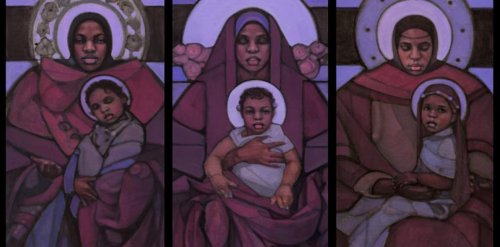
After further reflection, the Daily Meditations editorial team has decided to substitute a new image for this week’s theme. In our original choice, Mary appears white and is in the center of the image, while the two women adjacent to her are black. We recognize the historic centering of whiteness in Western art and religion, and we strive to use images in the Daily Meditations that disrupt this legacy. Together, we are developing, growing, and changing for the good—towards an ever more inclusive love in Christ. (The Universal Christ, 95)Gateway to Action & Contemplation:
Story from Our Community: I am a United Methodist pastor and . . . when the pandemic started . . . I started sharing the [Daily Meditations] online in our private Facebook group Monday – Friday. I could not have imagined how life-giving sharing these meditations would be. In a year of so much loss, these daily readings have helped us find comfort, given us strength to make hard decisions, and bound us together in a web of love. Thank you for sharing your wisdom and love with so many. It has made this year bearable. Thank you. —Jen S.
Christ
Is Born in Creation
Monday, December 7, 2020
Humanity
too is God’s creation. But humanity alone is called to co-operate with God in
the creation. —Hildegard of Bingen
For of his
fullness we have all received, grace upon grace. —John 1:16
The
Greek word for “fullness” in this gospel passage is pleroma, which Paul also uses in his writings to describe a
historical unfolding (see Ephesians 1:23, 3:19; Colossians 2:9–10). It is an
early hint of what we now call evolutionary development, the idea that history,
humanity and, yes, even God are somehow growing and coming to a divine
fullness. What hope and meaning this gives to all life!
In
his letter to the church in Rome, Paul writes: “From the beginning until now,
the entire creation, as we know, has been groaning in one great act of giving
birth” (Romans 8:22). Creation did not happen at once by a flick of the divine
hand, and it is not slowly winding down toward Armageddon or tragic Apocalypse.
Creation is in fact a life-generating process that’s still happening and
winding up! We now know the universe
is still expanding—and at an ever-faster rate, which means that we are a part
of creating God’s future.
As
Sister Ilia Delio says so well,
We can read the
history of our 13.7-billion-year-old universe as the rising up of Divine Love
incarnate, which bursts forth in the person of Jesus, who reveals love’s urge
toward wholeness through reconciliation, mercy, peace, and forgiveness. Jesus
is the love of God incarnate, the wholemaker who shows the way of evolution
toward unity in love. In Jesus, God breaks through and points us in a new
direction; not one of chance or blindness but one of ever-deepening wholeness
in love. In Jesus, God comes to us from the future to be our future. Those who
follow Jesus are to become wholemakers, uniting what is scattered, creating a
deeper unity in love. Christian life is a commitment to love, to give birth to
God in one’s own life and to become midwives of divinity in this evolving
cosmos. We are to be wholemakers of love in a world of change. [1]
The
common Christian understanding that Jesus came to save us by a cosmic
evacuation plan is really very individualistic, petty, and even egocentric. It
demands no solidarity with anything except oneself. We whittled the great Good
News down into what Jesus could do for us personally and privately, rather than
celebrating God’s invitation to participate in God’s universal creative work.
Instead of
believing that Jesus came to fulfill us separately, how about trusting that we
are here to fulfill Christ? We take our small but wonderful part in what Thomas
Merton calls “The General Dance.” [2] We are a part of this movement of an
ever-growing Universal Christ that is coming to be in this “one great act of
giving birth” (Romans 8:22).
Giving Birth to Christ
The
DNA of Creation
Sunday, December 6, 2020 Second Sunday of Advent
We Franciscans believe that the first coming of “the
Christ” is in creation itself. The Franciscan philosopher and theologian John
Duns Scotus (1266‒1308), whom I studied for four years, wrote that “God first wills Christ as his supreme work.” [1] Creation could not have been empty of
Christ for billions of years. In other words, God’s “first idea” and priority
was to make the Godself both visible and shareable. The word used in the Bible
for this idea was Logos (from Greek philosophy), which I would
translate as the “Blueprint” or Primordial Pattern for reality. The whole of creation is the beloved community, the partner in the
divine dance. Everything is the “child of God”—not only Jesus. There are no
exceptions. When you think of it, what else could anything be? All creation
must in some way carry the divine DNA of the Creator.
At
Christmastime, most people think about the birth of the baby Jesus as the
“coming” of Christ. Yet Advent reveals more; it is about preparing ourselves
for the Christ to come in personal, contracted, and visible form. Only a
perfect, trusting individual could allow such greatness to focus and communicate
through a human body. Modeling the entire divine pattern of incarnation, Mary
had to trust littleness or, better said, bigness becoming littleness! Go
imagine.
Mary
could trustingly carry Jesus, because she knew how to receive spiritual
gifts—in fact, the spiritual gift. She offers a profound image of
how generativity and fruitfulness break into this world. We have much to learn
from her.
First,
we learn that we can’t manage, maneuver, or manipulate spiritual energy. It is
a matter of letting go and receiving what is given freely. It is the gradual
emptying of our attachment to our small “separate” self so that there is room
for new conception and new birth. There must be some displacement before there
can be any new “replacement”! Mary is the archetype of such self-displacement
and surrender.
There
is no mention of any moral worthiness, achievement, or preparedness in Mary,
only humble trust and surrender. She gives us all, therefore, a bottomless hope
in our own little state. If we ourselves try to “manage” God or manufacture our
own worthiness by any performance principle whatsoever, we will never give
birth to the Christ, but only more of ourselves.
Whenever the material and the
spiritual coincide, there is the Christ. Jesus fully accepted that human-divine identity and
walked it into history. Henceforth, the Christ “comes again” whenever we are
able to see the spiritual and the material coexisting, in any moment, in any
event, and in any person. All matter reveals Spirit, and Spirit needs matter to
“show itself”! What I like to call the “Forever Coming of Christ” happens whenever
and wherever we allow this to be utterly true for us. This is how God
continually breaks into history.
Participating
in Movements for Justice
Friday, December 4, 2020
I think there are three basic levels of social ministry,
and none is better than the other. I believe all are the movement of the Holy
Spirit within us for the sake of others. I like to imagine a river flooding out
of control—symbolizing the circumstances and injustices that bring about
suffering—overflowing its banks and sweeping those in its path off their feet.
At
the first level, we rescue drowning people from the swollen river, dealing with
the immediate social problem right in front of us: someone hungry comes to our
door and we offer them some food, or invite them inside. These are hands-on,
social service ministries, like the familiar soup kitchen or food pantry. Such
works will always look rather generous, Christian, charitable, and they tend to
be admired, if not always imitated.
At
the second level, there are ministries that help people not to fall into the
swollen river in the first place, or show them how to survive despite falling
in. In general, these are the ministries of education and healing. Most of the
religious orders in the Catholic Church in the last three hundred years went in
that direction, filling the world with schools, hospitals, and social service
ministries that empowered people and gave them new visions and possibilities
for their lives.
Finally,
on the third level, some ministries build and maintain a dam to stop the river
from flooding in the first place. This is the work of social activism and
advocacy, critique of systems, organizing, speeches, boycotts, protests, and
resistance against all forms of systemic injustice and deceit. It is the gift
of a few, but a much-needed gift that we only recently began to learn and
practice. It seeks systemic change and not just individual conversion.
I
don’t think most people feel called to activism; I myself don’t. It was
initially humiliating to admit this, and I lost the trust and admiration of
some friends and supporters. Yet as we come to know our own soul gift more
clearly, we almost always have to let go of certain “gifts” so we can do our
one or two things well and with integrity. I believe that if we can do one or
two things wholeheartedly in our life, that is all God expects.
The important thing is that we all should be doing something for the rest of the world! We have to pay back, particularly those of us born into privilege and comfort. We also must respect and support the other two levels, even if we cannot do them. Avoid all comparisons about better or lesser, more committed or less committed; those are all ego games. Let’s just use our different gifts to create a unity in the work of service (Ephesians 4:12–13), and back one another up, without criticism or competition. Only in our peaceful, mutual honoring do we show forth the glory of God.
A Migrant Movement for Justice Thursday, December 3, 2020
In the 1960s, while the Civil Rights movement was creating significant change on a national level, the farmworkers in the western United States, under the leadership of César Chávez (1927-1993), were organizing for better pay and working conditions. The movement was informed and strengthened by Chávez’s authentic Catholic faith. Marvin Mich shares some of the history of that time:
As a Mexican American from the farms of Gila Valley (near Yuma), Arizona, César [Chávez] had known the poverty, despair, and discrimination that went with being a migrant worker. In 1949 when Chávez was 22, he was married and living in a barrio of San Jose, California, called “Sal Si Puede” (meaning “leave if you can”). . . .
The young Chávez was being shaped by his own experience of poverty and despair, but also by the vision and moral principles of Catholic social thought. Rerum Novarum [the 1891 papal encyclical concerning the Rights and Duties of Capital and Labor] and the Roman Catholic tradition were not distant, dusty principles for Chávez, but rather the building blocks for his emerging social, moral, and spiritual identity. . . .
The strike, la huelga, which began in September 1965, lasted for five years before contracts were signed with 140 grape growers and the United Farm Workers. During this time many church people and college students joined the strikers and supported the call for a national table grape boycott. [1]
Writer Daniel Rhodes explains how César Chávez’s spiritual roots impacted all aspects of the farmworkers struggle for justice:
The farmworker union was no normal union, and this would be no standard union struggle. It was a struggle that reached all the way down to their values, their spirits and faith—something Chávez understood and from which he drew. In fact, his first act after the vote [to strike] was to gather his family and pray a Hail Mary for each grower. Incessant prayer and regular Mass permeated the movement. [2]
The following prayer is César Chávez’s “Prayer of the Farm Worker’s Struggle,” which shows how devotion to God combined with action in the movement. I am deeply touched by the simplicity and humility of his prayer:
Show me the suffering of the most miserable; So I will know my people’s plight.
Free me to pray for others; For you are present in every person.
Help me take responsibility for my own life; So that I can be free at last.
Grant me courage to serve others; For in service there is true life.
Give me honesty and patience; So that I can work with other workers.
Bring forth song and celebration; So that the Spirit will be alive among us.
Let the Spirit flourish and grow; So that we will never tire of the struggle.
Let us remember those who have died for justice; For they have given us life.
Help us love even those who hate us; So we can change the world.
Spirituality
in the Civil Rights Movement
Wednesday, December 2, 2020
The
deeply spiritual foundation of the Civil Rights movement is often
underemphasized. The movement that sought political and legal equality for
Black Americans was grounded in faith. The devout Christian commitment of
virtually all its leaders, from Martin Luther King, Jr. to Fannie Lou Hamer to
John Lewis, inspired them to work for the dignity and equality of all.
Rosemarie Freeney Harding (1930–2004), the wife of civil rights leader Vincent
Harding (1931-2014), recalls the power of the Holy Spirit working in the
movement during that time.
One
of the most exciting things for me about being in the freedom movement was
discovering other people who were compelled by the Spirit at the heart of our
organizing work, and who were also interested in the mysticism that can be
nurtured in social justice activism. We experienced something extraordinary in
the freedom movement, something that hinted at a tremendous potential for love
and community and transformation that exists here in this scarred, spectacular
country. For many of us, that “something” touched us in the deepest part of our
selves and challenged us in ways both personal and political.
There
was an energy moving in those times. Something other than just sit-ins and
voter registration and Freedom Schools. Something represented by these signal
efforts but broader. As I traveled around the country in the sixties, it seemed
to me that the nation—from the largest community to the smallest—was permeated
with hope; the idea that people can bring about transformation; that what we do
matters. . . .
Martin
and Coretta [King] and Anne Braden and Ella Baker and others like them had a
beautiful effect on people who spent time with them. Living and working in
their presence hastened changes in your own thoughts, your reactions, your
priorities; even if you weren’t always cognizant of the shift. . . . Being
constantly in the presence of people who lived so fervently in the power of
nonviolence, who believed and acted from the understanding that love and
forgiveness were essential tools for social justice; being surrounded by people
like that fed those commitments in me, in many of us. And it infused the
nation. . . .
For
a lot of people in the Movement, our participation gave us a craving for
spiritual depth. . . . Sometimes not knowing what was right or wrong in a
situation, they had to be quiet about it. Had to go somewhere and just meditate
about it. Pray on it. . . .
Rosemarie Harding’s description of
the Spirit working within the young people of the Civil Rights movement reminds
me of my time with the New Jerusalem Community where we also sang, prayed, and
trusted that God would speak to us—and God did!
This CO2- (Church Of 2) is where two guys meet each day to tighten up our Connections with Jesus. We start by placing the daily “My Utmost For His Highest” in this WordPress blog. Then we prayerfully select some matching worship music and usually pick out a few lyrics that fit especially well. Then we just start praying and editing and Bolding and adding comments and see where the Spirit takes us.
It’s been a blessing for both of us.
If you’d like to start a CO2, we’d be glad to help you and your partner get started. Also click the link below to see how others are doing CO2.Odds Monkey
Steve Harvey Introduces Jesus To A Secular Audience
About
Change this text in the admin section of WordPress
You are currently browsing the CO2MannaToday blog archives.