There is a really deep well inside me. And in it dwells God. Sometimes I am there, too.
Dear God, these are anxious times… We must help You to help ourselves. And that is all we can manage these days and also all that really matters: that we safeguard that little piece of You, God, in ourselves. —Etty Hillesum, An Interrupted Life
Father Richard turns to Scripture and contemplation in the face of collective suffering.
In the wisdom of the Psalms, we read:
In God alone is my soul at rest. God is the source of my hope. In God I find shelter, my rock, and my safety. —Psalm 62:5–6
What could it mean to find rest like this in a world such as ours? Every day more and more people face the catastrophe of extreme weather. The neurotic news cycle is increasingly driven by words and deeds that incite hatred, sow discord, and amplify chaos. There is no guarantee of the future in an economy designed to protect the rich and powerful at the expense of far too many people subsisting at society’s margins.
It’s no wonder the mental and emotional health of so many people in the USA is in tangible decline! We have wholesale abandoned any sense of truth, objectivity, science, or religion in civil conversation; we now recognize we’re living with the catastrophic results of several centuries of what philosophers call nihilism (nothing means anything; no universal patterns exist).
Somehow our occupation and vocation as believers must be to first restore the Divine Center by holding it and fully occupying it ourselves. If contemplation means anything, it means that we can “safeguard that little piece of You, God,” as Etty Hillesum describes. What other power do we have now? All else is tearing us apart, inside and out. We cannot abide in such a place for any length of time or it will becomeour prison.
God cannot abide with us in a place of fear. God cannot abide with us in a place of ill will or hatred. God cannot abide with us inside a nonstop volley of claim and counterclaim. God cannot abide with us in an endless flow of online punditry and analysis. God cannot speak inside of so much angry noise and conscious deceit. God cannot be born except in a womb of Love. So offer God that womb.
Contemplation can help stand watch at the door of your senses, so chaos cannot make its way into your soul. If we allow it for too long, it will become who we are, and we’ll no longer have natural access to the life-giving “really deep well” that Etty Hillesum returned to so often to find freedom.
In this time, I suggest some form of public service, volunteerism, mystical reading from the masters, prayer—or, preferably, all of the above.
You have much to gain now and nothing to lose. Nothing at all. And the world—with you as a stable center—has nothing to lose. And everything to gain.
“[The Prophets] introduced a completely novel role into ancient religion: an officially licensed critic, a devil’s advocate who names and exposes their own group’s shadow side.”
The Hebrew Prophets have been wildly misunderstood in conventional Western Christianity.
Prophets are commonly understood to be fortune-tellers for the faithful and doom-casters for the heathens. However, some diminish them even further and say that the only thing they did that mattered was to utter a few odd prophecies that the Messiah was coming.
Instead, the Prophets were religious and political critics of their people. They did not tell those outside the faith they were doomed as much as they called out their own kings and priests when they lost sight of true justice, mercy for the vulnerable, and conviction for those who commit evil “on our behalf” or “in our stead.” It was mainly AFTER the coming of the Messiah that the first generation of the Church looked back and saw that some of their words could be seen as referring to the life of Jesus of Nazareth.
The Prophets were and continue to be like anti-viruses within the religious culture, who are fighting against corruption, immorality, greed, malice, scapegoating, and so many other things that the rest of us are content to let be unless they negatively affect us.
It is sometimes translated into English as “chiefly.” However, most translations will say “especially.”
Toward the end of his life, this single verse called out to Billy Graham more and more. In fact, it rather haunted him. As a famous American Baptist Evangelist, he later in life wished he had gone to seminary. There were particular mysteries of the faith that he could never fully resolve, and as I mentioned, this passage was one of them.
In a famous interview, Billy Graham said that he believed there were Christ-followers in other religious traditions, even if they didn’t know it. The interview was a bit scandalous because it sounded as though Graham was enlarging the circle of who God might save beyond those who fit a particular category of “Christian.”
After all, Christ is the savior of all people, especially those who believe. It’s almost as if they are in on a secret…
3.
“The operation of the Church is entirely set up for the sinner; which creates much misunderstanding among the smug.”
In my most recent book, The Way of Holy Foolishness, I wrote about the need to be a part of a community. It was a turning point for me because I was finally able to articulate some of my own healing and growth. A subsection in that chapter says, “If a community hurt you, it will take a community to heal you.”
Seeing the line above from Flannery O’Connor made me think I should write a book about my ecclesiology (my theological understanding of the church community) at some point.
I have long understood the Church as a collective that witnesses each other’s successes and failures together in full view of the teachings of Jesus, the Word, the Sacraments, and this ineffable mystery we call God. The collective is not held together by a building or a charismatic leader but more around a conscious decision to love all neighbors and enemies because they have chosen to give up on the old way of exclusive, merit-based affection.
4.
“When we speak of divine things, we have to stammer, because we have to express them in words.”
This is known as “apophatic theology,” which seeks to “move away from what can be positively stated.”
We all better slow down, show more reverence for this mystery we call God and recognize that our limited languages can never fully describe God’s infinity.
5.
“However beautiful and adorned Christianity can be and however useful it is by its works, all this still remains imperfect.”
Well, I am still reading a book of his sermons, and there are so many good liners!
This last quote, especially, simultaneously affirms and negates Christianity.
Faith and how it is expressed will always be limited, with faults or cracks, and constantly dealing with unhealthy things within itself. However, it is still beautiful and adorned even if people practice it in fractured ways.
Reverend Liz Walker is the founder of the Can We Talk… network, which creates safe spaces for people to connect through sharing their stories. She describes the importance of contemplative, healing practices to support the work of social justice:
[In contemplative practice] we are fully claiming the space and community we are in. We are seeking help in tending to our suffering. We are honoring our ancestors who testified, danced, and sang their way to transcendence in the midst of chaos and pain. In celebrating those past practices, we gently hold this community in hope and possibility. We trust that whatever needs to be healed will be healed by the Spirit of a creative God who works in and through us….
Dr. [Barbara] Holmes writes that the civil rights movement was born through the contemplative spirit of the Black church.
The spark that ignited the justice movements did not come from the hierarchical institutional black church. Rather, it was the quixotic and limber heart of that institution, its flexible, spiritually open, and mystical center, that ignited first the young people and then their elders to move their symbolic initiatives from ritual ring shouts to processional and contemplative marches. [1]
The contemplative practices of Can We Talk… are no less important than those of the civil rights movement. By lovingly joining our neighbors and sharing our painful stories in the interest of finding peace within our own souls, we are taking seriously the interior work necessary for our collective healing.
Some people would not consider a healing community like ours to be part of a social justice movement. They’d argue that our work is anemic—not the “on the ground” activism necessary to catalyze social change. But such critics may not be aware of the centrality of contemplative action in the work of social movements across history.
They may not be aware of the contemplation that sat at the center of the work of interracial groups of students who, in 1964, protested segregated Presbyterian churches in Memphis, Tennessee, by kneeling in public prayer….
The exterior work of social justice is only as strong as the interior work that births and fuels it.We can’t heal as a community if we do not concern ourselves with healing our inner lives. Storytelling, listening, movement, and music all represent the gentle, interior healing necessary to empower the hard work of social change. During the civil rights movement, Howard Thurman came under criticism for not taking a lead in the marches and protest and activism. But his writing and thinking and contemplative commitments helped the movement remain rooted and grounded in nonviolent resistance.
The people who come to our events may not lead marches or protest efforts against institutional racism. But they participate as truth seekers, unashamed to process their own pain. They show us that authentic joy is reached through a healing process. We help solve our community’s problems when each of us faces our own sorrow, authentically and creatively.
______________________________________________________ Sara Young Jesus Calling
In Me you have everything. In Me you are complete. Your capacity to experience Me is increasing, through My removal of debris and clutter from your heart. As your yearning for Me increases, other desires are gradually lessening. Since I am infinite and abundantly accessible to you, desiring Me above all else is the best way to live. It is impossible for you to have a need that I cannot meet. After all, I created you and everything that is. The world is still at My beck and call, though it often appears otherwise. Do not be fooled by appearances. Things that are visible are brief and fleeting, while things that are invisible are everlasting.
RELATED SCRIPTURE:
Ephesians 3:20 (NIV) 20 Now to him who is able to do immeasurably more than all we ask or imagine, according to his power that is at work within us, 2nd Corinthians 4:18 (NIV) 18 So we fix our eyes not on what is seen, but on what is unseen, since what is seen is temporary, but what is unseen is eternal.
Today’s Prayer:
Dear Jesus,
In You, I find completeness. As You remove clutter from my heart, my longing for You grows, diminishing worldly desires. You are infinite, able to fulfill every need I could ever have.
Please grant me the wisdom to prioritize my yearning for You above all else. Help me to see beyond the fleeting appearances of this world and fix my eyes on the eternal, which is You and only You.
Thank You for Your immeasurable power at work within me, exceeding all I can ask or imagine. May I always seek You above all else. In Jesus’ name, amen.
Episcopal priest Adam Bucko offers encouragement for action and contemplation amid circumstances of systemic injustice:
That is the heart of the challenge—what do we believe? What is our ground? What narratives have shaped us and are shaping us? We must have the clarity to name evil for what it is, yet without losing ourselves in othering, understanding that in some way or form, we are part of what we are naming. We must engage not just with what’s out there but with what’s within us as well. History is filled with revolutions that promised liberation only to replicate the cruelty they overthrew. Justice movements have struggled against the pull of ego. Institutions built to resist oppression have, over time, become oppressive themselves.
Jesus called his disciples to be fishers of people—to be caught up in love and drawn out of the world’s illusions. Have we been caught? Have we been pulled out of a system that thrives on violence, on stepping over others to climb higher? Or are we still trapped in it, confused and disoriented?
If we have been pulled out, then we must see clearly. We must commit to both inner and outer work. We must say no to violence, no to greed, no to power that exploits and destroys. And we must do it even when it costs us—because that is what it means to live in truth. That is what it means to allow ourselves to be caught in the net of love.
Returning to the gospel and tending to our spiritual lives are essential practices in times of crisis and unknowing:
It may not be in our power to determine how things will unfold, but it is in our power to decide how we respond. It is in our power to hold on to the practices that nourish us, inform us, and give us courage. It is in our power to remain in integrity, to choose nonviolence and noncooperation in the face of all the violence we are already seeing.
Jesus was clear: Love always. Bless those who persecute you. Forgive even the unforgivable. Turn the other cheek, not in surrender but in defiance of violence. Do not repay evil with evil, but overcome evil with good. This may not change the world, but sometimes it is important to do things simply because they are the right things to do. In the end, all we have is our integrity. So let us stand in it, grounded in the One who renews us each moment and calls us to a nonviolent witness of love—one that is big enough to hold both our friends and our oppressors, knowing that love endures beyond violence.
In the Oscar-winning film “I’m Still Here,” we witness the resilience and endurance of Eunice Paiva, the wife of a disappeared politician under Brazil’s military dictatorship. Rubens Paiva was a Congressman when the military overthrew the government in 1964. He returned to his previous career as an engineer but helped smuggle letters to relatives of regime opponents. Members of the Brazilian military descended upon his home in Rio de Janeiro and imprisoned him, along with Eunice Paiva. And, like so many people taken and killed by the military dictatorship—he disappeared. Eunice was released after several days, returning to her shaken family, but Rubens was never heard from again, nor was any official information provided about his whereabouts or fate. Whispers from a journalist friend pointed to the obvious—that the state murdered Rubens. Eunice held her family together, advocated for twenty-five years until after the eventual re-emergence of democracy, until she finally received the official death certificate. It’s a harrowing and simultaneously beautiful movie about the story of one woman’s slow and persistent resistance and one family’s loving endurance amid authoritarian rule.
The Brazilian military initiated a coup d’etat after President Goulart introduced sweeping reforms aimed at helping the poor. Policies like land reform that redistributed unused rural land to peasants were deemed by the Brazilian right-wing as “communist-inspired,” and the military took action. The United States was right there, ready to aid the military coup, with a mission that would have lent U.S. Navy and Air Force officers to the cause named “Operation Brother Sam.” The military takeover was not opposed, and the U.S. did not implement its secret operation.
I’m thinking these days about the United States’s long collusion with dictators in Latin America, from its readiness to participate in the Brazilian coup to the CIA-involved Chilean overthrow, friendly relations with dictator Augusto Pinochet, and many more. The disappearances that happened in Brazil and elsewhere are now starting in my own country. Instead of the scapegoating category of communism and the “red scare,” it is now terrorism, “support for Hamas,” and an imagined immigrant crime problem.
Palestinian activist Mahmoud Kahlil is a legal resident of the United States with a green card who led nonviolent actions opposing the Israeli genocide in Gaza at Columbia University. Now he sits in an ICE detention center in Louisiana. The list is growing.
Coverage in Democracy Now and The New York Times tells me the following. Georgetown professor Badar Khan Suri—who studies and teaches about religion and peace—is not an activist. Still, Homeland Security agents raided his home in Virginia, arrested him without cause, and now he, too, sits in a (different) Louisiana ICE detention center. Momodou Taul is a PhD student at Cornell University and a pro-Palestinian activist facing deportation. This week, Homeland Security agents apprehended Tufts student Rumeysa Oztur. She is a Turkish citizen in the United States on a student visa who was on her way to a dinner to break her Ramadan fast. She signed an op-ed that criticized Tufts for failing to acknowledge the Palestinian genocide. The reason Homeland Security provided for terminating her visa? That she had engaged in activities in support of Hamas.
Here is a call for the nonviolent resistance of the saints, those who keep the commandments of God and hold fast to the faith of Jesus. —Revelation 14:12
The readers of John’s apocalyptic vision lived under an imperial state: the Roman Empire. They were very familiar with the imperial tactics of disappearances, erosion of civil liberties, persecution, and imprisonment. The South African theologian Allan Boesak considers Revelation a subversive book—the critique of unjust power in the book is so symbolically incisive that it became underground literature:
Because of their political perception and challenge in such dangerous times, these [apocalyptic] books could not be written in the “normal” way. Any person who has ever lived under political oppression, where every move is watched and every word carefully weighed and where every other person could be an informer, knows this.… These books were, in the real sense of the word, underground protest literature.
John uses a word to encourage his readers-hearers to continue in faithful resilience: hypomone. It’s often translated as “patient endurance.” But a commentator I trust named Brian Blount says that the Greek is much more active and determined than passive waiting. He renders it instead as “nonviolent resistance.”
In the cascade of visions in Revelation, here’s a quick summary of where we’ve been around chapter 14. In chapter 13, readers witness beastly monsters: a dragon, a sea beast, and a land beast, all symbolizing structures of evil and oppressive imperial power. Rome is writ large in metaphor and archetype.
The beast’s followers even have their bodily brand of 666, a tricky linguistic way to refer to the Roman emperor. At the beginning of chapter 14, we see the Christ-Lamb standing on the sacred mountain of Zion. The followers of Christ-Lamb, too, have their own brand, with God’s name written on their foreheads.
Then, John gives us three angels flying and heralding the good news (14:6) of divine love and justice, which is always true, and the terrible news that divine judgment is coming. (Much more on this in future weeks). John lists some of the horrible things that will happen—fire, sulfur, and the like—and then provides his pastoral clarity:Here is a call for the endurance of the saints, those who keep the commandments of God and hold fast to the faith of Jesus.
The endurance John calls Revelation readers to is not passive withdrawal. It is faith-filled nonviolent resistance. When John uses the word hypomone, he links it to faith. The faith he has in mind is inherently political. It is faith that God holds reality with love, justice, and peace, even when we can’t perceive it. It is faith that the realm of Jesus Christ will last and the rule of empires and power-hungry leaders will pass away. But this resistance is fiercely embodied and, to quote Blount quoting another scholar, involves “unbending determination, an iron will, the capacity to endure persecution, torture, and death without yielding one’s faith. It is one of the fundamental attributes of nonviolent resistance.” This resistance is revealed in the tenacious patience and courage of Eunice and Ruebens Paiva, the determined resolve of civil rights organizers like Ella Baker and Bayard Rustin, climate organizers like Greta Thunberg and the Sunrise Movement, democracy-defenders in courts and communities across the United States, and those decrying the genocide in Gaza like Mahmoud Kahlil.
There is the fierce side of “nonviolent resistance,” but there is also the patient side of enduring. The endurance John of Patmos counsels is not only for activists. It is for those who, in small and large, ordinary and extraordinary actions, live their lives with the faith that oppression and evil do not have the last word. I often experience my meditation sits as “patient endurance.” I’m not solving anything when I sit in silence, nor am I succeeding at anything. Contemplative prayer is an exercise in failure by any measurable standards. But it’s also the place where I bring my powerlessness, my cries, and my personal and political pain to God. Like the cyclist or runner, I’m training. Somehow, the act of prayer day in and day out trains me to remember and participate in a deeper reality. Contemplative practice sustains me in a trust that reality is far more expansive and truth far more piercing than authoritarians would have us believe.
It’s time to cry out to God, to our legislators and to anyone who will listen. I recommend reading this thoughtful Substack post by Cameron Bellm about the necessity of crying out prayerfully at this time. All of us are asked to do what we can to edge us collectively toward greater love, compassion, liberation, peace, and community. The diversity of our actions will mirror the diversity of who we are.
Religion scholar Diana Butler Bass ponders the crowd’s outrage after Jesus’ first sermon in Nazareth (Luke 4:18–30)—and the courage required to resist it:
A preacher gets up, quotes scripture, and reminds the gathered congregation that God loves the outcast—those in fear for their lives—the poor, prisoners, the disabled, and the oppressed.
In response, an outraged mob tries to kill the preacher….
Jesus spoke directly to the congregation saying that God loved widows and those stricken with leprosy—implying that his neighbors had not treated widows and lepers justly. They praised God’s words about justice but were not acting on God’s command to enact mercy toward outcasts.
That’s when they “all” got angry and turned into a mob. At least, the majority of them didn’t want to hear this. They flew into a rage.
When they heard this, all in the synagogue were filled with rage. They got up, drove him out of the town, and led him to the brow of the hill on which their town was built, so that they might hurl him off the cliff. But he passed through the midst of them and went on his way. [Luke 4:28–30]
… What do you do when the mob turns ugly? When widows and lepers, when LGBTQ people and immigrants, are afraid and treated cruelly—and when a brave prophet calls out the self-righteous? What do you do when there’s a lynch mob or a cross-burning?
I suspect the unnamed heroes of this story stepped outside of the “all,” not willing to be part of the totality, and made a way for the intended victim to pass safely. Did they spot one another in the angry throng? A furtive glance, seeing another hesitant face across the room? Maybe they moved toward one another, hoping to keep each other safe. Did a few others notice the two and the small band then began to multiply? The “all” was furious; the few didn’t understand how it had come to this.
It was frightening for them; it must have been hard to go against their family, friends, and neighbors. As they followed the mob to the bluff, they must have worried that if they spoke up they could be thrown off, too. But instead of submitting to the tyranny of the “all,” maybe they formed a little alternative community in solidarity with each other. When Jesus was herded to the cliff, perhaps it was they who saw an opening—made an opening—and helped him escape. He passed through the midst of them and went on his way.
That is, indeed, a miracle. The bystanders find the courage to do something.
If Jesus needed that, so do we…. We must form squads of love and make a path through together … no matter how fearsome the mob.
And that’s the overlooked miracle of Luke 4: Only a community—even one that goes unnoticed in the crowd—the band that refuses to join the rabble—can keep us from going completely over the edge.
Untangling Twisted Teachings:
A Journey to Joy and Identity
by Jennifer Cochrane. (@Life Model Works)
At 45, I began the painful but freeing process of learning to live from the heart Jesus gave me. Ironically, it was “church hurt” that became the catalyst for discovering true healing and identity.
I was raised in environments steeped in legalism and performance-based Christianity—a rigid home, a fundamentalist school, and a denomination more focused on theology than genuine connection. Joy—the deep assurance that God and others delighted in me—was missing.
I internalized damaging messages:
God’s acceptance was conditional.
I was inherently worthless.
My emotions and needs were dangerous and needed to be suppressed.
After becoming a believer at 32, these lies only deepened as I absorbed teachings on biblical womanhood: that my primary role was to serve men, that my discernment was inherently flawed, and that forgiveness meant unconditional relationship—regardless of harm.
These teachings fractured my sense of self and left me with no voice, no confidence, and a deep ache I couldn’t name. When my suppressed emotions of grief and anger finally surfaced, I felt overwhelmed and lost.
But in that painful season, I began to hear God’s voice for myself.
One night, in the midst of my confusion, I heard Him whisper: “You have value to Me. And I’m not okay with the way you’re being treated.”
It was a turning point.
God gently began dismantling the lies that had bound me. I slowly reclaimed my agency and began trusting my own discernment again. Though I wrestled with triggers—tightening in my chest, swirling anxious thoughts, and a sense of dread when stepping into traditional church environments—they gradually lost their power as I allowed God to meet me in my pain.
God’s promises of “hope and a future” (Jeremiah 29:11) and “wide open spaces” (Psalm 18:19) began to manifest. He provided a life-giving, multi-generational community at work and supportive friendships that mirrored my true identity. Healthy men in my life challenged my distorted view of masculinity, showing me compassion and kindness. These people held space for my grief and didn’t rush my healing process. Over time, I began to see myself through heaven’s eyes and experience the joy and freedom I had longed for.
I also began learning about attachment, relational circuits, and fear/love bonds, which brought clarity to my past and healing to my present.
Looking back, I’m amazed at God’s faithfulness to redeem what was broken.
If you’re walking through the pain of “church hurt,” know this: God’s commitment to your healing is deeper than your own.
Courageously face the pain. Let Him untangle the lies. And ask Him to bring even a few safe, like-hearted people who will walk with you toward wholeness.
“Central to the Christian experience is an unchanging belief that God is at work in all things for the good of those who love Him (Rom. 8:28), and that means all things. He is particularly at work when we are stuck in pain that seems to be endless and meaningless. The time-honored Christian approach to pain and wholeness involves our activity as well as God’s: His work in us is to bring redemption to all of the traumas that have broken us, and our work is to strive for maturity as we progress to wholeness. The word ‘redemption’ is sometimes difficult to understand, simply because it is used in so many contexts. Here is the way it is used in the Life Model: Redemption is God bringing good out of bad, leading us to wholeness, and the experience of God’s amazing power. Redemption means that out of our greatest pain can come our most profound personal mission in life.”
Richard Rohr explores the nature of evil—and our collective complicity in it.
After all our religion, higher education, reformations, and revolutions, it seems we’re still quite capable of full complicity in deeds of death. Religions, governments, corporations, and organizations are all highly capable of evil while not recognizing it as such, because it profits us for them to be immoral. Evil finds its almost perfect camouflage in the silent agreements of the group when it appears personally advantageous.
Such deadness continues to show itself in every age. This is what the multifaceted word “sin” is trying to reveal. If we don’t see the shape of evil or recognize how we are fully complicit in it, it will fully control us, while not looking the least like sin. Would “agreed-upon delusion” be a better description? We cannot recognize it or overcome it as isolated individuals, mostly because it’s held together by group consensus. We need to be in solidarity with alternative communities and minority groups to see it. The dominant group normally cannot see its lies—in any country or context. It’s the air we’re breathing, reaffirmed at every gathering of like-minded people.
The beginning of a way out is to honestly see what we are doing. The price we’ll pay is that we will no longer comfortably fit in the dominant group! Mature religion must train us to recognize the many camouflages of evil, or everyone’s future will always be dominated by some form of denied deadness, and not just for the oppressed group; the oppressor dies too, just in much more subtle ways. [1]
Brian McLaren writes about contemplation as a way of sustaining our spirits and minds while suffering under systems of domination:
Solitary contemplation becomes the doorway into communion—communion with the Spirit in whom we find a new relationship with ourselves, with others, with history, and with the cosmos….
Contemplation may start in silence and solitude, but it never stops there. Especially in times of crisis, when truth is drowning …, we are drawn from contemplative solitude into contemplative community. We find ourselves hungry for communion with others who are also seeking to live examined, mindful lives, to pull aside with even two or three mindful people for deep, honest fellowship. We might come together to sit in silence for a period of time or take a walk together, letting the shushing of our feet passing through autumn leaves hush the noise of a million monkey-minds clacking to the beat of a million keyboards, hankering for our attention….
When even two or three of us gather in the name of truth, honesty, and love, in the name of courage, compassion, and kindness, we find ourselves feeling joined by another presence—the presence of Christ, the way, the truth, and the life. We listen to one another with compassion and curiosity. We speak to one another with wisdom and wonder. We turn together toward the light. And that helps us create islands of sanity in a world that is losing its mind.
Protecting Our Own Light
Brian McLaren considers how authoritarian systems seek conformity. He highlights practices of contemplation and community that can strengthen our resolve and enable us to remain “salt and light” under difficult circumstances.
An expert in authoritarian regimes, Sarah Kendzior captures the danger like this:
Authoritarianism is not merely a matter of state control, it is something that eats away at who you are. It makes you afraid, and fear can make you cruel. It compels you to conform and to comply and accept things that you would never accept, to do things you never thought you would do.
No wonder, in a time of authoritarian Caesar-worship, the early Christian leader Paul wrote, “Do not be conformed to this world. But be transformed by the renewal of your minds” (Romans 12:2). Kendzior addresses this very need for inner renewal and transformation. Authoritarian regimes, she says,
… can take everything from you in material terms—your house, your job, your ability to speak and move freely. They cannot take away who you truly are. They can never truly know you, and that is your power. But to protect and wield this power, you need to know yourself—right now, before their methods permeate, before you accept the obscene and unthinkable as normal.
Although she doesn’t use the word contemplation, Kendzior points to the importance of knowing who we are, centering into what Howard Thurman called “the sound of the genuine” inside us. She continues,
We are heading into dark times, and you need to be your own light. Do not accept brutality and cruelty as normal even if it is sanctioned. Protect the vulnerable and encourage the afraid. If you are brave, stand up for others. If you cannot be brave—and it is often hard to be brave—be kind. But most of all, never lose sight of who you are and what you value. [1]
I am thinking about these authoritarian patterns not only to better understand what’s happening now in my country. I’m also trying to understand my own country’s history—how millions of so-called Christians in [the United States] consented to the genocide of Indigenous peoples and then consented to the enslavement of kidnapped and trafficked Africans and then consented to American apartheid in the Jim Crow era and then resisted the civil rights movement.
Studying biases and authoritarianism is also helping me understand in a deeper way why contemplative practices, and especially contemplative practices in community, are so important right now.
Contemplative practices are many things. Our Christian tradition teaches us that they are pathways into the direct experience of divine presence and love. Contemporary neuroscience adds that they are also pathways into self-regulation…. Contemplative practices—both solitary and communal—help us resist conformity with wisdom and courage.
John Chaffee Learning from the Mystics: St. Francis of Assisi
Quote of the Week: “Almighty, eternal, just and merciful God,grant us in our misery the grace to do for You alone what we know You want us to do,and alwaysto desire what pleases You.Thus,inwardly cleansed,interiorly enlightened,and inflamed by the fire of the Holy Spirit,may we be able to followin the footprints of Your beloved Son,out Lord Jesus Christ.And,by Your grace alone,may we make our way to You, Most High, Who live and rulein perfect Trinity and simple Unity,and are glorified God all-powerful forever and ever.Amen.”- From A Letter to the Entire (Franciscan) Order
Reflection St. Francis of Assisi was a remarkable figure. During the 13th century in Italy, the Catholic church was in increasing need for reform. Obviously, this reached its apex in the 16th century when Luther kickstarted the Protestant Reformation, but in the 13th century, God called and sent St. Francis. There is a fascinating characteristic about St. Francis, and it is that every religion seems to look favorably upon him. Christian or not, his life and lifestyle was as impressive as it was humble. It should be no surprise that he then created a whole order within Catholicism that came to be known as Franciscanism. And that is what many people miss. Many people believe that he was a simple man that inspired reform, which is true, but his simplicity is not to be confused with a simplicity of faith. St. Francis was deeply devoted to his own faith, and his letters and writings are proof that he was also deeply theological. If anyone takes the time to read what we have from his own hand, they will see references to the Trinity, doctrines of the church, a high ecclesiology (view of the church), the need to be a servant in the world, and so much more. Do not let his simplicity lead you to think that he was a simpleton. He lived humbly, but that was actually the ground and foundation of his massive influence. He wrote poetry and prayers. Letters and admonitions. We actually have more from his own hand than people realize. Early on in his religious life, after he had denounced his family’s merchant business, St. Francis was out walking in the woods. As he walked he came upon the ruins of an old church and heard the voice of God say to him, “Rebuild my church.” So Francis got on his hands and knees and proceeded to literally rebuild the physical ruins right in front of him, only to eventually realize that his life’s purpose was to rebuild the Church, not the church ruins before him. His life is one that helped to rebuild people’s understanding of and faith in the Church.May we all live lives that help others to do the same today.
Prayer God, who lives and rules in perfect Trinity and simple Unity, helps us to rebuild the Church. We recognize that some cracks and repairs must be made. If you see fit, grant us a humble and devoted faith, that we can follow in the footsteps of St. Francis who walked in the footsteps of Your Son, Jesus of Nazareth. Help us to take the words of Christ seriously, and to to live them faithfully. Amen and amen.
Life Overview of St. Francis of Assisi:
Who is He: Giovanni di Pietro di Bernardone
When: Born in 1181 AD, died on October 3rd, 1226.
Why He is Important: GK Chesterton claimed that he was the most Christlike person since Jesus himself, that everyone has attempted to walk in the footsteps of Jesus but that Francis actually did it.
Most Known For: Being the founder of Franciscans, one of the mendicant religious orders of Catholicism. He is also attributed as the originator of the first Nativity scene in 1223 AD. And, famously received the stigmata toward the end of his life. He was canonized as a saint within 5 years of his death.
Father Richard reminds us that regular contemplative practice is not an end in itself, but for the sake of solidarity with the suffering of the world:
One of the main works of contemplation is detaching from the ego, from the self, from impure motivations of success or power, money or control. That will never stop, but it isn’t really that meaningful unless that detachment is accompanied by an attachment. What do we find after all the months and years we’ve been practicing some form of contemplation or meditation? Do we have an increased attachment, sympathy, empathy, and compassion for what I call in The Tears of Things the suffering of the world? For the women of Gaza, the children of Ukraine, the starving people of Africa, the poorest of the poor, and all those marginalized in the United States and around the world? If the emptiness of “letting go” is not pretty soon filled up by “holding on” to some kind of deep solidarity with the suffering of the world, I don’t know that it’s Christian contemplation or even meaningful contemplation at all. It seems we’re simply back into private spirituality again.
We’ve spent much of our history of contemplation seeking individually pure motivation. That’s a real temptation, but are we really going to spend the years ahead seeking only to be motivated to love Jesus on some private level? What does it even mean to love Jesus? What is the positive act of love? When we are in silent meditation or prayer, that’s what we’re praying is growing inside of us. As we let go of false motivations, and false, ego-based concerns, we’ve got to pray, hope, and desire for an increase in compassion, in caring, in solidarity with human suffering.
I believe that’s what the cross means. The raised arms of Jesus are an act of solidarity and compassion with the human situation. So, as we sit in silence this morning and every morning, let’s pray that’s what we’re praying for: an increase in compassion by letting go of false purity codes and agendas, which we think make us holy or worthy of God’s love. It doesn’t matter if we have perfect motivation or a perfectpractice.What is motivating us? Instead of perfection, let’s look for growth. Ultimately, we only see that growth over time as we grow in communion with those who suffer, grow in solidarity with human and beyond-human pain, and with thetears of things.
This is a directly challenging statement, especially to Western Christianity.
I have found that there are two main approaches to thinking about God.
An Emphasis on Separation
An Emphasis on Union
It seems that whole systematic theologies reinforce the idea of separation. Sermons, books, and Bible studies hammer home the idea that God is the “Wholly Other.” These theologies’ underlying statements are: “Don’t become separated from God,” “Become reunited with God,” etc.
But didn’t St. Paul say that “Nothing can separate us from the love of God”? (Romans 8) Or before that, didn’t King David ask, “Where can I flee from Your Presence?” (Psalm 139)
It is a complete paradigm shift to center the faith around the ever-consistent presence and union with God. We are in God, and God is in us. There is a perichoretic, mutual in-dwelling that always has been and always will be. It has taken time, but I now agree with Meister Eckhart. No one is ever cut off from God. It is in God whom we “live and move and have our being.” (Acts 17:28)
What is unfortunate is that this interpretation of Christianity is the minority view, but it feels as though the tide is turning.
2.
“Many praise and bless Jesus as long as they receive some consolation from Him, but if He hide Himself and leave them for a little while, they fall either into complaining or into excessive dejection.”
It is one thing to be in love with God, and it is another thing entirely to be in love with the benefits of God.
For this reason, God forces some people to experience the Dark Night of the Soul. It is not so much that it is a season of depression or sadness; it is a matter of God “weaning” us off of the “sweetness” of loving God to reveal to us our addiction to the “sweetness” rather than loving God directly.
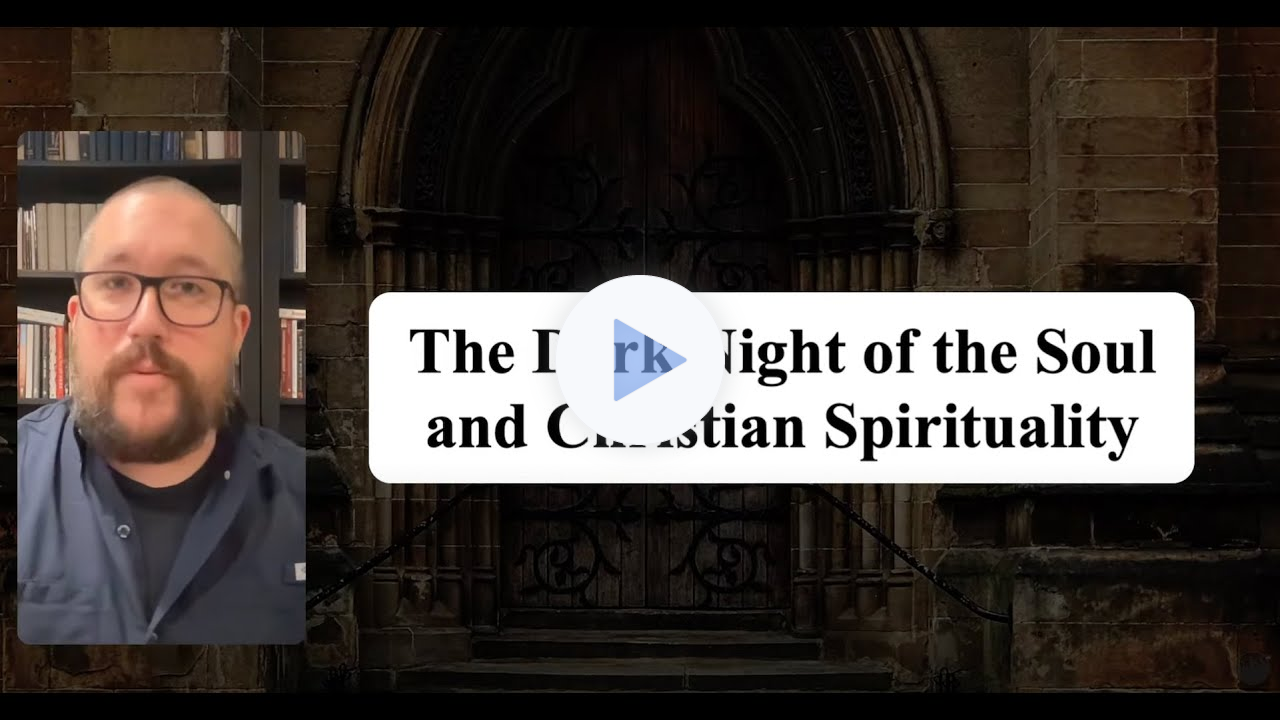
About a year ago, I made a video explaining this experience.
Perhaps it will speak to you at this point in your journey.
3.
“Some of us believe that God is almighty, and can do everything; and that he is all wise, and may do everything; but that he is all love, and will do everything— there we draw back.”
One thing that I enjoy about the Christian mystics is their courage.
They have the gumption to make statements that challenge the status quo.
And it is not that they do it just because they want to. No, it is because they allowed themselves to be vulnerable before this mystery we call God and were then able to experience the Ineffable, from which they had to re-evaluate everything.
No Christian mystic ever came back from an experience of the Divine and said, “We are all screwed.”
Every Christian mystic returned and proclaimed, “It is true; I have seen it; God is infinite, unconditional love!”
4.
“The one who wills anything other than the Good will become divided.”
It kickstarted our little friend group of seminarians to read everything we could from Kierkegaard, but I still consider Purity of Heart is to Will One Thing my favorite.
In it, Kierkegaard evaluates what it means to have divided interests from every angle possible. We often avoid doing evil for mixed reasons, and we do charitable things for mixed reasons, and these things can lead to us having a “split-soul.” As a philosopher and ethicist, Kierkegaard emphasizes the need to love the Good and to devote one’s life to enacting the Good at every opportunity.
5.
“I no longer you servants, because a servant does not know his master’s business. Instead, I have called you friends, for everything that I learned from my Father I have made known to you.”
I have been thinking a fair amount about “obedience.”
It is a form of early faith that frames everything about the Christian faith through obedience and disobedience. And I am not necessarily saying that this is bad. We should curtail our desires and submit to what Love requires of us in a particular moment.
However,
Even Jesus seems to frame the faith differently at the end of his time with the disciples. For him, he had to invite them into friendship while they perhaps wanted to stay servants. The Greek word for “servant” is the same as “slave.” I find it enormously uplifting for Jesus to tell his disciples that he no longer considers them as servants/slaves but as loving friends.
Obedience does not exactly fit within the framework of “loving friends.”
I just wanted to let you know that I have no further thought beyond this. I am still mulling over this topic…
Community activist Rosemarie Freeney Harding (1930–2004) describes her experience of contemplative awareness—what she calls “the Light”—and how it sustained her throughout her life:
I can’t say exactly where the Light entered, where it started from. Suddenly, it was just there with me. A white light, bright enough that it should have hurt to look. But it didn’t hurt. In fact, as the Light grew and enveloped everything in the room, I felt the most astonishing sense of protection, of peace. It surrounded me and I was in it, so joyfully. I don’t know how long I was engulfed by this Light, this space. But when I came out of my room my family was looking at me oddly, like there was something different about me they couldn’t quite name….
I had come in from work and greeted everyone awhile. Then I went into my bedroom to rest. I was just lying on the bed. Maybe dozing. And then I was in the Light….
The Light became a kind of touchstone in my life. It was so much love. Like an infinite compassion. At the same time it was something very precious and intimate. It awed me, really. And when I walked out of the room, everything looked different. Clear. Even later, outside the house, in my classes and at my job, everything looked sharper. It was like a heightened sense of presence. Almost a shine.
Freeney Harding honors numerous paths that can lead to the deepened spiritual grounding that “the Light” provides:
I do believe that whole experience put me on a path. And the Light stayed with me a long time. It gave me a sense of security and deep internal connectedness to God, I would say. All these journeys I’ve been on, these spiritual practices and traditions—from the Mennonites to Bawa Muhaiyaddeen and the Dalai Lama—the meditation, the prayers; I’ve been trying to sustain what the Light gave me. What it awakened and showed me. I guess that’s what the definition of “spirituality” is for me: whatever sustains us like the Light sustained me for years. Is it similar to the Light? Is it the Light?
As I moved away from my family and struggled for years with the unexpected strains of my marriage, I needed the grounding and shelter and strength of that Light. There is something in there, in that profoundly embracing energy, that allows you to come out with a kind of forgiveness, an absence of animosity. It’s like the Dalai Lama says, there’s nothing we can’t go through. We can live through it all with compassion. I want to tell you that this Spirituality of Compassion, if we can call it that, can come through very ordinary people…. There are so many ways—some people go through Vipassana meditation; some say they have seen Jesus; or that they’ve met the Buddha. However they describe it, they’ve met … Help. Encouragement. A deep deep encouragement in this life. For me, it was the Light.
Let thanksgiving temper all your thoughts. A thankful mindset keeps you in touch with Me. I hate it when My children grumble, casually despising My sovereignty. Thankfulness is a safeguard against this deadly sin. Furthermore, a grateful attitude becomes a grid through which you perceive life. Gratitude enables you to see the Light of My Presence shining on all circumstances. Cultivate a thankful heart, for this glorifies Me and fills you with Joy.
RELATED SCRIPTURE:
1st Corinthians 10:10 (NIV) 10 And do not grumble, as some of them did—and were killed by the destroying angel.
Additional insight regarding 1st Corinthians 10:10: Paul warned the Corinthian believers not to grumble. We start to grumble when our attention shifts from what we have to what we don’t have. The people of Israel didn’t seem to notice what God was doing for them – setting them free, making them a nation, giving them a new land – because they were so wrapped up in what God wasn’t doing for them. They could think of nothing but the delicious Egyptian food they had left behind (Numbers 11:5). Before we judge the Israelites too harshly, it’s helpful to think about what occupies our attention most of the time. Are we grateful for what God has given us, or are we always thinking about what we would like to have? Don’t allow your unfulfilled desires to cause you to forget God’s gifts of life, family, friends, food, health, and work.
Hebrews 12:28-29 (NIV) 28 Therefore, since we are receiving a kingdom that cannot be shaken, let us be thankful, and so worship God acceptably with reverence and awe, 29 for our “God is a consuming fire.”
Additional insight regarding Hebrews 12:27-29: Eventually the world will crumble, and only God’s kingdom will last. Those who follow Christ are part of this unshakable Kingdom, and they will withstand the shaking, sifting, and burning. When we feel unsure about the future, we can take confidence from these verses. No matter what happens here, our future is built on a solid foundation that cannot be destroyed; instead, build your life on Christ and his unshakable Kingdom. (see Matthew 7:24-27 for the importance of building on a solid foundation -> 24 “Therefore everyone who hears these words of mine and puts them into practice is like a wise man who built his house on the rock. 25 The rain came down, the streams rose, and the winds blew and beat against that house; yet it did not fall, because it had its foundation on the rock. 26 But everyone who hears these words of mine and does not put them into practice is like a foolish man who built his house on sand. 27 The rain came down, the streams rose, and the winds blew and beat against that house, and it fell with a great crash.”
Additional insight regarding Hebrews 12:28: Here are five ways we can be thankful: (1) We can be thankful that God answers our friends, (2) We can be thankful for God’s provision for our needs, (3) We can be thankful for God’s blessings, (4) We can be thankful for God’s character and wondrous works, and (5) we can be thankful for our brothers and sisters in Christ.
Today’s Prayer:
Heavenly Father,
Teach us to let gratitude temper all our thoughts. Keep us in touch with You, guarding against grumbling and despising Your power and goodness.
Grant us a grateful attitude, Lord, that becomes a lens through which we perceive life and helps us see the countless blessings. Help us to see Your presence shining in all circumstances.
Cultivate within us a thankful heart, God, for it glorifies You and fills us with joy. In Jesus’ perfect name, Amen.
The song that would be here is below. Let it be a bridge DJR
Inaction sometimes is the greatest action we can take. Stillness is sometimes the most important move we can make. —Charles Lattimore Howard, Pond River Ocean Rain
Howard Thurman (1899–1981) offers instructions for practicing stillness and silent meditation:
We must find sources of strength and renewal for our own spirits, lest we perish…. It is very much in order to make certain concrete suggestions in this regard. First, we must learn to be quiet, to settle down in one spot for a spell. Sometime during each day, everything should stop and the art of being still must be practiced. For some temperaments, it will not be easy because the entire nervous system and body have been geared over the years to activity, to overt and tense functions. Nevertheless, the art of being still must be practiced until development and habit are sure. If possible, find a comfortable chair or quiet spot where one may engage in nothing. There is no reading of a book or a paper, no thinking of the next course of action, no rejecting of remote or immediate mistakes of the past, no talk. One is engaged in doing nothing at all except being still. At first one may get drowsy and actually go to sleep. The time will come, however, when one may be quiet for a spell without drowsiness, but with a quality of creative lassitude that makes for renewal of mind and body. Such periods may be snatched from the greedy demands of one’s day’s work; they may be islanded in a sea of other human beings; they may come only at the end of the day, or in the quiet hush of the early morning. We must, each one of us, find [our] own time and develop [our] own peculiar art of being quiet. [1]
Chaplain Charles Lattimore Howard shares the importance of stillness in his faith journey:
Being still has been a necessary part of my walk. Stillness, I should add, is not for me the same as emptiness. While the waters of the pond might be still on the surface, there is much life moving within. Life is within. Love is within!
When I am still I do not empty myself. I would rather be filled with love than have nothing within. And being still allows for this to happen, or rather being still allows for you and I to notice that this has happened already. The love is there within us, even now. Yet sometimes the waves of life rage so incessantly that it is difficult to see or feel that love.
Pausing and being still enough to notice love within and around is a deeply powerful and countercultural act…. In the case of most of contemporary society, stillness is a prophetic act, defying that which demands that we move quickly and move upward. It challenges the notion that it is better to be busy and occupied. It refuses the call to be constantly distracted and perpetually plugged in.
There are texts that you return to not because you want to but because they won’t leave you alone. This confession from Bonhoeffer’s Ethics is one of those for me. What draws me back isn’t primarily how clearly he sees the church’s failures or his steadfast refusal to look away from what he sees. It’s that he writes as one under judgment. He reminds me that in reading the Law as the Word of God, I am drawn into a space where confession is already being made and my failures are already being named.
Grace manifests not despite but through the confession’s unsparing clarity. For it is only when we begin to know our sins as our sins—not as mistakes to correct but as symptoms of a terrible sickness, not as others’ failures but as our own stubborn refusal of and resistance to grace—something shifts in how we see; we begin to glimpse what God is asking the church to be. And that very act of recognition becomes a door into new possibility.
By refusing both the false comfort of premature absolution and the equally false finality of despair, Bonhoeffer opens a space where truth and mercy meet. His confession functions, then, not as an instrument of condemnation but as an invitation into that peculiar form of vision that becomes possible only when we consent to be known by God.
The church confesses that it has not professed openly and clearly enough its message of the one God, revealed for all times in Jesus Christ and tolerating no other gods besides. The church confesses its timidity, its deviations, its dangerous concessions. It has often disavowed its duties as sentinel and comforter. Through this it has often withheld the compassion that it owes to the despised and rejected. The church was mute when it should have cried out, because the blood of the innocent cried out to heaven. The church did not find the right word in the right way at the right time. It did not resist to the death the falling away from faith and is guilty of the godlessness of the masses.
The church confesses that it has misused the name of Christ by being ashamed of it before the world and by not resisting strongly enough the misuse of that name for evil ends. The church has looked on while injustice and violence have been done, under the cover of the name of Christ. It has even allowed the most holy name to be openly derided without contradiction and has thus encouraged that derision. The church recognizes that God will not leave unpunished those who so misuse God’s name as it does.
The church confesses it is guilty of the loss of holidays, for the barrenness of its public worship, for the contempt for Sunday rest. It has made itself guilty for the restlessness and discontent of working people, as well as for their exploitation above and beyond the workweek, because its preaching of Jesus Christ has been so weak and its public worship so limp.
The church confesses that it is guilty of the breakdown of parental authority. The church has not opposed contempt for age and the divinization of youth because it feared losing the youth and therefore the future, as if its future depended on the young! It has not dared to proclaim the God-given dignity of parents against revolutionary youth and has made a very worldly-minded attempt “to go along with youth.” Thus it is guilty of destroying countless families, for children’s betraying their parents, of the self-divinizing of youth, and therefore of abandoning them to fall away from Christ.
The church confesses that it has witnessed the arbitrary use of brutal force, the suffering in body and soul of countless innocent people, that it has witnessed oppression, hatred, and murder without raising its voice for the victims and without finding ways of rushing to help them. It has become guilty of the lives of the weakest and most defenseless brothers and sisters of Jesus Christ.
The church confesses that it has not found any guiding and helpful word to say in the midst of the dissolution of all order in the relationship of the sexes to each other. It has found no strong or authentic message to set against the disdain for chastity and the proclamation of sexual licentiousness. Beyond the occasional expression of moral indignation it has had nothing to say. The church has become guilty, therefore, of the loss of purity and wholesomeness among youth. It has not known how to proclaim strongly that our bodies are members of Christ.
The church confesses that it has looked on silently as the poor were exploited and robbed, while the strong were enriched and corrupted.
The church confesses its guilt toward the countless people whose lives have been destroyed by slander, denunciation, and defamation. It has not condemned the slanderers for their wrongs and has thereby left the slandered to their fate.
The church confesses that it has coveted security, tranquility, peace, property, and honor to which it had no claim, and therefore has not bridled human covetousness, but promoted it.
The church confesses itself guilty of violating all of the Ten Commandments. It confesses thereby its apostasy from Christ. It has not so borne witness to the truth of God in a way that leads all inquiry and science to recognize its origin in this truth. It has not been able to make the loving care of God so credible that all human economic activity would be guided by it in its task. By falling silent the church became guilty for the loss of responsible action in society, courageous intervention, and the readiness to suffer for what is acknowledged as right. It is guilty of the government’s falling away from Christ.¹
Usually, we read the Decalogue as a catalogue of moral imperatives, a checklist for good behavior—don’t lie, don’t kill, don’t steal, honor your parents. Bonhoeffer sees them as lamp and as mirror, both revealing the will of God and truthfully reflecting the church’s participation in—or resistance to—God’s purposes in the world. He also sees that they primarily address the people of God as a body, not the individual believer.
Consider how he reads the breaking of the Sabbath commandment. The issue isn’t missed services or a refusal to work on Sunday. The failure is how the church has become complicit in patterns of exploitation that make faithful prayer and genuine rest impossible. Similarly, what he recognizes in the violation of the commandment to honor parents is the surrender to an idolatry of youth, which betrays the church’s vocation to embody and sustain the bonds between generations.
Seen this way, personal sins are recognized as symptoms of corporate failures that have damaged the very structure of our common life. This is why Bonhoeffer keeps returning to the church’s silence. When we stay quiet in the face of injustice, when we watch violence without protest, when we let God’s name be misused without objection—we’re not just failing to act; we’re actively participating in evil.
This kind of silence sends its own message. It says “yes” to wrong, manifests fear, and proves we care more about keeping our institutions safe than knowing the truth or welcoming the Kingdom of God. Yet we’d be wrong to think Bonhoeffer is calling for endless protest and hot-blooded pronouncements. He recognizes, and we must recognize with him, a deeper, truer silence, one that emerges not from anger or the fear that drives it but from unshaken confidence in God, from that restraint and self-possession that characterizes the meek and lowly life of Christ. This is holy silence—the silence of patience with God (in both senses of that phrase), the glad attentiveness that is faith’s most natural posture. It is the silence that makes room for prayer and that at its truest itself becomes prayer.
Holy silence creates a peculiar kind of teachability, a loving receptivity to the Word that comes to those who have discovered in their own poverty the inexhaustible power and endlessly creative wisdom of God. Only in this stillness, this learned receptivity to God’s own rhythm of speech and silence, we learn to distinguish between our anxious need to speak and God’s actual summons to witness.
Good silence and good speech share a common root: attention to what God is doing in the world. Bad silence and bad speech likewise spring from a common source: the fear that what God is doing isn’t enough. This helps us understand why Bonhoeffer sees worship and witness as inseparable. The church gathers not to escape the world but to learn to see it truly. In worship, we practice the attention that makes both prayerful silence and prophetic speech possible.
The church must make God credible. And it does that by how we worship, how we live out our lives. So, when worship becomes weak or listless, it’s not merely an aesthetic disappointment. It’s a fundamental failure of vision and a shirking of vocation. Notice how Bonhoeffer links “the barrenness of public worship” directly to the church’s silence before violence and its failure to defend victims. This is also why he insists that weak worship and failed witness aren’t separate problems needing separate solutions but two faces of a single failure: our inability to be the people of God in and for the world.
When we gather for worship, we’re not just performing rituals or seeking spiritual comfort. We’re learning to see reality as God sees it. Without this fundamental formation in truthful seeing, we lose our capacity to recognize Christ’s presence in the vulnerable and become blind to what God is doing in the world and so find ourselves complicit in the very structures of violence we’re called to resist in praise and intercession.
The confession ends with what might seem an absurd claim: that the church bears guilt for “the government’s falling away from Christ.” Bonhoeffer can say this because he believes Christ has already given himself completely to us, to all of us, holding nothing back. This total gift makes total confession possible. The church’s answerability, therefore, extends beyond its own disobedience to include the moral and spiritual deterioration of the society in which the Spirit roots it.
The problem is never that the church has failed to gain political power or establish Christian control over society (assuming such a thing were even possible). The failure is always more fundamental: we haven’t made “the loving care of God so credible that all human economic activity would be guided by it.” This language of credibility is crucial. It suggests that our task isn’t to dominate but to demonstrate, not to rule but to reveal—to embody divine love in ways that transform how humans imagine and organize their life together.
What does it mean to make God’s love “credible”? The word itself is telling—this isn’t about asserting authority or demanding compliance, but about embodying truth in such a way that it becomes more believable, more compelling, less untrustworthy. When the church fails in this task—when we cannot or will not make visible the reality of divine love in the midst of human frailty and failing—something happens to our moral imagination. The very possibility of organizing common life around something other than power and self-interest begins to fade.
Yet precisely here, in this recognition of the church’s comprehensive failure, mercy finds its opening. These words of confession, when held to the light, work like a photographic negative. They not only expose our disobedience but also reveal what our obedience would mean. Each confession carries within it a shadow of possibility, a glimpse of what the church might yet be if it accepted its true vocation. Paradoxically, the church makes God’s love credible not so much in its successes but in how it responds to its failures.
To confess our guilt for the world’s brokenness, then, is not to collapse under our own weight. It is to begin taking up our actual task, making visible in our common life the love that alone can heal what we have broken and refused to repair. This is what it means to make God’s love credible—to demonstrate in our actual flesh and blood that another way of being human is possible. Not because we have achieved it, but because in confessing our failure to achieve it, we find ourselves somehow already caught up in its movement.
Perhaps this is why Bonhoeffer’s words continue to haunt us. They offer no easy comfort, no simple path to institutional renewal. Instead, they invite us into a more difficult hope. By naming our comprehensive failure to make God’s love visible and credible, they open up the possibility of living differently. Not by our own strength or wisdom, but by learning to inhabit more deeply the life we’re given in Christ.
This means unlearning some of our usual ways of thinking about church reform. We typically imagine that recognition of failure should lead either to despair or to energetic programs of correction. Bonhoeffer suggests another way: dwelling in the truth of our condition until we begin to see what God is already doing. Only there, in that difficult space where truth and mercy meet, can we begin to glimpse what genuine reformation might mean.
What emerges isn’t a program but a posture—learning to live as Christ’s body in ways that make God’s love tangible and trustworthy in the world. This isn’t about success or failure, really. It’s about faithfulness. And faithfulness begins in learning to tell the truth about ourselves in the light of God’s tender mercies.
Her greatest gift was her willingness to consent to God’s presence and action in her life. —Thomas Keating, Mary, the Mother of God
CAC Faculty Emerita Cynthia Bourgeault has spent decades teaching the practice of Centering Prayer. She shares:
For over forty years now, the following four guidelines have successfully introduced tens of thousands of people worldwide to Centering Prayer:
Choose a sacred word as the symbol of your intention to consent to God’s presence and action within.
Sitting comfortably and with eyes closed, settle briefly and silently introduce the sacred word as the symbol of your consent to God’s presence and action within.
When engaged with your thoughts [including body sensations, feelings, images, and reflections], return ever-so-gently to the sacred word.
At the end of the prayer period, remain in silence with eyes closed for a couple of minutes. [1]
Father Thomas Keating suggests praying for twenty minutes twice a day.
So are we really saying that in Centering Prayer you meditate by simply letting go of one thought after another? That can certainly be our subjective experience of the practice, and this is exactly the frustration expressed by an early practitioner. In one of the very earliest training workshops led by Keating himself, a nun tried out her first twenty-minute taste of Centering Prayer and then lamented, “Oh, Father Thomas, I’m such a failure at this prayer. In twenty minutes I’ve had ten thousand thoughts!”
“How lovely,” responded Keating, without missing a beat. “Ten thousand opportunities to return to God.”
This simple story captures the essence of Centering Prayer. It is quintessentiallya pathway of return in which every time the mind is released from engagement with a specific idea or impression, we move from a smaller and more constricted consciousness into that open, diffuse awareness in which our presence to divine reality makes itself known along a whole different pathway of perception.
That’s what the anonymous author of the fourteenth-century spiritual classic The Cloud of Unknowing may have had in mind when he wrote, “God may be reached and held close by means of love, but by means of thought never.” [2] “Love” is this author’s pet word for that open, diffuse awareness which gradually allows another and deeper way of knowing to pervade one’s entire being.
Out of my own four decades of experience in Centering Prayer, I believe that this “love” indeed has nothing to do with emotions or feelings in the usual sense. It is rather the author’s nearest equivalent term to describe what we would nowadays call nondual perception anchored in the heart.
And he is indeed correct in calling it “love” because the energetic bandwidth in which the heart works is intimacy, the capacity to perceive things from the inside by coming into sympathetic resonance with them. Imagine! Centuries ahead of his time, the author is groping for metaphors to describe an entirely different mode of perceptivity.
I’m good-weird, my family tells me. I’ve explained to our boys that weird can be a positive trait, rather than an adjective of uncertainty used to reject something or someone.They turned my description back on me, and I ham it up and act the part. I sing at random moments. I make up incomprehensible raps in the car, which always ends in family giggling. I’m obsessed with books, and my wife and the boys understand that they are super nerdy books, like commentaries on the book of Revelation. I’m convinced that the more we live into God’s True Self in us, the more “good-weird” we become. The more we seek God, the more we become who we are.
I know your works; you are neither cold nor hot. I wish that you were either cold or hot. So, because you are lukewarm, and neither cold nor hot, I am about to vomit you out of my mouth. —Revelation 3:15–16
In this section of the book of Revelation, John of Patmos has been writing letters to churches across Asia Minor (or ancient Turkey). Here he writes to a well-off Roman administrative center called Laodicea. To be more accurate, John of Patmos has been writing in the voice of the Cosmic Christ speaking to angels of seven churches, who are intended to receive the message on behalf of the congregations. (Check out the section “Make Sense of Angels Like a Scientist” in my book The Holy Ordinary to dive more deeply into the good-weirdness of angels). The message Christ has for the Laodiceans is graphic and challenging, needed in their time and ours, and it boils down to this: Be different! Be “good-weird” from the surrounding culture! Stand up for something!
The hot or cold liquid imagery is taken from banqueting practices of the time. I grew up listening to an evangelical praise song that asked God to “Light the Fire Again,” presuming that becoming hot for God was the goal. Christ here seems to think either hot or cold is advantageous; what matters is, at all costs, not to be lukewarm. Apparently, this magisterial commentary tells me, a well-off banquet host in Roman imperial cities would have hot and cold water available to mix with wine. You wanted to keep guests happy, and giving them options to fix their drinks was one way. Surely there would be guests who went overboard and vomited due to excessive food and drink; the image here, though, is Christ as a disgusted banquet-attendee throwing up after drinking lukewarm wine. Neither hot nor cold.
“I know your works” is one of the phrases that the Cosmic Christ repeats to multiple congregations. To the Jesus-followers in another ancient city named Thyatira, Christ says, “I know your works—your love, faith, service, and patient endurance” (Romans 2:19; “patient endurance” is best translated as nonviolent resistance). This gives us a sense of what Christ is looking for: love and devotion to God and other people, faith that this reality and the power of empire are not ultimate, service to those most in need, and firm nonviolent resistance that knows larger power and love still guide us, even when appearances are to the contrary.
The problem seems to be the Laodiceans privileged complacency: “For you say, “I am rich, I have prospered, and I need nothing” (Revelation 3:17). Wealth, fullness, and distance from those most suffering breed lukewarm hearts. If someone is white, wealthy, and seemingly self-sufficient, it becomes easy to ignore the struggles of immigrants, transgender individuals, and those advocating for Palestinian rights in an increasingly repressive United States.
But the entry fee to God’s banquet is powerlessness. It’s the first step of the twelve: “We admitted that we were powerless over ____ (fill in the blank), that our lives had become unmanageable.” It’s humiliating to admit it, but addictive patterns are universal to the human condition. Call it sin or woundedness, but we are all looking for gratification, comfort, control, and esteem, and many of us will go to great lengths to secure them. Or we will live in terror that it will all be taken away. Some identify as people in recovery, but those in recovery are simply harbingers of our authentic state. We need help. We can’t do it alone. Our accomplishments, bank accounts, and friends are not enough. The spiritual journey is recovery.
Once we are empty, we can begin to feast. Christ knocks on the door, John writes, “if you hear my voice and open the door, I will come in to you and eat with you, and you with me” (3:20). Our pregnant emptiness will result in “good-weird” works that set us apart from dominant systems. We may grow our own food in simplicity, hug trees in our love for nature, befriend immigrants, help feed people who are hungry, protest harmful federal funding cuts, refuse to see Palestinians as less than human, or simply read authors such as James Baldwin or Louise Erdrich for the first time. We may publish our thoughts, like me, on a Substack, or share them through a sermon, poem, or a song. We may shut off devices and turn off our social media accounts, for a day, a week, or a year. We may sing, pray, shout, or weep to God because our hearts are anything but lukewarm.
Father Richard Rohr describes the importance of a practice of contemplation:
Contemplation is about seeing, but a kind of seeing that is much more than mere looking because it also includes recognizing and thus appreciating. The contemplative mind does not tell us what to see but teaches us how to see what we behold.
Contemplation allows us to see the truth of things in their wholeness. It is a mental discipline and gift that detaches us, even neurologically, from our addiction to our habitual way of thinking and from our minds which like to think they are in control. We stop believing our little binary mind (which strips things down to two choices and then usually identifies with one of them) and begin to recognize the inadequacy of that limited way of knowing reality. In fact, a binary mind is a recipe for superficiality, if not silliness. Only the contemplative, or the deeply intuitive, can start venturing out into much broader and more open-ended horizons. This is probably why Einstein said that “Imagination is more important than knowledge. Knowledge is limited. Imagination encircles the world.” [1]
But how do we learn this contemplative mind, this deep, mysterious, and life-giving way of seeing, of being with, reality? Why does it not come naturally to us? Actually, it does come momentarily, in states of great love and great suffering, but such wide-eyed seeing normally does not last. We return quickly to dualistic analysis and use our judgments to retake control. A prayer practice—contemplation—is simplya way of maintaining the fruits of great love and greatsuffering over the long haul and in different situations. And that takes a lot of practice—in fact, our wholelife becomes one continual practice.
To begin to see with new eyes, we must observe—and usually be humiliated by—the habitual way we encounter each and every moment. It is humiliating because we will see that we are well-practiced in just a few predictable responses. Few of our responses are original, fresh, or naturally respectful of what is right in front of us. The most common human responses to a new moment are mistrust, cynicism, fear, knee-jerk reactions, a spirit of dismissal, and overriding judgmentalism. It is so dis-couraging when we have the courage to finally see that these are the common ways that the ego tries to be in control of the data instead of allowing the moment to get some control over us—and teach us something new!
To let the moment teach us, we must allow ourselves to be at least slightly stunned by it until it draws us inward and upward, toward a subtle experience of wonder. We normally need a single moment of gratuitous awe to get us started—and such moments are the only solid foundation for the entire religious instinct and journey.
A Simple Practice
Richard Rohr encourages regular contemplative practice.
To live in the present moment requires a change in our inner posture. Instead of expanding or shoring up our fortress of the small self—the ego—contemplation waits to discover who we truly are. Most people think they are their thinking; they don’t have a clue who they are apart from their thoughts. In contemplation, we move beneath thoughts and sensations to the level of pure being and naked awareness.
In contemplative prayer, we calmly observe our own stream of consciousness and see its compulsive patterns. We wait in silence with an open heart and attuned body. It doesn’t take long for our usual patterns to assault us. Our habits of control, addiction, negativity, tension, anger, and fear assert themselves. When Jesus is “driven” by the Spirit into the wilderness, the first things that show up are “wild beasts” (Mark 1:13). Contemplative prayer is not consoling, at least not at first, which is why so many give up. Yes, truth will set us free, but generally, it first makes us miserable. [1]
Inspired by Father Thomas Keating (1923–2018), the founder of Contemplative Outreach, Richard developed this exercise:
Imagine you are sitting on a riverbank. Boats and ships—thoughts, feelings, and sensations—are sailing past. While the stream flows by your inner eye, name each of these vessels. For example, one of the boats could be called “my anxiety about tomorrow.” Or along comes the ship “objections to my husband” or the boat “I don’t do that well.” Every judgment that you let pass is one of those boats; take time to name each one and then allow them move down the river.
This can be a difficult exercise because you’re used to jumping aboard the boats—your thoughts—immediately. As soon as you own a boat and identify with it, it picks up energy. This is a practice in un-possessing, detaching, letting go. With every idea, with every image that comes into your head, say, “No, I’m not that; I don’t need that; that’s not me.”
Sometimes, a boat turns around and heads back upstream to demand your attention again. It’s hard not to get hooked by habitual thoughts. Sometimes you’ll be tempted to torpedo your boats. But don’t attack them. Don’t hate them or condemn them. Contemplation is also an exercise in nonviolence. The point is to recognize your thoughts, which are not you, and to say, “That’s not something I need.” But do it very amiably. As you learn to handle your own soul tenderly and lovingly, you’ll be able to carry this same loving wisdom out into the world. [2]
Many teachers insist on at least twenty minutes for a full contemplative “sit,” because we have found that the first half (or more) of any contemplative prayer time is just letting go of those thoughts, judgments, fears, negations, and emotions that want to impose themselves. We become watchers and witnesses, stepping back and observing without judgment. Gradually we come to realize those thoughts and feelings are not actually “me.”
Thomas Keating and Centering Prayer
Today’s post is by Mary van Balen
I’m not sure when I began reading books by Thomas Merton. Probably late high school or early college. I’m also not sure how I discovered them. Though I was naturally drawn to contemplative prayer, the word was unfamiliar to me until Merton’s writings provided it. “Contemplative” was not something you heard about sitting in the pews on Sundays or even in religion classes. Not usually. Reflecting on that later, I never understood why. Christianity has a long, rich contemplative tradition.
Some of my friends from those early days, searching as college students do and longing for an alternative to rote prayers and rituals that, for them, had become mindless habit, explored meditation found in Eastern traditions. They hungered for a deeper relationship with God.
A way to sink deeply into that relationship is contemplative prayer. Not reserved for “special” people or for a few “advanced” souls as sometimes thought, it is simply resting in silence with the loving God who dwells within each of us.
I was lucky to find not only Thomas Merton, but also a small community that introduced me to classics in Christian literature like Teresa of Avila and John of the Cross and provided a vocabulary to talk about contemplative prayer. What a gift it was to finally have others with whom to pray and share the journey.
Later, I found the Desert Fathers and Mothers, The Cloud of Unknowing (written by an anonymous 14thcentury English monk), John Cassian, Julian of Norwich, and other mystical writers. I had begun to practice Lectio Divina and realized that my longtime journaling was part of my contemplative prayer journey (something I love to share at retreats and workshops). Time spent with Benedictine monks and sisters broadened and deepened my prayer experience.
The hunger for contemplative prayer among many Christians remains as deep as ever. Even if it’s not talked about much in parishes, there are many resources available today.
What prompted me to reflect on this was the passing on October 25 of Fr. Thomas Keating, at age 95. He is likely the most well-known Trappist monk since Merton. Keating is recognized for his development and promotion (along with others including M. Basil Pennington and William Meninger) of the centering prayer method of Christian meditation.]
This prayer practice began in the 1970s at Saint Joseph’s Abbey in Spencer Massachusetts where Keating was abbot for twenty years. It was a prompted by conversations with young Christians, who, like my college friends, were seeking a prayer path that was meditative and transformative. They stopped by the Abbey to ask directions to a Buddhist meditation center that had been opened nearby in what once had been a Catholic retreat house. When Keating asked the young searchers why they didn’t look for a path in the Christian tradition, their answer was the same as my friends’ might have been: There’s a Christian path?
Keating talked to the monks at the Abbey about developing a method of meditation—based on Scripture and Christian tradition—that would be accessible to anyone, those beyond the monastery walls as well as inside them. The result is what is now known as Centering Prayer.
There are many resources available if you are interested in learning more about it; here are a few: Open Mind, Open Heartby Keating; Finding Grace at the Centerby Thomas Keating, M. Basil Pennington, OCSO and Thomas E. Clark, SJ.; Centering Prayer and Inner Awakeningby Episcopalian priest Cynthia Bourgeault. The Contemplative Outreach, an organization Keating founded in 1984, has a website full of information and resources. Some parishes have Centering Prayer groups that meet weekly.
Centering Prayer is not the only way to practice and nurture one’s contemplative life. Shalem introduces program participants to a variety of approaches. And, of course, a person is not restricted to practicing only one. As Fr. Keating wrote in a selection found on the Contemplative Outreach website addressing different approaches to meditative prayer: “In Buddhism there are a wide variety of methods (perhaps techniques would be a better designation). Why shouldn’t Christians have a few?”
There are many! If you find yourself drawn to contemplation, Centering Prayer is one method to consider. It is popular, accessible, and practiced by hundreds of thousands around the globe.
This CO2- (Church Of 2) is where two guys meet each day to tighten up our Connections with Jesus. We start by placing the daily “My Utmost For His Highest” in this WordPress blog. Then we prayerfully select some matching worship music and usually pick out a few lyrics that fit especially well. Then we just start praying and editing and Bolding and adding comments and see where the Spirit takes us.
It’s been a blessing for both of us.
If you’d like to start a CO2, we’d be glad to help you and your partner get started. Also click the link below to see how others are doing CO2.Odds Monkey
Steve Harvey Introduces Jesus To A Secular Audience
About
Change this text in the admin section of WordPress
You are currently browsing the CO2MannaToday blog archives.