A Sign of God’s Love

December 23rd, 2021 by JDVaughn No comments »

Father Richard counts the German Jesuit Karl Rahner (1904–1984) as an influential theologian in his life. Here Rahner reflects on the Incarnation and the meaning of Christmas:

If in faith we say, “It is Christmas”—in faith that is determined, sober, and above all courageous—then we mean that an event came bursting into the world and into our life, an event that has changed all that we call the world and our life. . . .

Through this fact, that God has become human, time and human life are changed. Not to the extent that God has ceased to be Godself, the eternal Word of God, with all splendor and unimaginable bliss. But God has really become human. And now this world and its very destiny concern God. . . . Now God’s self [as Jesus] is on our very earth, where he is no better off than we and where he receives no special privileges, but our every fate: hunger, weariness, enmity, mortal terror and a wretched death. That the infinity of God should take upon itself human narrowness, that bliss should accept the mortal sorrow of the earth, that life should take on death—this is the most unlikely truth. But only this—the obscure light of faith—makes our nights bright, only this makes them holy.

God has come. God is there in the world. And therefore everything is different from what we imagine it to be. . . . When we say, “It is Christmas,” we mean that God has spoken into the world his last, his deepest, his most beautiful word in the incarnate Word. . . . And this word means: I love you, you, the world and human beings. [1]

Father Richard also celebrates the Incarnation as God’s positive and affirming “I Love You” to all creation:

What we are all searching for is Someone to surrender to, something we can prefer to life itself. Well, here is the wonderful surprise: God is the only one we can surrender to without losing ourselves. The irony is that we find ourselves, and now in a whole new and much larger field of meaning. An eternal promise came into the world at Christmas, “full of grace and of truth” (John 1:14). Jesus is the gift totally given, free for the taking, once and for all, to everybody and all of creation. This Cosmic Risen Christ really is like free wireless, and all we need to do is connect.

Henceforth humanity has the right to know that it is good to be human, good to live on this earth, good to have a body, because God in Jesus chose and said “yes” to this planet and this humanity. As we Franciscans have said, “Incarnation is already Redemption.” The problem is solved. Now go and utterly enjoy all remaining days. Not only is it “always Advent,” but every day can now be Christmas because the one we thought we were just waiting for has come once and for all.

Sarah Young

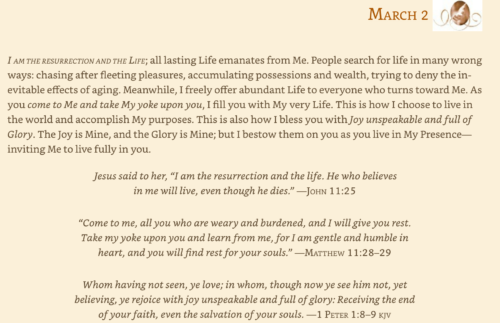
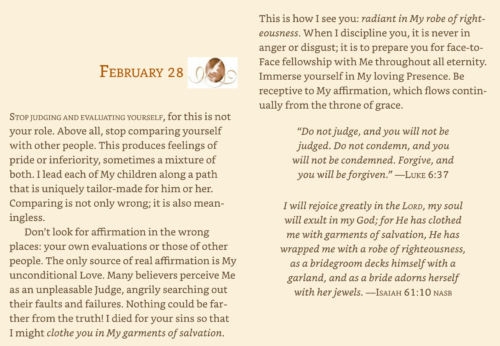
IAM KING OF KINGS and Lord of lords, dwelling in dazzlingly bright Light! I am also your Shepherd, Companion, and Friend—the One who never let’s go of your hand.

Worship Me in My holy Majesty; come close to Me, and rest in My Presence. You need Me both as God and as Man. Only My Incarnation on that first, long-ago Christmas could fulfill your neediness.

Since I went to such extreme measures to save you from your sins, you can be assured that I will graciously give you all you need. Nurture well your trust in Me as Savior, Lord, and Friend.

I have held back nothing in My provision for you. I have even deigned to live within you! Rejoice in all that I have done for you, and My Light will shine through you into the world.

1 TIMOTHY 6:15–16; 15which God will bring about in his own time-God, the blessed and only Ruler, the King of kings and LORD of lords, ^16who alone is immortal and who lives in unapproachable light, whom no one has seen or can see. To him be honor and might forever. Amen.

PSALM 95:6–7; Come, let us bow down in worship, let us kneel before the LORD our Maker; ⁷for he is our God and we are the people of his pasture, the flock under his care. Today, if only you would hear his voice,

ROMANS 8:32; He who did not spare his own Son, but gave him up for us all-how will he not also, along with him, graciously give us all things?

2 PETER 1:19 19We also have the prophetic message as something completely reliable, and you will do well to pay attention to it, as to a light shining in a dark place, until the day dawns and the morning star rises in your hearts

Young, Sarah. Jesus Calling Morning and Evening Devotional (Jesus Calling®) (p. 738). Thomas Nelson. Kindle Edition.

December 22nd, 2021 by Dave No comments »

Hope for Our Humanity

Author and poet Kathleen Norris acknowledges the exhaustion many of us feel after “we scurry for weeks, baking, shopping, working extra hours, rehearsing and presenting Christmas pageants.” She believes, however, that it is in admitting our weariness that we find hope:

It is not merely the birth of Jesus we celebrate [now] although we recall it joyfully, in song and story. The feast of the Incarnation invites us to celebrate also Jesus’ death, resurrection, and coming again in glory. It is our salvation story, and all of creation is invited to dance, sing, and feast. But we are so exhausted. How is it possible to bridge the gap between our sorry reality and the glad, grateful recognition of the Incarnation as the mainstay of our faith? We might begin by acknowledging that if we have neglected the spiritual call of Advent for yet another year, and have allowed ourselves to become thoroughly frazzled by December 24, all is not lost. We are, in fact, in very good shape for Christmas.

It is precisely because we are weary, and poor in spirit, that God can touch us with hope. This is not an easy truth. It means that we do accept our common lot, and take up our share of the cross. It means that we do not gloss over the evils we confront every day, both within ourselves and without. Our sacrifices may be great. But as the martyred archbishop of El Salvador, Oscar Romero, once said, it is only the poor and hungry, those who know they need someone to come on their behalf, who can celebrate Christmas.

[At Christmas] we are asked to acknowledge that the world we have made is in darkness. We are asked to be attentive, and keep vigil for the light of Christ. . . . We, and our world, are broken. Even our homes have become places of physical and psychological violence. It is only God, through Jesus Christ, who can make us whole again.

The prophecy of Isaiah [62:1–5] allows us to imagine a time when God’s promise will be fulfilled, and we will no longer be desolate, or forsaken, but found, and beloved of God. We find a note of hope also in the Gospel of Matthew [1:1–17]. In the long list of Jesus’ forebears, we find the whole range of humanity: not only God’s faithful, but adulterers, murderers, rebels, conspirators, transgressors of all sorts, both the fearful and the bold. And yet God’s purpose is not thwarted. In Jesus Christ, God turns even human dysfunction to the good.

The genealogy of Jesus reveals that God chooses to work with us as we are, using our weaknesses, even more than our strengths, to fulfill the divine purpose. . . . In a world as cold and cruel and unjust as it was at the time of Jesus’ birth in a stable, we desire something better. And in desiring it, we come to believe that it is possible. We await its coming in hope.


The Birth of Christ in Us Is What Matters

December 21st, 2021 by JDVaughn No comments »

Make ready for the Christ, Whose smile, like lightning, 
Sets free the song of everlasting glory
That now sleeps, in your paper flesh, like dynamite.
—Thomas Merton, “The Victory”

Anglican mystic and author Evelyn Underhill (1875–1941) shares her perspective on the importance of Jesus’ incarnation and this season in the church’s life:

The Christmas Mystery has two parts: the Nativity and the Epiphany. A deep instinct made the Church separate these two feasts. In the first we commemorate God’s humble entrance into human life, the emergence and birth of the Holy, and in the second its manifestation to the world, the revelation of the Supernatural made in that life. And the two phases concern our inner lives very closely too. The first only happens in order that the second may happen, and the second cannot happen without the first. Christ is a Light to lighten the Gentiles as well as the Glory of His people Israel. Think of what the Gentile was when these words were written—an absolute outsider. All cosy religious exclusiveness falls before that thought. The Light of the world is not the sanctuary lamp in your favourite church. . . .

Underhill continues by exploring what it means for Christ to be born in our lives and souls:

Beholding His Glory is only half our job. In our souls too the mysteries must be brought forth; we are not really Christians till that has been done. “The Eternal Birth,” says [Meister] Eckhart, “must take place in you.” [1] And another mystic says human nature is like a stable inhabited by the ox of passion and the ass of prejudice; animals which take up a lot of room and which I suppose most of us are feeding on the quiet. And it is there between them, pushing them out, that Christ must be born and in their very manger He must be laid—and they will be the first to fall on their knees before Him. Sometimes Christians seem far nearer to those animals than to Christ in His simple poverty, self-abandoned to God.

The birth of Christ in our souls is for a purpose beyond ourselves: it is because His manifestation in the world must be through us. Every Christian is, as it were, part of the dust-laden air which shall radiate the glowing Epiphany of God, catch and reflect His golden Light. Ye are the light of the world—but only because you are enkindled, made radiant by the One Light of the World. And being kindled, we have got to get on with it, be useful. As Christ said in one of His ironical flashes, “Do not light a candle in order to stick it under the bed!” [Mark 4:21] . . .

When you don’t see any startling marks of your own religious condition or your usefulness to God, think of the Baby in the stable and the little Boy in the streets of Nazareth. The very life was there which was to change the whole history of the human race.

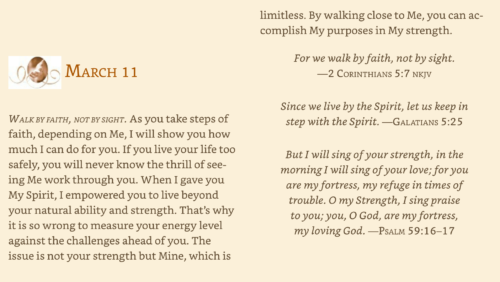
MY PLAN FOR YOUR LIFE is unfolding before you. Sometimes the road you are traveling seems blocked, or it opens up so painfully slowly that you must hold yourself back.

Then, when time is right, the way before you suddenly clears—through no effort of your own. What you have longed for and worked for I present to you freely, as pure gift. You feel awed by the ease with which I operate in the world, and you glimpse My Power and My Glory.

Do not fear your weakness, for it is the stage on which My Power and Glory perform most brilliantly. As you persevere along the path I have prepared for you, depending on My strength to sustain you, expect to see miracles—and you will.

Miracles are not always visible to the naked eye, but those who live by faith can see them clearly. Living by faith, rather than sight, enables you to see My Glory.

PSALM 63:2–5; I have seen you in the sanctuary and beheld your power and your glory. ³Because your love is better than life, my lips will glorify you. ⁴I will praise you as long as I live, and in your name I will lift up my hands. ⁵I will be fully satisfied as with the richest of foods; with singing lips my mouth will praise you.

2 CORINTHIANS 5:7; For we walk by faith, and not by sight.] Faith is a grace which answers many useful purposes; it is the eye of the soul, by which it looks to Christ for righteousness, peace, pardon, life, and salvation; the hand by which

JOHN 11:40; Then Jesus said, “Did I not tell you that if you believe, you will see the glory of God?”

Young, Sarah. Jesus Calling Morning and Evening Devotional (Jesus Calling®) (p. 734). Thomas Nelson. Kindle Edition.

December 20th, 2021 by Dave No comments »

What Are We Waiting For?

Father Richard Rohr describes how Francis of Assisi (1182–1226) shaped Christianity’s celebration of Christmas.

In the first 1200 years of Christianity, the most prominent feast was Easter, the celebration of Christ’s resurrection. Around 1200, Francis of Assisi entered the scene, and he felt we didn’t need to wait for God to love us through the cross and resurrection. He believed God loved us from the very beginning and showed this love by becoming incarnate in Jesus. He popularized what we take for granted today, the great Christian feast of Christmas. But Christmas only started being popular in the 13th century.

The main point I want to make is the switch in theological emphasis that took place. The Franciscans realized that if God had become flesh and taken on materiality, physicality, and humanity, then the problem of our unworthiness was solved from the very beginning! God “saved” us by becoming one of us!

Franciscans fasted a lot in those days, as many Christians did, and Francis went so wild over Christmas that he said, “On Christmas Day, I want even the walls to eat meat!” [1] He said that every tree should be decorated with lights to show that that is its true nature. That’s what Christians around the world still do eight hundred years later.

But remember, when we speak of Advent or waiting and preparing for Christmas, we’re not simply waiting for the little baby Jesus to be born. That already happened two thousand years ago. We’re forever welcoming the Universal Christ, the Cosmic Christ, the Christ that is forever being born in the human soul and into history.

Franciscan sister and theologian Ilia Delio invites us to consider Advent as a time to wake up to God’s incarnate presence:

The word Advent comes from the Latin adventus meaning arrival, “coming.”. . .

[But] if God has already come to us, what are we waiting for? If God has already become incarnate in Jesus what are we waiting for? And I think that’s a really interesting question. . . .

We’re called to awaken to what’s already in our midst. . . . I think Advent is a coming to a new consciousness of God, you know, already loving us into something new, into something more whole, that we’re not in a sense waiting for what’s not there; we’re in a sense to be attending to what’s already there.

But the other part I think is that we can think of Advent as God waiting for us to wake up! You know, as if we’re asleep in the manger, not Jesus! Jesus is alive in our midst. . . . What if we’re in the manger and God is already awakened in our midst and we’re so fallen asleep, we’re so unconsciously asleep that God is sort of looking for “someone [to] get up and help bring the gifts into the world?” . . .

Let’s awaken to what God is doing in us and what God is seeking to become in us.

The Poverty of Christmas

Father Richard reminds us of the startling realities of the first Christmas: 

There’s really nothing necessarily pretty about the first Christmas. We have Joseph breaking the law, knowing what he should do with a seemingly “adulterous woman,” but he doesn’t divorce Mary as the Law clearly tells him to do, even though he has no direct way of knowing that the baby was conceived by the Holy Spirit [Matthew 1:18–24]. It can certainly lead us to wonder why so much of Christianity became so legalistic when we have at its very beginning a man who breaks the law to protect the dignity of the woman he loves. Then we clearly have a couple that is homeless and soon to be refugees or immigrants in their flight to Egypt shortly after Jesus’ birth [Matthew 2:13–15].

So where is this God revealing God’s self? Certainly not in the “safe” world, but at the edge, at the bottom, among those people and places where we don’t want to find God, where we don’t look for God, where we don’t expect God. The way we’ve shaped Christianity, one would think it was all about being nice and middle class and “normal” and under the law. In the Gospels, Jesus, Mary, and Joseph are none of those things, so they might just be telling us we should be looking elsewhere for our status and dignity. Maybe the reason that our knowledge of God is so limited is because we’ve been looking for God in places we consider nice and pretty. Instead, God chooses the ordinary and messy.

Dorothy Day (1897–1980), founder of the Catholic Worker, writes: 

It would be foolish to pretend that it is always easy to remember [that Christ is present in the ordinary stranger]. . . . If Mary had appeared in Bethlehem clothed, as St. John says, with the sun, a crown of twelve stars on her head, and the moon under her feet [Revelation 12:1], then people would have fought to make room for her. But that was not God’s way for her, nor is it Christ’s way for Himself, now when He is disguised under every type of humanity that treads the earth. [1]

Father Richard continues: 

What is our story as Christians? God being totally vulnerable, totally poor, a little child. If we’re honest, this is not a fitting image for God. It’s telling us right away that God is not who we think God is! Sadly, most people’s image of God is jolly Santa, making a list and checking it twice, finding out who’s naughty or nice. It’s certainly not this humble, helpless baby who has come to love us in ways that we’re not ready to be loved.

What this feast tells us is that reality, at its deepest foundation, is good, even “very good.” The divine is hidden quietly inside the human. The holy is hidden in the physical and the material. Therefore, we have every reason to live in hope and trust and confidence.

Our Sacred Hearts

December 17th, 2021 by JDVaughn No comments »

Devotion does not end at a shrine or image. It is only authentic when it reaches all the way into ourselves and into our lifestyle with an utterly transforming power. —David Richo, The Sacred Heart of the World

David Richo is a therapist, author, and teacher who integrates spirituality and psychology. In his book, The Sacred Heart of the World, he seeks to return the devotion to the Sacred Heart of Jesus to its cosmic origins. He writes:

As we look symbolically, the image of a divine open and grace-giving heart shows what our own inmost core looks like. It is a spiritual portrait of our hearts and the heart of the universe: strongly aglow with the divine fire, beaming light in every direction, and at the same time opened because it is wounded. . . .

It is ironic that a symbol of generous love became focused on our need to make reparation, that a powerful divine presence became associated with a saccharine image, that a liberating message became moralistic, that a call to universal compassion became a Jesus-and-I devotion. It is time to remove the past from the Sacred Heart and restore it to the meaning it had for the mystics and can have for us today. . . .

The heart of Christianity is the Heart of Jesus, a passionate devotedness to the well-being of humanity. To be a Christian is to be possessed by that same passionate intention. Indeed, to say that God created the world is to affirm that it vibrates at a pitch identical to the nature of God, who is love. Indeed, the pitch we were meant to live at is love. Life does not ever feel quite right unless love is the best and greatest part of it. . . .

Our heart is the soft center of our egoless self and it has one impelling desire: to open. The heart is the capacity to open. This is the force that complements our other powers. It takes us beyond our limits. It contains our ability to reach out so it is the antidote to despair. We are spiritually coded in ways we have not yet dared even to imagine. The depths of our spiritual capacity are still unplumbed. Contemplation of Jesus’ Heart shows us how deep we really are, how vast our potential for love, how high our aspiration for the light. . . .

An opened heart is boundless; that is, unconditional in its scope. Once we are awakened to love as the lifelong purpose of our hearts, then feeling love for all the world becomes the meaning—and greatest joy—of living. St. John Chrysostom [c. 347–407] says: “If you have found the way to your heart, you have found the way to heaven.” . . .

As we grow in spiritual consciousness, we move away from superstitions that seem to assure a stranglehold on God. The only promise of the Sacred Heart of Jesus is that we have not yet lost nor will we ever lose our capacity to love.

_________________________________________________

Sarah Young

COME TO ME with your gaping emptiness, knowing that in Me you are complete. As you rest quietly in My Presence, My Light within you grows brighter and brighter. Facing the emptiness inside you is simply the prelude to being filled with My fullness. Therefore, rejoice on those days when you drag yourself out of bed, feeling sluggish and inadequate. Tell yourself that this is a perfect day to depend on Me in childlike trust. If you persevere in this dependence as you go through the day, you will discover at bedtime that Joy and Peace have become your companions. You may not realize at what point they joined you on your journey, but you will feel the beneficial effects of their presence. The perfect end to such a day is a doxology of gratitude. I am He from whom all blessings flow!

2 CORINTHIANS 4:6;
For God, who said, “Let light shine out of darkness,” made his light shine in our hearts to give us the light of the knowledge of God’s glory displayed in the face of Christ.

MATTHEW 5:3, 6;
Blessed are the poor in spirit, for theirs is the kingdom of heaven. Blessed are those who mourn, for they will be comforted. Blessed are the meek, for they will inherit the earth.

COLOSSIANS 2:9–10;
For in Him dwells all the fullness of the Godhead bodily; 10 and you are complete in Him, who is the head of all principality and power.

PSALM 150:6;
Let everything that hath breath — Either to make a vocal noise, or a sound by blowing into pipes, fifes, flutes, trumpets, Let all join together, and put forth all your strength

Young, Sarah. Jesus Calling Morning and Evening Devotional (Jesus Calling®) (p. 726). Thomas Nelson. Kindle Edition.

Prayer of the Heart

December 16th, 2021 by JDVaughn No comments »

Search inside yourself with your intellect so as to find the place of the heart, where all the powers of the soul reside. —St. Symeon the New Theologian, The Three Methods of Prayer

Many of the Desert Fathers and Mothers, along with thinkers and mystics in the Eastern Orthodox tradition, have described prayer as bringing our thinking down into our heart. It is not the words themselves as much as the rhythmical repetition that localizes one in the heart. It is the same with the rosary. One cannot “think” Hail Mary 50 or 100 times. There is no content to “think” after a few recitations! Chants and repetitive prayers are, in fact, a technology to help you stop thinking! And it works. [1]

Greek Orthodox author Frederica Mathewes-Green describes the practice of the Jesus Prayer, which is the simple repetition of the phrase: “Lord Jesus Christ, Son of God, have mercy on me.” She writes:

God doesn’t need [reminders from us] to be merciful; [God] is merciful all the time, even when we don’t ask. But unless we make a habit of asking for mercy, we forget that we need it. . . .

At first the Prayer is just a string of words repeated, perhaps mechanically, in your mind. But with time it may “descend into the heart,” and those who experience this will be attentive to maintain it, continually “bringing the mind” (the nous, that is) “into the heart.” . . . This “descent into the heart” does include reference to the physical heart (or the general region of the heart within the chest). This blending of matter and spirit can be surprising to Western Christians, but it came naturally to the earliest Christians, who inherited from ancient Judaism an expectation that God is present throughout Creation. “Do I not fill heaven and earth? says the LORD” (Jeremiah 23:24).

“Prayer of the heart” occurs when the Prayer moves from merely mental repetition, forced along by your own effort, to an effortless and spontaneous self-repetition of the Prayer that emanates from the core of your being, your heart. You discover that the Holy Spirit has been there, praying, all along. Then heart and soul, body and mind, memory and will, the very breath of life itself, everything that you have and are unites in gratitude and joy, tuned like a violin string to the name of Jesus.

The simplicity of the Jesus Prayer makes it available to anyone at any time. The more we commit to it, the greater our heart’s capacity for God grows. Mathewes-Green continues:

The practice of the Prayer will initially take some serious self-discipline, but it gradually grows sweet, and then irresistible. The hope of protection from your own vicious or self-hating thoughts is alone a strong impetus to persevere. Day by day the healing advances, and continual immersion in Christ’s presence becomes your goal. One day you will find that the Prayer is starting up within you on its own, like a dearly loved melody.

___________________________________________

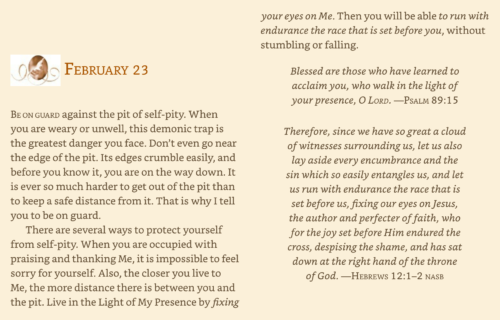
I AM SPEAKING in the depths of your being. Be still so that you can hear My voice. I speak in the language of Love; My words fill you with Life and Peace, Joy and hope. I desire to talk with all of My children, but many are too busy to listen. The “work ethic” has them tied up in knots. They submit wholeheartedly to this taskmaster, wondering why they feel so distant from Me. Living close to Me requires making Me your First Love—your highest priority. As you seek My Presence above all else, you experience Peace and Joy in full measure. I also am blessed when you make Me first in your life. While you journey through life in My Presence, My Glory brightens the world around you.

PSALM 119:64; The earth is filled with your love, LORD; teach me your decrees.

ISAIAH 50:4; The Sovereign LORD has given me a well-instructed tongue, to know the word that sustains the weary. He wakens me morning by morning, wakens my ear to listen like one being instructed.

REVELATION 2:4; Yet I hold this against you: You have forsaken the love you had at first.

ISAIAH 60:2; ²See, darkness covers the earth and thick darkness is over the peoples, but the LORD rises upon you and his glory appears over you.

Young, Sarah. Jesus Calling Morning and Evening Devotional (Jesus Calling®) (p. 724). Thomas Nelson. Kindle Edition.

A Return to Devotion

December 14th, 2021 by JDVaughn No comments »

As we continue in the season of Advent, Father Richard shares why he believes devotion, or heart-centered faith, is essential to the Christian journey. 

I want to encourage the uncovering of what we mean by the word devotion. We have to somehow live a life that’s connected to the heart. Otherwise, we get into head ideology, righteousness, opinionatedness, and insisting on the right or wrong words. All are ways of avoiding the heart and staying in the head!

I have to admit that I’ve learned this kind of devotion from good old-time Catholics and healthy evangelicals. They’re invariably heart-based people who look out at reality with soft eyes. We can usually see it in their calm face or the natural smile on their lips before they even start talking. Trust that first impression, it is seldom wrong.

If our message at the CAC is not heartfelt and creating heartfelt people, I predict it will not last, and it doesn’t deserve to last. It’ll be another head trip that we can argue about. I think it was the gift of the early Franciscans, although I don’t know that we, as the later Franciscan Order, always kept it. Francis and the early friars had a heartfelt quality that made them dear to people. Not everyone always agreed with Francis on things such as not going to war or radical poverty—but authentic, heartfelt, devoted people cannot be dismissed.

Perhaps this is what Jesus was talking about when he taught, “Blessed are the pure of heart” (Matthew 5:8). It’s having achieved a purity of intention, desire, and motivation that isn’t about me—how I look and whether people are going to like me or affirm me. I think we all have to purify our intention several times a day: “Why am I doing what I’m doing?” If we don’t localize our intention in the compassionate space that we call the heart, it all becomes about making an impression that will ultimately benefit ourselves. We are all attracted to those loving people who are concerned about others more than themselves and concerned about us specifically. It’s really quite beautiful. We feel softened, we feel held, we feel more tender around people like that.

We can’t fake devotion but sometimes I do suggest we “fake it till we make it,” as many say. We need to practice some kind of heart-opening prayer and practice being compassionate and kind toward others. Eventually our hearts, as John Wesley said, will surely be “strangely warmed” [1] and no one is more surprised than we are!

This is one of the hardest things in the teaching of spirituality because we cannot manufacture devotion. It is the work of grace, but of course we have to want it and create the conditions that can allow it to happen. Anything that helps us to be less willful, less pushy, less judgmental toward ourselves is a good place to start, because the face we turn toward ourselves is the face we turn toward the world.

Sarah Young….

REST IN ME, MY CHILD, forgetting about the worries of the world. Focus on Me—Immanuel—and let My living Presence envelop you in Peace. Tune in to My eternal security, for I am the same yesterday, today, and forever. If you live on the surface of life by focusing on ever-changing phenomena, you will find yourself echoing the words of Solomon: “Meaningless! Meaningless! Everything is meaningless!” Living in collaboration with Me is the way to instill meaning into your days. Begin each day alone with Me so that you can experience the reality of My Presence. As you spend time with Me, the way before you opens up step by step. Arise from the stillness of our communion, and gradually begin your journey through the day. Hold My hand in deliberate dependence on Me, and I will smooth out the path before you.

MATTHEW 1:22–23; All this took place to fulfill what the LORD had said through the prophet: ²³”The virgin will conceive and give birth to a son, and they will call him Immanuel” (which means “God with us”).

HEBREWS 13:8; Jesus Christ is the same yesterday and today and forever.

ECCLESIASTES 1:2; Meaningless! Meaningless!” says the Teacher. “Utterly meaningless! Everything is meaningless

PROVERBS 3:6; ⁶in all your ways submit to him, and he will make your paths straight

Young, Sarah. Jesus Calling Morning and Evening Devotional (Jesus Calling®) (p. 720). Thomas Nelson. Kindle Edition.

December 13th, 2021 by Dave No comments »

Loving Mother of the Americas

“Listen. Put it into your heart, my youngest and dearest son, that the thing that frightened you, the thing that afflicted you is nothing: Do not let it disturb you. . . . Am I not here, I, who am your mother? Are you not under my shadow and protection? Am I not the source of your joy? Are you not in the hollow of my mantle, in the crossing of my arms? Do you need something more?” —Our Lady of Guadalupe to Juan Diego, 1513, Nican Mopohua 

One of the images of Mary that continues to inspire devotion throughout the Americas is Our Lady of Guadalupe, whose feast we celebrate today. In this passage, CAC friend and author Mirabai Starr writes about the transformation that Our Lady of Guadalupe brought to Mexico and the world:

Our Lady of Guadalupe appeared to the Indian Juan Diego [1474–1548] only a few short years after Hernán Cortés conquered Mexico for Spain. The conquistadors had initially presented themselves as friends. The Aztecs believed that Cortés was Quetzalcoatl, the divine savior figure who, legend had promised, would return one day when they needed him most, and so they welcomed him and his entourage with joy. Once the Spaniards had insinuated themselves among the indigenous people, however, they proceeded to destroy them. In a concerted act of genocide and enslavement, the conquistadors swiftly eradicated an ancient culture. . . .

Into this bloody mix of violent cultures, Our Lady of Guadalupe extended the hand of mercy, comfort, and protection. . . . She drew everyone—European and indigenous—under her blanket of love. . . .

Images of Our Lady of Guadalupe are found throughout Mexico, Central and South America, and the southwestern United States. . . . Roadside grottos every few miles hold her image nestled in rock and concrete, a tall glass candle perpetually burning at her feet. She is emblazoned on tee shirts and tattooed onto biceps. She is borrowed to advertise taxi companies and hardware stores, women’s circles and bikers’ gangs. . . . She extends her unconditional love to all who reach for her merciful hand—believers and atheists, Latinos and Anglos, women and men—and they love her back, with equal intensity.

In a world struggling against senseless violence and growing economic disparity, Our Lady of Guadalupe offers a distinctly feminine antidote to the poisons of poverty and war. Where society demands competition, Guadalupe teaches cooperation. In place of consumerism, she models compassionate service. She is not the whitewashed Virgin of the institutional Church. She is the radical, powerful, engaged Mother of the People.

Our Lady is not merely a sociopolitical symbol, however. People of all faiths call her Mother. In times of deeply personal grief, they turn to her for comfort. They turn to her for insight. They turn to her for a reminder of what matters most, what endures when all else seems to be lost, what grace may yet be available when we meet fear with love.

Full-Body Knowing

I will give you a new heart and put a new spirit in you; I will remove from you your heart of stone and give you a heart of flesh. —Ezekiel 36:26

Jesus is our model for what it means to live from our hearts. Father Richard teaches: 

In Jesus, God gave us a human heart we could love. While God can be described as a moral force, as consciousness, and as high vibrational energy, the truth is, we don’t fall in love with abstractions. So God became a person “that we could hear, see with our eyes, look at, and touch with our hands” (1 John 1:1).

Love—God incarnate—always begins with particulars: this woman, this dog, this beetle, this Moses, this Virgin Mary, this Jesus of Nazareth. It is the individual and the concrete that opens the heart space to an I-Thou encounter. Without it, there is no true devotion or faith but only argumentative theories.

This is the simple religious knowing that the West is going to have to rediscover, both on the Right and on the Left. It’s always a whole-body knowing. Since the Enlightenment and argumentative Reformation we have situated our “knowing” in the mind, illustrated by Descartes’ notorious “I think therefore I am.” The mind is good but it’s only a part of what Jesus recommended: “You must love the Lord your God with your whole heart, with your whole soul, and with your whole mind” (see Matthew 22:37). That’s full-body knowing! That is devotion.

Love lives and thrives in the heart space. It has kept me from wanting to hurt people who have hurt me. It keeps me every day from obsessive, repetitive, or compulsive head games. It can make the difference between being happy and being miserable and negative. Could this be what we are really doing when we say we are praying for someone? Yes, we are holding them in our heart space. Do this in an almost physical sense, and you will see how calmly and quickly it works.

We invite you to pray for the ability to be more loving with modern mystic Howard Thurman (1900–1981):

I want to be more loving in my heart! It is often easy to have the idea in mind, the plan to be more loving. To see it with my mind and give assent to the thought of being loving—this is crystal clear. But I want to be more loving in my heart! I must feel like loving; I must ease the tension in my heart that ejects the sharp barb, the stinging word. I want to be more loving in my heart that, with unconscious awareness and deliberate intent, I shall be a kind, a gracious human being. Thus, those who walk the way with me may find it easier to love, to be gracious because of the Love of God which is increasingly expressed in my living. “I want to be more loving in my heart!” [1]


December 10th, 2021 by Dave No comments »

Hope Beyond Our Lifetimes

Theologian and Carmelite sister Constance FitzGerald identifies hope as a profound freedom to accept God and reality as it is. She takes inspiration from the work of St. John of the Cross (1542–1591):

This dynamic of being able to yield unconditionally to God’s future is what John of the Cross calls hope, a hope that exists without the signature of our life and works, a hope independent of us and our accomplishments (spiritual gifts or ordinary human achievements), a hope that can even embrace and work for a future without us. This theological hope is completely free from the past, fully liberated from our need to recognize ourselves in the future, to survive, to be someone. [1]

This gift of hope is what allows author Victoria Loorz and others to embrace a “post-doom” spirituality [2] which is large enough to face climate crises and not be driven to despair. Grounded in the Gospel, such hope affirms that love is stronger than death. Loorz writes:

Post-doom spirituality . . . accepts the fullness of our reality: the tragedy as well as the beauty. This spirituality moves into—and then eventually beyond—grief and repentance toward a deeper, more courageous, compassionate, and spiritual aliveness. . . .

Facing the reality that we’re standing on a precipice right now, as a species and as a whole planet, is sobering, to say the least. But facing what is real opens the heart to grief, which somehow opens the heart to love even more deeply. . . .

When you reconnect with the alive world in a more compassionate way, and when you realize that the whole world is a living system that can only thrive when death makes room for new life, you may feel a calm settle into you. You may find yourself with the energy that comes from love to embrace the whole story, including the necessary emptiness and loss. . . .

When we look toward what has been lost with the climate crisis or other ecological damage that our species has inflicted, we do still need to strive toward repair, but the cure is within our own mentality. The mentality that love really is as strong as death (like the beloved says to the lover in [the] Song of Solomon) compels us to regard those of us who remain—forests, polar bears, wilderness, people—with fierce love, looking toward how we can all live our highest quality of life together as beloved community, no matter what.

We do not need to minimize or overlook the pain and tragedy we encounter as we live in this time of interwoven crises. Eventually, when we recognize that the pain is directly connected with our love, we can embrace it. We can move into actions of restoration that are firmly planted in love. [3]


December 8th, 2021 by Dave No comments »

The Christ Mystery

Richard writes about how the coming of Christ is far more than the birth of a baby. The Christ Mystery is nothing less than a cosmic hope for history: 

The Second Coming of Christ that history is waiting for is not the same as the baby Jesus or even the historical Jesus. The historical Jesus was one man, and Christ is not his last name. The Christ includes the whole sweep of creation and history joined with him—and us too. We call this the Cosmic Christ. We ourselves are members of the Body of Christ and the Cosmic Christ, even though we are not the historical Jesus. So we very rightly believe in “Jesus Christ,” and both words are essential.

The celebration of Christmas is not a sentimental waiting for a baby to be born, but much more an asking for history to be born! (see Romans 8:20–23). Any spirituality that makes too much of the baby Jesus is perhaps not yet ready for real life. God clearly wants friends, partners, and images, if we are to believe the biblical texts. God, it seems, wants mature religion and a free response from us. God loves us as partners, with mutual give and take, and we eventually become the God that we love. 

All of us take part in the evolving, universe-spanning Christ Mystery. Jesus is a map for the time-bound and personal level of life, and Christ is the blueprint for all time and space and life itself. Both reveal the universal pattern of self-emptying and infilling (Christ) and death and resurrection (Jesus), which is the process we have called “holiness,” “salvation,” or just “growth,” at different times in our history. For Christians, this universal pattern perfectly mimics the inner life of the Trinity in Christian theology, which is our template for how reality unfolds, since all things are created “in the image and likeness” of God (Genesis 1:26–27).

The power of the biblical proclamation is that it clearly invites us into “cooperation” (Romans 8:28), free “participation” (Philippians 3:10), and the love of free and mature persons in God (Ephesians 4:13). We can apparently trust ourselves to grow because God has done it first and foremost. The Christ we are asking for and waiting for includes our own full birth and the further birth of history and creation. Now we can say “Come, Christ Jesus” with a whole new understanding and a deliberate passion!

Franciscan theologian and scientist Ilia Delio affirms the intrinsic hope and loving responsibility of Christian faith in an evolutionary universe:

We must suffer through to something higher, something more unified, more conscious, more being in love. Hope must be born over and over again, for where there is love, there is hope. Christian life is birthing love into greater unity; it is our contribution to a universe in evolution. We point the way to something more than ourselves, something up ahead that we are now participating in, where heaven and earth will be renewed (Revelation 21). [1]

Cosmic Hope

Richard’s love for the Trinity finds inspiration from the Franciscan mystical scholar St. Bonaventure (c. 1217–1274), who viewed all reality as coming from, participating with, and returning to God. Such a cosmic vision is mystical hope at its best!

Bonaventure’s vision is positive, mystic, cosmic, intimately relational, and largely concerned with cleansing the lens of our perception and our intention so we can see and enjoy fully. He shows little interest in a reward/punishment frame for history.

He starts very simply: “For [none] can have understanding unless [they] consider where things come from, how they are led back to their end, and how God shines forth in them.” [1] For Bonaventure, the perfection of God and God’s creation is quite simply a full circle, and to be whole the circle must and will complete itself. He knows that Alpha and Omega are finally the same, and the key holding it all together in unity is the “Christ Mystery,” or the essential unity of matter and spirit, humanity and divinity.

In Bonaventure’s world, the frame of reality was still big, hopeful, and positive. He was profoundly Trinitarian, where the love always and forever flows in one positive and forward direction. That was both his starting point and his ending point. Most of Christian history has not been Trinitarian except in name, I am sad to report. It has largely been a worship of a Jesus who was extracted from the Trinity—and thus Jesus apart from the eternal Christ, who then became more a harsh judge of humanity than a shining exemplar of humanity “holding all things in unity” (see Colossians 1:17–20).

Today the Catholic Tradition celebrates the feast of the “Immaculate Conception” of Mary, who is the feminine archetype of a human woman carrying such wholeness from the very beginning of her life. This is esoteric for many, but it is really quite profound in its declaration!

God, for Bonaventure, is not an offended monarch on a throne throwing down thunderbolts, but a “fountain fullness” that flows, overflows, and fills all things in one exclusively positive direction. Reality is thus in process, participatory; it is love itself. God as Trinitarian Flow is the blueprint and pattern for all relationships and thus all of creation, which we now know from contemporary science is exactly the case.

I regret to say that there has been a massive loss of hope in Western history, a hope still so grandly evident in Bonaventure in the 13th century. His God was so much bigger and more glorious than someone to be afraid of, or the one who punished bad guys—because his cosmos was itself huge, benevolent, and coherent. Did his big God beget an equally big and generous cosmos? Or did his big cosmos imply a very big God? You can start on either side. For many today, awe before the universe leads them to reverence whoever created this infinity of Mystery and Beauty.