CAC core faculty member James Finley gently reminds us of our infinite preciousness to God. God cannot help but meet us with compassionate love. Offering ourselves compassion is one step to encountering the depths of God’s compassion for us.
Compassion is the love that recognizes and goes forth to identify with the preciousness of all that is lost and broken within ourselves and others. At first it seems as if compassionate love originates with our free decision to be as compassionate as we can be toward ourselves as we sit in meditation. As our practice deepens, we come to realize that in choosing to be compassionate, we are yielding to the compassionate nature of God flowing through us, in and as our compassion toward our self as precious in our frailty.
God is revealed in Christ as a compassionate love that recognizes and goes forth to identify with us as precious in our frailty. This is what Jesus reveals to us in the parable of the prodigal son (Luke 15:11–32). We all know the story of the son who goes off against his father’s wishes and squanders his share of his father’s money. When the money runs out, he realizes how foolish he has been and returns home. . . . As he continues on home, ashamed and remorseful, he is not prepared for the moment in which he first looks up to see his father running toward him with open arms.
The father embraces the son as preciousness almost too precious to bear. The son is at once undone and restored to wholeness in a flurry of embraces received and given. The two of them stand together out on the open road, each laughing and crying at once. Each causes the other to lose his balance as each holds up the other. We can sense in their awkward dance of compassionate love the dance we all long to dance. For we all intuit a taste of heaven in the compassionate embrace that welcomes home one who has been lost. . . .
In the actual moment of encounter there is, for the father and son, nothing but their overflowing, compassionate encounter. The parable reveals God’s version of reality. It reveals the way God always is toward us, regardless of how foolish and hurtful we may have been.
Jim teaches how God’s compassion transforms our brokenness:
As we yield to compassion, we are caught in the updraft of grace that carries us aloft. Then, in one single continuous movement of love, compassion draws us downward into the preciousness of all that is lost and broken within ourselves. The deeper the brokenness, the greater the momentum of the descent. The greater the momentum of the descent, the more deeply compassionate love descends into the innermost recesses of our doubts and fears. Suddenly encountering such love, our doubts and fears melt in the love that sets us free.
A compassionate presence is one of the fruits of contemplation. In Richard Rohr’s book Eager to Love, he writes about the great compassion of St. Francis of Assisi (1182–1226) for others, which is inspired by the great compassion of Jesus.
The most obvious change that results from the holding and allowing that we learn in the practice of contemplative prayer is that we will naturally become much more compassionate and patient toward just about everything. Compassion and patience are the absolutely unique characteristics of true spiritual authority, and without any doubt are the way both St. Francis and St. Clare (1194–1253) led their communities. They led, not from above, and not even from below, but mostly from within, by walking with their brothers and sisters, or “smelling like the sheep,” as Pope Francis puts it. . . .
A spiritual leader who lacks basic human compassion has almost no power to change other people, because people intuitively know he or she does not represent the Whole and Holy One. Such leaders need to rely upon roles, laws, costume, and enforcement powers to effect any change in others. Such change does not go deep, nor does it last. In fact, it is not really change at all. It is mere conformity.
We see this movement toward a shared compassion in all true saints. For example, St. Francis was able to rightly distinguish between institutional evil and the individual who is victimized by it. He still felt compassion for the individual soldiers fighting in the crusades, although he objected to the war itself. He realized the folly and yet the sincerity of their patriotism, which led them, however, to be un-patriotic to the much larger kingdom of God, where he placed his first and final loyalty. What Jesus calls “the Reign of God” we could call the Great Compassion.
Catholic author Judy Cannato, who worked to integrate the Gospels with the new cosmology, believed this Great Compassion was Jesus’ primary objective. She writes:
The realm of God that Jesus preached and died for was one that was known for its kindness and generosity, its compassion and healing. There was no one deemed outside the love of the Holy One whom Jesus called “Father.” No one was excluded from fellowship, not the rich or poor, male or female, slave or free. Jesus went beyond superficial divisions and called for a culture of compassion.
Compassion changes everything. Compassion heals. Compassion mends the broken and restores what has been lost. Compassion draws together those who have been estranged or never even dreamed they were connected. Compassion pulls us out of ourselves and into the heart of another, placing us on holy ground where we instinctively take off our shoes and walk in reverence. Compassion springs out of vulnerability and triumphs in unity. [1]
Only people at home in such a spacious place can take on the social illnesses of their time, and even the betrayal of friends, and not be destroyed by cynicism or bitterness.
Sarah Young
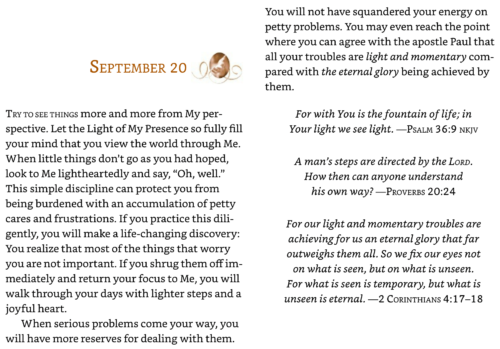
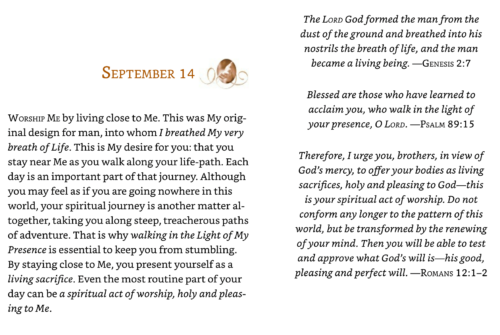
OPEN YOUR MIND AND HEART—your entire being—to receive My Love in full measure. So many of My children limp through their lives starved for Love because they haven’t learned the art of receiving. This is essentially an act of faith: believing that I love you with boundless, everlasting Love. The art of receiving is also a discipline: training your mind to trust Me, coming close to Me with confidence. Remember that the evil one is the father of lies. Learn to recognize his deceptive intrusions into your thoughts. One of his favorite deceptions is to undermine your confidence in My unconditional Love. Fight back against these lies! Do not let them go unchallenged. Resist the devil in My Name, and he will slink away from you. Draw near to Me, and My Presence will envelop you in Love.
EPHESIANS 3:16–19; 16I pray that out of his glorious riches he may strengthen you with power through his Spirit in your inner being, ^17so that Christ may dwell in your hearts through faith. And I pray that you, being rooted and established in love, ^18may have power, together with all the LORD’s holy people, to grasp how wide and long and high and deep is the love of Christ, ^19and to know this love that surpasses knowledge-that you may be filled to the measure of all the fullness of God
HEBREWS 4:16; 16Let us then approach God’s throne of grace with confidence, so that we may receive mercy and find grace to help us in our time of need.
JOHN 8:44; 44
John 8:44 ⁴⁴You belong to your father, the devil, and you want to carry out your father’s desires. He was a murderer from the beginning, not holding to the truth, for there is no truth in him. When he lies, he speaks his native language, for he is a liar and the father of lies.
JAMES 4:7–8 NKJV; Submit yourselves, then, to God. Resist the devil, and he will flee from you. 8 Come near to God and he will come near to you.
A practice of contemplation is one of the surest ways to develop the virtue of compassion—for both ourselves and others. Father Richard speaks to how this loving gaze is developed between ourselves and God.
Much of the early work of contemplation is discovering a way to observe ourselves from a compassionate and nonjudgmental distance until we can eventually live more and more of our lives from this calm inner awareness and acceptance. In a contemplative stance, we find ourselves smiling, sighing, and weeping at ourselves, much more than needing either to hate or to congratulate ourselves—because we are finally looking at ourselves with the eyes of God.
Actually, what is happening is we are letting God gaze at us, in the way only God can gaze—with infinite mercy, love, and compassion. God initiates a positive gaze, which now goes in both directions. Unfortunately, we seldom allow that to happen. Decades ago, Matthew Fox identified what it has cost us and the universe to have lost this mutually loving gaze with God. I believe it is even more true of the world today. Fox writes:
Compassion is everywhere. Compassion is the world’s richest energy source. Now that the world is a global village we need compassion more than ever—not for altruism’s sake, nor for philosophy’s sake or theology’s sake, but for survival’s sake.
And yet, in human history of late, compassion remains an energy source that goes largely unexplored, untapped and unwanted. Compassion appears very far away and almost in exile. Whatever propensities the human cave dweller once had for violence instead of compassion seem to have increased geometrically with the onslaught of industrial society. The exile of compassion is evident everywhere. . . .
In acquiescing in compassion’s exile, we are surrendering the fullness of nature and of human nature, for we, like all creatures in the cosmos, are compassionate creatures. All persons are compassionate at least potentially. What we all share today is that we are victims of compassion’s exile. The difference between persons and groups of persons is not that some are victims and some are not: we are all victims and all dying from lack of compassion; we are all surrendering our humanity together. [1]
As we receive God’s compassionate gaze in contemplation, all negative energy and motivation is slowly exposed and will eventually fall away as counter-productive and useless. There will be no mistrust, fear, or negativity in either direction! If we resort to any form of shaming ourselves, we will slip back into defense, denial, and overcompensation. We will not be able to “know as fully as we are known” (see 1 Corinthians 13:12).
But if we can connect with the Indwelling Presence, where the “Spirit bears common witness with our spirit” (see Romans 8:16), it can and will change our lives! This mutually loving gaze is always initiated by God and grace. Once you learn to rest there, nothing less will ever satisfy you. This is foundational.
Compassion as Steadfast Love
Quaker author Richard Foster has long written on themes of prayer and spiritual practice. Focusing on the Hebrew word hesed, Foster explores the many ways that compassion shows up in the Hebrew Bible, both in God and in how people relate to one another:
[The Hebrew word] hesed holds before us the great theme of compassion. It is a word so laden with meaning that translators struggle to find an English equivalent, often rendering it “loving kindness” or “steadfast love.” It is a word most frequently used in reference to God’s unwavering compassion for [God’s] people. God’s wonderful hesed love is “from everlasting to everlasting,” declared the Psalmist (Psalm 103:17). It is a “steadfast love” that “endures forever” (Psalm 106:1).
But the great challenge for us is that this covenant love, this durable mercy that is so central to the character of God, is to be reflected in us as well. Through Hosea the prophet, God declares, “I desire steadfast love [hesed] and not sacrifice, / the knowledge of God rather than burnt offerings” (Hosea 6:6).
Sprinkled throughout the Hebrew Scriptures are grace-filled laws of compassion, of hesed. The law of gleaning . . . is a prime example. Farmers were to leave some of the crop along the borders and the grain that fell on the ground during harvest so that the poor could gather it (Leviticus 19:9–10). Likewise the vineyards and the olive groves were not to be stripped bare, in order to make provision for the needy. . . . The simple fact of need was sufficient reason to provide for them.
Think of the tender compassion in the old Hebrew laws of giving and taking a pledge. If someone borrowed your oxcart and left his coat in pledge, you had to be sure to give the coat back before sunset even if he hadn’t finished with the oxcart. Why? Because the night air was cold, and he would need his coat for warmth. The rule was doubly binding if the person who made the pledge was poor, for in all likelihood he had no other coat with which to keep warm (Deuteronomy 24:12). . . . Graciousness, courtesy, compassion—this is hesed. [1]
Theologian Elizabeth Johnson understands acting with compassion to others in need as participating in the flow of God’s compassion:
If the heart of divine mystery is turned in compassion toward the world, then devotion to this God draws persons into the shape of divine communion with all others: “Be merciful, just as your Father is merciful” (Luke 6:36). To deny one’s connection with the suffering needs of others is to detach oneself from divine communion.
The praxis of mercy is propelled by this dynamic. So too is committed work on behalf of peace, human rights, economic justice, and the transformation of social structures. . . . Solidarity with those who suffer, being there with commitment to their flourishing, is the locus of encounter with the living God. [2]
In his unpublished notes on money, Fr. Richard explores a parable that has often troubled faithful Christians, including pastors, theologians, and scripture scholars alike.
Maybe the key to an honest Jesus hermeneutic around money has been lost in a parable that many of us never liked—the parable of the ten gold coins (Luke 19:11–27). Let me offer you a different slant on this story that, in my experience, few preachers have addressed:
A nobleman pays his staff equally well beforehand, and then upon leaving, says to them: “Do business with this while I am away!” (Luke 19:13). He leaves the country, freeing the servants from any pressure or duress. For anything to be a virtue, it must be a free choice, not just a mandate. Most of us were never taught that psychological truth! Jesus’ words must be seen as descriptive (what is possible) much more than prescriptive (what must be done). He is always describing and thus inviting his listeners into a big, inclusive life of love, which he calls the Reign of God. No language of counting or commanding can get you there.
The nobleman is telling his servants to do something with the money: “Yes, I am paying you well, but do something with it!” It is the one servant who refuses to do any business with the money who is deemed fully at fault. He loses what he stashed away in fear (Luke 19:20–21). He claims his right to the money but shows no responsibility for putting it to use.
This always-bothersome text has finally become more clear to me: money becomes evil when rights are not balanced by responsibilities, and responsibilities are not balanced by rights. When these are balanced, money can do a great deal of good—both for the giver and the receiver, and hopefully for others. There’s surely nothing bad about that!
This interpretation keeps us from wrongly framing the issue, as so many have done in history—by making the rich or the poor inherently bad or inherently virtuous. Individuals in both economic groups can be materialistic consumers or generous-hearted givers, just at their own scale. Paul never said money is the root of all evil, as he is often quoted to have said. He says, “the love of money is the root of all evils” (1 Timothy 6:10). This is a major difference.
When, at the individual or family level, we balance our rights with our responsibilities, money can be a moral good for all concerned. A corporation acts morally when it balances its rights to a just profit with its responsibilities for the common good—upon which it depends and profits. Most Western individualism refuses to recognize this common domain. Massachusetts, Pennsylvania, Virginia, and Kentucky were wise to name themselves “commonwealths” instead of states, although now it has just become an empty word. When a person, a community, or a corporation does not consistently seek this balance, they no longer work for the common good. This can become a web of deceits that benefits the very few. When the dominance and enthrallment of money controls almost every aspect of life, as we largely see today, it has become a demon, beyond moral control. Today, this “demon” is destroying the common good and even “our common home,” as Pope Francis calls the planet.
Young, Sarah. Jesus Calling
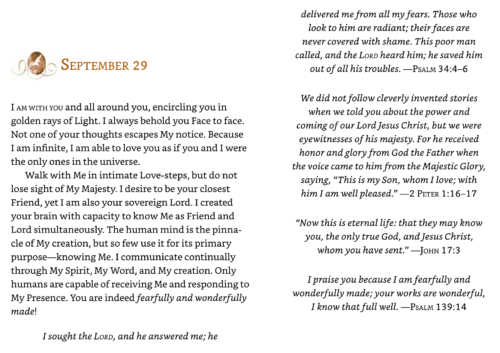
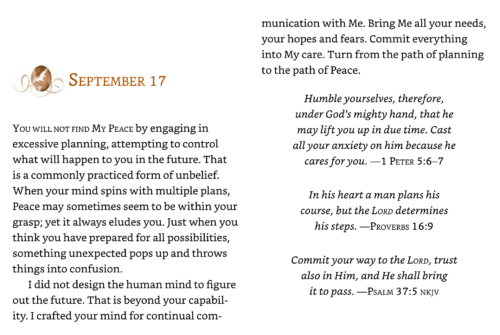
TRUST ME AND REFUSE TO WORRY, for I am your Strength and Song. You are feeling wobbly this morning, looking at difficult times looming ahead, measuring them against your own strength. However, they are not today’s tasks—or even tomorrow’s. So leave them in the future and come home to the present, where you will find Me waiting for you. Since I am your Strength, I can empower you to handle each task as it comes. Because I am your Song, I can give you Joy as you work alongside Me. Keep bringing your mind back to the present moment. Among all My creatures, only humans can anticipate future events. This ability is a blessing, but it becomes a curse whenever it is misused. If you use your magnificent mind to worry about tomorrow, you cloak yourself in dark unbelief. However, when the hope of heaven fills your thoughts, the Light of My Presence envelops you. Though heaven is future, it is also present tense. As you walk in the Light with Me, you have one foot on earth and one foot in heaven.
EXODUS 15:2; The Lord is my strength. ( A) and my defense[ a]; he has become my salvation. ( B) He is my God, ( C) and I will praise him, my father’s God, and I will exalt.
CORINTHIANS 10:5; We demolish arguments and every pretension that sets itself up against the knowledge of God, and we take captive every thought to make it obedient to Christ.
HEBREWS 10:23; Let us hold resolutely to the hope we profess, for He who promised is faithful. Let us hold unswervingly to the hope we profess, for he who promised is faithful. Let us hold tightly without wavering to the hope we affirm, for God can be trusted to keep his promise.
In 2019, Richard wrote a short book entitled What Do We Do with Evil? In it, he explored the apostle Paul’s teachings on “the world, the flesh, and the devil,” to clarify the often invisible, systemic, and hidden nature of evil, including systems of money.
For most of history we believed that evil was almost exclusively the result of “bad people” and that it was our job to make them into good people. We thought this alone would change the world. And sometimes it worked! Yet only in the 20th century did popes and many moral theologians begin to teach about corporate sin, institutionalized evil, systemic violence, and structural racism. These very words are new to most people, especially ones who benefit from such illusions.
I believe personal evil is committed rather freely because it is derived from and legitimated by our underlying, unspoken agreement that certain evils are necessary for the common good. Let’s call this systemic evil. However, if we would be honest, this leaves us very conflicted. We call war “good and necessary,” but murder bad. National or corporate pride is expected, but personal vanity is bad. Capitalism is rewarded, but personal gluttony or greed is bad (or, at least, it used to be). Lying and cover-ups are considered acceptable to protect powerful systems (the church, political groups, governments), but individuals should not tell lies.
Thus we now find ourselves unable to recognize or defeat the tyranny of evil at the most invisible, institutionalized, and entrenched level. Evil at this stage has become not only pleasing to us but idealized, romanticized, and even “too big to fail.” This is what I call “the devil” and Paul calls “the thrones, dominions, principalities, and powers” (Colossians 1:16) or “spirits of the air” (Ephesians 6:12). These were his premodern words for corporations, institutions, and nation states. Anything that is deemed above criticism and hidden in the spirit of the age will in time—usually in a rather short time—always become demonic.
As regards money and evil, money’s meaning and use is highly obfuscated by small print and obscure vocabularies which only highly-trained economists can understand: annuities, interest (“usury” used to be a major sin!), non-fiduciary, reverse mortgages, and more. Yes, the devil is in the details! The ordinary person is left at the mercy of these new clerics who alone understand how we can be “saved” by the “infallible laws of the market” and the “bottom line” of everything. They use the language of religion and transcendence to speak with a kind of assumed objectivity that we once only allowed in the realm of theology and from the pulpit.
Letting the domination systems of “the world” off the hook, we put almost all our moral concern on greedy or ambitious individuals. We tried to change them without recognizing that each isolated individual was on bended knee before the powers and principalities of the market and more. In most nations today, our moral compass has been thrown off its foundations.
In this week’s meditations, we are delighted to share some of Fr. Richard Rohr’s unpublished notes about money. As a Franciscan dedicated to simple living and the Gospel call to solidarity with the marginalized, Richard sees an opportunity for each of us to rediscover a “soulful” relationship with money.
I’m convinced that money and soul are united on a deep level. This truth is reappearing from the deep stream of wisdom traditions after centuries of almost total splitting and separation at the conscious level. [1] There is unrío profundo, a river beneath the river. The upper stream has always been money in all its forms, beginning with trading and bartering. The deeper stream is the spiritual meaning such exchanges must have for our lives. Money and soul have never been separate in our unconscious because they are both about human exchanges, and therefore, divine exchange, too.
Notice how much religion uses the language of commerce, such as gaining heaven, acquiring merit, doing penance, earning salvation, losing one’s soul, and deserving hell. Of course, there is also the notion of “penal substitutionary atonement” itself, with Jesus “paying the debt” for our sins. On the other side, commerce uses the metaphors of religion far more than it realizes: we purchase bonds and trusts, enter into covenants, forgive debts, are granted grace periods for repayment, enjoy indemnity, reconcile accounts, and redeem coupons!
From my perspective, when money and soul are separated, religion is the major loser. Without a vision of wholeness that puts money in its soulful place, religion “sells out.” Religion allowed itself to lose the only ground on which awe and transcendence stand—the foundation of totally gratuitous and “amazing grace.” We traded it for a “mess of pottage” (see Genesis 25:27–34), a secretly enthroned ego that only knows how to count, weigh, measure, dole out, judge, label, earn, expel, and compete. No wonder Jesus’ direct action in the Temple that exposed the idolatrous game got him killed within a week! All four Gospels in some form speak of “turning over the tables” of buying and selling. [2] Even with this forceful gospel teaching, our faith became transactionalinstead of transformational, calculating instead of consoling.
Lynne Twist, founder of the Soul of Money Institute, understands the impact that our culture’s disintegrated view of money has made and invites us to the spiritual practice of bringing the two—money and our souls—together in our lives:
In a world that seems to revolve around money, it is vital that we deepen our relationship with our soul and bring it to bear on our relationship with money. In that merger and that commitment, we can create a new and profound spiritual practice. We can have our money culture both balanced and nourished by soul. Our relationship with money can become a place where, day in and day out, we can engage in this meaningful spiritual practice. [3]
We Cannot Serve Two Masters
Fr. Richard continues his reflections on money by considering one of Jesus’ most challenging statements.
Many of us, myself included, have a confused, guilt-ridden, obsessive attitude about money. There’s hardly anybody who can think in a clear-headed way about it. At the end of Luke’s parable of the so-called dishonest steward, Jesus creates a clear dualism between God and wealth, or what he calls “mammon”: “You cannot serve God and mammon” (Luke 16:13). Mammon was the god of wealth, money, superficiality, and success. Jesus says, in effect, “You’ve finally got to make a choice.” Most of Jesus’ teaching is what I call nondual—a theme I often teach—but there are a few areas where he’s absolutely dualistic (either-or), and it’s usually anything having to do with power and anything having to do with money.
Jesus is absolute about money and power because he knows what we’re going to do. Most of us will serve this god called mammon. Luke’s Gospel even describes mammon as a type of illness, as Jesuit John Haughey (1930–2019) explained: “Mammon is not simply a neutral term in Luke. It is not simply money. It connotes disorder. . . . Mammon becomes then a source of disorder because people allow it to make a claim on them that only God can make.” [1] “Mammon illness” takes over when we think all of life is counting, weighing, measuring, and deserving. We go to places that have sales, so that we don’t have to give as much to get the same thing. My mother spent much of her time cutting coupons to save ten cents. It was good and even necessary for a while, I guess, but it’s very hard to get rid of that fixation.
To participate in the reign of God, we have to stop counting. We have to stop weighing, measuring, and deserving in order to let the flow of forgiveness and love flow through us. The love of God can’t be doled out by any process whatsoever. We can’t earn it. We can’t lose it. As long as we stay in this world of earning and losing, we’ll live in perpetual resentment, envy, or climbing.
Religion cannot work from a calculator without losing its very method, mind, foundation, and source. Surely this is what Jesus meant by his statement in Luke’s Gospel. Perhaps if we say it a bit differently, we can all get the point: “You cannot move around inside the world of Infinite Grace and Mercy, and at the same time be counting and measuring with your overly defensive and finite little mind.” It would be like asking an ant to map the galaxies. St. Thérèse of Lisieux (1873–1897) put it much more directly to a nun worried about God keeping track of her many failings: “There is a science about which [God] knows nothing—addition!” [2] The reign of God is a worldview of abundance. God lifts us up from a worldview of scarcity to infinity. Remember every part of infinity is still infinite! God’s love is nothing less than infinite.
My colleague Brian McLaren has long explored what it might mean to be a “new kind of Christian.” Brian once wrote a fictionalized story about a pastor asking questions at the edges of his faith. Dan, the book’s main character, strikes up a friendship with an older, former pastor who mentors him into a larger, more generous, and loving Christianity. This pastor leads Dan through a thought experiment:
Imagine that you have just died and passed through the doorway of death. And you enter heaven. And it is a place of intense brightness, a place fragrant with goodness, a place alive with love. The presence of God seems to pervade everyone and every thing. . . . In this place, people are humble and genuinely interested in others. . . . It is a place of true freedom, trust, and intimacy. And even though it is a place of great diversity, with people of all cultures and languages and times retaining all their uniqueness, it is a place where no one argues, no one fights, no one hates, and no one complains—not because they aren’t allowed to but because they don’t want to, because they accept and love one another completely. They are fully alive. . . . Think about how you would feel entering that place.
OK. Now I want you to imagine that someone has walked beside you through that doorway of death. And that person has lived his life cramped in hatred and fear, tight in guilt and greed, ingrown in lust and selfishness. He has spent every day of his life complaining and being bitter and blaming others and being ungrateful. He has been suspicious of those different from himself, and he has become an expert at lying and cheating and using others. He is proud, arrogant, unwilling to admit he is wrong. . . . Now, how would that person feel?
Could it be that the very light that seems beautiful to you would seem blinding to him? Could the very warmth of the love of that place that to you is so perfect seem to him horrible? Could the acceptance and love and trust and openness that welcome you seem to him disgusting, weak, terrifying, insipid, or repulsive? . . . Maybe it’s not that there are two places beyond the door of death, heaven and hell. Sometimes I wonder if hell is just what heaven feels like for those who haven’t learned in this life what this life is intended to teach. I believe with all my heart that God is not willing for even one person to miss out on the joy and glories of heaven. . . . We are becoming on this side of the door of death the kind of people we will be on the other side.
Richard here: In the Gospels, Matthew’s especially, Jesus teaches that we will face consequences for the choices we make in our lifetimes, but they are never for the sake of punishment. Instead, they are a manifestation of God’s redemptive and healing love, which will ultimately prevail.
We are born out of love. We live in love. We are destined for love.
—Blessed Raymón Llull, The Book of the Lover and the Beloved
There are few people who teach as passionately about love as scientist, scholar, and Franciscan Sister Ilia Delio. At the CAC CONSPIRE conference in 2014, the audience was able to witness and share Ilia’s enthusiasm for, and trust in, the “love energy of God,” which makes any of our typical notions of hell quite impossible. She said:
Everything that exists speaks of God, reflects that love energy of God. But God is more than anything that exists. God is always the more of our lives. We can’t contain God. If we try to control God, that’s not God; God always spills over our lives. So, God is our future. If we’re longing for something we desire, it’s that spilled-over love of our lives that’s pulling us onward, that’s luring us into something new. But we don’t trust this God [of implanted desire] often. We were pretty sure that God’s there, [and] we’re here, and we just need to keep [on] the straight and narrow path. . . .
What Francis [of Assisi] recognized is God is in every direction. That you might arrive, you might not arrive. You might arrive late; you might arrive early. It’s not the arrival that counts.It’s God! It’s not the direction that counts. It’s just being there, trusting that you will be going where God wants you. In other words, God is with us. Every step of the way is God-empowered love energy. But we tend to break down and start controlling things: “If I go this way, I’m going to get lost. Well, what if it’s wrong? What will happen to me?” Well, what will happen to you? Something will happen. But guess what? Something’s going to happen whether or not you go; that’s the whole point of life. So, it’s all about love.
So, it’s not like we’ve got this, “Here’s God; here’s us. God’s just waiting till we get our act together and then we’ll all be well.” That’s a boring God; that’s not even God. God is alive. God is love. Love is pulling us on to do new things and we need to trust the power of God in our lives to do new things. . . . We need to unwire ourselves to recognize that the God of Jesus Christ is, you might say, the power beneath our feet, the depth of the beauty of everything that exists, and the future into which we are moving. . . .
Every one of us is written in the heart of God from all eternity, born into the stars, born, you might say, into the galaxies, born on this earth in small forms, developing and coming to explicit form in our lives, given a name. It’s a fantastic mystery of love.
Elizabeth Johnson, the brilliant theologian, Sister of St. Joseph, and professor at Fordham University, has written extensively about the universal nature of salvation— not only for humans, but for all creation. By focusing our religious conversations on the problem of human sin and “worthiness,” we have often lost sight of the strong scriptural evidence for the universal return of all of creation to God. Dr. Johnson writes:
Biblical writers elaborated the good news using concepts of liberation, reconciliation, justification, victory over the powers, living in peace, fullness of life, being freed from slavery, adoption, and new birth as God’s children to name but a few. These long-untapped resources . . . open doors to understanding more varied dimensions of what is meant by the mystery of redemption.
One result has been renewed awareness of New Testament texts about cosmic redemption that previously just flew by. These texts that extend the promise of a future to all of creation are few in number, but they are strong. . . . The great hymn in Colossians which draws on the Wisdom tradition and the history of Jesus in equal measure, is suffused with this insight:
He is the image of the invisible God, the firstborn of all creation; for in him all things in heaven and on earth were created, things visible and invisible, whether thrones or dominations or rulers or powers—all things have been created through him and for him. He himself is before all things, and in him all things hold together. . . . For in him all the fullness of God was pleased to dwell, and through him God was pleased to reconcile to himself all things, whether on earth or in heaven, making peace by the blood of his cross. (Colossians 1:15–20)
This passage from Colossians has also been central to my understanding of and teachings on the Universal Christ in recent years. Johnson continues:
The drumbeat of “all things” repeated five times in this short text, coupled with reference to “all creation,” “everything,” and the encompassing “things visible and invisible,” drives home the blessing that flows to the whole world from the cross. . . .
The visionary writer of the book of Revelation hears “every creature in heaven and on earth and under the earth and in the sea, and all that is in them” singing praises to the Lamb (Revelation 5:13), and perceives a climactic event of transformation where the One who sits on the throne says, “See, I am making all things new” (21:5). . . . The New Testament includes a hope-filled vision of the whole universe pervaded with divine promise.
Would God bring all of creation to heavenly glory, while leaving out most of humanity, who are made in God’s own “image and likeness”? I can’t imagine that this would be so!
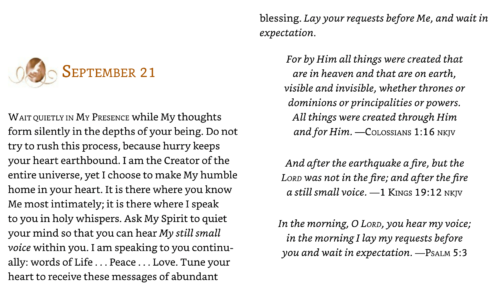
REST IN ME, MY CHILD. This time devoted to Me is meant to be peaceful not stressful. You don’t have to perform in order to receive My Love. I have boundless, unconditional Love for you. How it grieves Me to see My children working for Love: trying harder and harder, yet never feeling good enough to be loved. Be careful that your devotion to Me does not become another form of works. I want you to come into My Presence joyfully and confidently. You have nothing to fear, for you wear My own righteousness. Gaze into My eyes, and you will see no condemnation, only Love and delight in the one I see. Be blessed as My Face shines radiantly upon you, giving you Peace.
JOHN 15:13; Greater love has no one than this, that he lay down his life for his friends. Greater love has no one than this: to lay down one’s life for one’s friends. There is no greater love than to lay down one’s life for one’s friends. Greater love has no one than this, that someone lay down his life for his friends.
2 CORINTHIANS 5:21 NKJV; For he hath made him to be sin for us, who knew no sin; that we might be made the righteousness of God in him. 2
ZEPHANIAH 3:17; The LORD your God is with you, the Mighty Warrior who saves. He will take great delight in you; in his love he will no longer rebuke you, but will rejoice over you with singing.”
NUMBERS 6:25–26; The Lord make his face shine upon thee, and be gracious unto thee: 26 The Lord lift up his countenance upon thee, and give thee peace.
Young, Sarah. Jesus Calling Morning and Evening Devotional (Jesus Calling®) (p. 534). Thomas Nelson. Kindle Edition.
Your image of God creates you. This is why it is important that we see God as loving and benevolent and why good theology still matters. One mistaken image of God that keeps us from receiving grace is the idea that God is a cruel tyrant. People who have been raised in an atmosphere of threats of punishment and promises of reward are programmed to operate with this cheap image of a punitive God. It usually becomes their entire view of the universe.
Unfortunately, it’s much easier to organize people around fear and hatred than around love. Powerful people prefer this worldview because it validates their use of intimidation—which is quite effective in the short run! Both Catholicism and Protestantism have used the threat of eternal hellfire to form Christians. I am often struck by the irrational anger of many people when they hear that someone does not believe in hell. You cannot “believe” in hell. Biblical “belief” is simply to trust and have confidence in the goodness of God or reality and cannot imply some notion of anger, wrath, or hopelessness at the center of all that is. Otherwise, we live in a toxic and unsafe universe, which many do.
In his book Inventing Hell, Jon Sweeney points out that our Christian view of hell largely comes from several unfortunate metaphors in Matthew’s Gospel. [1] Hell is not found in the Pentateuch, the first five books of the Bible. It’s not found in the Gospel of John or in Paul’s letters. The words Sheol and Gehenna are used in Matthew, but they have nothing to do with the later medieval notion of eternal punishment. Sheol is simply the place of the dead, a sort of limbo where humans await the final judgment when God will finally win. Gehenna was both the garbage dump outside of Jerusalem—the Valley of Hinnom—and an early Jewish metaphor for evil (Isaiah 66:24). The idea of hell as we most commonly view it came much more from Dante’s Inferno than the Bible. Believe me on that. It is the very backdrop of Michelangelo’s Sistine Chapel. It makes for good art, I suppose, but it’s horrible, dualistic theology. This is not Jesus, “meek and humble of heart,” which is his self-description in life (Matthew 11:29). We end up with two different and opposing Jesuses: one before Resurrection (healing) and one after Resurrection (dangerous and damning).
Jesus tells us to love our enemies (Matthew 5:44), but the punitive god sure doesn’t. Jesus tells us to forgive “seventy times seven” times (Matthew 18:22), but this other god doesn’t. Instead, this other god burns people for all eternity.Many of us were raised to believe this, but we usually had to repress this bad theology into our unconscious because it’s literally unthinkable. Most humans are more loving and forgiving than such a god, but we can’t be more loving than God. It’s not possible. This “god” is not God.
Choosing Heaven Now
The shape of creation must somehow mirror and reveal the shape of the Creator. We must have a God at least as big as the universe. Otherwise, our view of God becomes irrelevant, constricted, and more harmful than helpful. The Christian image of a torturous hell and God as a petty tyrant has not helped us to know, trust, or love God—or anything else. If we understand God as Trinity—the fountain fullness of outflowing love, and relationship itself—there is no theological possibility of any hatred or vengeance in God.
Divinity, which is revealed as Love Itself, will always eventually win. God does not lose (see John 6:37-39). We are all saved by mercy. This is an orthodox opinion! In his book Introduction to Christianity, Pope Benedict XVI explains his understanding of the curious phrase in the middle of the Apostles’ Creed: “[Jesus] descended into hell.” Benedict says that since Christ went into hell, that means hell “is hell no longer . . . because love dwells in it.” [1] Jesus Christ and hell cannot coexist; once Jesus got there, the whole game of punishment was over, as it were. A basic principle of nonviolence is that we cannot achieve good by doing bad.
If this is true, any notion of an actual “geographic” hell or purgatory is unnecessary and, in my opinion, destructive of the very restorative notion of the whole Gospel. Pope John Paul II, who certainly was not a liberal, reminded listeners that heaven and hell are not physical places at all. They are states of being in which we dwell either in a loving relationship with God or one of separation from the source of all life and joy. [2] If that’s true, there are plenty of people on earth who are in both heaven and hell right now.
Heaven is not about belonging to the right group or following the correct rituals. It’s about having the right attitude toward existence. There are just as many Muslims, Buddhists, Hindus, and Jews who live in love—serving their neighbor and the poor—as there are Christians. Jesus says there will be deep regret—“wailing and grinding of teeth” (Luke 13:28)—when we realize how wrong we were. Be prepared to be surprised about who is living a life of love and service and who isn’t. This should keep us all humble and recognizing it’s not even any of our business who’s going to heaven. What makes us think that our little minds and hearts could discern the mind and heart of anyone else?
Further, Jesus never really taught “the immortality of the soul” as we understand it. That was Plato. Jesus taught the immortality of love. If we have never really loved anyone or anything, I doubt we are at all capable of eternity. We simply die. A torture chamber was an unfortunate metaphor to keep people from never loving, trusting, or hoping. I am not sure it ever really worked because you cannot threaten people into love.
Universal Good News
In the first five centuries of Christianity, many of the church fathers affirmed universal salvation. It seems we were much more hopeful at the beginning that the Gospel really was universally good news! A mystical experience led Carlton Pearson, a former evangelical megachurch pastor, to complete a thorough study of the ancient message of universal salvation. He shares that:
The message of Inclusion, also known as Universal Reconciliation, is not new. It was [a] widely held position . . . of respected early church fathers and founders throughout the first five hundred years of church history. . . .
Augustine (354–430), of African descent and one of the four great Latin/Afro church fathers (Augustine, Ambrose, Jerome, and Gregory the Great), admitted, “There are very many in our day, who though not denying the Holy Scriptures, do not believe in endless torments.” [1]
Origen. . . lived from 185 to 254. He founded a school at Caesarea, and is considered by historians to be one of the great theologians and scholars of the Eastern Church. In his book De Principiis, he wrote: “We think, indeed, that the goodness of God, through His Christ, may recall all His creatures to one end [that is, salvation], even His enemies being conquered and subdued . . . for Christ must reign until He has put all enemies under His feet.” [2]
Universal restoration and salvation was often embraced, as well as widely debated, in early Christianity. Pearson continues, quoting from some of the early church fathers:
In the end and consummation of the universe, all are to be restored into their original harmonious state, and we all shall be made one body and be united once more into a perfect [person], and the prayer of our Savior shall be fulfilled that all may be one. —St. Jerome, 331–420 [3]
For it is evident that God will in truth be all in all when there shall be no evil in existence, when every created being is at harmony with itself and every tongue shall confess that Jesus Christ is Lord; when every creature shall have been made one body. —Gregory of Nyssa, 335–390 [4]
Finally, here is an excerpt from a conversation between St. Silouan (1866–1938), a monk and Orthodox Staretz (elder), and a hermit.
[There was] a certain hermit who declared [to Silouan] with evident satisfaction: ‘God will punish all atheists. They will burn in everlasting fire.’ Obviously upset, the Staretz said: ‘Tell me, supposing you went to paradise and there looked down and saw somebody burning in hell-fire—would you feel happy?’ ‘It can’t be helped. It would be their own fault,’ said the hermit. The Staretz answered him with a sorrowful countenance. ‘Love could not bear that,’ he said. ‘We must pray for all.’[5]
This CO2- (Church Of 2) is where two guys meet each day to tighten up our Connections with Jesus. We start by placing the daily “My Utmost For His Highest” in this WordPress blog. Then we prayerfully select some matching worship music and usually pick out a few lyrics that fit especially well. Then we just start praying and editing and Bolding and adding comments and see where the Spirit takes us.
It’s been a blessing for both of us.
If you’d like to start a CO2, we’d be glad to help you and your partner get started. Also click the link below to see how others are doing CO2.Odds Monkey
Steve Harvey Introduces Jesus To A Secular Audience
About
Change this text in the admin section of WordPress
You are currently browsing the CO2MannaToday blog archives.