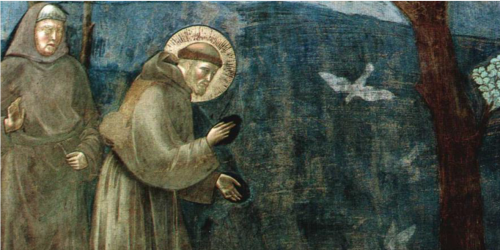
A powerful example of these five conversions at work is The Poor People’s Campaign, which was revived in 2018 by the Rev. Dr. William Barber II and the Rev. Dr. Liz Theoharis. [1] Their work with and for the poor of the United States through mutual respect, dialogue, and organizing is foundationally based on their Christian faith and study of the Gospels. In these paragraphs, Theoharis offers a scriptural exploration of what the Kingdom of God implies for the poor and marginalized—a movement of solidarity.
The New Testament . . . portrays the survival struggles of the marginalized, the solidarity and mutuality among different communities, and the critique of a social, political, and economic system that oppresses the vast majority of people. . . . Jesus’s teachings and actions around poverty, wealth, and power create a picture of him as a leader of a social, political, economic, and spiritual movement calling for a world without poverty, want, or oppression . . . what he named the Kingdom or Empire of God. . . .
The Greek word for “Kingdom of God” or “Empire of God,” basilea, has much to do with the economic order that Jesus advocated. Few would disagree that the Kingdom of God is central to the teachings of Jesus and the New Testament. However, many understand this kingdom as otherworldly and immaterial. But if we look at both the prevalence of the concept and the specific references to it in the New Testament, we can see that God’s kingdom is a real, material order, with a moral agenda different from and opposed to the reigning order of the day. The basilea is particularly present in the parables that describe how the reign of God functions differently from the Roman Empire: in God’s kingdom, there is no poverty or fear, and mutuality exists among all.
Throughout the New Testament, Jesus’s parables and stories paint a picture of a reign in which the poor and marginalized are lifted up and their needs are met, rather than being despised or ignored by those in control. . . . From these passages and others, we can see that . . . God’s followers are asked to model a community of mutuality and solidarity. . . .
Centuries of [New Testament] interpretation have attempted to spiritualize or minimize this good news for the poor, hiding the reality that the Bible is a book by, about, and for poor and marginalized people. It not only says that God blesses and loves the poor, but also that the poor are God’s agents and leaders in rejecting and dismantling kingdoms built upon oppression and inequality. . . . It is the vision of society the early Christians sought to create on earth, and that we who follow Jesus today are commanded to strive for as well.
The Fifth Conversion to solidarity is a choice to walk with the poor and oppressed, to be taught by them, and to love them as equals, each of us bearing the Divine Indwelling Spirit within.
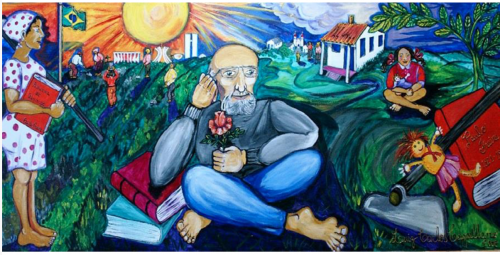
Although he was raised Roman Catholic and worked with many religious organizations, Paulo Freire rarely used religious language or metaphors to make his point. Yet his teaching on solidarity is fully aligned with the ministry of Jesus: “Conversion to [solidarity with] the people requires a profound rebirth. Those who undergo it must take on a new form of existence; they can no longer remain as they were.” [1]
In his work teaching literacy skills in Brazil and Chile, Freire employed a method of dialogue that created solidarity and transformed systems of injustice. The dialogue enables the “helper” to let go any personal agenda and allows the needs of the “helped” to be fully told. Eventually a movement towards liberation is born.
Dialogue further requires an intense faith in humankind . . . faith in their vocation to be more fully human. . . . Founding itself upon love, humility, and faith, dialogue becomes a horizontal relationship of which mutual trust between the dialoguers is the logical consequence. [2]
I hope you can see how living out the Gospel is always a process of what Freire calls humanization, [3] a movement toward greater freedom, dignity, inclusivity, and possibility. We are one, and through solidarity we more clearly identify and name the systems that separate us. We find in ourselves and in the other the true “image of God” in which we are created and connected.
The dialogue that leads to solidarity is a way that oppressors and oppressed begin to recognize each other as subjects in their full humanity, as both learn and teach in this active encounter of faith and love. Here is Freire, in his own words:
Dialogue cannot exist without humility. How can I dialogue if I regard myself as a case apart from others—mere “its” in whom I cannot recognize other “I”s? How can I dialogue if I consider myself . . . the owner of truth and knowledge . . .? How can I dialogue if I am closed to—and even offended by—the contributions of others? Self-sufficiency is incompatible with dialogue. At the point of encounter [in dialogue] there are neither utter ignoramuses nor perfect sages; there are only people who are attempting, together, to learn more than they now know. [4]
We are all on this journey together and we are all in need of liberation (which might be a better word than salvation). God’s intention is solidarity with, and universal responsibility for, the whole. As Paul taught, “If one part is hurt, all parts share in the pain. If one part is honored, all the parts share in the joy” (1 Corinthians 12:26). Think of Christianity as a giant act of solidarity with the marginalized, and all of creation.
The
Third and Fourth Conversions
Wednesday, May 27, 2020
We continue our conversions to greater solidarity with
the marginalized.
The Third
Conversion is when we idealize some of the virtues of the
poor that we ourselves do not have. When the lens is cleared by our initial
awakening to injustice, it is much easier to focus on people’s admirable
qualities, especially those that might be lacking in our own group. This was
certainly true for me. In my travels to India, the Philippines, and many Global
South nations, I saw plenty of people who were happy, generous and grateful
with the little they had. By contrast, I could be entitled and grumpy whenever
the littlest things went wrong! It was so humbling.
Although
it feels positive, staying at this conversion stage still places an unfair
burden on those who are marginalized. Projecting only good qualities onto them
tends to ease the burden of solidarity work from us. Layla F. Saad describes
this tendency in relation to black women in her book Me and White Supremacy:
Black women are
either superhumanized and put on pedestals as queens or the strong Black woman,
or they are dehumanized and seen as unworthy of the same care and attention as
white women. Both superhumanizing and dehumanizing are harmful because . . .
they fail to capture Black women in the mess, joy, beauty, and femininity of
women of other races. [1]
If
it is unjust to dehumanize others, it is equally unjust to “superhumanize”
them, applauding their ability to “do it all” instead of making sure they don’t
have to.
The Fourth
Conversion is a deepening recognition of the impact of
systemic oppression. This tends to come about as a result of
disillusionment and disappointment with the poor, especially when one
sees how they have been socialized to a worldview of failure and scarcity. This
is internalized oppression. As Paulo Freire puts it, “so often do [the
oppressed] hear that they are good for nothing, know nothing, and are incapable
of learning anything . . . that in the end they become convinced of their own
unfitness.” [2] From the very beginning, the systems we operate in either
support us or tear us down.
From
my place in society, I was able to enter into a good education system, and I
always had good healthcare. I was offered so many options and encouragement to
become “successful.” But when we come from a social location that has put us in
systems and relationships where options are limited, we are often humiliated
and looked down upon at every stage of our life. Under those conditions, it is
much harder to keep putting our best foot forward.
The work of
solidarity is to close the distance these systems have put between us by
joining and accepting others as fully human—in our struggles and gifts alike.
This work requires a commitment to relational
accompaniment. What
is needed, according to Freire, is for us to “stop making pious, sentimental,
and individualistic gestures, and risk an act of love.” [3]
If the first conversion to solidarity is to befriend or experience compassion for the poor, the Second Conversion to solidarity is anger at the unjust situation that caused their poverty. Many people never reach this stage of anger at injustice, especially in the United States. Our cultural worship of individualism and “bootstrap” mentality deprives us of the capacity to empathize with people in need and recognize systemic oppression. When we are in the middle or upper tier of privilege, it is almost impossible to see the many ways the system helped us succeed. We cannot recognize or overcome this “agreed upon delusion” as isolated individuals, mostly because it is held together by the group consensus. The dominant group—in any country or context—normally cannot see its own lies. We have to pay attention to whomever is saying “I can’t breathe” to recognize the biases at work.
This often only changes when, through friendship with people of different backgrounds and life experiences, we witness mistreatment and marginalization. We get to know someone outside our immediate social circle. Our sister falls in love with someone from another race, religion, or culture. Our grandchild is transgender. We see all the ways life is more difficult for them than it needs to be. We feel their pain instead of standing apart at a safe distance.
Anger is a necessary, appropriate, and useful response to this kind of injustice. It is the beginning of social critique and helps us protect the appropriate boundaries for ourselves and others. Yet anger can be dangerous, too. When it hangs around too long, it becomes self-defeating and egocentric. Then it distorts the message it came to offer us. We can become so intent on pointing out problems that we are never actually willing to be part of the solution. As I like to say, the best criticism of the bad is the practice of the better, not more criticism! The question of true conversion and solidarity is, “how can I work through my anger and get to the other side, so I can be a life-giving presence with and for those who are most suffering?”
For oppressed communities, however, anger can be a form of survival, a necessary stage on the path towards healing. Listening to such anger with compassionate friendship can itself be a form of solidarity. As my colleague Barbara Holmes writes:
Many spiritual traditions warn us against anger. We are told that anger provides fertile ground for seeds of discontent, anxiety, and potential harm to self and others. This is true. However, when systems of injustice inflict generational abuses upon people and communities because of their ethnicity, race, sexuality, and/or gender, anger as righteous indignation is appropriate, healthy, and necessary for survival. . . Until the killing of black and brown people stops, all peaceful methods of resistance are appropriate. Right now, our anger is our truth, and our anger is a sacred part of our humanity and our faith. [1]
If one of the primary markers of a Christian life is solidarity as modeled by Jesus, I am afraid that most of us still have a long way to go. It’s one of the reasons I say that Christianity is still in its infancy. We are just taking our first toddling steps towards a more mature and embodied faith. Transformed teachers like Francis of Assisi, Dorothy Day, and countless others, both sainted and anonymous, have invited us into solidarity with the poor and oppressed. When we are comfortably centered, it is difficult to move to the margins, but that is where we must go!
About fifty years ago, a Brazilian educator named Paulo Freire (1921–1997) wrote a book titled Pedagogy of the Oppressed. Freire worked for literacy amongst the poor in Brazil and Chile. His work became influential among many liberation theologians and those struggling against unjust systems. This book continues to impact my thinking about what it means to be in solidarity with those on the margins. It challenges many of our preconceived ideas about Christian “charity,” “service,” and “mission.” It is some of the most humbling subject matter we cover in our Living School curriculum. Many of our selfless and goodhearted students have dedicated their lives to Christian “service.” Yet they recognize the ways those vocations, as they are currently designed, often reinforce dehumanizing systems of oppression and marginalization. That paradox is often what drives them to study with us.
This week I will introduce you to a teaching I have developed in the Living School inspired by Paulo Freire’s work that I call “The Five Conversions.” It can offer us a path toward a more authentic Christian life where we recognize our deep connections to each other and choose to live in solidarity with suffering. Solidarity begins by becoming aware of our own social location, which is our place in society. For me and most of my readers that place is a starting point of privilege within the dominant culture. Let’s begin:
The First Conversion to solidarity is to have basic compassion for the poor in general, or one poor person. Throughout this discussion, I will be using the word “poor” in a very specific way—those who are powerless, dismissed, or considered lesser in society. This is far larger than mere economic poverty. Sadly, there seems to be many Christians who don’t even have basic compassion for the poor. In the United States, we are pretty much trained to blame people who are poor, immigrants or refugees, victims, or gay, lesbian, or transgendered people. Far too many seem to think, even if to themselves, that if “those people” would simply work a little more, do things the right way, change their minds, stay hidden, or just “pray a little harder,” we’d all be better off. The first conversion is where we must begin. Our hearts must be softened, and we must experience basic sympathy, empathy, and recognition of another person’s pain.
Throughout human history, countless people have been poor, vulnerable, or oppressed in some way. Those holding positions of authority within systems of power secure their own privilege, comfort, and wealth—almost always at the expense of those most on the margins. Much of history has been recorded to hide this fact and instead celebrates the so-called “winners.” I call this systemic reality a form of sin, or what the apostle Paul describes as the “the world” (Ephesians 2:1–2). This type of corporate evil is often culturally agreed-upon, admired, and deemed necessary, as is normally the case when a country goes to war, spends most of its budget on armaments, admires luxuries over necessities, entertains itself to death, or pollutes its common water and air.
The hidden nature of systemic oppression makes it all the more remarkable that the revelation of God in the Bible is written from the perspective of the oppressed. The Bible reveals a liberating path of humility, compassion, and nonviolence in the face of oppression that culminates in the life, ministry, and state-sponsored execution of Jesus.
We see in the Gospels that the people who tend to follow Jesus are the ones on the margins: the lame, poor, blind, prostitutes, drunkards, tax collectors, and foreigners. He lived in close proximity to and in solidarity with the excluded ones in his society. Those on the inside and at the center of power are the ones who crucify him: elders, chief priests, teachers of the Law, scribes, and Roman occupiers. Yet we still honor people in these latter roles and shun the ones in the former.
For the first three hundred years after Jesus’ death, Christians were the oppressed minority. But by the year 400 C.E., Christians had changed places. We moved from hiding in the catacombs to presiding in the basilicas. That is when we started reading the Bible not as subversive literature, the story of the oppressed, but as establishment literature to justify the status quo of people in power.
When Christians began to gain positions of power and privilege, they also began to ignore segments of Scriptures, especially the Sermon on the Mount. Our position in society determines what we pay attention to and what systems we are willing to “go along with.” This is what allowed “Christian” empires throughout history to brutalize and oppress others in the name of God. Sadly, this is still the case today.
But when the Bible is read through the eyes of solidarity—what we call the “preferential option for the poor” or the “bias from the margins”—it will always be liberating, transformative, and empowering in a completely different way. Read this way, Scripture cannot be used by those with power to oppress or impress. The question is no longer “How can I maintain my special and secure status?” It is “How can we all grow and change together?” I think the acceptance of that invitation to solidarity with the larger pain of the world is what it means to be a “Christian.”
Francis rejoices in all the works of the Lord’s hands, and through their delightful display he gazes on their life-giving reason and cause. In beautiful things he discerns Beauty itself; all good things cry out to him: “The One who made us is the Best.” —Thomas of Celano
Goodness is a first principle of the universe. God declares it on the first page of the story of creation. —Barbara Holmes
Creation is the first Bible, as I (and others) like to say [1], and it existed for 13.7 billion years before the second Bible was written. Natural things like animals, plants, rocks, and clouds give glory to God just by being themselves, just what God created them to be. It is only we humans who have been given the free will to choose not to be what God created us to be. Surprisingly, the environmentalist and author Bill McKibben finds hope in this unique freedom. He writes:
The most curious of all . . . lives are the human ones, because we can destroy, but also because we can decide not to destroy. The turtle does what she does, and magnificently. She can’t not do it, though, any more than the beaver can decide to take a break from building dams or the bee from making honey. But if the bird’s special gift is flight, ours is the possibility of restraint. We’re the only creature who can decide not to do something we’re capable of doing. That’s our superpower, even if we exercise it too rarely.
So, yes, we can wreck the Earth as we’ve known it, killing vast numbers of ourselves and wiping out entire swaths of other life—in fact . . . we’re doing that right now. But we can also not do that. . . .
We have the tools (nonviolence chief among them) to allow us to stand up to the powerful and the reckless, and we have the fundamental idea of human solidarity that we could take as our guide. . . .
Another name for human solidarity is love, and when I think about our world in its present form, that is what overwhelms me. The human love that works to feed the hungry and clothe the naked, the love that comes together in defense of sea turtles and sea ice and of all else around us that is good. The love that lets each of us see we’re not the most important thing on earth, and makes us okay with that. . . . [2]
Over these past several months I have witnessed many examples of this restraint, which Bill McKibben calls love. While the lives of our elders, our vulnerable, and essential workers are at stake during the COVID-19 pandemic, tens of millions of us across the globe have been restraining ourselves at home, choosing not to do many things for many weeks in order to protect those we love (and those others love as well). Surely the earth is breathing a sigh of relief for our reduction in pollution and fossil fuel use. This “Great Pause,” as some are calling it, gives me hope that we will soon find it within ourselves to protect our shared home, not only for our own sake, but for our neighbors across the globe, and future generations.
Loving
God by Loving the World
Thursday, May 21, 2020
I have often wondered what might
compel more Christians to take personal responsibility to mitigate climate
change. With all the scientific evidence we’ve been given, it doesn’t seem to
be a head issue but a heart one. Scholar Sallie McFague (1933–2019) offers both
theological and ethical reasons for us to make some much needed changes at an
individual level. She writes:
As St. Augustine [354–430] puts it, sin is “being curved
in upon oneself” [1] rather than being open to God. In our ecological age, we
now see that being open to God means being open to the other creatures upon
whom we depend and who depend upon us. We do not meet God only in Jesus of
Nazareth, because God is also incarnate in
our world as the universal Christ. . . .
To love God by loving God’s world has meant different
things to different people in different times. For us . . . it is epitomized by
climate change . . . the central crisis of the twenty-first century. Put
simply, climate change is the result of too many human beings using too much
energy and taking up too much space on the planet. Through excessive energy use
and its accompanying greenhouse-gas emissions, we are changing the planet’s
climate in ways that will make it uninhabitable for ourselves and many other
species. . . .
This is a strange “crisis” to face: It does not have the
immediacy of a war or plague or tsunami. Rather, it has to do with how we live on a daily
basis—the food we eat, the transportation we use . . . the luxuries . . . [and]
long-distance air travel we permit ourselves. We are not being called to . . .
fight an enemy; rather, the enemy is the very ordinary life we ourselves are
leading. . . . Yet, for all its presumed innocence, this way of life lived by
well-off North Americans [and
prosperous people in other countries —RR] is both unjust to those who cannot attain
this lifestyle and destructive of the very planet that supports us all.
What, then, would be [an appropriate] ethic for
twenty-first-century people and especially for well-off, religious people? One
of the distinguishing characteristics of many . . . religions is some form of
self-emptying. Often it takes the form of ego-lessness, the attempt to open the
self so that God can enter. . . . In the Christian tradition, kenosis or self-emptying is
seen as constitutive of God’s being in creation, the incarnation, and the
cross. In creation, God limits the divine self, pulling in, so to speak, to
allow space for others to exist. . . . In the incarnation, as Paul writes in
Philippians 2:7, God “emptied the divine self, taking the form of a slave,” and
in the cross God gives of the divine self without limit. Likewise, one
understanding of Christian discipleship is [as] a “cruciform” life, imitating
the self-giving of Christ for others. . . .
Could
we live and move and have our being in the universal Christ, participating in
the insight and power of God incarnate in the world as we deal with . . .
the basics of existence—space and energy—so we can live in radical
interdependence with all other creatures? We are not alone as we face this
challenge—the universal Christ is in, with, and for the world as we struggle to
deal with climate change
The Franciscan philosopher and theologian John Duns Scotus (1266–1308), whom I studied for four years in seminary, wrote that “God first wills Christ as his supreme work.” [1] In other words, God’s “first idea” and priority was to make the Godself both visible and shareable. The word used in the Bible for this idea was Logos, which was taken from Greek philosophy, and which I would translate as the “Blueprint” for reality. The whole of creation—not just Jesus—is the partner in the divine dance. Everything is the “child of God”—no exceptions. When you think of it, what else could anything be? All created beings must, in some way, carry the divine DNA of their Creator.
Without a sense of the inherent sacredness of the world—in every tiny bit of life and death—we struggle to see God in our own reality, let alone to respect reality, protect it, or love it. The consequences of this ignorance are all around us, seen in the way we have exploited and damaged our fellow human beings, the dear animals, the web of growing things, the land, the waters, and the very air. It took until the twenty-first century for a pope to clearly say this, in Pope Francis’ prophetic document Laudato Si′. May it not be too late and may the unnecessary gap between practical seeing (science) and holistic seeing (religion) be fully overcome. They still need each other.
Franciscan mysticism has an incarnational worldview, whichis the profound recognition of the presence of the divine in literally “every thing” and “every one.” It is the key to mental and spiritual health, as well as to a kind of basic contentment and happiness. An incarnational worldview is the only way we can reconcile our inner worlds with the outer one, unity with diversity, physical with spiritual, individual with corporate, and divine with human.
What we see in Franciscan mystics, again and again, is a joyful and unitive consciousness that intuits and experiences what Duns Scotus called “the univocity of being.” By this, Duns Scotus meant that we can speak with one consistent and true voice about a rock, a tree, an animal, a human, an angel, and God! They all participate in the one same state of Being to varying degrees, and Deus est Ens, he often wrote: “God is Being itself.” This eliminates any clear distinction between the sacred and the profane, because Christ existed in matter from all eternity (Colossians 1:15–20; Ephesians 1:3–11), ever since God decided to materialize and reveal who God is through creation. It is summarized on our Franciscan coat of arms by the Latin phrase Deus Meus et Omnia: “My God and All Things!”
Franciscan Ecological Wisdom
God is Being Itself Wednesday, May 20, 2020
The Franciscan philosopher and theologian John Duns Scotus (1266–1308), whom I studied for four years in seminary, wrote that “God first wills Christ as his supreme work.” [1] In other words, God’s “first idea” and priority was to make the Godself both visible and shareable. The word used in the Bible for this idea was Logos, which was taken from Greek philosophy, and which I would translate as the “Blueprint” for reality. The whole of creation—not just Jesus—is the partner in the divine dance. Everything is the “child of God”—no exceptions. When you think of it, what else could anything be? All created beings must, in some way, carry the divine DNA of their Creator.
Without a sense of the inherent sacredness of the world—in every tiny bit of life and death—we struggle to see God in our own reality, let alone to respect reality, protect it, or love it. The consequences of this ignorance are all around us, seen in the way we have exploited and damaged our fellow human beings, the dear animals, the web of growing things, the land, the waters, and the very air. It took until the twenty-first century for a pope to clearly say this, in Pope Francis’ prophetic document Laudato Si′. May it not be too late and may the unnecessary gap between practical seeing (science) and holistic seeing (religion) be fully overcome. They still need each other.
Franciscan mysticism has an incarnational worldview, whichis the profound recognition of the presence of the divine in literally “every thing” and “every one.” It is the key to mental and spiritual health, as well as to a kind of basic contentment and happiness. An incarnational worldview is the only way we can reconcile our inner worlds with the outer one, unity with diversity, physical with spiritual, individual with corporate, and divine with human.
What we see in Franciscan mystics, again and again, is a joyful and unitive consciousness that intuits and experiences what Duns Scotus called “the univocity of being.” By this, Duns Scotus meant that we can speak with one consistent and true voice about a rock, a tree, an animal, a human, an angel, and God! They all participate in the one same state of Being to varying degrees, and Deus est Ens, he often wrote: “God is Being itself.” This eliminates any clear distinction between the sacred and the profane, because Christ existed in matter from all eternity (Colossians 1:15–20; Ephesians 1:3–11), ever since God decided to materialize and reveal who God is through creation. It is summarized on our Franciscan coat of arms by the Latin phrase Deus Meus et Omnia: “My God and All Things!”
St. Bonaventure (1221–1274) taught that “Christ, as a
human being, shares with all creatures; indeed he possesses being with rocks,
lives among the plants, senses with animals, and understands with angels.” [1]
In saying this, Bonaventure wanted to give theological weight to the deep
experience of St. Francis of Assisi (1181–1226), who as far as we know, was the
first recorded Christian to call animals and elements and even the forces of
nature by familial names: “Sister Mother Earth,” “Brother Wind,” “Sister
Water,” and “Brother Fire.”
We
cannot jump over this world, or its woundedness, and still try to love God. We
must love God through, in,
with, and even because of this world. This is the message Christianity was supposed
to initiate, proclaim, and encourage, and what Jesus modeled. We were made to
love and trust this world, “to cultivate it and take care of it” (Genesis
2:15), but for some sad reason we preferred to emphasize the statement earlier
in Genesis, which seems to say that we should “dominate” the earth
(1:28).
Although
God “empties himself” into creation (Philippians 2:7), we humans have spent
most of history creating systems to control and subdue that creation for our
own purposes and profit, reversing the divine pattern. As Paul Swanson,
co-host of my podcast Another Name for
Every Thing, puts it, “The
[Franciscan mystics] are known for their celebrated connection
to being a part of nature and this world as a mirror to which we pass
over to God. There’s such a naturalness to this perspective, yet the bulk of
Christianity has seemed to pay no mind to this at all with the theology of
domination over the planet.” [2]
Franciscan
sister and scientist Ilia Delio writes that Francis modeled a way of relating
to creation with inherent dignity and equality rather than domination:
[Francis] did
not consider himself at the top of a hierarchy of being nor did he declare
himself superior to the non-human creation. Rather, Francis saw himself as part
of creation. His spirituality overturned the spirituality of hierarchical
ascent and replaced it with a spirituality of descending solidarity between
humanity and all of creation. [3] . . . He found God in all creatures and
identified with them as brother and sister . . . “because he knew they shared
with him the same beginning.” [4] By surrendering himself and daring everything
for love’s sake, the earth became his home and all creatures his brothers and
sisters. That led him to love and respect the world around him and made him
truly a man of peace.
Only prayer, the
Spirit of God breathing in us, dwelling in our hearts and joining us to Christ,
can lead us, like Francis, to the contemplative vision of God’s goodness in
every creature and in every living thing. . . . The God within us is the God
who permeates every aspect of our world—the One who is the source and goal of
creation. [5]
To mark the fifth anniversary of his encyclical Laudato Si′: On Care for Our Common Home, Pope Francis has declared May 16–24 “Laudato Si′ Week.” [1] The Daily Meditations this week will focus on how Franciscan spirituality impels us to act in response to “the cry of the Earth and the cry of the poor.” I must admit that I am often discouraged by the minimal efforts most Christians are willing to make to care for the earth, even at this critical juncture. The pandemic has shown our willingness to make sacrifices—at least to some degree—to protect our fellow humans, but we have not shown that same willingness to make even small changes to protect or heal the earth. I hope that will change!
Father Joshtrom Isaac Kureethadam, a theologian who has studied and written extensively about Laudato Si′, urges us to heed the warnings of both science and our conscience:
Today, our common planetary home is falling into ruin. We are on the brink of an unprecedented global challenge regarding the sustainability of our common home, which places a question mark on the future of human civilization. . . .
In the second chapter of the Gospel of John, there is a verse that the disciples attribute to Jesus as he drives out money lenders and sellers of sheep and cattle from the temple of Jerusalem: “Zeal for your house will consume me” [John 2:17). Prior to that verse Jesus tells those who are despoiling the holy place: “Stop making my Father’s house a marketplace!” [John 2:16]. . . .
Today, we could, and probably we should, understand this house as our common planetary home. It is this common home which is being despoiled and desecrated today. Significantly, our common home is also God’s own house, permeated by the Spirit of God from the dawn of creation, where the Son of God pitched his tent in the supreme event of the incarnation. It is in this common home that God co-dwells with humanity and of which we have been entrusted with stewardship, as we read in the book of Genesis [2:15]. The contemporary ecological crisis, in fact, lays bare precisely our incapacity to perceive the physical world as impregnated with divine presence. We have swapped the lofty vision of the physical world as God’s own abode, sanctified by the incarnation of the Son of God, with the one-dimensional mechanistic outlook of modernity. Accordingly, the physical world gets reduced to a mere storehouse of resources for human consumption, just real estate for market speculation. . . . Through pollution of the planet’s land, air, and waters, we have degraded our common home that is also God’s own home. We have turned this sacred abode into a marketplace.
In a situation of planetary emergency like the collapse of our planetary abode, we need to be aflame once again with the zeal for our common home.
Pope Francis and St. Francis of Assisi Monday, May 18, 2020
I deeply appreciate the many ways Pope Francis has continued the work of Vatican II by letting in the “fresh air” of modern science and other disciplines. While new information is one of the primary ways we come to understand Reality and God more fully, that doesn’t mean we can reject the past. Alongside the excellent scientific evidence offered by Laudato Si′, Pope Francis also honors my own spiritual father, St. Francis of Assisi, the patron saint of ecology.
10. I do not want to write this encyclical without turning to that attractive and compelling figure, whose name I took as my guide and inspiration when I was elected Bishop of Rome. I believe that Saint Francis is the example par excellence of care for the vulnerable and of an integral ecology lived out joyfully and authentically. [My emphasis here and below. —RR]He is the patron saint of all who study and work in the area of ecology, and he is also much loved by non-Christians. He was particularly concerned for God’s creation and for the poor and outcast. He loved, and was deeply loved for his joy, his generous self-giving, his openheartedness. He was a mystic and a pilgrim who lived in simplicity and in wonderful harmony with God, with others, with nature, and with himself. He shows us just how inseparable the bond is between concern for nature, justice for the poor, commitment to society, and interior peace.
11. . . . [Francis’] response to the world around him was so much more than intellectual appreciation or economic calculus, for to him each and every creature was a sister [or brother] united to him by bonds of affection. This is why he felt called to care for all that exists. His disciple Saint Bonaventure tells us that, “from a reflection on the primary source of all things, filled with even more abundant piety, he would call creatures, no matter how small, by the name of ‘brother’ or ‘sister.’” [1] Such a conviction cannot be written off as naïve romanticism, for it affects the choices which determine our behavior. If we approach nature and the environment without this openness to awe and wonder, if we no longer speak the language of fraternity and beauty in our relationship with the world, our attitude will be that of masters, consumers, ruthless exploiters, unable to set limits on their immediate needs. By contrast, if we feel intimately united with all that exists, then sobriety and care will well up spontaneously. The poverty and austerity of Saint Francis were no mere veneer of asceticism, but something much more radical: a refusal to turn reality into an object simply to be used and controlled.
12. What is more, Saint Francis, faithful to Scripture, invites us to see nature as a magnificent book in which God speaks to us and grants us a glimpse of his infinite beauty and goodness. “Through the greatness and the beauty of creatures one comes to know by analogy their maker” (Wisdom 13:5); indeed, “his eternal power and divinity have been made known through his works since the creation of the world” (Romans 1:20).
This CO2- (Church Of 2) is where two guys meet each day to tighten up our Connections with Jesus. We start by placing the daily “My Utmost For His Highest” in this WordPress blog. Then we prayerfully select some matching worship music and usually pick out a few lyrics that fit especially well. Then we just start praying and editing and Bolding and adding comments and see where the Spirit takes us.
It’s been a blessing for both of us.
If you’d like to start a CO2, we’d be glad to help you and your partner get started. Also click the link below to see how others are doing CO2.Odds Monkey
Steve Harvey Introduces Jesus To A Secular Audience
About
Change this text in the admin section of WordPress
You are currently browsing the CO2MannaToday blog archives.