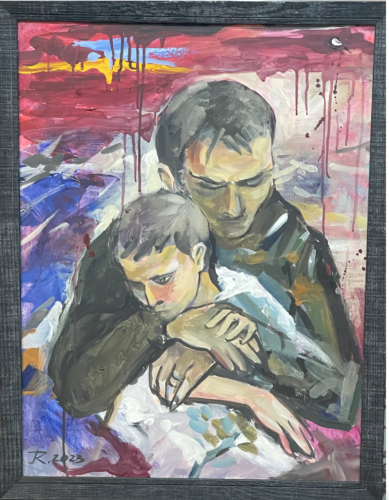
Strength In Weakness

January 4th, 2024 by JDVaughn No comments »

Richard Rohr observes how we grow spiritually through powerlessness and a willingness to change:

In Twelve Step Programs, there is no side to take. It is not a worthiness contest. There is only an absolutely necessary starting point! The experience of “powerlessness” is where we all must begin. The Twelve Steps are honest and humble enough to state this, just as Jesus himself always went where the pain was. Wherever there was human suffering, Jesus was concerned about it now, and about its healing now.… I do not really understand why God created the world this way. I do not know why “power is at its best in weakness” as Paul says, or “it is when I am weak that I am strong” (2 Corinthians 12:9–10).

Therapist Aundi Kolber writes about accepting our powerlessness as surrender and a way of “trying softer”: 

Surrender can lead us to be gentler with ourselves and others, and sometimes it enables us to ride through the waves of pain that life inevitably brings…. Paradoxically, when we choose surrender for the right reasons, it empowers us. A curious mystery comes from honoring the truth that surrender with gentleness can be its own form of strength. Our ability to hold our lives with a flexible, open posture allows God’s power to manifest in us.… When we give ourselves permission to try softer in this way … we remain attuned to our own experiences, which enables us to connect to our truest selves…. We are able to move toward integration, wholeness and peace, open to what may come. Essentially, we grow in our resiliency. [1]

Richard continues:

God seems to have hidden holiness and wholeness in a secret place where only the humble will find it. Why such a disguise? Why such a game of hide-and-seek?

I cannot pretend to understand God, but this is what I see: People who have moved from seeming success to seeming success seldom understand success at all, except a very limited version of their own. People who fail to do something right, by even their own definition of right, are those who often break through to enlightenment and compassion. It is God’s greatest surprise and God’s constant disguise, but we only know it to be true by going through it and coming out on the other side. We cannot know it just by going to church, reading Scripture, or listening to someone else talk about it, even if we agree with them.

Until we bottom out and come to the limits of our own fuel supply, there is no reason to switch to a higher-octane fuel. For that is what is happening! Why would we? We will not learn to actively draw upon a Larger Source until our usual sources are depleted and revealed as wanting. In fact, we will not even know there is a Larger Source until our own sources and resources fail us.

___________________________________________

Jesus was fed up with politics, too.

From Jesus Gets Us…

In Jesus’ time, communities were deeply divided by bitter differences in religious beliefs, political positions, income inequality, legal status, and ethnic differences. Sound familiar?

Jesus lived in the middle of a culture war, too. And though the political systems were different (not exactly a representative democracy), the greed, hypocrisy, and oppression different groups used to get their way were very similar.

Let’s set the scene.

Jesus was born at the height of the Roman Empire’s power. They’d conquered most of the known world, and Israel was no exception. Unlike previous empires that would try to destroy cultures by displacing conquered peoples’ leaders, the Romans didn’t force people to change their religion or customs as long as they kept their obligations to the empire. Rome would install a client king (a puppet government) and exact tribute (cash) in lots of different ways. Families were charged taxes per person—farmers on crops, fishermen on catches, and travelers were charged fees to use the roads. This was in addition to local business and religious taxes charged by priests.

In Israel, political and religious factions were one and the same. Back then, it was Pharisees and Sadducees. Today, we have conservatives and liberals.

The Pharisees were the most religiously conservative leaders. They had the most influence among the common working poor, who were the majority. They believed that a king would come one day to conquer Rome with violence and free their nation. Some preyed upon a mostly illiterate population by adding extra rules and requirements that were designed to force the working poor into a posture of subjugation.

The Sadducees were wealthy aristocrats who had a vested financial interest in Roman rule. They were in charge of the temple, and they didn’t believe any savior king was coming. They made themselves wealthy by exacting unfair taxes and fees from the labor of their own people and by contriving money-making schemes that forced the poor to pay exorbitant prices to participate in temple sacrifice—a critical part of their religion.

There were Zealot groups who hid in the hills and violently resisted Roman occupation, and then there were the Samaritans, often oppressed and marginalized because of their racial and ethnic identities.

And so, the common farmer, fisherman, or craftsman’s family lived through a highly volatile political period. Overbearing religious leaders who despised and oppressed them, wealthy elites who ripped them off, racial and ethnic tension with neighbors, and sporadic violent outbreaks between an oppressive occupying army.

So where was Jesus in all of this? Did he align with the religious elites? With the wealthy and powerful? Or did he start an uprising to overthrow them?

None of the above.

He went from town to town, offering hope, new life, and modeling a different way to live and to change the world. Instead of pursuing power, money, or religious authority, he shared a loving and sacrificially generous way of living. He chose not to go along with the schemes others used to impact the world. Instead, he championed a better way.

And so, each of these political groups saw him as a threat. The Pharisees recognized his movement as an affront to their authority—exposing the hypocrisy of their practices. The Sadducees saw Jesus as a threat to their power and wealth because he exposed their money-making schemes. The Zealots violently rejected one of the essential themes of Jesus’ movement: love your enemy.

In the end, it took all three of these groups to have him killed. A Zealot (Judas) betrayed his location to those seeking to arrest him, the Sadducees brought him before the Romans to be executed, and when the Romans couldn’t find a crime committed, the Pharisees rallied the people to force Rome’s hand.

Isn’t it funny how political foes can come together to destroy a common enemy that threatens their designs? But in spite of their best efforts, his execution was only the beginning of a movement that continues to impact the world thousands of years later. Jesus’ movement was so impactful because he actively resisted and rejected participating in culture-war politics.

Scripture References: 

Matthew 9:35-38,

The Workers Are Few

35 Jesus went through all the towns and villages, teaching in their synagogues, proclaiming the good news of the kingdom and healing every disease and sickness. 36 When he saw the crowds, he had compassion on them, because they were harassed and helpless, like sheep without a shepherd. 37 Then he said to his disciples, “The harvest is plentiful, but the workers are few. 38 Ask the Lord of the harvest, therefore, to send out workers into his harvest field.”


Luke 19:10;

The Parable of the Ten Minas

(A Mina is about four months’ wages)

11 While they were listening to this, he went on to tell them a parable, because he was near Jerusalem and the people thought that the kingdom of God was going to appear at once. 12 He said: “A man of noble birth went to a distant country to have himself appointed king and then to return. 13 So he called ten of his servants and gave them ten minas.[a] ‘Put this money to work,’ he said, ‘until I come back.’

14 “But his subjects hated him and sent a delegation after him to say, ‘We don’t want this man to be our king.’

15 “He was made king, however, and returned home. Then he sent for the servants to whom he had given the money, in order to find out what they had gained with it.

January 3rd, 2024 by Dave No comments »

A Collective Response

In the podcast The Cosmic We, CAC faculty member Dr. Barbara Holmes considers the collective resilience needed during times of crisis: 

It takes a village to raise a child. It takes a village to survive. For many of us, villages are a thing of the past. We no longer draw our water from the village well or share the chores of barn raising, sowing, and harvesting. We can get … almost everything that we need online. Yet even though our societies are connected by technology, the rule of law, and a global economy, our relationships are deeply rooted in the memory of local spaces.

Villages are organizational spaces that hold our collective beginnings. They’re spaces that we can return to, if only through memory, when we are in need of welcoming and familiar places. What is a village but a local group of folks who share experiences, values, and mutual support in common? I’m using the word “village” to invoke similar spiritual and tribal commitments and obligations.… When there is a crisis, it takes a village to survive.

In each generation, we are tested. Will we love our neighbors as ourselves, or will we measure our responsibilities to one another in accordance with whomever we deem to be in or out of our social circles? And what of those unexpected moments of crisis, those critical events that place an entire village at risk? How do we survive together? How do we resist together? How do we respond to unspeakable brutality and the collective oppression of our neighbors?

Our lifelong efforts to map our uniqueness do not defeat our collective connections. Although I’m an individual with a name, family history, and embodiment as an African American woman, I am also inextricably connected to several villages that reflect my social, cultural, national, spiritual, and generational identifications. These connections require that I respond and resist when any village is under assault.…

There’s a way in which we can come together as groups, as collectives, as individuals, and seek the highest good of all of us by using our gifts creatively. There really are alternatives. It’s not one thing or another. We don’t have to have large systems determining the outcome of our lives. We just have to think through creatively how we want to maximize the flourishing of most of us, not just a few of us.…

Where is your community hurting? Where can you be of help to that community? What resources and gifts do you possess that will enhance the healing of your own body and of your community? As a village, we have a sacred duty to respond to the crises of oppression and injustice. We have a responsibility to respond to the suffering of others around us. But first, we have to figure out who we are, how we’re going to show up, and how we’re going to work with others, our neighbors, in a communal response to crisis.

=================

“Any god who is mine but not yours, any god concerned with me but not with you, is an idol.

– Abraham Joshua Heschel, Jewish Philosopher and Theologian

Any concept of a god that does not show inclusive compassion and love for anyone outside of our own circle, is a limited and distorted idol.

January 2nd, 2024 by Dave No comments »

A Free “Yes” in Adversity

In his book Falling Upward, Richard Rohr helps us come to terms with the suffering of life: 

Carl Jung (1875–1961) believed much suffering occurs unnecessarily because people won’t accept the “legitimate suffering” [1] that comes from being human. He wrote, “Behind [mental conflict] there is so often concealed all the natural and necessary suffering the patient has been unwilling to bear.” [2] Ironically, refusal of the necessary pain of being human brings a person ten times more suffering in the long run. It’s no surprise that the first and always unwelcome message in the male initiation rites that I have helped lead is “life is hard.” We really are our own worst enemy when we deny this.

Episcopal priest and researcher Alice Updike Scannell (1938–2019) identified radical resilience as the ability to endure, grow, and thrive through adversity:

We usually think of resilience as the ability to recover from an adverse experience and pick up our lives where we left off. It is that too.… But there are times when adversity permanently changes our reality and we can’t go back to the way things were.…

Resilience then becomes the work of coming through the adversity so that, at least on most days, we see our life as still worth living. With this kind of resilience, we come through the adversity knowing that we’re still ourselves, even though things are very different for us now. I call this radical resilience.[3]

Richard sees suffering inherent in all of reality, but only humans have the choice to accept or deny it:

What I call “necessary” suffering goes on every day, seemingly without question. As I wrote this in the deserts of Arizona, I read that only one saguaro cactus seed out of a quarter of a million seeds ever makes it even to early maturity, and few reach full growth. Most of nature seems to totally accept major loss, gross inefficiency, mass extinctions, and short life spans as simply the price of life. Ironically, feeling that sadness, and even its full absurdity, pulls us into the general dance, the unified field, and an unexpected deep gratitude for what is given—with no necessity and so gratuitously.

Reality, creation, nature itself, what I call “the First Body of Christ,” has no choice in the matter of necessary suffering. It lives the message without saying yes or no to it. It holds and resolves all the foundational forces, all the elementary principles and particles within itself—willingly, it seems. This is the universe in its wholeness, the “great nest of being,” including even the powerless, invisible, and weak parts that have so little freedom or possibility. The Second Body of Christ, the formal church, always has the freedom to say yes or no. That very freedom allows it to say “no” much of the time, especially to any talk of dying, stumbling, admitting mistakes, or falling. Yet God seems ready and willing to wait for, and to empower, free will and a free “yes.”

=========================

From John Chaffee’s Friday Five

“The status quo will never invite itself to be disrespected, disrupted, or overthrown.

– From My Own Journals, 3 Years Ago

I hope it doesn’t seem too presumptuous to quote myself.  Facebook reminded me of a memory from 3 years ago.  If you remember, we were in the thick of Covid and there was a terrible amount of political upheaval.

Organizations, schools, churches, and schools were struggling with the world as we found it… and some chose to be innovative while others dug their heels in and defaulted back to old paradigms.

Hence why I wrote what I did.

Sometimes the status quo/the old paradigm of how to do things needs to be completely upended or overturned in order for any progress or innovation to happen.  And, I think this is why the prophets of old were killed or scapegoated back in their day… they disrespected, disrupted, and overthrew the status quo because it was what the Good Lord inspired them to do!

January 1st, 2024 by Dave No comments »

CAC Dean of Faculty Brian McLaren introduces Radical Resilience as the 2024 Daily Meditations theme.  

Each quarter this year we will examine this theme through a different metaphor of fire:  

  • Engaging With a World on Fire (Jan–Mar)
  • Tending the Inner Fire (Apr–Jun) 
  • Dancing With the Divine Fire (Jul–Sep) 
  • Embracing the Fire of Transformation (Oct–Dec) 

Radical Resilience

The annual Daily Meditations theme arises from several months of shared conversation and discernment among members of the CAC faculty and staff. CAC Dean of Faculty Brian McLaren introduces our 2024 theme:  

I’ve been invited to share with you all what our theme for 2024 will be: Radical Resilience. Each of those words is important. The word “radical” means going to the root, going to the depths, going beneath the surface.… In fact, that’s what contemplation really is: it’s paying deep attention to the deep dimensions of life. So, radical resilience means radical, deep attention to the deepest roots of resilience. Resilience is the capacity to withstand and recover from hardship or difficulty. It has to do with the ability to spring back into shape after you’ve been beaten down or knocked over or bent over.

I live in Florida, famous for hurricanes, and I’m a lover of trees. Many of our trees in Florida survive hurricanes by being flexible. They’re able to bend an amazing amount and spring back into shape. One of my favorite trees has a slightly different strategy. It’s called the “gumbo-limbo” tree, and the way it survives a hurricane is that when the wind starts to blow, it just lets branches break off. It knows that if you can keep the trunk solid and stable, and you don’t get overturned by the wind, you can bounce back after the storm. And that’s what the gumbo-limbo tree does. It travels light through the storm. It lets go of everything that’s not essential to focus on for life.

Brian connects Radical Resilience to the work of the prophets:  

Prophets are insiders who love a community enough to critique it in love. They don’t simply defend the community they love. They love it way too much for that. But neither do they attack it from the outside mercilessly and seize upon every imperfection to shame it and hurt it. As Richard Rohr often says, they critique with love from the edge of the inside.…

If we’re going to help people take wise action and imagine a better future amid coming troubles, then we will have to help people find that better future within themselves, so they can live that better future out into the world. And that’s what we hope to do together in 2024. We know that we are in hard and dangerous times. We, as a global civilization, are living destructively with our planet. We are living dangerously and divisively with one another. And we’re living often delusionally within ourselves. This year, we are going to seek to explore together radical resilience so we can become thermostats rather than thermometers in our world, setting the temperature, setting an example of contemplative depth and wisdom and love and peace—rather than just sinking into the fury and fear and denial and despair of so many of our times. Welcome, brothers and sisters, to a year of Radical Resilience.

=================

To Live Is to Change

In his New Year’s homily from 2020, Father Richard Rohr preached on the biblical call to change: 

The Greek word for “repent” (metanoia) means to change your mind. I’d like to emphasize change, because that’s not something we humans as a species are attracted to. We’re much like animals in this regard. Animals are creatures of habit. Those of us with a dog or a cat know their behavior is predictable. If we change some daily routine, they’ll get upset. I’m afraid to say that we’re much the same. We like things the way we like things. And yet the first words out of Jesus’ mouth tell us that he’s come to give us a philosophy of change: “Repent,”—change your mind—“for the kingdom of heaven has come near” (Matthew 3:2).

Psychologist Robert Wicks suggests part of resilience is making a decision to remain open to ongoing growth and change: 

Each of us has a range of resilience (the ability to meet, learn from, and not be crushed by the challenges and stresses of life)…. Of even more import than the different resiliency ranges people have is their conscious decision to maximize the ways in which they can become as hardy as possible. They may not call this resilience, but it is their ability to be open to life’s experiences, and so to learn. [1]

Richard continues:

St. John Henry Newman (1801–1890) said, “Here below to live is to change, and to be perfect is to have changed often.” [2] That’s a very different philosophy than most of us have. Our natural approach is to keep in cruise control. The way we do it is the way we do it, and any change is considered dangerous, heretical, and new. But here in this Gospel we were given a program of change and growth from the beginning. If we don’t grow, if we don’t change, we end up the same at 70 as we were at 17. We all know people like that, and we may even be one of them. Such people aren’t very fun to live with. They want to pick and win fights. It’s what a lot of politics is today. The important thing is not the truth or what’s good for the whole, but what’s good for the small part of which I’m a part.

If people refuse to change, what my mother used to call “bull-headedness,” the world will only get worse. We have to learn how to dialogue, how to forgive, and how to trust, and how to give people the benefit of the doubt. In the United States, our country has become very cynical about truth and love. We hear politicians take oaths to be fair and just leaders and we all know it doesn’t mean anything. We expect everybody to be for the truth of their group and their “kingdoms.” But Jesus tells us to change our minds and accept the kingdom of God, which is what’s good for the whole.

===================

“Begin Again.

– St. Teresa of Avila, Spanish Mystic and Nun

When St. Teresa of Avila finished hearing the confessions of her fellow nuns under her care, she would hug them, place each of her hands on their shoulders, and say, “Begin again.”

The day any of us believe we have mastered what it means to be human is the day we are most likely to mess it all up.  May we only ever believe ourselves to be beginners and always be willing to learn and grow.

A Full Prophet

December 29th, 2023 by JDVaughn No comments »

As we draw this year’s meditations on The Prophetic Path to a close, Richard Rohr reminds us of the loving heart of the prophets:

We need the wisdom of a “full prophet,” one who can love and yet criticize, one who can speak their words of correction out of an experience of gratitude, not anger. We have to pray to God to teach us that. I don’t know how else we learn it. We can’t learn it in our minds rationally. God has to soothe our angry hearts and spirits. God has to allow us to come to a place of freedom, a place of peace, and a place of fullness before we can speak as a prophet. [1]

A prophet must hold on to the truth of their anger, especially as it is directed toward injustice—but the danger of the anger is that when we let it control us, we’re not a help anymore. That’s why we have so many false prophets in America and in the world today. They are so angry. I want to sit there and say, “I agree with you. That situation deserves anger, but you’re not a good messenger because you’re only making me more angry. You’re feeding your anger by letting it become your ego.” Of course, in my early life that was me. I think what we see in the Hebrew prophets is autobiographical. My early social justice sermons at New Jerusalem just edged people out of the room. I’m sure many of them thought, “I don’t think we want to hear Richard today. He’s on one of his tirades.” They saw me at my angriest when I had just come back from Latin America and Africa. Anger is usually a necessary starting place, but it is never the full message. [2]

That’s why I always go back to prayer. It’s the only way for me. I rest in God, let God massage my heart for a while, cool me down and say, “I love you. You don’t have to save the world, Richard. You don’t have to ‘play’ the prophet and you don’t have to do anything except what I tell you to do.” The more I rest there with God, the next time the words come out so differently.

We’ve got to learn how to discern the Spirit. We have to listen to our own hearts and discern where the voices are coming from. Are they harsh, angry, hurtful, resentful, cynical voices telling us we’ve got to go out and do some righteous thing? Or are they coming from a place of freedom and a place of peace?

The prophet is the one who can be a faithful lover, who is truly seeking the whole and seeking the good, and not just seeking the self. We can tell after a while the difference between someone who is operating out of their own anger and compulsions, and someone who is operating out of the heart of God. [3]

________________________________________

Jesus Gets Us….

Jesus Responded to the ever increasing volume of hate with quiet and deliberate acts of Love….

Listening to the world around us, we couldn’t help but come to the conclusion that the volume is rising day by day. If you listen to the news, you hear louder voices, stronger opinions, and harsher disagreements. If you scroll through your social feeds, you see arguments in the comment section of the most benign posts. Everyone wants to be heard, and collectively, we seem to be going to greater and greater lengths to be the one voice loud enough to be made out above the din.

But as we listened, we noticed that most of what gets amplified — most of the stuff loud enough to be heard — is rife with hate, anger, and discontentment. And when hate gets amplified, too often, we try to drown it out with even louder hate from a different perspective. It’s a vicious cycle, and it’s one Jesus dealt with 2,000 years ago.

Everywhere he went, he was met with dissenting opinions, trap questions, and directed hatred. People were constantly trying to silence him, discredit him, or hijack his platform to amplify their own voices. It must have been infuriating, but he didn’t give in and add to the noise. Jesus used his voice, but he didn’t shout. He not only stayed on the path of preaching patience, selflessness, and love but more importantly, he also demonstrated them. He responded to the ever-increasing volume of hate with quiet and deliberate acts of love. And the result is evident in the fact that we’re still talking about it 2,000 years later: his love was louder, and it still is.

Proverbs 3:5-6New International Version

Trust in the Lord with all your heart
    and lean not on your own understanding;
in all your ways submit to him,
    and he will make your paths straight.[a]

We Are All Prophets

December 28th, 2023 by JDVaughn No comments »

In his book We Survived the End of the World, Choctaw elder and retired Episcopal bishop Steven Charleston writes about how prophets arise in periods of crisis or “apocalypse” to chart a message of resilience and hope.

In trying to discern how and why my ancestors lived through one of the greatest human cataclysms in history, I decided to rediscover the prophets of my people…. I listened once again to the voices of Native American prophets to discover what they could teach me about the world in which we live today.…

Prophets do not arise out of a vacuum. They are part of the apocalyptic process. They appear first as an early warning system within any culture at risk. They fulfill the classic role of the prophet as herald of a vision of what is to come. Then, as the apocalypse becomes ever more real, they serve as teachers to instruct people about what to do to end the suffering and alter the course of destruction. Finally, they are mystics who describe the future and guide people to find it within themselves.

In carrying out these roles in the apocalyptic process, the prophet strives to stand on solid ground, even while the earth beneath their feet is moving. That is, prophets not only talk about the future but the past. They ground their prophecy in the bedrock spiritual traditions of their people. They recall the ancient stories and covenants between the divine and human beings. They reinterpret ancient teachings and remind people of old promises. Prophets are immersed in tradition even as they talk about how that tradition will need to change to meet new apocalyptic challenges.

Charleston believes that everyone can be a prophet if we awaken to the possibility and responsibility of our time.

I invite you to join me in becoming a prophet.… It does not matter what your race or religion may be. It does not matter what age or gender you are. We can all become prophets of our own time. We are all needed….

We are all prophets. We are not divine messengers. We do not speak for God. We are not miracle workers or moral judges. Instead, we are … human beings living in extraordinary times. We are what the Hopi are: communities seeking a spiritual purpose to their lives. We are question askers. We are vision seekers. We strive to be common-sense advocates for what will work best to help our people.…

Believe in yourself. You are a prophet. You are already making your migration. You have been chosen because you have been born. You are a prophet because you are awake. You are a keeper of revelation: a person with a thought that may create a new world. Do not hide that piece of the sacred tablet, for the time is short, but give it to as many as you can, as often as you can, until the apocalypse becomes a blessing.

__________________________________________

Jesus Was Exclusively Inclusive…. (From He Gets US Daily Devotional)

Back in Jesus’ time, a respectable Jewish teacher wouldn’t dare consider taking a female student under his instruction. He would also not engage with someone who had a chronic illness or disability, since it was believed to be a testament of poor character and lineage. And never mind having dealings across the ethnic and political barriers that existed then. That, too, was a no-no.

Yet, Jesus—who, as a religious Jewish teacher, had these expectations tenfold—didn’t follow any of these rules. In fact, he went out of his way to break them.

Though there are still places today where women, ethnicities, and people with disabilities are openly excluded from society, it may be hard to fully understand how shocking Jesus’ behavior was when, for instance, he comforted a woman because she suffered from years of constant blood flow — a disorder that was considered unclean. Or when, without hesitation, he associated himself with a man sick with leprosy, and another with blindness, and yet another who was paralyzed. Or how about when he engaged in a deep conversation in broad daylight with a woman who came from a people that many likened to dogs, and then went on to visit a Roman man’s home to tend to the sick there.

Jesus sought to include everyone in his ministry, giving them a place to belong by treating all with value and respect. This meant he crossed the line countless times. One of the more notable instances happened when he befriended a woman who was widely considered to be demon-possessed. Even today, we can imagine how this might’ve gotten tongues wagging. But because of Jesus’ compassion, this woman would go on to find her health and become one of the most influential people associated with him. Her name was Mary Magdalene, and the fact that we know about her over two-thousand years later is a testament to the barriers Jesus successfully erased by simply ignoring them.

Today, Jesus’ legacy continues to challenge us to be inclusive in a real way, to reach past people’s physical and mental struggles, gender, and ethnicity so that we may really see them. And once we do, we might just find—much like those who knew Mary Magdalene in her time—that the people who are considered the least of us will impact us the most.

Scripture References:

Galatians 3:28: ‘ There is neither Jew nor Gentile, neither slave nor free, nor is there male and female, for you are all one in Christ Jesus.
Romans 12:15-17: Rejoice with those who rejoice; mourn with those who mourn. 16 Live in harmony with one another. Do not be proud but be willing to associate with people of low position. Do not be conceited. 17 Do not repay anyone evil for evil.
Luke 8:1-3: 1 After this, Jesus traveled about from one town and village to another, proclaiming the good news of the kingdom of God. The Twelve were with him, 2 and also some women who had been cured of evil spirits and diseases: Mary (called Magdalene) from whom seven demons had come out;

December 27th, 2023 by Dave No comments »

Jesus as Prophet

CAC teacher Brian McLaren reminds us of the power of knowing and following Jesus as a prophet:  

The understanding of Jesus as a prophet in the rich prophetic tradition of the Christian religion has been minimized. I bet many of us have never even heard a sermon or a talk about Jesus as prophet. Instead, we talked about Jesus as the Son of God, the Third Person of the Trinity, the Savior, and the sacrificial atonement lamb. We became very obsessed with talking about Jesus in some ways, but we minimized his work and life as a prophet. Of course, we’re welcome to understand Jesus as more than a prophet, but we should never understand him as less than a prophet. It should be the core and the baseline of our understanding of who Jesus is….

If we let Jesus’ prophetic identity be eclipsed by other understandings, Jesus is reduced and so are we, because Jesus was interested in us and his followers becoming like him. You’ll remember that Jesus says to the disciples, “Greater things you shall do” (John 14:12), and “As the Father sent me, so I send you” (John 20:21). He is telling his followers, “You’re going to be persecuted the way the prophets were before you. You’re fulfilling and falling into their movement. My movement is a prophetic movement. When you join my movement, you’re in that line of work.” Of course, in all of this, he’s echoing the prototypical prophet Moses’ words: “Would that all the Lord’s people were prophets and that God would put God’s spirit on them” (see Numbers 11:29)….

In all the ways we talk about Jesus, I hope we can get back the understanding of Jesus as prophet and let that revolutionize us. The prophet is not just somebody who reads a book and repeats what they have learned. The prophet is somebody who goes deep into themselves to hear the message that’s being birthed in the midst of their pain and their burdens and their frustrations and their sufferings and their questions and their perplexity and their disillusionments. In the foment and ferment of that inner journey, something begins to emerge, and they bring it out and they say, “I can’t just say these words. I have to demonstrate them. I’ve got to find two or three other people who see what I see so that we can do something about it.”

I think there’s a movement that’s happening in the world. It’s happening across religions. It’s happening with secular and religious people. It’s bubbling up in the hearts of people in pain. When people who are motivated by revolutionary love in the prophetic path of Jesus come together, knowing the pain of our planet and knowing the agony of the poor, to work for peace and against injustice and racism and hate, they can transform a broken world toward beloved community to the glory of God.

======================= From John Chaffee’s. Friday Five

“There is no coming to consciousness without pain.

– Carl Jung, Swiss Psychoanalyst

Sometimes it is easier in the short run to go through life oblivious to the problems we create for ourselves.  Over the years, I have had to face uncomfortable truths about myself that I could not avoid any longer.

The Enneagram was a major part of this process.

We all have a favorite mode in which we “play the game of life.”  That mode of living can work for a time before we begin realizing that it causes us more problems than not, and it is extremely difficult to look in the mirror and realize that we are our largest obstacle/hurdle.

Jung was correct, it is a painful experience to become self-aware.

December 26th, 2023 by Dave No comments »

Abounding in Kindness

Theologian Elizabeth Johnson summarizes the prophetic path as following a merciful God who abounds in kindness: 

Abounding in kindness, the holy mystery of God is love beyond imagining. Not enough people seem to know this, even those who practice the Christian religion. But the drumbeat of this good news resounds throughout the history of ancient Israel where, from the start of their liberation from slavery, people encountered “a God merciful and gracious, slow to anger, and abounding in steadfast love and faithfulness” (Exodus 34:6). The drumbeat becomes unmistakably intense in Jesus Christ who preached and enacted divine compassion in startling ways, all the way to the cross and beyond. Its volume ramps up in the church wherever this word is heard and practiced amid the joys and hopes, the griefs and anxieties of people of this age.

This is not a word that returns to its Maker empty. Working creatively for peace amid horrific violence; struggling for justice in the face of massive poverty and military oppression; advocating ecological wholeness for the earth’s life-giving systems and stressed-out species; educating the young and the old; healing the sick and comforting those in despair; creating beauty; taking joy in nourishing children; promoting freedom for captives: the list could go on because the needs are enormous. Even a simple cup of cold water given in Christ’s name symbolizes how the abounding kindness of God becomes effective in this world. [1]

For Johnson, God’s compassion and solidarity for those who are suffering requires us to show the same: 

If the heart of divine mystery is turned in compassion toward the world, then devotion to this God draws persons into the shape of divine communion with all others: “Be merciful, just as your Father is merciful” (Luke 6:36). To deny one’s connection with the suffering needs of others is to detach oneself from divine communion.

The praxis of mercy is propelled by this dynamic. So too is committed work on behalf of peace, human rights, economic justice, and the transformation of social structures. For those who engage in this work out of deep contemplative experience, it is far from mere activism or simple good deeds. Rather, solidarity with those who suffer, being there with commitment to their flourishing, is the locus of encounter with the living God. Through what is basically a prophetic stance, one shares in the passion of God for the world.…

The preferential option for the poor must now include the vulnerable, voiceless, nonhuman species and the ravaged natural world itself, all of which are kin to humankind. Loving these neighbors as their very selves, committed religious persons develop moral principles, political structures, and lifestyles that promote other creatures’ thriving and halt their exploitation. For the prophetic passion flowing from contemplative insight, action on behalf of justice for the earth participates in the compassionate care of the Creator God who wills the glorious well-being of the whole interdependent community of life. [2]

The Prophetic Path of Scripture

For he is like a refiner’s fire and like fullers’ soap; … Lo, I will send you the prophet Elijah before the great and terrible day of the Lord comes. He will turn the hearts of parents to their children and the hearts of children to their parents.
—Malachi 3:2, 4:5–6, NRSV 

Father Richard writes of the prophetic path shown in the Scriptures:  

These words from the prophet Malachi describe the one who will be the fitting precursor for any coming Messiah. Christians have usually applied this passage to John the Baptist, as Jesus himself and the gospel writers already have done. But this text has even more significance. In very few verses, it succeeds in charting the sequencing of the prophetic Word of God. When the Scriptures are used maturely, they proceed in this order: 

1. They confront us with a bigger picture than we are used to: “God’s reign” that has the potential to “deconstruct” our false world views.  

2. They then have the power to convert us to an alternative worldview by proclamation, grace, and the sheer attraction of the good, the true, and the beautiful (not by lower-level motivations of shame, guilt, or fear).  

3. They then console us and bring deep healing as they “reconstruct” us in a new place with a new mind and heart.  

The prophet Malachi does this. He describes the work of the God Messenger as both “great and terrible,” both wonderful and threatening at the same time. It is not that the Word of God is threatening us with fire and brimstone. Rather, the Scripture is saying that goodness is its own reward and evil is its own punishment. If we do the truth and live connected in the world as it really is, we will be blessed and grace can flow. The consolation will follow from the confrontation with the Big Picture. If we create a false world of separateness and egocentricity, it will not work and we will suffer the consequences even now. In short, we are not punished for our sins, but by our sins! [1]

The Eternal Word of God that we read about in the prologue to John’s Gospel “leapt down,” as it says in the Book of Wisdom (18:14–15). It took its abiding place on Earth in order to heal every bit of separation and splitness that we experience. That splitness and separation is the sadness of the human race. When we feel separate, when we feel disconnected, when we feel split from our self, from our family, from reality, from the Earth, from God, we become angry and depressed people. Deep down, we know we weren’t created for separateness; we were created for the Big Picture and for union.

God sent Jesus into the world as the One who would personify that union—who would put human and divine, matter and spirit together. That’s what we spend our whole life trying to believe: that this ordinary earthly sojourn means something. [2]

The Prophetic Holy Family

Father Richard praises the courageous and prophetic faith of Mary and Joseph:

Kingdom of God people are history makers. They break through the small kingdoms of this world to an alternative and much larger world, God’s full creation. People who are still living in the false self are history stoppers. They use God and religion to protect their own status and the status quo of the world that sustains them. They are often fearful people, the nice proper folks of every age who think like everyone else thinks and who have no power to break through, or as Jesus’ opening words put it, “to change” (Mark 1:15; Matthew 4:17).

How can we really think that Mary—if she thought like any good Jewish girl of her time was trained to think—could possibly be fully ready to hear, to speak, or to live out God’s message? She had to let God lead her outside of her box of expectations, her comfort zone, her dutiful religion of follow-the-leader (a feature of all religions at their lower levels). She was very young and largely uneducated. Perhaps theology itself is not the necessary path but instead simply integrity and courage. Nothing anyone said at the synagogue would have prepared Mary or Joseph for this situation. They both had to rely on their angels! What proper bishop would trust such a situation? I wouldn’t myself. All we know of Joseph is that he was “a just man” (Matthew 1:19), probably also young and uneducated. The circumstance is a total afront to our criteria and way of evaluating authenticity.

So why do we love and admire people like Mary and Joseph, and then not imitate their faith journeys, their prophetic courage, their non-reassurance by the religious system?

Like the prophets we have met this year, Mary and Joseph trusted their encounter with God and acted accordingly: 

These were two laypeople who totally trusted their inner experience of God and followed it to Bethlehem and beyond. There is no mention in the Gospels of the two checking out their inner experiences with the high priests, the synagogue, or even their Jewish Scriptures. Mary and Joseph walked in courage and absolute faith that their experience was true, with no one except God to reassure them they were right. Their only safety net was God’s love and mercy, a safety net they must have tried out many times, or else they never would have been able to fall into it so gracefully.

=============================

Quote from John Chaffee’s Friday Five….

“Religion is for people looking to avoid hell, spirituality is for people who have already gone through it.

– Fr. Richard Rohr, OSF

Wow.  That’s a good one, isn’t it?

It feels as though there are seasons of life to these things.  For a time (and perhaps it is a long time) some of us are very committed to “religion” and to being “religious” thinking that it can protect us from some particular suffering…

Then, suffering happens anyway and we are left asking, “What happened?  I was doing all the right things?”

If we are graced with the opportunity, we can then dive into spirituality when our religion falls apart.

Now, it is not that spirituality does not have a religion or utilize religious forms, ceremonies, or practices.  Spirituality uses them but does so from a different stance or posture.  The difference is that religion is no longer an end in and of itself, religion becomes the servant of spirituality.

Room for Christ

December 22nd, 2023 by JDVaughn No comments »

“Amen, I say to you, whatever you did for one of these least brothers and sisters of mine, you did for me.” —Matthew 25:40

In Matthew 25, Jesus identifies himself as incarnate always through people in need. Catholic Worker co-founder Dorothy Day (1897–1980) expands on this gospel message:

It is no use saying that we are born two thousand years too late to give room to Christ. Nor will those who live at the end of the world have been born too late. Christ is always with us, always asking for room in our hearts.

But now it is with the voice of our contemporaries that He speaks, with the eyes of store clerks, factory workers, and children that he gazes; with the hands of office workers, slum dwellers, and suburban housewives that He gives. It is with the feet of soldiers and tramps that He walks, and with the heart of anyone in need that He longs for shelter. And giving shelter or food to anyone who asks for it, or needs it, is giving it to Christ….

It would be foolish to pretend that it is always easy to remember this. If everyone were holy and handsome, with “alter Christus” [“another Christ”] shining in neon lighting from them, it would be easy to see Christ in everyone. If Mary had appeared in Bethlehem clothed, as St. John says, with the sun, a crown of twelve stars on her head, and the moon under her feet [see Revelation 12:1], then people would have fought to make room for her. But that was not God’s way for her, nor is it Christ’s way for Himself.

Day offers examples of those who ministered to the Christ child and how we can too:

In Christ’s human life, there were always a few who made up for the neglect of the crowd. The shepherds did it; their hurrying to the crib atoned for the people who would flee from Christ. The wise men did it; their journey across the world made up for those who refused to stir one hand’s breadth from the routine of their lives to go to Christ. Even the gifts the wise men brought have in themselves an obscure recompense and atonement for what would follow later in this Child’s life. For they brought gold, the king’s emblem, to make up for the crown of thorns that He would wear; they offered incense, the symbol of praise, to make up for the mockery and the spitting; they gave Him myrrh, to heal and soothe, and He was wounded from head to foot….

We can do it too, exactly as they did. We are not born too late. We do it by seeing Christ and serving Christ in friends and strangers, in everyone we come in contact with…. For a total Christian, the goad of duty is not needed … to perform this or that good deed. It is not a duty to help Christ, it is a privilege.

_______________________________________________

Sarah Young

Let My Presence override everything you experience. Like a luminous veil of Light, I hover over you and everything around you. I am training you to stay conscious of Me in each situation you encounter.
     When the patriarch Jacob ran away from his enraged brother, he went to sleep on a stone pillow in a land that seemed desolate. But after dreaming about heaven and angels and promises of My Presence, he awoke and exclaimed, “Surely the Lord is in this place, and I was not aware of it.” His discovery was not only for him but for all who seek Me. Whenever you feel distant from Me, say, “Surely the Lord is in this place!” Then, ask Me to give you awareness of My Presence. This is a prayer that I delight to answer.

RELATED SCRIPTURE:

Psalm 31:20 (NLT)
20 You hide them in the shelter of your presence,
    safe from those who conspire against them.
You shelter them in your presence,
    far from accusing tongues.

Genesis 28:11-16 (NLT)
11 At sundown he arrived at a good place to set up camp and stopped there for the night. Jacob found a stone to rest his head against and lay down to sleep. 12 As he slept, he dreamed of a stairway that reached from the earth up to heaven. And he saw the angels of God going up and down the stairway.
13 At the top of the stairway stood the Lord, and he said, “I am the Lord, the God of your grandfather Abraham, and the God of your father, Isaac. The ground you are lying on belongs to you. I am giving it to you and your descendants. 14 Your descendants will be as numerous as the dust of the earth! They will spread out in all directions—to the west and the east, to the north and the south. And all the families of the earth will be blessed through you and your descendants. 15 What’s more, I am with you, and I will protect you wherever you go. One day I will bring you back to this land. I will not leave you until I have finished giving you everything I have promised you.”

Mini Incarnations of Christ

December 21st, 2023 by JDVaughn No comments »

Franciscan sister Ilia Delio focuses on the theology of the incarnation and the universal nature of the Christ mystery:

The Christian message is that God has become flesh [sarx in Greek or “matter”]—not a part of God or one aspect of God but the whole infinite, eternal God Creator has become matter. The claim—God has become flesh—is so radical that it is virtually unthinkable and illogical. Christianity is the most radical of all world religions because it takes matter seriously as the home of divinity. [1]

So does everyone have to become Christian to know the Christ? Absolutely not. Christ is more than Jesus. Christ is the communion of divine personal love expressed in every created form of reality—every star, leaf, bird, fish, tree, rabbit, and human person. Everything is christified because everything expresses divine love incarnate. However, Jesus Christ is the “thisness” of God, so what Jesus is by nature everything else is by grace (divine love). We are not God, but every single person is born out of the love of God, expresses this love in [their] unique personal form, and has the capacity to be united with God…. Because Jesus is the Christ, every human is already reconciled with every other human in the mystery of the divine, so that Christ is more than Jesus alone. Christ is the whole reality bound in a union of love.

We cannot know this mystery of Christ as a doctrine or an idea; it is the root reality of all existence. Hence, we must travel inward, into the interior depth of the soul where the field of divine love is expressed in the “thisness” of our own, particular life. Each of us is a little word of the Word of God, a mini-incarnation of divine love. The journey inward requires surrender to this mystery in our lives, and this means letting go of our “control buttons.” It means dying to the untethered selves that occupy us daily; it means embracing the sufferings of our lives, from the little sufferings to the big ones; it means allowing God’s grace to heal us, hold us, and empower us for life; it means entering into darkness, the unknowns of our lives, and learning to trust the darkness, for the tenderness of divine love is already there; it means being willing to surrender all that we have for all that we can become in God’s love; and finally, it means to let God’s love heal us of the opposing tensions within us. When we can say with full voice, “You are the God of my heart, my God and my portion forever” [Psalm 73:26], then we can open our eyes to see that the God I seek is already in me … and in you. We are already One. [2]

__________________________________________________

December 12 2014

Journal Entry for Today-JDV

Lord, this devotional is very timely as I take stock of 2014 and look out at the future of 2015. However, there is something here that doesn’t quite ring true. If Jesus paid the price for our sins and transgressions, then why should we recall them and our yesterdays as if we need to be held accountable?  What can we be held accountable for, if Jesus paid the price? Is this one more of those “bait and switch” teachings? Jesus paid it all now it is up to me to live it out and be held to account for not doing so according to some measuring guide?

And God says…”I said I will remember your sins no more. They are as far as the east from the west. I do not recall past, present or future sins. When I look at the accounting, I see Jesus, and how you allowed My Spirit to live through you. There is no measurement, only yes and no. As you have been fond of saying, “God does not grade on the curve”. So let go of the past, present and future, and look to the new year as an opportunity to step out in a vision and faith so large, that the only way to live it is to be totally surrendered to Me. Seek first the kingdom of God and everything else you require will be provided. Delight yourself in the Lord and I will give you the desires of your heart. Do not get confused by the enemy contemplating your failures and missteps. Focus on Jesus and by the strength and faith of Jesus, allow your vision, hopes and dreams to become real. Acknowledge Me in all our ways and I will make your paths straight.”