Everyday Mysticism

June 10th, 2022 by JDVaughn No comments »

The Rev. Dr. Barbara Holmes shares her experiences of the Holy Spirit and being an “everyday mystic”:

There is no template; there is no right way to encounter the spirit world. It can occur as a simple understanding of unity, the nonduality of an observer and the observed, oneness, feelings of sacredness, peace, bliss, transcendence, a feeling of changing and transforming time and space, or an intuitive conviction that the experience is a source of objective truth and ultimate reality. The ordinariness of my mystical experiences taught me that being an everyday mystic is not limited to ritual, visitation, and mysterious power. It also just broadens the scope of your personal identity. It includes normal gifts like healing, grounds us in faith, grounds us in our ancestral heritage.

Being an “everyday mystic” for Dr. Holmes is also connected with her time spent in Pentecostal churches. She draws upon what Jesuit theologian Karl Rahner (1904–1984) described as “mysticism of the masses”:

The mysticism of everyday life is an opportunity to deeply mine the depths of human experience, relationships with others, and our encounters with nature. Rahner says to be a mystic is to occupy the core of human experience. . . . Mystery is mysterious. It is! Sometimes it comes in stillness when you’re alone. Sometimes it comes without drama and fanfare. Sometimes it comes as an epiphany, an awakening. And sometimes, it comes while you’re practicing the gifts of the Spirit. . . .

The “mysticism of the masses” [1] that Rahner refers to is a manifestation of charisms, Pentecostalism, dramatic conversions, glossolalia (speaking in tongues), prophecy, being drunk in the Spirit or slain in the Spirit in the language of Pentecostalism. [2] Rahner calls this “noisy mysticism,” and he considers it just fine and real if it increases faith, love, and charity. [3] He urges adherents to self-examine their own enjoyment of the phenomena.

I have inhabited those spaces most of my life. If I had a choice between a tall steeple church and a pew in a storefront in the middle of an impoverished neighborhood, I’d pick the storefront, because I’d know that there’d be more happening in the storefront than in the tall steeple church. There’d be mysteries inside those walls. . . .

One of the reasons I was attracted to this “mysticism of the masses” is because it was a recovery of Africanism’s long-lost past—in the transport from Africa to the Americas that my ancestors made. We’re always looking for ways to reconnect and this type of worship was very, very stimulating, and given the fact that my profession lawyering and academic work was very cool and wintry, when I came home on weekends and wanted to visit faith spaces, I tried to find the most mysterious, strange, storefront, noisy mystics that I could. . . .

Perhaps I am not the embodiment that Karl Rahner imagined but I am a mystic all the same. . . . Every ordinary thing is infused with mystery.

I am an everyday mystic. So are you.

Sarah Young…

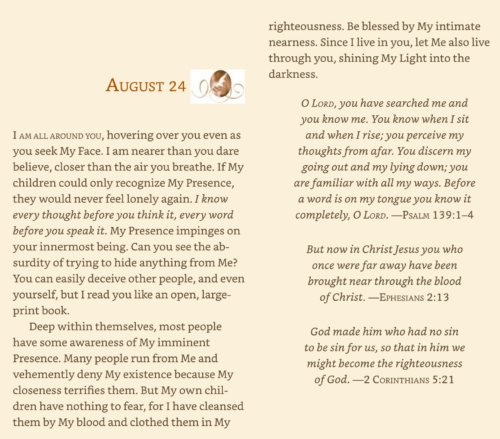
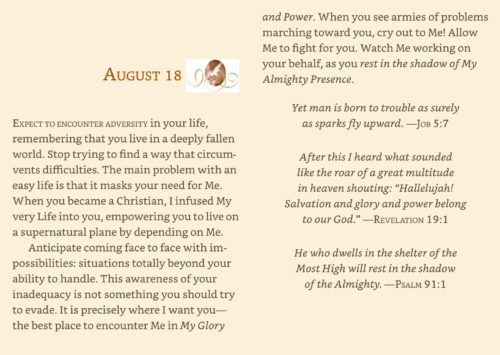
Rest in Me my child. Do not try to plan, organize and control your future. Pray instead, asking My Spirit to take over…. then rest in Me.

1 Thessalonians 5:15

Pray without ceasing.

Psalm 139:9-10
If I take the wings of the morning and dwell in the uttermost parts of the sea, even there your hand shall lead me, and your right hand shall hold me.

Psalm 62:5
Yes, my soul, find rest in God; my hope comes from him.

A Reconciling Power

June 9th, 2022 by JDVaughn No comments »

Amos Yong is a Malaysian-American, Pentecostal theologian. Yong describes how the Spirit’s coming at Pentecost begins a reconciled way of relating to one another across divisions:

First-century Palestinian life, in many ways like our global village today, was marked by suspicions about those who . . . spoke other languages, and who represented strange ways of life. It was the work of the Spirit . . . to bring those who were strangers together, and to reconcile those who might have otherwise lived apart from those unlike themselves.

Pentecost thus inaugurates a restored Israel and God’s kingdom by establishing new social structures and relations. Note that the gift of the Spirit was not withheld from any of the 120 men and women who had gathered in the upper room (Acts 1:14–15): the divided tongues of fire rested on each one and enabled each to either speak or be heard in foreign languages (Acts 2:3–4). In order to explain this phenomenon, Peter cites the prophet Joel:

your sons and your daughters shall prophesy,
and your young men shall see visions,
and your old men shall dream dreams.
Even upon my slaves, both men and women,
in those days I will pour out my Spirit;
and they shall prophesy (Acts 2:17–18; compare Joel 2:28–29).

The Spirit’s gifts are not only for individuals; they have social effects challenging the “powers that be”:

Peter clearly understood that, whereas the former Jewish era was patriarchal in character, the restoration of Israel would feature the equality of male and female: both would prophesy under the power of the Spirit. Whereas the former covenant featured the leadership of elders, the restored kingdom would involve the empowering of men and women of all ages. Whatever structures had previously sanctioned the social system of slavery, the outpouring of the Spirit had been and would be indiscriminately upon both free and slave, in effect making them equal. In all of this, the work of the Spirit was heralded in strange tongues, not the conventional languages of the status quo.

In effect, the restoration of the kingdom through the power of the Spirit actually overturned the status quo. As Mary and Zechariah had already foretold, those at the bottom of the social ladder—women, youth, and slaves—would be recipients of the Spirit and vehicles of the Spirit’s empowerment [Luke 1:46–55; 1:67–79]. People previously divided by language, ethnicity, culture, nationality, gender, and class would be reconciled in this new version of the kingdom. Potentially, “all flesh” would be included within this kingdom of the last days (Acts 2:17).

Do these characteristics continue to mark the church as the fellowship of the Holy Spirit? . . . Does the church still speak in the tongues of the Spirit . . . or do we remain captive to the divisive languages, structures, and conventions of the empires of this world? Our prayer should be, “Come Holy Spirit!” so that the proclaimed outpouring of the Spirit on all flesh might indeed still find its fulfillment in our time.

_____________

Sarah Young….Wear God’s Love

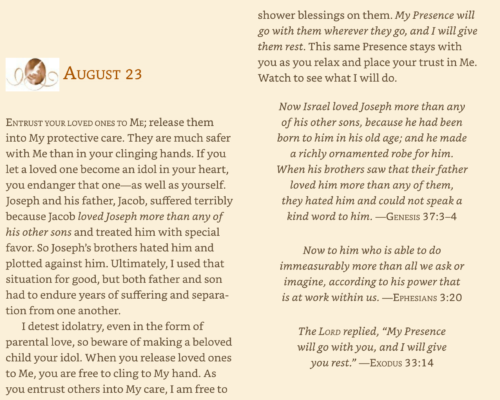
Seek to live in My Love…..wear My Love like a cloak of light. Look at people through My Lense of love.

1Peter 4:8
Most important of all, continue to show deep love for each other, for love covers a multitude of sins.

1John 4:18
There is no fear in love. But perfect love drives out fear, because fear has to do with punishment. The one who fears is not made perfect in love.

Revelation 2:4
Yet I hold this against you: You have forsaken the love you had at first

June 7th, 2022 by Dave No comments »

The Immensity Within

Father Richard describes the Holy Spirit as the loving immensity of God’s presence within us:

On one level, soul, consciousness, love, and the Holy Spirit can all be thought of as one and the same. Each of these point to something that is larger than the self, shared with God, and even eternal. That’s what Jesus means when he speaks of “giving” us the Spirit or sharing his consciousness with us. One whose soul is thus awakened actually has “the mind of Christ” (see 1 Corinthians 2:10–16). That does not mean the person is psychologically or morally perfect, but such a transformed person does see things in a much more expanded and compassionate way. St. Paul calls it “a spiritual revolution of the mind” (Ephesians 4:23, Jerusalem Bible)—and it is!

Jesus calls this implanted Spirit the “Advocate” who is “with you and in you,” makes you live with the same life that he lives, and unites you to everything else (John 14:16–20). He goes on to say that this “Spirit of truth” will “teach you everything” and “remind you of all things” (John 14:26) as if you already knew this somehow. Talk about being well-equipped from a Secret Inner Source! It really is too good to believe—so we didn’t believe it.

Consciousness, the soul, love, the Holy Spirit, on both the individual and shared levels, have sadly become largely unconscious! No wonder some call the Holy Spirit the “missing person of the Blessed Trinity.” No wonder we try to fill this radical disconnectedness through various addictions.

There is an Inner Reminder and an Inner Rememberer (see John 14:26, 16:4) who holds together all the disparate and fragmented parts of our lives, who fills in all the gaps, who owns all the mistakes, who forgives all the failures—and who loves us into an ever-deeper life. This is the job description of the Holy Spirit, who is the spring that wells up within us (John 7:38–39)—and unto eternal time. This is the breath that warms and renews everything (John 20:22). These are the eyes that see beyond the momentary shadow and disguise of things (John 9); these are the tears that wash and cleanse the past (Matthew 5:4). And better yet, they are not only our tears but are actually the very presence and consolation of God within us (2 Corinthians 1:3–5).

You must contact this Immensity! You must look back at what seems like your life from the place of this Immensity. You must know that this Immensity is already within you. The only thing separating you from such Immensity is your unwillingness to trust such an utterly free grace, such a completely unmerited gift.


June 6th, 2022 by Dave No comments »

Baptism of Fire and Spirit

When the day of Pentecost had come, they were all together in one place. And suddenly from heaven there came a sound like the rush of a violent wind, and it filled the entire house where they were sitting. Divided tongues, as of fire, appeared among them, and a tongue rested on each of them. All of them were filled with the Holy Spirit and began to speak in other languages, as the Spirit gave them ability. —Acts 2:1–4

In this Pentecost homily, Father Richard Rohr encourages us to recognize and call upon the Holy Spirit, a gift God has already given us!

It is a shame that the Holy Spirit tends to be an afterthought for many Christians. We don’t really “have the Spirit.” We tend, I’m afraid, to simply go through the motions. We formally believe, but honestly, there isn’t much fire to it. There isn’t much conviction. There isn’t much service. We just sort of believe. That’s why in the Gospels there are two baptisms that are clearly distinguished. There’s the baptism with water that most of us are used to, and there’s the baptism “with the Holy Spirit and fire” (Matthew 3:11); that’s the one that really matters.

The water baptism that many of us received as children really demands little conviction or understanding. Until that water baptism becomes real, until we know Jesus, and we can rely on Jesus, call upon Jesus, share Jesus, love Jesus, we’re just going along for the ride.

We can recognize people who have had a second baptism in the Holy Spirit. They tend to be loving. They tend to be exciting. They want to serve others, and not just be served themselves. They forgive life itself for not being everything they once hoped for. They forgive their neighbors. They forgive themselves for not being as perfect as they would like to be.

Even though we so often pray, “Come, Holy Spirit,” the gift of the Spirit is already given. The Holy Spirit has already come. You all are temples of the Holy Spirit, equally, objectively, and forever! The only difference is the degree that we know it, draw upon it, and consciously believe it. All the scriptural images of the Spirit are dynamic—flowing water, descending dove, fire, and wind. If there’s never any movement, energy, excitement, deep love, service, forgiveness, or surrender, you can be pretty sure you don’t have the Spirit. If our whole lives are just going through the motions, if there’s never any deep conviction, we don’t have the Spirit. We would do well to fan into flame the gift that we already have.

God does not give God’s Spirit to those of us who are worthy, because none of us are worthy. God gives God’s Spirit in this awakened way to those who want it. On this Feast of Pentecost, quite simply, want it! Rely upon it. Know that you already have it.

A Palpable Reality

In 1971, Richard was assigned to be in charge of the youth retreat program for the Archdiocese of Cincinnati, Ohio. For most of the very first retreat, Richard tells that he thought all the boys“a bunch of jocks”were just tolerating him. But as Richard finished preaching on the story of the prodigal son (Luke 15:11–32), “a perfect story of how Jesus saw God,” the boys began to cry and embrace each other. Here’s Richard in his own words:

I moved back; I didn’t know what to do with this. You’d think I’d be grateful that one of my sermons worked! And then they began singing in tongues. I’d never heard someone speaking in tongues before. My mouth fell open. What did this mean? I’d never heard anything so beautiful, and no one was orchestrating it!

I endured it for about ten or fifteen minutes. Although I was delighting in it, I was also scared. I didn’t know what to do; I didn’t know how to join in, so I just watched. Finally, I broke in and said, “Guys, I’ll put the pizzas in the oven next door. Come over in twenty-five minutes.” No one paid a bit of attention to me. I put those pizzas in the oven. Twenty-five minutes later, I took them out and there were no boys. I couldn’t understand why they were not on time!

I’ll never forget walking back across the parking lot into the chapel and opening the doors. Now they were all kneeling around the high altar of St. Anthony’s Church (where I had been a novice), still singing in tongues. They never left the church the whole night.

That was the birth of the New Jerusalem Community. The next Friday, many of these boys brought their girlfriends and it grew quickly by word of mouth. Soon the girls were singing in tongues, too. The next month they brought their parents and grandparents. [1]

Andreas Ebert (1952–2022) and Patricia C. Brockman, editors of the book Richard Rohr: Illuminations of His Life and Work, summarized the Spirit’s work through this period of Richard’s ministry: 

The young people he taught and led on retreats were overwhelmed with the gospel message. They gathered around this enthusiastic young priest, hungry for Scripture, increasingly eager for the shared life described there. Their weekly prayer gatherings began with fervent charismatic prayer and expanded from a group of teenagers to, at times, more than a thousand persons of many ages and diverse backgrounds. All the signs and wonders of the early church flourished among the prayers. It eventually became clear that enthusiasm was not enough, and among those followers some desired to live in a closer bond and within the discipleship of Christian community. Thus, New Jerusalem came into being, a laboratory-church where many came to commit themselves to the dream of a church that follows and trusts Jesus. This was now no mere ideal, but a palpable reality. [2]


Third-Eye Seeing

June 3rd, 2022 by JDVaughn No comments »

It’s quite simple: One sees clearly only with the heart. Anything essential is invisible to the eyes. —Antoine de Saint-Exupéry, The Little Prince

Father Richard describes a contemplative teaching on three different ways or levels of seeing, and points out the need for people capable of seeing from the “third eye” and acting upon its wisdom:

In the medieval period, two Christian philosophers offered names for three different ways of seeing, and these names have had a great influence on scholars and seekers in the Western tradition. Hugh of St. Victor (1096–1141) [1] and Richard of St. Victor [2] (died 1173) wrote that humanity was given three different sets of eyes, each building on the previous one. The first eye was the eye of the flesh (thought ;or sight), the second was the eye of reason (meditation or reflection), and the third was the intuitive eye of true understanding (contemplation). I describe this third eye as knowing something simply by being calmly present to it (no processing needed!). This image of “third eye” thinking, beyond our dualistic vision, is also found in most Eastern religions. We are on to something archetypal here, I think!

The loss of the “third eye” is the basis of much of the short-sight-edness and religious crises of the Western world. Lacking such wisdom, it is hard for churches, governments, and leaders to move beyond ego, the desire for control, and public posturing. Everything divides into dualistic oppositions like liberal vs. conservative, as vested interests pull against one another. Truth is no longer possible at this level of conversation. Even theology becomes more a quest for power than a search for God and Mystery.

One wonders how far spiritual and political leaders can genuinely lead us without some degree of contemplative “third-eye” seeing and action. It is hardly an exaggeration to say that “us-and-them” seeing, and the dualistic thinking that results, is the foundation of almost all suffering and violence in the world. [3] It allows heads of religion and state to avoid their own founding teachers, their own national ideals, and their own better instincts. Lacking the contemplative gaze, such leaders will remain mere functionaries and technicians, or even dangers to society.

We need all three sets of eyes to create a healthy culture and a healthy religion. Without them, we only deepen and perpetuate our problems.

The third-eye person has always been the saint, the seer, the poet, the metaphysician, or the authentic mystic who grasps the whole picture. We need true mystics who see with all three sets of eyes. Some call this movement conversion, some call it enlightenment, some transformation, and some holiness. It is Paul’s “third heaven,” where “he heard things that must not and cannot be put into human language” (2 Corinthians 12:2, 4).

Sarah Young….

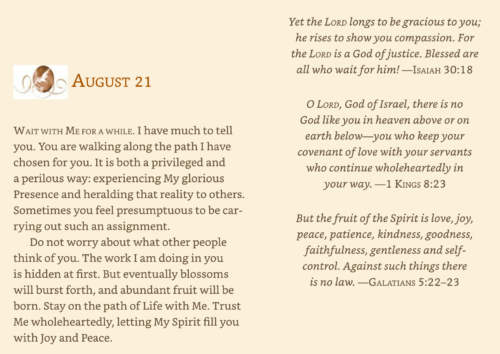
Seek My face and you will find fulfillment of your seepest longings.

Psalm 105:4…
Seek the Lord and his strength The ark, which is called his strength, and the ark of his strength,

Psalm 19:1-2…
The heavens declare the glory of God; the skies proclaim the work of his hands. Day after day they pour forth speech; night after night they reveal knowledge.

Isaiah 60:2…
For, behold, the darkness shall cover the earth, and gross darkness the people: but the Lord shall arise upon thee, and his glory shall be seen upon thee.

May 31st, 2022 by Dave No comments »

Ever-Widening Circles

Father Richard describes his spiritual development as a “pilgrim’s progress,” with God using the circumstances of his life—particularly his international ministry and travel—to expand his vision, heart, and mind:

As I moved in ever-widening circles around the world, the solid ground of the perennial tradition never really shifted. It was only the lens, the criteria, the inner space, and the scope that continued to expand. I was always being moved toward greater differentiation and larger viewpoints, and simultaneously toward a greater inclusivity in my ideas, a deeper understanding of people, and a more honest sense of justice. God always became bigger and led me to bigger places. If God could “include” and allow, then why not I? If God asked me to love unconditionally and universally, then it was clear that God operated in the same way.

Soon there was a much bigger world for me than the United States and the Roman Catholic Church, which I eventually realized also contained paradoxes. The e pluribus unum (“out of many, one”) on American coinage did not include very many of its own people (women, BIPOC, LGBTQIA+ people, poor folks, people with disabilities, and so many more). As a Christian I finally had to be either Roman or catholic, and I continue to choose the catholic end of that spectrum—remember, catholic means universal. Either Jesus is the “savior of the world” (John 4:42), or he is not much of a savior at all. Either America treats the rest of the world and its own citizens democratically, or it does not really believe in democracy at all. That’s the way I see it.

But this slow process of transformation and the realizations that came with it were not either-or decisions; they were great big both-and realizations. None of it happened without much prayer, self-doubt, study, and conversation. The journey itself led me to a deepening sense of holiness, freedom, and wholeness. Although I didn’t begin thinking this way, I now hope and believe that a kind of second simplicity is the very goal of mature adulthood and mature religion.

My small, personal viewpoint as a central reference for anything, or for rightly judging anything, gradually faded as life went on. The very meaning of the word universe is to “turn around one thing.” I know am not that one thing. There is Big Truth in this universe, and it certainly isn’t mine.

Mature religions, and now some scientists, say that we are hardwired for the Big Picture, for transcendence, for ongoing growth, for union with ourselves and everything else. Either God is for everybody, and the divine DNA is somehow in all creatures, or this God is not God by any common definition, or even much of a god at all. We are driven toward ever higher levels of union and ability to include, even if some of us go kicking and screaming. “Everything that rises must converge,” as Teilhard de Chardin put it. [1]

Seeing All the Things

For Rev. Dr. Jacqui Lewis, religion at its best teaches us how to “see” with greater clarity, which increases our courage and capacity to love ourselves, others, even our enemies.

In its truest sense, religion should reconnect human beings—bind them again—to the creation, to one another, to the divine, to love. Religion should reveal to us how much we need one another to survive and thrive. Religion should be revelatory and revolutionary, helping us see how our biases about color, gender, sexuality, and class cause deep hurt to both body and soul. . . .

The teaching of rabbi Jesus is simple: Love God. Love neighbor. Love self. Love period. . . .

At a lecture in Israel, I heard one of my favorite rabbis, Donniel Hartman, say, “A life of faith isn’t just about walking with God, but how one walks with humanity. The core feature of a moral life is to see. Choosing not to see is immoral. The goal of religion is to improve our willingness and our ability to see.” A spiritual life is supposed to help us see better. The aim of Love, and any God worth worshipping, is improved sight. . . .

An ethical and moral life is about letting go of indifference and learning how to see. It’s about waking up to love ourselves, love our posse, and love our world. Imagine love as our shared spiritual practice, binding us to one another, enabling us to see our connection—that we are kin. . . .

In order to live a moral life, a good life, an ubuntu life [1], we must commit to a life of love that means seeing all the things. See your neighbor suffering and do something about it. See a stranger laboring under a heavy load and help out. See lies spoken and shared in social media and call foul. See a friend soaring, and say, “I see you, beautiful creature!” to build their self-love tank. . . .

Friend, you are the only one standing where you stand, seeing what you see, with your vantage point, your story. You are right there for a reason: to have, as my dear friend Ruby Sales says, “hindsight, insight, and foresight.” I want us to learn to see, with our eyes wide open, how best to be healers and transformers. I want us to really see, to fully awaken, to the hot-mess times we are in and to the incredible power we have to love ourselves into wellness. . . .

I want us open to revelation, not afraid of it, and open to the ways that it will provoke us to believe assiduously in how lovable we each are, and in the love between us and among us because, actually, believing is seeing. 

Believing is seeing our connection: We are one.


Seeing Jesus Again

In the latest season of the CAC podcast Learning How to See, Diana Butler Bass speaks about seeing Christianity in a fresh way:

The question of how we see, and what the lenses are that allow us to understand our lives and the world more deeply is a question that I’ve cared about for a really long time. . . . How do we understand where and how the divine, where God, the Holy Spirit is operating in our lives, in our institutions, and the world around us? What gives us the capacity to even understand any of that? . . . In the latest book [Freeing Jesus], what I really wanted to do is settle down to the basic issue, or the basic central reality of Christianity. Because people started asking me about ten years ago, “Why do you stay Christian?” . . . And I’d have all sorts of fancy answers and then I’d just say, well, it’s because of Jesus. . . .

That’s where I wanted to go, and think about: who is Jesus really? Who has Jesus been for me? And why has that been so central to my own life story? . . . And I think where Freeing Jesus has taken me is that somehow staying Christian is about staying in and with and through Jesus. Jesus has everything to do with it. And that really matters to me. Yet Jesus has not stayed the same for me through my whole life’s journey. And so, I’ve had to be open to understanding that, even though there’s one verse in Hebrews that says “Jesus Christ is the same, yesterday, today, and forever” [Hebrews 13:8], I have not stayed the same yesterday, today, and forever. The church does not stay the same yesterday, today, and forever. And so, in a very real way, Jesus has changed for me. Jesus changes for the world. Jesus changes for the institutions of faith, for the church. . . . If you’re not doing that kind of work, of letting the end of one image emerge for you and a new image of Jesus be born for you, you’re probably in a pretty static place in your own faith.

In Freeing Jesus, Bass describes our relationship with Jesus as a dynamic opportunity to see God and ourselves perpetually anew: 

If we think that being with Jesus means getting the right answers from a creed or remembering points of doctrine from a sermon, we probably will not manage to truly know Jesus. We will only succeed in keeping the right responses scribbled on some back page of our memory. “Who are you, Lord?” [Acts 9:3–5] is the question of a lifetime, to be asked and experienced over and over again. That query frees Jesus to show up in our lives over and over again, and entails remembering where we first met, how we struggled with each other along the road, and what we learned in the process. [1]

Living Our Faith in All Circumstances

May 27th, 2022 by JDVaughn No comments »

Wherever we are on our journey with Christianity, Brian McLaren invites us to return to the instructions given by the Hebrew prophet Micah: “O human being, this is what God desires for you. That you do justice. That you love kindness. That you walk humbly in the presence of your God” (Micah 6:8). Brian writes:

Micah turns a religious question into a human question.

Christians very much like to call Jesus the Son of God. Jesus much preferred to call himself the Son of Man (or son of humanity). There are many layers of meaning to the term. But the simplest and most obvious is this: a son of humanity is a human being. If you want to put a finer point on it, son of means the essence of or perhaps a new generation of. Jesus is saying that he represents the essence of humanity, a new generation of humanity, a new kind of human being. In this light, his constant invitation, follow me, means imitate me and join me on my journey toward a new way of being human. . . .

In that light, whatever you choose to call yourself, Christian or not, I hope you will aspire to be a humble human being . . . religiously. . . .

I hope you will desire to be a kind human being, because . . . that person you call your enemy . . . that person is part of your family, part of your species, part of your story, part of your kind. . . .

And in addition to being a humble and kind human being, I hope you will aspire to being a just human being. Don’t seek power over others to control or exploit them or harm them. Instead, use whatever power that comes your way for the common good, so that all people everywhere can share equal justice and equal dignity. Seek justice. Love justice. Do justice. Be a just human being . . . religiously.

When I say religiously, I mean intentionally, seeking out practices that promote justice, kindness, and humility. And I mean collaboratively, joining or building communities or networks that promote those practices. And I mean reverently, knowing how precious this heartbeat and this breath really are, and feeling every moment how much danger and opportunity are held in these human hands. Religiously, as I’m using the term, means with a sense of the sacredness of everything and a commitment to re-consecrate everything.

In the midst of uncertainty for what the future of Christianity holds, Brian invites us to continue what he calls “our spiritual quest”:

To become the most just, kind, and humble version of ourselves that we possibly can, day by day . . . to practice a faith that expresses itself in love . . . to lean with others into a new humanity, a new generation or new kind of humanity, open to every good resource that can help us, explicitly Christian or not.

Sarah Young Jesus Calling

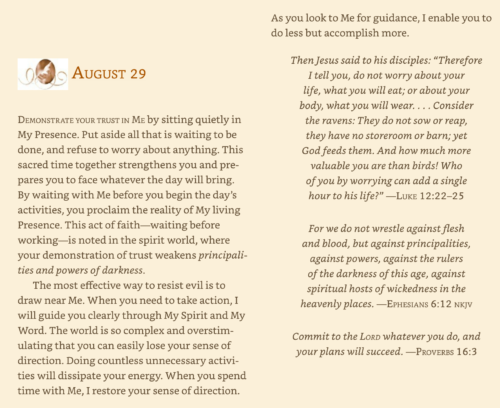
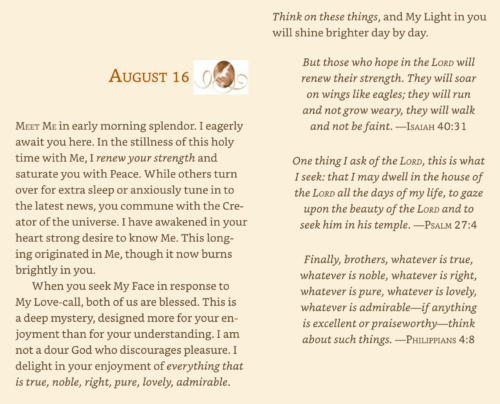
Seek My face at the beginning of your day. Put me on; “wear Me”, think My thoughts allow the Holy Spirit to control your thinking.

Psalm 27:8 NKJV… When You said, “Seek My face,” My heart said to You, “Your face, Lord, I will seek.”

Romans 13:14… Put ye on the Lord Jesus Christ.–A continuation of the metaphor introduced in Romans 13:12.So invest and identify yourselves with the spirit of Christ as to reproduce it in your outward walk and conduct.

1 Corinthians 2:16…For who has understood the mind of the Lord so as to instruct him?” But we have the mind of Christ.”

Colossians 3:12…You are God’s chosen people. You are holy and dearly loved. So put on tender mercy and kindness as if they were your clothes. Don’t be proud.

What Does it Mean to Set Jesus Free?

May 26th, 2022 by JDVaughn No comments »

Church historian Diana Butler Bass shares a moment she experienced while at prayer before the icon of Jesus in the Washington National Cathedral:

“Get me out of here,” the voice said again.

I stared up at the icon. “Jesus? Is that you?”

“Get me out of here,” I heard again, more insistent now.

“But Lord . . .”

The chapel fell silent, but I know I heard a divine demand for freedom. . . .

Millions of Americans have left church behind, probably many more have left emotionally, and countless others are wondering if they should. One of the most consistent things I hear from those who have left, those doubting their faith, and those just hanging on is that church or Christianity has failed them, wounded them, betrayed them, or maybe just bored them—and they do not want to have much to do with it any longer.

Bass reflects on the impact that the COVID-19 pandemic has had on our building-bound Christianity:

As millions have discovered in these many months, Jesus was not confined to a building. Jesus was around our tables at home, with us on walks and hikes, present in music, art, and books, and visible in faces via Zoom. Jesus was with us when we felt we could do no more, overwhelmed by work and online school. Jesus was with us as we prayed with the sick in hospital over cell phones. Jesus did not leave us to suffer alone. COVID-19 forced Jesus out of the cathedral into the world, reminding Christians that church is not a building. Rather, church is wherever two or three are gathered—even if the “two” is only you and your cat—and where Jesus is present in bread that regular people bake, bless, and break at family tables and homemade altars. I did not liberate Jesus from the cathedral; a pandemic did. Jesus is with us. Here.

One day, the doors will open again. Many will not go back to church, mostly because they left some time ago. They did not need help to find Jesus in their lives and in the world. They were already discovering what it meant to follow Jesus beyond the church. Perhaps the pandemic hastened the process, caused them to ask new questions, or renewed their courage on the journey.

But many others will return. And, as before, people will sit close, hug and pass the peace, and share bread and wine. I suspect I will pray again at the altar in the National Cathedral, under the gaze of Jesus. I cannot predict what he might say. I do, however, know what I will say: “Thank you.” Whatever happens, however, I hope none of us will ever forget the Jesus we have met in our own lives, who has been with us in fear and confusion and loss, in forced isolation and the surprising moments of joy, and through the ministrations of our shared human priesthood. It all matters. All of it.

Sarah Young….

I Am the first and the last. Find in Me the stability you need in your life.

Revelations 22:13… I am Alpha and Omega, the beginning and the end, the first and the last.

Romans 5:12…Therefore, just as sin entered the world through one man, and death through sin, and in this way, death came to all people,

John 16:33…I have told you these things, so that in me you may have peace. In this world you will have trouble.  But take heart I have overcome the world.”

May 25th, 2022 by Dave No comments »

What Does It Mean to Be Black, Christian, and American? 

Danté Stewart, a minister and writer, honors the central place the Bible held in his family: 

There’s an old King James Version Bible sitting on my bookshelf. It is black, rugged; the gold lining on the pages shines as light hits it. The jacket is missing, and the threads have unloosened from one another over the years. It has been tried. It has traveled across the South, across time. Now it sits on a shelf where it keeps the company of books written by Black folk. Black folk who have read a similar Bible, who have wrestled with it, been confused by it. Black folk who have held it as tight as I do today.

When I open up this old Bible . . . I am suddenly surrounded by preachers and mothers and friends and saints and sinners who tried to love and live well—while failing, learning, and trying again. When I read these ancient scriptures, I hear the way they flowed from my momma’s lips. . . .

This was her language. It was the language of my grandmother, the language of her mother. . . .

After many years of worshipping and working in white church spaces, Stewart came to a crossroads in his faith:

As I live and move and have my being in this country, I wonder to myself: How do I be Black and Christian and American?

So I return to this old King James Bible, and our Black prayers, and Black sermons. . . .

I have learned that many of us have not given up on faith, just the way our faith has been used to oppress others. We have not given up on the Bible, just the way it has been used to marginalize others. We have not given up on Jesus . . . we’re not becoming less spiritual or religious. It’s just that we have learned to put up with less, much less. Today many people talk a lot about people leaving churches, giving up on Christianity, and rejecting Jesus. In reality, they have given up on the white supremacist brand of Christianity that cares more about power than Jesus, that does not care enough to take either our bodies or our futures seriously. Like James Baldwin, we are holding on to Jesus while also living with our fear, trauma, doubts, and hope. Our story and the story of Jesus are bound together in faith, hope, love, and community. . . .

Faith—honest, deep, vulnerable faith, as Baldwin writes—is about growing up, becoming more loving, more honest, and more vulnerable. It is facing ourselves and what we desire. It is finding a way to begin again each day. It is not that we have the right answer, or all the right solutions. It is that we have found deep meaning in the story of Jesus. We have learned, as James Cone writes, that “being black and Christian could be liberating.”


May 24th, 2022 by Dave No comments »

Staying Out Loud

Over the decades Brian McLaren has had many conversations with faithful Christians who are also disillusioned by church and religion. After one evening spent in the company of two Roman Catholic sisters who have stayed in service to the church for over fifty years, McLaren reflects: 

“There are more than two options,” I thought. “I don’t have to choose between staying Christian compliantly or leaving Christianity defiantly. I can stay defiantly, like Sr. Ann and Sr. Jean [not their real names]. I can intentionally, consciously, resolutely refuse to leave . . . and with equal intention and resolution, I can refuse to comply with the status quo. I can occupy Christianity with a different way of being Christian.”

When I say stay defiantly, I don’t mean ungraciously. Srs. Ann and Jean radiate such gentleness and inner calm that accusations of being ungracious simply don’t stick. No, with firm yet gracious defiance, they will keep speaking their truths and will continue doing so from the inside as long as they can.

McLaren finds encouragement to remain a committed Christian in Jesus’ own decision to stay and wrestle with his Jewish faith even as he was rejected: 

I can no longer put a naïve trust in the structures of the Christian religion, seeing and knowing what I see and know now. But instead of rejecting my religious community, I remain paradoxically present to it, neither minimizing its faults nor hating it for its faults. . . .

Jesus, of course, counted this cost. He stayed out loud. And it’s worth noting where his staying led him. Not to winning. Not to success. It led him to the utter defeat and humiliation of the cross.

Was he a fool to keep faith through his dying breath, to translate his feeling of forsakenness into a prayer? Was he a fool to think that the legacy of the prophets, the legacy of his cousin John, and the legacy of his mother, Mary, were worth staying for, to save that legacy from corruption by the religious gatekeepers of his day?

Was he a fool to stay in the fray with the religious company men of his day, naming their corruption and toxicity with carefully chosen words like “whitewashed sepulchers” and “brood of vipers” [Matthew 23:27, 33]? Would he have been wiser to leave quietly for India and become Hindu, or to go quietly to China and become Buddhist instead of challenging the status quo of his own religion?

Was he a fool to think that the tiny handful of people who got only a tiny sliver of his message and saw some faint glimmer of what he saw could outlive him and do greater things than he had done?

Are you willing to be that kind of fool? Am I?

Today, at least, inspired by the example of Sr. Jean and Sr. Ann, I am.