A few years
ago, Father Richard was invited by Carmelite priest Bob Colaresi on a
pilgrimage to Thérèse’s community in France. Richard shares:
Our small group of five visited the infirmary where
Thérèse died. I stood nearest the window. I could see the black hole in the
bushes that Thérèse likened to her own soul when she was in pain, dying of
tuberculosis, and trying to believe that Jesus still loved her. The sister
guiding our tour was telling us the story of Thérèse’s death when she suddenly
paused and said, “We have a visitor!” The way she said it, we all got goose
bumps!
We followed the sister’s gaze and saw by the window a
beautiful orange and yellow butterfly. It was only April 3, way too early for
butterflies in northern France. She said, “Let it out, let it out!” Since I was
closest to the window, I tried to open the latch, but I didn’t understand how
it worked and just kept struggling with it. All of a sudden, I felt as though I
were levitating. I had to look down at my feet to make sure I was still on the
ground. I was definitely standing there, but I felt such ecstatic feelings of
presence, joy, love, and power. All the blood seemed to flow out of my head.
The sister could only see me from behind. She asked,
“What’s wrong? Open the window. The butterfly wants out! The butterfly wants
out!” I finally got the window open, and the butterfly flew away. I turned
around and the others said my face was white. “What just happened?” I asked,
even though I knew I had just been visited. I don’t know how else to say it:
Thérèse was there.
Before she died, Thérèse promised to spend her heaven doing good on earth. [1] Whether we believe in miracles of the saints or not, it seems like everybody who loves Thérèse has some miraculous story. She gets involved in our lives. I think she is present in millions of lives. There is something beautiful happening through this woman who said she wanted to perfect “the science of love.” [2] My own experience in her convent felt like an affirmation of what I truly believe and what has been a lot of my message. The little way is the spirituality of imperfection; we come to God not by doing it right, but by doing it wrong. It’s not a matter of doing great things. Whenever we act in conscious love, this is the little way. And I think whatever we do in conscious union and love is prayer. So many of our Catholic saints are examples of heroic martyrdom; the message they give is, “If I am perfect, then God will love me.” Because I was so programmed to think that way, I really needed to be released from that pursuit of perfection. Thank God both Thérèse and Francis of Assisi did that for me!
Sarah Young…..
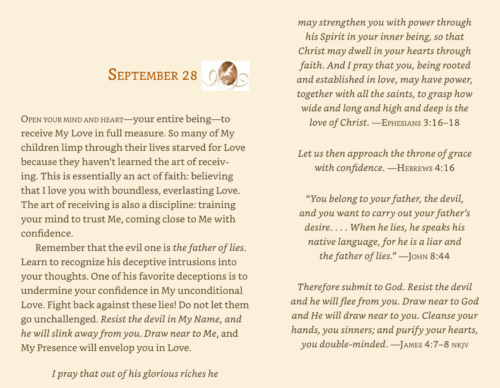
Leave the future to Me; live each day as a precious gift living in the moment by surrendering the future to Me. Surrender, connect and live out of that……… in the moment; for that is where I provide your spiritual energy.
Matthew 6:34 “Give your entire attention to what God is doing right now, and don’t get worked up about what may or may not happen tomorrow. God will help you deal with whatever hard things come up when the time comes.
John 10:10 The thief comes only to steal and kill and destroy; I came so that you may have life and life more abundantly
James 4:13-15 And now I have a word for you who brashly announce, “Today – at the latest, tomorrow – we’re off to such and such a city for the year. We’re going to start a business and make a lot of money.” 14 You don’t know the first thing about tomorrow. You’re nothing but a wisp of fog, catching a brief bit of sun before disappearing. 15Instead, make it a habit to say, “If the Master wills it and we’re still alive, we’ll do this or that.”
Richard shares
how the teachings of Thérèse of Lisieux have supported his own spiritual
journey:
French Catholicism in Thérèse’s time emphasized an ideal of human perfection, but Thérèse humbly trusted her own experience and taught the spirituality of imperfection instead. Thérèse is one of my favorite saints, perhaps because I’m an Enneagram Type One. The trap for the One is self-created perfectionism, which makes us dissatisfied and disappointed by nearly everything, starting with ourselves.
Thérèse has helped me to embrace imperfection—my own and others. When her sister Céline was upset with her own faults, Thérèse instructed, “If you want to bear in peace the trial of not pleasing yourself, you will give [the Virgin Mary] a sweet home.” [1] If we pay attention even for an hour, we observe how hard it is to be “displeasing” to ourselves! Often, this is the emotional snag that sends us into terribly bad moods without even realizing the origins of these moods. To resolve this problem, Thérèse teaches us to let go of the very need to “think well of yourself” to begin with! That’s our ego talking, not God.
Worthiness is not the issue; the issue is trust and surrender. As Thérèse understood, “Jesus does not demand great actions from us but simply surrender and gratitude.” [2] Let’s resolve this once and for all: You’re not worthy! None of us are. Don’t even go down that worthiness road. It’s a game of denial and pretend. We’re all saved by grace. We’re all being loved in spite of ourselves. That’s why I can also say, “You’re all worthy!” But your worthiness has nothing to do with you, and everything to do with the goodness of God.
Brené Brown, a contemporary
teacher who extols the gifts of imperfection, writes:
It is in the process of embracing our imperfections that we find our truest gifts: courage, compassion, and connection. . . .
When we can let go of what other people think and own our story, we gain access to our worthiness—the feeling that we are enough just as we are and that we are worthy of love and belonging. When we spend a lifetime trying to distance ourselves from the parts of our lives that don’t fit with who we think we’re supposed to be, we stand outside of our story and hustle for our worthiness by constantly performing, perfecting, pleasing, and proving. . . .
There is a line from Leonard Cohen’s song “Anthem” that serves as a reminder to me when . . . I’m trying to control everything and make it perfect. The line is, “There is a crack in everything. That’s how the light gets in.” [3] . . . This line helps me remember the beauty of the cracks (and the messy house and the imperfect manuscript and the too-tight jeans). It reminds me that our imperfections are not inadequacies; they are reminders that we’re all in this together. Imperfectly, but together. [4]
Sarah Young…..
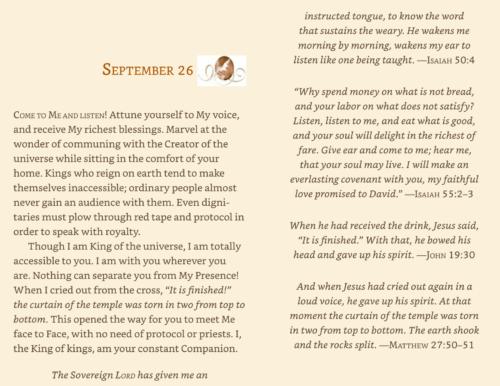
You can walk with Me as if you and I are the only one’s in the universe. Walk with Me in intimate love steps, knowing you are wonderfully and fearfully made to love Me.
Psalm 34:4-6 I sought the Lord, and he heard me, and delivered me from all my fears. 5 They looked unto him, and were lightened: and their faces were not ashamed.
Peter 1:16-17 since it is written, “You shall be holy, for I am holy.” 17 And if you call on him as Father who judges impartially according to each one’s deeds, conduct yourselves with fear throughout the time of your exile
JOHN 17:3 Now this is eternal life: that they know you, the only true God, and Jesus Christ,
In this homily, Father Richard reflects on the paradoxical relationship between weakness and strength:
I must be up front with you. I don’t really understand why God created the world in this upside-down way. I do not know why “power is at its best in weakness,” as Paul wrote in 2 Corinthians 12:9. I cannot pretend to understand God, but this is what I see: People who have moved from one seeming success to another seldom understand success at all—except for their own very limited version. People who fail to do something right, by even their own definition of right, are those who often break through to enlightenment and compassion.
Paul can talk in this paradoxical way about power and weakness because he meditated on the mystery of the cross. The one who was a failure became the redeemer. The one who looked naked and weak and like a loser became the ultimate winner. And so Paul sums it up in his beautiful philosophy, ending with the line, “It is when I am weak that I am strong” (2 Corinthians 12:10).
Let’s honestly admit almost none of us believe that. We think it’s when we’re strong that we’re strong. But no, it’s when we’re weak that we’re strong. It doesn’t make a bit of sense to the rational, logical mind. Only people of the Spirit understand how true it is. The Twelve Step Program made it the first step: We have to experience our powerlessness before we can experience our power.
Paul says he experienced God telling him, “My grace is sufficient for you. Power is made perfect in weakness” (2 Corinthians 12:9). But the philosophy of the United States of America is that power is made perfect in more power. Just try to get powerful: more guns, more weapons, more wars, more influence, more billionaires. Everybody’s trying to get higher, trying to get up, up, up. While Jesus, surprise of surprises, is going down.
The experience of powerlessness is where we all must begin, and Alcoholics Anonymous is honest and humble enough to state this, just as Jesus himself always went where the pain was. Wherever there was human suffering, Jesus was concerned about it and sought to heal it in the very moment of encounter. It is both rather amazing and very sad that we pushed it all off into a future reward system for those who were “worthy”—as if any of us are.
Is it this human pain that we fear? Powerlessness, the state of being shipwrecked, is an experience we all share anyway, if we are sincere, but Bill Wilson (1895–1971), co-founder of AA, discovered we are not very good at that either. He called it “denial.” It seems we are not that free to be honest, or even aware, because most of our wounds are buried in the unconscious. So, it is absolutely essential that we find a spirituality that reaches to that hidden level. If not, nothing really changes.
Tiny Opportunities to Love
Memoirist Heather King spent a year praying with Thérèse of Lisieux’s insights, and describes how Thérèse practiced her “little way” through relationships:
Some of the best-known anecdotes about Thérèse concern her saintlike, though seemingly small efforts with respect to her fellow nuns:
She overcame her instinctive dislike of a particular nun, and . . . [exhibited] such charity that the sister actually thought Thérèse felt a special fondness for her.
She stifled her almost compulsive desire to turn around and glare at the nun behind her in choir who made a clicking noise (apparently by tapping her rosary against her teeth), realizing that the more charitable act would be to pretend that the sound was music to Christ’s ears and endure the annoyance in silence.
Every evening at dinnertime Thérèse took it upon herself to usher a particularly vexatious elderly nun from chapel to her place at table in the refectory, even going the extra mile to lovingly cut the crabapple’s bread.
Saints do not live in some other world. . . . They live in the same world we do, and they show us that spirituality is intensely down-to-earth. We learn to love through frustration, disappointment, and failure. We learn through the seemingly trivial incidents of our daily lives.
“When I am feeling nothing . . . then is the moment for seeking opportunities, nothings, which please Jesus. . . . For example, a smile, a friendly word, when I would want to say nothing, or put on a look of annoyance,” [1] Thérèse wrote, and “I have no desire to go to Lourdes to have ecstasies. I prefer (the monotony of sacrifice)!” [2]
King applies the spirit of Thérèse’s small, loving acts to her own life:
I began to see the almost superhuman strength required to refrain from, say, repeating a juicy bit of gossip, or rolling my eyes, or allowing my voice to get harsh when I was upset. I began to sense as well that, just because they’re so difficult, such acts perhaps do far more good than we can ever know. Standing patiently in line helped the other people in line to be patient as well. Blessing the other person in traffic, even though nobody heard or saw, somehow encouraged someone else to bless the next person. When the neighborhood noise bothered me, I sometimes took to starting with one corner of my apartment complex, visualizing the person or people who lived there, and working my way around, praying for the inhabitants of each. (Other times I took to tearing out my hair and cursing.) . . .
We can try, at great personal sacrifice, to be perfectly righteous, a perfect friend, perfectly responsive, perfectly available, perfectly forgiving. But at the heart of our efforts must lie the knowledge that, by ourselves, we can do, heal, or correct nothing. The point is not to be perfect, but to “perfectly” leave Christ to do, heal, and correct in us what he wills.
During Richard Rohr’s novitiate year of becoming a Franciscan, he discovered the writings of Saint Thérèse of Lisieux (1873–1897). Father Richard describes Thérèse’s teaching as “a spirituality of imperfection”:
I have often mentioned my love for Thérèse of Lisieux, a French Carmelite nun with minimal formal education, who in her short, hidden life of only twenty-four years captured the essence of Jesus’ core teachings on love. Thérèse was declared a Doctor of the Church in 1997 [1], which means her teaching is seen as thoroughly reliable and trustworthy. She “‘democratized’ holiness,” as Brother Joseph Schmidt (1934–2022) said, “making it clear that holiness is within the reach of anyone willing to do God’s will in love at each successive moment as life unfolds.” [2]
Thérèse came into a nineteenth-century Catholic Church that often believed in an angry, punitive God, perfectionism, and validation by personal good behavior—which is a very unstable and illusory path. In the midst of this rigid environment, Thérèse was convinced that her message, taught to her by Jesus himself, was “totally new.” [3] The gospel of radical grace had been forgotten by many Christians, so much so that Thérèse had to call it “new.”
Thérèse called this simple, childlike path her “little way.” It is a spirituality of imperfection. In a letter to priest Adolphe Roulland (1870–1934), she writes: “Perfection seems simple to me, I see it is sufficient to recognize one’s nothingness and to abandon oneself as a child into God’s arms.” [4] Any Christian “perfection” is, in fact, our ability to include, forgive, and accept our imperfection. As I’ve often said, we grow spiritually much more by doing it wrong than by doing it right. That might just be the central lesson of how spiritual growth happens, yet nothing in us wants to believe it.
If there is such a thing as human perfection, it seems to emerge precisely from how we handle the imperfection that is everywhere, especially in ourselves. What a clever place for God to hide holiness, so that only the humble, “little,” and earnest will find it! A “perfect” person ends up being one who can consciously forgive and include imperfection rather than the ones who think they are totally above and beyond imperfection. It becomes rather obvious once we say it out loud.
Near the end of her life, Thérèse explained her little way to her sister, and this became part of her autobiography Story of a Soul. In contrast to the “big way” of heroic perfectionism, she teaches, in essence, that as a little one “with all [her] imperfections,” God’s love is drawn toward her. God has to love her and help her because she is “too small to climb the rough stairway of perfection.” [5] With utter confidence, she “believed herself infinitely loved by Infinite Love.”
A Gospel of Humility
In this talk, Richard unpacks the parable of the tax collector and the Pharisee (Luke 18:9–14), showing how Jesus affirmed a spirituality of imperfection:
With this parable, Jesus invites us to struggle with the contrast between a spirituality of perfection and what I’m calling a spirituality of imperfection. Notice the beginning lines: “Then he spoke this parable, to some who trusted in themselves, that they were righteous and therefore despised others. ‘Two men went up to the Temple to pray, one a Pharisee, the other a tax collector’” (Luke 18:9–10). Jesus, a consummate Jew, uses examples from his own culture and time. According to common definitions of the day, the Pharisees are the good guys and tax collectors are the bad guys. The tax collectors are those who have totally aligned with the Roman Empire, charging money to their own Jewish people, and giving it to the Empire. No one likes the tax collectors, and everyone looks up to the Pharisees. The Pharisees are simply religious people trying to obey the law, just like faithful Catholics or Bible-reading Protestants today. And as always, Jesus, with his nondual way of thinking, turns it all on its head.
“The Pharisee stood and prayed thus with himself, ‘God, I thank you that I am not like other people. Extortioners, adulterers, or even this poor tax collector here. I fast twice a week. I give tithes of all that I possess’” (18:11–12). None of us would be so foolish as to state our spiritual credit so forthrightly, but we do feel it inside. We think: “I’m a good person. I don’t steal; I don’t cheat.” We’ve all fashioned our positive, superior self-images on why we’re right and why we’re good. In contrast, “The tax collector, standing afar off, would not so much as raise his eyes to heaven. Instead, he beat his breast, saying ‘God be merciful to me, a sinner.’” Jesus said, “This man went down to his house justified—rather than the other” (18:13–14).
This repositions the whole role of religion. Didn’t most of us think that it’s all a meritocracy? I certainly did! Many religious people think that it’s all a merit badge system—all achievement, accomplishment, performance, and perfection. The good people win and the bad people lose. Of course, once we cast anything as a win-lose scenario, the irony is that everybody loses. Why can’t people see that competitive games are not the way to go?
I’m convinced that Jesus’ good news is that God’s choice is always for the excluded one. Jesus learned this from his Jewish tradition: God always chooses the rejected son, the barren woman, the people enslaved in Egypt or exiled in Babylon. It’s not a winner’s script in the Bible—it’s a loser’s script. It’s a loser’s script where, ironically, everybody wins.
Richard Rohr
draws on the archetype of the wise ruler to describe what it means to be a
“grand” parent, someone who has become a mature elder:
The final stage of the wisdom journey in mythology is
symbolized by the ruling image of the king or queen or what I like to call the
grand father or grand mother.
When we can let go of our own need for everything to be as we want it, and our own need to succeed, we can then encourage the independent journey and the success of others. The grand parent is able to relinquish center stage and to stand on the sidelines, and thus be in solidarity with those who need their support. Children can feel secure in the presence of their grandparents because, while their parents are still rushing to find their way through life’s journey, grandpa and grandma have hopefully become spacious. They can contain problems, inconsistencies, inconveniences, and contradictions—after a lifetime of practicing and learning.
Grand parents can trust life because they have seen more of it than younger people have, and they can trust death because they are closer to it. Something has told them along the way that who they are now is never the final stage, and this one isn’t either. We need to be close enough to our own death to see it coming and to recognize that death and life are united in an eternal embrace, and one is not the end of the other. Death is what it is. I am a grand father when I am ready to let go. To the grand mother, death is no longer an enemy, but as Saint Francis called it, a “welcome sister.”
The soul of the grand parent is large enough to embrace the death of the ego and to affirm the life of God in itself and others, despite all imperfections. Its spaciousness accepts all the opposites in life—masculine and feminine, unity and difference, victory and defeat, us and them and so on—because it has accepted the opposition of death itself. Grand parents know that their beliefs have less to do with unarguable conclusions than scary encounters with life and the living God. They have come to realize that spiritual growth is not so much learning as it is unlearning, a radical openness to the truth no matter what the consequences or where it leads. They understand that they do not so much grasp the truth as let go of their egos, which are usually nothing more than obstacles to the truth.
I cannot imagine a true grand father or grand mother who is not a contemplative in some form. And contemplatives are individuals who live in and return to the center within themselves, and yet they know that they are not the Center. They are only a part, but a gracious and grateful part at that.
Sarah Young.
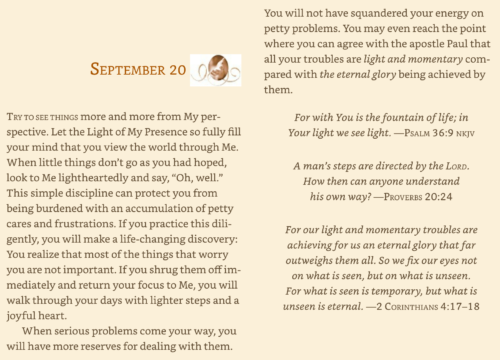
Walk with Me with the freedom of forgiveness. I have buried guilt at the foot of the cross. When you surrender you feel the power of My unconditional love. Live in this freedom.
Psalm 68:19 Blessed be the Lord, who daily bears our burden, the God of our salvation.
1John 1:7-9 But if we walkin the light, ashe is in the light, we have fellowship with one another, and the blood of Jesus, his Son, purifies us from all sin. If we claim to be without sin, we deceive ourselves …
1John 4:18 There is no fear in love, but perfect love casts out fear. For fear has to do with punishment, and whoever fears has not been perfected in love.
Contemplative elder and Benedictine Sister Joan Chittister writes of the humility we must cultivate if we hope to grow in love and compassion as we age:
If we learn anything at all as time goes by and the changing seasons become fewer and fewer, it is that there are some things in life that cannot be fixed. It is more than possible that we will go to our graves with a great deal of personal concerns, of life agendas, left unresolved. . . . So has life been wasted? Has it all been for nothing?
Only if we mistake the meaning of the last period of life. This time of life is not meant to solidify us in our inadequacies. It is meant to free us to mature even more. . . .
This is the period of life when we must begin to look inside our own hearts and souls rather than outside ourselves for the answers to our problems, for the fixing of the problems. This is the time for facing ourselves, for bringing ourselves into the light.
Chittister invites us to consider aging as an opportunity to grow into our true and larger selves:
Now is the time to ask ourselves what kind of person we have been becoming all these years. And do we like that person? Did we become more honest, more decent, more caring, more merciful as we went along because of all these things? And if not, what must we be doing about it now? . . .
Can we begin to see ourselves as only part of the universe, just a fragment of it, not its center? Can we give ourselves to accepting the heat and the rain, the pain and the limitations, the inconveniences and discomforts of life, without setting out to passively punish the rest of the human race for the daily exigencies that come with being human?
Can we smile at what we have not smiled at for years? Can we give ourselves away to those who need us? Can we speak our truth without needing to be right and accept the vagaries of life now—without needing the entire rest of the world to swaddle us beyond any human justification for expecting it? Can we talk to people decently and allow them to talk to us? . . .
Now, this period, this aging process, is the last time we’re given to be more than all the small things we have allowed ourselves to be over the years. But first, we must face what the smallness is, and rejoice in the time we have left to turn sweet instead of more sour than ever.
A burden of these years is the danger of giving in to our most selfish selves.
A blessing of these years is the opportunity to face what it is in us that has been enslaving us, and to let our spirit fly free of whatever has been tying it to the Earth all these years.
In this week’s meditations, Father Richard Rohr and other teachers consider how to age well with consciousness, spiritual depth, and purpose. In this essay from the CAC’s journal Oneing, Richard uses the image of ripening to describe this process:
The word “ripening” helps us move beyond any exclusive concern with physical aging, because our concerns are much more than that. If I am to believe the novels, myths, poems, and people I have met in my life, old age is almost never described as an apex of achievement as one sits atop a summit with the raised arms of a victorious athlete. It is something else, almost always something else—usually something other than what was initially imagined, or even hoped for.
Ripening, at its best, is a slow, patient learning, and sometimes even a happy letting go—a seeming emptying out to create readiness for a new kind of fullness—which we are never sure about. If we do not allow our own ripening, an ever-increasing resistance and denial sets in, an ever-increasing protection around an over-defended self. At our very best, we learn how to hope as we ripen. Youthful hopes have concrete goals, whereas the hope of older years is usually aimless hope, hope without goals, even naked hope — perhaps real hope.
Such stretching is the agony and the joy of later years, although one can avoid both of these rich experiences too. Old age, as such, is almost a complete changing of gears and engines from the first half of our lives, and does not happen without many slow realizations, inner calmings, lots of inner resistance and denials, and eventual surrenders. All of them by God’s grace work with our ever-deepening sense of what we really desire and who we really are.
Reality, fate, destiny, providence, and tragedy are slow but insistent teachers. The horizon of old age seems to be a plan that God has prepared as inevitable and part of the necessary school of life. What is gratuitously given is also gratuitously taken away, just as Job slowly came to accept. And sometimes we remember that his eventual pained response was “Blessed be the name of the Lord!” (Job 1:21).
If we are to speak of a spirituality of ripening, we need to recognize that it is always characterized by an increasing tolerance for ambiguity, a growing sense of subtlety, an ever-larger ability to include and allow, and a capacity to live with contradictions and even to love them! I cannot imagine any other way of coming to those broad horizons except through many trials, unsolvable paradoxes, and errors in trying to resolve them.
The ripening of mind and heart is most basically a capacity for nondual consciousness and contemplation. So my guidance is a simple reminder to recall what we will be forced to learn by necessity and under pressure anyway—the open-ended way of allowing and the deep meaning that some call faith. To live in trustful faith is to ripen; it is almost that simple.
The Second Journey
Father Richard describes the conscious attention and intention necessary to “fall upward” into a purposeful second half of life:
Most of us tend to think of the second half of life as largely about getting old, dealing with health issues, and letting go of our physical life, but I simply don’t believe that’s all there is to it. What looks like falling can largely be experienced as falling upward and onward, into a broader and deeper world, where the soul finds its fullness, is finally connected to the whole, and lives inside the Big Picture.
It is not a loss but somehow a gain, not losing but actually winning. We probably have to have met at least one true elder to imagine this could be true. I’ve met enough radiant people to know that it is possible. They have come to their human fullness, often against all odds, usually by suffering personally or vicariously and empathetically. As Jesus describes such a person, “from their breasts flow fountains of living water” (John 7:38). They are models and goals for our humanity, much more than the celebrities and politicians whose actions we seem to care so much about today.
Remember, no one can keep us from the second half of our own lives except ourselves. Nothing can inhibit our second journey except our own lack of courage, patience, and imagination. Our second journey is all ours to walk or to avoid. My conviction is that some falling apart of the first journey is necessary for this to happen, so don’t waste too many moments lamenting poor parenting, lost jobs, failed relationships, physical challenges, economic poverty, or other tragedies. Pain is part of the deal. If we don’t walk into the second half of our own life, it is surely because we do not want it. Let’s desire, desire deeply, desire ourselves, desire God, desire everything good, true, and beautiful. All of the emptying out is for the sake of a Great Outpouring.
Jesuit theologian and scientist Pierre Teilhard de Chardin (1881–1955) prayed to allow his life to unfold in full confidence of God’s presence until the very end:
When the signs of age begin to mark my body (and still more when they touch my mind); when the ill that is to diminish me or carry me off strikes from without or is born within me; when the painful moment comes in which I suddenly awaken to the fact that I am ill or growing old; and above all at that last moment when I feel I am losing hold of myself and am absolutely passive within the hands of the great unknown forces that have formed me; in all those dark moments, [1]
CAC teacher
emerita Cynthia Bourgeault suggests that the Divine attributes of love, mercy,
and forgiveness are most clearly called forth in our earthly existence. She
begins with the Sufi phrase “I was a hidden treasure and I loved to be known,”
a mystical description of why God created the universe.
Notice that there is a subtle double meaning at work in this phrase. At one level “I loved to be known” is a synonym for “I longed to be known” (and the phrase is often translated that way). But you can read the words in another way—“I loved in order to be known”—and when you do, they reveal a deeper spiritual truth. In order to become known to another, we must take the risk of loving that person, and this includes the real possibility of rejection and the even more painful prospect of heartbreak if the beloved is lost to us. . . .
Could it be like this for God as well?
Could it be that this earthly realm, not in spite of but because of its very density and jagged edges, offers precisely the conditions for the expression of certain aspects of divine love that could become real in no other way? This world does indeed show forth what love is like in a particularly intense and costly way. But when we look at this process more deeply, we can see that those sharp edges we experience as constriction at the same time call forth some of the most exquisite dimensions of love . . . qualities such as steadfastness, tenderness, commitment, forbearance, fidelity, and forgiveness. These mature and subtle flavors of love have no real context in a realm where there are no edges and boundaries, where all just flows. But when you run up against the hard edge and have to stand true to love anyway, what emerges is a most precious taste of pure divine love. God has spoken [God’s] most intimate name.
Let me be very clear here. I am not saying that suffering exists in order for God to reveal himself. I am only saying that where suffering exists and is consciously accepted,there divine love shines forth brightly.
Bourgeault invites readers
to examine this phenomenon in their own lives:
The principle can be tested. Pay attention to the quality of human character that emerges from constriction accepted with conscious forgiveness as compared to what emerges from rage and violence and draw your own conclusions.
At any rate, I have often suspected that the most profound product of this world is tears. . . . Tears express that vulnerability in which we can endure having our heart broken and go right on loving. In the tears flows a sweetness not of our own making, which has been known in our tradition as the Divine Mercy.Our jagged and hard-edged earth plane is the realm in which this mercy is the most deeply, excruciatingly, and beautifully released. That’s our business down here. That’s what we’re here for.
……….
Sarah Young
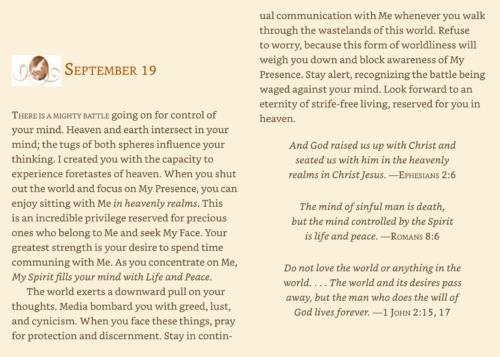
Rest in Me. Surrender and feel my love, absent from any performance requirements. You do not have to earn My love, it is unconditional and you realize that whenever you are surrendered and connected to Me.
John 15:13 Greater love has no one than this, that one lay down his life for his friends.
2 Corinthians 5:21 NKJV For He made Him who knew no sin to be sin for us, that we might become the righteousness of God in Him.
Zephaniah 3:17 The Lord your God is with you, the Mighty Warrior who saves. He will take great delight in you; in his love he will no longer rebuke you, but will rejoice over you with singing
Numbers 6:25-26 The Lord make his face shine upon thee, and be gracious unto thee: 26 The Lord lift up his countenance upon thee, and give thee peace.
In this homily, Father Richard Rohr reminds us of the radical and transformational power of forgiveness:
When all is said and done, the gospel comes down to forgiveness. I’d say it’s the whole gospel. It’s the beginning, the middle, and the end. People who know how to forgive have known how good it feels to be forgiven, not when they deserved it, but precisely when they didn’t deserve it.
If we’re Christian, we’ve probably said the “Our Father” ten thousand times. The words just slip off our tongues: “Forgive us our trespasses as we forgive those who trespass against us.” By saying this prayer, we’ve asked and prayed for forgiveness. Notice the full correlation between how we give and how we receive: “Forgive us as we forgive.” They’re the same movement. We need to know that we need mercy, we need understanding, and then we also need to know how to give it. Each flows with the energy of the other.
I have often found people in 12-step programs or in jail who were quite forgiving of other people’s faults because they’d hit the bottom. They knew how much it hurt to hurt. They knew how terrible it is to hate yourself and to accuse yourself. When someone with a generous heart and a loving spirit entered their lives and forgave them, it was like being reborn. Someone else loves a part of me that I can’t love myself! They just taught me how to do it!
I remember when I was jail chaplain in Albuquerque, I would read in the newspaper the stories of criminals in our city and I would form an opinion about how terrible they were. Years ago, a young woman committed murder to steal a baby. Everybody in the city hated her, I think. I went to the jail the very next day, and they told me that she wanted to see a priest.
I didn’t want to go in the cell because I knew I wouldn’t like her. I knew I would judge her because I’d already judged her. I can’t tell the whole story, but I will share this much: when I left that cell, I had nothing but tears and sympathy for the suffering of that young woman.
You see, the One who knows all can forgive all. But all we know is a little piece—the part that has offended us. Only God knows all, and so God is the One who can forgive all.
If we’re honest, none of us have lived the gospel. None of us have loved as we could love, or as we have been loved by God. I talk about it from the pulpit much better than I live it. And yet that very recognition—that I have not yet lived love—allows me to stand under the waterfall of infinite mercy. It’s only then that I know how to let mercy flow through me freely. That I receive it undeservedly allows me to give it undeservedly.
Essential Humility
Archbishop Desmond Tutu (1931–2021) and his daughter Mpho Tutu van Furth focus on our fragile humanity, the good and bad that we are all capable of, as the entry point for forgiveness:
We are able to forgive because we are able to recognize our shared humanity. We are able to recognize that we are all fragile, vulnerable, flawed human beings capable of thoughtlessness and cruelty. We also recognize that no one is born evil and that we are all more than the worst thing we have done in our lives. A human life is a great mixture of goodness, beauty, cruelty, heartbreak, indifference, love, and so much more. We want to divide the good from the bad, the saints from the sinners, but we cannot. All of us share the core qualities of our human nature, and so sometimes we are generous and sometimes selfish. Sometimes we are thoughtful and other times thoughtless, sometimes we are kind and sometimes cruel. This is not a belief. This is a fact.
If we look at any hurt, we can see a larger context in which the hurt happened. If we look at any perpetrator, we can discover a story that tells us something about what led up to that person causing harm. It doesn’t justify the person’s actions; it does provide some context. . . .
No one is born a liar or a rapist or a terrorist. No one is born full of hatred. No one is born full of violence. No one is born in any less glory or goodness than you or I. But on any given day, in any given situation, in any painful life experience, this glory and goodness can be forgotten, obscured, or lost. We can easily be hurt and broken, and it is good to remember that we can just as easily be the ones who have done the hurting and the breaking.
We are all members of the same human family. . . .
In seeing the many ways we are similar and how our lives are inextricably linked, we can find empathy and compassion. In finding empathy and compassion, we are able to move in the direction of forgiving.
Ultimately, it is humble awareness of our own humanity that allows us to forgive:
We are, every one of us, so very flawed and so very fragile. I know that, were I born a member of the white ruling class at that time in South Africa’s past, I might easily have treated someone with the same dismissive disdain with which I was treated. I know, given the same pressures and circumstances, I am capable of the same monstrous acts as any other human on this achingly beautiful planet. It is this knowledge of my own frailty that helps me find my compassion, my empathy, my similarity, and my forgiveness for the frailty and cruelty of others.
A Change of Consciousness
Father Richard believes that true forgiveness is only possible through a larger transformation of consciousness within us:
We cannot sincerely love another or forgive another’s offenses inside of dualistic consciousness. In our habitual, dualistic way of thinking, we view ourselves as separate from God and from each other. We have done the people of God a great disservice by preaching the gospel to them but not giving them the tools whereby they can obey that gospel. As Jesus put it, “cut off from the vine, you can do nothing” (John 15:5). The “vine and the branches” is one of the greatest Christian mystical images of the nonduality between God and the soul.In and with God, we can love and forgive everything and everyone—even our enemies. Alone and by ourselves, we will seldom be able to love in difficult situations over time through our own willpower and intellect.
Nondual consciousness is a new way of seeing. Jesus said, “The lamp of the body is the eye” (Luke 11:34). Spiritual maturity is largely growth in seeing. Full seeing seems to take most of our lifetime. There is a cumulative and exponential growth in perception for those who do their inner work. There is also a cumulative closing down in people who have denied all shadow work and humiliating self-knowledge. This is the classic closed mind and heart that we see in some older people. The longer we persist in not asking for forgiveness, the harder it becomes because we have more and more years of illusion to justify. Allow conversion as soon as possible! It gets harder with time.
All physical shadows are created by a mixture of darkness and light, and this is the only spectrum of human vision. We cannot see inside of total light or total darkness. Think about that. As the shadows of things gradually show themselves as understandable and real, we lose interest in idealizing or idolizing persons or events, especially ourselves. As Jesus says to the rich young man, “Only God is good” (Mark 10:18). All created things are a mixture of good and not so good.
This does not mean we stop loving other people; in fact, it means we actually begin to truly love people and creatures. It does not mean self-hatred or self-doubt, but finally accepting and fully owning both our gifts and our weaknesses; they no longer cancel one another out. We can eventually do the same for others too, and we do not let another’s faults destroy our larger relationship with them. This is why contemplative, nondual thinking is absolutely necessary for human flourishing. It is the change that changes everything else. It makes love, forgiveness, and patience possible. Without it, we are forever trapped inside of our judgments.
Bill Plotkin, depth psychologist and wilderness guide, identifies a crucial moment in the Grail story. He highlights the importance of asking ultimate questions of the soul:
In the popular European myth of the Holy Grail, the young man, Parsifal, goes out into the world to seek life’s deeper meaning—his soul (which is what the Grail ultimately symbolizes). His travels take him to the castle of the sick Grail King (who, as in most myths, symbolizes the old story, the ego’s old and fortressed way of being in the world). The only cure for the king is for an unknown knight (a Wanderer) to come along and ask the king two specific questions. But Parsifal’s mother had taught him that questions were foolish or rude, and so Parsifal does not ask. Consequently the castle (and the vison of the Grail) vanishes, and Parsifal finds himself in a great wilderness through which he must wander for many years, until he has learned enough, through the trials and losses of life, to be ready to ask the right questions. [FatherRichard: Thus, it was called a “quest”—seeking the right question, unlike today’s insistence on the right answer.]
The first question is, “Lord, what ails thee?” By asking ourselves (our egos) that question—and living it—we, like Parsifal, develop understanding and empathy for how we cocreate many of our ailments and how those difficulties teach us what we need to learn. We begin to uncover our sacred wounds. We develop compassion for ourselves, learning to appreciate our mistakes, failures, and wounds as much as our talents and successes.
The second question is, “Whom does the Grail serve?” By asking “Whom does my soul serve?” we learn to turn our attention to the deeper purposes of what we do. We enlarge our vision of what’s possible and gradually learn to root our actions in soul. Eventually we learn who and what to serve. The answer will have two parts to it, like two sides of a coin: we serve the specific purposes of our souls and we serve our people, and we do one by doing the other. . . .
One of the key features of the Grail myth is that, in order to heal the king, and thereby the land, Parsifal need only ask the questions. He doesn’t need to answer them himself (nor does the king). [1]
Richard writes that to go on a spiritual quest is inherently tied to asking life’s deeper questions:
We cannot go on a quest until we know what the question is. Whom does the Grail serve? What am I doing this for? Why am I feeling what I am feeling? This anger, this pain? Unless we feel it, unless we go down into the grief, into the depths, into the great unconscious, we won’t usually know the deeper answers. We will have stayed on the level of life’s superficial questions, which is precisely not to go on the quest. [2]
The Grail Experience
Richard tells of the maturity necessary for authentic spiritual experience to change us on a deeper level. He calls this the Grail experience:
Zen masters traditionally did not allow a young man to come and study spirituality until he was at least thirty-five. Carl Jung imposed similar restrictions at his institute in Zurich. The Roman Catholic Church has had comparable guidelines in Canon Law; for example, one could not become a bishop before the age of thirty-five.
We are not told Parsifal’s age, but we assume that as the story begins, he is no longer a youth. When we set out on the journey too quickly, we are not likely to know what the questions are, especially if we do not have a mentor to guide us.
Thus, if we have an experience of God—what I am calling a Grail experience—too early in our journey, we are likely to use it for our own ego inflation. If our egos attach us to the holy too quickly, we often do not know what to do with it except to say, “Aren’t I special?”
That’s why, when the Grail enters a young person’s life, it often appears veiled. This became a relevant issue for me in the early years of the New Jerusalem Community in Ohio, where it was basically myself and a thousand younger people. There, I saw the danger of religious experience that is protected, hovered over, and talked about. We had a bunch of eighteen-year-old boys all eager to be holy and right. It doesn’t, of itself, lead to true wisdom.
While heroic stories are always exciting to the young, the Grail myth probably makes more sense for people somewhere in the middle of life. We may recall that Jesus did not have a full Grail experience until he was thirty or so. At his baptism, he hears the voice from heaven say, “You are my beloved son” (Mark 1:11). He then immediately leaves the world of productivity and efficiency and success. He goes into the wilderness, where he fasts and faces suffering, testing, and uncertainty. Knowing he is God’s beloved child changes his life.
The Grail experience is the first numinous experience that opens our eyes. It only needs to happen once. When, finally, we are able to be open and awake—and it takes work—then we are on the true, heroic journey, also made by the ones we usually call saints.
What evolves in us is less and less control. More and more we sense that Someone Else is for us, more than we are for ourselves. All we can do is get out of the way. We realize that this is a radically benevolent universe, and it is on our side despite the absurdity, sin, pain, and dead ends. It will be more like letting go than taking on. Maybe this is why it is hard to accept.
This CO2- (Church Of 2) is where two guys meet each day to tighten up our Connections with Jesus. We start by placing the daily “My Utmost For His Highest” in this WordPress blog. Then we prayerfully select some matching worship music and usually pick out a few lyrics that fit especially well. Then we just start praying and editing and Bolding and adding comments and see where the Spirit takes us.
It’s been a blessing for both of us.
If you’d like to start a CO2, we’d be glad to help you and your partner get started. Also click the link below to see how others are doing CO2.Odds Monkey
Steve Harvey Introduces Jesus To A Secular Audience
About
Change this text in the admin section of WordPress
You are currently browsing the CO2MannaToday blog archives.