September 4th, 2022 by Dave No comments »

A Heroic Journey

The main character is a hero or heroine who has found or done something beyond the normal range of achievement and experience. A hero is someone who has given his or her life to something bigger than oneself. —Joseph Campbell, The Power of Myth

In this week’s meditations we turn to Quest for the Grail, based on Father Richard’s earlier work with men and spirituality. The power of myth and legend can help us grow in consciousness and maturity, and the Grail legends contain many such archetypal patterns. All are invited to embark upon a heroic journey: 

I am told that European quest legends emerged in various forms around 1180 to 1350 CE. They originated from different levels of society, at precisely the time when the great gospel story was in eclipse and no longer reaching the ears or affecting the souls of Christians. It could be said that Grail stories were lay persons’ ways of charting and describing a necessary and good spiritual path.

The myth expressed the deep wisdom of the Christian collective unconscious in a style that was neither churchy nor clerical. Instead, these stories moved confidently into a world of mystery and metaphor. They could do this because the quest was real and the myths were anchored in reality.

I believe we live in a time when the quest is no longer real. People are unsure of the goal, insecure in their search for meaningful patterns, and even unconvinced of any divine origins. It is a major crisis of meaning for the West; at the deepest level, it is a loss of hope. The anxiety and solutions to this crisis cannot be addressed at a mere surface or problem-solving level. Only sacred psychology or mythology are deep and true enough to address questions of meaning and hope.

What true religion has always done is open the door to this symbolic universe, to the world of the soul that is the primary access point for the spirit world. Healthy religion teaches us how to see, how to see more clearly, and how to see things all the way through.

The quest for the Grail is a homespun story of a man named Parsifal growing up and learning the right questions through trial and temptation as he pushes on toward God. During the quest, God speaks and leads through family, failure, violence, visitors, betrayal, sexuality, nature, shadow, and vision. Every person and every event the man encounters is a necessary and grace-filled occasion. There are no dead ends, though there seem to be many. There is no wasted time, no useless characters, no random happenings. All has meaning. It is a wholly enchanted universe; God is in all things waiting to speak and even to bless.

The Grail story can be told and retold, but finally it is a quest that must be walked. It is always a descent, always a terror, and for those who know the bigger story, always participation in a miracle.

The Fisher King

The most common version of the Grail myth takes place in a medieval kingdom. The King is tragically wounded, and the kingdom is in disrepair. Father Richard describes the situation:

Most versions of the Grail legend begin with a wasteland kingdom, ruled over by one called the Fisher King. Crops are dying, monasteries are empty, and the people have no hope. All the king can do, because his wound refuses to heal, is fish all day—that is why he is called the Fisher King. This name has Christ connotations, since Jesus too was the “fisher of people.”

Fishing is the appropriate symbol of dipping down into one’s own unconscious. The sea is the natural image of the vast unconscious. I think this is the reason we can sit by the ocean for hours and watch it with fascination—waiting for the gift from the sea, waiting for something to show itself.

For author and depth psychologist Carol Pearson, the Fisher King is an archetype connected to inner places of suffering and longing: 

Many times in our lives, we find ourselves in the position of the Fisher King. Something is not right. We feel wounded, disconnected from ourselves, and our kingdoms reflect our inner state. Often, we do not initially notice our own wounding; we just find ourselves unhappy with our lives. Answers that previously worked for us no longer serve. . . .

The part of us that is fragmented, split, and wounded—that knows of the splendor of the Soul, but cannot connect that splendor with our everyday lives—is the Fisher King. The young knight [Parsifal in the Germanic version] is the seeker in each of us, yearning for the Grail [DM team: the soul, our True Selves]. The Grail offers the capacity for renewal, forgiveness, and transformation. It also is within us. [1]

Father Richard speaks of what is required when we find ourselves in such suffering:  

The aim here is to do soul work. Such soul work, if taken seriously, is no picnic. The pain of the hero or heroine is heart-rending. And, to make coping harder, it is mysterious, often even to heroes and heroines themselves.

The journey to happiness involves finding the courage to go down into ourselves and to take responsibility for what’s there. All of it. This means looking at the self without flinching, owning up to whatever wreckage we find, while also acknowledging that there are some promises and some energy there.

The aim is to experience the fact that everything belongs—the good, the bad, and the ugly. Often this is hard—especially coming to terms with the ugly—and may take living a while. When I was almost fifty, I began to realize that more clearly. I could see myself better. At twenty-five, I had no strong sense that everything belonged, but it did, and it does. [RR: Now, at seventy-nine, I guess I am ready to believe and even trust that “everything belongs.” It has become my motto and my mantra.] 

Everything Is a Gift

September 2nd, 2022 by JDVaughn No comments »

Father Richard preaches about Jesus’ invitation to undeserved mercy, a worldview at odds with our entire economic system. Click here to read the Gospel passage (Matthew 20:1–16).

Another familiar parable is the story of laborers who arrive at the last hour and get paid as much as the ones that began work at the first hour. Let’s be honest: None of us who are “worker-bees” appreciate this story. All of us would think that if we bore the burden of the day’s heat working than we would deserve more than someone else. Yet this passage makes it clear that the landowner promised them what was fair, they agreed to the deal, and he gave them the usual wage.

We call this reaction a sense of entitlement. Many Americans have it, especially if we grew up rather comfortable. When we grow up comfortable, we think we deserve. We think we have a special right. We would be offended if we didn’t get our bonus or our raise. We all think we deserve just a bit more; this really creates a high degree of unhappiness and anger in our society. Of course, Jesus always turns everything on its head, ending with the punch line: “Those that you think are the last might well be first” (Matthew 20:16). We’d better be ready to be surprised. The way most of us measure things—especially if we are privileged and comfortable—demonstrates that we might in fact not love God at all, but just ourselves.

There’s only one way to get us out of this meritocracy and entitlement. Once in our lives we have to experience undeserved love at a deep, gut level. Where we didn’t merit it, we weren’t worthy of it; in fact we were unworthy of it, and we got it anyway. That’s called mercy. Only the experience of divine mercy breaks down this entire way of counting. And that’s what we do—we’re all counters. We are! We think to ourselves, “You gave this much, so you deserve this much.”

Every such expectation is a resentment waiting to happen. When we expect, we’re soon going to resent it when we don’t get what we think we deserve. So, what the Gospel says is “Stop expecting!” Entitlement is lethal for the soul. Everything is a gift—one hundred percent pure gift. The reason any of us woke up this morning had very little to do with us and everything to do with God. All twenty-four hours today are total gift. And so, the only real prayer is to say “Thank you!” and to keep saying it. When our prayer is constantly “Thank you,” and we know we deserve nothing, and that everything is a gift, we stop counting. Only when we stop counting and figuring out what we deserve, will we move from the world of merit into the wonderful world of grace. And in the world of grace, everything is free.

Sarah Young….

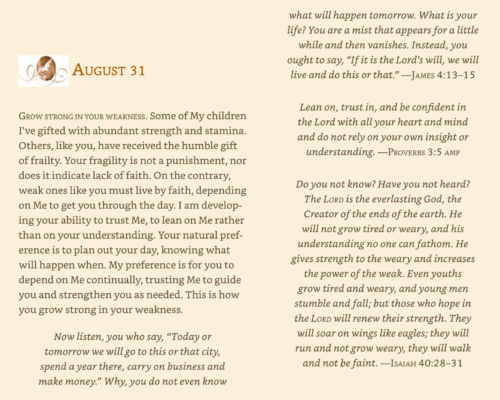
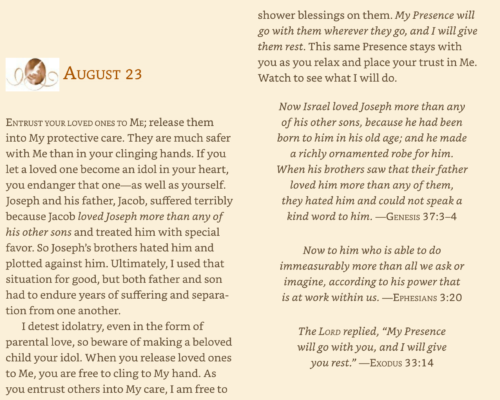
Live day by day, dependent and surrendered in Me. Whether you succeed or fail in your daily activities; being surrendered your perspective changes. You see miracles and possibilities knowing My plans for you are superior. Living in Me is the ultimate daily adventure.

2 Corinthians 12:9-10
But he said to me, “My grace is sufficient for you, for my power is made perfect in weakness.”. Therefore I will boast all the more gladly about my weaknesses, so that Christ’s power may rest on me.

Acts 17:28
For in him we live, and move, and have our being. The natural life which men live is from God; and they are supported in it by him; and from him they have …

Colossians 2 6-7
So then, just as you received Christ Jesus as Lord, continue to live your lives in him, rooted and built up in him, strengthened in the faith as you were taught, …

John 14:20
On that day you will realize that I am in my Father, and you are in me, and I am in you.

August 31st, 2022 by Dave No comments »

​​​​

Heaven Is a Great Party

In this homily, Father Richard considers the parable of the wedding feast and points out how few of us seem even to desire to attend God’s banquet. Click here to read the Gospel passage (Matthew 22:1–10). 

God has always had a very hard time giving away God: No one wants seems to want this gift. We’d rather have religion, and laws, and commandments, and obligations, and duties. I’m sure many of us attend church out of duty, but gathering with the Body of Christ is supposed to be a wedding feast. Do you know how many times in the four Gospels eternal life is described as a banquet, a feast, a party, a wedding, the marriage feast of the Lamb? There are fifteen different, direct allusions to eternal life being a great, big party. 

Do you know how many parables there are about eternal life being a courtroom or a judgment scene? One. Matthew 25. And that’s good. We need Matthew 25 because it makes it very clear that the ultimate issue is about how we care for the poor and marginalized. But we forget this good news of Jesus, sending a message out to the highways and the byways, inviting everybody who’s willing to come to the banquet. It’s that simple!  

Jesus goes out of his way to mention the good and the bad alike. We don’t like that either. We only want the good people to be there at the banquet, assuming, of course, that we’re the good people. Did you ever see the irony of that? Don’t you realize that every religion thinks that they are the ones that God likes? And we end up gathering at the party with that smug certitude; but when we do, it resembles something that very often isn’t much like a party. I don’t want to offend anybody, but sometimes only half of us even sing when we’re at church; half of us don’t even pick up the hymnals. I’m not trying to be cruel, but let’s just be honest and admit that many of us aren’t excited to be at church. For many of us, the Body of Christ is not a party.

Instead, we often believe that heaven is a giant courtroom scene. The good people win, the bad people lose, and almost everybody is bad except our group. That won’t work! It gives no joy and no hope to the world. It tells people they’re on the right side when sometimes they’re very unloving people who don’t care about the poor or the marginalized at all. And the statistics prove that Christians are no better than anybody else, in fact, very often—I’m sorry to say it—we’re worse. 

Do we want to be a part of the wedding feast to which all are invited? The only people who don’t get in on the party are those who don’t want to come—so I guess we have to ask ourselves, “Do we want to come?”

August 30th, 2022 by Dave No comments »

A Sheep Lost and Found

In this 1951 sermon, theologian and mystic Howard Thurman (1900–1981) reflects on Jesus’ parable of the lost sheep, starting with the sheep’s perspective. Click here to read the Gospel passage (Luke 15:4–7).

A sheep was enjoying his grass . . . and then when he started feeling chilly, he didn’t recall, but the only thing that he remembers is that suddenly he became aware that he was cold, and there was a throwback in his mind, and he realized that he had been cold for some time. But, the grass was good. Then he looked around, and he discovered that he was alone. That everybody had gone. That is, that all the sheep had gone. And he began crying aloud.

And then the shepherd, who had many sheep, missed him when he got back to the fold, and he left his ninety and nine . . . to try to find this sheep that was lost. And Jesus says, “God is like that.” Nothing heavy and theological about that. Very little that is dogmatic, technically, about it. Just that here is a shepherd who loves his sheep, and one of the sheep in doing the most natural thing in the world—and that is to eat the grass—did it with such enthusiasm and over a time interval of such duration that he didn’t know when the shepherd called, and he was lost.

And why was he lost? He was lost because he was out of touch . . . with the group that sustained him, the group that fed him, that gave him a sense that he counted. That’s all. And as soon as he was out there alone, he said, “I’m just here by myself. Nothing but me in all of this? And I want to feel that I count with the others.” There’s a certain warmth in that. There’s a certain something that is creative and redemptive about the sense of community, about the fellowship.

Thurman speaks of the pain of being separated from our communities:

Insulation is something that is spiritual; . . . there’s something inside of me that pulls up . . . the drawbridge. . . . Sometimes I do it because I’m afraid; sometimes I do it because I’m clumsy and awkward, and I don’t quite know how to establish a relationship or relationships with my fellows that can float my spirit to them and bring their spirit to me. . . .

Now, Jesus says that God is like the shepherd, seeking always to find those who are out of community with their fellows, and when they have found it, when they have found their community with their fellows, then all the world seems to fit back into place, and life takes on a new meaning. . . .

The lost sheep. The searching shepherd. And the cry of anguish of the sheep was the voice of identification that the shepherd heard. That is how God is, if we let him.


August 29th, 2022 by Dave No comments »

The Weeds and the Wheat

This week’s Daily Meditations focus on Jesus’ parables as teachings intended for our spiritual transformation. In this homily, Father Richard Rohr describes how Jesus’ parable of the weeds and wheat offers insight into becoming compassionate, “both-and” people instead of “either-or” people. Click here to read the Gospel passage (Matthew 13:24–30). 

This Gospel is not only extremely insightful, it’s also very realistic and compassionate. With injustices and crises in every part of the world, many of us are asking ultimate questions about good and evil. “Where do the weeds come from? Where does evil originate? Why do people do such harmful things?” I ask this about a dozen times every day. This world doesn’t make sense. How can people be so malicious, so unkind, so uncaring? It’s like we don’t know how to care anymore, as though we don’t know how to access our own hearts, our own souls, and our own spirits. 

For those of us who grew up as Christians, we may have heard this parable when we were younger. We may have been told to pull out the imperfect weeds and get rid of our faults. But since we really couldn’t get rid of them, we covered them up and pretended we didn’t have them. And that just doesn’t work.

Yet Jesus shows us an absolute realism. He says something that was never said to me when I was a young person: “Let the weeds and the wheat both grow together.” Wow! That’s risky. I can’t pretend to logically understand it, although I know it allows me to be compassionate with myself. After all, I’m also a field of weeds and wheat, just like you are, and just like everything is. Everything is a mixed bag, a combination of good and bad. We are not all weeds, but we are not all wheat, either. We have to learn, even now, to accept and forgive this mixed bag of reality in ourselves and in everybody else. If we don’t, we normally become very angry people. Our world is filled with a lot of angry people because they cannot accept their own weeds.

To accept this teaching doesn’t mean we can say, “It’s okay to be selfish, violent, and evil.” It simply means that we have some realism about ourselves and each other. We have to name the weed as a weed. We can’t just pretend it’s all wheat, all good, because it isn’t. We’re not perfect. Our countries are not perfect. The Church is not perfect. The project of learning how to love—which is our only life project—is quite simply learning to accept this. If you really love anybody, and I hope you all do, then you have learned to accept a person despite, and sometimes even because of, their faults.

What love means is to say, “I know your faults, I see your weeds, and I care for you anyway.” Only God’s heart, only the mind of Christ in us, really and fully knows how to do that.

Wisdom Teachings

Episcopal priest and CAC emerita teacher Cynthia Bourgeault describes how Jesus’ parables are a part of a genre that aims to bring about inner change in the hearer:

Parables are a wisdom genre. They belong to mashal, the Jewish branch of the universal tradition of sacred poetry, stories, proverbs, riddles, and dialogues through which wisdom is conveyed. . . .

We can see the razor edge of [Jesus’] brilliance as he takes the familiar world of mashal far beyond the safety zone of conventional morality into a world of radical reversal and paradox. He is transforming proverbs into parables—and a parable, incidentally, is not the same thing as an aphorism or a moral lesson. Its closest cousin is really the Buddhist koan, a deliberately subversive paradox aimed at turning our usual mind upside down. . . . Their job is not to confirm but to uproot. You can imagine the effect that had on his audience! Throughout the gospels we hear people saying again and again, “What is this he’s teaching? No one has ever said anything like this before. Where did he get this? Where did he come from?” [1]

Theologian Harvey Cox explores how parables invite the hearer to encounter God in an everyday and ever-changing reality: 

Stories were Jesus’ stock-in-trade, the main medium by which he conveyed his message. The parables occupy fully 35 percent of the first three Gospels. But one of their most surprising features is that they are not about God. They are about weddings and banquets, family tensions, muggings, farmers sowing and reaping, and shrewd business dealings. God is mentioned in only one or two. . . . Rabbi Jesus obviously wanted us to look closely at this world, not some other one. It is here and now—all around us in the most ordinary things—that we find the divine presence. . . .

But Jesus’ stories, though similar to Zen koans in some ways, were also different in important respects. While the Zen stories aim at changing one’s perception of the world, Jesus wanted people to see that the world itself was changing, and that therefore, they had better change the way they looked at it. He invited them, in effect, to become part of the change. Time after time he said, “They that have eyes to see, let them see, and they that have ears, let them hear.” He simply wanted people to pay attention to what was going on around them and to discern a reality that was just under their noses. To describe this change he used a term that his listeners would have found familiar, though they might have been startled by the way he used it. He called it the coming of the “reign of God.” What he meant was that something was happening, not just in the consciousness of the listener, but also in the world itself. Something new and unprecedented was happening, and they could be a part of it. [2]


Engaged Contemplation

August 26th, 2022 by JDVaughn No comments »

Author Sophfronia Scott draws on the wisdom and example of Trappist monk Thomas Merton (1915–1968) to discern her own response to the world’s pain: 

A hermitage is not where I’m supposed to be. Somehow I sense this. I’m supposed to be saying something, doing something. And yet I feel anything I could offer would get swallowed up in the noise—I’d be an infant crying out into a hurricane. I stand on the edge of an abyss, my hands in my pockets. . . . I feel as though Thomas [Merton] stands next to me in a similar stance. He helps me think about the possibilities. I think he’d say I have to get out there. I have to find a way to serve. He’d definitely say my hermitage idea is wrongheaded. 

“The contemplative life is not, and cannot be, a mere withdrawal, a pure negation, a turning of one’s back on the world with its sufferings, its crises, its confusions and its errors,” he writes. “The attempt itself would be illusory. No person can withdraw completely from the society of other people.” [1] When he entered the monastery after months of spiritual struggle, Merton described a lightness, as of . . . a leaving of the world. . . . His writings from his earlier years focused mainly on the cultivation of interior spirituality. . . . But as he matured, both emotionally and spiritually, he too sensed there was more—way more—he could be doing. The world, the very state of it, required that he bring his voice to the table. . . .

In 1961, he wrote his first article on peace, “The Root of War Is Fear,” and laid out the place for Christians in the struggle for peace. He writes, “The duty of Christians in this crisis is to strive with all their power and intelligence, with their faith, hope in Christ, and love for God and humankind, to do the one task which God has imposed upon us in the world today. That task is to work for the total abolition of war.” [2] . . .  

In the introduction to Merton’s book Passion for Peace, author William H. Shannon writes, “What had happened to him was that his solitude had issued into what all true solitude must eventually become: compassion. . . . This sense of compassion . . . moved him to look once again at the world he thought he had left irrevocably twenty years earlier, in 1941, when he had entered the monastery. He now felt a duty, precisely because he was a contemplative, to speak out.” [3]
 
Scott takes consolation from Merton’s reflections on contemplative life and the world:   I only have to step forward in my own vulnerable, broken, unkind, silly humanity. And I need to keep writing. I feel, as Thomas once did, I’ve come to a starting point: “The conviction that I have not yet even begun to write, to think, to pray, and to live and that only now I am getting down to waking up.” [4]

Sarah Young….

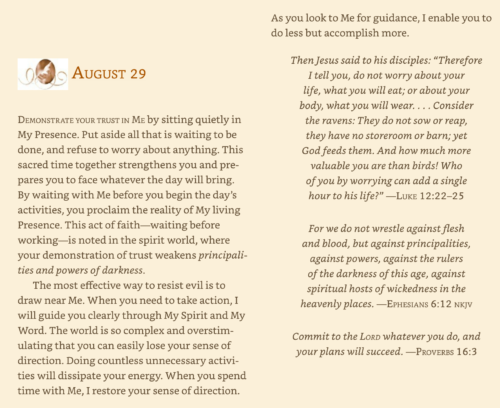
Trust Me in the midst of a messy day. Your peace-in my presence need not be shaken by what is happening around you.

When you start to feel stressed, surrender and detach yourself from the issues surrounding you.

Know that in your surrendered state you will be at peace, the peace I give you and it is more than sufficient.

John 16:33
I have said these things to you, that in me you may have peace. In the world you will have tribulation. But take heart; I have overcome the world.”

Psalm 105:4
Seek out the LORD and His strength; seek His face always

JOHN 14:27
Peace, I leave with you; my peace I give you. I do not give to you as the world gives. Do not let your hearts be troubled …

Seeking God’s Will

August 25th, 2022 by JDVaughn No comments »

You need to find what is genuinely yours to offer the world before you can make it a better place. Discovering your unique gift to bring to your community is your greatest opportunity and challenge. The offering of that gift—your true self—is the most you can do to love and serve the world. And it is all the world needs. —Bill Plotkin, Soulcraft

Once we have discerned “What is mine to do?” it can be tempting to believe we have settled the question once and for all. However, clinging to a single answer may limit our ability to grow and to trust the ongoing guidance of the Holy Spirit. After founding the CAC, Father Richard remained open to discerning anew how he might serve those on the margins. He explains:  

In the mid 1990s, the head of the Franciscan Order in Rome said that he wanted each province in the world to send someone to Africa.  

I spoke with my spiritual director about it. We agreed that I was probably experiencing “success guilt,” feeling that everything had come far too easily to me. I think I still live with this. I really didn’t seek or search for such success, but now I am used to it. I am used to having power and used to being listened to and being kowtowed to. It’s dangerous when you are always the person that others are listening to. I guess I was afraid I was becoming too well-known and that my ego had gotten too big! So when this invitation came from Rome, I said, “I think I should go to Africa.”

I left CAC for a thirty-day discernment retreat with Maryknoll. My goal was to discover God’s will for my life, but I was fully expecting to go to Africa afterward. 

Near the end of the retreat we each sat down privately with the leadership team of four or five wise people, primarily nuns. They told us what they saw and heard and thought, so we didn’t have to take the decision on by ourselves. Nor did we have to follow their recommendations. We could go back to our own superiors and make the final decision. 

Well, the leadership team told me, “We are convinced that you have a gift for America—to preach the gospel to a first world country. There’s not much point in you talking about the poor in Kenya; you need to talk about it in North America.” It was the consensus of the whole group. They said, “It’s your decision, but we strongly recommend that you stay here and keep doing what you are doing. If you are worried about your success guilt, well, you can worry about it!” 

I remember driving back from San Antonio, Texas, all the way through the Guadalupe Mountains, and everything was beautiful! I felt so happy, relieved and recommitted to working with the Center for Action and Contemplation. 

Sara Young….

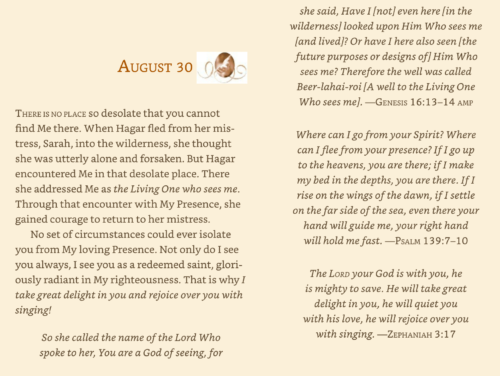
I am the eternal I am; I always have been, and I will always be.

I am intimately involved in all your moments and am training you to be aware of Me at all times.

When your thoughts wander, simply bring your thoughts back to Me….surrender, be connected and live out of that.

Exodus 3:14
God said to Moses, “I AM WHO I AM. This is what you are to say to the Israelites: ‘I AM has sent me to you.’”

1 Corinthians 3:16
Don’t you know that you yourselves are God’s temple and that God’s Spirit dwells in your midst?

Psalm 25:14-15
The Lord confides in those who fear him; he makes his covenant known to them. 15 My eyes are ever on the Lord, for only he will release my feet from the snare. 

August 24th, 2022 by Dave No comments »

Spirit-Led Action

CAC teacher Brian McLaren shares the power of ongoing discernment, allowing ourselves to be ever drawn by the Holy Spirit into service and action on behalf of others: 

The Spirit leads us downward. To the bottom, to the place of humility, to the position and posture of service . . . that’s where the Spirit, like water, flows. . . . 

If you listen to the Spirit, here is what will happen to you. You’ll be at a party and you’ll notice on one side of the room all the beautiful people laughing and having fun together. In a far corner, you’ll notice a person who is alone, feeling awkward, not knowing anyone. The Spirit will draw you to the person in need. You may become the bridge that connects the outsider to the insiders—and in that connection, both will be better off. . . .

Here’s what will happen to you if you listen to the Spirit. You will realize that someone is angry at you or resentful toward you . . . or worked behind your back to do you harm. Everything in you will want you to write them off or get them back. But the Spirit will draw you toward them in humility. . . . 

Here’s what will happen if you listen to the Spirit. You will see a person or a group being vilified or scapegoated. Everyone is blaming them, shaming them, gossiping about them, feeling superior to them, venting their anxieties on them. . . . But the Spirit will draw you to differ courageously and graciously. . . . You will risk your reputation in defending the person or people being scapegoated. And in that risk, both you and they will know that God’s Spirit is alive and at work in your midst. 

If you listen to the Spirit, here’s what will happen to you. It will be late. You will be tired. There will be dishes to do or clothes to pick up or trash to empty. Someone else should have done this, you will think with anger. You will rehearse in your mind the speech you will give them. And then you will think, But I guess they’re just as tired and overworked as I am. So maybe I can help.You won’t do this as a manipulative ploy but as a simple act of service. . . . 

There is a prison near you. A hospital. A park or a bridge or an alley where homeless people sleep. . . . There’s a country in great need or a social problem that few people notice. If you listen to the Spirit, you will be drawn toward an opportunity to serve. At first, the thought will frighten or repel you. But when you let the Spirit guide you, it will be a source of great joy—one of the richest blessings of your life. 

August 23rd, 2022 by Dave No comments »

Our Unique Path to Action

Writer and educator Cole Arthur Riley describes contemplation’s integral connection to action that supports justice:  

Activism is the body of justice. It invites you into embodied declarations of dignity and worth. As you participate in its body, you find yourself increasingly grounded in your own.

I think activism is a virtue. To be a person who cares and honors creation is to be a person who acts in favor of its flourishing. I am distrustful of spiritual people who are not roused in their bodies on behalf of justice. We can disagree on what activism should look like, but not on the necessity of its existence or your participation in it. . . . 

A mentor and friend once said to me, If there is someone who is both activist and contemplative and who does both well, I have not yet met them. I silently accepted the challenge. He was articulating a very credible tension between the heart of the contemplative and the heart of the activist. At first strike, they appear inherently in conflict. The contemplative, some pillar of stillness, tasked with thinking and asking enduring questions that require a kind of slowness and pause. The activist, a beacon for the movement, committed to the doing of justice and mercy—not later but now, which does, as the name suggests, require action. 

But what if what we take as stillness is not always inactivity as we perceive it? Can there be a form of contemplation that is at once stillness and movement? Some might say the beginnings of Christian monasticism were, in part, a defiant protest against the elitism and centering of the upper class in the faith. And today, activism tells the truth about what is and imagines what should be. This imagination for justice requires contemplation. 

While committed to activism, it took Riley time to discern her true calling as a writer in the service of justice:  

For quite some time, the only portraits of activism I had were Dr. King and Malcolm X. Marches, rallies, sit-ins—holy embodiments that should be respected deeply, for they protect and guide us today. But the first time I picked up James Baldwin, I finally saw myself. It occurred to me that I could be an activist from my own source of power—words. 

It can only make our journey toward justice more robust, more beautiful, when we offer a diversity of paths, a more expansive vision of action. This is not new. This is Detour and Hiero Veiga’s graffiti art resurrecting Black faces slain by the police. This is Tricia Hersey and The Nap Ministry creating collective sleeping experiences to reclaim the justice and liberation in rest. . . . If writing is a calling, I have a responsibility to demand justice in my writing as much as in the streets. When we expand our imaginations for activism,

 When we expand our imaginations for activism, we enter into practices of lament and rage with more particularity, and we begin to realize more nuanced paths to justice.


August 21st, 2022 by Dave No comments »

We Are Being Guided

What will happen if I really trust God’s love for me and allow God to direct my life? —Ilia Delio, Franciscan Prayer  

This week’s meditations focus on how we discern what actions are ours to do. As Francis of Assisi said on his deathbed, “I have done what is mine; may Christ teach you what is yours!” [1] Father Richard teaches that discernment begins with an authentic trust in God’s presence and guidance:

The full life of faith becomes a life of deep joy and rest. Once we are “grafted to the Vine,” to use Jesus’ words (see John 15:4–5), we don’t have to be anxious about many things (see Luke 10:41). We don’t have to be worried about the next moment or about tomorrow (see Matthew 6:34). We can trust that we are being guided; in fact, almost everything is seen as guidance. Our ability to trust that there is guidance available allows it to become guidance! Basically, we switch from the fixing, fully understanding, and controlling mode to the trusting, listening, and allowing mode. Then we start allowing the Divine Flow instead of stopping it with a “no” or a question mark. 

The Spirit in us knows how to use everything that happens to bring about healing and growth. We can trust that “God is even in this!” That does not mean we shouldn’t work to change and improve things; in fact, quite the contrary. But when our first heart and soul response is a “yes” and not a “no,” then we can experience God in the moment and see guidance in the events of our lives. We can trust that nothing is wasted. If there are changes and fixes that have to be made, we can now take care of them in an appropriate, calm, and positive way. That is what characterizes a mature believer in any religion.

Faith, as we see in the Hebrew Scriptures and Jesus’ usage of them, is much closer to our words “trust” or “confidence” than it is about believing doctrines to be true. Simply believing doctrines demands almost no ego-surrender or real change of the small self. Holding confidence that God is good, God can be trusted, and God is actively involved in my life is a much more powerful and effective practice. This is the practical power of biblical faith. Faith-filled people are, quite simply, usable for larger purposes because they live in and listen to a much Larger Self.  

Richard shares that contemplative practice helps us grow in such trusting faith:

From my own experience, I know I need a contemplative practice. Some form of the prayer of quiet is necessary to touch me at the unconscious level, the level where deep and lasting transformation occurs. From my place of prayer, I am able to understand more clearly what is mine to do and have the courage to do it.  

Contemplation and Right Action

Father Richard shares about an important time of discernment in his life:

There are two spiritual disciplines that keep me honest and growing: contemplative prayer and the perspective from the bottom. In 1985, I was freed for a year to pursue the contemplative part of my vocation. It was a major turning point. Father William McNamara’s definition of contemplation—“a long loving look at the real”—became transformative. [1] The world, my own issues and hurts, all goals and desires gradually dissolved into proper perspective. God became obvious and everywhere. 

Ultimately, we do not earn or find God. We just get ourselves out of the way. We let go of illusions and the preoccupations of our smaller selves. As the cheap scaffolding falls away, the soul stands revealed. The soul, or True Self, cannot be created or achieved by our work. It just is, and it is already. The soul is God’s “I AM” continued in me. That part of me already knows, desires, and truly seeks God. Discernment of God’s will comes naturally to the True Self because here “I” and God seem to be one “I.” 

Richard reflects on how this extended time of contemplation brought him to a point of decisive action: 

After my sabbatical year, I found my way to the conviction that I should open the Center for Action and Contemplation in New Mexico. I wanted to help people get thoroughly involved in the issues and goals of social justice, to help people work in solidarity with those on the margins, but from the right point of departure. It is possible to do the right thing for the wrong reasons! 

Contemplation is a way to hear with the Spirit and not just with the head. Contemplation is the search for a wide-open space, a space broad enough for the head, the heart, the feelings, the gut, the subconscious, our memories, our intuitions, our whole body. We need a holistic place for discerning wisdom.

The effect of contemplation is authentic action; if contemplation doesn’t lead to genuine action, then it remains only navel-gazing and self-preoccupation. 

I’m convinced that if we stick with it, if we practice contemplation regularly, then we will come to an inner place of compassion—for ourselves and for others. In this place, we notice how much the suffering of the world is our suffering. We become committed to this world, not cerebrally, but from the much deeper perspective of our soul. At this point, we’re indestructible, because in that place we find the peace that the world cannot give. We don’t need to win anymore; we just need to do what we have to do, as naive and simplistic as that might sound. That’s why Augustine could make such an outrageous statement as “Love [God] and do what you will”! [2] People who are living from a truly God-centered place instead of a self-centered place are dangerously free precisely because they are tethered at the center.