Theologian and podcaster Kate Bowler frames Easter as a feast of joy that doesn’t erase the pain that has come before it:
Easter is the season of joy.
The alleluias return. The story reaches its turning point. Death does not get the last word.
Easter is that gorgeous, sweet, closing note of the salvation hymn we believe with all our hearts: Christ has conquered death, and we will someday be with God forever. Hallelujah. Hallelujah.
Joy brings us incredible, brief, soul-filling moments when we feel the overwhelming love of God and our place in this world. Our soul cries: Yes. I am grateful. It is so good to be alive.
Joy is a gift from God and a feeling that bubbles up from wherever the soul lives (probably close to the intestines. This is my working theory after realizing I will never love anything as much as I love Old Dutch Ketchup Potato Chips).
But that is not the only way joy shows up.
There is an aspect of joy we often miss around Easter, and it appears precisely when Easter comes and goes and life remains … unfinished. We wake up the next morning and discover that we are still carrying the same griefs, the same unanswered prayers, the same ache we carried throughout Lent.
This can feel confusing. Shouldn’t we feel better? Was Easter not enough?
But Easter joy is not the feeling that everything has been fixed. It is not happiness, resolution, or emotional closure. Easter joy is the ability to live in Christian anticipation and trust—patiently and imperfectly—even while we remain here in the long middle.
Joy is one of the most powerful experiences we can have because it is an emotion that can co-exist with our actual lives. Unlike happiness, joy can live alongside sadness, boredom, fear, or despair. It expands our capacity to hold contradictory truths at the same time—and because we know joy, we recover a strange, steady confidence that life is still worth loving, even when it hurts.
Scripture is honest about this. Jesus weeps at Lazarus’s tomb, even knowing resurrection is coming. Paul speaks of being “sorrowful, yet always rejoicing” [2 Corinthians 6:10]. Revelation [21:4] promises a future where God will wipe away every tear—but that promise is not the same thing as pretending we are not crying now.
This is where Easter joy lives.
It is not joy instead of grief. It is joy with grief. Not joy that rushes us forward, but joy that allows us to remain human in the meantime.… This joy is more totalizing than optimism. It is truer than plain happiness. It is the deep assurance that the story is not finished, even when our lives feel painfully incomplete.
Easter joy is the grace of being able to say: This is hard. I am still waiting. And God is still good.
Not because everything has changed—but because, one day—poof—God promises everything will.
Father Richard Rohr explains how the resurrection offers us hope, especially in challenging times:
I often wonder why so much of human life seems so futile, so tragic, so short, and so sad. If Christ is risen, why do people die before they begin to truly live? Why has there been nonstop war? Why are so many people imprisoned unjustly? Why are the poor oppressed? Why do we destroy so many of our relationships? If Christ is risen, why is there so much suffering? What is God up to? It really doesn’t make any logical sense. Is the resurrection something that just happened once, in his body, but not in ours?
I believe the resurrection of Christ is saying that the final judgment has already happened. It’s nothing we need to fear. It’s nothing we need to avoid or deny. God’s final judgment is that God will have the last word! Easter reveals that there are no dead ends; ultimately, nothing is going to end in tragedy and crucifixion. Of course we look around us, at history and at life in its daily moments and it seems, “No, that isn’t true.” And yet, ever and again, here and there, more than we suspect, new life breaks through for those who are willing to see and to cooperate with this universal mystery of resurrection.
We’re so lucky in my part of the world that Easter coincides with springtime. If this applies to you, I hope you’re going out and seeing the leaves and the flowers being reborn after months of winter. I went out early this morning to see the Easter sunrise. Sure enough, the sun rose as it always does and peeked over the horizon, just between two mountains. It appeared not so much like a sunrise but as a groundswell. The light was coming from the earth. It was coming from the world we live in. It was coming not from the top, but from the bottom. It seemed to say that even all of this, which looks muddy and material, even all of this, which looks so ordinary and dying, will be reborn.
Easter is the feast of hope. This is the feast that says God will have the last word and that God’s final judgment is resurrection. God will turn all that we maim and destroy and hurt and punish into life and beauty.
What the resurrection reveals more than anything else is that love is stronger than death. Jesus walks the way of death with love, and what it becomes is not death but life. Surprise of surprises! It doesn’t fit any logical explanation. Yet this is the mystery: that nothing dies forever, and that all that has died will be reborn in love.
So, to be a Christian is to be inevitably and forever a person of hope. God in Christ is saying this is what will last: My life and my love will always and forever have the final word.
The Easter Story
We Are All Rising
Monday, April 6, 2026
CAC staff member Mark Longhurst recounts the Easter story which revealed the good news of Jesus’s resurrection—and our own:
Each year Easter is, for Christians, a celebration of the rising of Christ, but this rising is far more than one person’s death-defying divine act. The resurrection of Christ is expansive: Jesus the person rises and launches God’s resurrection movement that brings everyone and everything along with it.
It starts with a body or, rather, a body’s absence. Mary Magdalene and other women are at the tomb before sunrise to preserve Jesus’s body with spices (Luke 24:1). A rolled-away stone ensures they can enter the tomb easily, but the body is missing. Two men—angels—stand near them wearing clothes that dazzle like the very lightning of the sky. They point out the befuddled obvious: “He is not here” and the more shocking, “He has risen” (24:5).
Jesus Christ rises first on Easter morning to the women. [In Luke’s Gospel] shortly after, he will make appearances to two disciples on the road to Emmaus (24:13–35) and to disciples gathered in Jerusalem (24:36–49), but it’s the women who first see the empty tomb and believe. Jesus Christ rises to Mary Magdalene, the devoted disciple extraordinaire, to Mary the mother of James, to Joanna, who—Luke chapter eight tells us—is married to the manager of Herod’s household himself, and to the other women who were with them at the tomb (24:10). You could even say that the women are rising with Jesus. They are the first to witness the empty tomb, the first to herald a new message of hope, the first to glimpse a renewed world where love is stronger than death….
The implications of the empty tomb are not seen by those looking for an eyewitness investigative account of what did or did not happen. Only those whose hearts bear the capacity to love can see the resurrection and dream a new way out of no way. The men lack this consciousness—Luke says they “did not believe them” [See 24:10–11]. It’s to Peter’s credit that he follows his awakening heart, still bruised from his threefold betrayal of Jesus, and runs to check the tomb himself. Perhaps he hopes for a last-ditch chance to demonstrate his faithfulness. Perhaps out of aching desperation, Peter is rising, too….
Jesus rising, however, is only the beginning or “first fruits” of resurrection (1 Corinthians 15:20). In Jesus Christ, God’s resurrecting movement has begun, and it sweeps everyone and everything up within it. Dying and rising are a central pattern and truth of reality—and so to talk about Jesus’s rising is somehow to approach the weighty paradox of death and life evolving together at the center of the universe. Mary, Joanna, and the other women are rising, Peter is rising, I’m rising, you’re rising, and the universe itself is rising.
=======================
Individual Reflection: Where in your life right now does resurrection feel more like something you believe than something you’re experiencing?
Group Discussion — choose one:
What in you is still waiting to rise?
Where have you seen love outlast death?
What would it mean to cooperate with resurrection rather than just hope for it?
Father Richard offers a guided meditation, inviting listeners to be present with Jesus at the crucifixion:
Picture yourself before the crucified Jesus; recognize that he became what you fear: nakedness, exposure, vulnerability, and failure. He became sin to free you from sin (see 2 Corinthians 5:21). He became what we do to one another in order to free us from the lie of punishing and scapegoating each other. He became the crucified so we would stop crucifying. He refused to transmit his pain onto others.
Richard imagines Jesus speaking these words to us, offering God’s love and forgiveness:
My beloved, I am your self. I am your beauty. I am your goodness, which you are destroying. I am what you do to what you should love. I am what you are afraid of: your deepest and best and most naked self—your soul. Your sin largely consists in what you do to harm goodness—your own and others’. You are afraid of the good; you are afraid of me. You kill what you should love; you hate what could transform you. I am Jesus crucified. I am yourself, and I am all of humanity.
We are invited to respond to Jesus on the cross:
Jesus, Crucified, you are my life and you are also my death. You are my beauty, you are my possibility, and you are my full self. You are everything I want, and you are everything I am afraid of. You are everything I desire, and you are everything I deny. You are my outrageously ignored and neglected soul.
Jesus, your love is what I most fear. I can’t let anybody love me for nothing. Intimacy with you or anyone terrifies me.
I am beginning to see that I, in my own body, am an image of what is happening everywhere, and I want it to stop today. I want to stop the violence toward myself, toward the world, toward you. I don’t need to ever again create any victim, even in my mind.
You alone, Jesus, refused to be crucifier, even at the cost of being crucified. You never asked for sympathy. You never played the victim or asked for vengeance. You breathed forgiveness.
We humans mistrust, murder, and attack. Now I see that it is not you that humanity hates. We hate ourselves, but we mistakenly kill you. I must stop crucifying your blessed flesh on this earth and in my brothers and sisters.
Now I see that you live in me and I live in you. You are inviting me out of this endless cycle of illusion andviolence. You are Jesus crucified. You are saving me. In your perfect love, you have chosen to enter into union with me, and I am slowly learning to trust that this could be true.
_______________________________________________
John Chaffee 5 On Friday
1.
“We ought not to be weary of doing little things for the love of God, who regards not the greatness of the work, but the love with which it is performed.”
At one point this past week, we were out to dinner, and one of the people from our group said that Practicing the Presence of God had utterly changed the way she thought about work around the house.
Doing dishes.
Walking the dog.
Folding laundry.
Taking the trash out.
Restocking toilet paper.
Mopping the floor.
Making the bed.
Sort the mail.
Do some emails.
Modern culture tells us we must always be doing something grand, explosive, or extreme, but aspirituality of presence and depth is actually more interesting in the little things... Because, after all, our lives are chock full of the little things.
2.
“For it is God’s will that by doing good you should silence the ignorant talk of foolish people.”
The letter of 1 Peter, which tradition holds was written by the actual Apostle Peter, is hitting me differently after being at the Tomb of St. Peter.
Just before Peter was crucified on an inverted cross, he was clearly trying to help the Christians live while under Roman occupation. During the time of the first century, there were many rumors swirling about the Christians being “atheists” who did not have a temple of their own and who practiced cannibalism (it was actually the Eucharist).
In 64 AD, Rome caught on fire, and Nero did nothing to stop it. It ended up burning down a massive section (which he then rebuilt for himself), and he blamed it on the Christians.
So, of course, Peter encouraged the Christians to be of the utmost moral quality, to help “silence the ignorant talk of foolish people” who kept feeding the gossip and rumors that Christians were ruining Rome.
3.
“As surely as I live,’ says the Lord, ‘Every knee will bow before me; Every tongue will εχομολογησεται God.”
Εχομολογησεται (exomologesetai) is the Greek word that is often translated as “confess” in most English translations.
However…
The word “confess” often carries a negative connotation.
If we take a moment to look up other meanings of the word, they are all positive! The word can also be translated to mean “openly and joyfully profess without reservation.”
This is why I believe that it is vitally important to read the Bible in the original languages, if possible. There are so many nuances that are missed, such as this one!
This past week, a fellow traveler did a great job of convincing me to read Therese of Lisieux next. Although her writings can be seen as a bit “saccharine” by some, others find them quite beautiful.
I love this quote about love. It challenges me. I often calculate the cost/risk/worth of loving others, and it has not served me.
Fortunately, the whole of the Christian faith is built around love, and it keeps pointing me back to its primacy. I am beyond certain that I would be a miserable wreck without my faith.
5.
“We are convinced that believing in God is worthwhile. We thereby want to express the conviction that it is not death that has the last word but life; it is not the absurd but the full meaning in life that wins the day.”
Dr. Yolanda Pierce finds both comfort and challenge in the spiritual “Were You There?,” which invites listeners to reflect on how they are present to Jesus’s death on the cross:
In that small Baptist church where I was invited the invited preacher for Palm Sunday, the choir sang, “Were You There (When They Crucified My Lord)?” That beloved spiritual caused me to reflect theologically on the power of showing up and on the experience of the radical presence of God the song embodies….
More than two thousand years removed from the reality of Jesus’s crucifixion, this spiritual … stresses the reality of the current moment by daring to ask the listener, “Were you there?” With this emphasis on “you”—on those of us who could not have been physically present—it reminds us that the believer still needs to show up at the foot of the cross and to identify with the radical act of Jesus’s death andresurrection.
Pierce names examples of suffering where we are called to bring our presence and seek justice:
There is fullness of life when you show up, fully present, when people are suffering and where people are bearing the burdens of their own crosses. “Were You There?” is a reminder that to be fully present with the whole of humanity does not require us to enter the sanctuary or walk across the threshold of a church. The cross, Calvary, is a site of public spectacle. The rhetorical question “Were you there?” signifies the real pressing question about whether you will be present for lost and hurting generations.
To be present is to be wherever there is need. Were you there when the levees broke during Hurricane Katrina or when the earthquake shook Haiti?
Will you be there when the next natural disaster strikes and the most vulnerable cannot find shelter? …
To be present is to be where people are suffering. Were you there among the hungry and the homeless, those in search of both their spiritual and physical daily bread?… Or will you cross to the other side of the street?
To be present is to be at the front lines of the fight for justice. Were you there in Selma and Birmingham, risking the dogs and the water hoses? Will you be there on Capitol Hill to fight for health care for the uninsured? Will you be there at your senator’s office to protest the cuts to educational funding even as another several billion dollars are appropriated to fight unjust wars?
The lyrics of “Were You There?” continue with the words “Oh, sometimes it causes me to tremble! Tremble! Tremble!” I wonder whether we have lost our ability to tremble—to be deeply affected —in the face of injustice. I wonder whether we no longer tremble in the presence of a holy God who requires us to do the work of justice.
________________________________________________
Jesus Calling – April 2nd, 2026, Sarah Young
I have promised to meet all your needs according to My glorious riches. Your deepest, most constant need is for My Peace. I have planted Peace in the garden of your heart, where I live; but there are weeds growing there too: pride, worry, selfishness, unbelief. I am the Gardener, and I am working to rid your heart of those weeds. I do My work in various ways. When you sit quietly with Me, I shine the Light of My Presence directly into your heart. In this heavenly Light, Peace grows abundantly and weeds shrivelup. I also send trials into your life. When you trust Me in the midst of trouble, Peace flourishes and weeds die away. Thank Me for troublesome situations; the Peace they can produce far outweighs the trials you endure.
RELATED SCRIPTURE:
Philippians 4:19 (NLT) 19 And this same God who takes care of me will supply all your needs from his glorious riches, which have been given to us in Christ Jesus.
Additional insight regarding Philippians 4:19: We can trust that God will always meet our needs. Whatever we need on earth he will always supply, even if it is the courage to face death as Paul did. Whatever we need in Heaven he will supply. We must remember, however, the difference between our wants and our needs. Most people want to feel good and avoid discomfort or pain. We may not get all that we want. By trusting in Christ, our attitudes and appetites can change from wanting everything to accepting his provision and power to live for him.
2nd Corinthians 4:17 (NIV) 17 For our light and momentary troubles are achieving for us an eternal glory that far outweighs them all.
Additional insight regarding 2nd Corinthians 4:17: Our troubles should not diminish our faith or disillusion us. We should realize that there is a purpose in our suffering. Problems and human limitations have several benefits: 1) they remind us of Christ’s suffering for us; 2) they keep us from pride; 3) they cause us to look beyond this brief life; 4) they give us opportunities to prove our faith to others; and 5) they give God the opportunity to demonstrate his power. See your troubles as opportunities!
Today’s Prayer:
Dear Heavenly Father,
You promise to meet all my needs with Your abundant riches. Yet, weeds of pride, worry, and unbelief often choke the peace You offer to me unconditionally. As the true and wonderful gardener, You work to remove these obstacles and distractions.
Your presence brings abundant peace in quiet moments with You, and trials, when faced with trust, yield even more. Thank You for these assurances that give me comfort.
Help me to see troublesome situations as opportunities for growth and to witness Your extreme power.
Karen González, an immigrant advocate, points to the story of Joseph in Genesis 37 as an example of God’s love and protection for foreigners:
[Joseph] suffers a series of misfortunes as a vulnerable foreigner. Joseph’s story is powerful and effective because it raises questions about the goodness of God in the midst of suffering. It also depicts the human tendency to alternate between loving and fearing strangers. In his story we see the Egyptian society’s movement from fear to love and then back to fear again….
Without recourse, as an enslaved person in a foreign land, Joseph does not receive due process. Instead, he is thrown into jail for a crime he didn’t commit. The unknown narrator of Genesis states that God always sees Joseph and remains with him. Twice within the span of three verses we are told that “the Lord was with” Joseph, blessing his work and giving him favor with those in authority over him (Genesis 39:21–23)…. Nonetheless, he spends years unjustly imprisoned, largely forgotten by his foreign captors….
For many immigrants and others on the underside of history, God’s presence in suffering isn’t about complex theological arguments about theodicy or sovereignty or how bad things can happen to good people. For them, God’s presence in suffering is what enables them to live. Indeed, for many who suffer, Christ on the cross offers the comfort of knowing that they serve a God who himself has known great sorrow and suffering. [1]
Fear leads to scapegoating while friendship leads us to welcome Christ in our midst:
Fear has become the default in the current immigration conversation in North America, even for followers of Jesus, who are called to love our neighbors as ourselves. The Bible speaks to the need for philoxenia [love of foreigners] repeatedly, from Exodus all the way to Hebrews: “Keep loving each other like family. Don’t neglect to open up your homes to guests [strangers or foreigners], because by doing this some have been hosts to angels without knowing it” (Hebrews 13:1–2)….
When we open ourselves up to friendships with immigrants and take intentional steps to know and be known in mutuality, we widen the circle of our affections. Suddenly, immigrants are no longer a burden or a drain on our economy, but a Ruth, a Hagar, or a Joseph to be loved. They become multidimensional people to us—friends who enrich our lives with their very selves. We welcome them and simultaneously welcome Christ and his joy. Indeed, when the Egyptians welcomed the Israelites, they welcomed God and God’s blessing into their midst. And when they rejected the Israelites and oppressed them, they rejected God’s very self, even without realizing it.
Jesus often comes to us in disguise, as he himself says in Matthew 25: he is sometimes a prisoner, a sick person, a naked person, a hungry person, a thirsty person, or an immigrant (verses 35–36). If we learn anything from Joseph and his suffering, it is to welcome and embrace Jesus in disguise.
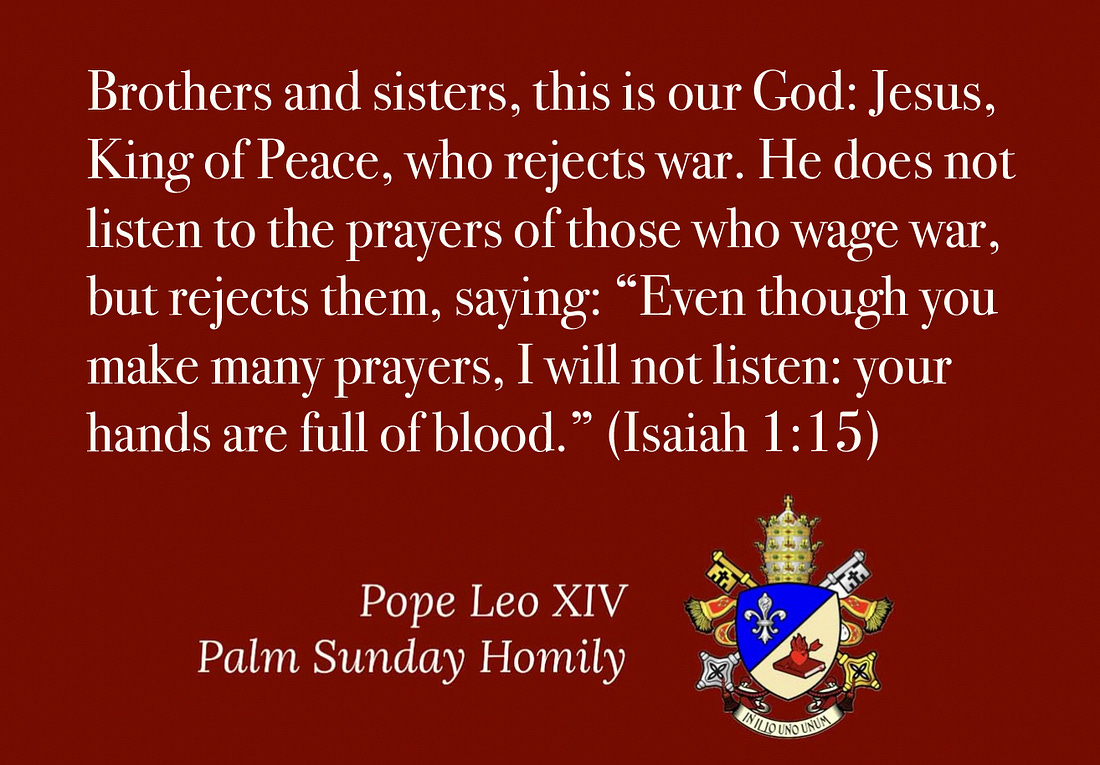
“Why did the Pope tell people Jesus doesn’t listen to some people’s prayers? We are all sinners. We all have blood on our hands. Doesn’t God promise to hear everyone?”
Response
Thank you for your thoughtful question.
For those wary of hearing a few lines out of context, I recommend reading the full text of Pope Leo’s short homily by clicking HERE. But it is also important to read it in it’s biblical and immediate context.
I. Biblical Context
The occasion of the homily was the Feast of the Triumphal Entry. In its biblical context, we see his message was permeated with Scripture. In the order that he referred to them:
Ephesians 2:14 – “He is our peace.”
Zechariah 9:9-10 –“Lo, your king comes to you; triumphant and victorious is he, humble and riding on a donkey, on a colt, the foal of a donkey. He will cut off the chariot from Ephraim and the war-horse from Jerusalem; and the battle bow shall be cut off, and he shall command peace to the nations.”
Matthew 26:52 – “Put your sword back into its place, for all who take the sword will perish by the sword.”
Isaiah 53:7 – [Jesus] “did not open his mouth, like a lamb that is led to the slaughter, and like a sheep that before its shearers is silent.”
Isaiah 1:15 – “Even though you make many prayers, I will not listen: your hands are full of blood.”
And since the last statement drew so much ire, let’s remember that the Pope was quoting the prophet Isaiah, who we should also here in his context—visions from God concerning Judah and specifically Jerusalem. Here is Isaiah 1:15 in its context [with emphases and in notes from me]:
10 Hear the word of the Lord, you rulers of Sodom! Listen to the teaching of our God, you people of Gomorrah!
[Ouch. God is addressing Jerusalem!]
11 What to me is the multitude of your sacrifices? says the Lord; I have had enough of burnt offerings of rams and the fat of fed beasts; I do not delight in the blood of bulls or of lambs or of goats. 12 When you come to appear before me, who asked this from your hand? Trample my courts no more! 13 Bringing offerings is futile; incense is an abomination to me. New moon and Sabbath and calling of convocation— I cannot endure solemn assemblies with iniquity. 14 Your new moons and your appointed festivals my soul hates; they have become a burden to me; I am weary of bearing them.
[God is rejecting their worship]
15 When you stretch out your hands, I will hide my eyes from you; even though you make many prayers, I will not listen; [Why not?] your hands are full of blood.
[But restoration is possible… How?]
16 Wash yourselves; make yourselves clean; remove your evil deeds from before my eyes; cease to do evil; 17 learn to do good; seek justice; rescue the oppressed; defend the orphan; plead for the widow.
[A fresh start awaits… if only…]
18 Come now, let us argue it out, says the Lord: If your sins are like scarlet, will they become like snow? If they are red like crimson, will they become like wool? 19 If you are willing and obedient, you shall eat the good of the land, 20 but if you refuse and rebel, you shall be devoured by the sword, for the mouth of the Lord has spoken.
Side note: Notice the formatting. This is a song. I’ve noticed that those who deliver poetic indictments seem to get away with more than those who write the same truths in prose or speak them directly. It’s not as though Isaiah was telling it slant, but the prophet whose words are recorded in chapter 1 may have “got published” rather than cancelled in part because the words were delivered in verse. Then again, there is the tradition that he was “sawn asunder” under King Manasseh (Hebrews 11:37), so there’s that.
Anyway, the real point is that while God is everywhere present and always attentive, what has caught God’s attention in this passage was the gross incongruity around blending worship and cruelty… perpetrating national injustice while weaponizing worship has put God off worship (similar to Micah and Amos and Jeremiah).
This was what came up in the Pope’s mind and heart and from his mouth when he spoke.
II. Immediate Context: Feb 28, Mar 26, Mar 29, 2026
The immediate context of the homily:
February 28 – the Minab Massacre: on the first morning of the Iran War, missile attacks destroyed the Shajareh Tayyebeh Elementary School in Minab, Iran. Over 170 people were killed, at least 100 of them primary-age girls were killed.
March 26 – the Secretary of War’s Pentagon Prayer: Pete Hegseth’s prayer invoking the name of Jesus Christ, calling for overwhelming violence without mercy.
March 29 – the Papal Homily, condemning war and rejecting prayers used to justify war, incite violence, and glorify death.
The Pope’s homily was, without a doubt, a response to a prayer offered at the Pentagon service just three days earlier. One cannot understand the Pope’s severity without reading Secretary Hegseth’s prayer in its entirety, HERE.
The prayer is a composite of imprecations from various Psalms, an invocation from a chaplain ahead of the Venezuelan incursion in January, and specific calls to violence for the war in Iran. “Imprecation” refers to calling down a curse or invoking harm upon someone—especially by appealing to God to bring judgment, punishment, or justice. The prayer included the following paragraphs (emphases in bold are mine):
Almighty God, who trains our hands for war and our fingers for battle, you who stirred the nations from the north against Babylon of old, making her land a desolation where none dwell, behold now the wicked who rise against your justice and the peace of the righteous. Snap the rod of the oppressor, frustrate the wicked plans, and break the teeth of the ungodly. By the blast of your anger, let the evil perish. Let their bulls go down to slaughter for their day has come, the time of their punishment. Pour out your wrath upon those who plot vain things and blow them away like chaff before the wind.
Grant this task force clear and righteous targets for violence. Surround them as a shield, protect the innocent and blameless in their midst. Make their arrows like those of a skilled warrior who returned not empty-handed. Let every round find its mark against the enemies of righteousness and our great nation.
Give them wisdom in every decision, endurance for the trial ahead, unbreakable unity, and overwhelming violence of action against those who deserve no mercy.Preserve their lives, sharpen their resolve, and let justice be executed swiftly and without remorse that evil may be driven back and wicked souls delivered to the eternal damnationprepared for them. For the wicked flee when no one pursues, but the righteous are as bold as a lion. We ask these things with bold confidencein the mighty and powerful name of Jesus Christ, King over all kingsand amen.
Not because of partisan politics or which party holds the keys to power, or which nation is to blame, but because we hate the destructive power of everywar and grieve the loss of all lives—children, civilians, and military. We are heartbroken when missiles fly in any direction for any reason. We know it is never the way of Jesus, who wept over Jerusalem, “If you, even you, had only recognized on this day the things that make for peace! But now they are hidden from your eyes” (Luke 19:42).
Every time nations go to war, grieving with Jesus and joining his lament is the righteous response. But when we (included the Pope) heard that prayer from Central Command in Arlington, many of us felt deeply sickened. Death-dealing was once again being baptized in Jesus’ name.
Pope Leo’s homily, offered just three days later, is now widely regarded as Rome’s obvious and immediate response. Some would say ‘prophetic.’
Yet many have since questioned Leo’s wording . . .
What does he mean God doesn’t listen? What does Isaiah mean by that?
III. The Language of “Listening”
This question is much simpler to understand if we think about the language of “listening” in the context of normal conversation.
For example, when someone says in exasperation, “You are notlisteningto me,” we’re not literally saying they can’t audiblyhear us. We’re often upset because what we’re saying is not getting an affirmative response of obedience. “You’re not obeying me! You’re not doing what I want!” And from the one “not listening,” the response comes, “No, I am not going to do that.”
The particular prayer that Pope Leo was referring to—the prayers God doesnotlisten to are precisely those prayers telling God to bless our extreme violence, show no mercy, and send the wicked to hell. That was the prayer. And the Pope is saying, “No, Jesus will not do that. Jesus will never do that.” Jesus told us to bless our enemies and pray for them, but if instead, we pray curses on them, then no, “God will not listen.” God is not the agent of violence, war, and death. In other words, “God doesn’t listen” = “Don’t expect a yes.”
And lucky for us. Because God is also not listening to prayers for violence of the Mullahs in Iran. Or of the Rabbis in Jerusalem. Like, what if God did listen and answer? What would that look like? Mutual annihilation. It’s true, “There is blood on all our hands.” My complicity in my nation’s death-dealing and evil-doing paints a target on my own back. Better if I don’t add to the body count.
Here’s what we know from Jesus’ Sermon on the Mount:
Blessed are the peacemakers. They get to be called the “children of God.” What does Jesus say to our claims of “Lord, Lord, … did we not _____ in your name?” but do not listen to what he said?
The measure with which we judge will be used on us. Prayers for violence sound like perilous projections. I don’t want God to listen to pastors, imams, or rabbis who ask God to align with their wrath. Why not? Because (1) some of them have me in mind and (2) according to Jesus, the judgments they make inevitably boomerang. As one of my friends used to say, when the lawnmower of judgment comes over, be the lowest blade of grass. Get low.
IV. The Function of Imprecatory Prayers
“Break the teeth of the wicked.
Snap the rod of the oppressor.
Frustrate wicked plans.”
Amen.
Even as a firm believer in the non-violent victory of Christ, I pray (actually, chant) the imprecatory Psalms. I don’t avoid reading them. I don’t avoid praying them. Including the most angry tunes:
Psalm 7
Psalm 31
Psalm 35
Psalm 55
Psalm 58
Psalm 59
Psalm 69
Psalm 83
Psalm 109
If you include every Psalm that includes imprecatory elements, the list gets longer: Psalm 3, 5, 6, 7, 9, 10, 12, 17, 28, 31, 35, 36, 40, 41, 52, 54, 55, 56, 58, 59, 64, 69, 70, 71, 79, 83, 94, 109, 129, 137, 139, 140, 141, 143.
V. How they work
How do imprecatory prayers work when Jesus has forbidden his disciples to curse their enemies or strike back in retaliation? How do we sing them authentically when Paul says, “Bless those who persecute you; bless and do not curse them” (Romans 12:14)?
Yes, we should read them Christologically as prefiguring Jesus’ conquest of death itself, where not one more person needs to die for the world to be made right. Death is the enemy and you don’t defeat death by killing.
But not quite so fast.
I remember Dr. Walter Brueggemann’s words, reminding us that somewhere in this word right now, there is someone for whom these prayers are the authentic cries of their heart… the parents of those little girls massacred in Minab, for example.
As those called to mourn with those who mourn (Romans 12:15), how do we pray these prayers without sounding like warmongers?
First, we pray them as lament. They are expressions to God about our anxieties, frustrations, and yes, our rage. When I pray them, I can authentically say, “Part of me feels this angry! God, why don’t you just throat-punch that guy!?” If I don’t let my self-righteous guard down and honestly confess those feelings to God, the repressed emotion rots into bitterness, resentment, vengeance, and violence. Better not to stuff it down where it can morph from a feeling into something that infects me and hardens my heart.
Second, we pray them as confession. Imprecation is admitting that I have these feelings, but also, that I’m increasingly attached to them in a way the condemns the other and wishes them harm. The dopamine pull I get by entertain it becomes a sin, a turning away from love. But if I confess my sins to God and to others, I can be healed of violence and malice can be expunged from my soul. “If your sins are like scarlet, will they become like snow?” It’s possible.
Third, I pray them to the Prince of Peace, NOT over others as a chest-pounding battle cry. Yes, God hears our cries for vengeance, but instead of directing God to “listen to them” as curses we expect God to bless, we pray our most toxic desires directly toJesus as Prince of Peace, who bears every curse we utter in himself. When I release those I regard as enemies over to Christ, I can be transformed into his likeness—his radical forgiveness and mercy. Jesus cried out, “Father forgive them!” not “Avenge me!” And we too can pray, “Forgive them as you forgive me. Show them the mercy I need for myself—including the gift of repentance.”
The mercy I need. That’s when we begin to see that our bloodlust exposes the blood on our own hands and the violence done our our behalf. Jesus directs us to forgive, reminding us that the measure with which we judge will be applied to us. That is not Jesus threatening to unleash violence on us when we ask for violence on others. But if our post-prayer intention is to say “Amen” and then go kill someone, Jesus wants us to know how a life given to violence actually works. He says, “Peter (or Pete), put away your sword. Now. For those who take up the sword will perish by the sword.” Gratefully, that’s a proverb, not a promise, and repentance is possible.
Imprecation is for deescalation. Gathering up these points, we can see how identical words and phrases can be used as a motivational monologue for militarism OR to bring broken hearts, tormented by injustice, to the throne of grace, aka the Cross of peace. In my case, these prayers can become repetitive because my anger runs deep when it comes to the suffering and death of children.
Pray them with gratitude. Thank God that Jesus hears our hearts without “listening”—i.e., without acting on our deranged prayers for violence. Question: Has God listened to the Pentagon prayer—has he answered it? No. Question: If God is listen to and answer the Pentagon prayer, whose side would God take? Would we still be alive?
Summary
When we employ imprecatory prayers, they can be therapeutic.Christ is well able to clean up whatever toxins we’re willing to vomit up—like when my Mom used to rub my back as I retched into the toilet.
But the same words, when used to justify war and glorify killing, cause death to spread like a plague—that’s when their utterance becomes a blasphemy of bravado. Then, mercifully, No. God will not not listen.
Far better to align with Leo’s beautiful words of empathy and love:
As we set our gaze upon him who was crucified for us, we can see a crucified humanity. In his wounds, we see the hurts of so many women and men today. In his last cry to the Father, we hear the weeping of those who are crushed, who have no hope, who are sick and who are alone. Above all, we hear the painful groans of all those who are oppressed by violence and are victims of war.
Christ, King of Peace, cries out again from his cross: God is love! Have mercy! Lay down your weapons! Remember that you are brothers and sisters!
I may need some new subscribers after this! Two posts per week, always free. Thanks to paid subscribers who make this possible.
We have not moved beyond the ancient practices of ritual scapegoating—we have just become better at hiding them. —Jennifer Garcia Bashaw, Scapegoats
Biblical scholar Jennifer Garcia Bashaw considers ancient religious practices of scapegoating:
Scapegoats have existed since the earliest civilizations began to form. Ancient societies practiced ritual scapegoating, symbolically transferring the sin and blame of a community onto a person or animal in order to absolve themselves of guilt and to perpetuate peace among their citizens…. Israel did not use human victims … [but] in other ancient societies, humans did serve as scapegoats and these victims were exiled or killed for the good of the community. Human scapegoats tended to be people who were dispensable….
Modern societies use scapegoats as well, but where the ancient practices involved the ritual of driving out or killing scapegoats, contemporary practices of scapegoating have expanded, appearing in new and different ways. Scapegoating today manifests itself in discrimination of all sorts—social, racial and ethnic, political, and religious. [1]
The Gospels reveal how Jesus’s death on the cross was, in part, a punishment for protecting the sacred dignity of those deemed disposable.
In his life, Jesus championed women, befriended and healed the poor and the disabled, and welcomed in the outsiders…. The Jesus who changed outsiders into insiders was pushed to the very edges of humanity, ridiculed by strangers, dehumanized…. If Jesus’s life reversed the fate of victims he had met, then his death reverses the fate of future victims. He becomes the scapegoat to end all scapegoats—and exposes the truth that could end human blame and violence once and for all. [2]
From our places of comfort, we are challenged to reverse the all-too-common scapegoating that takes place in our culture:
And so, it is together that we must follow in Jesus’s footsteps, conforming our lives and our churches to the values Jesus modeled…. We must call for and participate in the same kind of reversal that Jesus did. We must lift up the poor, the oppressed, and the outcasts and bring down the people, powers, and systems that create poverty, that marginalize the weak, and that scapegoat the outsiders. We must gather together at the communion table to remember the scapegoat’s death—and what it revealed—so that we might trade the needless cycle of fear, blame, and violence for the liberating cycle of confession, inclusion, and imitation of Christ. The reversal of powers, this movement from being a community that scapegoats to a community that liberates, is how we can participate fully in the divine reign of God that is remaking the world. It is how we will finally follow Jesus, in his life and his death, toward a world without scapegoats.
Those who want to hold onto a primitive vision of a violent and retributive God often cite the white horse rider passage from Revelation. They will say something like this: “Jesus came the first time as a lamb, but he’s coming back the second time as a lion.” (Despite the fact that no lion is ever seen in Revelation—the lion is the Lamb!) By this they mean the nonviolent Jesus of the Gospels is going to mutate into what they fantasize is the hyper-violent Jesus of Revelation.
Sadly, the proponents of this flawed interpretation seem to prefer their imagined violent Jesus of the future over the nonviolent Jesus of the Gospels. At a basic level they essentially see the Bible like this: After a long trajectory away from the divine violence of the Old Testament culminating in Jesus renouncing violence and calling his followers to love their enemies, the Bible in its final pages abandons a vision of peace and nonviolence as ultimately unworkable and closes with the most vicious portrayal of divine violence in all of Scripture.
In this reading of Revelation, the way of peace and love which Jesus preached during his life and endorsed in his death, is rejected for the worn-out way of war and violence. When we literalize the militant images of Revelation we arrive at this conclusion: In the end even Jesus gives up on love and resorts to violence. Tragically, those who refuse to embrace the way of peace taught by Jesus use the symbolic war of Revelation 19 to silence the Sermon on the Mount.
This kind of hermeneutic has disastrous implications; it mutes Jesus’ message of peace and forgiveness. When we literalize the ironic and symbolic images employed by John of Patmos, we illegitimately use Revelation to give license for our own hellish violence. We reason, if Jesus is going to kill two hundred million people upon his return, what does it matter if we kill one hundred thousand people at Hiroshima?
But is John the Revelator really trying to tell us that in the end the Lamb is going to transform into the ultimate killing machine? Of course that’s not what John is saying!
First we must remember that all of Revelation is communicated in theatrical symbol—all of it!
Locusts that look like horses with human faces, women’s hair, and lion’s teeth.
An army of two million soldiers riding lion-headed horses that breath fire and belch sulfur.
A red dragon with seven heads in the heavens that sweeps away a third of the stars with its tail.
A seven-headed beast from the sea with the body of a leopard, the feet of a bear, and the mouth of a lion.
An angel in the sky with a giant sickle who reaps all the grapes of the earth and puts them in a winepress that generates a river of blood for two hundred miles.
These are all symbols! None of them are literal! Just as Jesus riding a flying white horse wearing a blood-drenched robe with a sword protruding from his mouth is a symbol. The question is, what is John communicating to us with his creative symbols?
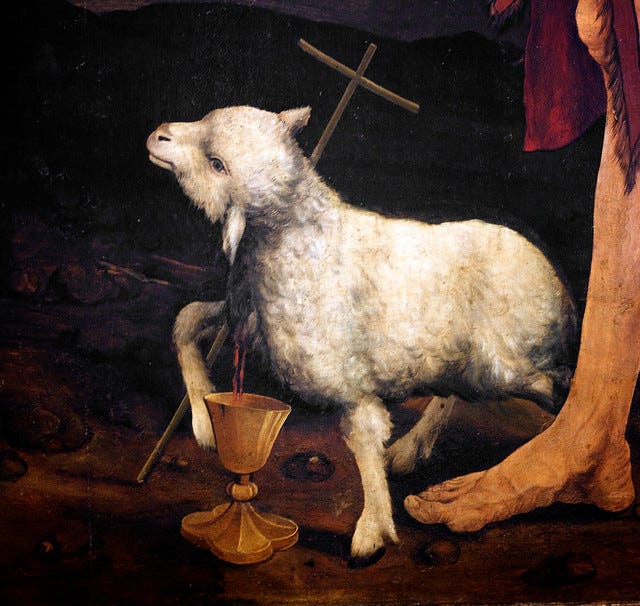
To begin with, the rider on the white horse is called Faithful and True, and his name is The Word of God. John is not depicting a literal event in the future, but giving us a symbolic reality about the present—John is depicting the glorious triumph of the Word of God (Jesus Christ). The one called The Word of God is not riding the red horse of war, but the white horse of triumph. Jesus doesn’t overcome evil by war, but by his word. This is how Jesus wages his righteous war. Jesus doesn’t wage war like the murderous beast of Rome; Jesus wages war as the slaughtered Lamb of God.
As Eugene Peterson says in Reversed Thunder (his excellent book on Revelation), “The perennial ruse is to glorify war so that we accept it as a proper means of achieving goals. But it is evil. It is opposed by Christ. Christ does not sit on the red horse, ever.”
After riding the peace donkey on Palm Sunday to contrast his peaceable kingdom with the violent empires of a pagan world, Jesus does not later contradict himself by riding a warhorse in an exaggerated imitation of Genghis Khan.
Perhaps John of Patmos is asking too much of modern readers, but he assumes we will keep in mind that Jesus is ever and always the slaughtered Lamb. As Richard Bauckham reminds us in his Theology of Revelation, “When the slaughtered Lamb is seen ‘in the midst of’ the divine throne in heaven, the meaning is that Christ’s sacrificial death belongs to the way God rules the world.”
Christ always rules from the cross, never from an Apache attack helicopter!
John stresses that Jesus reigns through self-sacrifice by depicting the white horse rider as wearing a robe drenched in blood before the battle begins. Jesus’ robe is soaked in his own blood. Jesus doesn’t shed the blood of enemies; Jesus sheds his own blood. This is the gospel! The rider on the white horse is the slaughtered Lamb, not the slaughtering Beast.
To further make his point, John tells us that the sword the rider uses to smite the nations is not in his hand, but in his mouth. This is not Caesar’s sword, but the word of God. The Revelator so desires that we not miss this point, that he comes right out and tells us, “and his name is called The Word of God.” It’s like when a political cartoon labels the symbol to make sure we properly identify it. The sword is not a sword; the sword is the word of God.
If we combine all of John’s creative symbols the message is clear: Jesus wages war by self-sacrifice and by what he says. Jesus combats evil by co-suffering love and the word of God. This is the righteous war of the Lamb.
Christians are called to believe that co-suffering love and the divine word are all Christ needs to overcome evil. A fallen world addicted to war does not believe this, but the followers of Jesus do…or should! If Jesus conquers evil by killing his enemies, he’s just another Caesar. But the whole point of John’s Revelation is that Jesus is nothing like Caesar! The war of the Lamb looks nothing like the war of the Beast. Jesus is not like Caesar; Jesus does not wage war like Caesar. To miss this point is to misunderstand everything the Apocalypse is trying to reveal! The war of the Lamb is the same war the Apostle Paul describes to the Corinthian church.
“We are human, be we don’t wage war as humans do. We use God’s mighty weapons, not worldly weapons, to knock down strongholds of human reasoning and to destroy false arguments. We destroy every proud obstacle that keeps people from knowing God. We capture their rebellious thoughts and teach them to obey Christ.” (2 Corinthians 10:3–5)
This is the kind of war that is symbolically depicted in Revelation with a rider on a white horse called The Word of God who wears a robe drenched in his own blood and wages a righteous war with a sword coming from his mouth.
This is not a literal war, this is a symbolic war. This is not a future war; Christ is waging this war right now. I know Christ is waging this war right now because I am among those who have been slain by the sword of his mouth and raised again to newness of life! Jesus slays me. He slays me with his divine word. And in slaying me, he sets me free. This is salvation. John the Revelator is showing us how Jesus saves the world, not how Jesus kills the world.
The book of Revelation is not where the good news of the gospel goes to die. The book of Revelation is where the good news of the gospel finds its most creative expression. Through inspired dreamlike images John the Revelator dares to imagine a world where the nightmare of endless war finally succumbs to the peaceable reign of Christ. And I, for one, believe in the vision John saw.
The kingdom of the world has now become the Kingdom of our Lord and of his Christ and he will reign forever and ever. -Revelation 11:15
Worthy is the Lamb!
BZ
P.S. This is a ten-year-old piece; but sadly it has gained a new and urgent relevance.
(The artwork is a detail from Ecce Agnus Dei by Matthias Grünewald, 1516)
===========
Individual Reflection
Where in your life are you currently part of a scapegoating pattern — whether as someone doing the blaming, someone absorbing it, or someone looking away?
Group Discussion — choose one:
Where do you find yourself most resistant to the idea that co-suffering love is actually more powerful than force?
What would it cost your community — practically, relationally — to move from scapegoating to liberation?
When you hear “the Lamb who was slain is the one who reigns,” does that feel like good news or like a category error?
Father Richard Rohr identifies the human impulse to solve problems by blaming others:
The human delusion seems to be this: We think someone else is always the problem, not ourselves. We tend to export our hate and evil elsewhere. In fact, this problem is so central to human nature and human history that its overcoming is at the heart of all spiritual teachings. Mature spirituality tries to keep our own feet to the fire—saying, just as the prophet Nathan did in convicting King David, “You are the one!” (2 Samuel 12:7).
Human nature always wants either to play the victim or to create victims—and both for the purposes of control. In fact, the second follows from the first. Once we start feeling sorry for ourselves, we will soon find someone else to blame, accuse, or attack—and with impunity! It settles the dust quickly, and it takes away any immediate shame, guilt, or anxiety. In other words, it works—at least for a while. So, for untransformed people, there is no reason to stop creating victims or playing the victim.
If we read today’s news, we see the pattern has not changed. Hating, fearing, or diminishing someone else holds us together, for some reason. The creating of necessary victims is in our hardwiring. Philosopher René Girard called this “scapegoat mechanism” the central pattern for the creation and maintenance of cultures worldwide since the beginning. [1]
It’s hard for us religious people to hear, but the most persistent violence in human history has been sacred violence, or more accurately, sacralized violence. Human beings have found a most effective way to legitimate their instinct toward fear and hatred. We imagine we are fearing and hating on behalf of something holy and noble like God, religion, truth, morality, our children, or love of country. It takes away our guilt. As a result, we can even think of ourselves as representing the moral high ground or as being responsible and prudent. It never occurs to most people that they can become what they fear and hate. It’s a well-kept secret. Without wisdom, we justify violent and even immoral actions for the sake of something honorable like “protecting the children.” [2]
Unless scapegoating can be consciously seen and named through concrete rituals, owned mistakes, shadow work, or repentance, the pattern will usually remain unconscious and unchallenged. The Scriptures rightly call such ignorant hatred and killing “sin.” Jesus came precisely to “take away” (John 1:29) our capacity to commit it—by exposing the lie for all to see. Jesus stood as the fully innocent one who was condemned by the highest authorities of both church and state (Jerusalem and Rome), an act that should create healthy suspicion about how wrong even the highest powers can be. “He will show the world how wrong it was about sin, about who was really in the right, and about true judgment” (John 16:8). [3]
Father Richard describes the scapegoat ritual that took place on Yom Kippur, the Jewish holy day of atonement:
The word “scapegoating” originated from an ingenious ritual described in Leviticus 16. According to Jewish law, on the Day of Atonement, the high priest laid hands on an “escaping” goat, placing all the sins of the Jewish people from the previous year onto the animal. Then the goat was beaten with reeds and thorns, driven out into the desert, and the people went home rejoicing. Violence towards the innocent victim was apparently quite effective at temporarily relieving the group’s guilt and shame. The same scapegoating dynamic was at play when European Christians burned supposed heretics at the stake, and when white Americans lynched Black Americans, and continues to this day. In fact, the pattern is identical and totally non-rational.
Whenever the “sinner” is excluded, our collective ego is delighted and feels relieved and safe. It works, but only for a while, because it is merely an illusion. Repeatedly believing the lie, that this time we have identified the true culprit, we become more catatonic, habitually ignorant, and culpable—because, of course, scapegoating never really eliminates evil in the first place. As long as the evil is “over there,” we think we can change or expel someone else as the contaminating element. We then feel purified and at peace. But it is not true peace, the peace of Christ which “the world cannot give” (see John 14:27).
Jesus became the scapegoat to reveal the universal lie of scapegoating. He became the sinned-against one to reveal the hidden nature of scapegoating, so that we would see how wrong even well-meaning people can be. Pilate, a representative of the state, and Caiaphas, the head of the temple, represent this pattern: Both find artificial reasons to condemn him (see John 16:8–11 and Romans 8:3).
In worshiping Jesus as the scapegoat, Christians should have learned to stop scapegoating, but we didn’t. We are still utterly wrong whenever we create arbitrary victims to avoid our own complicity in evil. It seems to be the most effective diversionary tactic. History has shown us that authority itself is not a good guide. Yet for many people, authority figures soothe their anxiety and relieve their own responsibility to form a mature conscience. We love to follow someone else and let them take the responsibility. It is a universal story line in history and culture.
With the mistaken view of God as a Punisher-in-Chief that most Christians seem to hold, we think our own violence is necessary and even good. But there is no such thing as redemptive violence. Violence doesn’t save; it only destroys all parties in both the short and long term. Jesus replaced the myth of redemptive violence with the truth of redemptive suffering. He showed us on the cross how to hold the pain and let it transform us.
=============
Individual Reflection
Where in your life right now is it most tempting to locate the problem entirely in someone else — and what might it cost you to look the other direction?
Group Discussion — choose one:
Where have you participated in — or quietly benefited from — a group’s need to find someone to blame?
What is the difference between the false peace that comes from expelling someone and the peace that holds the pain instead?
What does it do to your image of God to hear that there is no such thing as redemptive violence?
The Lord is my shepherd; I shall not want. He makes me lie down in green pastures: he leads me beside still waters; He restores my soul: he leads me in the paths of righteousness for his name’s sake. —Psalm 23:1–3 (NRSV)
While Psalm 23 is beloved for its message of consolation, Diana Butler Bass recounts how she was challenged to read it through the eyes of those who face poverty, food insecurity, injustice, and marginalization.
Psalm 23 a political tract?
I confess: I’ve never considered that possibility. But I took up … [the] challenge to read the psalm politically, with empathy toward a non-Western view. [1] The psalm’s central pivot is the line about paths and “for God’s sake.” The lines before lead up to that couplet—and the lines after flow from it….
In the Book of Common Prayer (the version I’ve read in worship and private prayer for forty years), the pivot reads: He revives my soul and guides me along right pathways for his name’s sake. In the King James version … that phrase reads: He restoreth my soul; he leadeth me in the paths of righteousness for his name’s sake.
I’ve heard scores of sermons about the “right pathways,” meaning that God guides us when lost and leads us on life’s journey. We can’t ultimately go astray. That’s pretty comforting….
And, of course, that is true. But it isn’t all.
Read Robert Alter’s version—a modern translation noted by scholars for its precision—and the pivot sentence contrasts sharply: My life He brings back. He leads me on pathways of justice for His name’s sake.” [2]
In the scriptures, right and righteousness are interchangeable with justice. But in North America? Well, not so much…. Very few middle-class church people would ever think of substituting justice for either word. Alter’s version, however, thunders justice as the pivotal word in the psalm.
Alter’s translation of Psalm 23:1–3 reads:
The LORD is my shepherd, I shall not want. In grass meadows He makes me lie down, by quiet waters guides me. My life He brings back. He leads me on pathways of justice for His name’s sake.
Butler Bass emphasizes the call to share our restored lives with others for the sake of justice:
The psalmist proclaims, This is the reality of the Lord’s government, the beloved community, over and against all oppression and exploitation. Through it, we humans are restored to what was always intended: My life He brings back; Our lives He brings back.
The renewed life, however, does not remain content in grass meadows or by quiet waters…. Instead, those who are citizens of this sacred realm are called forth on pathways of justice to make God’s name—God’s sabbath reign—knownthroughout the world.
“Meanwhile, for myself, I have only one desire, and that is the desire for solitude-to disappear into God, to be submerged in his peace, to be lost in the secret of His face.”
As an Enneagram 5, I am prone to living too often in my head.
I am also prone to believing my thoughts are more interesting than they really are.
Don’t get me wrong, some ideas are interesting and potentially worth sharing with people. (Or, at least, I think so!)
But it is important for me to remember that even if I do not have “brilliant deeds nor beautiful thoughts,” God still loves me infinitely and unconditionally.I do not have to earn one ounce of God’s love by any unique insights or shiny wisdom I might have stumbled across.
God can always do whatever God wants, and in one sense does not need our participation in the restoration of all things, but he chooses to include us in that project.
3.
“Thus, listening to sermons failed to give me what I wanted, and having had my fill of them without gaining understanding, I gave up going to hear public sermons. I settled on another plan-by God’s help to look for some experienced and skilled person who would give me in conversation that teaching about unceasing prayer which drew me so urgently.”
What I find interesting about this quote from the Russian spiritual classic The Way of a Pilgrim is that the Pilgrim says he is giving up on sermons. You wouldn’t think that, would you?
But I will admit I went through a similar season in my life as well.
There was a point when sermons did very little for me. Honestly, I am not embarrassed to say it. Sometimes sermons feel the need to overexplain a mystery to death, when it would be better to leave certain aspects of the faith wrapped in nuance. They also feel as though they rely on platitudes rather than inviting me into some deeper teaching.
So, in that season, I decided to start reading the old Christian mystics as if they were living mentors that I could sit down and talk with.
These included Bonaventure, Francis of Assisi, Pierre Teilhard de Chardin, Teresa of Avila, St. John of the Cross, Hildegaard of Bingen, Brother Lawrence of the Resurrection, George Herbert, Gregory of Nyssa, Athanasius of Alexandria, Origen of Alexandria, and so many others.
I don’t think anything else has had such a profound impact on my faith as to treat the old Christian tradition, regardless of denominational affiliation, as my personal mentors.
4.
“I’m not sure I have made this clear: self-knowledge is so important that even if you were drawn directly into heaven in prayer, I wouldn’t want you to relax your practices of humble and honest self-reflection.”
Yes, I am prone to overthinking and therefore will think about myself in more negative ways than positive, but I agree with Teresa that the world would be better if we could do that “honest self-reflection” more often.
5.
“There is indeed one great high priest, our Lord Jesus Christ. But he is not the high priest of priests, but the high priest of high priests…”
I have a volume of Origen’s writings that was compiled by Hans Urs von Balthasar. Although Origen was posthumously deemed a “heretic” for raising particular questions (not even for taking a final stance), everything I have read makes a lot of sense…
And I would argue that Origen seems more orthodox than many internet preachers.
That said, there is a certain poeticism to his saying that Jesus is not simply a high priest among the priests, but that Jesus is the High Priest of the high priests.
Old Testament scholar Walter Brueggemann describes how praying with the Psalms can be an act of solidarity with our universal humanity:
The Psalms, with few exceptions, are not the voice of God addressing us. They are rather the voice of our own common humanity—gathered over a long period of time, but a voice that continues to have amazing authenticity and contemporaneity. It speaks about life the way it really is, for in those deeply human dimensions the same issues and possibilities persist. And so when we turn to the Psalms it means we enter into the midst of that voice of humanity and decide to take our stand with that voice. We are prepared to speak among them and with them and for them, to express our solidarity with this anguished, joyous human pilgrimage. We add a voice to the common elation, shared grief, and communal rage that besets us all…. When we do, we shall find that the words of Scripture bring power, shape, and authority to what we know about ourselves. [1]
Exiled from Cuba, theologian Ada María Isasi-Díaz (1943–2012) found solace in Psalm 137:
When I first read Psalm 137, I remember resonating with most of what the psalm says; I remember feeling it could appropriately voice the pain I was experiencing being away from my country against my will. After the Cuban missile crisis in 1962 I realized that my absence from Cuba was to a be a long one. Shortly after there came a day when my visa status changed from “tourist”: I became a refugee. Psalm 137 became my refuge: “By the rivers of Babylon we sat and we wept when we remembered Jerusalem” (137:1).
I recall vividly the day I dared to mention to a friend how much I identified with Psalm 137. Jokingly she answered me, “Are you going to hang your guitar from a tree?”… They were incapable of understanding the sorrow of being away from la tierra que mi vió nacer (the land that witnessed my birth). At times, my friends would ask me to talk about Cuba. Those around me could not figure out why I, who love to sing, always seemed reticent about singing “Guantamanera,” the song that uses for its verses poems from the father of my country, José Martí. One of them says,
Yo quiero cuando me muera Sin patria pero sin amo Tener en mi tumba Un ramo de flores Y una bandera.
I want when I die without country but without master, to have on my tomb a bouquet of flowers and a flag.
So I kept saying to myself, “How can we sing Yahweh’s song in a foreign land?” (137:4) [2]
Brueggemann concludes:
The psalms are not used in a vacuum, but in a history where we are dying and rising, and in a history where God is at work, ending our lives and making gracious new beginnings for us. The Psalms move with our experience. They may also take us beyond our own guarded experience into the more poignant pilgrimages of our sisters and brothers. [3]
Waiting on Me means directing your attention to Me in hopeful anticipation of what I will do.It entails trusting Me with every fiber of your being, instead of trying to figure things out yourself. Waiting on Me is the way I designed you to live: all day, every day. I created you to stay conscious of Me as you go about your daily duties. I have promised many blessings to those who wait on Me: renewed strength, living above one’s circumstances, resurgence of hope, awareness of My continual Presence. Waiting on Me enables you to glorify Me by living in deep dependence on Me, ready to do My will. It also helps you to enjoy Me; in My Presence is fullness of Joy.
RELATED SCRIPTURE:
Lamentations 3:24-26 (NIV) 24 I say to myself, “The Lord is my portion; therefore I will wait for him.” 25 The Lord is good to those whose hope is in him, to the one who seeks him; 26 it is good to wait quietly for the salvation of the Lord.
Isaiah 40:31 (NIV) 31 but those who hope in the Lord will renew their strength. They will soar on wings like eagles; they will run and not grow weary, they will walk and not be faint.
Additional insight regarding Isaiah 40:31: Even the strongest people get tired at times, but God’s power and strength never diminish. He is never too tired or too busy to help and listen. His strength is our source of strength. When you feel all of life crushing you and you cannot go another step, remember that you can call upon God to renew your strength. Trusting in the Lord is the patient expectation that God will fulfill his promises in his Word and strengthen us to rise above life’s difficulties. Though your faith may be struggling or weak, accept his provisions and care for you.
Psalm 16:11 (NLT) 11 You will show me the way of life, granting me the joy of your presence and the pleasures of living with you forever.
Additional insight regarding Psalm 16: 8-11: This psalm (16:10 – “For you will not leave my soul among the dead or allow your holy one to rot in the grave.”) is often called the messianic psalm because it is quoted in the New Testament as referring to the resurrection of Jesus Christ. Both Peter and Paul quoted from this psalm when speaking of Christ’s bodily resurrection (see Acts 2:25-28, 31; 13:35-37).
Today’s Prayer:
Heavenly Father,
Teach us to patiently wait on You with hopeful anticipation of Your work in our lives. Help us trust You with every fiber of our being rather than relying on our own limited understanding. Your way is better than ours.
Waiting on You is the way You designed us to live—conscious of Your presence throughout each and every day. Grant us the promised blessings: renewed strength, hope above circumstances, and awareness of Your continual presence.
May our dependence on You glorify Your name, and may we find joy in Your presence, where fullness of joy abounds. You are a good God, and we are grateful.
How we read the Bible—as the literal word of God or as an expression of God’s people and their experience of God—makes a significant difference in who we think God is. Brian McLaren uses a psalm of Exile as an example:
The best known psalm of Exile is Psalm 137. While the beautiful poetry of the first part of the psalm is often read—and even became a popular hit in the musical Godspell—the ending of the psalm is often regarded as one of the ugliest passages of the whole Bible. It is seldom read aloud in most church settings because of its horrific content.
When lovers of the Bible glibly refer to the Bible as “The Word of God,” without also taking seriously the reality that the Bible is also the testimony of human beings in great pain, they can find themselves unintentionally rendering God a monster.
For example, read these closing lines of Psalm 137:7–9 in two different ways. First, read them as an expression of the agony and fury felt by displaced, dispossessed, oppressed people who are repeatedly dehumanized by their enemies and oppressors:
Remember, O Lord, against the Edomites the day of Jerusalem’s fall, how they said, “Tear it down! Tear it down! Down to its foundations!” O daughter Babylon, you devastator! Happy shall they be who pay you back what you have done to us! Happy shall they be who take your little ones and dash them against the rock!
Read in this way, this desire for horrific vengeance cannot be excused, nor can it be justified and attributed to God … but it can be understood. Of course, they would dream of and pray for revenge against the Babylonians who ransacked their country, kidnapped them, and now ask them to perform their native music for their captors’ entertainment. Again, when we understand their outrage, we feel their pain, but that doesn’t mean we justify it.
Now read the passage again, assuming that every word in the Bible should be read as God’s true opinion of a matter. Can you see why people who are taught to read the Bible in this way would get an idea of God as a heartless, vengeful, cruel monster?
Can you see how a wise and careful reading of Psalm 137 can help us read the whole Bible more wisely and carefully?
No, of course God does not take delight in the suffering and death of babies or the heartbreak of their bereaved parents. No! Of course not! If we see God as taking such perverse delight in violence, soon we will make ourselves in that God’s image.
Yes, reject that awful reading. But please, don’t stop there.
Ask this question: How can we stand with God and share divine loving kindness in the midst of all-too-real and all-too-often-repeated human cruelty?
We certainly do not tell the oppressed to shut up and submit to their ongoing dehumanization. Nor do we give them encouragement to act upon their revenge fantasies.
Instead, we dare to listen deeply, to understand and empathize, to put ourselves in the shoes of those who suffer and feel their fury and despair.
And we don’t stop there either: then we see how oppression and revenge, if we let them take over, create vicious cycles that grow uglier and more catastrophic. We imagine how in our future, we could repeat the worst mistakes of our past.
Then we are ready to take our stand: If we want to break out of the vicious, violent cycles of our history, we must develop a new way of reading the Bible, a new way of seeing, a new way of being.
That’s why, in a sense, Psalm 137 is like an eye exam: What we see there tells us how well we see.
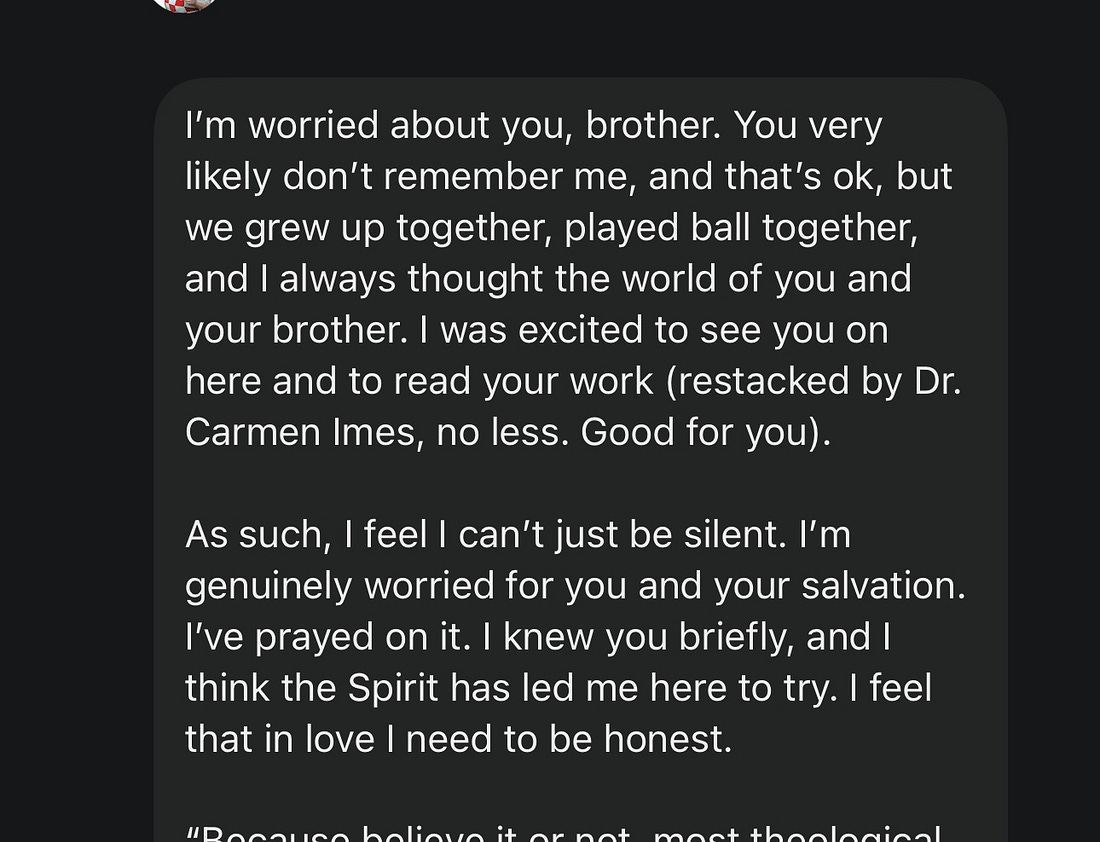
A few months ago a guy I grew up with sent me a message here on Substack. We played baseball together as kids. He said he used to think the world of me and my brother. He said he’d been praying about it and felt like he couldn’t stay silent. And then he told me he was genuinely worried about my salvation.
He wasn’t mean about it. That’s the part that made it so hard. He wasn’t trolling or picking a fight. He was a guy from my hometown who remembered me as a kid and believed with every fiber of his being that I was in spiritual danger. He told me my writing was misleading and manipulative. He told me I was bending scripture to fit the world. He quoted 1 Timothy and begged me to reconsider the path I was on. And then he signed off by saying he prayed for me to have the peace and love of Jesus.
I sat with that message for a long time, and I wasn’t angry. I was just sad. Because that message represents something that doesn’t get talked about nearly enough in deconstruction spaces. It represents grief. The slow, quiet kind of grief that settles in when you realize that people you love and respect are never going to be able to follow you to where you’ve landed. And that some of them will interpret the most honest season of your faith as evidence that you’ve lost it entirely.
When someone you love dies, the world makes space for your grief, at least for a little while. People bring food, they send cards, and your employer usually gives you a few days off. There kind of a cultural script for mourning the loss of a person and even though that script is inadequate in about a hundred ways, at least it exists.
But when you leave a faith tradition, there is no script. No casseroles show up at your door. Nobody sends a sympathy card that says “sorry you lost your entire theological framework and half your friendships in the process.” There is no bereavement leave for the death of your old belief system. And yet the grief is still very real. It is heavy and disorienting and it can last for years.
I trust me, I know, because I’ve lived it. Leaving evangelicalism cost me relationships I thought were permanent. It changed the way certain family members look at me. It has rearranged my social world in ways I’m still sorting out. And the hardest part wasn’t the people who got angry, it was the people who got sad. The people who looked at me with genuine concern and said they were praying for me (not to be passive aggressive) but because they sincerely believed I was walking away from God. That kind of love, the kind that comes wrapped in the theological certainty that you’re headed straight for destruction, is one of the most painful things I’ve ever experienced. Because you can’t argue with it and you can’t fix it. You can only grieve it.
The Bounce-Back Problem
And our culture has a very specific expectation about grief. You’re allowed to be sad for a little while. A few weeks, maybe a month. And then you should be getting back to normal. Moving on. Finding your new church. Rebuilding your community. Getting over it. The timeline varies depending on who you ask but the underlying message is always the same. Grief is just a phase. It has an expiration date. And if you’re still in it past that date then something is wrong with you.
The church is often even worse about this than the broader culture. There is an unspoken expectation in many Christian communities that grief should resolve quickly into worship. Or that sadness should transform into praise. That the appropriate Christian response to loss is to fast-forward to the part where God works it all together for good and to skip the long, messy, formless middle where nothing makes sense and the only honest prayer is “how long, O Lord?”
Nicholas Wolterstorff lost his twenty-five-year-old son in a mountain climbing accident. In his book Lament for a Son, he wrote something that stopped me cold. He said “every lament is a love song.” I think about that constantly now, because it reframes everything. Grief is not the absence of faith, or some kind of spiritual failure…
Grief is what love looks like when it has lost the thing it loves.
And we have to stop rushing people through that process.
Letting Grief Be Grief
Jesus never rushed anyone through their pain. When Mary and Martha were grieving Lazarus, he didn’t show up and immediately fix it. He wept with them first. He entered the grief before he entered the miracle, and I think the order matters more than we realize. Because it tells us something about the heart of God that all of our bounce-back theology misses entirely. God is not in a hurry to get past your pain. God is not standing at the end of your grief with a stopwatch, tapping his foot, wondering when you’re going to pull it together. God is sitting in it with you. For as long as it takes.
That message from my old baseball teammate still sits in my inbox. I haven’t deleted it. I probably won’t. It represents something I lost that I’m still learning to grieve. A version of belonging that doesn’t exist for me anymore. A world where everyone I grew up with was on the same page and the answers were simple and the people who loved you never had to worry about your salvation because you all believed the same things.
That world is gone for me, and I’m okay. But okay and grieving are not mutually exclusive. You can be further along than you’ve ever been in your faith and still feel the ache of what it cost to get there. Both things can be true at the same time. Lent makes space for that. The whole season is an invitation to stop fast-forwarding through the hard parts and just let them be hard for a while.
Try This
This week, give yourself permission to grieve something you haven’t fully grieved yet. Maybe it’s a relationship that didn’t survive your deconstruction. Maybe it’s a community you had to leave. Maybe it’s a version of God you used to believe in that you can’t believe in anymore. Whatever it is, don’t rush past it. Don’t slap a Bible verse on it. Don’t skip to the resurrection. (It’s not even Holy Week yet.) Just sit in the loss and let it be what it is. A love song for something that mattered to you. That’s one of the most faithful things you can do this Lent.
=======
Individual Reflection
What is one loss from your faith journey you haven’t fully grieved — and what has kept you from letting it just be what it is?
Group Discussion — choose one:
When you encounter the violent ending of Psalm 137, what does your gut reaction tell you about how you’ve been taught to read the Bible?
Who in your life looks at where you’ve landed spiritually with genuine concern — and what does it cost you to receive that kind of love?
Where have you felt the pressure — from others or yourself — to skip the hard middle and get to the part where it all works together for good?
This CO2- (Church Of 2) is where two guys meet each day to tighten up our Connections with Jesus. We start by placing the daily “My Utmost For His Highest” in this WordPress blog. Then we prayerfully select some matching worship music and usually pick out a few lyrics that fit especially well. Then we just start praying and editing and Bolding and adding comments and see where the Spirit takes us.
It’s been a blessing for both of us.
If you’d like to start a CO2, we’d be glad to help you and your partner get started. Also click the link below to see how others are doing CO2.Odds Monkey
Steve Harvey Introduces Jesus To A Secular Audience
About
Change this text in the admin section of WordPress
You are currently browsing the CO2MannaToday blog archives.