Beside the streams of Babylon, we sat and wept. —Psalm 137:1
Father Richard Rohr reflects on the fear, violence, and oppression that empires and nation-states continue to create, challenging us to respond:
Few would deny that there’s a palpable and growing fear and anger in our country. This fear is felt deeply by those who are most vulnerable. As a follower of both Jesus and Saint Francis of Assisi, my primary moral viewpoint is not centered on the wellbeing of those who are on top, but first in those who are at the bottom. For the vulnerable who have now been rendered more vulnerable, I lament and pray and promise to stand with you.
A time of national introspection must begin with self-introspection. Without our own inner searching, any of our quests for solutions and policy fixes will be based in shifting sands.
I suspect that we get the leaders who mirror what we have become as a nation. They are our shadow self for all to see. That is what the Hebrew prophets told Israel both before and during their painful and long exile (596–538 BCE).
Yet the Exile was the very time when the ancient Jewish people went deep and discovered their prophetic voices—Isaiah, Jeremiah, and others—speaking truth to power, calling for justice from their own political and religious leaders. Their experience laid the solid foundation for Jesus’s teaching and his solidarity with the poor and the outcast.
Maybe some of us have naively thought that we could or should place our loyalty in one political agenda or party. Remember, Yahweh told the people of Israel that they should never put their trust in “princes, horses, or chariots” (Psalms 20:7, 33:16–17), but only in the love of God.We must not imagine that political changes of themselves will ever bring about the goodness, charity, or transformation that the gospel offers the world.
We must not be afraid to allow conventional wisdom to fail and disappoint us. This is often the only path to wisdom. Imperial thinking focuses on judging who is worthy and who is unworthy, who is in and who is out. We who know about universal belonging and identity in God have a different form of power: Love (even of enemies) is our habitat, not the “powers and principalities,” the kingdoms of this world.
The present disorder is our time of exile and has solidified in us an urgent commitment to our work of action and contemplation. It seems needed more than ever before! Grounding social action in contemplative consciousness is not a luxury for a few, but surely a cultural necessity.Both the Christian religion and the American psyche need deephealing, and I do not say that lightly.
Only a contemplative mind can hold our fear, confusion, vulnerability, and anger and guide us toward love. Those who allow themselves to be challenged and changed will be the new cultural creative voices of the next period of history after this purifying exile.
____________________________________________
Sarah Young
Jesus Calling: March 24
This is a time in your life when you must learn to let go: of loved ones, of possessions, of control. In order to let go of something that is precious to you, you need to rest in My Presence, where you are complete. Take time to bask in the Light of My Love.As you relax more and more, your grasping hand gradually opens up, releasing your prized possession into My care. You can feel secure, even in the midst of cataclysmic changes, through awareness of My continual Presence. The One who never leaves you is the same One who never changes: I am the same yesterday, today, and forever. As you release more and more things into My care, remember that I never let go of your hand. Herein lies your security, which no one and no circumstance can take from you.
RELATED SCRIPTURE:
Psalm 89:15 (NLT) 15 Happy are those who hear the joyful call to worship, for they will walk in the light of your presence, Lord.
Hebrews 13:8 (NLT) 8 Jesus Christ is the same yesterday, today, and forever.
Isaiah 41:13 (NLT) 13 For I hold you by your right hand— I, the Lord your God. And I say to you, ‘Don’t be afraid. I am here to help you.
Today’s Prayer:
Dear Jesus,
In this season of our lives, You call us to let go – of loved ones, possessions, responsibilities, and the illusion of control. Yet, in the midst of these transitions, You invite us to find completeness in Your perfect and loving presence with peace that surpasses all of our understanding.
Help us, Lord, to rest in the light of Your love, knowing that in Your arms, we lack nothing. As we surrender our grip on what we hold dear, teach us to trust in Your care.
We find security in Your unchanging nature. You are the same yesterday, today, and forever. Your continual presence is our anchor amidst the storms of life that can bring sudden and unrelenting change.
Just as You hold us by our right hand, assuring us not to fear, help us to release our burdens into Your loving embrace. Grant us the grace to trust that You never let go of us, no matter the circumstance.
May we find the overflowing joy in worshipping You as we walk through life in the light of Your presence. Knowing that You are always with us, guiding us, and sustaining us. You are good, Father.
In the perfect name of Jesus, our constant and faithful companion, we pray. Amen.
CAC faculty member Brian McLaren offers a brief history of the Babylonian exile, a defining crisis in the biblical story:
It was about 800 BCE. The Israelites and Judeans had already survived so much. In addition to all the trouble within their respective borders—much of it caused by corrupt leaders—even bigger trouble was brewing outside. The two tiny nations were dwarfed by superpower neighbors, each of which had desires to expand. To the north and east were the Assyrians. To the east were the Babylonians, and to their east, the Persians. To the south were the Egyptians, and to the west, the Mediterranean Sea. How could Israel and Judah, each smaller than present-day Jamaica, Qatar, or Connecticut, hope to survive, surrounded in this way?
The northern Kingdom of Israel fell first. In 722 BCE, the Assyrians invaded and deported many of the Israelites into Assyria. These displaced Israelites eventually intermarried and lost their distinct identity as children of Abraham. They’re remembered today as “the ten lost tribes of Israel.” The Assyrians quickly repopulated the conquered kingdom with large numbers of their own, who then intermarried with the remaining Israelites. The mixed descendants, later known as Samaritans, would experience a long-standing tension with the “pure” descendants of Abraham in Judah to the south.
Judah resisted conquest for just over another century, during which Assyrian power declined and Babylonian power increased. Finally, around 587 BCE, Judah was conquered by the Babylonians. Jerusalem and its temple were destroyed. The nation’s “brightest and best” were deported as exiles to the Babylonian capital. The peasants were left to fill the land and “share” their harvest with the occupying regime. For about seventy years, this sorry state of affairs continued.
By 538 BCE, the Persian Empire allowed the exiled Judeans to return to the land and rebuild. They experienced new freedoms but remained under imperial rule:
How should they interpret their plight? Some feared that God had failed or abandoned them. Others blamed themselves for displeasing God in some way. Those who felt abandoned by God expressed their devastation in heart-rending poetry. Those who felt they had displeased God tried to identify their offenses, assign blame, and call for repentance. It was during this devastating period of exile and return that much of the oral tradition known to Christians as the Old Testament was either written down for the first time, or reedited and compiled. No wonder, arising in such times of turmoil and tumult, the Bible is such a dynamic collection! [1]
Psalm 42 expresses the pain of exile:
I say to God, my rock, “Why have you forgotten me? Why must I walk about mournfully because the enemy oppresses me?” As with a deadly wound in my body, my adversaries taunt me, while they say to me continually, “Where is your God?”
Why are you cast down, O my soul, and why are you disquieted within me? Hope in God, for I shall again praise him, my help and my God. (Psalm 42:10–11)
Exile: An Ongoing Reality
Monday, March 23, 2026
Brian McLaren considers the stories of empire and exile that appear in the Bible and continue to this day:
If you ask Jewish people what the central story of their Bible is, they will usually say the Exodus, the story of their refugee ancestors being enslaved by the rulers of the Egyptian Empire, until God liberated them and led them to freedom. Although historians and archeologists argue about how much of the story is historical and how much is literarily enhanced or fictional, biblical scholars date the story somewhere between 1500 and 1200 BCE.
Sadly, the non-fictional enslavement and mistreatment of refugees has happened too many times and to too many people over the centuries.
If you ask what the second most important biblical story in the Hebrew Scriptures is, many will say the Exile, when large numbers of Jewish people were taken to Babylon where they were made to serve the elites of the Babylonian Empire.
And sadly, mass deportation and domination of Indigenous peoples have happened too many times and to too many people over the centuries: There have been too many Trails of Tears, too many Nakbas, too many pogroms and internment camps over the centuries, right up until today.
Together, Exodus and Exile remind us that the same empires that produce luxuries for those at the top of the social and economic pyramid also produce great suffering for those at the bottom. And just as the gods of the emperors are portrayed as legitimizing their rule, for those at the bottom, God is seen as their only hope for liberation. In fact, I often propose that the English words liberate and liberation would be better translations for the Hebrew and Greek words commonly translated as save or salvation.
Many of the psalms are intense poems of pain from the Exile period. One of the best known is Psalm 137. You feel the pathos as the Judean exiles feel they have been dehumanized, turned into entertainment for their oppressors:
By the rivers of Babylon— there we sat down, and there we wept when we remembered Zion. On the willows there we hung up our harps. For there our captors asked us for songs, and our tormentors asked for mirth, saying, “Sing us one of the songs of Zion!” How could we sing the Lord’s song in a foreign land? If I forget you, O Jerusalem, let my right hand wither! Let my tongue cling to the roof of my mouth, if I do not remember you, if I do not set Jerusalem above my highest joy. (Psalm 137:1–6)
In this psalm, the refugees in exile refuse to sing. They refuse to sacrifice their own dignity and humanity for the entertainment of their oppressor. Their pain echoes through the centuries and asks us: Where are people experiencing exile today? Dare we humanize them and feel their pain? Dare we take their story seriously—even if doing so offends the elites of today’s empires of violence and domination?
=============
Individual Reflection: Think of one specific community experiencing exile or forced displacement today. What has kept you from fully entering their story — is it distance, overwhelm, ideology, or something harder to name? What might it cost you to stop looking away?
Group Discussion — choose one:
Where are you currently being asked to sing a song you don’t have?
Who are the exiles you’ve been trained not to humanize?
What would it mean for you personally if liberation and salvation were the same word?
After living with a violent father, psychotherapist James Finley found himself retraumatized by an abusive priest as a young man. Finley shares how Jesus met him in his deep shame and suffering:
I was now a young man living at the edge of a precipice of knowing that if God loved me and cherished me as real and lovable in his eyes, I could not pretend that I was not the real person God loved and called me to be….
It was in the midst of this road to nowhere that I began to sense that God was inviting me to give up trying to overcome my fear and to instead bring my feelings of fear and shame to Jesus. I was already committed in my heart to follow the directive of Saint Benedict in his Rule that the monk should “prefer nothing to Christ.” But at this point I needed to go beyond a theological understanding of the universality of Christ by praying my way into the deathless presence of Jesus.
The felt need to pray in this way led me to imagine, as in a kind of waking dream, that I was alone on a moonlit night in the garden where the Gospels tell us Jesus would go to spend whole nights alone in prayer. In my mind’s eye I could see and feel myself searching here and there, looking for Jesus so that I might share with him how powerless I was to be true to who I sensed he was calling me to be….
Then suddenly, looking this way and that, I saw Jesus sitting alone in the moonlight at the edge of a clearing. I walked across the clearing and knelt at his feet. I could feel his hand on my shoulder as I leaned in close to whisper in his ear, revealing the burdens of my shame-based weakness and fear.
Having poured out all that my wounded and hurting heart was moved and able to say, Jesus drew me in close and whispered in my ear three words that set me free, words that still echo inside me to this day. I heard him whisper: “I love you!”
Dazed and amazed in being so unexplainably loved, the spirit within me let me know what both Jesus and I were waiting to hear me say. So I leaned in close and whispered my secret “I love you” to Jesus. And there in that instant there was the realization between us that the matter was settled once and for all. The matter being that the good news of God’s love for us is never measured by our ability to be true to who we know in our heart God is calling us to be. For the sole measure of God’s love for us is the measureless expanse of God’s merciful love, permeating us and taking us to itself in the midst of our faltering and wayward ways.
==============
Friday 5. John Chaffee
1.
“God is self-giving, radically forgiving, co-suffering love.”
Brad is one of the most relatable theologians today. I get the sense from him that he is a well-rounded person who has navigated the deconstruction process well, emerged on the other side, and become one of the more grounded and self-aware educators on the Christian faith.
This definition of God from him is something I muse over occasionally when I am driving in my Jeep.
2.
“People ruin their lives by their own foolishness and then are angry at the Lord.”
I guess we all do it. We often want to find someone else to blame for our problems rather than taking responsibility ourselves.
Like any loving parent, God does not protect us from the consequences of our actions. Remember in Galatians? Where Paul says that we will “reap what we sow”? God is not some cosmic being who protects us from hitting rock bottom. If anything, it might be the best thing for us in the long run to hit that rock bottom.
(And, at that point, how interesting that some people thank God that they are finally able to take ownership of their actions and turn their life around!)
3.
“It is through our fulfilling of the commandments that the Lord makes us dispassionate; and it is through His divine teachings that He gives us the light of spiritual knowledge.”
The early Church had an understanding of “dispassion” as a virtue.
It is a word that we do not use much today, but it carries within it some profound wisdom. Dispassion is a certain detachment from our desires that bring us suffering. (Dis- meaning against, and Passio- meaning suffering). The early Church quickly came to understand that it is our disordered loves/passions that cause us suffering.
For this reason, we must practice this virtue or habit of dispassion, to learn to have the right kind of detachment from outcomes and to allow our ego the humiliation of not always getting its way.
The Ten Commandments, then, are simply the starting point for us to learn how to cultivate dispassion and to come to realize that it is in our best interests not always to get our way.
4.
“Those who would know much, and love little, will ever remain at but the beginning of a godly life.”
I am slowly re-reading Søren Kierkegaard’s Works of Love. It is his treatment and analysis of Christian love, examining “You shall love your neighbor as yourself” from every possible angle.
When I first read Works of Love, it was a punch in the face. As a head-oriented person who loves to read and think deeply about things, it was a shock to realize that even reading a book about love does not necessarily translate to loving other people. It was a safe way to engage my brain without having to interact with others. It was in that moment that I realized my tendency to avoid feelings by going into academic thought.
I want to think that, over time, I have become a little less head-oriented as a person and have been able to grow a little bit past “beginner Christianity” and actually love people.
Martin Buber’s work has been an influence on me for some time, ever since I discovered his book, I and Thou.
The dichotomy of Sacred and Profane is something that makes sense during one stage of faith, but not so much in another stage. We treat Sacred things as special and as things to be protected or revered, but then treat Profane things as things to be avoided, discarded, and the like. But at a later stage of faith, it’s more so that there are things that are Sacred and other things that need to be made Holy Again.
The possibility of making something Holy Again is exciting to me. It is not a passive sitting back, and it is not the flippant discarding of something “profane.” To make things Holy Again is a mission, it is a calling, it is to join God in the Christ Project of the Reconciliation of All Things.
Richard Rohr points out how honor-and-shame systems play out around and within us today:
One of the best ways to study Scripture is to use the lens of cultural anthropology; in other words, to learn about the social setting in which Jesus lived and the problems with which he was dealing. What we find is that the culture of his time was overwhelmingly dominated by an honor-and-shame system largely based on externals. In truth, we still live that way in the United States and Western Europe, although we pretend we don’t.
Honor and shame are what we would call ego possessions, personal commodities that we can lose or gain. We don’t have them naturally, so we have to work for our honor and then show it off and protect it. We have to deny our shame, which is now what we would call the shadow self. At Jesus’s time in history, and frankly with many today, there is no inherent sense of the self, no sense of natural dignity that comes from within.
Religion at its best and most mature is exactly what is needed for this problem. Without healthy religion and psychology, we will have no internal or inherent source for our own dignity and positive self-image, no “stable core.” Instead, we are driven to find our status and our dignity externally—by what we wear, our job title, by how much money we have, what car we drive, or even by how much “good” we do. That’s a pretty fragile way to live. We are constantly evaluating, “How am I doing? How am I looking?”
A transformed believer knows that their stable core dignity is something that God gratuitously gives from the moment of conception. Each of us is inherently, objectively, totally, and forever a child of God. We cannot gain or lose that by any achievement or failure whatsoever. God doesn’t participate in the honor-and-shame system.
In most honor-and-shame systems, which are almost always grounded in culturally male values, a “true man” always seeks the best, the top, and the most in terms of roles, power, status, and possessions. Jesus tried to free us from all these traps. Throughout the Gospels, we find numerous teachings promoting downward mobility. The most familiar of these may be, “The last shall be first, and the first shall be last” (Matthew 20:16), and Jesus’s consistent honoring of the least, the outsider, the sinner, and the physically or mentally challenged.
Some form of the honor-and-shame system is seen in almost all of history. In such a system, there is immense social pressure to follow “the rules.” If a person doesn’t follow the rules, they are not honorable and no longer deserve respect. And anyone who shows such a “shameful” person respect is also considered dishonorable.
Jesus frequently and publicly showed respect to “sinners” (see John 8:10–11) and even ate with them (see Luke 19:2–10; Mark 2:16–17). In doing so, he was openly dismissing the ego-made honor-and-shame system of his time—and ours.
=============
The Freedom of Hiddenness
by Henri Nouwen
Adapted excerpt (from Nouwen’s writings on hiddenness and humility):
“Our greatest temptation is to do good in order to be seen. But Jesus calls us to a different way—the way of hiddenness.
In a world that rewards visibility, recognition, and success, we are invited to live from a place where we do not need to prove anything.
When we can act without needing affirmation, we begin to trust that we are already loved.
The question is not ‘How am I perceived?’ but ‘Am I resting in the love of God?’”
______________________________________________
Jesus Calling: March 19
I speak to you from the depths of your being. Hear Me saying soothing words of Peace, assuring you of My Love. Do not listen to voices of accusation, for they are not from Me. I speak to you in love-tones, lifting you up. My Spirit convicts cleanly, without crushing words of shame. Let the Spirit take charge of your mind, combing out tangles of deception. Be transformed by the trust that I live within you. The Light of My Presence is shining upon you, in benedictions of Peace. Let My Light shine in you;don’t dim it with worries or fears. Holiness is letting Me live through you. Since I dwell in you, you are fully equipped to be holy. Pause before responding to people or situations, giving My Spirit space to act through you. Hasty words and actions leave no room for Me; this is atheistic living. I want to inhabit all your moments–gracing your thoughts, words, and behavior.
RELATED SCRIPTURE: Romans 8:1-2 (NLT) Life in the Spirit 8 So now there is no condemnation for those who belong to Christ Jesus. 2 And because you belong to him, the power of the life-giving Spirit has freed you from the power of sin that leads to death.
Colossians 1:27 (NLT) 27 For God wanted them to know that the riches and glory of Christ are for you Gentiles, too. And this is the secret: Christ lives in you. This gives you assurance of sharing his glory. 1st Corinthians 6:19 (NLT) 19 Don’t you realize that your body is the temple of the Holy Spirit, who lives in you and was given to you by God? You do not belong to yourself,
Author and CAC team member Cassidy Hall reflects on the cost of making choices out of shame and the “toxic silence” it creates:
For over five years, I actively participated in one of the most toxic silences of my life. I was in a romantic relationship with someone who wouldn’t publicly date me because they weren’t open about their sexuality. At the mercy of someone else’s comfort—or lack thereof—I participated in a silencing of myself in public places, around family members, with friends, at work, even at the grocery store…. This kind of silence, brought on by shame, creates long-lasting damage and knots to be untied for years to come. Silence where love cannot prevail is a place of toxicity, a place of stunted existence.
Hall describes the positive effects of “loving silence” cultivated through contemplative practice:
We need to name toxic silence as the silence that causes harm, shame, minimization, and damage to our world. And we need to name loving silence as the silence that is generative and creative, a silence that deepens our unity with self and others—the kind of silence that cultivates a more expansive and loving world….
When I finally stepped away from that relationship’s hamster wheel of toxic silence, I began to see how I had silenced other parts of myself. Beyond the ways I was hiding my sexuality, I also hid parts of myself informed by intuition—places of creativity and aliveness, places of openness and community, places of clarity and calm—ultimately the places where a loving silence thrived….
In the Christian context, the toxicity of silent bystanders creates and feeds countless acts of violence: the sexual abuse in many church settings and its continuation through empty apologies; Christianity’s lack of reckoning with its history of colonization; denominations’ refusal to honor and elevate the leadership and dignity of women, people of color, refugees, people with disabilities, and people from other marginalized communities; churches filling with Christian nationalism and white supremacy culture; the countless times the silent acceptance of bad theology has caused an LGBTQIA+ person to hate or harm themselves; and more. This is the silence of harm, violence, shame, and toxicity….
Toxic silence is embedded in the fabric of our daily lives…. Yet a [contemplative] loving silence can also be pursued, and we can seek and find it even in the chaos of our days. Sometimes it seeps in with our efforts to repeat an internal mantra or take an intentional pause, and other times it pours in like the colorful morning light through the east-facing window. This is the contemplative silence I continually seek and practice. This silence regenerates, regulates, allows for the emergence of loving presence and action. The more we engage in the silences that aren’t toxic—the beautiful, loving, and infinite possibilities of silence—the more we encounter silence as a creative, generative force and not a destructive one.
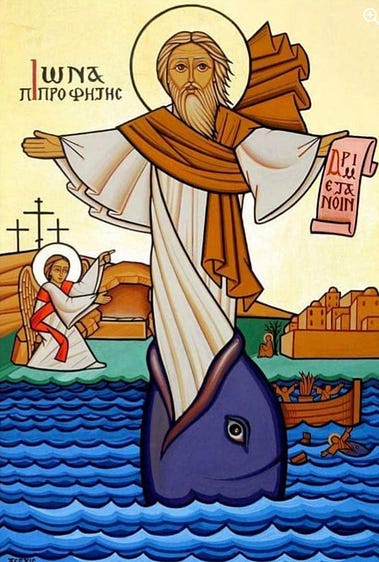
I was grateful for another fascinating discussion with Pete Enns in my “Peace and Violence in the Old Testament” class today at SSU/JFI. One intriguing topic was around legend vs. history in books such as Jonah.
Jonah is a wild ride. I love that book and have some opinions.
Let’s start with a caveat, echoing Pete’s humility. I’m fairly convinced of many things I don’t actually know for a fact to be true. Convictions I don’t feel the need to prove to myself or others with certainty. When it comes to biblical interpretation, I certainly don’t require my friends, colleagues, or students to agree with me. So I won’t impose a theory of Jonah on others as dogma. So I present these thoughts as a thoughts and as a fellow learner.
Is the Person or Book of Jonah History?
One common question: When the NT preachers or authors (Jesus and Paul especially) reference OT characters like Adam or Jonah, did they think they were historical figures? And if they weren’t historical stories, does that negate their argument? And when Jesus associates his resurrection with ‘the sign of Jonah,’ what if Jonah didn’t literally rise from the dead? Even if the story were historical, the prayer from the sea creature still seems obviously poetic. In fact, I don’t know any conservative scholar (even literalists) who argue that Jonah died and was resurrected—even though the song reads that way.
Here is the text from Jonah to which Jesus refers:
Jonah 2:3, 7 “I cried in my affliction to the Lord, my God, and He heard my voice; out of the belly of *hades* [not just the sea creature]: You heard the cry of my voice. I descended into the earth, the bars of which are *everlasting barriers* [supposedly!]; YES let my life ascend from corruption, O Lord, my God.”
Jesus calls this the sign of Jonah. That he would descend to hades and ascend again, puked out from its embittered belly, its so-called *everlasting* [αιώνιοι!!] barred gates be damned… a great text to show how ‘eternal hades’ is undone by the Resurrection).
I don’t think Jesus needs to take Jonah’s poetry literally to make his point about the resurrection. And if Jesus doesn’t need to take Jonah 2 literally, do we need to read the book historically?
Some go so far as to say that if Jonah (or Eden, or Noah, etc.) is a Jewish moral legend, that undercuts my belief in Jesus’ actual resurrection. Does it?
The More-than-Literal Point
I was once very into apologetics (mistaking it for evangelism) and this was all very troubling. I wasted a lot of time trying to find biological evidence of a fish that could swallow a man and spit him out alive for three days. Meanwhile, I missed the more- than-literal point that God is making through Jonah. Which is? That the Jewish revelation that God is gracious, compassionate, slow to anger, and abounding in lovingkindness extends even to our most hated enemy. And at the time, Assyria was at the top of the list. I was inclined to play my apologetics games far more than taking up the cross of loving my enemy. Just like Jonah.
Now, whether to read the story as literal history… we can. But I don’t think we need to be faithful. Whatever Jesus thought about the story, he was already reading the song creatively as poetic prefigurement (foreshadowing his resurrection) to make his point. I see no problem with that. Could Jesus’ point be this simple?
“Just as in the Jonah story, where the song from the sounds like a resurrection, that language anticipates something surprising I’m about to do in real life.”
It would be a little like me saying to my son (a big Lord of the Rings fan),
“I am going to be at your apartment next month, on this date, for sure. Count on it. Just as Gandalf showed up at dawn for the Battle of Helm’s Deep, expect me to arrive at your place Tuesday morning.”
I’m symbolically referencing a fictional story my son knows and loves. I’m doing so symbolically to illustrate my assured and actual arrival.
He gets the reference.
He does not feel the need to remind me that the LOTR is not historical.
The reference does not raise any doubt that my arrival will happen as promised.
Whether the Jonah is history or legend has no impact on the promise.
But neither would I feel any need to prove Jonah IS fictional.
This is where we could learn from Jewish rabbis today. Those I’ve engaged roll their eyes at Christian modernists (liberal or conservative) who obsess over what ‘really happened.’ At last, the right use of the phrase “moot point.”
On Shrines
One student wisely brought up shrines. They are an excellent illustration.
Yes, there is a tomb of Jonah. My student had been there. I haven’t. But I have been to the tombs of the patriarchs at Hebron (Abraham, Sarah, Isaac, Rebekah, Jacob, and Leah). And I’ve also been to the resting place of Mary the Mother of Jesus… both shrines (Gethsemane and Ephesus). I felt the holiness of accumulated devotion in those spaces. But I’m not at all sure that they were buried there. And I don’t need to be. As shrines to their memory, they tell a story. And over time, they have become sacred space where we can experience the beauty and power of their lives (or at least their story).
My Shift
So a shift happened in me along the way. It didn’t occur overnight. But as a young Evangelical with a modernist bent toward literalism, I feared (and was taught to fear) that if I discovered the earth was over 7000 years old, or if the Garden of Eden isn’t somewhere in Iraq, or if Noah’s ark didn’t actually sit on Ararat, or if Job and Jonah were legends, I would diminish or even lose my faith. The motto was, “If the waters did not cover Everest, Christ is not risen.”
No. That doesn’t follow. And weirdly, I didn’t lose my faith—only my ill-gotten certitude. Even better, God got bigger and more mysterious and filled me with more and more wonder … and the Bible became a more intriguing adventure and far richer treasury … and my trust grew dramatically when I didn’t have to believe God slaughtered all those people across the Bible’s pages. The barriers to experiencing Scripture as a place of encounter and communion with God were removed.
And just as importantly to me, when my dear Baptist mom sits in her armchair reading these stories for strength, comfort and encouragement, believing she is immersed in the Word of God, now I know she is. I don’t have to mess with that experience because that IS how the Bible is to be read—as a venue for encounter and communion with and by the Spirit of Christ.
Did Jonah happen? I don’t know. Is Jonah true? Absolutely.
=========
Individual Reflection Hall talks about how stepping out of one silence revealed other places she’d been hiding. Where have you been living in a silence that feels like safety but is actually a slow shrinking — and what part of yourself has been waiting on the other side of it?
Group Discussion Jersak says he didn’t lose his faith when he loosened his grip on literalism — he lost his “ill-gotten certitude,” and God got bigger. Where has your own faith required you to give something up that you thought was holding it together — and what did you actually find when you let it go?
Theologian Yolanda Pierce grew up in a church that offered her a sense of belonging. She grieves that churches often fail to follow Jesus’s example of welcoming and including everyone:
I grew up in [a Holiness-Pentecostal] church, and in the space of those wooden pews, which were lovingly dusted and polished by the church mothers, my gifts were affirmed and room was made for my talents….
Itis only with an adult’s deep gratitude that I can appreciate a space that never shamed me for what I couldn’t do well, never humiliated me for my failures, and also managed to extract gifts I didn’t even know I had. Not a single soul told me that I sounded like a hoarse frog when I sang. No one told me that I missed a line in my Easter speech.… I was simply aware that I could try anything in this church and it would be a safe space to land.
So it grieves my spirit that so many churches, so many religious spaces, have been sites of humiliation and shame for individuals and groups. I mourn that a place that taught a little Black girl that she could go to a college no one had ever seen before is the same place that tells someone else they are going to hell for who they love or who they marry. I lament the private and public humiliations suffered by those whose truths and identities are mocked from the pulpit. I grieve with those whose humanity, vocational calling, or salvation seems under debate by way of narrow-minded sermons and poor biblical exegesis….
These hierarchies, in which those with power and privilege—or those who simply wield the microphone—shame and blame others and reinforce their “superior” social standing, diminish the radical equality God promises in places like Galatians 3:28. These hierarchies fail to recognize that we are all one in Christ Jesus and that our work as Christians is to exalt God, not to shame our neighbors….
I grieve that a place that loved me and propelled me to a rich, full life has been a space of condemnation and castigation for others.
By relinquishing the tools of shame, we become God’s beloved community:
Here is the holy lesson that I have learned: there is no progress unless the wounded among us—those broken in heart and bruised in spirit—have space to tell their stories and share their burdens. Justice is only possible if the ones cast outside of the camp, the city, or the church are lovingly brought back into a changed and transformed community. The discarded and forsaken must be given the lead if we are to move forward in building God’s beloved community…. We build a new foundation for justice and love by releasing the power of the tools of shame and humiliation used by those who try to break our souls. After all, is it progress if we leave the most vulnerable behind?
==============
Thoughtful faith, progressive theology, and a gospel that’s still good news.
Everybody has an opinion about everything now. And not just an opinion but an urgent, fully formed, publicly stated opinion that needs to be shared within the first fifteen minutes of any event happening anywhere in the world. A politician says something controversial and within seconds your feed is a wall of hot takes. A celebrity makes a statement and suddenly everyone you know is a cultural commentator. A tragedy happens and before the facts are even clear there are already a thousand threads telling you exactly what it means and who is to blame and what you should think about it.
We are drowning in words. And I don’t think most of us realize how much it’s costing us.
I read somewhere recently that the average American consumes somewhere around thirty-four gigabytes of information per day. I don’t even know what that means exactly but it sounds like way too much. We wake up and reach for the phone before our feet hit the floor. We fill the car with podcasts. We scroll through lunch. We fall asleep to Netflix. Every available moment of silence gets stuffed with content and noise and opinion and commentary until there is literally no space left in the day where we are just quiet. Just still. Just existing without someone else’s words in our heads.
And the church has bought into this completely. Pastors feel the pressure to make public statements about every cultural moment within hours of it happening. If you don’t post your take fast enough, people assume you either don’t care or you’re on the wrong side. Social media has turned ministry into a never-ending press conference where silence is interpreted as complicity and thoughtfulness is mistaken for cowardice. The hot take has replaced the sermon as the primary unit of pastoral communication and I think we’ve lost something enormous in the exchange.
My Commute
This Lent I made a commitment that sounded simple and turned out to be one of the hardest things I’ve done in a while. I decided to drive to and from work in complete silence. No podcasts. No music. No phone calls. No audiobooks. Just me and the road and thirty minutes of nothing each way.
The first few days were brutal. I’m not exaggerating. The silence felt physically uncomfortable, like an itch I couldn’t scratch. My hand kept reaching for the phone. My brain kept racing to fill the gap with something, anything, because apparently I have trained myself over the years to be incapable of sitting in a quiet car without external stimulation. That realization alone was worth the experiment.
But somewhere around the end of the first week something started to shift. The noise in my head began to quiet down. Not all at once and not completely, but enough that I started to notice things I hadn’t noticed before. Ideas I didn’t know I was carrying. Convictions I’d been too busy to feel. Creative thoughts that had been waiting patiently for a gap in the noise to slip through. Some mornings the Holy Spirit showed up in that silence in ways that genuinely surprised me. Not in a dramatic, clouds-parting kind of way. More like a quiet nudge. A thought I didn’t generate on my own. A gentle correction I probably would have missed if I’d had a podcast filling the space instead.
Five hours a week. That’s what an hour of silence a day during the work week adds up to. And I can tell you honestly that those five hours have been more formative than most of the content I’ve consumed in the last year, because it turns out you can’t hear much of anything when you never stop talking.
The Ministry of Shutting Up
James 1:19 might be the most ignored verse in the entire New Testament. “Everyone should be quick to listen, slow to speak, and slow to become angry.” Quick to listen. Slow to speak. Read that again and then open any social media platform and notice how completely we’ve inverted that instruction.
We are quick to speak, slow to listen, and angry about everything all the time.
We have built an entire culture around the exact opposite of what James is telling us to do and then we wonder why everything feels so exhausting and fruitless.
Henri Nouwen understood this. He wrote that “silence is the home of the word” and that “without silence, the word loses its power.” I’ve been sitting with that idea during these quiet commutes and I think he’s right in a way that goes deeper than just personal devotion. Our words have lost their power because we’ve multiplied them beyond all reason. We speak so much and so fast and so constantly that nothing we say carries weight anymore. Everything is content. Everything is a take. Everything is noise piled on top of noise until the signal is completely buried.
Nouwen spent significant time living in monastic communities and what he discovered there wasn’t that monks had figured out how to escape the world. It was that they had figured out how to be present in it. Silence wasn’t just the absence of something, it was the presence of something. It was the space where God’s voice could actually land because someone had finally stopped talking long enough to hear it.
What Silence Isn’t
I want to be careful here because I don’t want to over-spiritualize this. Not every silent commute ends with a divine revelation. Some mornings I just drove to work and thought about what I was going to have for lunch. And that’s fine. Silence doesn’t have to be productive. It doesn’t have to result in a spiritual breakthrough or a creative epiphany or a moment of profound clarity. Sometimes silence is just silence. And in a world that demands constant output and constant engagement and constant noise, just being quiet for thirty minutes is a radical act all by itself.
But I will say this. The days when something does break through are the days that remind me why this matters. There is a version of my life where I fill every available second with sound and stimulation and never once create enough space for God to get a word in. I’ve lived that version. Most of us have. And it’s exhausting in a way that has nothing to do with physical tiredness and everything to do with spiritual depletion.
You can be busy for God and completely deaf to God at the same time.
I know because I’ve done it.
Try This
This week, find your silence. You don’t have to join a monastery or go on a retreat or sit cross-legged on a cushion for an hour. Just pick one space in your day that you normally fill with noise and leave it empty. The commute. The morning coffee. The walk to pick up the kids. Whatever it is, let it be quiet. Don’t fill it. Don’t optimize it. Just sit in it and see what happens when you give your soul a few minutes without words.
You might hear nothing. You might hear everything. Either way, you’ll be practicing something the church has known for two thousand years that our culture has almost entirely forgotten.
Sometimes the most faithful thing you can do is close your mouth and open your ears.
===========
Individual reflection: Think of a space in your life — a relationship, a community, a season — where you were free to fail without being shamed. What did that freedom make possible in you that you couldn’t have accessed otherwise?
Group discussion: Pierce grieves that the same community that made space for her has shut others out. Stringer suggests we’re often too noisy to hear the people we’ve marginalized. Where do you see those as the same problem — and what would it actually cost us to practice the silence that makes room for those Pierce calls “the discarded and forsaken”?
Father Richard Rohr identifies how Jesus challenged the strict laws of his day that governed what was “honorable” and what was not:
In Jesus’s time, the very architecture of the temple revealed in stone what Jesus was trying to reform. The actual design of the building seemed to protect degrees of worthiness, as immature religion often does. At the center stood the Holy of Holies, which only the high priest could enter on one day a year. This was surrounded by the court of the priests and the Levites, which only they could enter. Outside that was the court for ritually pure Jewish men.
Jewish women had access only to the outermost court of the temple, although during their childbearing years, their entrance to that court would be limited because of religious beliefs about blood and ritual purity (see Leviticus 15:19–30). Outside the entrance to this court, a sign warned any non-Jewish people that to enter would be punishable by death.
In the temple, we find structured in stone something all religions invariably do: create insiders and outsiders. Jews defined all non-Jews as “gentiles”; some Catholics still speak of “non-Catholics.” Almost everybody seems to need some kind of sinner or heretic against which to compare themselves. Judaism is an archetypal religion, and illustrates a pattern that is replicated in almost all religions.
On some level, we all create “meritocracies” or worthiness systems and invariably base them on some kind of purity code—racial, national, sexual, moral, or cultural. This material makes up much of Leviticus and Numbers, and also is the compulsion of almost every Christian denomination after the Reformation. The pattern never changes because it’s the pattern of the fearful and over-defended ego.
Jesus was a radical reformer of religion, in large part because he showed no interest in maintaining purity systems or closed systems of any kind. They only appeal to the ego and lead no one to God. Jesus actively undercut these systems, even against his own followers when they wanted to persecute others (see Luke 9:49–56). He showed no interest in the various debt and purity codes of ancient Israel, which are the religious forms of power and exclusion. In fact, Jesus often openly flouted many of the accepted purity codes of his own religion, especially the Sabbath prohibitions, rules about washing hands and cups, and the many restrictions that made various people “impure.” Jesus’s attempts at reform comprise half of the Gospel text directly or indirectly (see Matthew 15:1–14).
I sometimes jokingly say that Jesus appears to relax from Saturday night until Friday at sunset, and then goes out of his way to do most of his work on the Sabbath! It’s fairly obvious that he is provoking the religious system that puts customs and human laws before people
==================================
A Divine Identity
Monday, March 16, 2026
Father Richard describes how the early church followed Jesus’s practice of honoring universal human dignity:
There is a telling phrase used in the Acts of the Apostles to describe this new Jewish sect that is upsetting the old-world order in Thessalonica. Christians there were dragged before the city council and referred to as “the people who have been turning the whole world upside down…. They have broken Caesar’s edicts” (Acts 17:6–7). No one is called before the city council for mere inner beliefs or new attitudes unless they are also upsetting the social order. Almost all of Jesus’s healing and nature miracles were a rearranging of social relationships and therefore of social order. By eating with the underclass, touching the untouchables, healing on the Sabbath, and collaborating with upstarts like John the Baptist down at the river, he turns the traditions of his society upside down.
Jesus refuses to abide by the honor-and-shame system that dominated the Mediterranean culture of his time. He refuses to live up to what is considered honorable and refuses to shame what people consider shameful. This does not gain him many friends. It’s perhaps the thing that most bothers the priests and the elders. In response to his ignoring the debt codes and purity codes, they decide to kill him (see Mark 3:6, 11:18; Matthew 12:14; Luke 19:47; John 11:53). [1]
In an honor-and-shame system, a person’s status, self-image, and meaning are primarily achieved through how others see them. The system around Jesus didn’t ask individuals to think in terms of “Who am I really before God?” (as Jesus did), or “What do I feel about myself?” (as our culture might), but rather, “How does my village see me?” Many cultures to this day are built on some kind of honor-and-shame system. A person’s meaning is almost entirely tied up in how their family and friends see them. It’s a highly effective means of social control.
In New Testament times, shame and honor were in fact moral values that people felt compelled to follow. If a situation called for retaliation, one must retaliate. Not to retaliate would have been considered immoral, because it would have meant abandoning the honor of the individual, their family, and maybe their entire village. For Jesus to say, “Do not retaliate,” was to subvert the whole honor-and-shame system. It is one of the strongest arguments people can make that Jesus taught nonviolence.
Once challenged to live outside their cultural systems, Jesus’s listeners were given a new place to find their identity: in God. Who we are in God is who we are. That’s the end of ups and downs. Our value no longer depends upon whether our family or village likes us, whether we’re good-looking, wealthy, or obedient to the laws. Jesus’s message is incredibly subversive in an honor-and-shame society. Yet, as he takes away their old foundations, he offers a new, more solid one: neither shame-based nor guilt-based, but based in who they—and we—are in God. [2]
=================
For personal reflection:
Rohr says Jesus offers a new identity foundation — not shame-based, not guilt-based, but grounded in who we are before God. Sit quietly with this question: “Who am I really before God?” What comes up — relief, emptiness, unfamiliarity, something else?
For group discussion:
The early church was dragged before city councils not for new beliefs, but for disrupting social order — Jesus’s movement was visibly, practically subversive of honor-and-shame systems. Where do you see his followers today genuinely turning things upside down in that way — and where do you see us (including ourselves) quietly reinforcing the same systems he was dismantling?
Richard Rohr describes how moving beyond an emphasis on personal sin allows us to focus on larger forces at play that create systemic harm:
For some reason, the word “sin” now seems old-fashioned and no longer helpful or even clarifying in most discussions. It can send any conversation down a rabbit hole of side comments, judgments, and clarifications that derail the original direction of the conversation.
Perhaps so many of us stopped using the word because we located sin inside of our own small, cultural categories, with little awareness of the true subtlety, depth, and importance of the broader concept. As each culture and religion defined sin in its own idiosyncratic way, the word itself ceased being helpful. Instead, we simply used it to designate various taboos and cultural expectations, usually having to do with bodily purity codes. (Some Christians are into dancing and drinking, whereas others consider it almost obscene).
My assumption and conviction are that sin became a less useful idea for many of us because we needed to move around in a different field to regain our notion of the deadly nature of true evil. No one can deny that evil is very real, but what many of us now observe as the real evils destroying the world—such as militarism, greed, scapegoating of other groups, and abuses of power—seem very different from what most people call sin, which has mostly referred to personal faults or guilt, or supposed private offenses against God. These did not actually describe the horrible nature of evil very well at all. So, we lost interest in sin.
We also lost interest because we usually heard the concept of sin being used to judge, exclude, or control others, or to shame and control ourselves, but seldom to bring discernment or deeper understanding, much less compassion or forgiveness, to the human situation. In my observation, the more sin-obsessed a religion or culture became, the more unloving and cognitively rigid its people tended to be.
If we are honest and perceptive, we surely see that actual evil often seems to “dominate the very air” (a phrase found in Pauline texts such as Ephesians 2:2) and is more the norm than the exception. In fact, evil is often culturally agreed-upon, admired, and deemed necessary, as is normally the case when a country goes to war, spends most of its budget on armaments, admires luxuries over necessities, entertains itself to death, or pollutes its own common water and air. Evil seems to be corporate, admired, and deemed necessary before it becomes personal and shameable.
Sin and evil must be more than personal or private matters. Convicting people of individual faults does not change the world. I believe the apostle Paul taught that both sin and salvation are, first of all,corporate realities.Yet, we largely missed that essential point, and thus found ourselves in the tight grip of monstrous evils in Christian nations, all the way down to the modern era.
“Be persecuted, rather than be a persecutor. Be crucified, rather than be a crucifier. Be treated unjustly, rather than treat anyone unjustly. Be oppressed, rather than be an oppressor. Be gentle rather than zealous. Lay hold of goodness, rather than justice.”
The early Church understood goodness better than we do today.
It would be an interesting thought experiment to go through human history and catalogue all the evil that was done in the name of trying to be the distributors of justice.
The first mention of the word “sin” in the Hebrew Bible is in Genesis 4, when Cain kills Abel. It is as if to say that the first true sin was when humanity turned to violence against fellow man.
2.
“He who busies himself with the sins of others, or judges his brother on suspicion, has not yet even begun to repent or to examine himself so as to discover his own sins.”
My lovely wife got me a daily devotional that goes through the sayings of the early desert mothers and fathers of the Church.
Some of the stories are fanciful.
Some are just plain odd.
But one thing is for sure: a constant theme is awareness of one’s own faults. The path to humility, the path to compassion for others, the path to forgiving others for their sins begins with remembering your own capacity for sin. If we are able to gently and consistently remind ourselves of our own past follies, we will be less likely to get too high up on our horses and succumb to the proud condescension of others.
I am feeling rather humbled this week, just thinking about the mistakes that I have since learned from.
You know that old saying, right? “If you don’t look back and cringe at who you used to be, then you haven’t grown as a person.”
The way forward for all of us is humility, humility, humility.
3.
“I never so much as take a step onto the ladder of spiritual progress without placing death before my eyes.”
In addition, I began serving as a pastor at a retirement community.
I’m not sure if I have thought about or talked about death as much as I have in this season of life.
My time is limited. I want to make good use of it.
And it seems that for Amma Sarah of the Desert, remembering one’s mortality is a sure foundation for making spiritual progress in the life of faith.
This actually pairs rather well with the reflection from quote #2. Remembering our faults and remembering that our time is limited are both spiritually beneficial things to keep at the forefront of our minds.
4.
“For if we all took only what was necessary to satisfy our own needs, giving the rest to those who lack, no one would be rich, no one would be poor, and no one would be in need.”
I think that conservative Christians misunderstand sayings like this.
It sounds too much like Marxism.
However, as I understand it, Marxism demands the equal distribution of goods. Meanwhile, Christian charity leaves it to free will.
I wonder what God thinks about our scarcity mindsets. I admit that I struggle with a fearful mindset toward scarcity. God must look at our stockpiling, at all our various types of wealth, and wonder why we keep goods under lock and key from people who need food to feed their children. God must weep that there are kids who do not have school lunches. God must grieve that there are elders in our communities who may not have heat or running water.
God designed the universe to operate on abundance rather than scarcity, yet here we are, keeping more than we need.
Again, I struggle with a scarcity mindset myself, so I am not trying to throw anyone under the bus with this.
Lord, have mercy.
5.
“The sages of Israel teach that those who would be wise must aim, not at power, but at goodness.”
Author Danielle Shroyer shares how the Scriptures in Hebrew and Greek frequently define sin as “missing the mark”:
Though original sin has told us a story of being stuck in our sin, when we turn to scripture, we actually find a very different story. Though modern science has just come to realize how amazingly malleable people are, the wisdom of scripture has told us this all along.…
The most predominant word for sin in both the Hebrew [hatta] and the Greek [hamartia] assumes in its very definition our ability to hit the mark. We can’t miss the mark unless we assume the mark is where we’re aiming, right? In 768 instances of the word “sin” in the Bible, we are described as people who are standing with a bow and arrow, aiming at a target that we miss. That’s not a sin nature, and it’s definitely not total depravity. That’s novice, or perhaps distractedness, or bad aim. It could be any number of things. But the idea that we are not designed to hit the target set before us would be completely antithetical to the way sin is put forth in the vast majority of scripture.
When scripture calls us to goodness, to repentance, to grace, it’s not like telling a fish to ride a bicycle. It’s not something so contradictory to who we are and what we can do that it’s an impossible notion. Salvation is available to us because God has offered it, but also because God has designed us to be capable of responding to it. We can take aim at the target simply because God chose to make us that way. Yes, we miss the mark … but that doesn’t mean we are without any ability to play the game.
In Scripture, sin is often described as an error or mistake, not a condition of our being:
The Bible talks about sin as something that ought to be called out, but not something that ought to be condemning to the point of shame…. Sin is an action, a choice, or if we’ve made a number of them in a row, a path or a habit. There is nothing irreversible or determinate about it. Sin is not a state of being. It is a way of being in the world that is always and every moment in flux, based on our choices. It’s a growth mindset, not a fixed one.
To put this another way, there is a difference between having fallen and being fallen. Sin (hamartia, hatta) means that we have fallen. It doesn’t mean we are fallen. We may be in flux depending on our last action and our next intention, but we aren’t simply tossed around on the waves of our own competence. We reside in the boat of blessed grace, which holds us steady even as we falter and sway from day to day. We may have fallen, but we can get up.
Returning to the Center Inspired by the writings of Henri Nouwen
The spiritual life is not a straight line toward perfection. It is a continual process of wandering andreturning.
We often think of sin as something that separates us permanently from God, but the deeper truth is that sin is usually forgetting who we are.We lose sight of our identity as God’s beloved and drift into fear, distraction, and self-reliance.
But the good news of the Gospel is that every moment holds the possibility of return.
When we recognize that we have wandered—through impatience, anger, indifference, or pride—we are already standing at the doorway of grace. The awareness itself is an invitation. God is not waiting to condemn but to welcome us home again.
The spiritual journey, then, is not about never missing the mark. It is about learning how to return—again and again—to the One who never stops calling us beloved.
Each small act of turning back—through prayer, repentance, kindness, or humility—re-aims our lives toward love.
Father Greg Boyle considers how many of the evils we witness today reflect the consequences of our painful disconnection from the God of love:
In the face of senseless gun violence, political treachery and revenge, hate crimes, mass shootings, and terrorist attacks, some people will just say, “Sin and evil are on display.” When we do this, we’ve given up. We’re not even trying. We declare that we will no longer be seeking solutions, because we believe that human beings are somehow stained from the start. Original sin doesn’t explain the terrible. Lots of things do. Original sin is not one of them. There is no sin gene in us. We’re born from love and always invited to love….
I asked a friend to talk to her daughter who had just graduated from a Jesuit [Catholic] university about how she and her peers saw sin. Her daughter said, “We don’t really use the word ‘sin’ or talk about it. Sin is an Old World map.” Now, I suppose some might lament that sin is not on the front burner. It’s actually not even on the back burner. It is nowhere near the stove. And, of course, if you tried to use an Old World map today to get you to, say, Iraq, it would drop you off at Mesopotamia.
We could lament that young folks might see sin this way. Or we could find the invitation in it. Is the love of God looking down on a sinful world in need of salvation, or does our God see a broken world in pain and in need of healing? Scripture has it as “Then your light shall break like the dawn and your wound shall quickly be healed. The light shall rise for you in your gloom. The darkness shall become for you like midday” [Isaiah 58:10]. I endlessly tell gang members that the God of love doesn’t see sin. Our God sees son (and daughter). “I believe that sin has no substance,” Julian of Norwich writes, “not a particle of being.” Then she says, “With all due respect to Mother Church … but this does not line up.” She couldn’t get sin to align with her God of love.
Boyle suggests a shift in emphasis when it comes to behavior:
The moral quest has never kept us moral; it’s just kept us from each other. So maybe we should abandon the moral quest, since it’s an Old World map, and embrace instead the journey to wholeness, flourishing love, and defiant joy. We don’t want to end up in Mesopotamia. Yes, we want to do the next right thing, but what is the next right thing and who is able to choose it? Only the healthy person can. So we help each other, not to make better choices but to walk home to well-being and deeper growth in love.
Definition: Theodicy is the branch of theology that seeks to reconcile the existence of evil and suffering in the world with the belief in a benevolent, omnipotent God. Theodicies aiming to provide a rational explain of why a good God permits the presence of tragedy and injustice.
Recommended Reading:
Cat Bohannon, Eve: How the Female Body Drove 200 Million Years of Human Evolution (Knopf, 2023). Matt Lynch, Flood and Fury:Old Testament Violence and the Shalom of God (IVP, 2023). Susan Neiman, Evil in Modern Thought: An Alternative History of Philosophy(Princeton University Press, 2015)
Theodicies
I am not fan of theodicies. Following Martin Luther and Simone Weil, I believe that every effort to rationalize affliction inevitably calls evil good or good evil, precisely because the premises are flawed. I regard Luther and Weil’s Theology of the Cross as an anti-theodicy that sees goodness and affliction intersect in the Passion of the Christ without trying to harmonize real contradictions.
That said, theodicies are ancient. They express humanity’s authentic lament and our wrestle with the Why? of the absurd inside our fragile belief systems. When I regard that deeply human effort through that lens, I have a lot of patience for what’s going on. As I discovered recently, alongside the particular calamities that trigger our theodicies, we can also identify ongoing social crises that a culture has begun to recognize and weaves with the activity or inactivity of the Divine in the narratives we compose.
Flood Stories as Theodicies
Ancient flood myths are a form of theodicy. The collective memory of a world-ending or catastrophic floods are ubiquitous to human cultures across the world. While they very dramatically, they also share themes including creation, judgment, survival, and renewal. A brief web search turned up far more than I expected:
Mesopotamian Flood Myths:
Epic of Gilgamesh: Utnapishtim survives a divine flood by building a boat, similar to Noah’s Ark.
Atra-Hasis: Another Mesopotamian tale where a flood is sent to curb human overpopulation.
Jewish Flood Narratives:
Noah’s Ark: A global flood sent by God, with Noah saving his family and animals in an ark.
Enoch: Noah’s flood sent to drown the Nephilim, who are destroying the world.
Greek Mythology:
Deucalion and Pyrrha: Zeus floods the earth, and Deucalion and Pyrrha survive by building a chest.
Hindu Mythology:
Manu and the Fish: A fish warns Manu of a great flood, and he builds a boat to save himself and the seeds of life.
Chinese Mythology:
Great Flood of Gun-Yu: A flood controlled by Yu the Great, who becomes a cultural hero.
Native American Flood Myths:
Ojibwe: The Great Flood and the creation of Turtle Island.
Choctaw: A flood story involving survival on a raft.
Mesoamerican Myths:
Maya Popol Vuh: A flood sent to destroy the wooden people, an early creation of the gods.
Inca Mythology:
Unu Pachakuti: A flood sent by the god Viracocha to destroy giants.
Norse Mythology:
Bergelmir: A flood caused by the blood of Ymir, the primordial giant.
African Myths:
Mandingo: A flood story involving divine retribution and survival.
Pacific Islander Myths:
Hawaiian Flood Myth: Nu’u survives a flood in a canoe, guided by the god Kane.
Australian Aboriginal Myths:
Floods caused by ancestral spirits as acts of creation or punishment.
Zoroastrian Mythology:
Yima’s Vara: A divine flood avoided by building an underground refuge.
I’m particularly interested in reading how some of these stories may function as theodicies and what crises they address. While some flood stories focused on how the gods/God created conditions for human habitation (Ojibwe) or disposed of monsters that threatened human life (Enoch, Unu Pachakuti), I’m pondering those that may begin with the memory of a catastrophe that begged the question of why it happened. The story may then function as an archetype and/or warning for the reader.
An additional note: prior to the Enlightenment (including in the Bible), theodicies did not distinguish between natural disasters and human wickedness since both alike were considered sovereignly ordained acts. Whether it was a plague, a famine, an earthquake, or an invading army, God is typically pictured as the active agent (though Jesus handily refutes that inference in the first paragraph of Luke 13).
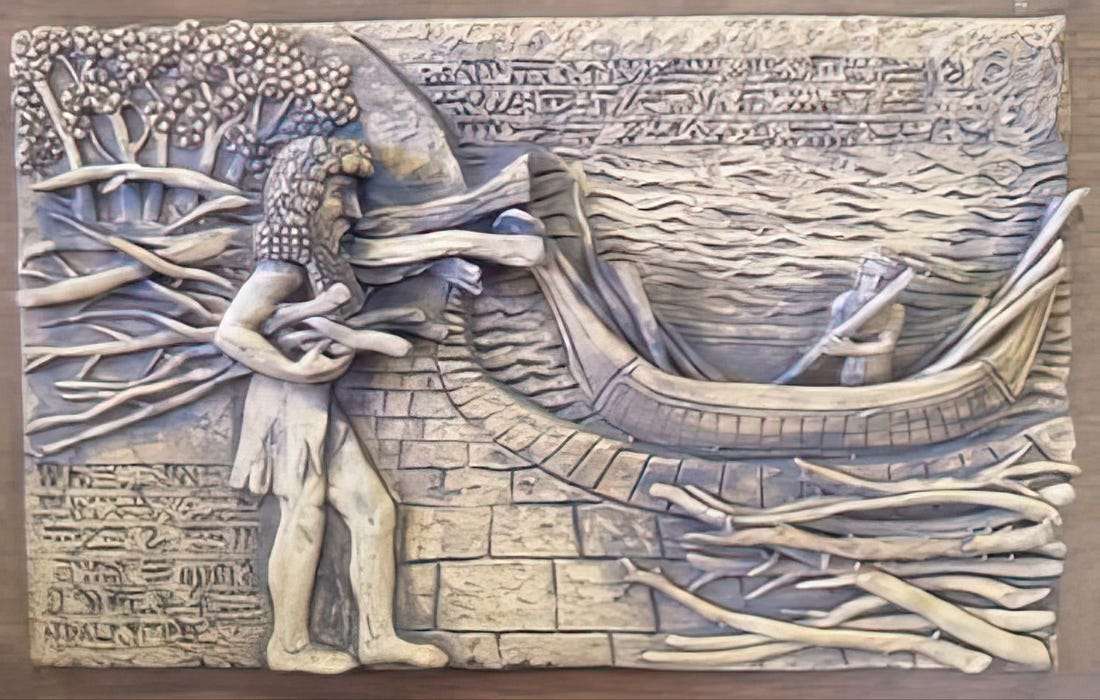
Gilgamesh via Bohannon
The earliest Sumerian poems about Gilgamesh may be dated as early as 2100 BCE, prior to the composition of Genesis. In that account, Enlil (the chief god) leads the decision to flood the earth. Why? Because the gods (most of them) are irritated by the growing clamor and chaos caused by humanity. The rising din is disruptive—by eliminating humankind in a great flood, peace will be restored. Humanity is saved when Ea (or Enki), god of wisdom, secretly warns Utnapishtim and instructs him to build a boat. Utnapishtim survives the flood, so the human race is preserved.
Previously, I had not given any thought to the meaning of the gods’ aggravation or why our noise assaulted to their ears. But I’ve been captivated by Cat Bohannon’s must-read book, Eve: How the Female Body Drove 200 Million Years of Human Evolution.
Bohannon posits that flood myths such as Atra-Hasis and Gilgamesh were composed to address a human crisis: the problem of explosive population growth in the cities. The gods were annoyed because the people were ‘noisy’ … but why noisy? Because of the rapid expansion of big cities, due in great part, she believes, to practices such as urban wet nursing (and her argument is biologically solid).
Thus, the social foundations for those flood myths (meaning, how they tried to explain the ‘why?’ of a big flood theologically) was a response to overpopulation. In hindsight, they believed that when the big floods came, the gods’ agenda was to depopulate. In other words, an actual sociological crisis was projected into a divine response to address the problem with a flood. It’s an early form of theodicy. OR was the flood a metaphor for the people themselves… a human deluge overflowing the banks of the city!
In either case, the story can function as a theodicy (justifying the gods) at two levels: (1)
The gods are not simply capricious. Their judgments may be destructive, but their acts aren’t simply arbitrary. When bad things happen, if the gods are involved, they are addressing an actual problem (not necessarily sin) relative to human activity. And (2) at least one of the gods was even sympathetic and humane. In polytheistic religions, the various gods represent aspects or attributes of the Most High God or council of gods.
Genesis via Lynch
By way of both comparison and contrast, following Matt Lynch’s, Flood and Fury:Old Testament Violence and the Shalom of God (2023) describes how the Genesis flood story also addresses a sociological crisis—though a different one: the problem of human violence. As Lynch reads, Genesis 6, he hears echoes of Genesis 1, where we read that “God saw that [what he created] was good”—and specifically, good for people to inhabit.
But in Genesis 6:11, we read, “Now the earth was corrupt in the sight of God, and the earth was filled with violence.” Lynch reads a similar Hebrew construct here, but in reverse. “God saw that the earth was RUINED.” That is, the earth was ruined for human habitation—rendered uninhabitable by human violence such that human extinction would be inevitable. “God saw how corrupt [destined to perish] the earth had become, for all the people on earth had corrupted their ways” (6:12), leading to a ruined creation that would ultimately be uninhabitable and bring about our extinction.
So, in meaning-making a big flood in their oral history or cultural memory, the Jews set their story over against Gilgamesh, by reading Yahweh’s flood not as mitigating overpopulation through human extinction, but rather, restoring an inhabitable world to preserve humankind from extinction. It is a re-Creation story, a reset, a fresh start.
Theodicies as Social Commentary
What the stories have in common is a flood, an act of divine compassion, and a hero who saves the race by building an ark. And to my point, both are theodicies that seek to somehow rationalize a divinely sanctioned apocalyptic flood. But my question is how the stories also function as social commentaries. Gilgamesh deals with cities flooded with or because of extreme overcrowding; Genesis is critiquing with human violence toward one another and its environmental impact.
In the Genesis account, one message is that unlike the Gilgamesh gods, despite the destructive power of the flood, God’s heart is to restore. That’s the theological message. But the story also sends an ongoing ethical message: human violence is so self-destructive that unchecked, it will lead to our extinction. God has provided a way of escape, of salvation—an ark into which all are still being welcomed.
Noah’s ark thus becomes a spiritual archetypes for both Jews and Christians, and a metaphor for readers today. It’s not that God is the agent of divine genocide, nor that God ‘sends’ climate-related disasters as punishment upon humanity. But then what? Historically, a Christian reading was that when the flood comes (e.g., politically, socially, ideologically, etc.), there is an invitation via repentance (admitting we can’t save ourselves) to enter ‘the ark of salvation’ (don’t read that narrowly) to endure whatever comes together as a human family (a every human and every creature with us) that knows God is ultimately the life-giver and not the death-dealer.
This CO2- (Church Of 2) is where two guys meet each day to tighten up our Connections with Jesus. We start by placing the daily “My Utmost For His Highest” in this WordPress blog. Then we prayerfully select some matching worship music and usually pick out a few lyrics that fit especially well. Then we just start praying and editing and Bolding and adding comments and see where the Spirit takes us.
It’s been a blessing for both of us.
If you’d like to start a CO2, we’d be glad to help you and your partner get started. Also click the link below to see how others are doing CO2.Odds Monkey
Steve Harvey Introduces Jesus To A Secular Audience
About
Change this text in the admin section of WordPress
You are currently browsing the CO2MannaToday blog archives.