For Father Richard, liminal space transforms us when we are attentive to the presence of God in times of change:
The Latin word limen means “threshold.” Liminal space is an inner state and sometimes an outer situation where we can begin to think and act in new ways. It is where we are betwixt and between, in transition, having left one room or stage of life but not yet entered the next. We usually enter liminal space when our former way of being is challenged or changed—perhaps when we lose a job or a loved one, during illness, at the birth of a child, or a major relocation. It is a graced time, but often does not feel “graced” in any way. In such space, we are not certain or in control.
The very vulnerability and openness of liminal space allows room for something genuinely new to happen. We are empty and receptive—blank tablets waiting for new words. Liminal space is where we are most teachable, often because we are most humbled. Liminality keeps us in an ongoing state of shadowboxing instead of ego-confirmation, struggling with the hidden side of things, and calling so-called normalcy into creative question.
It’s no surprise then that we generally avoid liminal space. Much of the work of authentic spirituality and human development is to get people into liminal space and to keep them there long enough that they can learn something essential and new. [1]
We all need to consciously spend time at the thresholds of our lives, and we need wise elders to create and hold such spaces for us. Liminality is a form of holding the tension between one space and another. It is in these transitional moments of our lives that authentic transformation can happen. Otherwise, it is just business as usual and an eternally boring, status quo existence.
Over the decades, I’ve seen the need for such liminal spaces again and again. Without some sort of guidance and reframing, we don’t understand the necessary ebb and flow of life, the ascents and descents, and the need to embrace our tears and our letting go as well as our successes and our triumphs. Without standing on the threshold for much longer than we’re comfortable, we won’t be able to see beyond ourselves to the broader and more inclusive world that lies before us.
Revelation 3:20 tells us that Christ stands at the door and knocks. Too many of us want to show up at the doorway looking prim and proper and perfect. We stuff our egos and anxieties in the front hall closet so Christ won’t see them when we open the door. But Christ isn’t showing up to see our perfect selves. Instead, we are invited into a real, deep, transformative conversation, there on the threshold between who we are and who we can become, if we are willing to let go of what holds us back. [2]
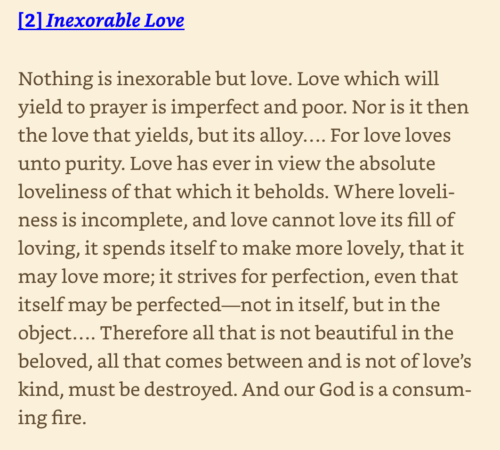
The following is from an anthology composed by CS Lewis of daily snippets from his hero and mentor, George MacDonald.
Benedictine and Celtic scholar Esther de Waal finds inspiration to manage life’s transitions in the Scriptures:
If we are going to see life as a succession of thresholds to be crossed, we are reminded of the journeys of the people of Israel in the desert, and we then find symbols and images that we can apply to our own experience. The very words passover and exodus carry a fullness of meaning as a journey from bondage into freedom. It is important to remember that the Passover was a yearly ritual, so that its memory was kept alive and the cycle lived through time and time again….
The psalms are the journey songs of the people who made that passage. Time and again they raised a fist to God and shouted angrily at him…. They are the songs of a people who were moving away from a known situation into the unknown, and they were often angry with a God who removed all those certainties, who instead seemed to be leading them along an apparently precarious path. They did not sit down for long beside gently flowing streams or linger in lush meadows….
In the Gospels we watch a Christ who, in dismissing certainties, shows us what freedom might mean. We watch the way in which he enters into people’s lives and dissolves an existing situation, whatever it might be. The likelihood was that the condition had promised security, safety, but now Christ challenges the people to leave their nets, or to leave a nice safe booth, and follow him. He says to Peter, James, and John, “Come,” and to Matthew, “Stand up, move, walk, come with me.” Our God is a God who moves and he invites us to move with him. [God] wants to pry us away from anything that might hold us too securely: our careers, our family systems, our money making. We must be ready to disconnect. There comes a time when the things that were undoubtedly good and right in the past must be left behind, for there is always the danger that they might hinder us from moving forward and connecting with the one necessary thing, Christ himself.
De Waal shares how we might navigate the resistance we feel as we stand on the threshold of something unknown:
Of course there is loss and it is right to grieve and not to pretend otherwise. Insecurity makes certitude attractive, and it is in times like these that I want to harness God to my preferred scheme of things, for it is risky to be so vulnerable. Yet it is this vulnerability that asks for trust and hope in God’s plans, not mine. So I try to learn each time that I am called upon to move forward to hand over the past freely, putting it behind me, and moving on with hands open and ready for the new.
Richard Rohr honors how painful transformation can be and reminds us to be patient with ourselves and the process:
The word change normally refers to new beginnings. But the mystery of transformation more often happens not when something new begins, but when something old falls apart. The pain and chaos of something old falling apart invite the soul to listen at a deeper level, and sometimes force the soul to go to a new place. Most of us would never go to new places in any other way. The mystics use many words to describe this chaos: fire, dark night, death, emptiness, abandonment, trial, the Evil One. Whatever it is called, it does not feel good, and it does not feel like God.
We will normally do anything to keep the old thing from falling apart, yet this is when we need patience and guidance, and the freedomto let go instead of tightening our controls and certitudes. Perhaps Jesus is describing just this phenomenon when he says, “It is a narrow gate and a hard road that leads to life, and only a few find it” (Matthew 7:14). Not accidentally, he mentions this narrow gate and hard road right after teaching the Golden Rule. He knows how much “letting go” it takes to “treat others as you would like them to treat you” (Matthew 7:12).
Spiritual transformation always includes a disconcerting reorientation. It can either help people to find new meaning or it can cause people to close down and slowly turn bitter. The difference is determined precisely by the quality of our inner life, our practices, and our spirituality. Change happens, but transformation is always a process of letting go, and living in the confusing, shadowy, transitional space for a while. Eventually, we are spit up on a new and unexpected shore. We can see why Jonah in the belly of the whale is such an important figure for Jews, Christians, and Muslims.
In moments of insecurity and crisis, shoulds and oughts don’t really help. They just increase the shame, guilt, pressure, and likelihood of backsliding into unhealthy patterns. It’s the deep yeses that carry us through to the other side. It’s those deeper values we strongly support—such as equality and dignity for all—that allow us to wait it out. Or it’s someone in whom we absolutely believe and to whom we commit. In plain language, love wins out over guilt any day.
It is sad that we settle for the short-term effectiveness of shaming people and shutting them down, instead of the long-term life benefits of true transformation. But then, we are a culture of productivity and efficiency, not terribly patient or even open to growth. God is clearly much more patient—and, finally, much more effective, patiently supporting our inner transformation through all of life’s transitions.
God’s Goodness Is Dynamic
I used to think that things were real, and change was something that happened to them over time. Now I think that change is real, and things are events that happen over time. Change is the constant and things come and go, appear and disappear. —Brian McLaren, Do I Stay Christian?
CAC teacher Brian McLaren locates resistance to change in our misunderstanding of God and encourages us to embrace reality’s dynamism:
Richard Rohr often recounts a story from seminary, when a professor ended … the semester by saying that Christian theology has in many ways been more influenced by the thought of Greek philosophers than by Jesus’ thinking. A case in point is the Greek idea of absolute perfection, the idea that if something is transcendent, it is unchangeable, immovable, absolute, and incapable of transition.
Because we want to lift God to the highest level possible, many of us were taught to conceive of God in this Greek category of perfection. After all, what’s the alternative—imperfection?
McLaren reflects on his own study of Genesis:
I had been preaching through the creation story of Genesis, and I realized that the universe described there didn’t fit with the categories of Greek philosophy. The universe fashioned by the word and creative character of God was not immovable. It was not absolute and incapable of change. It was not immutable or static or, in the Greek sense, perfect….
In the Hebrew poetry of Genesis 1, God’s creation was, simply put, in process. It started simple and grew more complex. It started in chaos, and order took shape. It started without life, and life “sprang forth” and “multiplied.” A sentence formed in my head that day … : “Hebrew good is better than Greek perfect.”
In other words, Greek perfect is static, but Hebrew good is dynamic. Greek perfect is sterile and changeless, but Hebrew good is fertile and fruitful….
Could this deep-seated understanding help explain why so many Christians today remain chained to the past, unable to imagine that change could be for the better, unable to accept that the present order, while superior to the past for some, is still deeply unjust for many and therefore deserves to be challenged and changed? Could sin be better understood as a refusal to accept needed change, a refusal to grow, a resistance to the arc of transition that bends toward justice?
Sometime soon, I hope you can take a walk outdoors or find a place to sit and observe the created world. Seasons change. Trees grow. Rivers flow. Rocks roll downstream and go from rough and sharp to smooth and round. You can look in the mirror and sense the same reality in your own face: new wrinkles, new wisdom.
Perhaps you can look at this world in transition and dare to echo God in Genesis [1:31]: behold, it is good … it is very good. Perhaps you can see transition as an essential part of that goodness that is better than perfection.
“When troubles of any kind come your way, consider it an opportunity for great joy. For you know that when your faith is tested, your endurance has a chance to grow. ”
2 fixing our eyes on Jesus, the pioneer and perfecter of faith. For the joy set before him he endured the cross, scorning its shame, and sat down at the right hand of the throne of God.
6 In all this you greatly rejoice, though now for a little while you may have had to suffer grief in all kinds of trials. 7 These have come so that the proven genuineness of your faith—of greater worth than gold, which perishes even though refined by fire—may result in praise, glory and honor when Jesus Christ is revealed.
10 In bringing many sons and daughters to glory, it was fitting that God, for whom and through whom everything exists, should make the pioneer of their salvation perfect through what he suffered.
Buddhist teacher angel Kyodo williams emphasizes how human it is to have desires—and how we can lessen our attachment to them:
It can give you a headache just thinking about how many times a day your mind goes chasing after some real or imagined desire….
A desire can appear instantly: BANG! There it is! When we think of not having desires, we’re afraid we will disappear. Why is that?… Because our desires are so persistent and so constant, we think we are our desires. And that shows how really, really attached to them we are….
None of us escapes desire, and we don’t want to escape. That is not the point. We would just like to stop holding on to them for dear life. We want to see them for what they are. They are cravings. They are desires. They do not own us. They do not need to force us in every possible direction, contorting our bodies to chase down the next thing. I won’t be a captive to my desires, helpless in their power. More important, I won’t make myself miserable because of my attachment to my wants... [1]
Williams offers instructions on the practice of “letting go” of our thoughts, desires, and judgments through mindfulness meditation:
Letting go means simply releasing the thoughts and ideas that our minds get in the habit of attaching themselves to, including the ideas of yesterday and tomorrow. Letting go is not hard or harsh. We should let it be easy and gradual. Our habitual way of reacting makes us feel as if we have to go on a journey with every thought that comes, or that we have to wrestle them to the ground to control them. That isn’t true at all. None of our actions will be forced or contrived if we keep from grasping at everything that appears in front of us….
We can see the thoughts that come up in our minds the same way a mirror “sees” things. A mirror just notices. It registers whatever passes in front of it without holding on to it in any way. It just lets go. It doesn’t think about it or have a long conversation about it. Since the mirror doesn’t cling to the object that it is reflecting, when the object goes, so does the reflection. It’s the same way with your mind. We don’t hold on to the random thoughts that arise over and over again in our minds and that can take us away from the full experience of now. We want to be aware only of our breath and nothing else. The moment that we become aware that a thought has taken form, we just relax and allow it to pass. We just notice the thoughts and we return to our breath. If nothing grabs onto the thoughts as they arise, they will keep on moving on, leaving no trace that they were ever there. Let your mind be like the mirror. Clear mirror, clear mind. [2]
_______________________________________________
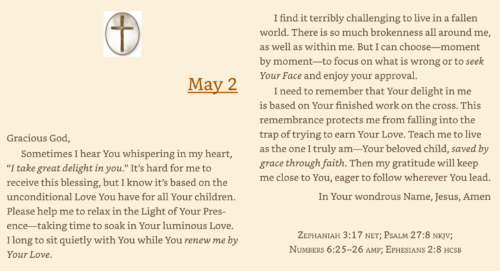
Sarah Young; Jesus Listens
Supreme Savior, Help me to give up the illusion that I deserve a problem-free life.Part of me still hungers for the resolution of all my difficulties, but I realize this is a false hope. Your Word states clearly that in this world I will have trouble. I must link my hope not to problem solving in this life but to the promise of an eternity of trouble-free life with You in heaven. Instead of seeking perfection in this fallen world, I want to pour my energy into seeking You—the Perfect One. You’ve shown me that it’s possible to glorify You in the midst of adverse circumstances. Your Light shines brightly through believers who trust You in the dark. This is supernatural trust, produced by Your indwelling Spirit. Lord, I invite You to transform me more and more into the one You designed me to be. I want to yield to Your creative work in me, neither resisting it nor trying to speed it up. I long to enjoy the tempo of a God-breathed life—with You setting the pace. I’m grateful that You hold me by my right hand, You guide me with Your counsel, and afterward You will take me into Glory. In Your triumphant Name, Jesus, Amen
JOHN 16:33; I have overcome the world. In this world his disciples would be persecuted and have sorrow, but he bids them Be of good cheer. The world can only afflict for a season; it is a conquered world; Christ has overcome it.
2 CORINTHIANS 3:18 ESV; And we all, with unveiled face, beholding the glory of the Lord,[ a]are being transformed into the same image from one degree of glory to another.[ b] For this comes from the Lord who is the Spirit.
PSALM 73:23–24; Nevertheless, I am continually with you; you hold my right hand. 24 You guide me with your counsel, and afterward you will receive me to glory.
Young, Sarah. Jesus Listens (p. 123). Thomas Nelson. Kindle Edition.
Richard Rohr calls for contemplative prayer to teach us the “art of detachment.” He stresses that in such prayer we don’t deny our feelings, but simply let go of their ultimacy:
We need forms of prayer that free us from fixating on our own conscious thoughts and feelings and from identifying with them, as if we are our thinking. Who are we before we have our thoughts and feelings? That is our naked being. We have to learn to be spiritually empty, or, as Jesus says in his first beatitude, “How blessed are the poor in spirit” (Matthew 5:3). If we are filled with ourselves, there is no room for another, and certainly not for God. We need contemplative prayer, in which we simply let go of our constantly changing ego needs, so Something Eternal can take over.
This may sound simple, but it’s not easy! Because we’ve lost the art of detachment, we’ve become almost fully identified with our stream of consciousness and our feelings. Don’t misunderstand me; I’m not saying we should repress or deny our feelings. I’m challenging us to name them and observe them, but not to directly fight them, identify with them, or attach to them. Unless we learn to let go of our feelings, we don’t have our feelings; our feelings have us.
We might ask: “What does this have to do with God? I thought prayer was supposed to be talking to God or searching for God. This seems to be saying prayer is about getting myself out of the way.” That is exactly what I am saying. As John the Baptist put it, “I must grow smaller so he can grow greater” (John 3:30). [1]
To any of us comfortable people, detachment sounds like losing, but it is actually about accessing a deeper, broader sense of the self, which is already whole, already content, already filled with abundant life. This is the part of us that has always loved God and has always said “yes” to God. It’s the part of us that is Love, and all we have to do is let go and fall into it. It’s already there. Once we move our identity to that level of deep inner contentment and compassion, we realize that we’re drawing upon a Life that is larger than our own and from a deeper Abundance. Once we learn to do that, why would we ever again settle for some scarcity model for life? [2] God is already present. God’s Spirit is dwelling within us. We cannot search for what we already have. We cannot talk God into coming “to” us by longer and more urgent prayers. All we can do is become quieter, smaller, and less filled with our own self and our constant flurry of ideas and feelings. Then God will be obvious in the very now of things, and in the simplicity of things. To sum it all up, we can never get there, we can only be there.
_________________________________
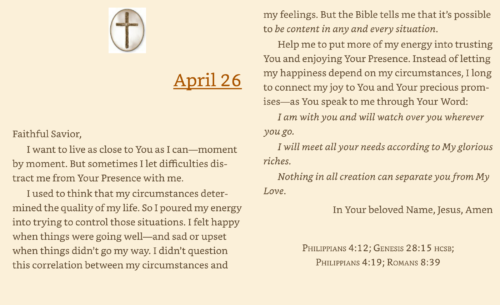
Sarag Young Jesus Listens……
Merciful Jesus, I come gladly into Your Presence—basking in the luxury of being fully understood and perfectly loved. Help me to see myself as You see me: radiant in Your righteousness, cleansed by Your blood. I’m grateful that You view me as the one You created me to be, the one I will actually be when heaven becomes my home. It is Your Life within me that is changing me from Glory to Glory! I rejoice in this mysterious miracle. As I sit quietly in Your Presence, my awareness of Your Life within me is heightened. You are Christ in me, the hope of Glory. I’m grateful that You—the One who walks beside me, holding me by my hand—are the same One who lives within me. This is a glorious, unfathomable mystery. The Light of Your Presence shines within me as well as upon me. You and I are intertwined in an intimacy that involves every fiber of my being. You are in me, and I am in You. This means that nothing in heaven or on earth can separate me from You. Hallelujah! In Your magnificent Name, Amen
PSALM 34:5; Those who look to Him are radiant with joy; their faces shall never be ashamed.
2 CORINTHIANS 5:21 HCSB; He made the One who did not know sin to be sin for us, so that we might become the righteousness of God in Him.
2 CORINTHIANS 3:18 NKJV; But we all, with unveiled face, beholding as in a mirror the glory of the Lord, are being transformed into the same image from glory to glory, just as by the Spirit of the Lord.
COLOSSIANS 1:27 ESV; To them God chose to make known how great among the Gentiles are the riches of the glory of this mystery, which is Christ in you, the hope of glory. 28 Him we proclaim, warning everyone and teaching everyone with all wisdom, that we may present everyone mature in Christ.
Young, Sarah. Jesus Listens (p. 122). Thomas Nelson. Kindle Edition.
In whatever state we may find ourselves, whether in strength or in weakness, in joy or in sorrow, to whatever we may feel attached, we must renounce it. —Meister Eckhart, sermon on Luke 1:57
For CAC teacher James Finley, practicing contemplative detachment helps us recognize that our feelings, real as they are, do not ultimately determine who we are. From his work as a psychotherapist and spiritual director, Finley offers a gentle way of understanding this teaching:
Do not become attached. If you’re in sorrow and utter loss, don’t become attached to the experience of yourself in moments of utter loss. Rather, be detached from your loss. It’s real—but know that the loss doesn’t have the authority to name who you are, for only the infinite generosity of God giving itself to you in this very moment has the authority to name who you are. So, the loss is real. Feel it; it’s real. But don’t yield to its claim to carry you off, as if the sorrow that you’re in has the authority to name who you are and what’s possible for you. Because only the infinite love of God has the authority.
Likewise, if you’re in a moment of joy, like real joy over something, be joyful, but be detached from your joy. Because the joy is finite, the joy is ephemeral, the joy is passing away. Enjoy it but realize that compared to the eternal joy—“the joy that death does not have the power to destroy”—this joy that you’re experiencing is fleeting. Don’t get hung up over your joy. Be detached from joy.
Finley offers wisdom he learned from Thomas Merton (1915–1968), who was his novice master when Finley was a young monk:
Often, when I’d go in to see Thomas Merton for spiritual direction, he’d say, “How’s it going?”
And I’d say, “I’m doing well!”
And he’d say, “Don’t make much of it; it’ll get worse.”
And other times I would go in really down about something. And he’d say, “Don’t make much of it; it’ll get better.”
It ebbs and flows, it ebbs and flows. But what is the infinite love that unwaveringly permeates the wavering ways of our heart? And how can we reserve this inner core place within ourself that cannot be accessed by the finite because it belongs completely to God?
By the way, we should even be detached from that by also being aware of our inability to practice that, because we’re just a human being. We know that when we’re down, we’re really down. And when we’re joyful, we’re joyful. So we have to be very careful not to become attached to the goal of becoming detached!
We have to take a deep breath, and roll with the waves of the unfoldings of ourselves.
We are to sink eternally from letting go to letting go into God. —Matthew Fox, Meditations with Meister Eckhart
The Desert Fathers and Mothers understood detachment as the practice of letting go of everything that draws us away from God. Laura Swan explains:
Yearning for complete union with God, desert ascetics sought to remove all obstacles to the deepening of this relationship. Obstacles included unhelpful attitudes and motives, thoughts that stalled their pursuit of God, and emotional ties that complicated their inner journeys.
The desert ascetics’ relationships were non-possessive: They cared for others while leaving them free. Concern for reputation was discarded. Feelings were acknowledged and listened to for their wisdom but were subjected to the discipline of the heart’s goal to seek God. The desert ascetics sought to [discipline] disordered passions that distracted them from their deepening relationship with God and actively to cultivate a burning love for God.
Although the journey began with giving away possessions, desert ascetics understood that what possessed them was greater than the sum of goods owned. All that owned them [italics added], all that possessed their minds and hearts, their attachments and compulsions, must be healed and reconciled. Desert ascetics called this process of moving toward inner freedom detachment. Detachment allows for greater direct experience of the Divine Presence as the seeker is attached to fewer distractions.
Desert ascetics understood that the cultivation of inner freedom was vital to the deepening of their experience of God. As they deepened their interior freedom, all aspects of their false self [were] removed and a clearer understanding of their truest self emerged. It is this true self that dwells deeply with God. In the abundant simplicity of our true self, we experience deepest joy.
Swan explores the goal of “apatheia” (mindfulness or equanimity) in the teachings of the desert mystics:
Apatheia is a mature mindfulness, a grounded sensitivity, and a keen attention to one’s inner world as well as to the world in which one has journeyed. Strong emotions such as anger, fear, or anxiety did not dominate or control the ascetic’s inner world—they were disciplined to serve the inner journey rather than disrupt it.
Apatheia is purity of heart. The ammas [desert mothers] teach us to intentionally let go of all that keeps us from the single-minded pursuit of God: feelings and thoughts that bind us, cravings and addictions that diminish our sense of worth, and attachments to self-imposed perfectionism. Apatheia is nourished by simplicity grounded in abundance of the soul. This simplicity is in balance and harmony with the human community and the created world. To cultivate apatheia, we must be uncluttered in mind and heart and continue to be watchful and vigilant about those “seeping boundaries” where we can be deceived out of simplicity and into complexity under the guise of a “good.”
God asks only that you get out of God’s way and let God be God in you. —Meister Eckhart, sermon on 1 John 4:9
Father Richard describes the spiritual discipline of detachment as the practice of “letting go”:
In the larger-than-life people I have met, I always find one common denominator: in some sense,they have all died before they died—and thus they are larger than death, too! Please think about that. At some point, they were led to the edge of their private resources, and that breakdown, which surely felt like dying, led them into a larger life. They went through a death of their various false selves and came out on the other side knowing that death could no longer hurt them. They fell into the Big Love and the Big Freedom—which many call God.
Throughout most of history, the journey through death into life was taught in sacred space and ritual form, which clarified, distilled, and shortened the process. Today, many people don’t learn how to move past their fear of diminishment, even when it stares them down or gently invites them. This lack of preparation for the “pass over,” the absence of training in grief work and letting go, and our failure to entrust ourselves to a bigger life, have contributed to our culture’s spiritual crisis.
All great spirituality is about letting go. Instead, we have made it to be about taking in, attaining, performing, winning, and succeeding. True spirituality echoes the paradox of life itself. It trains us in both detachment and attachment: detachment from the passing so we can attach to the substantial. But if we do not acquire good training in detachment, we may attach to the wrong things, especially our own self-image and its desire for security. [1]
Each time I learn to let go of what I thought was necessary for my own happiness, I invariably find myself in a larger place, a larger space, a deeper union, a greater joy. I’m sorry I can’t prove that to you ahead of time. We only know it after the fact. I used to read every book I could as a young man thinking if I understood good theology, good philosophy, good psychology, I’d know how to live the so-called perfect life and it would show me how to open the door in front of me. Now, in the last season of my life, I realize that what’s in front of me is still largely darkness—but it doesn’t matter anymore. That’s because letting go has taught me that I can look back, not forward, back at the past of my life and I can truthfully say, “What have I ever lost by dying? What have I ever lost by losing?” I have fallen upward again and again. By falling I have found. By letting go I have discovered, and I find myself in these later years of my life still surprised that that is true. [2]
God Is the Ground of Our Being
God is not found in the soul by adding anything, but by a process of subtraction. —Meister Eckhart, sermon on Romans 8:18
In his writings and sermons, medieval mystic Meister Eckhart (1260–1327) counseled detachment from anything that would separate us from God, whom he understood as the very ground of our being. In the latest season of his podcast Turning to the Mystics, CAC teacher James Finley shares his understanding of Eckhart’s teachings:
The guidance that Meister Eckhart offers us in his sermons attempts to help us deepen our experiential understanding of the depths of God’s presence in our lives. A foundational way that he helps us with this deepening is with his metaphor of the ground. The ground of God is the deepest depths of God. And in the generosity of God, the deepest depths of God are given to us as the deepest depths of ourselves, in our nothingness without God. Our ground and God’s ground is one ground. And hidden down in the depths of ourselves is a union that’s already present, waiting to be realized, lived, and shared. [1]
What is this path along which we can actually, experientially abide in the oneness of the ground? The path cannot be a path of attaining because nothing’s missing. The ground is this infinite generosity of God completely being given to us as this depth of ourselves. Therefore, the path has to be one of becoming detached from what hinders us from realizing it.
Eckhart is saying we can choose to live this way: in a kind of empty-handed, open process of constantly letting go of everything as having the final say in who we are. We acknowledge it [the trait, the preference, the condition], but we know it doesn’t have the final say in who we are. The more we continue in that way, we are in this Gelassenheit, which means being released from everything that hinders. A key phase of this is what Eckhart calls “the birth of the Word in the soul.” [2] What comes welling up out of the ordinariness of everything is the divinity of everything. What Eckhart is looking for is a habitual underlying state of this releasing, of this birthing. [3]
He gives some practical strategies so that we can practice finding our way to the ground in day-by-day consciousness by being sensitive to certain tendencies in our heart.
Every time we catch ourselves getting reactive, every time we catch ourselves acting asif the outcome of the situation has the authority to name who we are, we are to take a deep breath and remind ourselves that it’s not true. That there’s this hidden, unfelt, deep, abyss-like center in which we’re being unexplainably sustained in the midst of the circumstances. [4]
Ecologist and pastor Andi Lloyd writes of the Hebrew prophets’ understanding that the land itself grieves with its people:
In the Hebrew Bible, mourning is an expansive practice. The people mourn, of course, but so do the land, the pastures, and the deep springs. Even gates and walls lament. The Hebrew verb abal, translated here [in Hosea] as “mourn,” also carries the meaning “to dry up, to wither.” Where a widow might put ashes on her head, the land and pastures and springs mourn by withering and drying up—all ways of speaking aloud the truth of inward grief.
Therein lies the power of lament: to speak the truth that all is not well. Walter Brueggemann writes that grief, spoken aloud, is “the counter to denial.” [1] Lament is prophetic speech. It bears faithful witness to all that is not right with the world and to all that is not right with ourselves. To take the land’s mourning seriously is to ask about its grief—to wonder what truth the land’s grief spoke to the people in Hosea’s day and what truth it might speak to us now.…
The land’s lament speaks a foundational ecological truth: when one part of creation goes awry, the whole suffers. The land’s grief at what the people have done points to the fundamental reality of our interconnection. Perhaps it is the boundedness of our bodies that makes it so easy to overlook the truth of our connectedness. We appear so discrete, so unitary, but we are not.
Lloyd describes our interconnectedness with God, each other, and the earth on which we dwell:
Our lives are held, connected, one to the other and all to God: we are bound up in a beautiful, multicolored, homespun fabric. That fabric is an ecological truth: it describes the deeply interconnected and interdependent world that I came to know as an ecologist. And that fabric is a theological truth, reflecting the world as God made it to be—a relational world, a connected world, an interdependent world.
The land’s mourning speaks simultaneously of a vision of the world as it ought to be—that beautiful fabric—and the truth of the world as it is: too much injustice and too little love fraying the threads that hold us all. The land feels those fraying threads. The land grieves those fraying threads. The land mourns.
Now, as then, the fabric that connects all of creation is badly torn: torn by manifold injustices wrought and perpetuated by the exploitative systems in which we live, torn by ideologies of scarcity that teach us to love too narrowly and too little. To mourn is to speak that truth to the lies that prop up the denial on which the status quo depends.….
Mourning together, in true solidarity, we name the truth of what’s wrong. And in so doing, we begin to make it right.
________________________________________
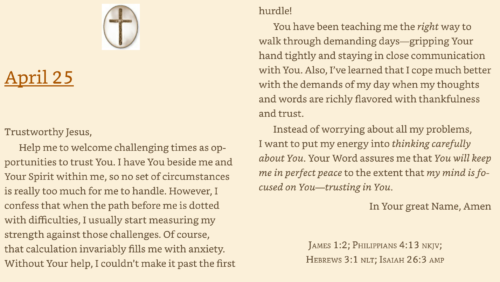
Sarah Young Jesus Listens
Refreshing Lord Jesus, I come to You for rest and refreshment. My journey has been a strenuous, uphill climb, and I am bone-weary. Help me not to be ashamed of my exhaustion but to see it as an opportunity to rely more fully on You. Please keep reminding me that You can fit everything into a plan for good, including the things I wish were different. I need to just start with where I am right now—accepting that this is where You intend for me to be. As I lean on You for support, I can get through this day—one step, one moment at a time. My main responsibility is to remain attentive to You, asking You to guide me through the many decisions I must make. This sounds like an easy assignment, but I find it quite challenging. My desire to live in awareness of Your Presence goes against the grain of the world, the flesh, and the devil. Much of my weariness results from my constant battle with these opponents. But I won’t give up! Instead, I will hope in You—trusting that I will again praise You for the help of Your Presence. In Your worthy Name, Amen
ROMANS 8:28 AMPC; We are assured and know that [God being a partner in their labor] all things work together and are [fitting into a plan] for good to and for those who love God and are called according to [His] design and purpose.
PROVERBS 3:5 AMPC; Lean on, trust in, and be confident in the Lord with all your heart and mind and do not rely on your own insight or understanding. In all your ways know, recognize, and acknowledge Him, and He will direct and make straight and plain your paths.
PSALM 42:5 NASB; Why are you in despair, O my soul? And why have you become disturbed within me? Hope in God, for I shall again praise Him For the help of His presence.
Young, Sarah. Jesus Listens (p. 116). Thomas Nelson. Kindle Edition.
Through studying Francis of Assisi, Richard Rohr learned that weeping is a mode of being that relinquishes any need to be in control:
When I was a Franciscan novice in 1961, I only went to my novice master once with a complaint. Every month, we had been encouraged to read another life of Saint Francis. I kept reading about Francis going off into a cave and crying. These books said he spent whole days in tears, weeping. Frankly, this made no sense to me, so I went to my novice master. I said, “What’s he crying about all the time? I don’t get it. I don’t know if I want to be a Franciscan.” My educated, rational mind already resisted that kind of losing, weakness, vulnerability. My novice master told me, “You won’t understand it now, but I promise you will later.”
The mode of weeping, of crying, is different than the mode of fixing. It’s different than understanding. That’s why we often cry when we forgive. I’ve given up trying to make rhyme or reason or blame or who’s right or who’s wrong. The dualistic mind just goes back and forth seeking justification, seeking the right reason to hate or reject another person. We never find home base. Now I understand why Francis wept so much. When we go to the place of tears, and I don’t mean necessarily literally—I still don’t cry very easily myself, I’m sad to say—it’s an inner attitude where when I can’t fix it, when I can’t explain it, when I can’t control it, when I can’t even understand it, I can only forgive it. Let go of it, weep over it. It’s a different mode of being. [1]
After her father’s death, Nigerian writer Chimamanda Ngozi Adichie captures the embodied experience of “the weeping mode,” in which no attempts to “fix” or “move on” will do:
Grief is a cruel kind of education. You learn how ungentle mourning can be, how full of anger. You learn how glib condolences can feel. You learn how much grief is about language, the failure of language and the grasping for language. Why are my sides so sore and achy? It’s from crying, I’m told. I did not know that we cry with our muscles. The pain is not surprising, but its physicality is: my tongue is unbearably bitter, as though I ate a loathed meal and forgot to clean my teeth; on my chest, a heavy, awful weight; and inside my body, a sensation of eternal dissolving. My heart—my actual, physical heart, nothing figurative here—is running away from me, has become its own separate thing, beating too fast, its rhythms at odds with mine. This is an affliction not merely of the spirit but of the body, of aches and lagging strength. Flesh, muscles, organs are all compromised. No physical position is comfortable. For weeks, my stomach is in turmoil, tense and tight with foreboding, the ever-present certainty that somebody else will die, that more will be lost. [2]
____________________________________________
Sarah Young Jesus Listens
Almighty God, Your Word tells me that You will fight for me; I need only to be still. Lord, You know how weary I am. I’ve been struggling just to keep my head above water, and my strength is running low. I need to stop trying so hard—and just let You fight for me. This is very difficult for me to do because my feelings tell me I must keep striving in order to survive. But I know You’re working on my behalf, and You are calling me to rest in You. So please help me to be still and know that You are God. Trying to calm my mind is even more challenging than quieting my body. In my battle to feel secure, I have relied too heavily on my own thinking. As I’ve struggled to feel in control, I’ve unwittingly elevated my mind to a position of self-reliance. Forgive me, Lord!I desperately need Your Spirit to work within me—controlling my mind more and more, soothing me from the inside out. While I spend time resting in the shadow of Your Almighty Presence, I’ll rejoice that You are fighting for me. In Your invincible Name, Jesus, Amen EXODUS 14:14; The Lord will fight for you; you need only to be still.”
PSALM 46:10 NKJV; 10Be still, and know that I am God; I will be exalted among the nations, I will be exalted in the earth! 11 The Lord of hosts is with us; The God of Jacob is our refuge. Selah
ROMANS 8:6; The mind governed by the flesh is death, but the mind governed by the Spirit is life and peace. 7 The mind governed by the flesh is hostile to God; it does not submit to God’s law, nor can it do so. 8 Those who are in the realm of the flesh cannot please God.
PSALM 91:1; He that dwelleth in the secret place of the most High shall abide under the shadow of the Almighty.
Young, Sarah. Jesus Listens (p. 115). Thomas Nelson. Kindle Edition.
This CO2- (Church Of 2) is where two guys meet each day to tighten up our Connections with Jesus. We start by placing the daily “My Utmost For His Highest” in this WordPress blog. Then we prayerfully select some matching worship music and usually pick out a few lyrics that fit especially well. Then we just start praying and editing and Bolding and adding comments and see where the Spirit takes us.
It’s been a blessing for both of us.
If you’d like to start a CO2, we’d be glad to help you and your partner get started. Also click the link below to see how others are doing CO2.Odds Monkey
Steve Harvey Introduces Jesus To A Secular Audience
About
Change this text in the admin section of WordPress
You are currently browsing the CO2MannaToday blog archives.