Through studying Francis of Assisi, Richard Rohr learned that weeping is a mode of being that relinquishes any need to be in control:
When I was a Franciscan novice in 1961, I only went to my novice master once with a complaint. Every month, we had been encouraged to read another life of Saint Francis. I kept reading about Francis going off into a cave and crying. These books said he spent whole days in tears, weeping. Frankly, this made no sense to me, so I went to my novice master. I said, “What’s he crying about all the time? I don’t get it. I don’t know if I want to be a Franciscan.” My educated, rational mind already resisted that kind of losing, weakness, vulnerability. My novice master told me, “You won’t understand it now, but I promise you will later.”
The mode of weeping, of crying, is different than the mode of fixing. It’s different than understanding. That’s why we often cry when we forgive. I’ve given up trying to make rhyme or reason or blame or who’s right or who’s wrong. The dualistic mind just goes back and forth seeking justification, seeking the right reason to hate or reject another person. We never find home base. Now I understand why Francis wept so much. When we go to the place of tears, and I don’t mean necessarily literally—I still don’t cry very easily myself, I’m sad to say—it’s an inner attitude where when I can’t fix it, when I can’t explain it, when I can’t control it, when I can’t even understand it, I can only forgive it. Let go of it, weep over it. It’s a different mode of being. [1]
After her father’s death, Nigerian writer Chimamanda Ngozi Adichie captures the embodied experience of “the weeping mode,” in which no attempts to “fix” or “move on” will do:
Grief is a cruel kind of education. You learn how ungentle mourning can be, how full of anger. You learn how glib condolences can feel. You learn how much grief is about language, the failure of language and the grasping for language. Why are my sides so sore and achy? It’s from crying, I’m told. I did not know that we cry with our muscles. The pain is not surprising, but its physicality is: my tongue is unbearably bitter, as though I ate a loathed meal and forgot to clean my teeth; on my chest, a heavy, awful weight; and inside my body, a sensation of eternal dissolving. My heart—my actual, physical heart, nothing figurative here—is running away from me, has become its own separate thing, beating too fast, its rhythms at odds with mine. This is an affliction not merely of the spirit but of the body, of aches and lagging strength. Flesh, muscles, organs are all compromised. No physical position is comfortable. For weeks, my stomach is in turmoil, tense and tight with foreboding, the ever-present certainty that somebody else will die, that more will be lost. [2]
____________________________________________
Sarah Young Jesus Listens
Almighty God, Your Word tells me that You will fight for me; I need only to be still. Lord, You know how weary I am. I’ve been struggling just to keep my head above water, and my strength is running low. I need to stop trying so hard—and just let You fight for me. This is very difficult for me to do because my feelings tell me I must keep striving in order to survive. But I know You’re working on my behalf, and You are calling me to rest in You. So please help me to be still and know that You are God. Trying to calm my mind is even more challenging than quieting my body. In my battle to feel secure, I have relied too heavily on my own thinking. As I’ve struggled to feel in control, I’ve unwittingly elevated my mind to a position of self-reliance. Forgive me, Lord!I desperately need Your Spirit to work within me—controlling my mind more and more, soothing me from the inside out. While I spend time resting in the shadow of Your Almighty Presence, I’ll rejoice that You are fighting for me. In Your invincible Name, Jesus, Amen EXODUS 14:14; The Lord will fight for you; you need only to be still.”
PSALM 46:10 NKJV; 10Be still, and know that I am God; I will be exalted among the nations, I will be exalted in the earth! 11 The Lord of hosts is with us; The God of Jacob is our refuge. Selah
ROMANS 8:6; The mind governed by the flesh is death, but the mind governed by the Spirit is life and peace. 7 The mind governed by the flesh is hostile to God; it does not submit to God’s law, nor can it do so. 8 Those who are in the realm of the flesh cannot please God.
PSALM 91:1; He that dwelleth in the secret place of the most High shall abide under the shadow of the Almighty.
Young, Sarah. Jesus Listens (p. 115). Thomas Nelson. Kindle Edition.
For Ugandan theologian Emmanuel Katongole and peacemaker Chris Rice, lamentation is a profound cry to God. It echoes through the Bible and generations of all who suffer and ask, “How long, O Lord?”:
We are called to learn the anguished cry of lament.
Lament is the cry of Martin Luther King Jr. [1929–1968] from his kitchen table in Montgomery after hearing yet another death threat: “Lord, I’m down here trying to do what’s right…. But Lord, I must confess that I’m weak now, I’m faltering. I’m losing my courage. Now, I am afraid…. I am at the end of my powers. I have nothing left. I’ve come to the point where I can’t face it alone.” [1]
It was not a cry in isolation but rather a tradition King had learned from generations of African American families who were literally torn apart by slavery. The cry of lament had been passed down to him in the music of the Christian spiritual, “Sometimes I feel like a motherless child … a long way from home.”
Lament is the cry of the psalmists of Israel in exile who, feeling abandoned by God, demanded, “Where are you, Lord?” Or the psalmists who were bothered by God’s remarkably bad sense of timing: “Why are you taking so long?” “The poor are being crushed. The wicked are winning. Don’t you see it?” The twin sisters of Psalms are prayers of praise and lament, and they are always walking hand in hand, sometimes singing, sometimes crying.
Lament is not despair. It is not whining. It is not a cry into a void. Lament is a cry directed to God. It is the cry of those who see the truth of the world’s deep wounds and the cost of seeking peace. It is the prayer of those who are deeply disturbed by the way things are. We are enjoined to learn to see and feel what the psalmists see and feel and to join our prayer with theirs. The journey of reconciliation is grounded in the practice of lament.
The prophet Jeremiah writes of Rachel’s lamenting “voice in Ramah” that can only weep at the world’s suffering:
A voice is heard in Ramah, lamentation and bitter weeping. Rachel is weeping for her children; she refuses to be comforted for her children, because they are no more. (Jeremiah 31:15)
The voice from Ramahrefuses to be consoled. These are profound words in a world full of easy ways of consoling ourselves. Rachel’s cry refuses to spiritualize, explain away, ignore or deny the depth and truth of suffering in this world. She rejects soothing words and “can’t we all just get along” sentiments. Her refusal takes seriously the rupture and wounds of the world as well as the deep cost of seeking healing. It is a protest against the world as it is and the brokenness that seems so inevitable. Rachel allows the truth to shake her to the very core. And she is remembered for this.
You have searched me, Lord, and you know me. 2 You know when I sit and when I rise; you perceive my thoughts from afar. 3 You discern my going out and my lying down; you are familiar with all my ways.
12 For now we see only a reflection as in a mirror; then we shall see face to face. Now I know in part; then I shall know fully, even as I am fully known.
22 This righteousness is given through faith in[a] Jesus Christ to all who believe. There is no difference between Jew and Gentile,
Surely you have granted him unending blessings and made him glad with the joy of your presence.
Poet Ann Weems (1934–2016) suffered tragedy firsthand when her twenty-one-year-old son was murdered. She poured her profound grief into writing her own versions of lament psalms. Here she takes heart from Jesus’ own weeping:
Jesus wept, and in his weeping, he joined himself forever to those who mourn. He stands now throughout all time, this Jesus weeping, with his arms about the weeping ones: “Blessed are those who mourn, for they shall be comforted.” He stands with the mourners, for his name is God-with-us. Jesus wept. “Blessed are those who weep, for they shall be comforted.” Someday. Someday God will wipe the tears from Rachel’s eyes. In the godforsaken, obscene quicksand of life, there is a deafening alleluia rising from the souls of those who weep, and of those who weep with those who weep. If you watch, you will see the hand of God putting the stars back in their skies one by one.
So God created mankind in his own image, in the image of God he created them; male and female he created them.
We destroy arguments and every lofty opinion raised against the knowledge of God, and take every thought captive to obey Christ,
They will have no fear of bad news; their hearts are steadfast, trusting in the Lord.
You will keep in perfect and constant peace the one whose mind is steadfast [that is, committed and focused on You—in both inclination and character], Because he trusts and takes refuge in You [with hope and confident expectation].
How lonely sits the city, that once was full of people…. She weeps bitterly in the night, with tears on her cheeks. —Lamentations 1:1, 2
The Psalms and the books of the Hebrew prophets honor the deep, public grief of lamentation as holy prayer. Brian McLaren reflects on Jeremiah’s prophetic message and our need to lament today:
The work of prophets is to warn, to warn people of the inevitable consequences of their foolish or immoral actions. It will be the end of the world as you know it, the prophets say, unless you rethink your current assumptions, values, and priorities, unless you become ready to change your way of life. Usually, the people don’t listen.
Jeremiah lived long enough to see the result in 586 [BCE]. And it caused him to write this poem of public lament. Why is public lament so important? Well, imagine you’re a Hebrew slave in Babylon. Whenever you think of what you’ve lost, you weep. Your tears keep alive the folly of your people in not listening to the prophet’s warnings. Your tears keep alive your rage against the cruelty and domination of the Babylonians. Your tears keep alive a desire for change to regain your freedom, to return some day to your homeland. Guess who doesn’t want you to feel that grief? Guess who wants you to accept your new reality and surrender to it forever? Guess who wants you to put on a happy face in public? Guess who wants to defeat you into emotional numbness rather than emotional aliveness? Your oppressors, those who profit from your compliance, those who want you to be happy and well-adjusted drones in their system. They don’t want you to feel your own pain.
Think of the prophets of recent decades: Rachel Carson warning of a silent spring, Dr. King warning of America’s unpaid promissory note coming due, César Chávez calling us to stop oppressing and exploiting farmworkers, Pope Francis warning us to hear the cries of the earth and the cries of the poor, Bishop Gene Robinson calling us to see every LGBTQ+ person as God’s beloved child, Dr. William Barber warning us that our national heart needs a moral defibrillator to shock us out of our coma, and Greta Thunberg warning us that the earth is on fire. The prophets warn us, and too few listen; when the inevitable consequences come, the prophets invite us not to let our opportunity pass by without being named, mourned, and lamented.
Father Richard often defines contemplation as meeting all the reality we can bear. To help us meet and bear reality, the prophets say, mourn privately and lament publicly.… Feel the surge of divine grief, the groaning of the Holy Spirit deep within you, and let those groans of loss become the groans of labor so a better world can be born from our failure, beginning with a better you who is still capable of seeing, and feeling, and meeting all the reality we can bear.
Complaining to God
I live / in the open mindedness / of not knowing enough / about anything. / It was beautiful.… / How quietly, / and not with any assignment from us, / or even a small hint of understanding, / everything that needs to be done / is done. —Mary Oliver, “Luna”
Richard Rohr considers lamentation’s spiritual power:
There is one strong form of biblical prayer that has been almost completely overlooked by the Christian tradition, maybe because it feels more like pre-prayer than what we usually think of as prayer at all. Let’s call it lamentation or grief work, and it is almost perfectly described in the Mary Oliver epigraph above.
Lamentation prayer is when we sit and speak out to God and one another—stunned, sad, and silenced by the tragedy and absurdity of human events. It might actually be the most honest form of prayer. It takes great trust and patience … so I think it is actually profound prayer, but most of us have not been told that we could, or even should, “complain” to God. I suspect we mustcomplain like Job, Judith, and Jeremiah, or we do not even know what to pray for—or how to pray. Or we do not suffer the necessary pain of this world, the necessary sadness of being human.
About one-third of the Psalms are psalms of “lament,” but they have been the least used in Catholic and Protestant liturgies. We think, perhaps, they express sinful anger or negativity, when grief and loss are actually something quite different. We think they make us appear weak, helpless, and vulnerable, and most of us don’t want to go there. We think, perhaps, they show a lack of faith, whereas they are probably the summit of faith. So we quickly resort to praise and thanksgiving, even when it is often dishonest emotion. We forget that Jesus called weeping a “blessed” state (Matthew 5:4). We forget that only one book of the Bible is named after an emotion: Jeremiah’s book of “Lamentations.” [1]
Peace activist John Dear asks what Jesus’ teaching “Blessed are those who mourn, for they will be comforted” might mean for us in times of global injustice:
“Blessed are those who mourn,” Jesus [says]. Millions of people in our world mourn because their loved ones have been killed by war, starvation, or injustice. Do we grieve for those who die in war? For those incinerated by nuclear weapons and bombs? For the [many thousands] who die each day from starvation? Do we allow the sorrow of the world’s poor to touch our hearts? Do we look the suffering of the world in the eye … or do we turn away in denial and thus postpone our own inevitable confrontation with grief? Jesus promises that, as we mourn the death of our sisters and brothers around the world, God consoles us, and we find a peace—even a joy that we did not know possible. [2]
Do Not Worry
22 Then Jesus said to his disciples: “Therefore I tell you, do not worry about your life, what you will eat; or about your body, what you will wear. 23 For life is more than food, and the body more than clothes. 24 Consider the ravens: They do not sow or reap, they have no storeroom or barn; yet God feeds them. And how much more valuable you are than birds! 25 Who of you by worrying can add a single hour to your life[a]?
1 Peter 5:7 In-Context
All of you, clothe yourselves with humility toward one another, because, “God opposes the proud but shows favor to the humble.” 6 Humble yourselves, therefore, under God’s mighty hand, that he may lift you up in due time. 7 Cast all your anxiety on him because he cares for you.
20 All go to the same place; all come from dust, and to dust all return. 21 Who knows if the human spirit rises upward and if the spirit of the animal goes down into the earth?”
The apostle Paul teaches that the resurrection confirms what the incarnation anticipates—Christ is another name for everything. Father Richard writes:
The core message of the incarnation of God in Jesus is that the Divine Presence is here, in us and in all of creation, and not only “over there” in some far-off realm. The early Christians came to call this seemingly new and available Presence “both Lord and Christ” (Acts 2:36).
Read 1 Corinthians 15:3–8, 3 For I delivered to you first of all that which I also received: that Christ died for our sins according to the Scriptures, 4 and that He was buried, and that He rose again the third day according to the Scriptures, 5 and that He was seen by [a]Cephas, then by the twelve. 6 After that He was seen by over five hundred brethren at once, of whom the greater part remain to the present, but some have [b]fallen asleep. 7 After that He was seen by James, then by all the apostles. 8 Then last of all He was seen by me also, as by one born out of due time; ……where Paul describes how Christ appeared a number of times to his apostles and followers after Jesus’ death. The four Gospels do the same thing, describing how the Risen Christ transcended doors, walls, spaces, water, air, and times, eating food, and sometimes even bilocating, but always interacting with matter. While all of these accounts ascribe a kind of physical presence to Christ, it always seems to be a different kind of embodiment. Or, as Mark says right at the end of his Gospel, “he showed himself but under another form” (16:12). This is a new kind of presence, a new kind of embodiment, and a new kind of godliness.
This, I think, is why the people who witnessed these apparitions of Christ seemed to finally recognize him, but not usually immediately. Seeing and recognizing are not the same thing. And isn’t this how it happens in our own lives? First we see a candle flame, then a moment later it “blazes” for us when we allow it to hold a personal meaning or message. We see a homeless person, and the moment we allow our heart space to open toward them, they become human, dear, or even Christ. Every resurrection story seems to strongly affirm an ambiguous—yet certain—presence in very ordinary settings, like walking on the road to Emmaus with a stranger, roasting fish on the beach, or one who appeared like a gardener to the Magdalene. [1] These moments from Scripture set a stage of expectation and desire that God’s presence can be seen in the ordinary and the material, and we do not have to wait for supernatural apparitions. We Catholics call this a sacramental theology, where the visible and tactile are the primary doorway to the invisible. This is why each of the formal Sacraments of the church insists on a material element like water, oil, bread, wine, the laying on of hands, or the absolute physicality of marriage itself.
Christ is the light that allows people to see things in their fullness. The precise and intended effect of such a light is to see Christ everywhere else. In fact, that is my only definition of a true Christian. A mature Christian sees Christ in everything and everyone else. That is a definition that will never fail us, always demand more of us, and give us no reasons to fight, exclude, or reject anyone.
___________________________________
Sarah Young, Jesus List
Prince of Peace, I come to You, feeling weary and burdened. I want to spend time resting in Your Presence. I need Your Peace continually, just as I need You each moment. When things are going smoothly in my life, it’s easy to forget how dependent on You I really am. Then, when I encounter bumps in the road, I tend to become anxious and upset. Eventually, this revives my awareness of my need for You, and I return to You—seeking Your Peace. I’m thankful that You give me this glorious gift, but it’s hard for me to receive it until I calm down. How much better it would be to stay close to You at all times! Please help me remember that You, my Prince, are Mighty God! All authority in heaven and on earth has been given to You. Whenever I’m experiencing hard times, I can come to You and tell You my troubles. But I need to come humbly, acknowledging how great and wise You are. Rather than shaking my fist at You or insisting that You do things my way, I can pray these wonderful words of David: “I trust in You, O Lord; I say, ‘You are my God.’ My times are in Your hands.” In Your majestic Name, Jesus, Amen
ISAIAH 9:6 AMPC; For to us a Child is born, to us a Son is given; and the government shall be upon His shoulder, and His name shall be called Wonderful Counselor, Mighty God, Everlasting Father [of Eternity], Prince of Peace.
MATTHEW 11:28; Come to Me, all you who are weary and burdened, and I will give you rest.
MATTHEW 28:18; And Jesus came and spake unto them To the eleven disciples and apostles; for though there might be so large a number as before observed, yet the following words were only spoken to the apostles: saying, all power is given unto me in heaven and in earth
PSALM 31:14–15; But I trust in you, O Lord; I say, “You are my God.” 15 My times are in your hand; rescue me from the hand of my enemies and from my persecutors!
Young, Sarah. Jesus Listens (p. 109). Thomas Nelson. Kindle Edition.
Matthew Fox is one of the primary contemporary theologians to articulate a renewed vision of the universal or cosmic Christ. Here, he focuses on the Resurrection’s cosmic implications:
Who does not seek Resurrection? Who does not seek a full and fuller life? Did Jesus not promise, “I have come that you may have life, life in abundance” (John 10:10)? How am I Resurrection … [and] Life for others?
To be Resurrection for another I need to be Resurrection for myself. That means I cannot dwell in [despair] and death and anger and oppression and submission and resentment and pain forever. I need to wake up, get up, rise up, put on life even when days are dark and my soul is down and shadows surround me everywhere…. I have to listen to the voice that says:
“Be resurrection.”… “Be born again. And again. And again. Rise up and be counted. Rise up and imbibe the good news deeply—that death does not conquer, that life, not death, has the last word….”
Fox insists that resurrection carries both grace and responsibility:
Resurrection is a commitment to hope and being reborn. It is a commitment to creativity, to the Spirit who “makes all things new” (Revelation 21:5). Resurrection is the Spirit’s work. It is the life of the Spirit.
And what about Life? How am I Life? How living and alive am I? How much in love with life am I? Can anyone or any event separate me from my love of life? Paul the mystic asks (and then answers), “Who shall separate us from the love of God? Neither death nor life, height nor depth, neither present nor future” (Romans 8:35, 38). Is my curiosity alive? My gratitude? My mind? My imagination? My laughter and sense of humor? My creativity? My powers of generosity and compassion? My powers for continually generating and regenerating life?
Many mystics … say, “God is life.” Thus to say, “I am fully alive and fully in love with life” means that I am feeling fully the God presence in me—I am in love with God who is Life; the living God. And to say “I am the Life” is to say “I am God,” or at least a part of God, a son or daughter of God, an expression, an offspring, a manifestation, an incarnation of God. Another Christ.
How are we doing? Are we growing in God-like-ness? In God action? In works of justice and compassion and healing and celebrating? To celebrate life is to celebrate God, to thank God for life, to worship. How are we doing in expressing the “sheer joy” of God (Aquinas) [1] as well as the justice of God?
Yes, I am, yes, we are, the Resurrection and the Life. We bring aliveness and rebirth and plenty of hope into the world, however [distressing] the news becomes. That is what it means to believe in Easter Sunday and the Resurrection. We become Resurrection and the Life. Christ rises anew.
_______________________________
Sarah Young Jesus Listens
Mighty Jesus, When things don’t go as I would like, help me to accept the situation immediately. I realize that fantasizing about how things might have gone is a waste of time and energy. Moreover, I’ve learned that if I indulge in feelings of regret, they can easily spill over into resentment. I need to remember that You are sovereign over all my circumstances—and humble myself under Your mighty hand, casting all my anxiety on You. I can rejoice in what You are doing in my life, even though it’s beyond my understanding. You are the Way, the Truth, and the Life. In You I have everything I need—for this life and for the life yet to come. I don’t want to let the impact of the world shatter my thinking or draw my attention away from You. The challenge I face each moment is to keep my eyes on You—no matter what is going on around me. When You are central in my thinking, I can view circumstances from Your perspective. This enables me to walk with You along the path of life, experiencing Joy in Your Presence. In Your matchless Name, Amen
1 PETER 5:6–7 NASB; Therefore, humble yourselves under the mighty hand of God, so that He may exalt you at the proper time, 7 having cast all your anxiety on Him, because He cares about you.
JOHN 14:6 NKJV; Jesus said to him, “I am the way, the truth, and the life. No one comes to the Father except through Me
HEBREWS 12:2 NLT. We do this by keeping our eyes on Jesus, the champion who initiates and perfects our faith. * Because of the joy* awaiting him, he endured the cross, disregarding its shame. Now he is seated in the place of honor beside God’s throne.
PSALM 16:11. You make known to me the path of life; you will fill me with joy in your presence, with eternal pleasures at your right hand. You make known to me the path of life; you will fill me with joy in your presence, with eternal pleasures at your right hand.
Young, Sarah. Jesus Listens (p. 108). Thomas Nelson. Kindle Edition.
Author Judy Cannato believes we experience Christ’s resurrection through ongoing growth and transformation:
[Jesus] engaged death with every bit of consciousness and freedom that were his, and what we all discovered as a result is that death—while inevitable, while altering our dreams and causing us to let go of everything—does not have the final word. There is always—always—resurrection. And what is resurrection for us, in the context of the new universe story? It is a transformation in consciousness, an experience of transcendence in which we live out of the connectedness that is our truth. As we continue to evolve in consciousness, continue to emerge as more and more capable lovers, we share in the resurrection of Christ. We not only walk in the Light, we become light for others. Even little resurrections that come after choosing to die to fear and egocentricity release the Spirit. When we engage in a lifetime of death and resurrections as Jesus did, we become ever more empowered to do the work God asks us to do.
Life and death are a single mystery. That is what the Paschal Mystery teaches us. Death is inevitable—but so is resurrection. We can be sure that dyings will intrude upon our lives, and we may have some choice about how we can respond to their coming. We can be awake and watchful for the resurrections as well, for the creative ways that new life streams into our lives even in the midst of death. Like supernova explosions that shatter every recognizable fragment of life [and scatter elements for new stars], we are capable of transcendence, capable of never allowing death to have the final say. [1]
Theologian and mystic Howard Thurman (1899–1981) poetically described the surprise of resurrection and renewal:
It is ever a new thing, a glad surprise, the stirring of life at the end of winter. One day there seems to be no sign of life and then almost overnight, swelling buds, delicate blooms, blades of grass, bugs, insects—an entire world of newness everywhere. It is the glad surprise at the end of winter. Often the same experience comes at the end of a long tunnel of tragedy and tribulation. It is as if a person stumbling in the darkness, having lost their way, finds that the spot at which they fall is the foot of a stairway that leads from darkness into light. Such is the glad surprise. This is what Easter means in the experience of the [human] race. This is the resurrection! It is the announcement that life cannot ultimately be conquered by death, … that there is strength added when the labors increase, that multiplied peace matches multiplied trials, that life is bottomed by the glad surprise. Take courage, therefore:
When we have exhausted our store of endurance, When our strength has failed ere the day is half done, When we reach the end of our hoarded resources, Our Father’s full giving is only begun. [2]
“And we know that all that happens to us is working for our good if we love God and are fitting into his plans.”
Psalm 40:2 NIV“He lifted me out of the slimy pit, out of the mud and mire; he set my feet on a rock and gave me a firm place to stand.
But you are a chosen people, a royal priesthood, a holy nation, God’s special possession, that you may declare the praises of Him who called you out of darkness into His wonderful light.
Contemplative theologian Beatrice Bruteau (1930–2014) describes the profound effect that our participation in the eternal life of God can have on us:
Now that we know that our “roots” are “immortal” … we are reconciled to taking up again the work of the world. We come again into everyday life. But the transformation is still going on, both in ourselves and in the world that we touch. It has begun in earnest and is proceeding. What is different is that we are no longer concerned to gain eternal life for ourselves. We have that, we know it, we are sure of it. And because of that confidence, “faith,” we turn our attention and concern to manifesting the divine life in the forms of cosmic reality. We are looking now from a point of view that is rooted in our sense of our own reality in God. It makes everything look quite new to us, and our new ability to offer love-and-meaning energy to our world helps it to become “new” (Romans 6:4; Revelation 21:5).
For Bruteau, resurrection starts in our lives now and transforms our engagement with the world:
Coming back to our small private selves in very ordinary daily life, we also incarnate the Wondrous Being. One of the most striking things that happens to us in our resurrection of the body is that tiny, trivial things seem beautiful and marvelous—which, indeed, they are, as we recognize when we take time to study them carefully. Such a humble and common thing as water is almost miraculous in its varied properties, so essential to our survival…. What artistry and orderly connections we find all about us, how astonishing the complex world is.
When we take a little time to remember to look, to marvel, we find that there are sources of joy, of esthetic delight, of quiet happiness on every hand….
Our joy is not confined to ourselves but radiates out to all. Just as Jesus intended to enter into us, that his joy might be in us and our joy might be full (John 15:11), so neither can we contain our joy: our peace and happiness envelop all those around us. When we interact with people—or circumstances—we do not feel drained of energy, as we did when we were still obliged to protect and defend our ego-self. Perceiving creative action and interaction as reality itself, we feel ourselves fully living, full of the richness of God’s life, the interior fountain that never fails.
The divine life now becomes natural for us, no longer something to be compared to an alternative. We are really “saved” when we no longer think of ourselves as “saved,” because there is no alternative. This is when profound incarnation takes places. The reality of God is intensely perceived as present in everything.… The kingdom is hidden right here, even in the passions and illusions of our superficial consciousness. When we are shaken awake, we see it.
As we celebrate Easter, the Daily Meditations explore Father Richard’s teachings on the Universal Christ, which reconnect Christ to his cosmic origin.
Understanding the Universal or Cosmic Christ can change the way we relate to creation, to other religions, to other people, to ourselves, and to God. Knowing and experiencing this Christ can bring about a major shift in consciousness. Like Saul’s experience on the road to Damascus (see Acts 9), we won’t be the same after encountering the Risen Christ.
Many people don’t realize that the apostle Paul never met the historical Jesus and hardly ever quotes Jesus directly. In almost all of Paul’s preaching and writing, he refers to the Eternal Christ Mystery or the Risen Christ rather than Jesus of Nazareth before his death and resurrection. The Risen Christ is the only Jesus that Paul ever knew! This makes Paul a fitting mediator for the rest of us, since the Omnipresent Risen Christ is the only Jesus we will ever know as well (see 2 Corinthians 5:16–17).
Jesus’ historical transformation (“resurrected flesh”) and our understanding of the Spirit he gives us (see John 16:7–15; Acts 1:8) allow us to more easily experience the Presence that has always been available since the beginning of time, a Presence unlimited by space or time, the promise and guarantee of our own transformation (see 1 Corinthians 15; 2 Corinthians 1:21–22; Ephesians 1:13–14).
In the historical Jesus, this eternal omnipresence had a precise, concrete,andpersonal referent. God’s presence became more obvious and believable in the world. The formless took on form in someone we could “hear, see, and touch” (1 John 1:1), making God easier to love.
But it seems we so fell in love with this personal interface in Jesus that we forgot about the Eternal Christ, the Body of God, which is all of creation, which is really the First Incarnation. Jesus and Christ are not exactly the same. In the early Christian era, a few Eastern Fathers (such as Origen of Alexandria and Maximus the Confessor) noticed that the Christ was clearly older, larger, and different than Jesus himself. They mystically saw that Jesus is the union of human and divine in space and time; and Christ is the eternal union of matter and Spirit from the beginning of time.
Jesus willingly died—and Christ arose—yes, still Jesus, but now including and revealing everything else in its full purpose and glory. (Read Colossians 1:15–20, so you know this is not just my idea.)
When we believe in Jesus Christ, we’re believing in something much bigger than the historical incarnation that we call Jesus. Jesus is the visible map. The entire sweep of the meaning of the Anointed One, the Christ, includes us and all of creation since the beginning of time (see Romans 1:20).
The Resurrection of All Things
Father Richard invites us to expand our understanding of resurrection:
I want to enlarge your view of resurrection from a one-time miracle in the life of Jesus that asks for assent and belief, to a pattern of creation that has always been true, and that invites us to much more than belief in a miracle. It must be more than the private victory of one man to prove that he is God.
Resurrection and renewal are, in fact, the universal and observable pattern of everything. We might just as well use non-religious terms like “springtime,” “regeneration,” “healing,” “forgiveness,” “life cycles,” “darkness,” and “light.” If incarnation is real, and Spirit has inhabited matter from the beginning, then resurrection in multitudinous forms is to be fully expected.
Richard explains:
The Christ Mystery anoints all physical matter with eternal purpose from the very beginning. We should not be surprised that the word we translate from the Greek as Christ comes from the Hebrew word mashiach, which means “the anointed one,” or Messiah. Jesus the Christ reveals that all is anointed!
If the universe is anointed or “Christened” from its very beginning, then of course it can never die forever.
Resurrection is just incarnation taken to its logical conclusion.
If God inhabits matter, then we can naturally believe in the “resurrection” of the body.
Most simply said, nothing truly good can die! (Trusting that is probably our real act of faith!)
Resurrection is presented by Paul as the general principle of all reality (see 1 Corinthians 15:13). He does not argue from a one-time anomaly and then ask us to believe in this Jesus “miracle.” Instead, Paul names the cosmic pattern, and then says in many places that the “Spirit carried in our hearts” is the icon, the guarantee, the pledge, and the promise, or even the “down payment” of that universal message (see 2 Corinthians 1:21–22; Ephesians 1:14).
One reason we can trust Jesus’ resurrection is that we can already see resurrection happening everywhere else. Nothing is the same forever, states modern science. Geologists with good evidence can prove that no landscape is permanent over millennia. Water, fog, steam, and ice are all the same thing, but at different stages and temperatures. “Resurrection” is another word for change, but particularly positive change—which we tend to see only in the long run. In the short run, it often just looks like death. The Preface to the Catholic funeral liturgy says, “Life is not ended, it is merely changed.” Science is now giving us a very helpful language for what religion rightly intuited and imaged, albeit in mythological language. Remember, myth does not mean “not true,” which is the common misunderstanding; it actually refers to things that are always true!
Jesus’ first incarnate life, his passing over into death, and his resurrection into the ongoing Christ life is the archetypal model for the entire pattern of creation. He is the microcosm for the whole cosmos, or the map of the whole journey.
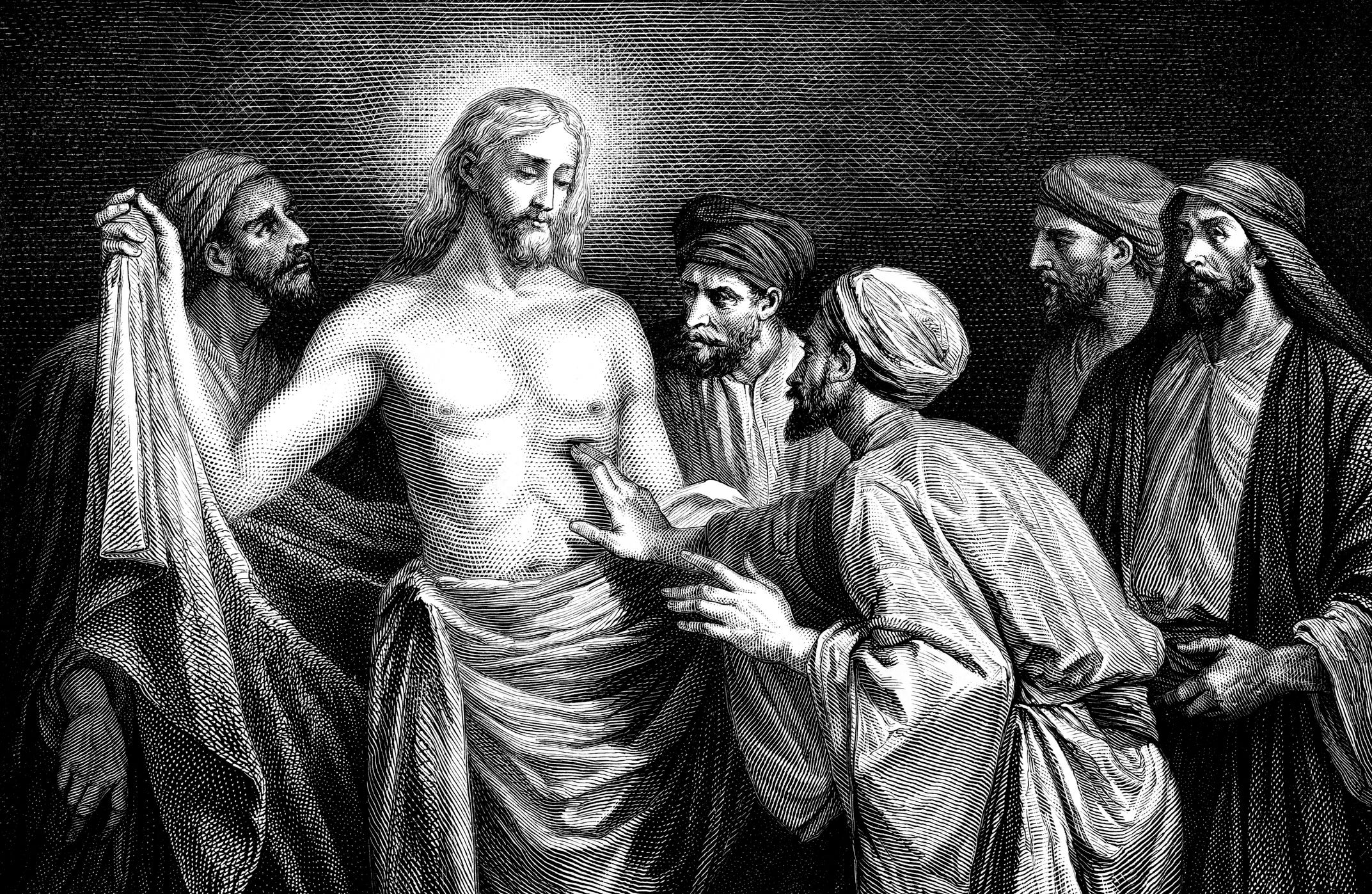
When it was evening on that day, the first day of the week, and the doors were locked where the disciples were, for fear of the Jews, Jesus came and stood among them and said, “Peace be with you.” After he said this, he showed them his hands and his side. Then the disciples rejoiced when they saw the Lord. – John 20
I’ve been thinking about scars a lot this week. And how much of my life I spent trying to hide mine. I would use concealer on the scars on my face from all the surgeries I had as a kid. Most of my torso is covered in stretch marks from gaining 70 whole pounds when I was pregnant. So, 2-piece swim-suits were not my friend. And I always thought that scar on my knee was pretty gross– the one I got before getting clean and sober when I was drunk and thought riding my motorcycle on icy streets was a really smart thing to do on a Tuesday in February.
And those are just the scars I have on the outside, if you know what I mean.
I thought of this all week when reading this story about Jesus appearing to his disciples. Because what I realized is I find it comforting that that his resurrection did not erase the marks of having lived his life or even having endured his death.
I find it comforting that when Jesus rose from the dead he was recognizable by his scars.
The band The Hold Steady has some perfect lyrics for the messiness of resurrection,
She crashed into the Easter Mass with her hair done up in broken glass. She was limping left on broken heels. When she said ‘Father can I tell your congregation how resurrection really feels?’
Jesus came and stood among his disciples and said peace be with you, then he didn’t try and hide the mark from the spear on his side. He didn’t wear gloves to conceal his scars. Jesus came and stood among his disciples and said peace be with you then he showed them his hands and his side.
He knew that he would be known by his wounds.
And isn’t that true for us as well? We can only really know and be known when we show our scars. I never really feel a connection to someone until they have shared with me the lumpy, broken, petty, parts of themselves. I may be inspired by the virtue and accomplishments of others, but I only feel less alonewhen someone shares their failures with me, the parts of themselves that have been hurt. As Beyonce says, show me your scars and I won’t walk away.
Scars are like the metabolized remains of our wounds. And as you know, they can be physical and emotional. If your mom left when you were young, you will always be someone whose mom left when you were young. There will always be a mark on you in the place that was hurt by that loss.
I will never be someone who was not a chronically ill child. Those scars never leave. It doesn’t work like that. And everything that has happened to you has happened to your bodies. Every act of violence, every moment of pleasure. Every hateful thing we have said or which has been said to us has happened to our bodies. Every kindness, every sorrow. Every ounce of laughter.
We carry all of it with us in some form or another. We are walking embodiments of our entire story. The scars from that aren’t optional, but the shame is.
Being an Easter people — a people of resurrection — is not to be cleansed from all harm, and it is not to have all the bad things that we have done or that have happened to us erased. Resurrection is not about rewriting our past or forgetting what happened. I wish that’s how it worked but it just isn’t. Because (as many preachers before me have said) resurrection is not reversal.
The things that happened to Jesus’ body — the state sanctioned violence, the flogging, the crucifixion — remained even after he defeated death and rose from the grave. He still bore the marks of that pain, but the pain was not what defined him.
And if you think about it, his resurrection tracks with the messiness of the rest of the ministry. Jesus went about the countryside turning water to wine, eating with all the wrong people, casting out demons, angering the religious establishment. He touched the unclean and used spit and dirt to heal the blind and said crazy things like “the first shall be last and the last shall be first”, and “sell all you have and give it to the poor and pray for those who persecute you”. (Or as we like to say here, pray for those who prosecute you).
And the thing that really cooked people’s noodles wasn’t the question “is Jesus like God” it was “what if God is like Jesus”. What if God is not who we thought? What if the most reliable way to know God is not through religion, not through a reward and punishment program, but through a person. What if the most reliable way to know God is to look at how God chose to reveal God’s self in Jesus, even in Jesus’ wounds.
Because that changes everything. If what we see in Jesus is God’s own self revealed, then what we are dealing with here is a God who is very different than how I would be if I were God. In Jesus we see a God who would rather die than be in the sin accounting business anymore. A God who does not lift a finger to condemn those who crucified him, but went to the depths of Hell rather than be separated even from his betrayers. A God unafraid to get his hands dirty for the ones he loves. This is the God who raised Jesus from the grave — still wounded and who chose a woman with a past to tell everyone else about it.
I guess what I am saying is don’t believe the paintings of the resurrection — where Jesus is all cleaned up and shiny, like nothing bad really happened.
If you think that’s what resurrection looks like, if you think it looks like perfection and therefore it is out of reach, if you think the only sign of God bringing new life is the absence of pain or failure and therefore you haven’t experienced it, you might be wrong.
That’s the point.
Our scars and our sorrow will always be part of our story but they will never be the conclusion of our story. Which means that even when you feel trapped in your pain, trapped in your past, trapped in your own story like it is itself a tomb, know this — that there is no stone that God cannot roll away.
Happy Easter, friends.
(sermon preached in The Beacon at Skyline Correctional Facility chapel in Canyon City Colorado)
Presbyterian pastor Rachel Srubas writes of the paradox at the heart of Good Friday and the three-day “triduum” of Holy Week:
Jesus anticipated his arrest, passion, and entombment, calling this triduum “three days and three nights … in the heart of the earth,” and likening it to the prophet Jonah’s journey “in the belly of the sea monster” (Matthew 12:40). Thomas Merton, the brilliant contemplative writer of the twentieth century … also wrote of Jonah (or as Merton and others have called him, Jonas). In The Sign of Jonas, … Merton said, “It was when Jonas was traveling as fast as he could away from Nineveh, toward Tharsis, that he was thrown overboard and swallowed by a whale who took him where God wanted him to go…. Even our mistakes are eloquent, more than we know.” [1]
A sense of sacred irony, of eloquent mistakes, has for centuries enabled Christians to call the Friday of Jesus’ tortuous execution “good.” This is not a matter of putting a happy spin on a grisly, unjust tragedy. Good Friday, and all Christian life, is about embracing paradox. Jesus’ teachings and his death reveal sacred contradictions. The truth that you and I may try to avoid, the pain we’re loath to face, point the way toward our freedom from captivating lies that perpetuate our suffering. When you and I embrace Jesus’ essential paradox—that to lose is to gain and to die is to live—we come to God, who gathers up the broken pieces of the world and makes them more complete and beautiful than they were before they broke. God integrates all fractious dualities into the wholeness of life that Christians call eternal salvation. It’s a life we get to live here and now, by grace and faith. It’s the life toward which Lent has always pointed.
Like Father Richard, Srubas considers the cross a “collision of opposites” that leads us deeper into reality and the presence of God:
Following his jubilant entry into Jerusalem (which Christians celebrate on Palm Sunday), Jesus told his disciples, “The hour has come for the Son of Man to be glorified. Very truly, I tell you, unless a grain of wheat falls into the earth and dies, it remains just a single grain; but if it dies, it bears much fruit” (John 12:23b–24). Pay attention to that pivotal unless and understand: without the fatal fall, no glorious resurrected life can be lived.
From this divine paradox, it follows that there can be no compassion without passion, no responsive loving-kindness unless there first comes suffering. Until God ultimately mends all of creation’s broken pieces, there will come suffering.…
“You will know the truth,” Jesus said to those who trusted him, “and the truth will make you free” (John 8:32). By his clear-eyed honesty, Jesus revealed holy, ironic wholeness. Denying pain would intensify it but facing hard facts of life and death would lead people deep into reality, the only place where God eternal can be found.
________________________________________________
Sarah Young
My Savior-God, I long for the absence of problems in my life, but I realize this is an unrealistic goal. Shortly before Your crucifixion, You told Your followers candidly: “In this world you will have trouble.” I’m thankful I can look forward to an eternity of problem-free living, reserved for me in heaven. I rejoice in this glorious inheritance, which no one can take away from me. Teach me to wait patiently for this promised perfection rather than seeking my heaven here on earth. Lord, help me to begin each day anticipating problems—asking You to equip me for whatever difficulties lie ahead. The best equipping is Your living Presence, Your hand that never lets go of mine. Discussing my problems with You frees me to take a more lighthearted view of trouble—seeing it as a challenge that You and I together can handle. Please remind me again and again that You are on my side and You have overcome the world! In Your conquering Name, Jesus, Amen
JOHN 16:33; I have told you these things, so that in me you may have peace. In this world you will have trouble. But take heart! I have overcome the world
PSALM 73:23 NKJV; Nevertheless I am continually with You; You hold me by my right hand. 24 You will guide me with Your counsel, And afterward receive me to glory.
PHILIPPIANS 4:13 NKJV; I can do all things through [ a]Christ who strengthens me.
ROMANS 8:31;What then shall we say in response to these things? If God is for us, who can be against us?
Young, Sarah. Jesus Listens (p. 102). Thomas Nelson. Kindle Edition.
This CO2- (Church Of 2) is where two guys meet each day to tighten up our Connections with Jesus. We start by placing the daily “My Utmost For His Highest” in this WordPress blog. Then we prayerfully select some matching worship music and usually pick out a few lyrics that fit especially well. Then we just start praying and editing and Bolding and adding comments and see where the Spirit takes us.
It’s been a blessing for both of us.
If you’d like to start a CO2, we’d be glad to help you and your partner get started. Also click the link below to see how others are doing CO2.Odds Monkey
Steve Harvey Introduces Jesus To A Secular Audience
About
Change this text in the admin section of WordPress
You are currently browsing the CO2MannaToday blog archives.