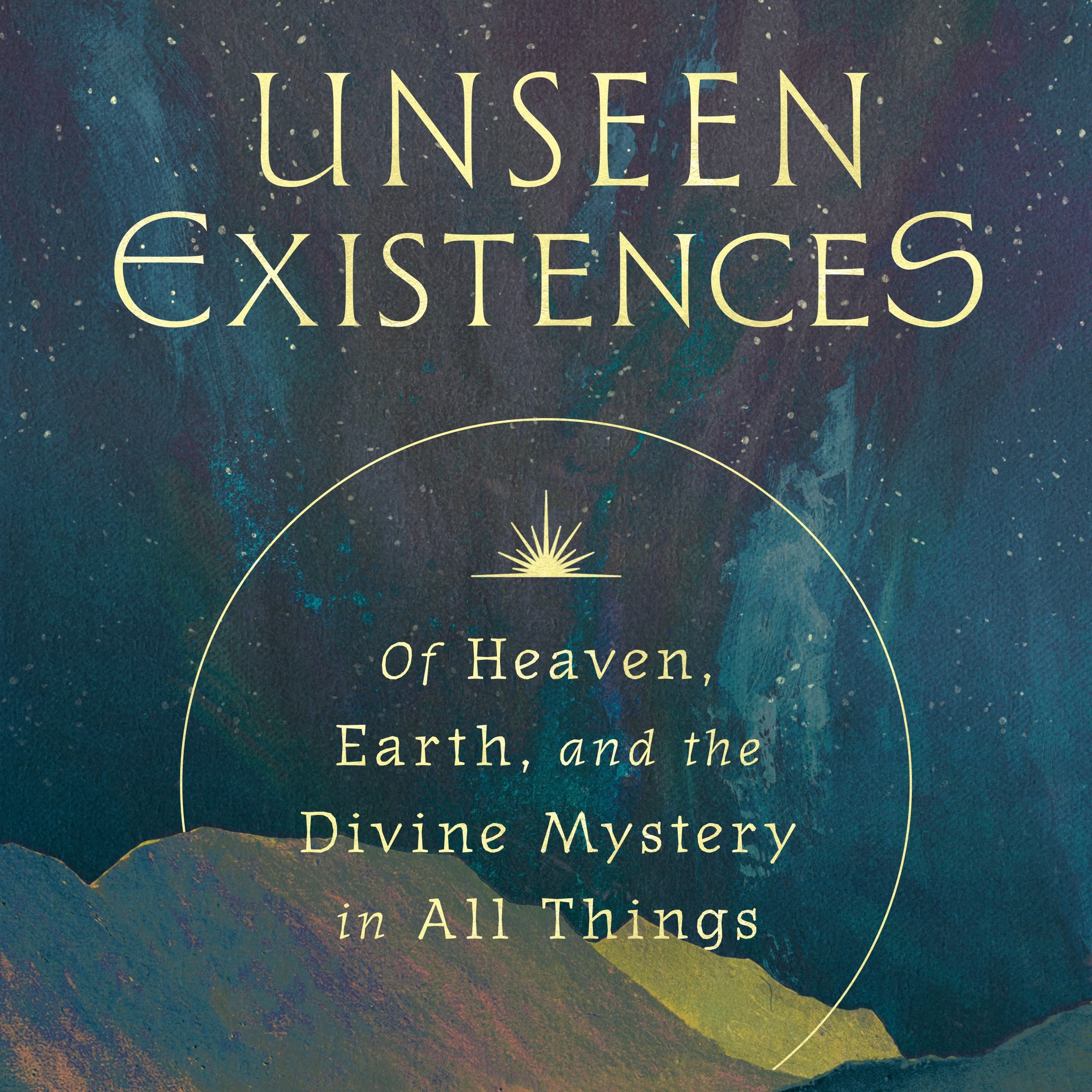
Father Richard teaches that true religion leads us to an experience of our true self and undermines our false self:
The true self is who you are because of the divine indwelling, the Holy Spirit within you (Romans 8:9). We are all temples of God, says Paul (1 Corinthians 3:16). What happened in Christ, the Anointed One, is an announcement of what is happening in all of us, too. We are children of heaven and earth, both at the same time. Much of the work of enlightenment is bringing those two identities together, just as Jesus did.
Putting the human and the divine together is what it means to be “the Christ” (Colossians 1:17–20), and what it means for us to be “the new Adam [and Eve]” (1 Corinthians 15:45–49). Ephesians could not make it much clearer: “You too have been stamped with the seal of the Holy Spirit that was promised—this is the pledge of your inheritance” (1:13–14).Few Christians have ever been seriously taught about their inherent union with God and will find all kinds of self-hating reasons to deny it. Only the true self can dare to believe the gospel’s good news.
The false self is characterized by separateness. Jewish and Christian traditions call this state of disconnectedness “sin.” When we’re separated from our deepest being, we are in a state of sin or alienation. When we are disconnected from our true self in God, we look for various false and addictive ways to fill our emptiness. The small or false self is who we think we are, but our thinking does not make it so. It is our identity created through culture, education, class, race, friends, gender, clothes, and money. That’s all that Adam and Eve had once they left the garden where they walked with God. But let’s not feel too bad for them or even guilty ourselves. It seems that we have to leave the garden. We have to create a false self to get started; the trouble is that we take it far too seriously. It is always passing away—in stages and then all at once at death. Only the true self is eternal. We all suffer from a terrible case of mistaken identity.
The true self is characterized by communion and deep contentment. It’s okay, right here, right now. The true self is the realigned self; and religion’s main purpose is to lead us to experience this self, which is who we are in God and who God is in us. It has to do with participating in a Universal Being that is beyond our being. Ultimately, our lives are not about us. We are about life! That doesn’t mean we stay in the true self twenty-four hours a day. Life is three steps forward and two steps backward. Yet once we know the big picture, we will never be satisfied with the little picture.
Reference: Adapted from Richard Rohr, “True Self, False Self,” Radical Grace 25, no. 4, (2012): 39, 40, 41.
I feel compelled to, but I’m not sure why. I am a mystery to myself. Is this my attempt to share some truth, or is this some means by which I am looking for validation? I contain multitudes… I am a walking contradiction at all times. In our current era of social media and internet use, I question whether anything I say here will be shared with anyone who doesn’t already agree with me.
All that said, I would like to share something with you. Consider these the thoughts of an incomplete individual who is still learning how to integrate and incarnate paleo-orthodoxy today.
Here is what I believe and hope to humbly share:
Any rhetoric that creates an Us vs Them thinking is inherently diabolical, anti-Christian, and utterly unbecoming of anyone who believes in Christianity’s claim of tearing down the wall of separation and creating one new humanity (Ephesians 2).
Any Us vs Them thinking is diabolical in the deepest and truest sense of the word. It originates from the Greek word Διαβολος, which breaks down etymologically as Δια- (Dia- meaning “two”) and Βολλω (Bollo- meaning “I throw”). Anything is therefore “diabolical” if it takes one thing and breaks it down into two and throws them apart.
The current political discourse is inherently diabolical. When I read the news, all I can see is the scapegoat mechanism happening, the throwing of all blame, shame, anger, and fury at some “other” individual or collective. To define who you are by who you are collectively casting out is the way of the “old humanity” and not the way of the “new humanity” of Ephesians 2, mentioned above.
The solution to the issues of our day is a deep and meaningful return to Christianity by the Christians. I say this knowing that conservative-leaning people would applaud this part. At the same time, a deep and meaningful return to Christianity by the Christians might throw some people off. Other, progressive-leaning people would applaud the same statement for different reasons.
Last night, I had a great conversation with three men younger than me, and at the end of the conversation, I encouraged them to re-read the entire New Testament with entirely fresh eyes. One of the problems of Christianity is that we defer to what our religious and political parties tell us about what it is all about. And, in a world where those lines are becoming more and more blurred, I want to echo the words of Shane Claiborne and say, “What if Jesus actually meant what He said?”
For Christians (and that is the only people group for whom I am remotely qualified to speak), the way forward is always a deeper return to the words of Jesus. And, I would add that the words of Jesus are more conservative than the progressives would ever admit, and also more progressive than conservatives would ever admit.
There is goodness, beauty, truth, and love that must be protected, but it is not protected by scapegoating, ostracising, eliminating, or killing our “enemies.” Christ was to be the last Crucified One. It is utterly unbecoming and a massive missing of the point to be Christians who then want to “crucify” others. That is not the way of Christ, that is the way of the Διαβολος.
Please, I beg all of us who ever hope to be called “devout,” to follow a Christianity that looks like Christ and not some diabolical “Christianity” that is not worthy of the Carpenter from Galilee. Go back and reread the New Testament, and do your best to remove every presupposition and previous stance you have ever had and read it as if for the first time… at no point is Christ interested in creating a new empire of man, but only invites people into a Kingdom of God where people are…
patient, kind, not boastful, not proud, not crude, does not dishonor others, not self-seeking, not easily angered, and keep no record of wrongs. Who do not delight in evil but rejoice in truth. Who always protect (those at the Bottom), who always trust (that fear should not rule our decisions), who always hope (that we can find a non-violent way), and who always perseveres (in virtues rather than submitting to vices).
Father Richard first encountered the concept of the true self and false self from the Trappist monk Thomas Merton (1915–1968), who had a mystical experience on the corners of Fourth and Walnut (now Fourth and Muhammed Ali Boulevard) in Louisville, Kentucky. Merton wrote:
At the center of our being is a point of nothingness which is untouched by sin and by illusion, a point of pure truth, a point or spark which belongs entirely to God, which is never at our disposal, from which God disposes of our lives, which is inaccessible to the fantasies of our own mind or the brutalities of our own will. This little point of nothingness and of absolute poverty is the pure glory of God in us. It is so to speak [God’s] name written in us, as our poverty, as our indigence, as our dependence, as our [birthright]. It is like a pure diamond, blazing with the invisible light of heaven. It is in everybody, and if we could see it we would see these billions of points of light coming together in the face and blaze of a sun that would make all the darkness and cruelty of life vanish completely…. I have no program for this seeing. It is only given. But the gate of heaven is everywhere. [1]
Father Richard reflects:
Most people spend their entire lives living up to the mental self-images of who they think they are, instead of living in the primal “I” that is already good in God’s eyes. But all we can “pay back” to God or others or ourselves is who we really are. This is what Merton is describing above. It’s a place of utter simplicity. Perhaps we don’t want to go there because it is too simple and almost too natural. It feels utterly unadorned. There’s nothing to congratulate myself for. I can’t prove any worth, much less superiority. There I am naked and poor. After years of posturing and projecting, it will at first feel like nothing.
But when we are nothing, we are in a fine position to receive everything from God. As Merton says, our point of nothingness is “the pure glory of God in us.” If we look at the great religious traditions, we see they all use similar words to point in the same direction. The Franciscan word is “poverty.” The Carmelite word is nada or “nothingness.” The Buddhists speak of “emptiness.” Jesus speaks of being “poor in spirit” in his very first beatitude (Matthew 5:3).
A Zen master would call the true self “the face we had before we were born.” Paul would call it who we are “in Christ, hidden in God” (Colossians 3:3). It is who we are before we’ve done anything right or anything wrong, before we even have a conscious thought about who we are. Thinking creates the separate self, the ego self, the insecure self. The God-given contemplative mind, on the other hand, recognizes the God self, the Christ self, the true self of abundance and deep inner security.
References: [1] Thomas Merton, Conjectures of a Guilty Bystander (Doubleday & Company, 1965, 1966), 142.
Image Credit and inspiration: Mick Haupt, untitled (detail), 2022, photograph. Unsplash. Click here to enlarge image. A shattered mirror reveals the light within each broken piece. Letting go of the false self is not a loss, but a breaking through that allows more light in.
Q. What prompted you to write Unseen Existences? Was there a particular moment or experience that made you realize the need for this book?
I began to notice that with a desire for a “this world” faith (a desire with which I fully concur) many theological circles had overcorrected to the point that heaven had gone missing from any serious consideration. But without heaven as the spiritual world of unseen existences Christian theology is rendered incoherent. Without metaphysics Christianity is reduced to mere ethics. Or to put it more severely, Christianity without transcendence degenerates into politics. We need to recover heaven—not the escapism of The Late Great Planet Earth and its successors; not the sensationalism of “my thirty minutes in heaven;” not the sentimentalism of kitschy social media memes—but heaven as the awareness of the spiritual world enfolded into the material world all around us. This was my motivation for writing Unseen Existences.
Q. Many people today struggle with belief in anything beyond the material. How would you invite skeptics or disenchanted Christians to rediscover the “unseen”?
To quote Nick Cave, “We must take our subtle spiritual intuitions seriously and view them as the quintessence that underlies the ordinary world. The rejection of the sacred is the fundamental reason for our existential discontent.” Our modern existential discontent will not be healed unless we remember what our ancestors knew: A spiritual world underlies what we think of as the ordinary world. Furthermore, philosophical materialism has the embarrassing problem of being unable to account for matter itself! With just a modicum of thought most people recognize that meaning must be derived from something that transcends the material world. If all there is is matter, not much really matters. I want to encourage people to lean into what they already intuit in the deepest part of their being. In a world where existential discontent is a genuine phenomenon I want to offer something constructive. Not a trite solution but a gesture in the direction of where I believe hope can be found. What is needed is a pilgrimage—a pilgrimage of the soul toward the homeland where we’ve never been. If our pilgrimage is true, it is a journey inspired by wonder, waymarked by beauty, and ultimately a quest for a forgotten realm called heaven.
Q. How do you see this book fitting into your broader body of work?
Q. If readers only take away one thing from Unseen Existences, what do you hope that one thing is?
I’m going to be ambitious and hope that readers can take away two things from Unseen Existences: Our true home is in the unseen world of heaven, and life is a pilgrimage of the soul toward our true home of union with God.
The words, “not I, but Christ” urged me to come home to myself more fully, to the petaled truth buried deep within. —Sue Monk Kidd, When the Heart Waits
The author Sue Monk Kidd reflects on her midlife discovery of the concept of the true self:
Over and over again God calls you and me … to the cultivation of what Meister Eckhart called the “true seed” within us. God calls us to tend what lies seeded in the soul, this kernel of our truest nature—the God-image or True Self….
Throughout our lives we create patterns of living that obscure this identity. We heap on the darkness, constructing a variety of false selves. We become adept at playing games, wearing masks as if life were a masquerade party. This can go on for a long while. But eventually the music of the True Self seeks us out. Sooner or later (often in midlife), we’re summoned back to the garden. We’re called to soul-work….
The soul wants to be acknowledged and nurtured. The True Self wants to bloom and grow. And the way to begin this spiritual flowering is to confront your false selves—the ego patterns you have created—and come home to who you really are inside.
Monk Kidd compares soul work to the art of whittling:
The art of soulmaking is taking our lives in our hands and—with all the love and discernment we can muster—gently whittling away the parts that don’t resemble the True Self. In spiritual whittling, though, we don’t discard the shavings. Transformation happens not by rejecting these parts of ourselves but by gathering them up and integrating them. Through this process we reach a new wholeness.
Spiritual whittling is an encounter with Mystery, waiting, the silence of inner places—all those things most folks no longer have time for. I’ll be honest. As I began my own spiritual whittling, I often clung to my “block of wood” resistantly. After all, wasn’t I fine just as I was?…
But there were also days when I felt drawn to try, when I yearned to discover how I was living falsely….
The writings of Thomas Merton encouraged me. He envisioned much of the spiritual life as whittling away the false self in order to become the True Self. He called the struggle for authenticity a “contemplative crisis” and insisted that no one can avoid it, that eventually we all “get the treatment.” According to Merton, “One’s actual self may be far from ‘real,’ since it may be profoundly alienated from one’s own deep spiritual identity. To reach one’s ‘real self’ one must, in fact, be delivered from that illusory and false ‘self’ whom we have created.” [1]
How real am I, I asked myself. What are the illusions I’ve created? What false selves do I need to pare away? Those are the whittling questions. Taken seriously, they’re tough and agonizing. “We are not very good at recognizing illusions, least of all the ones we cherish about ourselves,” wrote Merton. [2]
=====================
The following introduces the work of Wayne Jacobsen. And how he is beginning to use AI to assist readers in finding his thoughts from his life in writing, speaking and teaching. (A dozen books and over 1000 podcasts). Like all of us, he is nervous about AI and shares some examples of it’s use here….
What Does it Mean to Make Disciples?08/25/2026
A few weeks ago, we introduced the new Trail Guide at Lifestream and The God Journey websites with some trepidation. It’s a chatbot loaded with all the information from those websites and My Friend Luis, as well as all my books. It can help people search those resources as well as summarize my thoughts on a variety of topics drawn from my writings and podcasts.I get that some people are deeply concerned about AI and its future, and question my use of it here. I appreciate those concerns, which is why I keep a close check on the Trail Guide. As long as it’s helpful, we will keep it available. But it is on a short leash, should something go awry. Weekly, I get to review a log of the questions and answers from the previous week to ensure that all is well. Rest assured, however, that I do not see the names of anyone asking questions, since the Trail Guide does not ask for, nor does it retain, any identifying information about who is interacting with the Trail Guide. So, how is it working? Better than I could have hoped. I’m fascinated by how it can pull from so many sources and come up with summaries that are accurate and helpful, as well as provide additional links if people want to explore the answer a bit more deeply. The way people are using the Trail Guide is exactly what I hoped for. It allows you to access my content and explore topics that might interest you.For those who haven’t tried it yet, here are a few examples of what it does: Q: What does Wayne teach about making disciples? Trail Guide: Wayne’s understanding of discipleship is quite different from what most people have been taught. He sees it not as a program or a set of practices to master, but as learning to follow Jesus himself—and that happens through relationship, not religious instruction. In Learning to Follow the Shepherd, Wayne pushes back against the idea that discipleship means building a relationship with God through intellectual principles or becoming like a particular teacher.The real goal, he says, is to become a follower of Jesus—to reflect the Father’s nature in the world. That means learning to listen to his voice and follow him, not following a person or a program. What makes discipleship real, in Wayne’s view, is conversation and relationship. In The Approval Addiction, he reflects on how Jesus discipled his friends by talking with them about what mattered most—not performing for an audience, but inviting them into genuine friendship. The goal of a good teacher, he says, is to enable people to do what he’s done and even more, not to create dependency on himself.This comes through clearly in So You Don’t Want to Go to Church Anymore? Wayne’s novel about a disillusioned pastor learning from a stranger who bears an uncanny resemblance to John the apostle. The story shows discipleship as it really works: asking questions, helping someone see what they haven’t seen before, and pointing them toward Jesus rather than toward yourself.Wayne also teaches that real discipleship happens when people learn to recognize the Father’s voice in their own lives—not when they’re told what to believe or how to behave. In The Church Jesus Modeled, he contrasts this with the religious approach of making “good practitioners of Christianity” through programs. True discipleship, he says, is about helping people discover Jesus’s voice and learn to follow him—so they don’t need you anymore.Sources: The Approval Addiction (#566), The Church Jesus Modeled (#809), Learning to Follow the Shepherd This exchange made me laugh as a typo, or autocorrect, caused some initial confusion, but the Trail Guide finally understood:Q: Tell me about living from foldersTrail Guide: I’m not finding where Wayne takes up “living from folders” directly in the material I have at hand. That phrase doesn’t surface in his books, articles, or podcast episodes that I can see.Could you say a bit more about what you mean? Once I understand what you’re getting at, I can point you toward what Wayne has said that might speak to it. Q: FullnessTrail Guide: I’d love to help, but I’m not quite sure what you’re asking about. When you say “fullness,” are you wondering about: Living in the fullness of God’s love and the Father’s affection? Experiencing fullness in your relationship with Jesus day to day? Something else entirely? A quick word would help me point you toward what Wayne has written that speaks to what’s on your heart.Q: Living from fullness. Trail Guide: Living from fullness is one of Wayne’s most central themes — and it’s the opposite of what most of us have been taught to do. The heart of it is this: fullness isn’t something you achieve or figure out. It’s not about keeping rules or getting your life in order first. You’re already rooted in Christ, already complete in him. The work is learning to live from that reality instead of constantly reaching outside yourself — to your job, your relationships, your circumstances, money, respect — trying to fill a hole that only God can fill.When your fullness comes from the Father’s love and presence, everything changes. You stop needing things from people or situations to make you whole. That frees you to love others without desperation, to respond to life from a full tank rather than an empty one. As Wayne puts it, when you’re full in God, you can live toward others in genuine love — what he and Tobie van der Westhuizen call “the justice of love” — instead of using them to get what you’re missing.The practical side is simple but profound: when you notice discontent rising, when you’re grasping for something outside yourself, pause and redirect your heart. “I want my fullness to be in you,” not in that thing, that person’s approval, that outcome. Over time, that reorienting becomes a way of life. Wayne explores this beautifully in Living from Fullness (#1009), and it’s woven through Just Love and his teaching on Affection Presence And Fullness. You might also find the curated page How can I live every day in the Father’s love? a rich place to explore this theme more deeply.Sources: Living from Fullness (#1009), Affection Presence And Fullness And sometimes I ask it a question, just to see how it will answer:Q: How does the business model behind religious institutions distort the authenticity of its message?Trail Guide:Wayne sees the business model behind religious institutions as fundamentally at odds with the gospel itself. Once money enters the picture—salaries to pay, buildings to maintain, growth metrics to hit—the machinery takes over, and the message gets distorted almost inevitably.In “Monetizing Ministry,” Wayne traces how this happens. When an institution depends on donations and revenue, decision-making revolves around economics rather than the Spirit’s leading. Large donors gain leverage. Pastors are forced to sign non-compete clauses. Publishers become publicly traded corporations chasing shareholder profits. The result is that we’ve moved from serving God’s kingdom to building our own—valuing size, influence, money, and notoriety instead of the obscurity, servanthood, and flexibility that actually mark Jesus’s way.The deeper problem is that money always wins out, even among those who start with the best intentions. Jesus said you cannot serve God and money, but we’ve convinced ourselves we can blend them. We can’t. The business model doesn’t just distort the message—it replaces it. Instead of inviting people into genuine encounter with the Father, institutions resort to pressure and manipulation, framing attendance as obligation and threatening spiritual danger for those who leave.What gets lost is authenticity itself. When people have to perform to please leadership whose success depends on their obedience, when guilt and fear become the tools of “accountability,” the relational heart of the gospel—living loved, known by the Father—disappears. The machinery grinds on, but the life is gone.If this resonates with you, “Finding Church”explores what authentic church actually looks like when it’s freed from institutional frameworks, and the curated page “Where will I find the church Jesus is building?” gathers Wayne’s best work on this theme.Sources: Monetizing Ministry, Finding ChurchThe post What Does it Mean to Make Disciples? first appeared on Lifestream | Wayne Jacobsen. This post is published at Lifestream.org. View the original post at https://www.lifestream.org/what-does-it-mean-to-make-disciples/
Richard Rohr appreciates the purpose the false or egoic self serves, while encouraging us not over-identify with it.
Our false self is not our bad self, our inherently deceitful self, the self that God does not like or we should not like. Actually, our false self is quite good and necessary as far as it goes. It just does not go far enough, and it often poses and substitutes for the real thing. That is its only problem, and that is why we call it “false.” Various false selves (temporary costumes) are necessary to get us all started, but they show their limitations when they stay around too long. If a person keeps growing, their various false selves usually die in exposure to greater light.
Our false self, which we might also call our small or separate self, is our launching pad: our body image, our job, our education, our clothes, our money, our success, and so on. These are the functional trappings of ego that we all use to get us through an ordinary day. However, they are largely projections of our self-image and our attachment to it.
When we are able to move beyond our false self—as we are invited to do over the course of our lives—it will feel precisely as if we have lost nothing. While this “moving beyond” almost always entails some suffering, it ultimately feels like freedom and liberation. When we are connected to the Whole, it lessens our need to protect or defend the mere parts. We no longer need to compare and compete. We are now connected to something inexhaustible.
To not let go of our false self at the right time and in the right way is precisely what it means to be stuck, trapped, and addicted to our self. (The traditional word for that was sin, the result of being separate from the Whole.) Discovering the true self is not just a matter of chronological age. Some spiritually precocious young people see through the false self rather early, while some old men and old women are still dressing it up. If all we have at the end of our life is our separate or false self, there will not be much to eternalize. These costumes are transitory and impermanent, useful to us in our development, but also largely created by the mental ego. The false self is what changes, passes, and dies when we die. Only our true self lives forever.
Before we have encountered our true self, our false self is who we think we are. But our thinking does not make it true. The false self is primarily a social construct to get us started on life’s journey. It is a set of agreements made during childhood with our parents, family, neighbors, school friends, partner or spouse, and religion. Jesus might call it an “old wineskin,” which he points out cannot hold any new wine (Mark 2:22).
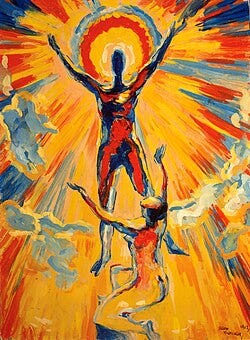
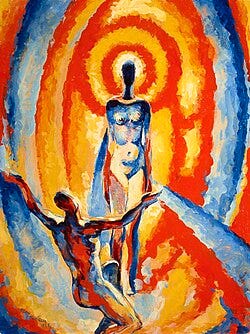
Egon Tschirch Song of Songs Nº. 8 1923Egon Tschirch Song of Songs Nº. 10 1923
What, exactly, is the Song of Solomon doing in our Bibles? How are we to pray with it or preach or teach on it, given that God is never named, nothing even remotely religious is called for, and what the poems do describe is, well, disturbingly sexy?
One approach is simply to let it be what it is, accepting that God means to embarrass us. Rowan Williams has suggested that the one thing we must not do is “explain it away by allegory,” reducing the erotic to the merely symbolic.
The woman in the Song of Songs is neither a virgin, nor a mother, nor a prostitute, so she escapes all the usual stereotypes attached to her gender; she is allowed to express her desire in unambiguously erotic language, as indeed is the man. “Love one another fervently”—yes, certainly; but “with a pure heart”? Not so much. For this isn’t an allegory of desire: it’s the real thing. Passion fierce as the grave, love strong as death, raging flames…
It has become a familiar critique, the one Williams suggests. Ancient and medieval Jewish and Christian readers, the majority of them, at least, felt the need to spiritualize the poem because they were deeply ambivalent toward sex and sexuality. The Song itself, however, has no such qualms. It forces the reader to face the naked truth of desire. As human beings, we are, as C.S. Lewis famously put it, made for need-love as well as gift-love; so, we actually do need both to want and be wanted, both to get what we want and to give satisfaction to others. That, Williams, argues, is what the Song reveals. He ends the homily with a call to let ourselves be needy, to long for God and to love like God, passionately, unashamedly, refusing to be satisfied with anything less:
Love is not for the faint-hearted. That’s the charge laid against the church in Laodicea, in our second reading. They are too lukewarm, too dispassionate. There may be purity in their hearts, but there is no fervour. God’s love demands more. It is uncompromising, bringing with it “reproof and discipline” for those who do not give everything. But it is not self-indulgent. For God’s love treats us as absolutely real. God wants our fulfilment, our satisfaction and completion. God wants us to be who we are, who we are called to be; complete with our unruly bodies and our messy desires. Whether it is a person or a principle we want most, to love them—with a pure heart, fervently—is the most Godlike thing we could ever do.
Williams is not wrong. Too many readers have been scandalized by the Song’s eroticism, and repelled by the naughtiness/knottiness of human sexuality. But I would contend that that discomfort is more modern than it is ancient. It was a Protestant theologian, after all, who so famously set erosand agape into total contrast.
I agree too that the Song is not an allegory. The text does not speak of one thing meaning another. Indeed, it is because it is not an allegory that the Song is ripe for a particular kind of allegorical interpretation. As Williams makes clear in the closing words of his homily, it precisely because the Song is about these lovers and their love that it reveals what is true of God’s love affair with us. The letter of the Song does not hide the spirit we are meant to receive but is wholly inspired by it, the flesh of the letter quickened, flushed with desire, luminous in longing.
Origen and Gregory and the other great allegorists knew this. They read the Song as the celebration of the marriage of the divine and the human, agape and eros, gift and need. So, whatever the errors and excesses of their methods ,and notwithstanding their sometimes quite serious misunderstandings and anxieties about sexuality and embodiment, they still come nearer than we do to the sacred heart of the Song. For they come to the text knowing that all things are what they are onlyin Christ, in his divine-human heart. They come knowing that that because of him all things are related to all other things, held in at-one-ment. They come knowing that that must be so, because the Father has created all things simply by the giving of the Son to Mary and her family, her people, her friends.The Father speaks no Word other than the Son, and in speaking him calls every creature into being. In the words fo the master preacher: “the Father always speaks the Son in unity and pours forth all creatures in him.”¹
All things have come into being in him, the uncreated Word, eternally begotten before all ages with and in the same Spirit who overshadows his mother in the fulness of time. Because of him, because of how he is who he is, nothing exists by or for itself, self-grounded and self-fulfilled, but exists instead for him and with him. Therefore, everything—truly, everything—is capable of bearing and revealing everything else. AsNicholas of Cusa says, going beyond even Anaxagoras: “all is in all and each in each” because “God is the actuality of all things” (On Learned Ignorance 2.5.117-118). This is why in the Song the garden is a body and the body a garden, the man a cedar and the mountain into which the cedars reach their roots, a king and a pillar of smoke, and the woman a grande city, an army arrayed with banners, her eyes doves, her neck a balustrade, their kisses, goblets of wine.
Perhaps tautegory, then, is what we should say the Song is, not allegory. Or even better: it is all-egory. The lovers in the Song do not represent a bride and bridegroom; they are the Bride and Bridegroom. And precisely in their wanting and finding, their trysts and romances, we know and are known.
Franz Rosenzweig, in a lengthy meditation on the Song in The Star of Redemption, speaks for the traditional reading, the tried-and-true appreoach that led to the canonization of the text in the first place:
The allegory of love, as allegory, goes through the whole Revelation. It is the allegory that keeps coming up in the Prophets. But it is supposed to be more than an allegory. And it is so only when it appears without a “this means,” without any reference to that for which it is supposed to be the allegory. So it is not enough that the relationship of God to man is presented in the allegory of the lover and the beloved; God’s word must immediately hold the relationship of the lover to the beloved, without the signifier making any allusion at all to the signified. And so we find it in the Song of Songs. It is no longer possible to see in that allegory “only an allegory.” The reader seems to be confronted here with the choice either of allowing the “purely human,” purely sensuous meaning, and then of asking himself by what surprising error these pages managed to get into the word of God, or of recognizing that here, precisely in the purely sensuous meaning, the deeper significance is hidden, immediately and not “only” in the allegorical form.²
Modern biblical criticism called into question what the synagogue and the church had always known, inventing a rift between the “original” fully human love poems and the supposedly later mystical interpretations of it. This hermeneutics of disjunction (it is not enough to speak of it as suspicious) sundered what God had joined together, as Rosenzweig explains:
Until the beginning of the nineteenth century, the Song of Songs was recognized as a love song, and at the same time immediately as a “mystical” poem. One simply knew that the I and You of inter-human language are also quite simply the I and You between God and man. One knew that in language the difference between “immanence” and “transcendence” is extinguished. It is not although but because the Song of Songs was an “authentic,” that is to say a “worldly” love song, that it was an authentic “spiritual” love song of God’s love for man. Man loves because, and as, God loves. Man’s human soul is the soul awakened and loved by God.³
Like Wittgenstein a decade or so later in his response to Frazer’s Golden Bough, Rosenzweig recognized biblical criticism’s main failing as its refusal to be honestly critical of its own aims and methods. Through the “hopelessly arbitrary and venturesome character of textual criticism,” the “I and You of the lyric” is reduced into the “He and She of the epic,” a reduction that is done, quite intentionally, to generate distance from the holy.
The language of the Revelation of the soul had something disquieting in it for the spirit of that century, which modeled all according to its image in order to make it something objective and worldly. At first, the denial of the word of God had still taken place in an exuberant joy for the word of man, now qualified by “pure,” but it lost no time in taking revenge on the word of man, which, detached from its immediate, living, trustful union with the word of God, hardened into the dead objectivity of the third person.⁴
We should have listened to Rosenzweig. But we did not. Too many of us, including “conservatives,” invented or adopted methods and (more importantly) attitudes that could not help but distort the truth we were supposedly seeking. Like a restorer using the wrong solvent, we damaged and deface—and at times erased altogether—the very image we sought to renew. “The dead objectivity of the third person”—that is the dead giveaway, the ugly smear left by the hermeneutics of disjunction and its pseudo-scientific “findings.”
The traditional ways of reading knew that the reading of Scripture is always an I-Thou exchange—communion, intercourse—not an I-It enterprise. For Origen and the other allegorists who follow him as he follows Hebrews, following Paul, following Jesus, spiritual exegesis, far from turning away from reality, is instead always about “encountering the Logos who speaks in the text.”⁵ They could expect such an encounter because they believed that the “opening of the Scriptures” was a mystical reality, as indeed all realities are, and not some “subjective” experience happening only in the heart and mind of the individual via some reader-response meaning-making process. It is not as if in reading the text and finding some meaning in it we have met the Lord. No, the Word speaks in the words so that the Scriptures are fulfilled in our hearing. Gregory, in one of his homilies on the opening chapter of the Song, says plainly that “the words of the present passage are a participation in divinity itself…”⁶ Think of what that must mean.
Ben Myers has identified this approach to reading Scripture as “exegetical mysticism,” a way of knowing and being that refuses to separate being from knowing, a form of attention ordered toward first-person intimacy not third-person mastery. Christ is no idea to be grasped, the canonical texts not artifacts of a now-dead history, teaching never a matter of analyzing and applying information. The Word is the Word, and we have been captured by the sight and sound of him, as the Shulamite is captured by the sight and sound of her beloved. What we call “interpretation,” then, is nothing less than lived communion with him, born of hearing what was once said about him as what he is saying now, speaking for himself to us in the words of his friends.
Laboring over a difficult passage, the reader suddenly catches a glimpse of the divine Logos and “perceives him to be present” in the text. As Christ “draws near to [the] senses” he “illuminates the things that are obscure,” so that the soul sees him clearly. He “leaps” over the text toward the expectant soul… In the disciplined contemplative reading of scripture, “the hand of the interior soul” reaches out and touches the living Word.⁷
This, then, is the crux of the matter, the determining factor in our approach to the Song: the human body cannot not speak of God and our ache to be in secret with God, especially in the acts and angst of love, because the God who created the body reveals himself as love by what is done to his body. Now, thanks to the Spirit, what is true of his body is true of all bodies, including yours and mine, and true of the body of these sacred texts. For, when all is said and done, we are ourselves and they are themselves just because we are all his—no, more than that: because we arehim, bone of his bone and flesh of his flesh.
Father Richard Rohr encourages us to look within to discover our true self, the presence of God within us:
We are all looking for something utterly reliable, something loyal and true, something we can always depend on. In John’s very short second letter in the New Testament, the writer offers us an invitation to discover what we are looking for when he writes of “the truth that lives within us that will be with us forever” (2 John 2). Most of us know little about this truth, so we end up as St. Augustine admits in his Confessions: “Late have I loved you, Beauty so very ancient and so ever new. Late have I loved you! You were within, but I was without.” [1]
We are right to go inside; otherwise, we become lost in an outer and revolving hall of mirrors, as Augustine confesses above. But the question is, “Which inside?” I use the language of the true self and the false self, which many have found quite helpful in talking about this concept. [2] It is good and necessary to pull back into our true self, but it is quite a disaster if we pull back into our egoic or false self for too long (or, worse, never leave it). The confusion comes because both true self and false self feel like our “self.” One might be called truly “centering,” while the other is the more common “ego centering.” This reveals the core of the problem. Jesus and most other great spiritual teachers make it very clear that there is a self that has to be found and one that has to be let go of or even “renounced” (Mark 8:35; Matthew 10:39, 16:25; Luke 9:24; John 12:25).
We might call the true self our soul, and we might call the false self our ego, our small or separate self. In finding our true self, we will have found an absolute reference point that is both utterly within us and utterly beyond us at the very same time. This grounds the soul in big and reliable truth. “My deepest me is God!” St. Catherine of Genoa shouted as she ran through the streets of town, just as Colossians had already shouted to both Jews and pagans, “The mystery is Christ within you—your hope of Glory!” (1:27).
Once discovered, the healthy inner authority of the true self can be balanced with the outer authority of Scripture and Tradition. Our experience can be validated by others’ experience. That’s what assures us that we are grounded in reality, not a fantasy. That God is both utterly beyond us and yet totally within us at the same time is the exquisite balance that most religion seldom achieves, in my opinion.
==================
Recognizing Our True Self
Monday, August 24, 2026
Father Richard describes the characteristics and purposes of the true self in greater depth:
Searching for and rediscovering the true self is the fundamentum, the essential task that will gradually open us to receiving love from and giving love to God, others, and ourselves. We are created in the image of God from the very beginning (Genesis 1:26–27).
You and I (and every other created thing) begin with a unique divine DNA, an inner destiny as it were, an absolute core that knows the truth about our being. This true believer is tucked away in the cellar of our being, an imagoDei that begs to be allowed, to be fulfilled, and to show itself. “You were chosen in Christ before the world was made—to stand before God in love—marked out beforehand as fully adopted sons and daughters” (see Ephesians 1:4–5). This is the true self. Historically, it was often called “the soul.”
Jesus revealed and accepted a paradox in his entire being: Human and divine are not separate, but one! His life shouted it. I wonder why we so resist our same destiny. For most of us, this seems just too good and too dangerous to be true. There is so much contrary evidence! Many clergy fight me on this, even though it is quite constant in the Tradition. Is it because we are afraid to bear the burden of divinity? As Marianne Williamson says: “Our deepest fear is that we are powerful beyond measure.” [1] Maybe we realize subconsciously that if we really believed that we are temples of God (see 1 Corinthians 3:16, 6:19; 2 Corinthians 6:16), then we would have to live up to it.
The true self is the Divine Indwelling, the Holy Spirit within us. I would say that the true self is precisely the divine part of us that is great enough, deep enough, gracious enough to fully accept the human part of us. If we are merely human, we will tend to reject our embarrassingly limited humanity. Think on that!
Paradoxically, immense humility, not arrogance, characterizes someone who lives from their true self. They simultaneously know they are a child of God, but they also know that they didn’t earn it and are not worthy of it. They know it’s entirely a gift (see Ephesians 2:8–9 and throughout the Pauline writings). All they can do is thank Somebody Else, occasionally weep with joy, and kneel without any hesitation.
The true purpose of mature religion is to lead us to ever new experiences of our true self. If religion does not do this, it is junk religion. Every sacrament, every Bible story, every church service, every sermon, every hymn, every bit of priesthood, ministry, or liturgy is for one purpose: to allow us to experience our true self—who we are in God and who God is in us—and to live a generous life from that Infinite Source.
==============
Thinking About It:
If God is already present within you, what part of you would you need to become quiet enough to hear—and what part of you might you need to let go?
Father Richard finds in the prophets an invitation to follow their path of disrupting injustice:
When prophets see that the status quo is not working, they encourage what I call “holy disorder,” a scenario in which the fundamental conditions and relationships of the group are disrupted (as when the Israelites were conquered by the Babylonians or persecuted by their enemies). This disruption can take positive form or negative form. Either God outgrows our present, limited understanding and we grow with God, or we regress due to our inability to love and trust what is happening. Then society reverts to legalism and formality until it ultimately disintegrates. From these disruptions, a new order arises (what I call “reorder”), in which human relations can work at a higher level that is more imaginative, less dualistic, and usually less violent than the first order or the reactive disorder.
The process of allowing and creating holy disorder is surely what Representative John Lewis called getting into “good trouble.” He was referring to the good and necessary trouble of civil disobedience in the pursuit of racial justice, but his philosophy is equally powerful when we think about the prophets. For them, good trouble and holy disorder could draw forth better things—an entirely different consciousness characterized by more justice, more mercy, greater closeness to God. Of course, the process is never linear, and it never stops. The new reorder soon becomes a new order, and we need prophets to keep us from idolizing the new status quo. The only thing more dangerous and more common than narcissism is group narcissism.We have always needed a mechanism for positive change that is organic and comes from within. We must ask, Why has critical thinking always had to come from outside our religious systems and hardly been allowed from within? This is a major problem.
We have tried to reform religion with the same codes of violence and willpower used by corporations, monetary systems, landowners, and nation-states, often leaving the egos and self-interests of hierarchs quite in control. Further, we have a tendency to minimize evil, attacking it in individual “bad guys” instead of exposing and convicting the intergenerational lies that consume most cultures: things like pride, deceit, power, war, and greed.
This, more than any other reason, is why Christianity did little to reform or evolve the Roman, Holy Roman, Russian, French, Spanish, English, or American empires, but instead slept comfortably with every one of them. The evils that ate us alive were seldom called evil because the “priestly” groups were intent on enforcing ritual requirements and purity codes—in which Jesus and the prophets showed little or no interest.Once we lose the prophetic analysis, most evil will be denied, disguised, or hidden among the rules and rituals of religion and the law itself. This is how truth is “discerned” in a dualistic world: by winning the purity and identity contests.
Image Credit and Inspiration: Valentin Walter, untitled (detail), 2019, photo. Unsplash. Click here to enlarge image. Water flowing steadily over stone echoes Amos’s call for justice to roll down like an ever-flowing stream, and Isaiah’s promise of a peace that outlasts every obstacle in its path.
John Chaffee – Five on Friday, 8-21-26
1.
“God meant for things to be much easier than we have made them.”
We are so quick to blame God for the problems in our lives when we should be looking at our own behavior and holding one another accountable for living well.
Add into the mix the fact that we are each immature, acting on partial knowledge, failing to see how we are all connected, dealing with hurts, addictions, or traumas, and it is easy to see that we have made our lives rather difficult.
Sure, we might be angry with God that God did not make a cosmos without pain, but pain is an inevitable part of a universe that is still (even 13.8 billion years later) learning how to be a universe.
2.
“To go against self is the beginning of salvation.”
– Early Desert Monastic Saying
After all, Jesus said, “Pick up your cross daily and follow Me.”
3.
“Of all bad men, religious bad men are the worst.”
When we have taken the faith and refuse to allow it to accuse and convict us of things that we need to change, we become living mockeries of the faith we claim allegiance to.
In Christian theology and practice, building on the work of Dietrich Bonhoeffer, we have the terms “cheap grace” and “costly grace.”
“Cheap grace” is grace that excuses whatever we do in life and makes no claim on us to change how we live. For Bonhoeffer, this is an abomination and a distortion of the faith.
On the flip side is “costly grace,” which offers us true grace alongside the demand that we give up “living as we want” and submit to a higher ethical standard. I do not remember where, but someone said, “Spiritual maturity happens when we choose to bend the knee before a Mystery larger than ourselves, rather than to continually fall into greater and greater self-destructive habits.”
I am not aware that CS Lewis or Dietrich Bonhoeffer ever communicated, but I have a feeling that they would have agreed on many points about how a Christian ought to live.
4.
“A saint is not someone who never sins, but one who sins less and less frequently and gets up more and more quickly.”
Maximus the Confessor has been a growing influence on my life.
He lived in the 7th century AD and was a major proponent of the Chalcedonian Creed, which emphasized Jesus’ two natures (human and divine) as fully coexistent within him.
And, born out of his deep commitment to the early creeds of the church, Maximus also developed a rather robust ethical framework.
If we are still slaves to our pleasures and the need for the approval of others, then we are in an incredibly dangerous place.
The inability to deny ourselves every so often, and instead chasing headlong into whatever gives us a little squirt of dopamine, will lead us and those around us into pain. Think about a toddler who cannot do any amount of impulse control and will seek whatever soothes their own discomfort… If we are like that, then we have much growing up to do.
Add on top of that the need to be liked? The need to get other people’s approval even though we are impulsively chasing after whatever soothes us?
Wow, that’s a recipe for self-destruction, isn’t it?
What does the Lord require of you? Only to do justice and to love goodness, and to walk humbly with your God. —Micah 6:8
Rabbi Nahum Ward-Lev reflects on the central themes of the biblical prophets:
The historical period of the prophets, from around 740 to 520 BCE, was a time of shattering social crisis and political instability that ultimately led to the destruction of both Israel and Judah….
While [the Jewish] elites treated the impoverishment of common laborers as an acceptable condition of society, the prophets would not turn aside from this human suffering. Seeing the situation as if through God’s eyes and carrying God’s word, the prophets proclaimed that economic injustice and the oppression of the poor were intolerable and abhorrent. The growing inequality was, in the prophetic perspective, an existential crisis….
Animated by God’s love for creation and God’s passion for justice, the prophets confronted the princes and the privileged, decrying the greed and insensitivity of these elites. Amos, the first of the writing prophets, was unstinting in his condemnation:
They sold the righteous for silver and the poor for a pair of shoes. They pant after the dust of the earth on the head of the poor, and turn aside the way of the humble (Amos 2:6–7)….
Isaiah and Micah were contemporaries of Amos. While Amos confronted the king and the high priest in the northern kingdom of Israel at the height of its wealth and regional dominance, Isaiah and Micah condemned the arrogant elites in Judah, the southern kingdom, at the apex of its power.
Your princes are rebellious, and companions of thieves; everyone loves bribes, and follows after rewards (Isaiah 1:23).
Hear, I beg of you, O heads of Jacob …. Is it not for you to know justice? You who hate the good and love the evil (Micah 3:1).
Though each prophet has a unique style, they share God’s concern for justice in our fractured world:
Amos, Isaiah, Micah, and Hosea are just four of the fifteen prophets whose words have been preserved in Scripture. Each of these prophets possessed extraordinary vision. Perceiving their world as if through God’s eyes, these prophets were able to maintain a sustained focus on the suffering of the poor, to see the disaster that would inevitably come in the wake of profound, endemic injustice. At the same time, lifted by divine inspiration, each prophet possessed the moral imagination to transcend the brokenness of [their] own day and envision an alternative society.Even in the midst of crisis and imminent disaster, the prophets could see an inclusive economic and social order in which all beings would flourish.
These then are the three qualities inherent in every prophet and in the prophetic stream: an encounterwith divine love and concern for the world, courage to name oppression, and moral imagination to articulate an alternative future.
_________________________________________________
Jesus Calling Sarah Young
Trust Me, and don’t be afraid. I want you to view trials as exercises designed to develop your trust-muscles. You live in the midst of fierce spiritual battles, and fear is one of Satan’s favorite weapons. When you start to feel afraid, affirm your trust in Me. Speak out loud, if circumstances permit. Resist the devil in My Name, and he will slink away from you. Refresh yourself in My Holy Presence. Speak or sing praises to Me, and My Face will shine radiantly upon you. Remember that there is no condemnation for those who belong to Me. You have been judged NOT GUILTY for all eternity. Trust Me, and don’t be afraid; for I am your Strength, Song, and Salvation.
RELATED SCRIPTURE:
James 4:7 (NLT) 7 So humble yourselves before God. Resist the devil, and he will flee from you.
Additional insight regarding James 4:7: Although God and devil are at war, we don’t have to wait until the end to see who will win. God has already defeated Satan (Revelation 12:10-12) and when Christ returns, the devil and all he stands for will be eliminated forever (Revelation 12:10-15). Satan is here now, however, and he is trying to win us over to his evil cause. With the Holy Spirit’s power, we can resist the devil, and he will flee from us.
Romans 8:1-2 (NLT) Life in the Spirit 1 So now there is no condemnation for those who belong to Christ Jesus. 2 And because you belong to him, the power of the life-giving Spirit has freed you from the power of sin that leads to death.
Additional insight regarding Romans 8:1: “Not guilty; let him go free.” What would those words mean to you if you were on death row? The fact is that the whole human race is on death row, justly condemned for repeatedly breaking God’s holy law. Without Jesus we would have no hope at all. But thank God! He has declared us not guilty and has offered us free from sin and power to do his will.
Additional insight regarding Romans 8:2: This life-giving Spirit is the Holy Spirit. He was present at the creation of the world (Genesis 1:2), and he is the power behind the rebirth of every Christian. He gives us the power we need to live the Christian life.
Isaiah 12:2 (NLT) 2 See, God has come to save me. I will trust in him and not be afraid. The Lord God is my strength and my song; he has given me victory.”
Additional insight: This chapter of Isaiah is a hymn of praise – another graphic description of the people’s joy when Jesus Christ comes to reign over the earth. Even now we need to express our gratitude to God, thanking him, praising him, and telling others about him. From the depths of our gratitude, we must praise him. And we should share the Good News with others.
Brian McLaren considers how the Hebrew prophets dreamed of peace in the midst of war and oppression:
Prophets in the Bible have a fascinating role as custodians of the best hopes, desires, and dreams of their society…. And when they see people behaving in harmful ways, they warn them by picturing the future to which that harmful behavior will lead.
One of the most important prophetic compositions was the book of Isaiah. Most scholars today agree that at least three people contributed to the book over a long period of time, but their combined work has traditionally been attributed to one author. The first thirty-nine chapters of Isaiah were situated in the southern kingdom of Judah…. The prophet saw deep spiritual corruption and complacency among his people and warned them that this kind of behavior would lead to decline and defeat.
That defeat came in 587 BC at the hand of the Babylonians. After the invasion, many survivors were taken as exiles to Babylon. Chapters 40–55, often called Second Isaiah, addressed those Judean exiles, inspiring hope that they would someday return to their homeland and rebuild it. That soon happened, beginning in 538 BCE under the leadership of Ezra and Nehemiah. That era of rebuilding was the setting for Third Isaiah, chapters 56–66.
For readers in later generations, ingredients from these three different settings blend into one rich recipe for hope, full of imagery that still energizes our imagination today….
They shall beat their swords into plowshares, and their spears into pruning-hooks. Nation shall not lift up sword against nation, Neither shall they learn war any more (2:4)….
The wolf shall live with the lamb, the leopard shall lie down with the kid, the calf and the lion will feed together, and a little child shall lead them (11:6)….
Isaiah’s descriptions of that better day were so inspiring that Jesus and his early followers quoted Isaiah more than any other writer. But many other prophets added their own colors to this beautiful vision of hope. In Ezekiel’s vision, people’s hearts of stone will be replaced with hearts of flesh. For Malachi, the hearts of parents would turn to their children, and children to their parents. Joel describes the Spirit of God being poured out on all humanity—young and old, men and women, Jew and Gentile. Amos paints the vivid scene of justice rolling down like a river, filling all the lowest places….
In the centuries between the time of the prophets and the birth of Jesus, these prophetic dreams never completely died. But they were never completely fulfilled, either…. It remained alive in people like Elizabeth and Zechariah, Mary and Joseph, and Anna and Simeon, and even among humble shepherds who lived at the margins of society.
To be alive in the adventure of Jesus is to have a desire, a dream, a hope for the future. It is to translate that hope for the future into action in the present and to keep acting in light of it.
Jesus is God. Nothing is more central to the Christian faith than this confession. Christianity orbits around the audacious claim that the Galilean Jew known to history as Jesus of Nazareth was and is uniquely and fully divine. We insist that no matter how incongruent it may seem, the carpenter of Nazareth is also the Creator of the Cosmos. In the most important of the ancient Christian creeds we confess that Jesus Christ is “God from God, Light from Light, true God from true God.” But I suspect that most Christians misunderstand why this is so important.
In confessing the divinity of Christ we do not mean that we already know what God is like—omnipotent, omniscient, omnipresent, omni-benevolent, all the theistic omnis put together—and Jesus is that. No. We do not know what God is like. We don’t begin with an abstract philosophical concept of God and then project it on Jesus. Instead we begin with Christ himself as the only way to know what God is truly like. In seeking to understand the transcendent Creator who dwells in unapproachable light, we cannot begin with “God” in abstraction or we will mostly end up with a divinized projection of our own aspirations, fears, values, and concepts of violent power. Which is to say we have fashioned an idol.
At the end of the poetic prologue to his Gospel, John the Evangelist makes this daring assertion: “No one has ever seen God. It is God the only Son, who is close to the Father’s heart, who has made him known.” (Jn 1:18) Think about what John has said. No one has ever seen God? We might protest. Didn’t Abraham see God under the oaks of Mamre? Didn’t Jacob see God at Bethel as the angels trafficked the ladder between heaven and earth? Didn’t Moses see God on Mount Sinai so that his face shone? Aren’t we told that Moses took the seventy elders of Israel up the mountain that they too might see God? Didn’t Isaiah see God in the Temple in the year King Uzziah died? Didn’t Ezekiel have visions of God by the river Chebar? Yes, the Bible tells all of these stories and more. And yet John is adamant—“No one has ever seen God.” Why? Because no matter what dreams, visions, revelations, epiphanies, theophanies, or Christophanies people have had in times past, compared to the revelation of God in Christnoone has ever seen God! Thus the reason Christians confess the full deity of Christ is so that at last we might know what God is like. God is like Jesus! Or in the language of the New Testament, Jesus is “the exact imprint of God’s very being.” (Heb 1:3) To see Jesus is once and for all to behold God and finally know what God is like. At the Last Supper Jesus told his disciples requesting to see the Father, “whoever has seen me has seen the Father.” (Jn 14:9)
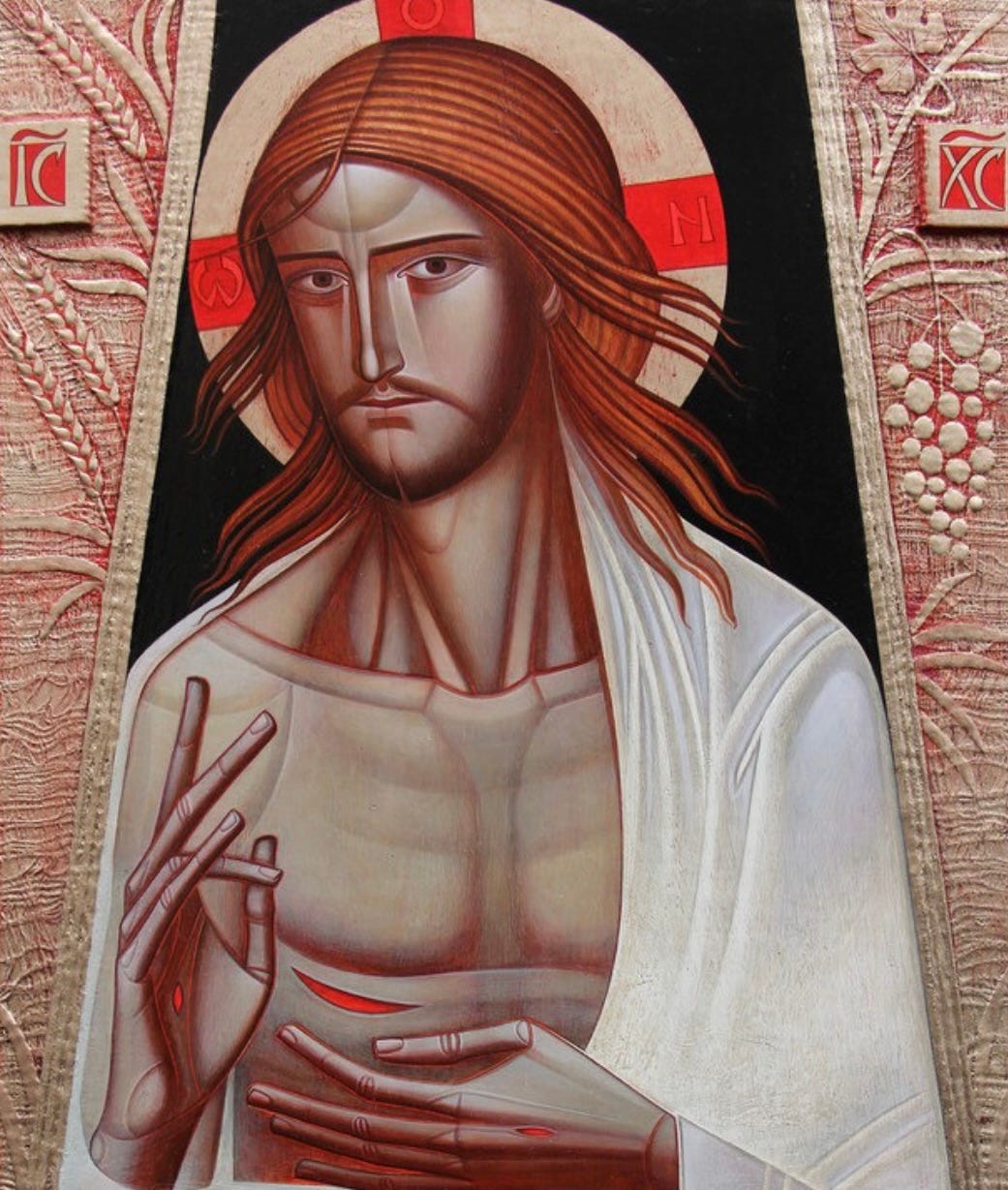
I know of nothing more central to Christian theology and Christian spiritual formation than a sustained meditation on Jesus Christ as the Word of God. The incarnation is the boundless mystery that should eternally fascinate our theological imagination. All Christian theology begins with wonder—and the greatest wonder of all is the Eternal Logos assuming human flesh. Why does the Word of God enter the world through a human birth? “In order that the world might be saved through him.” (Jn 3:17) The world will not be saved by political movements or various activisms. This is the folly of the culture wars—or of all wars for that matter. The crucified and risen Word of God may, at times, inspire movements and activism, but we must not imagine that Christ is a mere accessory to our political or social agendas. Christ is not an addendum; Christ is the Alpha and Omega. All things have been created by and for Christ. He is the origin and telos of all creation. In pronouncing that all things are created by and for Christ, and that all things in heaven and on earth are reconciled in Christ, the Apostle Paul begins his lofty Christological hymn by first telling us that, “He is the image [icon] of the invisible God.” (Col 1:15) Jesus is the perfect icon of the invisible God. We are no longer guessing in abstraction concerning what God is like—we now gaze upon the icon who is Christ and move toward the beatific vision.
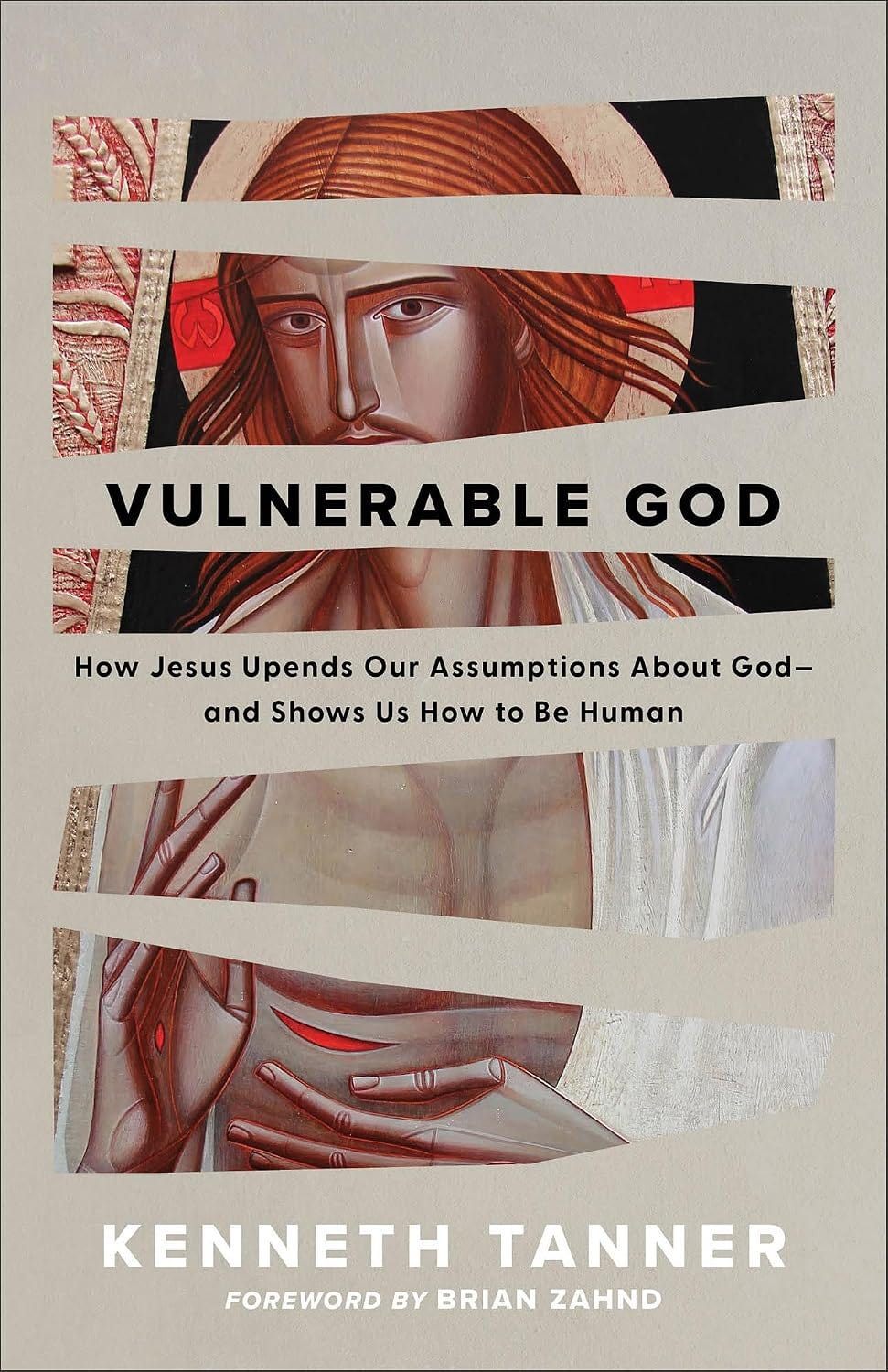
I know Kenneth Tanner, and I know he loves icons. You will find icons in his domestic and ecclesial habitats. He speaks frequently of icons and has given small replicas of the famous Sinai Pantocrator to many a soul. I am a grateful recipient of one of these gifts. And Kenneth Tanner is an iconographer himself. No, he doesn’t work with egg tempera and goldleaf on wooden panels, but he is an iconographer, nonetheless. Tanner is a pastor-theologian who works with the medium of words. In Vulnerable God we find a valuable and beautiful sustained meditation on Jesus Christ. This book does not read like a dry academic theological tome—it is far more like a poetic portrait. Thankfully, this book does not join the ranks of the ubiquitous catalogs of Christian pragmatism where we are told “how to” do this or that. This book simply invites us to gaze upon the face of Christ until the miracle of inner transformation begins to occur. Christ does the saving, all we have to do is look upon him. “Look to me and be saved.” (Is 45:22) This book is not angry—we have far too many of those. This book is gracious. It doesn’t strike as lightning, it falls as a gentle rain. Vulnerable God as a sustained meditation on the implications of the incarnation draws regularly upon ancient Christian theologians and pastors, but Tanner does it in such a way that Origen, Athanasius and others feel bracingly contemporary.
What I love most about this book is that every single page is about Jesus. Yes, every single page! This is why I describe Vulnerable God as an icon, and Kenneth Tanner as a theological iconographer. Page after page we are invited to look upon Christ—as a helpless infant, as a curious adolescent, as a young carpenter, as an itinerate healer, as a humble servant, as one crucified and buried, as one risen and ascended. Through this literary icon we are invited to look upon the vulnerable God who sustains the Cosmos with his word and fills all things everywhere with himself. Read this icon and behold the beauty of the Lord.
The late Dr. Barbara Holmes (1943–2024), a beloved member of the CAC faculty, acknowledges the complicated feelings that prophets evoke in their listeners:
Prophets are difficult to have around. No one wants to claim the title or do the work because of it. In this postmodern age, everybody is uncomfortable with prophets. They yell when you don’t want them to. They ask for trouble when it could be avoided. They don’t have a politically correct bone in their bodies.…
Prophets are leaders, but not leaders of their own choosing. Inevitably, they have some sort of divine encounter. They meet a burning bush, a ram in the bush, or hear a call in the night. They have visions and dreams. They’re quirky and more than a little weird. As an example, take Jeremiah—he’s crying all the time. Isaiah fasts and lies in the dirt; John the Baptist eats locusts, and Huldah prophesies doom. Finally, one of the most important characteristics of prophets is that they are dangerous to the system.…
In bringing messages from God—and God doesn’t mince words—God speaks directly through them. They have a relationship and intimacy with the Divine. They communicate with God through prayer and direct speech. God walks and talks with them (perhaps not literally but in other ways). They have gifts, and they offer signs and wonders associated with the verification of the presence of God. They have communal connections. They act on behalf of community, not for their own gain, and are dependent on the community for help when they need it.
Though they are often portrayed as solitary figures, Holmes emphasizes the communal nature of the prophetic role:
There is a neglected but important aspect of the prophetic call. In Numbers 11:24–29, Moses is exhausted with the people. Basically, God says “Okay, okay, assemble the elders. Look to the community. You were never supposed to do this alone. I told you to do it; I didn’t tell you to do it alone.” How many of us are carrying burdens that are not ours, and are feeling pretty righteous about it? The work of living and dying, raising children, and leading congregations, was never meant to be solitary work. After the elders assemble, Joshua tells Moses that the elders are prophesying, and he says, “Moses, make this stop!” Moses’s reply in Numbers 11:29 is, “Are you jealous for my sake? Would that all the Lord’s people were prophets, and that God would put God’s Spirit on them!”
Let’s just sit with that for a minute. Have you ever felt as if God’s Spirit was on you? Although many of the prophets in the Bible are presented as single carriers of God’s word, often there was a community of other prophets that they came from or were associated with. Who is your community?… If you’re called to the prophetic task, and I think in some aspects all of us are—where is your prophetic community that will feed you and support you and guide you and help you?
================
From Curt Thompson
Dear friend,
Every couple of years, I find myself returning to C.S. Lewis’s The Space Trilogy.
People occasionally ask why. Surely, after reading the novels so many times, I know how the story ends. But that isn’t really the point.
Yes, the through-line of the narrative continues to captivate me. The development of the central character—especially across the first two novels—is as compelling today as it was the first time I encountered it. And I continue to believe Lewis offers some of his richest theology in his fiction. The truths he entrusts to his characters often reach places that straightforward explanation cannot.
But the deepest reason I return is this: These stories continue to train my imagination.
They remind me that the world is far more alive than I often remember. * * * * * I first encountered The Space Trilogy in college, but it was the second novel, Perelandra, that took hold of me. Its vision of temptation, beauty, obedience, and the unseen conflict between good and evil did more than capture my attention—it shaped the way I began to understand the world.
In fact, my first serious research paper was devoted to Perelandra.
At the time, I was a chemistry major with very little exposure to literature or the humanities. Writing this kind of research paper felt impossible. The assignment had called for ten pages; somehow I wrote twenty. To my surprise, it earned high marks and awakened something in me that I hadn’t known was there.
Later, one of my literature professors asked me a question I’ve never forgotten. “Why aren’t you an English major?”
My response came almost instinctively. “Why didn’t someone tell me I should be?”
I’ve often wondered if there was a deeper question hidden beneath those words.
Who is paying close enough attention to notice what is coming alive in another person?
Who sees gifts that the person carrying them cannot yet recognize?
Formation often begins because someone notices.
Perhaps that is another gift of stories like Perelandra. They do more than entertain us. They awaken our capacity to perceive what is most real—within the world, within ourselves, and within one another.
Warmly, Curt
Question for Reflection
Who has been someone who “noticed” something coming alive in you before you could see it yourself—and who might God be inviting you to notice in that way now?
Father Richard Rohr describes why the example and message of the Hebrew prophets continue to be important for us today:
My favorite thing about the prophetic books of the Bible is that they show a whole series of people in evolution of their understanding of God. Like most of us, the prophets start not only with judgmentalism and anger but also with a superiority complex of placing themselves above others. Then, in various ways, that outlook falls apart over the course of their writings. They move from that anger and judgmentalism to a reordered awareness in which they become more like God: more patient like God, more forgiving like God, more loving like God.
Throughout Scripture, the prophets seem to emphasize one sin above all the rest: idolatry, our habit of making things “God” that are not absolute, infinite, or objectively good. They are also ruthless toward the preoccupations of our private self, which always wants to put itself in the best light.
Prophets are full truth-tellers, not fortune-tellers. They pull back the veil to radically reframe our preferred storyline of history: the boring and predictable narrative of winners and losers, rewards and punishments. They are by definition those rare individuals who see reality in its fullness and dimension, rather than in dualities like totally right or totally wrong, all good or all bad.
There must be someone—or several someones—in every age who can tell the faith community, and society at large: Your first egoic glance at life—and God—is largely wrong! And it is largely engendered by fear. “No one else is your problem,” says the prophet. “You are your own problem. What you think is goodness is too often delusion, and what you think is bad just might be your spiritual best friend.” In doing so, prophets offer not only criticism but also visions of a more just, more merciful, more peaceful society—and call the people to live into it. Any religion or philosophy that teaches group blindness instead of full seeing is standing in the way of such clarity.
We must be eternally conscious of this fact: For the untransformed self, religion is the most dangerous temptation of all. Our egos, when they are validated by religion, are given full permission to enslave, segregate, demean, defraud, and inflate—because all bases are covered with pre-ascribed virtue and a supposed hatred of evil. This is what the prophets expose in their wholesale assault on temple worship, priestly classes, self- serving commandments, and intergenerational wealth. “Be very careful here!” they keep shouting. The prophets know that religion is the best and that religion also risks being the worst. We love to choose sides and declare ourselves sinless and pure and orthodox (“right”), with little evidence that it is true. This is always a surprise to everyone except the prophets.
The Task of the Prophets
Monday, August 17, 2026
It is the task of the prophet to bring to expression the new realities against the more visible ones of the old order. Energizing is closely linked to hope. We are energized not by that which we already possess but by that which is promised and about to be given. —Walter Brueggemann, The Prophetic Imagination
In 1980, Richard Rohr gave a series of talks on the Hebrew prophets. Here he speaks of the hopeful imagination to which the prophets and God invite us:
Prophets nurture and evoke a new way of thinking. They give us images and words which subvert our system and tell us that we haven’t seen the whole picture yet. Prophets are not just concerned about social change for the sake of social change. They are concerned above all with transformation andfreedom of the heart, and then out of that free heart, the prophet says, “Listen.” The prophet creates a new, freeing consciousness which allows us to hear the divine word.
In the midst of that freedom, the prophets plant a promise, an alternative and new vision—but the promise never really gets fulfilled. It both tantalizes and torments us with dissatisfaction—and nevertheless calls us forward! It isn’t that God or the prophets are playing games with us. It’s that we are energized by the hope of God’s promises. What gives us the energy and power to keep moving is the promise, the dream, the vision of what could be and what’s beyond the moment. The prophet knows that, and God knows that. In the exodus, God plants the promise in Moses’s heart, and then Moses gives it to the people.
These promises are not lies. They’re true, but they’re not always what we expect or hope for, and so God calls us a little further. This is the way that divine love stretches our hearts. This is the real rebirth. This is the way we’re reborn again and again until we enter, through death, the promise of a deeper life.
The established and dominant culture does not have authentic promises because it seeks to maintain itself. The system has materialistic and self-protecting promises for more money and a better life; it encourages us to consume more and more. It cannot offer a promise which fills and expands the heart beyond itself to the larger world.
God’s promises energize and expand the heart, deepening our capacity for life and our quality of being in this world. They put the authority inside us. This, finally, is the only overcoming of death, the only answer to the absurdity that this time is going to end. That’s what the promises of God do—lead us to the experience of deeper life. The Gospel writers call it resurrection.
This CO2- (Church Of 2) is where two guys meet each day to tighten up our Connections with Jesus. We start by placing the daily “My Utmost For His Highest” in this WordPress blog. Then we prayerfully select some matching worship music and usually pick out a few lyrics that fit especially well. Then we just start praying and editing and Bolding and adding comments and see where the Spirit takes us.
It’s been a blessing for both of us.
If you’d like to start a CO2, we’d be glad to help you and your partner get started. Also click the link below to see how others are doing CO2.Odds Monkey
Steve Harvey Introduces Jesus To A Secular Audience
About
Change this text in the admin section of WordPress
You are currently browsing the CO2MannaToday blog archives.