Archive for October, 2025

The Prophetic Work of Jesus

October 17th, 2025

Carriers of the Gospel

Friday, October 17, 2025

Let us be carriers of the gospel. The gospel of the revolutionary, brown-skinned Palestinian Jew who made it very clear that he didn’t come to be status quo. He wasn’t a chaplain of the empire but a prophet of God.  
—Liz Theoharis and Charon Hribar, We Pray Freedom  

Rev. Dr. Liz Theoharis and Dr. Charon Hribar describe crises as opportunities to work for justice, as Jesus did:  

As our society continues to be engulfed by crises, the time for complacency has passed. From the lack of health coverage for tens of millions of Americans to the tragic death toll of endless wars and environmental disasters; from the assault on democracy to the glaring inequalities laid bare by the pandemic, it is clear we stand at a generational crossroads. This is a kairos moment—a time of crisis and opportunity. In biblical terms, it is a moment when the foundations of injustice are exposed, prophetic voices call for change, and movements for justice take root.  

Luke 4:14–30 is known as Jesus’ first sermon, delivered in his hometown of Nazareth. It marks the beginning of his public ministry during a kairos moment not unlike our own…. Jesus announces his mission of societal transformation [quoting the prophet Isaiah]. He proclaims: “The Spirit of the Lord is upon me, because he has anointed me to bring good news to the poor. He has sent me to proclaim release to the captives and recovery of sight to the blind, to set free those who are oppressed, to proclaim the year of the Lord’s favor” (Luke 4:18–19).  

Too often, the Bible’s good news is reduced to matters of individual salvation and detached from Jesus’s goal to transform the world. But a close reading of the Bible, including the teachings of Jesus, reveals a vast antipoverty program and social justice mission, which call on us to resist unjust economic practices and build a society in which everyone’s needs are met.  

The Freedom Church of the Poor provides resources to empower prophetic and hopeful movements for justice:  

Drawing strength from these biblical principles, the Freedom Church of the Poor tradition teaches us to stand up for one another, care for the least of these, and dismantle laws that perpetuate injustice. If we believe that God stands with the oppressed and that Jesus preached liberation, then collective action by those most impacted by injustice is imperative. By taking collective action with and as poor and dispossessed people, we bridge our spiritual convictions and our hunger for transformative change….  

In the Freedom Church of the Poor tradition, we envision a world where every life is sacred and every need is met. This vision challenges the normalization of injustice and the valuing of profit over people. Through nonviolent, moral direct action—marches, boycotts, sit-ins, and more—we reject the status quo and reclaim the moral narrative. We create spaces where justice is reimagined and a moral revolution of values becomes irresistible.  

_______________________________________________

1.

“On that glad night, in secret, for no one saw me, nor did I look at anything, with no other light or guide than the one that burned in my heart.”

– St. John of the Cross, The Dark Night of the Soul, 3rd Stanza.

The line that gets me is “with no other light or guide than the one that burned in my heart.”

There are whole theologies that I believe are destructive and dehumanizing that not only encourage but make it a matter of piety to disregard our hearts, to discredit the little voice of the genuine within us, to disbelieve what our deepest core might be telling us with sincerity.

Our hearts can indeed be tricked or deceived.  I do not discount that possibility.  I think one reason this happens is that we do not have many teachers who invite us to listen to the subtle movements within ourselves.

St. John of the Cross’ favorite thing to do was spiritual direction.  He found it to be the most rewarding ministry: helping people listen to God for themselves rather than through a proxy— mentor, pastor, or priest.

True spirituality invites and enables people to listen to the Divine for themselves.

2.

“The fly that clings to honey hinders its flight, and the soul that allows itself attachment to spiritual sweetness hinders its own liberty and contemplation.”

– St. John of the Cross, The Sayings of Light and Love, 24.

“Spiritual sweetness” is a term that St. John of the Cross invented.  It describes how we each are enamored of and enjoy the things that are next to God, but perhaps not God per se.

I think that one of the most profound wisdoms of St. John of the Cross is that we can become addicted to these forms of “spiritual sweetness.”

It is actually a sign of spiritual immaturity, addiction, or co-dependence that we whine, rage, and question everything as soon as those spiritual sweetnesses are either taken away from us or we find ourselves increasing the effort to try and get the same fix as we used to.

The goal is not to avoid experiencing such sweetness; the goal is to give up our attachment to it.  Instead, we can be grateful for when it comes to us and keep on keeping on, even when it does not.

As Meister Eckhart says, we must learn to live, love, and be “without a why,” and stop doing all things for some potential “spiritual sweetness” we might stumble across.

3.

“This change is a surprise to them because everything seems to be functioning in reverse.

– St. John of the Cross, The Dark Night of the Soul, Book 8.3.

The wisdom of the Dark Night of the Soul is so paradoxical and unsuspecting that it is little wonder it throws people completely off kilter.

When all the world seems to endorse the philosophy that more effort, intentionality, and energy put into something creates a better “return on investment,” St. John of the Cross reminds us that faith has a completely different set of mathematics.

The day may come when it is not more effort that is needed, but less.  It is not that we need to engage in prayer more than we need to redefine what we think prayer is.  It is not that God is absent because we have done something wrong; it is that God is so furiously present that we are blinded by the sheer volume of activity God is engaged in.

Below is a video I made that explains the Dark Night of the Soul in 4 (or 5) stages.  I hope it is a help to you.
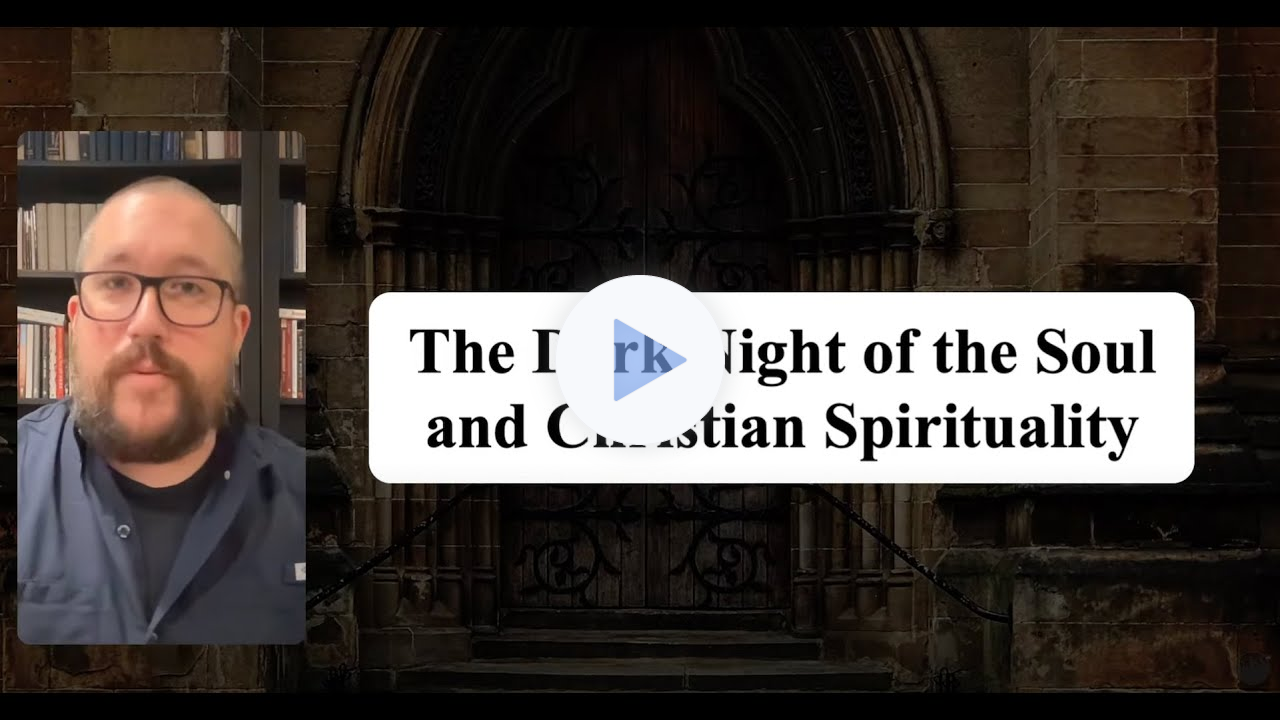
The Dark Night of the Soul and Christian Spirituality

4.

“Some spiritual fathers are likely to be a hindrance and harm rather than a help to these souls that journey on this road. Such directors have neither understanding nor experience of these ways.”

– St. John of the Cross, The Ascent to Mount Carmel, Prologue 4.

Man.

I think about this quote often.

It pairs well with the New Testament’s exhortation that not many should take up being leaders because they will be judged more harshly.

There are things I have said from the pulpit that I wish I could take back.  The same is also true of my time working at a Christian summer camp.  I did not know what I did not know.

Fortunately, the seminary gave a list of names that I should continue learning from after I graduated.  And so I did.  Not only that, but I began studying outside my home denomination, the Lutheran Church, and turned more toward the Reformers, then the Catholics, then the Patristics, then the Christian mystics, and, more recently, Eastern Orthodoxy.

It is so easy to give bad advice when you are a pastor or priest, and some of that stems from the fact that we are often only taught a small slice of the Christian tradition, when, in reality, there is so much more to it than we ever could imagine. 

I was joking with my wife that one of my favorite things about what I do is frequently encouraging people to go back and read the New Testament all over again, or simply giving them permission to dive deeper into this mystery we call “God.”

How wild that my path had such an emphasis on telling people what they needed to know, and now it is so much more about inviting people to listen to their deepest self and to go full tilt into the heart of the Christian tradition for themselves, and to report back to me what they found?

Life is too good to me.

5.

“The soul that journeys to God, but does not shake off its cares and quiet its appetites, is like one who drags a cart uphill.”

– St. John of the Cross, The Sayings of Light and Love, 56.

Note: This does not mean that such a person will not successfully, eventually, journey into God, but that it will involve more struggle, effort, and difficulty.

Which quote jumped out at you?

Reply to this email if one of the quotes above stirred, resonated, or aggravated you!

The Prophetic Work of Jesus

October 16th, 2025

Prophetic Solidarity and Compassion

Thursday, October 16, 2025

Old Testament Scripture scholar Walter Brueggemann (1933–2025) witnesses Jesus’ prophetic role in his solidarity and his compassion for those on the margins: 

Among his other functions it is clear that Jesus functioned as a prophet. In both his teaching and his very presence, Jesus of Nazareth presented the ultimate criticism of the royal [empire] consciousness…. The way of his ultimate criticism is his decisive solidarity with marginal people and the accompanying vulnerability required by that solidarity. The only solidarity worth affirming is solidarity characterized by the same helplessness they know and experience. [1]  

Jesus’ prophetic actions were motivated by his deep solidarity and compassion for those who are suffering: 

Jesus in his solidarity with the marginal ones is moved to compassion. Compassion constitutes a radical form of criticism, for it announces that the hurt is to be taken seriously, that the hurt is not to be accepted as normal and natural but is an abnormal and unacceptable condition for humanness. In the arrangement of “lawfulness” in Jesus’ time, as in the ancient empire of Pharaoh, the one unpermitted quality of relation was compassion. Empires are never built or maintained on the basis of compassion. The norms of law (social control) are never accommodated to persons, but persons are accommodated to the norms. Otherwise the norms will collapse and with them the whole power arrangement. Thus the compassion of Jesus is to be understood not simply as a personal emotional reaction but as a public criticism in which he dares to act upon his concern against the entire numbness of his social context.  

Empires live by numbness. Empires, in their militarism, expect numbness about the human cost of war. Corporate economies expect blindness to the cost in terms of poverty and exploitation. Governments and societies of domination go to great lengths to keep the numbness intact. Jesus penetrates the numbness by his compassion and with his compassion takes the first step by making visible the odd abnormality that had become business as usual. Thus compassion that might be seen simply as generous goodwill is in fact criticism of the system, forces, and ideologies that produce the hurt. Jesus enters into the hurt and finally comes to embody it. [2]  

At the end of his book The Tears of Things, Richard Rohr identifies characteristics of those he calls “true prophets” who follow in the footsteps of Jesus and the Hebrew prophets.   

Prophets embrace religion as a way of creating communities of solidarity with justice and suffering.  
They look for where the suffering is and go there, just as Jesus did.  
They speak of solidarity with one God, which also implies union with all else. 
The prophet learns to be for and with, not against.  
They are for those who are suffering or excluded.  
They are centered not on sin but on growth, change, and life.  
They know that the best teachers are reality itself and creation.  
They do not reject the way of the priest—they have just moved beyond it alone. [3]  

________________________________________________

Jesus Calling Sarah Young

Jesus Calling: October 16th, 2025

Jesus Calling: October 16th

Look to Me continually for help, comfort, and companionship. Because I am always by your side, the briefest glance can connect you with Me. When you look to Me for help, it flows freely from My Presence. This recognition of your need for Me, in small matters as well as in large ones, keeps you spiritually alive.
     When you need comfort, I love to enfold you in My arms. I enable you not only to feel comforted but also to be a channel through whom I comfort others. Thus you are doubly blessed, because a living channel absorbs some of whatever flows through it.
     My constant Companionship is the piece de resistance: the summit of salvation blessings. No matter what losses you experience in your life, no one can take away this glorious gift.

RELATED SCRIPTURE: 

Psalm 34:4-6 (NLT)
4 I prayed to the Lord, and he answered me.
    He freed me from all my fears.
5 Those who look to him for help will be radiant with joy;
    no shadow of shame will darken their faces.
6 In my desperation I prayed, and the Lord listened;
    he saved me from all my troubles.
Psalm 105:4 (NLT)
4 Search for the Lord and for his strength;
    continually seek him.

Additional insight regarding Psalm 105:4-5: If God seems far away, persist in your search for him. God rewards those who sincerely look for him (Hebrews 11:6). Jesus promised “Every who seeks, finds” (Matthew 7:8). The writer suggested a valuable way to find God – become familiar with the way he has helped his people in the past. The Bible records the history of God’s people. In searching its pages we will discover a loving God who is waiting for us to find him.
2 Corinthians 1:3-4 (NLT)
God Offers Comfort to All
3 All praise to God, the Father of our Lord Jesus Christ. God is our merciful Father and the source of all comfort. 4 He comforts us in all our troubles so that we can comfort others. When they are troubled, we will be able to give them the same comfort God has given us.


Beyond a Gentle Jesus

October 15th, 2025

Theologian Dr. Obery Hendricks Jr. describes the Jesus he was introduced to in his church communities as a meek and gentle Savior: 

I was raised on the bland Jesus of Sunday school and of my mother’s gentle retellings, the meek, mild Jesus who told us, in a nice, passive, sentimental way, to love our enemies, and who assured us that we need not worry about our troubles, just bring them to him. He was a gentle, serene, nonthreatening Jesus whose only concern was getting believers into heaven, and whose only “transgression” was to claim sonship with God.… 

Yet for all my trust and love and fervor, something in the portrayals of Jesus and his message did not seem quite right; something just didn’t make sense. Was this meek, mild Jesus the same Jesus who defiantly called the Pharisees “a brood of vipers” and described them as “whitewashed tombs full of every unclean thing”?… And if he was so meek and mild, how could he get anyone’s interest in the first place…? And what did Jesus mean by sayings like “I have come not to bring peace, but a sword”? I tried my best to understand, although questions like these were frowned on by my parents and every believer I knew as evidence of weak faith or, worse, of the devil’s confusion.  

Outside communal worship, Hendricks came to know a prophetic and revolutionary Jesus: 

I have been blessed to experience the adoration and worship of Jesus in every aspect of his person and grandeur … except one: Jesus the political revolutionary, the Jesus who is as concerned about liberating us from the kingdoms of earth as about getting us into the kingdom of heaven. Yet the Gospels tell us that is who Jesus is, too. And what he was crucified for. This is the Jesus that called me back to the Church—the revolutionary Jesus. 

Yes, Jesus of Nazareth was a political revolutionary. Now, to say that he was “political” doesn’t mean that he sought to start yet another protest party in Galilee. Nor does it mean that he was “involved in politics” in the sense that we know it today, with its bargaining and compromises and power plays and partisanship. And it certainly doesn’t mean that he wanted to wage war or overthrow the Roman Empire by force.  

To say that Jesus was a political revolutionary is to say that the message he proclaimed not only called for change in individual hearts but also demanded sweeping and comprehensive change in the political, social, and economic structures in his setting in life: colonized Israel. It means that if Jesus had his way, the Roman Empire and the ruling elites among his own people either would no longer have held their positions of power, or if they did, would have had to conduct themselves very, very differently…. It means that Jesus had a clear and unambiguous vision of the healthy world that God intended and that he addressed any issue—social, economic, or political—that violated that vision. 

=======================

Fred Rogers: The Television Preacher We Need
Fred Rogers didn’t fit the stereotype of a charismatic television preacher, but that is exactly what he was. His preaching was done with puppets, simple songs, and subtle storytelling rather than big hair, exciting sermons, or signs and wonders—but that doesn’t mean his ministry didn’t produce miraculous healing in both children and adults struggling with brokenness and anger. Deeply shaped by his faith in Christ, seminary educated, and ordained by the Presbyterian Church in 1963, Fred Rogers saw his PBS children’s program, Mister Rogers’ Neighborhood, as a ministry to a generation of wounded, frightened children and their families.The casual observer of Fred Rogers’ daily television show, which ran from 1968 until 2001, might not have noticed the profound theological depth informing every aspect of the program. I certainly did not as a child in the late 1970s, but as an adult, I was amazed to discover that Rogers designed the show around his doctrine. He often taught children about the value of different jobs, which flowed from his theology of vocation. He used the language of “neighbor” because of its deep biblical roots, particularly in Jesus’ teaching. Even the familiar show opening where Mr. Rogers enters, changes his shoes, and puts on his sweater was intended to be a formative liturgy to help children enter a different kind of sacred space.Fred Rogers was also unafraid to tackle some of the most difficult personal and controversial social issues in American culture like war, racism, death, mental illness, and divorce. As a result, he was more pastoral and more prophetic than many pulpits in America. He understood and sympathized with the fear children felt in turbulent times, and brought each child the assurance that your feelings mattered and that you are loved exactly as you are.In a recent biography by Shea Tuttle, I discovered another part of Fred Rogers’ ministry that went beyond his television show. In his daily times of Bible reading and prayer, Rogers would often feel what he called a “strong urge” to visit someone, and would then arrive unexpectedly at their door. In 1987, he traveled from his home in Pittsburgh to Baltimore to be with a girl he learned was having brain surgery. When Dr. King was assassinated in 1968, Rogers drove down to the home of Francois Clemmons, an African-American actor on his program. Race riots had erupted outside his building. “I was upstairs in my apartment, but I was scared to death,” Clemmons recalled. But then Fred suddenly appeared.Lisa Hamilton, who worked as a director on Mister Rogers’ Neighborhood, explained how Fred ministered to her young family during her 31-year-old husband’s battle with cancer. Hamilton thought her husband was recovering, but woke up one morning to discover he had died in their bed during the night. With a 4-year-old son at home, Hamilton was overwhelmed. “I was really panicky,” she said, “And then the doorbell rang.” It was Fred Rogers.“I was praying,” Fred explained, “and I felt you needed some help.” He didn’t know Hamilton’s husband had just died. He stayed with Hamilton and her son, wept with them over her husband’s body, and was the one to call the funeral home.Fred Rogers died in 2003, but the last few years have seen a resurgence in his popularity through biographies, documentaries, and a 2019 film starring Tom Hanks. Some think it’s the product of a generation raised with his television show reaching adulthood. I suspect there is something more than nostalgia at work. Fred Rogers was a powerfully gifted minister who brought the calming, healing presence of Jesus to both children and adults. In our own turbulent times marked by aggression, anger, and division I think we all sense a need for more ministers like Fred Rogers.
DAILY SCRIPTURE
ISAIAH 42:1-9
GALATIANS 5:16-23
MATTHEW 11:25-30


WEEKLY PRAYER
from Desmond Tutu (adapted from an original prayer by Sir Francis Drake)

Disturb us, O Lord
when we are too well-pleased with ourselves
when our dreams have come true because we dreamed too little,
because we sailed too close to the shore.
Disturb us, O Lord
when with the abundance of things we possess,
we have lost our thirst for the water of life
when, having fallen in love with time,
we have ceased to dream of eternity
and in our efforts to build a new earth,
we have allowed our vision of Heaven to grow dim.
Stir us, O Lord
to dare more boldly, to venture into wider seas
where storms show your mastery,
where losing sight of land, we shall find the stars.
In the name of Him who pushed back the horizons of our hopes
and invited the brave to follow.
Amen.

October 15th, 2025

Beyond a Gentle Jesus

Theologian Dr. Obery Hendricks Jr. describes the Jesus he was introduced to in his church communities as a meek and gentle Savior: 

I was raised on the bland Jesus of Sunday school and of my mother’s gentle retellings, the meek, mild Jesus who told us, in a nice, passive, sentimental way, to love our enemies, and who assured us that we need not worry about our troubles, just bring them to him. He was a gentle, serene, nonthreatening Jesus whose only concern was getting believers into heaven, and whose only “transgression” was to claim sonship with God.… 

Yet for all my trust and love and fervor, something in the portrayals of Jesus and his message did not seem quite right; something just didn’t make sense. Was this meek, mild Jesus the same Jesus who defiantly called the Pharisees “a brood of vipers” and described them as “whitewashed tombs full of every unclean thing”?… And if he was so meek and mild, how could he get anyone’s interest in the first place…? And what did Jesus mean by sayings like “I have come not to bring peace, but a sword”? I tried my best to understand, although questions like these were frowned on by my parents and every believer I knew as evidence of weak faith or, worse, of the devil’s confusion.  

Outside communal worship, Hendricks came to know a prophetic and revolutionary Jesus: 

I have been blessed to experience the adoration and worship of Jesus in every aspect of his person and grandeur … except one: Jesus the political revolutionary, the Jesus who is as concerned about liberating us from the kingdoms of earth as about getting us into the kingdom of heaven. Yet the Gospels tell us that is who Jesus is, too. And what he was crucified for. This is the Jesus that called me back to the Church—the revolutionary Jesus. 

Yes, Jesus of Nazareth was a political revolutionary. Now, to say that he was “political” doesn’t mean that he sought to start yet another protest party in Galilee. Nor does it mean that he was “involved in politics” in the sense that we know it today, with its bargaining and compromises and power plays and partisanship. And it certainly doesn’t mean that he wanted to wage war or overthrow the Roman Empire by force.  

To say that Jesus was a political revolutionary is to say that the message he proclaimed not only called for change in individual hearts but also demanded sweeping and comprehensive change in the political, social, and economic structures in his setting in life: colonized Israel. It means that if Jesus had his way, the Roman Empire and the ruling elites among his own people either would no longer have held their positions of power, or if they did, would have had to conduct themselves very, very differently…. It means that Jesus had a clear and unambiguous vision of the healthy world that God intended and that he addressed any issue—social, economic, or political—that violated that vision. 

Can We Be Prophets Like Jesus?

October 14th, 2025

In a teaching for the CAC’s Living School, Dr. Barbara Holmes (1943–2024) invites the students to reflect on Jesus’ prophetic tasks:   

What did Jesus the prophet do? As a prophet, Jesus performed miracles, exercised authority over nature and spiritual entities, walked on water, and turned water into wine. As a prophet, Jesus healed. As a prophet, Jesus fed the hungry. As a prophet, Jesus taught prophetically.… He sat at the feet of elders, but he also taught with his heart: he heard the whispers of the Holy Spirit and allowed it to speak through him. If teaching is not anointed by the Spirit, it is just the ego strutting and repeating information. Teaching prophetically goes beyond facts and material. It reaches into the unutterable and allows silence and Spirit to do the teaching.   

Jesus also exercised spiritual gifts.… Prophecy is a spiritual gift. Paul wrote about the gift of prophecy in his letter to the Romans. He said, “We have gifts that differ according to the grace given to us … prophecy in proportion to faith” (Romans 12:6). Although prophecy is mentioned more than any other gift in the Bible, it’s also stated that prophecy will pass away, and the only thing left will be love.… Prophecy comes to life as love. Jesus the prophet is love manifested. We also can be love manifested in the world.…  

As Christians, Jesus is the prophet who guides us. This is what I want to share with you. You don’t have to eat locusts [John the Baptist] or lay on your side in rags [Ezekiel]. Perhaps all it requires is the willingness to offer your life as “a living sacrifice, holy and acceptable unto God” [Romans 12:1]. All we have to do is recognize that the time has come to make full use of our gifts, and that we are the embodiment of a new order. We’re following the example set by the prophet Jesus. During his time, Jesus was the embodiment of a new order, he was a fulfillment of the prophecy of those who had gone before.…  

Jesus has come and truly overturned and overcome the systems of the world, and he beckons us to do likewise. The system says things like, “It can’t be done. You cannot walk on water. Gravity wins.” The system says things like, “Religion is of no use except to placate the people, and you’d better put your money in growth mutual funds.” Jesus says there’s another way, the prophetic way. Even now Jesus beckons, saying, “Step out on the water, come.”    

You may be thinking, “How am I going to walk on water? I don’t even know how to swim.” We offer our gifts to God and our neighbors—that’s how we walk on water. Your gift may be prayer or art or business or teaching, but the prophetic call will hone your gifts so that your very lives are a prophetic witness to the world.   

===================

Roger Williams: Father of Religious Freedom
The word secularism is scorned by many Christians today. They associate it with the marginalization of faith and the desire to erase religion from the culture, but they forget that devout Christians were the first to invent and advocate for secular government. For example, I believe James Madison, one of the founding fathers of the United States, did a great favor to the Christian faith when he wrote the First Amendment, excluding any government involvement in religion. Madison understood that in order for true faith to thrive, for people’s affections to be stirred for their Creator, they needed freedom. Freedom from state coercion. Freedom of conscience. Freedom of practice. Freedom of speech. Freedom to accept religion or reject it.

But these ideas were not original to James Madison, and the United States was not the first secular government to enshrine religious freedom. Madison was deeply influenced by Roger Williams, a Puritan who had lived a century earlier. In seventeenth-century England, many Puritans, like Williams, resented the way civil authorities interfered in religious matters and were particularly upset with having Catholic ideas imposed upon them. With a desire to practice his faith freely, Williams left England in 1630 and was among the early settlers of the Massachusetts Bay Colony, but what he discovered there troubled him greatly.

The government of Massachusetts had copied the English model of combining civil and religious authority, only this time it was the Puritans imposing their beliefs rather than the Catholics. This meant citizens of the colony could be fined or imprisoned by the government for breaking the sabbath, not attending worship, or questioning doctrine. Although a devout Puritan himself, Roger Williams understood that when religion, and particularly faith in Christ, is mandated by the state, it inoculates the population from the power of the gospel. It lulls them into thinking they are truly of Christ when they are not.

As he said, “Forced worship stinks in God’s nostrils.”Instead, Williams advocated a “wall of separation” between civil authority and religious authority. Referring to the two stone tablets of the Ten Commandments, Williams said the government should have no voice regarding the “first table”—commands about the individual’s relationship with God, but only the “second table”—laws about social order, including murder, adultery, stealing, and lying. For this belief, Williams was banished from the Massachusetts Bay Colony in 1636 and cast into the wilderness during a January blizzard. He survived through the compassion of Native Americans who welcomed him into their camp.

Experiencing the cruelty of so-called “Christians” and the compassion of so-called “savages” solidified Wiliams’ belief in religious freedom. Rather than conquering those of different beliefs, he saw the importance of a government that allowed each person, even Native Americans, to worship according to their conscience. This was a revolutionary and deeply unpopular idea at the time. Critics said separating civil from religious authority would lead to chaos and social disorder. To prove them wrong, Williams and other outcasts established a small oasis of religious tolerance.

Rhode Island became the first secular government in history. And not only did the new colony not descend into chaos, but religion there thrived.Today, many Christians are trapped in a culture war mindset, believing whoever possesses political power can, and will, impose their values and beliefs on society. This echoes the fruitless and bloody battles Roger Williams witnessed 400 years ago, and he also discovered the best way out of them—tolerance. He understood that true faith cannot be imposed, enforced, or policed. As Christians, we cannot, and should not, demand that everyone share our beliefs. But we can, and should, demand that everyone share our freedom. Because where this freedom exists, we know that Christ will be lifted up and draw people to himself.

DAILY SCRIPTURE
LEVITICUS 19:33-34
1 THESSALONIANS 2:1-13
MARK 6:7-13


WEEKLY PRAYERfrom Desmond Tutu (adapted from an original prayer by Sir Francis Drake)
Disturb us, O Lord
when we are too well-pleased with ourselves
when our dreams have come true because we dreamed too little,
because we sailed too close to the shore.
Disturb us, O Lord
when with the abundance of things we possess,
we have lost our thirst for the water of life
when, having fallen in love with time,
we have ceased to dream of eternity
and in our efforts to build a new earth,
we have allowed our vision of Heaven to grow dim.
Stir us, O Lord
to dare more boldly, to venture into wider seas
where storms show your mastery,
where losing sight of land, we shall find the stars.
In the name of Him who pushed back the horizons of our hopes
and invited the brave to follow.
Amen.

Prophetic Love

October 12th, 2025

Brian McLaren emphasizes knowing and following Jesus as a prophet:  

Many Christians have tried to understand Jesus primarily through his spiritual descendants by asking, “What did Paul say about Jesus? What did Augustine say about Jesus? What did John Calvin or John Wesley say about Jesus?” If we only try to understand Jesus through what people said after his lifetime, we will miss how much more we could understand about Jesus by seeing him in the context of those who came before him—in the story of his ancestors and his spiritual lineage. Jesus waits to be rediscovered in the context of his history and story. Growing up as a Jew, Jesus enters the ancestral lineage of the patriarchs and matriarchs—Abraham, Isaac, Jacob, Sarah, Rebekah, and Rachel. But Jesus also enters through a spiritual lineage of prophets and prophetesses beginning with Moses, the first biblical prophet….  

He begins his public ministry with a prophetic proclamation [see Luke 4:14–30]. He acts like a prophet by doing all kinds of bizarre public demonstrations. Like the prophets, Jesus offers warnings and promises, blessings and woes. He also loves to quote prophets, especially Isaiah and Hosea….

Unfortunately, this rich prophetic understanding of Jesus became minimized in the Christian tradition. Instead, we talked almost exclusively about Jesus as the Son of God, … the savior from original sin, and the sacrificial lamb. We minimized his work and life as a prophet. We are free to understand Jesus as more than a prophet, but we should never understand him as less. His prophetic tradition should form the core and the baseline of our understanding of Jesus.  

If we take Jesus seriously as a prophet, we take his incarnation seriously, because Jesus comes into a particular historical situation. As part of a society, he had to grapple with politics and economics. The crucifixion makes sense because prophets’ lives don’t usually end well. Very few have a comfortable retirement. His prophetic identity also requires us to take the story of the resurrection seriously as a prophetic demonstration and affirmation that the work of the prophet must continue even after he is executed and buried.  

If we let Jesus as prophet be eclipsed by other understandings, Jesus is reduced, and so are we. Jesus wants his followers to become like him…. He says, “My movement is a prophetic movement. If you join my movement, you’re in that line of work, including its hazards.”  

If we take Jesus seriously as prophet, it will help us in our multi-faith conversations because other religions take the role of prophet seriously. Muslims love and revere Jesus as a prophet. When we think about the white patriarchy and white supremacy that are so deeply embedded in many forms of Christianity, we realize that the revolutionary contributions of Black, eco, feminist, womanist, and liberation theologies take Jesus’ life and work as a prophet more seriously. When we can reclaim the understanding of Jesus as prophet and let that revolutionize us, we can rediscover prophets in today’s world.  

Jesus the Prophet

In a homily Father Richard describes the tension between priestly and prophetic tasks—both necessary for healthy religion:   

There are two great strains of spiritual teachers in Judaism, and I think, if the truth is told, in all religions. There’s the priestly strain that holds the system together by repeating the tradition. The one we’re less familiar with is the prophetic strain, because that one hasn’t been quite as accepted. Prophets are critical of the very system that the priests maintain.  

If we have both, we have a certain kind of wholeness or integrity. If we just have priests, we keep repeating the party line and everything is about loyalty, conformity, and following the rules—and that looks like religion. But if we have the priest and the prophet, we have a system constantly refining itself and correcting itself from within. Those two strains very seldom come together. We see it in Moses, who both gathers Israel, and yet is the most critical of his own people. We see it again in Jesus, who loves his people and his Jewish religion, but is lethally critical of hypocrisy and illusion and deceit (see Matthew 23; Luke 11:37–12:3).  

Choctaw elder and Episcopal bishop Steven Charleston considers how Jesus invited others to share in his prophetic vision: 

Jesus … saw a vision that became an invitation for people to claim a new identity, to enter into a new sense of community.… Jesus offered the promise of justice, healing, and redemption.… Jesus became the prophetic teacher of a spiritual renewal for the poor and the oppressed…. Jesus was more than just the recipient of a vision or the messenger of a vision. What sets Jesus apart is that he brought the elements of his vision quest together in a way that no one else had ever done….  

“This is my body,” he told them. “This is my blood.” For him, the culmination of his vision was not just the messiahship of believing in him as a prophet. Through the Eucharist, Jesus was not just offering people a chance to see his vision, but to become a part of it by becoming a part of him. [1]  

Richard honors the role of prophets in religious systems:   

The only way evil can succeed is to disguise itself as good. And one of the best disguises for evil is religion. Someone can be racist, be against the poor, hate immigrants, and be totally concerned about making money and being a materialist but still go to church each Sunday and be “justified” in the eyes of religion.   

Those are the things that prophets point out, so prophets aren’t nearly as popular as priests. Priests keep repeating the party line, but prophets do both: they put together the best of the conservative with the best of the liberal, to use contemporary language. They honor the tradition, and they also say what’s phony about the tradition. That’s what fully spiritually mature people can do.   

Addiction as Idolatry

The Things We Worship Instead of God

by Mark Longhurst

We are all addicted to something.

Some of us struggle, or know people who struggle, with devastating addictions to drugs, alcohol, sex, or gambling. But even for those of us untouched by substance abuse, addiction reaches much deeper. It hides in our habits of thought and behavior, in our compulsions to control, perform, or prove ourselves.

Psychologist and spiritual writer Gerald May defined addiction as “a state of compulsion, obsession, or preoccupation that enslaves a person’s will and desire.” That line gets to the heart of it. Addiction is not only about substances; it’s about the ways we become attached to whatever promises relief, affirmation, or control.

For about half of my life, I’ve been addicted to caffeine. It’s one of the socially accepted addictions—alongside sugar, chocolate, and nicotine. I started drinking thick, black German coffee at fourteen, eager to prove my maturity. I was suffering from undiagnosed depression and discovered that caffeine gave me the energy I couldn’t summon on my own. So I drank six or seven cups a day. I would walk into the Black Forest (where my boarding school was located) with a thermos, find a quiet place to sit, pull out my self-serious existentialist novel, and finish the whole thing. My brain needed—and still needs, if I’m honest—that jolt to keep going.

But it’s not just me. We are all addicted in some way. Our desires and wills are compulsive, obsessed, and preoccupied—attached to habits of behavior and thought that enslave us. Some of us are addicted to caffeine or chocolate, some to hidden fantasies, email, our phones, or television. Most of us are addicted to ways of thinking: being right, being in control, being successful, being loved, being needed, even helping others.

And our addictions don’t stop at the individual level. We can see how the United States is addicted to white supremacy and fights fiercely to reject and attack the inherent diversity that defines us. We can see how the United States is addicted to fossil fuels, which connects to our addiction to war and the increasingly desperate craving to remain a global empire. 

From a spiritual perspective, addiction is idolatry: worshiping something other than God. When we attach ultimate desire to anything finite, whether a person, a substance, a nation, or an ideology, we place our trust in what cannot sustain us. As the apostle Paul writes in Romans 1, we turn away from God when we “worship and serve the creature rather than the Creator.”

Paul’s insight echoes the first commandment given through Moses: “You shall have no other gods before me.” Yet even as Moses descended from the mountain, the Israelites had enlisted Aaron to craft a golden calf. That story in Exodus is timeless. Golden calves are a symbol of the human tendency to orient our trust toward what we can see—something shiny, attainable, or seemingly secure. When we direct our longing toward what is not Infinite Love, we treat something other than God as god. Addiction, then, is misplaced worship.

That’s why the third of the Twelve Steps reads: “Made a decision to turn our will and our lives over to the care of God as we understood God.” AA founder Bill Wilson understood that sobriety requires a spiritual change of course in one’s will and desire. And that is true not only for alcoholics; it is true for everyone.

Paul had a word for our universal addictive tendencies: sin. 

I know that word makes many people uneasy, and often for good reason. For folks hurt by religion, we can easily use different words. I live only a stone’s throw from the church where Jonathan Edwards preached “Sinners in the Hands of an Angry God.” This category of sin has often been wielded as a weapon of fear. But understood rightly, sin is simply the truth of our condition: our woundedness, our misaligned desires, our addictions. Naming sin is not self-hatred or a way of avoiding our inherent divine image within; it’s just truth-telling—and as Jesus said, “the truth shall set you free.” 

In Romans 7, Paul captures our inner struggle: I do what I do not want to do; I intend to do the right thing, but my intentions fall flat. I grabbed the bottle after five years of sobriety. I lashed out at someone I love. I meant to seek the other’s good, but couldn’t control my reaction. There is something in each of us that fails to live up to our own standards and is misaligned with Love. 

Romans 7 builds on the argument Paul makes earlier: all have sinned and fall short of the glory of God. It’s a brilliant rhetorical reversal. In Romans 1, Paul seems to play into stereotypes about Gentiles as immoral outsiders and he lists their supposed vices in a kind of moral crescendo. It’s an over-the-top list: Gentiles are guilty of envy, murder, deceit, craftiness, malice, covetousness, gossip, slandering, God-hatred, insolence, haughtiness, boasting, inventing evil, rebelling against parents, heartlessness, ruthlessness. On and on. But then, in chapter 2, he turns the tables: “You have no excuse when you judge others, for in passing judgment you condemn yourself.”

You Gentiles who think you’re upright. You Jewish believers confident in divine favor. You modern Christians convinced God is on your nation’s side. You conservatives so certain that others are damned, and you liberals so certain that others are ignorant—all have sinned and fall short of the glory of God. As Jesus reminds us in Matthew’s Gospel, we first must remove the plank from our own eyes.

Transformation begins only when we face the truth of our situation. The first of the Twelve Steps says: “We admitted we were powerless over alcohol—that our lives had become unmanageable.” We resist this kind of conversion at every turn. Paul himself needed a blinding encounter with Christ before he could release his violent certainty. Most of us need a crisis—a death, a diagnosis, a collapse, a reckoning—to wake us to the truth of life’s unmanageability. We just won’t let go, it seems, unless something forces us to. 

Prayer, then, becomes a recovery practice: a way of detaching from our attachments. Detachment doesn’t mean aloofness or indifference. It means learning to witness our obsessions and slowly reorder our desires toward God.

Contemplative prayer is a daily humiliation for the aggrandized ego. When we sit in silence, even for two minutes, the first thing we notice is that we are not silent. Our minds teem with opinions and judgments: I need to do that thing later. What does that person think of me? That other person is really annoying me. I look pretty good today. Do I look pretty good today? Anything to avoid resting in the grace-filled enoughness of God’s love

In prayer we throw our addicted selves onto the mercy of God. We confess our powerlessness and acknowledge that our lives have become unmanageable. As the ancient Christians prayed: Jesus Christ, Son of the living God, have mercy on me, a sinner.

From Accumulation to Abundance

October 10th, 2025

Work Hard, Rest Well

Friday, October 10, 2025

To overwork—that is, to spend time working for what one does not need—means that one’s life is out of balance, and it breaks the circle of harmony.  
—Randy and Edith Woodley, Journey to Eloheh 

Randy and Edith Woodley co-founded the Eloheh Indigenous Center for Earth Justice and Eloheh Farm and Seeds. They explore Indigenous values in relation to materialism and life balance: 

Materialistic values of Euro-American modernity are very different from our own Indigenous values…. Generally speaking, Indians are not materialistic. Materialism and consumerism are values imposed on Native Americans. The differences between Native North American values and those of the dominant society have been noted throughout our mutual history. Ronald Wright, author of Stolen Continents, writes of this conflict between settler and Native American understandings of wealth:  

The problems were those which arise wherever a stable, collective system and one based on expansion and individual profits collide. It was, for instance, impossible to run a store or plantation profitably without violating the [way] of reciprocity fundamental to most Amerindian societies. To obtain respect in the Native world, people had to redistribute wealth; for esteem in the white world, they had to hoard it. To a Cherokee, sufficient was enough; to a white, more was everything. [1] 

“More was everything”: what an apt description of the culture that surrounds us. And “sufficient was enough” gives us a window into Indigenous perspectives on consumption. The Cherokee concept of redistribution of wealth was at direct odds with the individualism of settlers. Until the nineteenth century, the Cherokees were able to retain their communal values. Remember: this was even after removal from their homelands. For a people to hold on to cultural values during times of extreme oppression, including forced relocation, is remarkable.  

After touring Indian Territory in 1887, Senator Henry Dawes described the Cherokees in this way:  

The head chief told us that there was not a family in the whole nation that had not a home of its own. There is not a pauper in that nation, and the nation does not owe a dollar. It built its own capitol … and built its schools and hospitals. Yet the defect of the system was apparent. They have got as far as they can go, because they hold their land in common…. There is no selfishness, which is at the bottom of civilization. Till these people will consent to give up their lands, and divide them among their citizens so that each can own the land he cultivates, they will not make much progress. [2] 

Progress,” according to Senator Dawes, meant individualism, materialism, and even selfishness. None of these ideals are Cherokee values, nor do they represent the values of other Native Americans…. 

Native Americans are not immune to hard work. In fact, some of the hardest-working people we have known are Indigenous. But in order to maintain a life of harmony, there must be a balance between work and rest, or recreation.  

Work hard and rest well.  

_____________________________________________

John Chaffee 5 on Friday

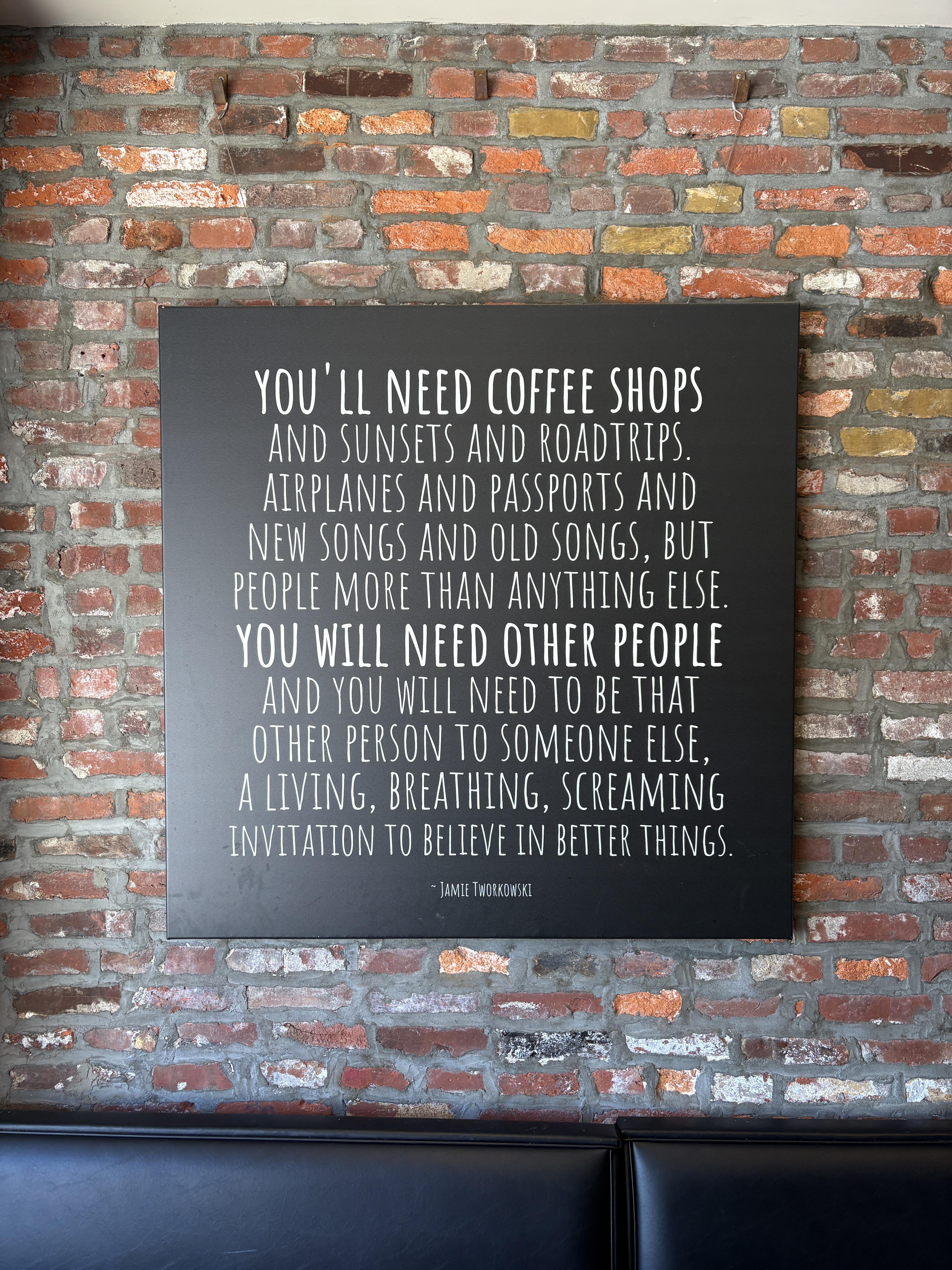
1.

This quote is in on the left as soon as you enter House Cup, a coffee shop near me in Havertown, PA.

Jamie Tworkowski is the founder of To Write Love on Her Arms, an organization devoted to giving hope to those dealing with depression and suicidal ideation.

2.

“Good teaching cannot be reduced to technique; good teaching comes from the identity and integrity of the teacher.”

– Parker Palmer in The Courage to Teach

The Courage to Teach is a fantastic book.

I’ve been slowly reading it over the past month or so, and I’ve been underlining whole paragraphs.

To anyone who has the vocation of being an educator (of any sort), this is a potentially life-changing book.  To me, it highlights some of the tensions and struggles of being an educator who wants their teaching to be a direct expression of their personhood.  Too many teaching modes emphasize information sharing but lack the dynamism of the intersubjective and mutual transformation that can occur between a teacher and a student, THROUGH whatever field of study is being taught.

Education is for formation and transformation, not just the passing of information.

3.

“Christ was never in a hurry.”

– Mary Slessor, Scottish Missionary

Richard Foster writes that the three most significant obstacles to spiritual formation in modern society are “hurry, noise, and crowds.”  As long as those things dominate our lives, and we do not intentionally choose a rhythm of stillness, silence, and solitude, then we should never expect to make much progress on the spiritual path.

Hurry is not something for which I am physically at fault.  I despise running. 

However, I admit that my mind is almost always racing toward the next event, task, deadline, etc.  That type of hurried thinking leads me to sometimes fail at being joyfully present in the moment.  Unfortunately, I must admit that I gave in to this type of hurried thinking quite a bit this week, and it came at the cost of my own joy, and perhaps at the cost of some of those around me.

So, if Christ was never in a hurry, that is quite convicting.  I would guess that he had many of the same stressors, including deadlines, people clamoring, and dealing with incomplete people.

Fortunately, I believe Jesus lived the “perfect” life not to shame us for not doing it, but to reveal to us that it is possible for human beings not to be dominated by “hurry, noise, and crowds.”

4.

“We can know only that we know nothing. And that is the highest degree of human wisdom.”

– Leo Tolstoy in War and Peace

The older I get, the more I realize that I barely know anything.

It is youthful hubris that kickstarts that misguided belief that I know better than others, and then life comes along and dismantles that entire belief structure right in front of us.

I am absolutely guilty of being arrogant, brash, and a know-it-all.  Looking back, I can see at least one decade where my hubris prevented me from cultivating humility.  What kind of foolishness is that? 

If I could sit down a younger version of myself, I would tell them to stop talking so much and do at least ten years more of listening to authentic people around me and that tiny, inescapable, authentic voice inside myself.  I would tell a younger version of myself that no amount of knowledge will ever protect you from the pain of living a life, and that the most important lessons to learn are the ones that lead to personal transformation and vulnerable maturity.

5.

“To say that God turns away from the sinful is like saying the sun turns away from the blind.

– St. Anthony the Great, Desert Monastic

The early desert mothers and fathers of the Church were so incredibly wise.  I love this one from St Anthony the Great.

5. (Again)

Gradually it was disclosed to me that the line separating good and evil passes not through states, nor between classes, nor between political parties either—but right through every human heart—and through all human hearts.

This line shifts. Inside us, it oscillates with the years. And even within hearts overwhelmed by evil, one small bridgehead of good is retained. And even in the best of all hearts, there remains … an unuprooted small corner of evil.

– Aleksandr Solzhenitsyn, The Gulag Archipelago

(Embarrassingly, last week I sent out the weekly email with this last quote, but it did not have a commentary/brief word of reflection on it.  I must have been tired or just out of it to let that mistake slip by.

So, here it is again.

But this time with said commentary/brief word of reflection.)

The best writers are not only those with impressive vocabularies or a precise command of grammar.

The best writers are those who best name what it means to be human.  It can be either through poetry or prose, and it can rhyme or not.  Those things do not matter.  What matters is that when the reader comes to a new sort of clarity about themselves and the world.

And guess what?

That clarity does not always have to create warm and fuzzy feelings.  Sometimes, clarity about ourselves or the world involves facing the hard truths that reveal there is good and evil within all of us, and that the responsibility rests with us to confront that evil and cultivate the good.  In a sense, Solzhenitsyn reminds us here that the stakes are as high as they are personal.

And that is a big pill to swallow.

Rich in Good Will

October 9th, 2025

Thursday, October 9, 2025

What if scarcity is just a cultural construct, a fiction that fences us off from a better way of life?
—Robin Wall Kimmerer, The Serviceberry 

Potawatomi botanist and author Robin Wall Kimmerer critiques our obsession with economic growth:  

The threat of real scarcity on the horizon is brought to us by unbridled capitalism. Extraction and consumption outstrip the capacity of the Earth to replenish what we have taken. An economy based on the impossibility of ever expanding growth leads us into nightmare scenarios. I cringe when I hear economic reports celebrating the accelerating pace of economic growth, as if that were a good thing. It might be good for [some in power], for the short term, but it is a dead end for others—it is an engine of extinction.

Kimmerer learns about the benefits of a “gift economy” from a local farmer and businesswoman who occasionally offers surplus Serviceberries to her neighbors for free.  

Paulie has a reputation to uphold for being no-nonsense in her approach to life …: “It’s not really altruism,” she insists. “An investment in community always comes back to you in some way. Maybe people who come for Serviceberries will come back for Sunflowers and then for the Blueberries. Sure, it’s a gift, but it’s also good marketing. The gift builds relationships, and that’s always a good thing….The currency of relationship can manifest itself as money down the road, because Paulie and Ed do have to pay the bills….  

Even when something is paid for as a commodity, the gift of relationship is still attached to it. The ongoing reciprocity in gifting stretches beyond the next customer, though, into a whole web of relations that are not transactional. Paulie and Ed are banking goodwill, so-called social capital….  

I cherish the notion of the gift economy, that we might back away from the grinding system, which reduces everything to a commodity and leaves most of us bereft of what we really want: a sense of belonging and relationship and purpose and beauty, which can never be commoditized. I want to be part of a system in which wealth means having enough to share, and where the gratification of meeting your family needs is not poisoned by destroying that possibility for someone else. I want to live in a society where the currency of exchange is gratitude and the infinitely renewable resource of kindness, which multiplies every time it is shared rather than depreciating with use….  

I don’t think market capitalism is going to vanish; the faceless institutions that benefit from it are too entrenched. The thieves are very powerful. But I don’t think it’s pie in the sky to imagine that we can create incentives to nurture a gift economy that runs right alongside the market economy. After all, what we crave is not trickle-down, faceless profits, but reciprocal, face-to-face relationships, which are naturally abundant but made scarce by the anonymity of large-scale economics. We have the power to change that, to develop the local, reciprocal economies that serve community rather than undermine it.  

_______________________________________________

How to respond…when I disagree and find relationship…. JD Vaughn. (Me and my AI.)

In a world marked by division, polarization, and loud voices, it is tempting to treat disagreement as an enemy. When someone holds a view, I consider wrong — or even harmful — my instinct is often to fight, to silence, or to withdraw. Yet Scripture invites us into a different posture: one of listening, humility, and care, even (especially) toward those we vehemently disagree with.

James 1:19 gives us three simple but radical instructions: be quick to listen, slow to speak, slow to anger. Listening first means we seek to understand before we respond. It means resisting the urge to leap in with our counterargument or correction. When I choose to listen, I send a message: You matter. Your voice matters. It disarms defensiveness and opens a doorway for meaningful exchange.

But listening alone is not enough. We must also care. Caring means that in the midst of difference, we hold the other person’s dignity and well-being in our heart. It means we pray for them, we pause before judging, and we welcome the possibility that God might teach us something. Sometimes care looks like speaking softly, asking questions, or even acknowledging where we too may be blind or wrong.

It’s important to note that listening and caring don’t demand agreement. We can hear and love without capitulating our convictions. In fact, sometimes the most powerful witness is not winning an argument but being present, humble, and grace-filled in the tension.

Jesus himself modeled this. He engaged with people whose beliefs and lives were radically different from his own. He asked questions, listened to their stories, and walked with them through brokenness (e.g. the woman at the well, Nicodemus, Zacchaeus). He never compromised truth, but he never discarded relational love either.

So when I’m tempted to dismiss, dehumanize, or retreat, I want to ask:

  • Am I more eager to speak than to listen?
  • Do I truly value the person across the divide, or am I seeing them as an opponent?
  • How can I demonstrate care (through compassion, patience, prayer) even if I continue to hold a different conviction?

May God give us courage to lean in rather than back away; wisdom to listen more than lecture; and hearts to see people (not problems). In this way, we reflect the reconciling love of Christ into a fractured world.

Prayer

Holy Spirit, soften my heart where it is hard. Give me ears to hear—not just your voice, but the voice of those I disagree with. Help me to care more about people than winning an argument. May I reflect Jesus’ grace and gentleness even in tension. Teach me humility, give me courage, and guide every word I speak. In Jesus’ name, Amen.

Systems of Wealth

October 8th, 2025

Richard Rohr explores the apostle Paul’s teachings on “the world, the flesh, and the devil,” to clarify the often systemic and hidden nature of evil, including systems of money.  

For most of history we believed that evil was almost exclusively the result of “bad people” and that it was our job to make them into good people. We thought this alone would change the world. And sometimes it worked! Yet only in the 20th century did popes and many moral theologians begin to teach about corporate sin, institutionalized evil, systemic violence, and structural racism. These very words are new to most people, especially ones who benefit from such illusions. [1]  

I believe personal evil is committed rather freely because it is derived from and legitimated by our underlying, unspoken agreement that certain evils are necessary for the common good. Let’s call this systemic evil. However, if we would be honest, this leaves us very conflicted. We call war “good and necessary” when it serves the interests of the nation-state, but we condemn murder. National or corporate pride is expected, but personal vanity is bad. Capitalism is rewarded, but personal gluttony or greed is bad (or, at least, it used to be). Lying and cover-ups are considered acceptable to protect powerful systems (the church, political groups, governments), but individuals should not tell lies.  

Thus we now find ourselves unable to recognize or defeat the tyranny of evil at the most invisible, institutionalized, and entrenched level. Evil at this stage has become not only pleasing to us but idealized, romanticized, and even “too big to fail.This is what I call “the devil” and Paul calls “the thrones, dominions, principalities, and powers” (Colossians 1:16) or “spirits of the air” (Ephesians 6:12). These were his premodern words for corporations, institutions, and nation states. Anything that is deemed above criticism and hidden in the spirit of the age will in time—usually in a rather short time—always become demonic. [2]  

As regards money and evil, money’s meaning and use is highly obfuscated by small print and obscure vocabularies which only highly-trained economists can understand: annuities, interest—“usury” used to be a major sin!—non-fiduciary, reverse mortgages, and more. Yes, the devil is in the details! The ordinary person is left at the mercy of these new clerics who alone understand how we can be “saved” by the “infallible laws of the market” and the “bottom line” of everything. They use the language of religion and transcendence to speak with a kind of assumed objectivity that we once only allowed in the realm of theology and from the pulpit.  

Letting the domination systems of “the world” off the hook, we put almost all our moral concern on the greedy or ambitious individuals. We tried to change them without recognizing that each isolated individual was on bended knee before the powers and principalities of the market and more. In most nations today, our moral compass has been thrown off its foundations. [3]  

=============

Andrew Lang….
This week, I want pass along one specific story – and I hope it can give us a bit of inspiration to be bold and brave if and when we experience and or observe authoritarianism. Here is the (abbreviated) story of Le Chambon-sur-Lignon:

In the late 1930s, south-central France began to experience a sizable increase in refugees fleeing Nazi Germany and post-Civil War Spain. And for a farming region with only a few small towns, this presented a real, economic and cultural challenge. At first, the town of Le Chambon-sur-Lignon, one of the main population centers with roughly 4,000 residents, turned away many of the refugees. Spanish refugees were turned away so tourist season wouldn’t be impacted; Jewish refugees were rejected and many interned in the nearby French-run Gurs Internment Camp. The folks in town wanted to maintain their way of life, their comforts, their status quo.

But as the flow continued and the small town learned more and more of the brutalities of Nazi Germany and of the inhumane conditions at their own Gurs Internment Camp, perspectives slowly began to shift: people began accepting refugees into their homes and helping them escape into Switzerland.And when Nazi Germany invaded France in 1940, residents of the town refused to stop their efforts, despite the massive danger it put them in.

Led by a local pastor and his wife, André and Magda Trocmé, the town sheltered 2,000 refugees over the course of five years.André preached openly about the moral imperative to shelter refugees; Roger Darcissac, a schoolteacher, quietly forged identity documents for the newcomers, changing names and nationalities; Burns Chalmers organized funding to transition a vacant hotel into housing for the kids; Magda connected incoming refugees with families who would take them in.The unspoken rule throughout the town was simple: see something? Say  nothing. The less people knew, the safer it was for them.Obviously forged papers? No problem.Clearly fake names? Seems legit!

There was little organization beyond one-on-one conversations and even these were few and far between; this was a town of folks choosing, grounded in their religious and cultural values, to protect people.When a local pastor was asked about what it was like, he said this:We never really discussed refugees…we also never told parishioners that they were hosting Jews, who had become ‘non-Jews’ with their new identification papers…if they were hiding someone and were caught, they could always sincerely say, ‘I did not know he was Jewish.’

But it’s not like the Vichy and German governments didn’t know what was going on.Police were sent several times between 1942 and 1943 to raid the town and came up empty nearly every time. When these raids occurred, residents and refugees did everything they could to hold strong to their stories and new identity documents or escape to hide in the countryside for weeks at a time. And the town certainly and intimately understood what was at stake: the one “successful” raid resulted in German police arresting 25 kids and Daniel Trocmé, André’s cousin, most of whom were then killed in Vichy or German camps.When pressured by the authorities to sabotage the town’s efforts and turn people in, André bravely told them, “these people came here for help and for shelter. I am their shepherd, and a shepherd does not forsake his flock.”Eventually, because of the stalwartness of the town’s residents and the bravery of its leaders, both German and Vichy police mostly gave up – turning away from the town and informally allowing them to continue.

A few lessons from Chambon:To point out the obvious: the context of this story is radically different from today.Le Chambon-sur-Lignon was a tight-knit farming town, rooted together by a shared Huguenot religious history, isolated from major French cities, and facing invasion from a fascist Nazi Germany. They had deeply enmeshed shared values that made it possible for communal understanding even without communication. On the other hand, most of us live in cities and don’t even know our neighbors’ names.That said, I still think there are some really powerful lessons we can translate from this historical moment.

We can develop communities of resilienceIn the midst of conflict and widespread harm, we don’t need to think on a city-wide or country-wide level for all things. Who is on your block? In your building? Who is within your circle of trust?The residents of Chambon were necessarily knitted together through shared tradition and proximity; if we choose to do so, we can do the same. Each of us can issue an invitation of some kind: monthly potlucks, intentional friend chats, weekly Zooms, tool-sharing networks, regular neighborhood walks.Find your people; create a rhythm of interaction; build relational resilience.

Shared values need to be named One of the most important aspects of this story: the residents of Chambon did not accept the refugees from the very beginning; they turned them away because of fears about their economy and way of life. Their comforts.But when one of their pastors, André Trocmé, had the courage to name their shared values, point to the facts on the ground, and remind them of their tradition, their behaviors shifted.If you’ve ever been talking with someone and weren’t sure where they stood politically, and then they said something that revealed you share the same values – you know that instant sense of relief and connection.Let’s do that more. In conversations with folks around us and when we feel like a value or concern might be shared, name them. “I’m worried about what ICE is doing.” “I want to find ways to help our immigrant neighbors more.” “I think this is just wrong and I would love to find something to do about it.”When we name our values, our concerns, and our dreams, we invite others to remember their own – and then we can work from that space of common humanity.Don’t look away – look out for. In Chambon, the unwritten rule was: if you see something, protect our community through silence.In our context, with ICE raids, military deployments to cities, and the daily creep of fascism into regular conversation, our unwritten (or now written, I guess) rule can be: we look out for each other and we don’t cooperate with systems that harm our neighbors.This is easier said than done, so here are some ideas for what this can look like in practice: attend Know Your Rights trainings and Bystander Intervention trainings, connect with your local immigrants-rights group and ask what is needed, show up at protests in the ways you can, and talk to your family, friends, your partner, and your circle of trust about what each of you will do when something happens. Prepare early with tangible action steps.

For me, the most amazing aspect of this story is that the town didn’t have one over-arching organization leading the way and their resistance wasn’t a top-down, individualistic initiative powered forward by one specific leader.It was a community of folks leaning into the skills and resources they had, to help as many people as they could. If folks had food, they’d share food. If a family had room in their home, they hid a child. If they had a friend on the way to Switzerland, they got connected and made sure the journey would be as safe as possible. Every individual was a normal person choosing to engage in a radical act of care.And that’s how it became an entire town that resisted authoritarianism.

(A note: I think it’s important to be careful with comparing our current moment to Nazi Germany. The two are not the same, although the rise of authoritarianism in all contexts have similarities.Rather than focusing on the context of Nazi Germany, I think this story really illustrates the power of community and taking action, no matter how small, in the face of rising authoritarianism. And that’s a message I think is very important for us today.)

Money and Soul

October 7th, 2025

Money and Soul

Richard Rohr articulates an opportunity for each of us to rediscover a “soulful” relationship with money.  

I’m convinced that money and soul are united on a deep level. This truth is reappearing from the deep stream of wisdom traditions after centuries of almost total splitting and separation at the conscious level. There is un río mas profundo, a river beneath the river. The upper stream has always been money in all its forms, beginning with trading and bartering. The deeper stream is the spiritual meaning such exchanges must have for our lives. Money and soul have never been separate in our unconscious because they are both about human exchanges, and therefore, divine exchange, too.  

From my perspective, when money and soul are separated, religion is the major loser. Without a vision of wholeness that puts money in its soulful place, religion “sells out.” Religion has allowed itself to lose the only ground on which awe and transcendence stand—the foundation of totally gratuitous and “amazing grace.” [1] 

Lynne Twist, founder of the Soul of Money Institute, understands the impact that our culture’s disintegrated view of money has made:  

For most of us, this relationship with money is a deeply conflicted one, and our behavior with and around money is often at odds with our most deeply held values, commitments, and ideals—what I call our soul…. I believe that under it all, when you get right down to it and uncover all the things we’re told to believe in, … what deeply matters to human beings, our most universal soulful commitments and core values, is the well-being of the people we love, ourselves, and the world in which we live. 

We really do want a world that works for everyone. We don’t want children to go hungry. We don’t want violence and war to plague the planet…. We don’t want torture and revenge and retribution to be instruments of government and leadership. Everyone wants a safe, secure, loving, nourishing life for themselves and the ones they love and really for everyone….  

Each of us experiences a lifelong tug-of-war between our money interests and the calling of our soul. When we’re in the domain of soul, we act with integrity. We are thoughtful and generous, allowing, courageous, and committed. We recognize the value of love and friendship….  

In the grip of money, those wonderful qualities of soul seem to be less available. We become smaller…. We often grow selfish, greedy, petty, fearful, or controlling…. We see ourselves as winners or losers, powerful or helpless, and we let those labels deeply define us in ways that are inaccurate….  

In a world that seems to revolve around money, it is vital that we deepen our relationship with our soul and bring it to bear on our relationship with money…. We can have our money culture both balanced and nourished by soul. [2]  

=========================

Silence on Aisle Nine

(or The Sound of Being Enough)

LIFE, DEATH, AND COMEDYOCT 7


Beep. Beep. Beep.
The register scans your almond milk, your toothpaste, the protein bars you will forget by Tuesday. 

The sound is steady, impersonal. The familiar music of purchase.

Do I really need all these Cheez-Its? Beep.

Another box of paper towels? Didn’t I just buy these? How many spills can one family possibly anticipate?
Beep.

What vegetable is that again? Arugula? Do I even know how to cook arugula, or am I just trying to look like someone who eats arugula?
Beep.

The woman ahead of me has thirty-six cans of sparkling water. I applaud her hydration plans. The guy behind me is buying beef jerky and incense. What hippie keto party is he going to? Everyone’s cart looks like a personality test we did not mean to take. 

Beep.

The beeping grows louder. It’s so defining. It’s like I’m always either buying something, wanting to buy something, or worried about not being able to buy something.
Beep.

Somewhere mid-cart, the beeps begin to feel like a heartbeat. 
A hospital monitor.
Beep. Beep. Beep…

If you listen closely, the register is announcing something about your aliveness—or your quiet dying.

Every item—batteries, berries, bread—is another small jolt of proof that you’re here, still moving through the world.

But maybe it is the opposite. Maybe the beeps are not telling us we are alive. Maybe they are counting us down.

“If I am what I have and if what I have is lost, who then am I?” 

— Erich Fromm, To Have or To Be?

The Noise We Mistake for Life

I catch myself doing it all the time: filling the cart, filling the calendar, filling the air with sound.

A podcast on the drive. News alerts at checkout. A playlist called Morning Motivation streaming into my skull before the second coffee.

There seems to always be a soundtrack demanding I perform: the earnest shopper, the busy citizen, the aspiring sage who reads Merton during coffee breaks. 

Noise feels like proof of life. 

Speaking of Merton – 

“Our being is silent, but our existence is noisy. It is in silence that we find life.” 

— Thomas Merton, The Springs of Contemplation

I tell myself I am comfortable with silence, but there are days when the loneliness seeps in and I fear that silence might mean I have disappeared. If there isn’t a soundtrack, how do I perform?

What’s the soundtrack of your life?

Is it a war march, a marketing jingle, a lullaby you forgot the words to?

We live in a culture where noise = life, having = life, performing = life. We call it “wanting more out of life,” but usually it’s just more in life—more objects, opinions, hustle.
More. More. More.
Beep. Beep. Beep.

What if the deeper invitation, the one our bodies and souls are starving for, is less?

The Gospel of Less

Most religions tell some version of the same story — the gospel of less.
Different languages, same invitation: to set down what we clutch so that life can hold us again.

Buddha called it non-attachment. The Hindus call it vairāgya, acting without clinging to results. In Islam, it’s zuhd—the simplicity that keeps the heart soft to God. The Taoists talk about wu wei, the way of doing less so that life can move through you. And Judaism builds it right into the week: Sabbath, a holy un-doing, a pause from proving and producing.

And then there’s the Christian story of the rich young ruler.
He’s not a villain. He’s earnest, devout, probably better behaved than most of us. He wants eternal life. He’s done everything right.

Jesus looks at him—Mark says, “and loves him”—and then offers the invitation no one wants: “Go, sell what you have, give to the poor, and you will have treasure in heaven. Then come, follow me.”

Not because wealth is evil, but because attachment is. Jesus doesn’t shame ambition; he redefines abundance.

Maybe holiness begins right here, in the checkout line, when we notice what we reach for without hunger.

The treasure isn’t in the having.
It’s in the letting go.
It’s in the leaving.

You lack one thing: less.

Meister Eckhart’s Counterbeat

Meister Eckhart, the 13th-century mystic, called detachment—abegescheidenheit—“the supreme virtue.”

He wrote that a detached soul “should be as free as a mountain of lead, unmoved by a breeze.” For him, freedom wasn’t getting what you want; it was no longer needing to.

Eckhart’s paradox is radical: Once a person has let go of himself, then he has really let go.
The shedding isn’t just of stuff but of identity because the self that must always prove, perform, and possess.

Detachment isn’t numbness. It’s spaciousness—the room where God can breathe again.

Across centuries, mystics have been humming the same quiet tune.
It’s hidden in John of the Cross “the dark night.”
tucked away in Thomas Merton’s “hidden wholeness.”
and in what Simone Weil called pure attention “prayer.”

All of them whisper the same refrain:
Less, less, less.

The Science of Less

Modern psychology agrees with the mystics.

A 2021 review of 23 studies found a consistent link between voluntary simplicity—intentionally reducing consumption or commitment, and higher well-being (Hook et al., Journal of Positive Psychology). People who live with less report less anxiety and more meaning.

There’s a caveat, though: simplicity heals only when it’s chosen, not forced. Poverty imposed by injustice doesn’t sanctify; it wounds. The research shows minimalism helps most when the letting-go is internally motivated, when you give up not because you must, but because you’re free to.

Maybe that’s the real test of freedom—not just how we simplify our lives, but how we imagine strength itself. Because even our faith traditions get noisy. The urge to prove, to defend, to win—it sneaks into our prayers and our politics just the same.

The Warrior’s Soundtrack

Another soundtrack blares across American Christianity: the warrior march.
“Take back the nation.”
“Reclaim the culture.”
“Stand firm.”

The metaphors of conquest and dominance have become the chorus of Christian nationalism—empire logic wrapped in worship lyrics.

The irony is painful. The Christ who refused the sword, who rode a donkey instead of a warhorse, has been repackaged as a general in a culture war.

But what if the opposite of “Onward Christian Soldier” isn’t cowardice: it’s surrender?
Not resignation, but radical relinquishment. The mystics would call that freedom, and I think Jesus would recognize that a lot more than this “so-called” warrior ethos soundtrack. 

The revolution we need might not be a flag to wave, but a sword to lay down.

How tragic it is that they who have nothing to express are continually expressing themselves, like nervous gunners, firing burst after burst of ammunition into the dark, where there is no enemy…. They confound their lives with noise. They stun their own ears with meaningless words, never discovering that their hearts are rooted in a silence that is not death but life. They chatter themselves to death, fearing life as if it were death.

Thomas Merton

So, enough already with this noise that calls itself courage—this drumming of shields where hearts should be listening. Maybe the real bravery now is to lower the flag, unclench the fist, and move with the kind of strength that heals instead of conquers.

Silence as a Heartbeat

In my own life, transformation hasn’t come through victories but vanishings.
The job that ended.
The prayer that dried up.
The moment I could no longer perform my way into worth.

Each one felt like a small death.
Each one cracked me open to something truer.

So I ask again:
What’s the soundtrack of your life?
Do you know how it sounds when the register stops, when the heart monitor goes flat?

It’s terrifying at first, but underneath the silence, something gentler appears:

The sound of being itself.

The Pulse of Enough

Maybe the gospel we need isn’t “more.”
It’s “enough.”

Meister Eckhart said: “God is not found in the soul by adding anything, but by a process of subtraction.”
That’s not just theology; it’s medicine.

Beep. Beep. Beep.
The cart is empty now. The monitor is quiet.

At first, it feels like loss.
Then you realize: this isn’t death.
It’s the sound of being alive.