Archive for June, 2026

Mutual Interabiding

June 9th, 2026

Tuesday, June 9, 2026

CAC faculty emerita Cynthia Bourgeault highlights that the primary quality of the kingdom of God is an experience of interabiding—one with God and with one another.

The hallmark of this [kingdom] awareness is that it sees no separation—not between God and humans, not between humans and other humans. And these are indeed Jesus’s two core teachings, underlying everything he says and does.

No separation between God and humans. When Jesus talks about this Oneness, he is not speaking in an Eastern sense about an equivalency of being, such that I am in and of myself divine. What he more has in mind is a complete, mutual indwelling: I am in God, God is in you, you are in God, we are in each other. His most beautiful symbol for this is … where he says, “I am the vine; you are the branches. Abide in me as I in you” [see John 15:4–5]. A few verses later he says, “As the Father has loved me, so I have loved you. Abide in my love” [John 15:9]. While he does indeed claim that “the Father and I are one” (John 10:30) … he does not see this as an exclusive privilege but as something shared by all human beings. There is no separation between humans and God because of this mutual interabiding that expresses the indivisible reality of divine love. We flow into God—and God into us—because it is the nature of love to flow. And as we give ourselves into one another in this fashion, the vine gives life and coherence to the branch while the branch makes visible what the vine is…. The whole and the part live together in mutual, loving reciprocity, each belonging to the other and dependent on the other to show forth the fullness of love. That’s Jesus’s vision of no separation between human and Divine.

No separation between human and human is an equally powerful notion—and equally challenging. One of the most familiar of Jesus’s teachings is “Love your neighbor as yourself” [Mark 12:31; Matthew 22:39]. But we almost always hear that wrong. We hear “Love your neighbor as much as yourself.”… If you listen closely to Jesus’s teaching however, there is no “as much as” in there. It’s just “Love your neighbor as yourself”—as a continuation of your very own being. It’s a complete seeing that your neighbor is you. There are not two individuals out there, one seeking to better herself at the price of the other, or to extend charity to the other; there are simply two cells of the one great Life. Each of them is equally precious and necessary. And as these two cells flow into one another, experiencing that one Life from the inside, they discover that “laying down one’s life for another” [John 15:13] is not a loss of one’s self but a vast expansion of it—because the indivisible reality of love is the only True Self.

==================

Dear friend,

In May I was honored to be invited to give the commencement address at my undergraduate alma mater, Malone University. That alone was humbling enough. But in addition—and quite to my utter astonishment—the University also conferred upon me an honorary Doctorate of Letters, a decision and ritual I would soon come to discover was the result of no small amount of work on the part of those responsible for it. I must also freely admit: writing the previous sentence makes me a bit uncomfortable.

Uncomfortable because, like many people I know, I am uneasy naming anything that potentially raises even the slightest hint of self-aggrandizement. Even talking about how worried I am that I might sound self-aggrandizing can sound, to me, well, self-aggrandizing in my potentially drawing attention to how virtuous I am in not wanting to draw attention to myself. Imagine living in my mind.
 
All of that notwithstanding, receiving the honorary doctorate in particular has revealed some things to me about gratitude, belonging and becoming. It is commonly known that practicing gratitude has multiple health benefits. This does not necessarily make becoming a person of gratitude any easier. Perhaps this is why we refer to gratitude as something we practice. But on this occasion especially, I discovered that not only was I grateful, but that gratitude alone was not a word that adequately contained all that I was feeling.When Dr. Gregory Miller, President of Malone, informed me of his intention to initiate the process that was required to award me the doctorate, I was immediately overwhelmed. I am aware of others who have received this type of honor but have never paid much attention to it. But this had my attention. And not, as it turns out, just because it had to do with me. Rather, that it had to do with community.One of the first thoughts that came to my mind upon hearing from Dr. Miller was, “Why me and not someone else?” I know of many other Malone graduates who are just as, if not more, deserving given what they have done to make the world a better place. But this thought of comparison was immediately followed with the awareness that I was, in so thinking it, simply protecting myself and my shy temperament from this attention. And not just attention from one person (Dr. Miller), but from an entire institution. Which revealed something more.
 
I often say that, despite growing up in an imperfect family, it is still the case that anything good in my life that I have had something to do with has my parents’ fingerprints all over it. And contemplating being with all of those gathered for the commencement, I could see that it is equally true that the same could be said about Malone.

However, it also struck me that in conferring the honorary doctorate, the Malone community was not just saying, “Thank you.” or, “Well done.”, although they very much did say those things. Rather, what I mostly heard them saying was, “You belong to us.” And in that moment the awareness arose in me quite viscerally that this ritual was so much more about who I belong to as much as it has to do with anything I have done.
 
And this belonging is no mere abstraction, but an embodied encounter that comes, yes, in the form of a ceremony, but behind which are the voices and warmth of friendships and mentors who have continued to form me long after I have graduated. I couldn’t begin to name all of those whose lives are shaping me even as I write this. It is to them—and the present Malone community—to whom I belong. 

It is in belonging that I have become whoever it is that I am.Furthermore, it was in belonging at Malone University (although I would not have known it at the time) that set the course for what it means for me to belong to the communities to which I am now a part and are forming me. People who love me and with whom we are all doing the hard work of being known.To whom do you belong who are forming you into who you are becoming?You don’t have to receive an honorary doctorate to know that these are important questions. But the moment you begin to practice gratitude, you will soon be drawn to and hopefully discover their answers. Godspeed, my friend, as your heart of gratitude expands, and you find yourself belonging—through no small amount of work—to those by whom you are deeply known and in whose presence you will become who God is preparing us for readiness to live in his heaven on earth when it arrives in its fullness. 

Warmly,
Curt

June 8th, 2026

A Pattern of Relationship

Sunday, June 7, 2026

Father Richard Rohr reflects on how understanding the Trinity as relationship encourages us to live in greater communion with God and life:

The genius of the Trinitarian doctrine has the power to rearrange our universe. We know nothing about this being called God, except that this God is perfect giving and perfect receiving. The very nature of God is communion, receptivity, and generosity, one hundred percent unhindered dialogue between three. It all begins with three! This isn’t just an abstraction; it’s the foundational template of reality. Reality is total, continual givenness and perfect, humble receptivity; that is the very form and shape of being as we know it. It is the very source, pattern, and goal of reality.

The wonderful thing about living in our time is how many scientists, such as physicists and astronomers, are confirming that this interconnected nature of reality is true. Looking through microscopes or telescopes, they see this same pattern of utter relationship. They are discovering that if reality is anything, it’s absolutely relational. It’s something we used to know, something our ancestors knew on an intuitive, spiritual level. But since the Enlightenment, at least in the West, many people basically dismissed the possibility of interconnection or interbeing. We’ve primarily produced individualists who try to save themselves by believing things intellectually. This view of religion is not a mystery of participation. It’s not a mystery of surrendering; no surrender is even necessary. Instead, it’s a quest to get the right information, which only makes us more proud and self-centered. It makes community less possible, which is clearly evident from our politics and our international relations. Everyone is put back upon themselves, where the only question Christians seem to ask is “How can I get to heaven?” That’s not even a gospel question! It’s a question of the ego. It’s not the question of the Trinity within us.

A conversion to this foundational definition of God as relationship is needed right now. Only people who undergo that conversion can possibly be converted to Jesus and not have their faith distorted. When there isn’t a primary understanding of who Jesus is as part of the Trinity, Jesus will be used for our own nationalistic and egocentric purposes, as a means of power and a ticket to heaven. Can we all be converted, not to Jesus (as strange as that must sound) but to the Trinity, where Jesus Christ actually exists? Only inside the mystery of the Trinity can we begin to understand what Jesus is saying, the mystery he is inviting us into, and the meaning of salvation.

===================

A Positive Relationship

Monday, June 8, 2026

Father Richard describes relationship as the nature of God and reality:

The Christian belief in the Trinity says that God is absolute relatedness. God is our word for the ultimate ecosystem that holds all things in positive relationship (see Colossians 1:17). As long as we’re in honest and loving relationship with what is right in front of us, the Spirit can keep working in us, through us, and for us.

Jesus comes as a naked, vulnerable baby, totally dependent upon relationship with others. Naked vulnerability means that we allow otherness to influence and change us. When we think that otherness can’t change us or teach us anything, we don’t give other people any power over our lives. When we block them by thinking we can stand alone, we are spiritually dead. It’s true that nothing stands alone! We are intrinsically like the Trinity, living in an absolute relatedness. We call this love.

We really were made for love, and outside of love we die very quickly. If we are going to start with Trinity, then loving relationship is the universal pattern, the nature of our being. When we start with a philosophical concept of being and then try to convince everyone that this being is, in fact, love, we don’t have a lot of success. I’ve been a priest for over fifty years and can say that more Christians seem to be afraid of God than in love with God. Sadly, Christians aren’t more loving than anyone else; sometimes, we’re even less loving than other people! In some ways, that’s inevitable if we’re basically relating to God out of fear, if we haven’t been drawn into the love between the Father and the Son by the Spirit.

In some ways the Spirit is the hardest to describe. Jesus says, “The Spirit blows where it will” (John 3:8). Jesus’s message to us is clear: Don’t try to control the Spirit; don’t try to say where it comes from, where it goes, or who has it. It’s group narcissism to believe that only our group has the Spirit or the truth. At less mature levels, every group will try to put God in their own pocket and say God only loves their group, but such a belief has nothing to do with the love of God. It isn’t a search for Truth or Holy Mystery, but a search for control. It’s the search of the small self, the search to make myself feel superior and to stand alone.

I’m not in control or in charge of this Holy Mystery. I don’t presume to understand it; all I know is that I’m forever being drawn through everything. Each manifestation or epiphany of God calls for surrender, communion, and intimacy.

===========

A Place for God to Move In

June 5th, 2026

Friday, June 5, 2026

Embody me.
Flare up like flame
and make big shadows I can move in.
—Rainer Maria Rilke, Rilke’s Book of Hours

Father Richard invites us to know and honor ourselves and others in all our complexity: 

For you who have loved Jesus, do you recognize that any God worthy of the name includes and transcends creeds and denominations, time and place, nations and ethnicities, and all the vagaries of gender and sexual orientation, extending to the limits of all we can see, suffer, and enjoy? We are not only our gender, our nationality, our ethnicity, our skin color, or our social class. These are not the qualities of our true self in God!  Why, oh why, do we allow temporary costumes, or what Thomas Merton called the “false self,” to pass for the substantial self, the soul, which is always “hidden with Christ in God” (Colossians 3:3)?

You are a child of God, and always will be, even when you don’t believe it. And so is everyone else! God created us all. We are all God’s children. 

Now don’t get me wrong. I’m not saying that social identifiers don’t make a difference in our lives. We must be in relationship with and value the “other” in all their individuality and uniqueness, before we can see ourselves as “one.”

God loves and creates each one of us as a unique being with different gifts and challenges. If we stay small and “hide our light” under a bushel basket, there is almost no place for God to move in, through, and with us for the sake of the world!

Episcopal priest Elizabeth Edman recounts a story of challenging expectations as a child:

I was born in Fort Smith, Arkansas in 1962. The world I grew up in was defined by rigid binaries: white/black, capitalist/communist, north/south. Oh yeah, and male/female. That one didn’t work for this tomboy.

When I was five, I had to drag my mother into the boy’s section of the shoe store to look at sneakers. “Mama, c’mere! Let me show you the ones I want!”…

When I presented the shoes to the clerk, he said, “Those are boys’ shoes.”

My mother cut him off: “Yes, size four, please.”

My mother was a singer. Being who she was meant having the courage to witness God’s presence in the sacred music she loved. You could see her put her whole trust in God, entering into this space between heaven and earth where her best voice, her best self, emerged.

Christianity is all about being who you are. That’s what Jesus was trying to tell us: Orient your whole being to the sacred, he insisted. Not because I’m telling you to, not because it’s what Scripture demands; do it because it’s who you are. It’s who God created you to be. God made us to be complex creatures, every one of us, for a reason. So if you want to honor God, here’s the first step: Know who you are. Be who you are. Be the person God created you to be. Amen.

==================

John Chaffee’s Friday Five

1.

“If you are willing to serenely bear the trial of being displeased with yourself, you will be a pleasant shelter for Jesus.”

– Therese of Lisieux, French Carmelite Nun

Some of us are so displeased with ourselves that we are violent, angry, and condescending to ourselves.  And, according to Therese of Lisieux, this makes our hearts/minds/souls an uncomfortable place for Jesus to dwell.

If only we could learn to be more tender with ourselves, I am sure many of our issues would soften.

2.

“No sinner can escape future judgment without experiencing in this life either voluntary hardships or afflictions he has not chosen.”

– Maximus the Confessor, in Four Hundred Centuries on Love (2.66)

We reap what we sow.

We should not be fooled.

There is always a price to pay.

God is judicious (He knows what is good and bad for us) and at the same time God is not judgmental (He does not look down on us condescendingly for our mistakes).

God does not spare us from the consequences of our own decisions.

God gives us the freedom to make some terrible mistakes that hurt us and/or those around us.

Again, there is always a price to pay.

Do we want the hardship of living a life of as much virtue as possible…  Or do we want a life of hardship from living a self-destructive life that drags others down with us?

Some forms of Christianity falsely believe that consequences and punishment only happen to those who are unbelievers, and that if we are church-going people, we should be spared from the consequences of our own decisions.  However, I believe orthodox Christianity (of which Maximus the Confessor helped to shape) teaches us that “all will be held accountable, first the Jew and then the Gentile, for what he has done.”

We just have a hard time separating accountability from punishment.  I believe God will hold each of us accountable AND will perform the necessary, painful act of pruning us of our self-destructive and sinful patterns.

3.

“To follow Jesus is to be a wholemaker, essentially to love the world into new being and life.”

– Ilia Delio, Franciscan Theologian and Neuroscientist

There is a philosophical shift happening in some scientific circles.

There is one mindset that sees the world as composed of parts and that we need to break things down to understand each layer of smaller and smaller parts.

Meanwhile, another mindset sees the world as composed of whole things that come together to form larger wholes with greater and greater complexity.

Think about it.

Whole atoms make up whole molecules that make up whole cells that make up whole organs that make up whole persons who make up whole families who make up whole communities who make up whole states who make up whole nations who make up whole continents who make up the whole world… that make up solar systems that make up universes that make up the whole cosmos that makes up… something else?

Either way, it is a mystery all the way up or all the way down, but the difference is whether we see things as parts or as wholes.

Seeing the world as parts means we do not yet recognize or value the relationships between things.

However, seeing things as wholes implies a certain a priori appreciation of relationships.

Ilia Delio is the theologian who first made me realize that Jesus is a wholemaker, who values relationship, interdependence, and coming together to fix what is broken or to bring something new into existence.

4.

“Where our money is, there our theology will be also.”

– Joash P. Thomas, Episcopal Priest

Dang.  That’s an interesting one, right?

I just finished The Justice of Jesus: Reimagining Your Church’s Life Together to Pursue Liberation and Wholeness (How the Local Church Can Examine Its Preaching, Budget, and Theology for the Good of Its Neighbors).

It is Joash’s first book, and it takes some big swings.  And of all the big swings, this one actually landed the most for me.

I believe our theology and how we think about money are closely tied.  Not only that, but how many of us would be willing to change our theology to something that might eventually become a financial loss for us?  How often do we defend or endorse a theology simply because it financially benefits us?

Is money our actual metric for orthodoxy?  If it is… it shouldn’t be.

A few weeks ago, I was reading Basil of Caesarea’s book called Social Justice.  It takes to task the way that the early church interpreted the Gospel stories of the young man who turned away from Jesus, sad because he could not give up his material possessions.

Basil pulled no punches.  As a youth, Basil grew up in a very wealthy family, so it is fascinating how strongly he turned against the accumulation of wealth.  I am not yet done reading Basil’s work, so I probably shouldn’t comment further, but back to the main point: Joash is onto something here…  Our theologies are often too influenced by our money.

5.

“I drink beer whenever I can lay my hands on any. I love beer, and by that very fact, the world.”

– Thomas Merton, Trappist Monk

I am not a big drinker.  It can take me a few months to get through a six-pack of beer or more than a year to get through a bottle of whiskey.  I will say, though, that a cold beer on a hot summer day does hit the spot for me.

When I read this quote from Merton, I chuckle.

It feels very human and yet at the same time quite grand and connected to the whole of everything.

How we do the small things is how we do the big things, right?

Individual Reflection

What part of yourself have you been most reluctant to let God inhabit?


Group Discussion — choose one:

  1. Where in your life are you still wearing a costume Rohr would call the false self — and what would it cost to take it off?
  2. Therese says serenely bearing disappointment with yourself makes you a shelter for Jesus. What would that kind of tenderness toward yourself actually look like today?
  3. Merton drinks a beer and loves the world. Where does ordinary delight open you to something larger?

Blurring Boundaries

June 4th, 2026

Thursday, June 4, 2026

READ ON CAC.ORG

The Rev. Dr. Jacqui Lewis reflects on the liberating impact of receiving unconditional love:

If you are a parent, you’re present at important moments of discovery and growth all along the way…. You get to be wise and also glean wisdom from that person forming right before your eyes. Watch, observe, see what is becoming; celebrate the mystery of what is unfolding. Guide as best you can, to keep your child safe, while creating a brave space where they can experiment and become…. Your love—your lavish, fierce love, will surround your child with permission and confidence to be their best self. He will bask in your love; it will morph into love for his own unique and wonderful self. Your love, taken in deeply, will enable your child to stand on his feet and say, “I am enough; I am loved.”

In any relationship, fierce love causes us to cross boundaries and borders to discover one another, to support one another, to heal one another. When we do this, when we go crazy with affection, and offer wild kindness to our neighbor across the street or across the globe, we make a new kind of space between us. We make space for discovery and curiosity, for learning and growing. We make space for sharing stories and being changed by what we share. This is the space of the border, of mestizaje, of both/and. It’s the kind of space where we can enhance our knowing with what the other knows; we can develop this kind of knowing, which W. E. B. Du Bois called “double consciousness.” We can learn to see the world not only through our own stories, through our own eyes, but also through the stories and worldview of the so-called other. This is the kind of space that changes us, that grows empathy, this is ubuntu…. We simply must open our eyes, look across the room, the street, the division, the border—and reach out to that neighbor, offering our hand, our compassion, and our heart.

Lewis acknowledges that it can be a struggle to love even those closest to us when they do not conform to our expectations:

You know what might be the riskiest, most uncomfortable, heart-expanding, border- crossing work of all? Loving those impossible people who are related to you might be what tests you most. Right there in your home, where your closest neighbors live, are folks who can get on your last nerve. Your teenaged child, who is conflicted every day about who she is, so much so that you want to throttle her. Your back-in-the-nest-again son, who can’t afford his own place…. Your spouse, who is showing you parts of their personality that make you want to pack your bags and leave…. These intimate neighbors also need to be loved. Even though you disagree with them, even though you can’t fix them, when you love them across the borders of difference, when you hold them with grace, you are loving them fiercely

============================

The Doctrine of the Trinity is a Mighty Angel

a post-script homily for Trinity Sunday

CHRIS EW GREEN JUN 4

In the Name of the Father, of the Son, and of the Spirit.

In her funny (and not-so-funny) book, An Unauthorized Guide to Choosing a Church, Carmen Renee Berry offers this (cringe) account of the much-misunderstood doctrine of the Trinity:

In the Old Testament God’s identity was clear—there was one and only one God—the God of Abraham, Isaac, and Jacob. With the appearance of Jesus, and later the Holy Spirit, the Christian concept of God got a little more complicated. Christians retained the “one God” idea from Judaism, but now had three variations of God to deal with.

Berry is convinced that no one “really understands the mystery of divinity in general, let alone fully grasps a three-in-one God.” Everyone struggles to hold “irreconcilable concepts in perfect balance.” Yet Christians have no choice, ultimately: “this unfathomable God is at the heart of Christianity—an unsolvable mystery who asks for our devotion.”

To cope with this, Christians default, Berry suggests, into identification with one member of the Trinity or another. That should not be surprising, because “it’s just human nature to have a favorite.” So, she argues, the surest way to find out which church suits you best is to see if their “Trinity affinity” matches your own. Some (Episcopalians, for example, and Methodists) will speak mostly to and about God, not Jesus or the Spirit. Others (Evangelicals, especially) will be Christ-centered. Still others—the Pentecostals, surprise, surprise—will focus their attention mainly on the Spirit.

This is all wrong, of course. And not only theologically. Sociologically, it distorts the lived truth of each tradition beyond all recognition. But it does gesture toward something we all sense, I think, although it too is wrong. We have been left to feel the doctrine of the Trinity is hopelessly complex—and entirely beside the point, anyway. Not just unnecessarily difficult but flat-out unnecessary. Extra. Something for scholars to worry over, while those in real ministry attend to truly important matters. But what if the doctrine is neither nonsense nor excessive, of concern only for intellectuals and heresy-hunting theobros? What if it’s the rule of faith, necessary and life-giving? 

Today’s Gospel reminds us that Jesus says we are to use this name to form the Church. And today’s Epistle is sealed with the same blessing: “the grace of the Lord Jesus Christ, the love of God, and the communion of the Holy Spirit be with you all.” I suspect such uses seem to us mere formalities, flourishes—something fancy added on to make whatever we’re doing seem important. But again: what if not?

The doctrine of the Trinity is not a mystery. It is a witness to, a servant of the mystery. It is an angel with a golden trumpet and a flaming sword, announcing the arrival of God, guarding the way so that we do not turn away from God to our own hurt.

Despite what Berry said, then, to talk about the Trinity is not to try and fail to hold together irreconcilable ideas; it is to direct our attention toward the one who holds all things together and reconciles them in himself for good. Remember: this doctrine is not something we devised for ourselves. It is the way the Spirit and the Church have given us of talking about God, so that we know what it means to have been befriended by Christ, claimed by his love.

God cannot be explained. But God can be experienced. Indeed, we are never not experiencing God. If for a moment God were to cease being there for us, we would cease to be at all—cease ever to have been. So, when we say God is mystery, ineffable and incomprehensible, we are not speaking nonsense about God; we are reminding ourselves that there is so much sense to God that we could never say it all. And in that way, we are reminding ourselves of our own essence. We are remembering that we are not God, that we do not and cannot create ourselves or make ourselves good. And we are remembering that we do not need to do any of that—life and all that is good about life is given to us freely, lavished on us in love, simply because God rejoices to share it with us. 

We are also saying that God’s goodness and delight are almighty—wholly unconditioned and therefore wholly unconditional. And by confessing that, we are reminding ourselves that nothing can keep God from being God for us. God is beyond being, beyond knowing, beyond every name that can be named, angelic or human, infinitely exceeding all that is and all that could be, real or imagined, an infinite number of times. Eriugena, wonderfully, says that even God does not know what God is, because God is not a “what,” not a something, not even the greatest of all somethings. God is, as Nicholas of Cusa says, Not-Other—not a being in contrast with other beings, but the beginning, middle, and end of all beings from beyond being—inconceivably good, indescribably generous, inexhaustibly merciful and compassionate, exceedingly, abundantly beyond all we could ever ask or think. All to say: we cannot get our minds around how it is that God is God. But we can touch and be touched by him. Indeed, in a moment, at the altar, he will kiss us. 

It is in this sense that the doctrine is an angel with a flaming sword. We are, as Nicholas Lash says, tempted to make idols of what we cannot understand, of what lies beyond the reach of our grasp or even of the darkness itself. And we are tempted to make idols of what we do understand, of the mastery and control our knowledge affords us—the light we consider our own. And we are tempted to worship the natural order, its beauty or its terror. But the rule of faith, standing sentinel, keeps us from idols. It will not let us settle for regarding God as sheerly “Father,” or “Majesty,” or “Other,” utterly unlike and beyond us; or as only “Son” or “Friend”—near to us, in our likeness; or only “Spirit,” the wild, ungovernable forces that energize and overwhelm us, carrying us away from ourselves, bringing life and death to bear on us suddenly. Instead, the doctrine of the trinity, that ministring spirit, 
prevents us from fixing our eyes on these shadow-figures, turning us away from the lure of false gods back onto the path God has taken ahead of us into the dark.

It does so by directing our attention to Jesus Christ. He is not one-third of God, doing part of what God wants done, leaving other things for the Father and the Spirit to do, each in their own way. He is the fullness of God, very God of very God, Light from Light, consubstantial with the Father. And he fulfills God’s will fully. He is the one to say both “Let there be” and “It is finished.” There is nothing in him, nothing, that is not identical with the Father in every way. Seeing him, the one who does only what he sees the Father doing, we see the Father. Can you see that that, finally, is what the doctrine of the Trinity is for? It teaches us that there is no God other than the God we meet in the life of this man from Galilee, shuddering his last breaths out on that Roman tree.

So, no, the coming of Jesus and the outpouring of the Spirit do not muddy the clear picture of the God of the Old Testament. They open up for us the life of the one and only true God; creator of all things, seen and unseen; the God of Abraham, Isaac, and Jacob; the God who spoke by the prophets—so that we are included in his life, made to share in all he is and does. Drowned in the waters of his goodness. Swallowed up by the consuming fires of his love. 

In the words of Craig Keen, a Nazarene theologian, the doctrine of the Trinity serves us by training our awareness on the gape of agape love, the opening that is the room God is for us, the space that opens between the unspeakable exaltation of the Father and the unspeakable abasement of the Son. That space opens by the breathe, the wind, the storm, the sigh, the outcry, the rupturing outgoing of the Holy Spirit, the one who holds exaltation and abasement apart and together.

We never stand outside or apart from the mystery, not at any moment, not even for even a breath. We live in the space opened up in God by God’s going out from God to God—and that space lives in us. We live within the sacrament the Son is, caught up in the move of the Spirit that draws us magnetically to the Father and the Father to us, so we become his as surely as Jesus is. This doctrine, then, in all its glories, is a mighty angel—it tells us not only who our God is but also that we are always already en-Godded. That, nothing less, is the blessing spoken over us, and I speak it over you, now: May the grace of our Lord Jesus Christ, the love of God, and the communion of the Holy Spirit be with you all.

Amen.

====================

Individual Reflection

Where in your life right now is Love holding you in place — not letting you go — even as part of you strains against it?


Group Discussion — choose one:

  1. Lewis describes fierce love as what crosses borders and changes us — where have you experienced being genuinely changed by someone across a line of difference?
  2. Green says we are “always already en-Godded” — we never stand outside the mystery. What would it mean to actually live from that, rather than toward it?
  3. Both pieces suggest love is less about our reaching and more about being held. Where does that feel like relief, and where does it feel like a threat?

Resisting Definition

June 3rd, 2026

Wednesday, June 3, 2026

Everyone carries their own true self in their own way, in their own words, and in their own time.
—Cassidy Hall, Queering Contemplation

CAC team member Cassidy Hall reflects on our impulse to ask questions of those we see as fundamentally different than us:

“When did you know?” “How did you find out you were queer?” “When did you first realize you liked women?”…

We usually ask questions like this—and sometimes over-ask them—because we’re seeking our own comfort or self-understanding. Our questions might come from pondering the vastness of the Divine’s image upon, within, or all around us. But I’m all too familiar with the harm of certitude, assumptions, and internalized dispositions toward norms and expectations.

Even if we let go of the need to know or understand, our society still obsesses about naming, claiming, and defining. As I worked on my documentary film about Thomas Merton, I listened to audio clips of his stream-of-consciousness thoughts from his hermitage, and I especially resonated with this line: “I know in my heart that I do not need to be defined, I do not need to define myself, and yet I have this allergy of definition.”

Like most of us, I’ve spent a large chunk of my life figuring out, naming, and identifying the things around me…. But when we reach to trap anything in definition, we also trap ourselves. A desire to define or know does not give me permission to ask questions simply to satisfy my own curiosity. Rather, the desire to name, define, or identify is a different invitation altogether. It’s an invitation for me to examine and hold openhanded my own definition, my own name, and my own identity, over and over again….

We are ever evolving, ever becoming, and ever unfolding. Identity is an ever-moving target, and any conviction that the self is singular or fixed is limiting and often even harmful. Instead, we can hold what we think we know about ourselves with open hands. We can allow ourselves to become, which offers us room to breathe and blossom…. Contemplative life beckons us to the same: encouraging us to loosen our grip on ourselves, those around us, and the Divine.

Hall encourages us to seek a deeper understanding of ourselves: 

Knowing is elusive and closes down potentials outside of certitudes or declarations. What’s more true, more curious, and more exciting is the infinite deep dive into who we are as ever-changing human beings. For those of us who are allergic to definitions: Can we turn inward to unfold our own becoming and blossoming?

This stepping into the spaciousness of our own being will help us hold questions, and also invite questions in. Our curiosity can run wild in the spaciousness of possibility. The infinite expanse of who we are is a place to offer our own unfixed and unmixed attention, a place of prayer, a place where the contemplative life thrives.

=====================

THE STORY. from Dianna Butler Bass

The parable itself is found only in Luke 10: 25-37:

Then a lawyer stood up to test Jesus. ‘Teacher,’ he said, ‘what must I do to inherit eternal life?’ He said to him, ‘What is written in the law? What do you read there?’ He answered, ‘You shall love the Lord your God with all your heart, and with all your soul, and with all your strength, and with all your mind; and your neighbour as yourself.’ And he said to him, ‘You have given the right answer; do this, and you will live.’

But wanting to justify himself, he asked Jesus, ‘And who is my neighbour?’ 

Jesus replied, 

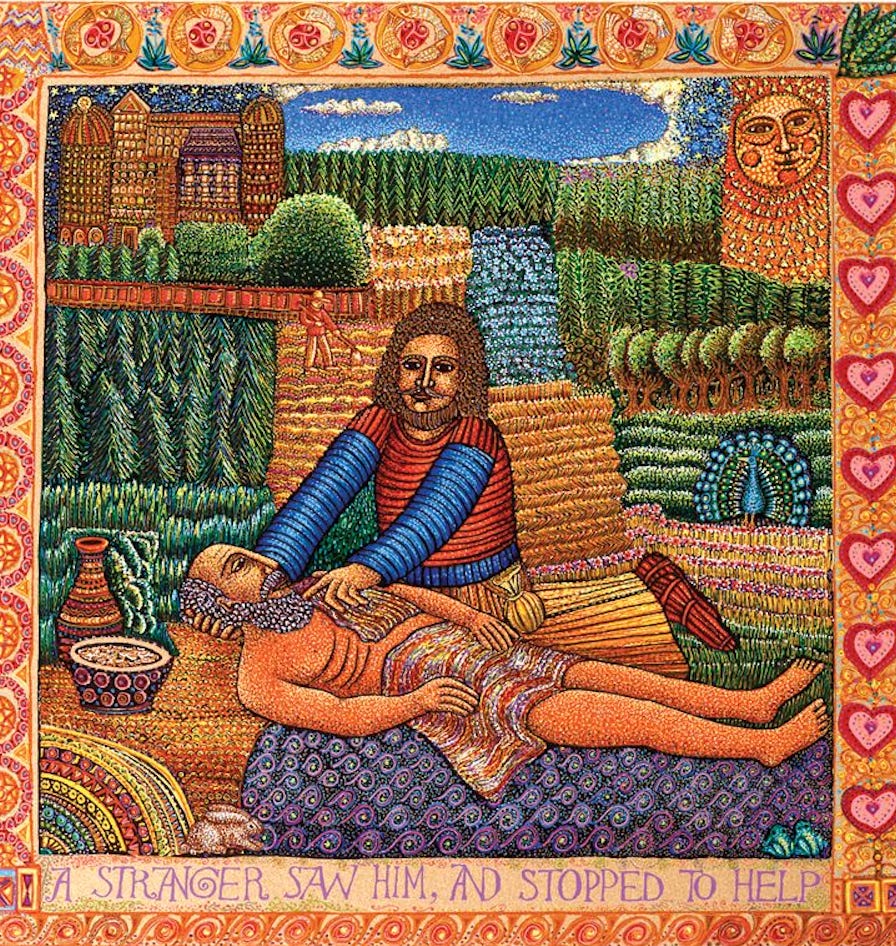
‘A man was going down from Jerusalem to Jericho, and fell into the hands of robbers, who stripped him, beat him, and went away, leaving him half dead. 

Now by chance a priest was going down that road; and when he saw him, he passed by on the other side. So likewise a Levite, when he came to the place and saw him, passed by on the other side. 

But a Samaritan while travelling came near him; and when he saw him, he was moved with pity. He went to him and bandaged his wounds, having poured oil and wine on them. Then he put him on his own animal, brought him to an inn, and took care of him. The next day he took out two denarii, gave them to the innkeeper, and said, “Take care of him; and when I come back, I will repay you whatever more you spend.” 

Which of these three, do you think, was a neighbor to the man who fell into the hands of the robbers?’ He said, ‘The one who showed him mercy.’ 

Jesus said to him, ‘Go and do likewise.’


WHAT IS THIS STORY ABOUT?

How would you explain this story to someone who had never heard it before? What’s the point? Is there more than one point?

Do you like the story? Do you not like it? Does it puzzle you? Anger you? Make you resentful? What emotions does it stir? Be honest!


THE STORY AND YOUR STORY

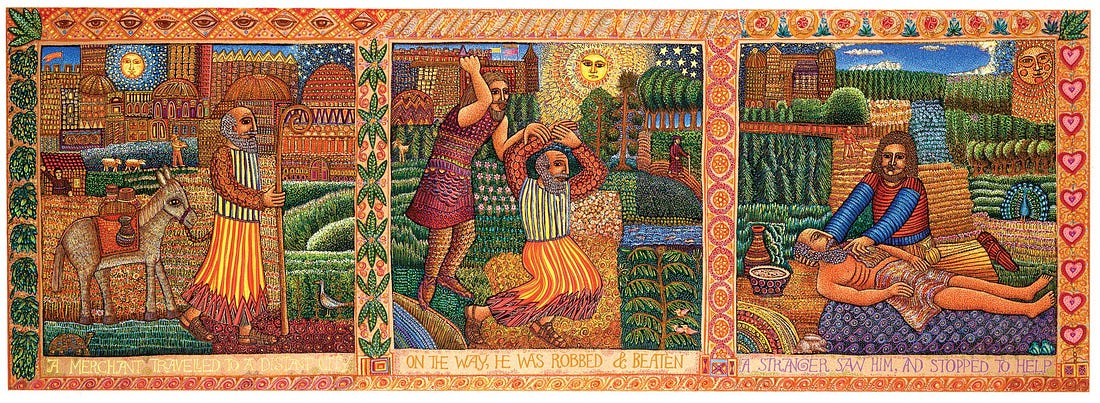
Below is a download of the late John August Swanson’s triptych, “Good Samaritan.” 

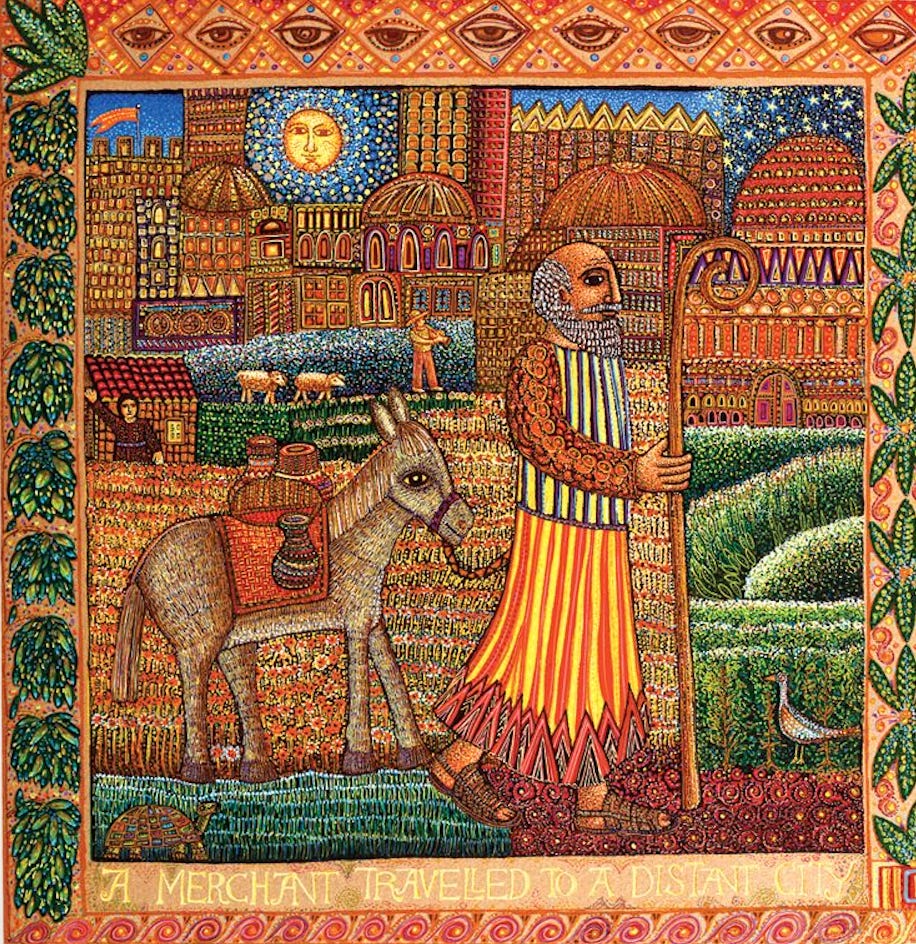
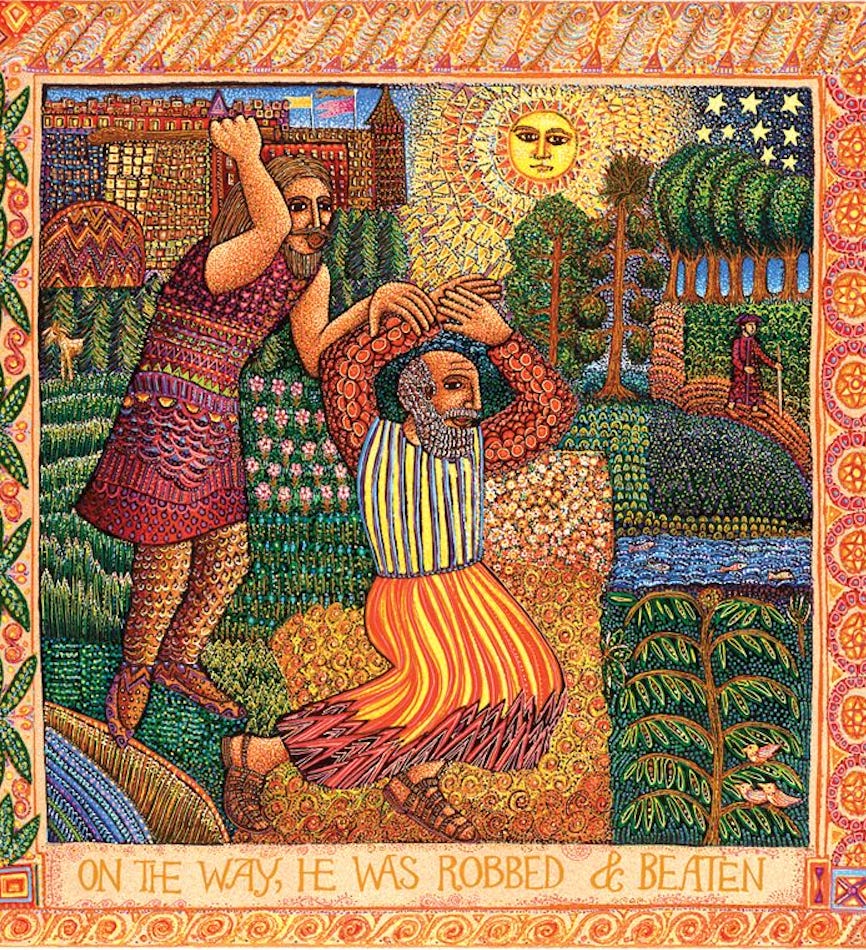
The triptych is followed by close-ups of the three panels. Swanson first painted the Good Samaritan in 1970. This version was done 32 years later, repainting it as a mature work in a story that he felt called to revisit: “It is remarkable that one can discover many new ideas in an old and familiar story. Sometimes it is necessary to take a long journey to rediscover earlier creative ideas that are so personal and connected to one’s history.”

Swanson’s Good Samaritan triptych, 2002.
Panel 1
Panel 2
Panel 3

WHAT DOES THIS STORY MEAN TO YOU NOW?

A few questions to consider: Have you ever been a good Samaritan? One of the passers-by? Or, have you been the person in the ditch?

Do you resonate with John Swanson’s experience of revisiting an “old and familiar story”?

How has your understanding of this story changed over the years? What stands out for you differently today than at other times in your life? As you re-read it or listen to my reflections on it, what surprises you? Is there something you’ve never noticed before?


THE STORY AND OUR STORY

Last Friday, John Dominic Crossan joined with the paid subscriber community in an online conversation about the parables. We focused on how the parables challenged empire, how they present an alternative to Christian nationalism, and how they widen our vision toward evolutionary — and revolutionary — possibilities for a sustainable, non-violent future for humankind. 

In his book, The Power of Parable, Crossan wrote:

My conclusion is that the Good Samaritan was not intended by Jesus as a simple example story, a straightforward moral lesson, a positive paradigm for compassionate behavior. The story presumes that compassionate help is the proper response…. Rather, it is better understood as a challenge parable, a story that challenges listeners to think long and hard about their social prejudices, their cultural presumptions, and, yes, even their most sacred religious traditions.

HOW DOES THIS PARABLE CHALLENGE YOU — AND US — AT THIS SPECIFIC MOMENT IN HISTORY? 

What do you think about Crossan’s view of the Good Samaritan? Does it resonate with my reflection? With your experience? 

Would you rather this be a “simple example story” or, as Crossan suggests, a challenge? What is most challenging for you? For our communities? What’s the challenge for NOW?

What does this parable say to the global rise of authoritarianism and Christian nationalism? 


INSPIRATION

An example parable may be good, a challenge parable is a far more importantly subversive operation. Why? Because challenge parables humble our prejudicial absolutes, but without proposing counter-absolutes in their place. They are tiny pins dangerously close to big balloons. They push or pull us into pondering whatever is taken totally for granted in our world. 
— John Dominic Crossan

People say you should be a good Samaritan.
You can’t.
Samaritans were despised outsiders.
Good or not,
you have too much privilege to be a Samaritan.
That’s for the queers, the immigrants,
the trans, the blacks, the homeless.

You can be good, 
you can be generous to strangers,
even to your enemy.
But you are not the hero of this story. 
You can’t be.

You’re the one in the ditch. 
Your neighbor is the other one.
You call them rapists and they pick your fruit.
You call them shiftless and dangerous
and they build your economy.
You abhor them and they bless you.

Stop making it about you.
Confess your dependence.
Receive your neighbor’s grace.
Be humbly grateful.
Let yourselves be neighbors.

— Steve Garnaas-Holmes, “Good Samaritan”

On the parable of the Good Samaritan: I imagine that the first question the priest and Levite asked was: “If I stop to help this man, what will happen to me?” But by the very nature of his concern, the good Samaritan reversed the question: “If I do not stop to help this man, what will happen to him?”

That’s the question before you tonight. Not, “If I stop to help the sanitation workers, what will happen to my job. Not, “If I stop to help the sanitation workers what will happen to all of the hours that I usually spend in my office every day and every week as a pastor?” The question is not, “If I stop to help this man in need, what will happen to me?” The question is, “If I do not stop to help the sanitation workers, what will happen to them?” That’s the question. 

Let us rise up tonight with a greater readiness. Let us stand with a greater determination. And let us move on in these powerful days, these days of challenge to make America what it ought to be. We have an opportunity to make America a better nation. 
― Martin Luther King Jr., “I’ve Been to the Mountaintop” April 3, 1968

=============

Individual Reflection

Where in your life are you currently more like the priest or Levite — not out of malice, but because stopping would cost you something?

Group Discussion — choose one:

Who in your world right now is “the Samaritan” — the one you’re tempted to dismiss but who may be carrying something you need?

What would it mean today to hold your identity — your sense of who you are and what you stand for — with open hands rather than as a fixed possession?

Crossan says the parable doesn’t replace one absolute with another, just punctures the balloon — what balloon in you needs puncturing right now?

The Spirit Reworks Us

June 2nd, 2026

Tuesday, June 2, 2026

The Rt. Rev. Michael Curry considers how God is always leading us beyond what we think we know:

There will be a time when God’s GPS points you in a direction that makes people uncomfortable. It may make you uncomfortable. The evolution of long-held beliefs can be a spiritual earthquake; the ground beneath us shaking, the very fault lines of our identity shifting and seeking to resettle. But if we can make it through, we find the reward: not an easy journey but a share of what the Bible calls “peace that passes all understanding,” the peace of knowing we are living love’s way, without contradiction….

We humans are walking bundles of contradictions. I know that I am, and experience suggests that I’m not alone in that. As people often describe relationships … “It’s complicated.” It is and we are.

In 2000, Curry was elected bishop in the Episcopal Church as the church wrestled with questions about the full inclusion and equality of LGBTQ persons in the church:

Experience and friendships had long taught me that gays and lesbians were as Christian as anybody else. Still, when it came to the public blessing of unions (marriage wasn’t yet on the table), I was stuck in the unspoken disapproval of my upbringing. Homosexuality happened behind closed doors, not at the altar.

And yet, during that same upbringing, … “love your neighbor” was held up constantly, forcefully, as a core value and commitment. That conviction fueled the civil rights movement that had given me birth. I heard it all the time. But somehow it hadn’t occurred to me that that truth must be true for gay and lesbian friends in every respect.

As a bishop, I made a solemn vow to “guard the faith, unity, and discipline of the Church.” I had also vowed to “be merciful to all, show compassion to the poor and strangers, and defend those who have no helper.” I was beginning to see that obedience to the letter and the spirit of both of those vows was leading me to a real contradiction….

I was growing, and my own beliefs had evolved. But another way to say it is that I was becoming more and more open to letting the spirit of God breathe through me and make me new. Therein is the source of real personal change, evolution, and transformation, and it’s never ending….

The late [lay theologian] Verna Dozier … was a real mentor, teacher, and soul friend to me. In her book The Dream of God, she offered this wisdom: “We always see through a glass darkly, and that is what faith is about. I will live by the best I can discern today. Tomorrow I may find out I was wrong. Since I do not live by being right, I am not destroyed by being wrong.”

================

Fill Up Where You Feel Empty

A simple practice that could change your life.

TYSON BRADLEY. JUN 1

Hey friends,

On a recent morning call, someone shared a picture she’d drawn. It was a pitcher pouring water into a cup, filling it until it overflowed, and then the cup became a pitcher pouring into someone else’s cup.

She’d been sitting with this idea that God pours His love into us until we’re so full we can’t hold it, and it just naturally spills over onto the people around us. And she said when she actually practices it, when she takes a few minutes to imagine that love pouring in and let herself feel it, something shifts. She stops being thirsty. She’s not grasping at people to get something from them anymore, because she’s already full. Loving others stops being a chore she has to push herself to do, and just becomes the overflow of what she already has.

So I asked her a question, and I want to ask you the same one.

What if you got specific about receiving until you are full?

Because here’s what I’ve found. When we talk about being filled with God’s love, it can stay kind of vague. But the love isn’t vague. It always meets us in the exact place we feel empty.

So say the thing you feel you lack the most is money. What would it be like to just fill up with the sense of being fully resourced? To sit with all the stories of Jesus and just always having enough… enough, enough, enough… until you’re overflowing with it? Or say the thing you ache for is to feel safe. What’s it like to fill up with safety until it spills over? Or to feel wanted. Or to feel like you’re not a disappointment.

I’ll be honest with you about mine. The thing I keep coming back to is a fear of not being right with God. So for me, it’s filling up with this sense of, “Tyson, you’re right on track. I see you in the truth of who you are. I’m not disappointed in you.” Filling up with that until there’s no more room for the fear.

And that’s the thing underneath all of it.

Every one of these, the money, the safety, the feeling wanted, the health, the fear of letting people down… they all trace back to the same root. They all come back to some version of fear. Fear that there won’t be enough. Fear that I’m on my own. Fear that I’m not okay.

And fear dissolves in love. There’s a line in Scripture that says it plainly: “There is no fear in love. But perfect love drives out fear.” (1 John 4:18)Not “manage your fear.” Not “try harder to be brave.” The fear just doesn’t survive contact with love that’s complete. You don’t have to fight the fear. You fill up the room it was living in.

Now I want to be careful here, because our heads love to take something like this and turn it into a formula. “Great, I found the hack. Fill up with love, get the thing.” That’s not it. This isn’t a vending machine. It’s just a practice… a way of receiving what’s already true, and then seeing what comes of it. Some days you’ll forget entirely. You’ll get caught up in life. And then you’ll step into one of these moments and there it is again. His presence. His peace. The sense of having enough.

There’s even something to this that your body already knows. When you feel genuinely safe and full, your nervous system actually settles out of survival mode, and that’s the state where you can be generous, present, creative, connected. You literally cannot pour out when you’re clenched and protecting yourself. Scarcity makes us grasp. Fullness lets us give. God designed us so that receiving comes first, and the overflow takes care of itself.

So here’s what I want to invite you into.

Take a moment and get honest about where you feel empty right now. Not the surface thing… the real one. The thing you keep trying to secure on your own.

And then ask Him:

“Lord, what am I actually afraid of here? And what would it be like to receive what I really need from You instead of trying to get it on my own?”

Then just let Him fill that exact place. Don’t measure how full you are. Don’t grade it. Just receive, and notice what happens when there’s a little less room for the fear.

You were never meant to generate this on your own. You were meant to receive it… and then watch it overflow.

====================

Individual Reflection

Where is the place you most keep trying to fill yourself — and what would it feel like to just stop and receive there?


Group Discussion — choose one:

  • What has it cost you to stay “stuck in the unspoken disapproval” of something you were raised with?
  • Where in your life right now is fear occupying space that love hasn’t fully reached yet?
  • What does it look like for you when receiving comes before giving — and what makes that hard?