Theologian Willie Jennings recalls how his parents cultivated a sense of safety and belonging through stories told at home:
Mary, my mother, taught me to respect the dirt. Like many black women from the South, she knew the earth like she knew her own soul. I came along late. I was the last of her eleven children, born not of the South but of the North, the fruit of the great migration when black folks wearied of the Jim Crow South and, in search of work, pointed their hopes toward northern cities and replanted their lives in colder air. So I was born in Grand Rapids, Michigan, and found myself each spring with my mother, Mary, in her garden in the backyard.
There near the soil Mary deepened my understanding of her life, her history, and her hopes. My mother and my father, Ivory Jennings, were both magnificent storytellers. They told stories the way water cascades over Niagara Falls or runs down the Mississippi, stories that encompassed larger or smaller fragments of people, places, jokes, incidents, sayings, sermons, arguments, clothing, foods, meals, body parts, and prayers. I could never take in all those stories. I had to simply let them wash over me, again and again, until I was able to locate myself in the stream of their historical consciousness.
Mary and Ivory Jennings found their home in Jesus, who sustained them in all circumstances:
Running through their amazing stories were several themes. Like large, immovable rocks that shaped the contours of the water’s flow, these themes carried the keys for understanding every story. Foremost was Jesus. Ivory and Mary loved Jesus.To say they were devout Christians is simply too pale a descriptor. A far more accurate characterization would be, “There were Ivory, Mary, and Jesus.” Woven into the fabric of their lives was the God-man Jesus, who, rather than simply serving as an indicator of their orthodoxy, became the very shape of their stories. The stories of Jesus and Israel were so tightly woven into the stories my parents told of themselves, their lives in the South and in the North and then with their youngest children in the North, that it took me years to separate the biblical figures from extended family members, biblical sinners from the sinners all around us, and biblical places of pain from their places of pain. I was never able to separate biblical hopes from their real hopes. They knew the Bible, but, far more important, they knew the world through the Bible….
As a little girl [my mother] lived with her grandmother, a former slave…. The experience of agricultural labor, life in the dirt, also brought her into a contradictory but very intimate relationship with the land itself.
My parents loved the soil, the earth, the outside, and in their garden I saw the freedom they felt with it. The garden announced to them and the world that they were absolutely free to be themselves.
_______________________________________________
Sarah Young Jesus Calling
Jesus Calling: October 18th
Go gently through this day, keeping your eyes on Me. I will open up the way before you, as you take steps of trust along your path. Sometimes the way before you appears to be blocked. If you focus on the obstacle or search for a way around it, you will probably go off course. Instead, focus on Me, the Shepherd who is leading you along your life journey. Before you know it, the “obstacle” will be behindyou and you will hardly know how you passed through it. That is the secret of success in My kingdom. Although you remain aware of the visible world around you, your primary awareness is of Me. When the road before you looks rocky, you can trust Me to get you through that rough patch. My Presence enables you to face each day with confidence.
RELATED SCRIPTURE:
John 10:14-15 (NLT) 14 “I am the good shepherd; I know my own sheep, and they know me, 15 just as my Father knows me and I know the Father. So I sacrifice my life for the sheep.
Isaiah 26:7 (NLT) 7 But for those who are righteous, the way is not steep and rough. You are a God who does what is right, and you smooth out the path ahead of them.
Additional insight regarding Isaiah 26:7,8: At times the “path” of the righteous doesn’t seem smooth, and it isn’t easy to do God’s will, but we are never alone when we face tough times. God is there to help us, to comfort us, and to lead us. God does this by giving us a purpose (keeping our mind centered on him, 26:3: You will keep in perfect peace all who trust in you, all whose thoughts are fixed on you!”) and giving us provisions as we travel. God provides us with relationships of family, friends, and mentors.God gives us the wisdom to make decisions and faith to trust him. Don’t despair; stay on God’s path.
Father Richard reflects on Homer’s Odyssey as an archetypal story that reveals the necessary journey from and return to home:
Home is another word for the Spirit that we are, our true self in God. The self-same moment that we find God in ourselves, we also find ourselves inside God, and this is the full homecoming. Until then, we are homesick, although today most would probably just call it loneliness, isolation, longing, sadness, restlessness, or even a kind of depression.
The common word for this inner abiding place of the Spirit, which is also a place of longing, has usually been the word soul. We are born with our soul. The end is already planted in us at the beginning, and it gnaws away at us until we get there freely and consciously.
In The Odyssey, the stirring of longing and dissatisfaction is symbolized by the collapse of Troy and the inability of most of the Greeks to return home. It seems they had forgotten about home, had made home in a foreign land, or were not that determined to return home (which are all excellent descriptions of the typical detours or dead ends on the spiritual journey). Only Odysseus was trying to get home at all costs, and he is the stand-in for what we all must be. Those who do not seek their home are symbolized perhaps by the lotus eaters whom Odysseus encounters, who forgot themselves and lost their own depths and consciousness.
Remember Odysseus’s oar that an inland wayfarer thought was a winnowing fan? His oar, a symbol of his first-half-of-life occupation, had become a tool for inner work, a means for knowing the difference between wheat and chaff, essentials and nonessentials, which is precisely the turn toward discernment and subtlety that we come to in the second half of life.
It’s no surprise that this marks the end of Odysseus’s journey. Now he can go home because he has, in fact, come home to his true and full self. His sailing and rowing days of mere outer performance are over, and he can now rest in the simplicity and ground of his own deeper life. He is free to stop his human doing and can at last enjoy his human being, at home in himself.
And so, like Odysseus, we leave from Ithaca and we come back to Ithaca, but now it is fully home because all is included and nothing wasted or hated; even the dark parts are used in our favor. All is forgiven. What else could homecoming be?!
Poet C. P. Cavafy (1863–1933) expressed this understanding most beautifully in his famous poem “Ithaca.” This is my rendering of its final lines:
Ithaca has now given you the beautiful voyage.
Without her, you would never have taken the road.
With the great wisdom you have gained on your voyage,
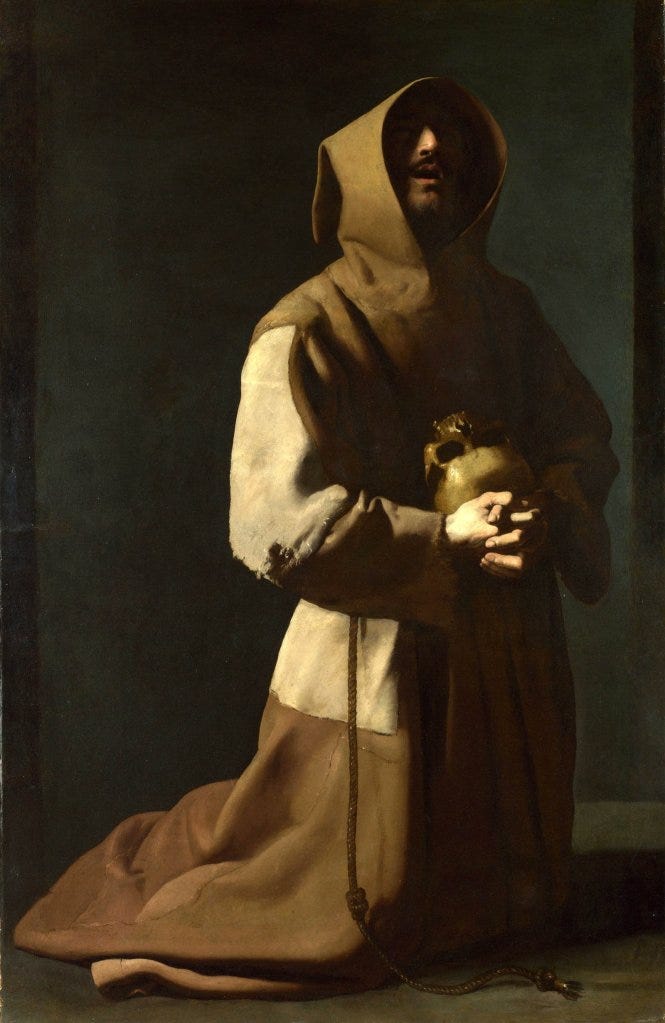
Francisco de Zurbarán Saint Francis in Meditation 1639
In her book, Eating Beauty: The Eucharist and the Spiritual Arts of the Middle Ages, Ann Astell, drawing on Balthasar’s reading of Bonaventure’s meditations, shows how Francis’ reception of the stigmata was the outworking of his inner conformity to Christ:
The imprint of the wounds corresponds to the opening wide of the saint’s soul… In Bonaventure’s theological aesthetics, expressio and impressiobelong together and are proportioned to each other. “It is significant,” Balthasar insists, “that although the power of expression goes out from the Crucified, the bodily sign [of the stigmata] is imprinted only because Francis, through grace and his own inflamed love, has already become in spirit an expression of the love of the Crucified.” The “open seeing of faith” that is an expression of Francis’s soul is exactly configured to the image of the crucified Seraph, so that the image, in turn, “stamps [its] impression” on Francis’s body. Like Christ, the stigmatized Francis becomes a book that is “written within and without” (Ezec. 2:10).¹
The same opening-out marks, one way or another, the lives of all the saints. And it is that that draws us to them. What made and makes them so attractive is that they mirrors the love from which they do not look away. They are transfixing because they let us see them being transfigured.
“I’m no saint.” When, in everyday conversations, we say this, we imply that being a saint is about perfection, blamelessness, purity. Ironically, though, the saints we’re actually drawn to are much more “human” than that. We’re drawn to saints like Augustine, who was open about his failings, and saints like Francis, who was unafraid of the failings and frailty of others. So, despite what we sometimes suggest, we are compelled not by the innocence of the saints but by their vulnerability and compassion—their openness to God, and their God-like openness to others. They make grace visible precisely because they need it.
That said, the saints are not always easy for us to take. That is because their lives, attractive in their openness, disclose how much we have closed ourselves against.But they do not expose and shame us. They reveal us, as well as the mercy of God. And in that way they spark hope—that all-consuming fire in the bramble-bush of our gut that says despite everything that it is good to be alive, here and now, to have these people around us, to have this future opening up before us.
The saints don’t always look like God. They always look to God. Just so, they make it so we can take more of God, more of ourselves and others, more of reality in all its seeming absurdity and dumbfounding complexity. In their company, we are surprised to find we are not as out on life as we had feared we were. All that at is what this poem is trying to honor:
The saint is a question
God has left open. A safe

blown apart, nothing
missing. A flower

that blossoms for water
to know the truth

of its nature. A tear in the
veil made of tears,

a wound in the shape of
the cleft we were borne through.

The lion’s carcass—
honeycomb sweet

under its ribs.
The grace of a grave

robbed of its dead.
An iris widening its dark.

A window blue with bruised light.
The space in the sentence

to stop,
listening.
1
Ann Astell, Eating Beauty: The Eucharist and the Spiritual Arts of the Middle Ages (Cornell University Press, 2006), 127-128.
Researcher and storyteller Brené Brown shares her sense of spiritual homesickness.
The word “homesick” often conjures up images of a child’s fleeting sadness or their temporary yearning for home and family. In today’s culture, the emotion itself is often dismissed … [as] a fuzzy overnight-camp feeling, not a fierce emotional experience that is key to the human experience and central to our hardwired need for a sense of place and belonging.
Brown tells of her soul’s regular longing for home:
Spiritual homesickness has been a constant in my life. It was not an everyday experience, but a predictable and always reoccurring desperation to find a sense of sacredness within me, not outside of me: my soul, my home, God in me. It was homesickness for a place that exists only inside me.
Through my thirties and forties, I would occasionally succumb to the yearning, drop everything, and run as fast as I could to visit the home within me. The door to my internal spiritual home would be one simple experience, one encounter with a thin place—maybe sitting in my car listening to Loretta Lynn sing “How Great Thou Art,” or an afternoon swim with God in Lake Travis, or one night praying the Daily Examen. But then, after that visit, I would leave and go back to my first-half-of-life world. I’d describe this first-half-of-life spirituality as the ebb and flow of [the Greek words] nostos and alga, homecoming and pain.
Over the past two years, I’ve found that I’m more spiritually homesick than not. Spiritual homesickness has become an almost daily dulling grief. It’s not depression or exhaustion. It’s an uncomfortable knowing that I’m coming to the end of one thing and the beginning of the next. I’m leaving and arriving. There’s fear, but there’s also joyful anticipation.
Today, when I return home to the place in me where God dwells, I’m no longer interested in making it a quick visit so I can run back to the world of “what other people think” and “what I can get done.” Today, I can barely be dragged out of the house. I’m drawn to different conversations and deeper connections. I want this sacred space to be my home, not somewhere I visit to buttress my “real life” that’s on the outside of my connection with God. I’m starting to wonder if my alga, my pain, is fueled by my separation from God and from my True Self.…
Leaving the first half of life is scary. Most of us have the first-half-of-life hustle down. The thing is, I’m just never, ever homesick for the first half of my life when I walk away from it…. Maybe I’m not homesick for the first half of life because it’s really never been my true home.
==================
Friday Five on Tuesday
1.
“For the most part, these anxieties and struggles come from the fact that we don’t understand ourselves.”
Teresa of Avila was the first Christian mystic to make sense to me.
I had tried reading her works before, but then, after a very difficult and trying season around 2013, she finally clicked.
At the King of Prussia Mall, outside Philly, I distinctly remember sitting at a Starbucks and reading her magnum opus, Interior Castle. Plenty of people milled about, and I found myself crying while reading Teresa of Avila.
Why?
Because there was something about her and the way she wrote about the human soul that brought tears to my eyes. It was the right combination of words at the right time, and it led me to several realizations about myself: how I am a walking, talking, and gloriously beautiful bundle of contradictions.
I absolutely agree with her that most of our problems stem from not understanding ourselves.
Not only that, but I deeply regret the way that religion is sometimes interpreted in a manner that confuses or even blocks us from coming to understand ourselves more.
For many of the Christian mystics (if not all of them), self-knowledge and God-knowledge are two sides of the same coin… One affects and influences how the other is done. Hopefully, the more we come to understand ourselves, the more we come to understand God… and vice versa.
2.
“Jesus, my feet are dirty. Come, even as a slave to me, pour water into your bowl, come and wash my feet. In asking such a thing, I know I am overbold, but I dread what was threatened when you said to me, ‘If I do not wash your feet, I have no fellowship with you’. Wash my feet then, because I long for your companionship…”
It is something of a prayer after reflecting on John 13, the passage in which Jesus washes the disciples’ feet.
3.
“Moses’ vision of God began with light; afterward God spoke to him in a cloud. But when Moses rose higher and became more perfect, he saw God in the darkness.”
In German, Immanuel Kant coined a word: “Grenzbegriff.” It denotes a concept or idea that exists beyond the boundaries of human comprehension.
There are many concepts or ideas that are Grenzbegriff.
Time.
God.
Death.
Infinity.
The ever-expanding edge of the known universe.
Quantum physics.
Black holes.
Transcendental experiences.
Many things exist beyond the boundary of human comprehension.
Gregory of Nyssa, the Cappadocian Early Church Father, understood God as utterly beyond human comprehension; if you can understand it, then it isn’t God. For Gregory, the longer one stays with the mystery that we call “God”, the more mystery, darkness, and unknowing there comes to be.
Most of us in the West believe that the longer you stay with a concept or idea, the more you come to understand it… Well, not so in Christian theology.
The more we try to comprehend God, the less we should feel like we understand.
Hans Urs von Balthasar was an interesting fellow. While doing the Spiritual Exercises of St. Ignatius of Loyola, he found a vocation to join the Jesuit order. Then, many years later, he did the Spiritual Exercises again, and they led him to decide to leave the Jesuit order! He considered both decisions right and true, and a matter of correctly discerning how best to show his love of God and neighbor.
As a Catholic, he sounds here as though he was deeply influenced by Martin Luther (the Protestant Reformer) in that the Christian life will make a way straight through hardship, rather than around it. In short, this is known as having a “Theology of the Cross.”
It is impossible to follow Jesus and yet believe that we will be spared hardship. Oh, and this hardship is not just the simple consequence of our own actions; no, it is suffering imposed on our lives from without.
Fortunately, the Cross is only one side of the coin; the other side is the Resurrection.
The Cross might be an inevitable fact, but then so is Resurrection.
Which Quote Most Jumped Out at You?
Individual Reflection What are you still asking God to help you get around that may only be gotten through?
Group Discussion — choose one
Why do we read unknowing as God’s absence rather than God’s nearness?
What makes it harder to let our feet be washed than to wash someone else’s?
Whose fire did you catch, and is anyone catching it from you?
Letting go into God is coming home to our true selves. —Ilia Delio
Father Richard Rohr considers how the spiritual journey of “homecoming” requires holding the tension between the past and future:
The archetypal idea of ‘‘home’’ points in two directions at once. It points backward toward an original hint and taste for union, starting in our mother’s body. We all come from some kind of home—at times, a bad one—that plants the foundational seed of a possible and ideal paradise. It also points forward, urging us toward the realization that this hint and taste of union might actually be true. It guides us like an inner compass or a homing device. In Homer’s Odyssey, it’s the same home, the island Ithaca, that is both the beginning and the end of the journey. Carl Jung offered this concise, momentous insight: “Life, so-called, is a short episode between two great mysteries, which yet are one.” [1]
Somehow, the end is in the beginning, and the beginning points toward the end. We are told that even children with sad or abusive childhoods still long for ‘‘home’’ or ‘‘mother’’ in some idealized form and still yearn to return to it somehow, maybe just to do it right this time. What is going on there? I believe the One Great Mystery is revealed at the beginning and forever beckons us forward toward its full realization. Most of us cannot let go of this implanted promise. Some would call this homing device their soul, some would call it the indwelling Holy Spirit, and some might just call it nostalgia or dreamtime. All I know is that it will not be ignored. It calls us both backward and forward, to our foundation and our future, at the same time. It also feels like grace from within us and, at the same time, beyond us. The soul lives in such eternally deep time. Wouldn’t it make sense that God would plant in us a desire for what God already wants to give us? I am sure of it.
To understand better, let’s look at the telling word homesick. This usually connotes something sad or nostalgic, an emptiness that looks either backward or forward for satisfaction. I use it in an entirely different way. I propose that we are both sent and drawn by the same force, which is precisely what Christians mean when they say the Cosmic Christ is both alpha and omega. We are both driven and called forward by a kind of deep homesickness, it seems. There is an inherent and desirous dissatisfaction that both sends and draws us forward, and it comes from our original and radical union with God. What appears to be past and future is in fact the same home, the same call, and the same God, for whom ‘‘a thousand years are like a single day’’ (Psalm 90:4) and a single day like a thousand years.
========================
Returning Home
Monday, October 12, 2026
Indigenous People’s Day
Home is a feeling in the centre of my chest of rightness, balance and harmony of the mind, body and spirit…. To be away from it, even for a day, is that acute awareness. It is also knowing that home is what I bring to it, and in that is the sure and quiet knowledge that home is within me and always was. —Richard Wagamese, Embers
In the Everything Belongs podcast, Father Richard speaks about the spiritual path that winds away from and toward one’s true home:
The first going out from home we can say is the creation of the ego. While this is a necessary creating, it is also the creating of a separation. It’s taking myself as central. We probably need to do that, at least until we reach middle age. But then we need to allow what we’ve created to be uncreated. Maybe I was a great basketball player, but that’s gone now. Or maybe I was good-looking, but that’s gone now.
When we can say “yes” to that uncreation and still be happy, we’ve done our work. My true self is in God and not in what I’ve created. My self-created self gave me a nice trail to walk on, and something to do each day, but it isn’t really me. It might be my career or my vocation; yet as good as it is, it isn’t my true self, my home in God.
In the metaphor of life as a journey, I think it’s finally about coming back home to where we started. As I approach death, I’m thinking about that a lot. I think the best way to describe what’s coming next is not “I’m dying,” but “I’m finally going home.” I don’t know what it’s like yet, but in my older age I really trust that it is home. I don’t know where that trust comes from or even what home is like, but I know I’m not going to someplace new. I’m going to all the places I’ve known deeply. They’re pointing me to the big deep, the Big Real. I do think homecoming is what it’s all about. [1]
The retired Episcopal bishop and theologian Stephen Charleston offers a benediction for our life’s journey:
We are forgiven for the mistakes we have made. We are loved without condition. We are blessed without asking. We are watched over when we are careless. We are understood when we are not making sense. We are remembered Even when we have forgotten ourselves….
The Spirit around us is compassion. We may not understand it all. We may differ widely in how we describe it. But we each have an invitation to freedom A chance to see more deeply, a path to follow home. We awaken to what is sacred. We grow into the holy. We find what has always been there. [2]
=================
Individual Reflection What in my self-created self am I still unwilling to let be uncreated?
Group Discussion — choose one
When has your homesickness shown up as dissatisfaction rather than nostalgia?
How has the home you came from, good or bad, shaped the home you long for?
What would change if we truly believed we’re not going anywhere new?
Have you been around? Have you done your share of comin’ down On different things that people do? Have you been aware? You got brothers and sisters who care About what’s gonna happen to you In a year from now
Maybe I’ll be there to shake your hand (Shake your hand) Maybe I’ll be there to share the land (Share the land) That they’ll be givin’ away When we all live together, we’re talkin’ ’bout together, now
Maybe I’ll be there to shake your hand (Shake your hand) Maybe I’ll be there to share the land (Share the land) That they’ll be givin’ away When we all live together, we’re talkin’ ’bout together, now
Did you pay your dues? Did you read the news This morning when the paper landed in your yard? Do you know their names? Can you play their games Without losin’ track And coming down a bit too hard?
Maybe I’ll be there to shake your hand (Shake your hand) Maybe I’ll be there to share the land (Share the land) That they’ll be givin’ away When we all live together, we’re talkin’ ’bout together, now
Maybe I’ll be there to shake your hand (Shake your hand) Maybe I’ll be there to share the land (Share the land) That they’ll be givin’ away When we all live together, we’re talkin’ ’bout together, now
Maybe I’ll be there to shake your hand (Shake your hand) Maybe I’ll be there to share the land (Share the land) That they’ll be givin’ away When we all live together, we’re talkin’ ’bout together, now
Maybe I’ll be there to shake your hand (Shake your hand) Maybe I’ll be there to share the land (Share the land) That they’ll be givin’ away When we all live together, together together
(Shake your hand, share the land) You know I’ll be standing by to help you if you worry (Shake your hand, share the land) No more sadness, no more sorrow, and no more bad times (Shake your hand, share the land) Everyday comin’ sunshine, everyday everybody laughin’ (Shake your hand, share the land) Walkin’ together by the river, walkin’ together and laughin’ (Shake your hand, share the land) Everybody singin’ together, everybody singin’ and laughin’ (Shake your hand, share the land) Good times, good times, everybody walkin’ by the river now (Shake your hand, share the land) Walkin’, singin’, talkin’, smilin’, laughin’ diggin’ each other (Shake your hand, share the land) Everybody happy together, I’ll be there to worry you if you need-a me (Shake your hand, share the land) Call on me, call on me, call my name, I’ll be runnin’ to help you (Shake your hand, share the land) Everybody walkin’ by the river now, everyday everybody laughin’ (Shake your hand, share the land) Everybody singin’ and talkin’, smilin’, laughin’, diggin’ each other
Listen, Learn, and Contribute
Friday, October 9, 2026
Cherokee descendant Randy Woodley responds to Francis of Assisi’s deathbed invitation, “I have done what was mine to do. May Christ teach you what is yours”:
My Keetoowah ancestors had a concept that I think gets at what this question really means. They understood that every person, every being, every element of creation has a particular responsibility—a role to play in the harmony of the whole. Not everyone had the same role. Some were healers, some were warriors who protected the people, some were farmers, some were storytellers. But everyone had something that was theirs to do, and the community couldn’t function without all of it.
An old Indian saying puts it more bluntly: The worst thing that can be said about a person is, “He acts like he has no relatives.”
To act as if you have no relatives means to live as though your actions don’t ripple outward. It means to treat the world as though you’re the only one in it. It means to extract what you want without asking what you owe.
Sound familiar? This is essentially the operating system of Western capitalism—the worldview that treats land as inventory, water as delivery system, people as labor units, and the sick as revenue streams. Take what you can, discard the rest, and never ask who’s downstream.
What my ancestors practiced was the opposite. They understood that humans are the younger siblings in creation—that the plants, animals, waters, and stones have been here longer and know how things work. Our job is not to dominate but to listen, learn, and contribute to the wellbeing of the whole. That’s not metaphor. That’s a survival strategy developed over thousands of years of living in reciprocal relationship with the land.
The mystics have always known that the separate self is an illusion—that we are woven into one another and into creation. That what we do to the least of these, we do to the Sacred. Indigenous peoples have been practicing that truth in daily life for millennia, not as theology to be debated but as a way of being to be lived. It goes by various names, but I call it the Harmony Way….
This is what contemplation should lead to—vulnerability. Not withdrawal from the world but deeper engagement with it. Not escape from suffering but the willingness to sit with it long enough to see clearly what is ours to do. Vulnerability requires living reflectively with yourself but also living deeply into the whole community of creation—all your relatives.
Reference: Randy S. Woodley, “Planting for the Seventh Generation: What Is Ours to Do” ONEING 14, What Is Ours to Do?” (CAC Publishing, 2026): 100–101, 102.
Image credit and inspiration: Nina Plobner, untitled (detail), 2020, photo. Unsplash. Click here to enlarge image. The mystery of creation reveals itself most fully when we pause to notice something small and simple, like dew caught on a single blade of grass.
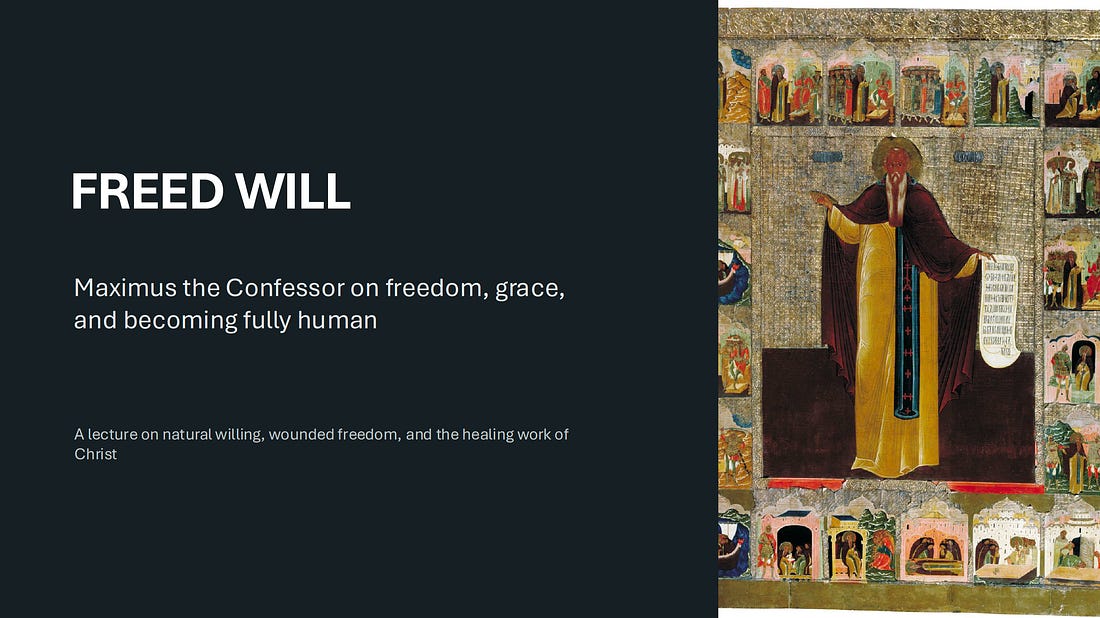
Maximus the Confessor on Freedom Grace and Becoming Fully Human Love Wins Conference – PPT Lecture Notes (without footnotes)
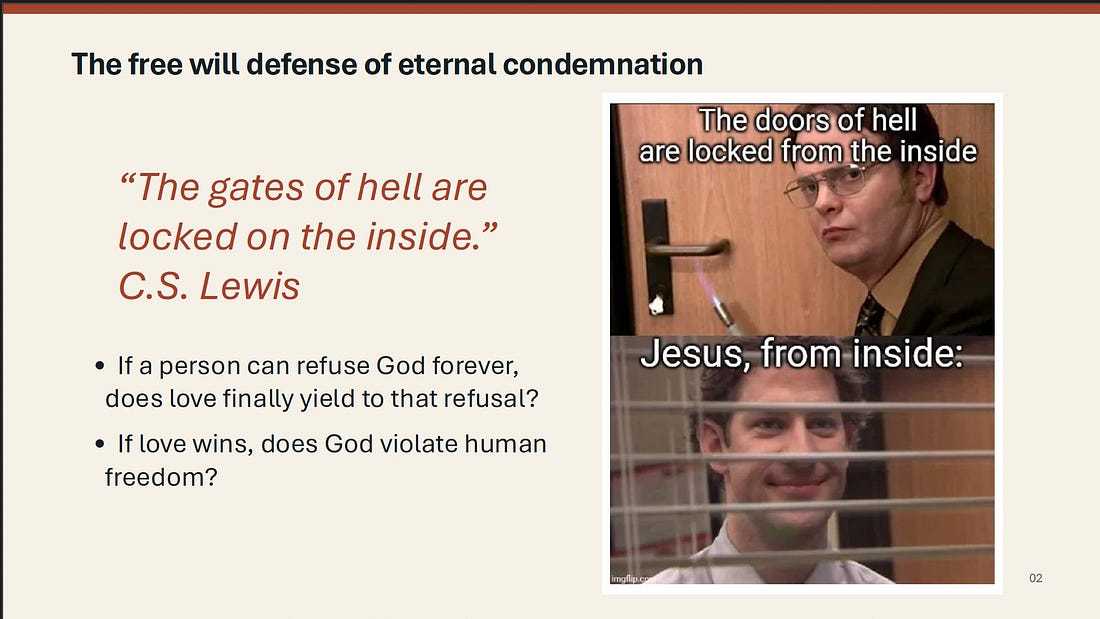
Perhaps you have seen the familiar exchange. Someone asks, “If God is all-powerful and all-loving, why doesn’t God save everyone?” The answer comes back: “Because God respects our free will.”
That answer presents a serious challenge to apokatastasis, the early Christian hope that God will finally restore all things in Christ. If someone refuses God until the day they die, what can God do? Would saving that person require God to overpower the will? Must a loving God permit the refusal to continue forever?
C. S. Lewis gave this argument its most memorable image: “The gates of hell are locked on the inside.” He meant that hell is finally self-chosen. God does not keep people out; they refuse to come in
.The image has real moral force. It reminds us that love does not treat persons as objects. Even so, it assumes that we already know what a free will is and how it works. Maximus the Confessor gives us reason to look more carefully.
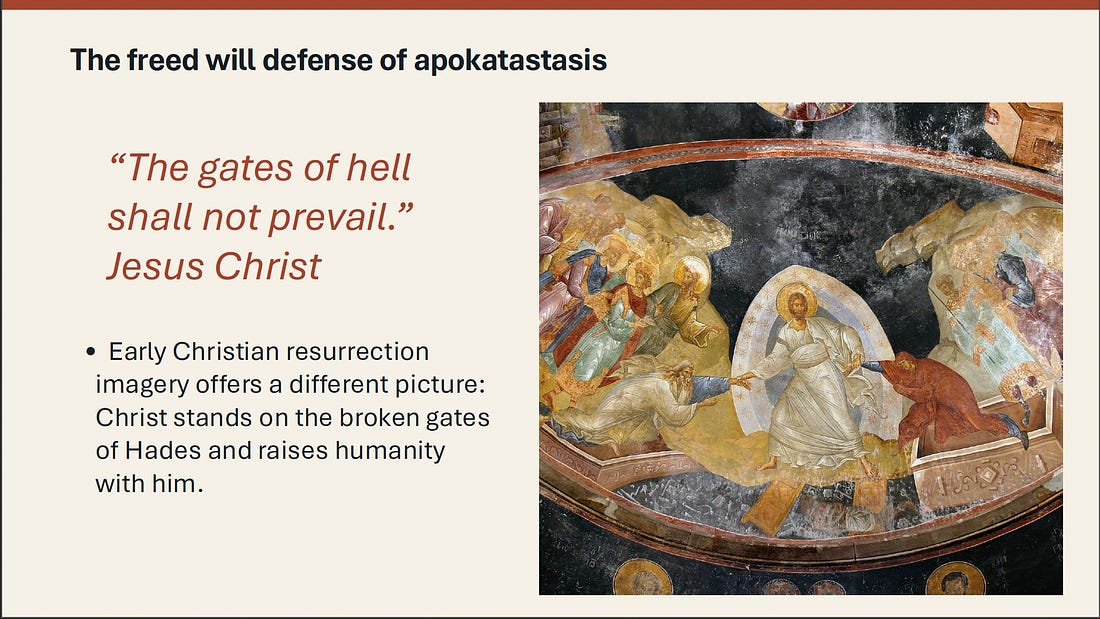
But first Christians never portrayed Christ standing outside the door of Hades, waiting for its inhabitants to unlock it. In the traditional icon of the resurrection, Christ stands on the broken gates and reaches into the grave. He takes Adam and Eve by the wrists and raises them with him.
So too the hymns of the ancient church. Two angles:
The Gates of Hades are Opened — Canon of the Cross & Resurrection
Having been tested by wounds, by Your suffering of the Cross, You raised up with Yourself those wounded by hades. Wherefore, I cry out: Lead up my life from corruption, O You who loves mankind.
The gates of hades opened to You in fear, And the vessels of the enemy were plundered. Wherefore, the women met You, receiving joy instead of grief.
The Gates of Hades are Broken — Kontakion, in Tone I
As God, You arose from the tomb in glory, and with Yourself, raised up the world; Human nature hymns You as God, and death has vanished, Adam dances, O Master, and Eve, delivered from bonds, now rejoices, Crying aloud: You are He, O Christ, Who grants resurrection to all!
Let us hymn as God the Almighty Who rose on the third day, Who broke down the gates of hades, Who raised up from the grave those held there from ages past,…
Hades groans and death utters lamentation; the world is filled with gladness, and all rejoice with it, for You, O Christ, granted resurrection unto all.
The image does not settle the theological question, but it does suggest a different place to begin. Perhaps salvation depends less on God’s ability to persuade an untouched, self-contained will and more on Christ’s power to free a will that has become bound.
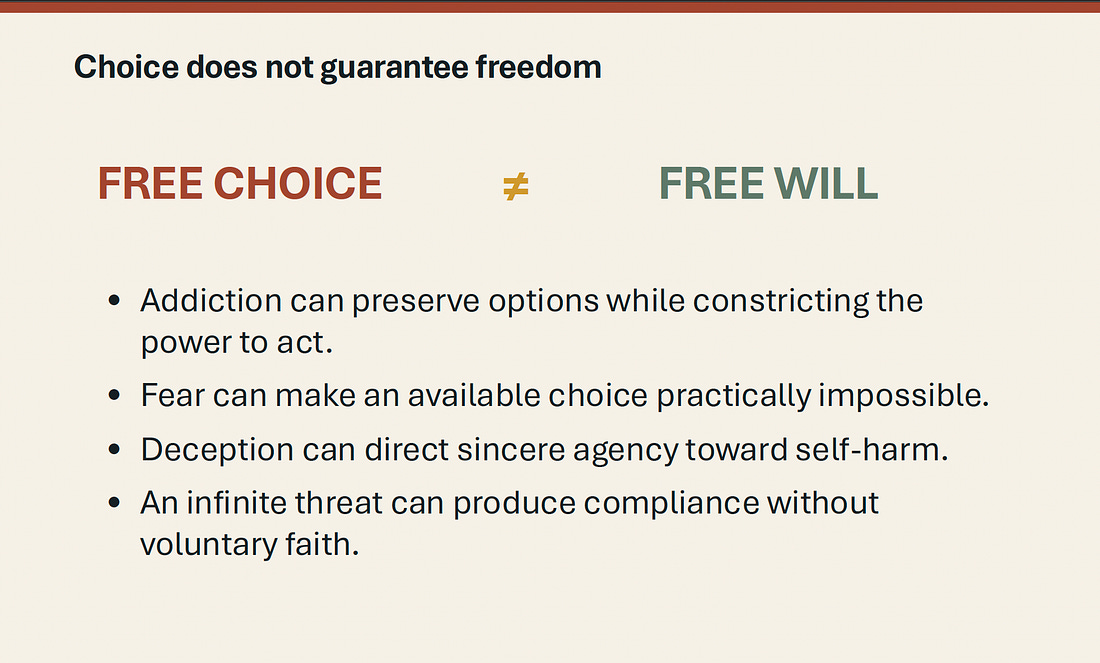
This brings us to Maximus. His account of freedom starts with a simple distinction that modern discussions often miss. The ability to choose is real, but choice and freedom are not identical.
When Choosing Is Not Freedom
Consider a person living with an addiction. There may come a point when the person understands the harm and wants to stop, yet repeatedly returns to the same behaviour. In one sense, the person still chooses. In another, we can see that freedom has narrowed. The will operates under a form of bondage.
Fear can do something similar. A person who is terrified of flying can decide whether to board the plane, but one option may feel almost impossible. Deception complicates matters further. People can act voluntarily on the basis of propaganda or manipulation and sincerely believe that they are choosing for themselves. The decision belongs to them, but a false picture of reality has shaped it.
Religious coercion belongs in this conversation too. If a preacher says, “Accept our gospel freely or suffer forever,” the resulting confession may be a choice, but the threat makes its voluntary character difficult to judge.
These examples are different, and none of them removes personal responsibility. They do show why bare choice is an inadequate definition of freedom. A decision can arise from fear, ignorance, compulsion, or a badly distorted sense of what is good. The will is active, though it is not necessarily well.
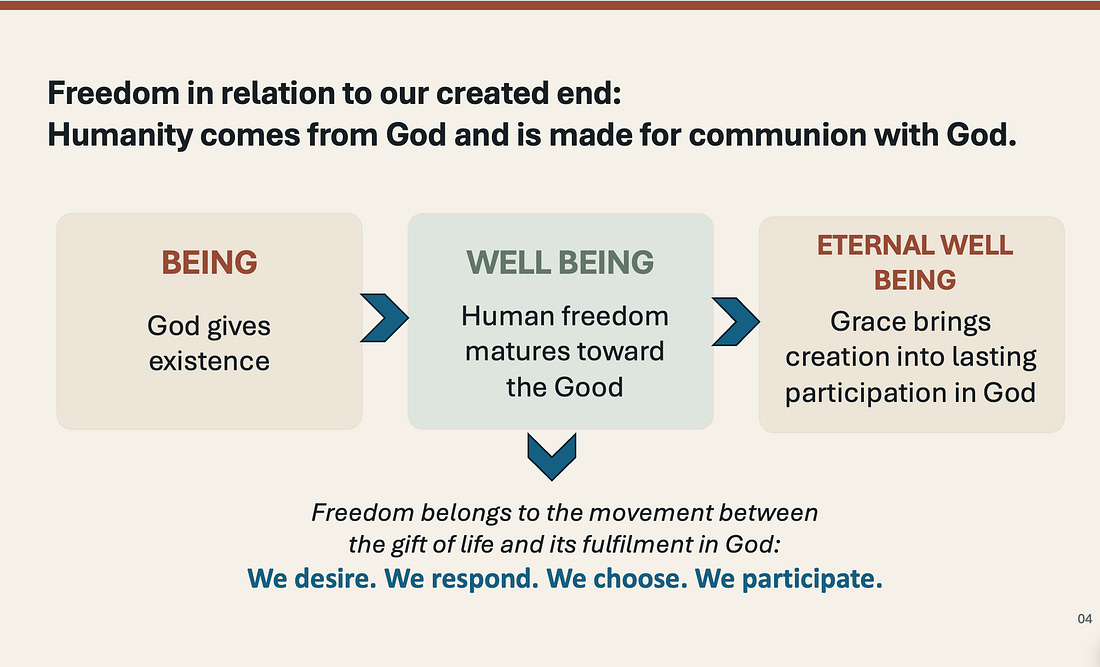
Maximus understands freedom in relation to our created end. Human beings come from God and are made for communion with God. Our natural will is the movement of human nature toward life and goodness. We do not begin as neutral creatures with an equal appetite for good and evil. We desire what appears good to us because desire itself belongs to the good creation of God.
This is easier to see in Maximus’s account of being, well-being, and eternal well-being.Being is the gift of existence. Well-being is our life developing according to its proper end. Eternal well-being is the fulfilment of creaturely life in communion with God, which Maximus calls deification. Deification does not mean that we stop being human or become God by nature. It means that grace brings human nature into full participation in the life of God.
Freedom belongs within this movement. It is not simply a possession handed to us in complete form at birth. It is our capacity to become what we were created to be.
In every work of the artist, he praised the Artist; whatever he found in made things he referred to the Maker. —Thomas of Celano on Francis of Assisi
Father Richard reflects on how Francis and Bonaventure recognized the natural world as the place through which we learn to witness and love God:
St. Bonaventure (1221–1274) taught that to work up to loving God, we start by loving the very humblest and simplest things and then move up from there. “Let us place our first step in the ascent at the bottom, presenting to ourselves the whole material world as a mirror, through which we may pass over to God, who is the Supreme Craftsman,” he wrote. And further, “The Creator’s supreme power, wisdom, and benevolence shine forth through all created things.” [1]
In the end, we either love everything or there is reason to doubt that we love anything. This one love and one loveliness was described by many medieval theologians and others as the “Great Chain of Being.” The message was that if we failed to recognize the divine Presence in any one link of the chain, the whole sacred universe would fall apart.
Creation—be it planets, plants, or pandas—was not just a warm-up act for the human story of the Bible. The natural world is its own good and sufficient story, if we can only learn to see it with humility and love. That takes contemplative practice, stopping our busy and superficial minds long enough to see the beauty, allow the truth, and protect the inherent goodness of what it is—whether or not it profits us or pleases us. [2]
Franciscan poet Murray Bodo points to Francis as a contemplative model for praying with creation:
Francis took his place among creatures and, in reverence and prayerfulness, praised God with them. I believe that the goodness of our gestures toward the world around us and our gratitude for it depend a great deal upon the depth of the silence out of which those gestures come.
As it was with St. Francis, only in silence and solitude do we learn to see and hear and respond with reverence to creatures other than our busy, noisy selves…. Only the silence of solitary seeing and listening will remedy what today has grown into a violent use and abuse of the beauty and fertility of the very earth that nourishes, supports, and directs us….
The Umbrian words for what the earth does are sustenta (“nourishes”) and governa, which in one translation means “directs,” “shows the way,” and “produce,” which together mean “brings forth.” These three verbs are what silent contemplation does and is for us: it nourishes us, directs us, and produces understanding and wisdom.
I cannot prove such an assertion, nor do I wish to, for that would be just another argument. I can only ask you to try it, experience it, and feel it. That is what St. Francis did in his own time and place. And something began to grow in him, slowly, like a plant. [3]
References: [1] Bonaventure, The Soul’s Journey into God 1, 9–10 (Paulist Press, 1978), 63.
[3] Murray Bodo and Susan Saint Sing, God’s Love Song: The Vision of Francis and Clare (Franciscan Media, 2024), 122–123.
Image credit and inspiration: Nina Plobner, untitled (detail), 2020, photo. Unsplash. Click here to enlarge image. The mystery of creation reveals itself most fully when we pause to notice something small and simple, like dew caught on a single blade of grass.
There are four “yogas” that are essential aspects of Vedanta (the word yoga literally refers to a “yoke,” and by extension, a “yoga” is a practice that fosters “union” with the divine). All four are “branches” of a single religious “tree,” but each of the four, as Swami Vivekananda (1863 – 1902) described them in his book Raja Yoga (1896), appeals to different human temperaments. Karma Yoga, the way of selfless or non-egocentric service, appeals to the active, hands-on type; Bhakti Yoga, the way of affective or loving devotion, appeals to the feeling type; Jñāna Yoga is the way of intellect and philosophy, and appeals to the intellectual type (it is what we might call “apophatic” or the via negativa – neti, neti – “not this, not this”); and Rāja Yoga is the way of meditation, appealing to those who invest their energies in practicing deep contemplation. I don’t bring up these four kinds of yoga as systematized in Vedantic teaching to explore them, but only to illustrate a universal principle wherever religion (“natural” or “revealed”) is concerned, which is simply this: each holds a special appeal for persons possessing different temperaments or characteristics, all of whom are joined in the same faith and devoted to achieving union with the transcendent. Within classical Christianity, too, there is a similar variety of models of devotion. Within the corporate body of “Adam,” so to speak, God creates individuals of a near-endless multiplicity; and in the corporate Body of Christ, that united multiplicity of individual souls is brought collectively, and each one distinctively, to perfection. The Christian models of spirituality do not correspond neatly with the four Vedantic yogas (in Christianity, it should be stressed, there is no understanding of “spirituality” or of a “spiritual man” — pneumatikos — that has not God the Holy Spirit, who proceeds from the Father and is sent by the Son, specifically in mind), but it can be said that one or another of those models, which have grown up in the Church over the centuries, will tend to attract an individual of this or that temperament more strongly than will any of the others. Some persons are more emotional than cerebral (not to the exclusion of the latter, of course) and thus will require a more immediately affective form of devotion. Some are more intellectual and will need a spirituality that ignites their minds before it can begin to warm their hearts (as it should). Many are drawn into greater seclusion and to a “rule” (regula) that emphasizes silence and contemplation. And so on. A single method is not advanced in the Church to the utter exclusion of all the rest. Even in Orthodoxy, while hesychasm (a consistent but developed tradition of the prayer of quiet) is standard, it cannot be said to exclude other expressions of Orthodox piety. In short, then, each person has his or her own attrait, to use the apt word introduced into the study of the inner life by the influential Austrian-Scottish Catholic theologian, Baron Friedrich von Hügel (1852 – 1925). It is — it cannot be stressed sufficiently — of first importance in spiritual guidance to know the various temperaments of the persons with whom one has to do. One size doesn’t fit all.
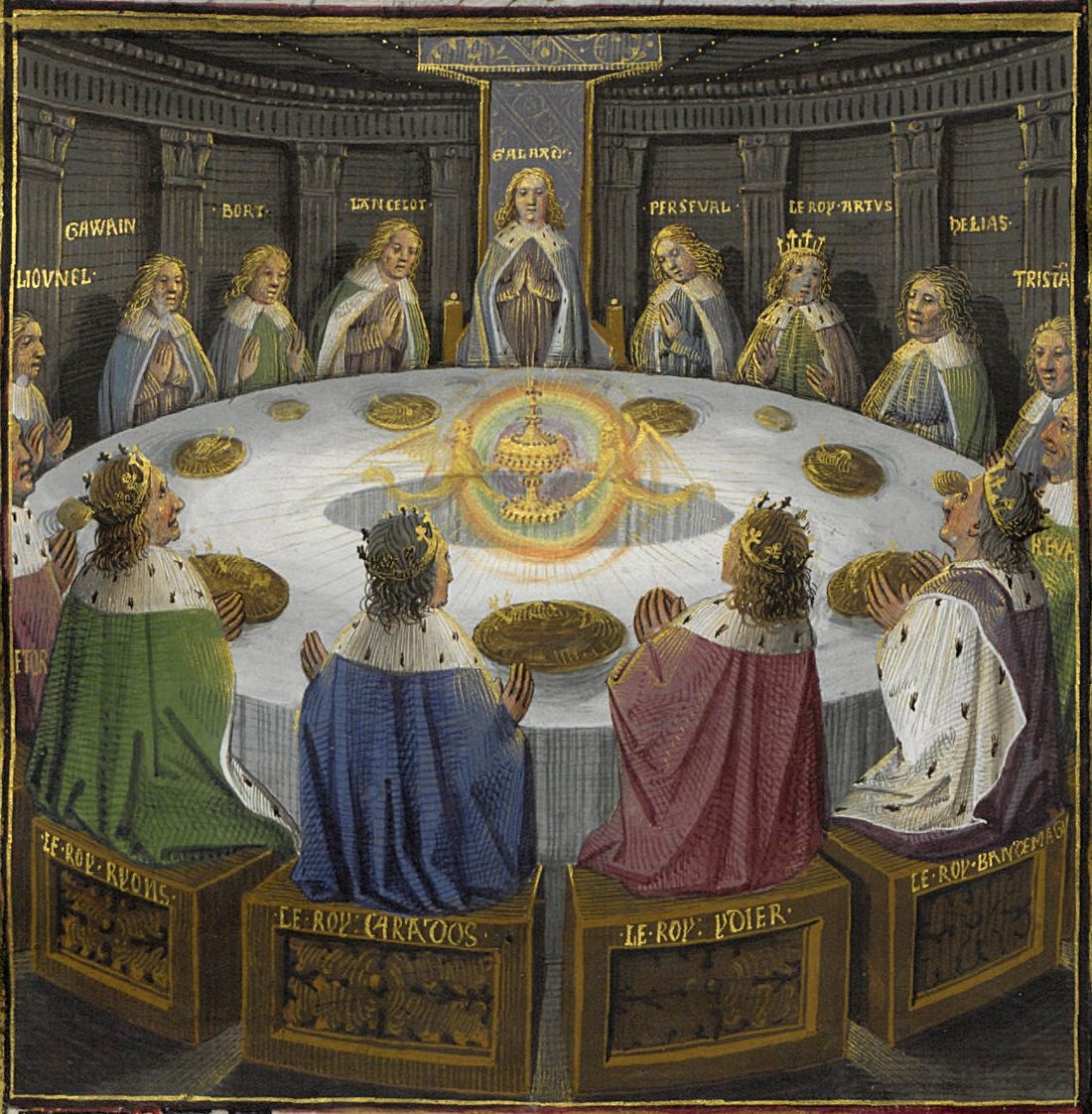
(King Arthur’s knights, gathered at the Round Table to celebrate Pentecost, see a vision of the Holy Grail; Medieval illumination) …
Brazilian theologian and philosopher Leonardo Boff highlights how Francis of Assisi recognized the elements of creation as kin:
[Francis] walked over rocks with reverence in attention to the One who called himself a rock; he took snails off the roads so that they would not be trampled by people; he gave honey and wine to bees in the winter to keep them from dying of cold and hunger…. Kinship is more than human; it is cosmic….
What we observe here is another way of being in the world, one quite different from that of the modernity that we have criticized. The latter stands above things in order to possess and dominate them, whereas that of St. Francis is together with them, to love them and live with them as brothers and sisters at home. Even with regard to anxieties and pains “he did not regard them as pains but as sisters.” Death itself is greeted as a sister who leads us to life. The Franciscan universe is never dead, nor are things simply placed within reach of the possessive human grasp or tossed one alongside another, without interconnections between them. Everything makes up a grand symphony–and God is the conductor. All things are alive and personal; through intuition Francis discovered what we now know empirically, that all living things are brothers and sisters because they [nearly] have the same genetic code. Francis experienced this consanguinity in a mystical way. We all live together under the same parental roof. Because we are brothers and sisters we love one another; violence among family members is never justified. [1]
Sister Elizabeth Johnson notes how becoming aware of our kinship with all of creation leads to “deep incarnation”:
The flesh that the Word of God became as a particular human being is part of the tree of evolving life on earth, which in turn is part of the vast body of the cosmos….
To catch this broad meaning, the Danish theologian Niels Gregersen has coined the phrase “deep incarnation.” It is starting to be used in theology to indicate the radical divine reach in Christ through human flesh all the way down into the living web of organic life with its growth and decay, amid the wider processes of evolving nature that beget and sustain life…. The saving God became a human being, who was part of the wider human community, which shares the membrane of life with other creatures, all made from cosmic material, and vulnerable to death and disintegration….
Deep incarnation understands John’s gospel to be saying that the sarx [flesh, material] that the Word of God became not only weds Jesus Christ to other human beings in the human species; it also reachesbeyond us to join the incarnate one to the whole evolving biological world of living creatures and the cosmic dust of which they are composed. [2]
_____________________________________________
Sarah Young; Jesus Calling
Stop judging and evaluating yourself, for this is not your role. Above all, stop comparing yourself with other people. This produces feelings of pride or inferiority; sometimes, a mixture of both. I lead each of My children along a path that is uniquely tailor-made for him or her. Comparing is not only wrong; it is also meaningless. Don’t look for affirmation in the wrong places: your own evaluations, or those of other people. The only source of real affirmation is My unconditional Love. Many believers perceive Me as an unpleasable Judge, angrily searching out their faults and failures. Nothing could be farther from the truth! I died for your sins, so that I might clothe you in My garments of salvation. This is how I see you: radiant in My robe of righteousness. When I discipline you, it is never in anger or disgust; it is to prepare you for face-to-Face fellowship with me throughout all eternity. Immerse yourself in My loving Presence. Be receptive to My affirmation, which flows continually from the throne of grace.
Luke 6:37 NLT
Do Not Judge Others
37 “Do not judge others, and you will not be judged. Do not condemn others, or it will all come back against you. Forgive others, and you will be forgiven.
John 3:16-17 NLT
16 “For this is how God loved the world: He gave[a] his one and only Son, so that everyone who believes in him will not perish but have eternal life. 17 God sent his Son into the world not to judge the world, but to save the world through him.
Isaiah 61:10 NLT
10 I am overwhelmed with joy in the Lord my God!
For he has dressed me with the clothing of salvation
and draped me in a robe of righteousness.
I am like a bridegroom dressed for his wedding
or a bride with her jewels.
Proverbs 3:11-12 NLT
11 My child, don’t reject the Lord’s discipline,
and don’t be upset when he corrects you.
12 For the Lord corrects those he loves,
just as a father corrects a child in whom he delights.
Sister Ilia Delio describes Francis of Assisi as a nature mystic:
Francis attained the heights of contemplation through his penetrating vision of creation…. Some regard him as “the first materialist” in the best sense of the word because of the way he looked on the material world—not for what it is but for how it is—God’s creation.
Francis has been described as a nature mystic, one who finds God in the vast and beautiful fields of nature. A nature mystic is one whose mystical experiences involve an appreciation of creation as God’s handiwork; nature manifests the divine. Francis’s nature mysticism included a consciousness of God, with the appropriate religious attitudes of awe and gratitude…. He took spontaneous joy in the material world, singing its praises like a troubadour poet. With a disarming sense of immediacy, he felt himself part of the family of the creation.
Delio describes how Francis’s conversion deepened as he became more aware of God’s presence in the material world:
Coming to an awareness of God’s presence in creation was not an immediate experience for Francis but required growth in love. Conversion is a slow, lifelong process. It is a constant effort of moving away from sin-centered attitudes and behaviors toward God-centered relationships. With this movement from sin toward God, there is a gradual change in one’s consciousness or awareness of others and in one’s relationship to others. It took Francis a lifetime to realize his integral relationship to others, not only to humans but to all of creation. The Canticle of Creatures, which sings of Francis’s cosmic fraternity, his integral relationship to all the elements of the universe, was composed in 1225, one year before he died. It took Francis a lifetime to realize that he was truly brother to the sun, moon, stars, fire and water, that is, to the whole cosmos….
In his Major Legend, Bonaventure describes Francis’s relationship with Christ as one of deepening piety. The word “piety” (pietas) means “blood-related” or “family related.” It can be defined as an attitude of respect toward those to whom one is bound by ties of religion, consanguinity; of relationships between human beings. Bonaventure highlights the idea that, through his relationship with Christ, Francis came to realize his “family” relatedness to everything, including the tiny creatures of creation….
Bonaventure claims that everything in creation “spoke” to Francis of God. He came to “see” God’s goodness in every aspect of creation, so that everything ultimately led him to Christ, the Word of God. That Francis came to “see” God in creation points to the idea that Francis contemplated God in the things of creation. Contemplation is a penetrating gaze that gets to the truth of reality, and Francis came to “see” the truth of things by following the footprints of Jesus Christ.
================================
Grace is not a race to the finish line
Rethinking quick comebacks and recommitting to the slow work of transformation
“Appear to be what thou art. Tear off thy masks. The church was never meant to be a masquerade.” —Charles Spurgeon
“How long will this take?” may be one of the most common questions I’ve heard over 25 years of counseling leaders. Whether it comes amidst a season of burnout, after a massive relational rupture, a major failure, a marriage crisis, or something else, a primary question centers one thing: speed.
Let’s just name this first: Speed confuses the immediacy of grace with the slow work of becoming.
Saul encountered grace on Damascus Road, but it took three years in the desert to become Paul. The Israelites were rescued from Egypt, but it took forty years to navigate an 11-day journey home.
The immediacy of grace does not ignore the slow work of awakening to the depth of personal pain, the extent of relational harm, the awareness of impact, the story of formation, the autonomic dysregulation, the work of repair, the sincerity and specificity of confession, the restoration of trust.
As I often remind people, the first question isn’t one of speed, it’s can I stay in the discomfort long enough to be changed through it?
However, this is when the pushback comes. Who are we to put a time limit on God’s grace?
And yet, in Scripture repeatedly centers wounded sheep over a fallen shepherd. Ezekiel condemns the leaders who “rule harshly” and neglect the weak while God becomes the good shepherd who attends to those wounded. Jeremiah pronounces woe on shepherds who harm the flock. Micah condemns leaders who should know better. Jesus pronounces woe on religious leaders who look and dress the part but compromise justice, mercy, and faithfulness, burdening others. James follows the tradition, reminding leaders that they’ll be judged more strictly. And Peter warns against domineering. Grace is never understood as an escape hatch from accountability; rather grace enables the care of those harmed and a slow path of transformation of the one who did the harm.
Dietrich Bonhoeffer provides us a way forward. In Life Together, he warned of the “pious confession” of those who say what seems to be the right thing, but haven’t confessed with sincerity and specificity. You know the words: “I shouldn’t have done that,” “I’ve made some mistakes,” “That’s just how my Enneagram shows up,” “I know I can be a bit strong, but it’s also your daddy issues,” “I’ve apologized—I don’t know what more you want me to say.”
Bonhoeffer writes:
Sin wants to remain unknown. It shuns the light. In the darkness of the unexpressed it poisons the whole being of a person. This can happen even in the midst of a pious community. In confession the light of the gospel breaks into the darkness and seclusion of the heart. The sin must be brought into the light.
He goes on to say that people “usually are satisfied when they make a general confession,” reminding his readers that “it is precisely for the sake of this certainty that confession should deal with concrete sins.”
This concreteness goes beyond, “I’ve made some mistakes” or “It was a tough season and I wasn’t leading from my best self.” It names reality:
I intimidated.
I lied.
I retaliated.
I retreated.
I minimized.
I managed my image.
And it impacted this person, in this specific way.
This, according to Bonhoeffer, frees us from the “circle of self-deception.”
But I’d also argue there is yet another level to consider, which invites us to consider the psychology of self-deception.
What we know neurobiologically and physiologically is that it’s impossible to confess, to repair, to own, and to engage humbly when operating in a dysregulated state. And even more, we know that this for many becomes a kind of permanent operating state. It often takes weeks and months alone to begin to see the depths of one’s dysregulation. But the good news is that this often awakens further curiosity: How did I get here in the first place? And how can I cultivate a soul at rest?
This can’t be rushed.
This curiosity is often the very beginning of humility. Writing to a young man consumed with status, appearance, and reputation, St. Augustine wrote these words in AD 410:
“If you should ask me what are the ways of God, I would tell you that the first is humility, the second is humility, and the third is humility. Not that there are no other precepts to give, but if humility does not precede all that we do, our efforts are fruitless.”
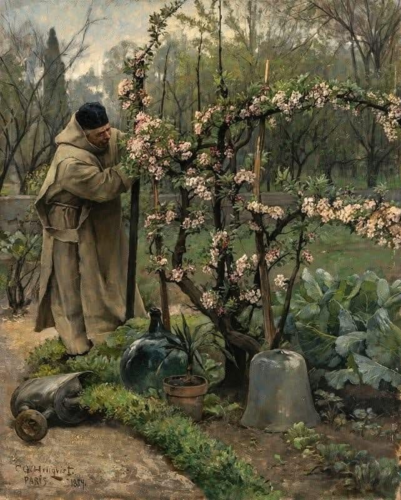
Humility is from the latin humus, meaning earth, soil, ground. Humility invites our descent, like a seed lowered into the earth, where life can begin anew.
Friends, I don’t know when grace became connected to speed. I don’t know when we turned sanctification into a 100-meter dash. Sadly, the long history of the church reveals our penchant for control, efficiency, speed, power, mastery, and more.
As I say in the new book, grace isn’t a race to the finish line. Sometimes grace looks like enough love and safety and time and care and truth and limits for a person to finally encounter the parts of themselves that charisma and competence had long allowed them to outrun.
In the end, grace enables us to ask: What am I becoming?
This essay is free. I’d be grateful if you’d become a paid subscriber, as it helps me keep writing. Comments are enabled for paid subscribers, which allows me to respond to you. And I occasionally offered paid subscriber content like books I’m reading and recommending. You can become a paid subscriber here:
Sit with Chuck is a reader-supported publication. To receive new posts and support my work, consider becoming a free or paid subscriber.
Father Richard Rohr explains how Saint Francis of Assisi (1182–1226) experienced the natural world as filled with God’s presence:
In stories of his life, Francis is quoted as talking to or about larks, lambs, rabbits, pheasants, falcons, cicadas, waterfowl, bees, the famous wolf of Gubbio, pigs (whom he praised for generously giving their bodies for our food), and hooked fish that he tried to throw back into the water whenever possible. He addressed inanimate creation too, as if it were indeed ensouled. We know this because his “Canticle of the Creatures” includes fire, wind, water, Brother Sun, Sister Moon, and, of course, “our Sister Mother Earth” herself. [1]
So-called “nature mysticism” was in fact a worthy first path for Francis and also for Bonaventure, the first Franciscan theologian, who saw all things as likenesses of God (vestigia Dei), fingerprints and footprints that reveal the divine DNA underlying all living links in the Great Chain of Being.
Creation itself—not ritual or spaces constructed by human hands—was Francis’s primary cathedral, his resting place in God, which then drove him back into the needs of the city. It’s very similar to Jesus’s own movement between desert solitude and small-town healing ministry. The gospel transforms us by putting us in touch with that which is much more constant and satisfying, literally the “ground of our being,” and has much more “reality” to it, rather than theological concepts or the mere ritualization of reality.
Daily cosmic events in the sky and on the earth are the reality above our heads and beneath our feet every minute of our lives: a continuous sacrament. I find that a preoccupation with religious rituals tends to increase the more we remain untouched by Reality Itself—to which the best rituals can only point.
Jesus himself commonly points to things like the red sky, a hen, lilies, the fig tree, a donkey caught in a pit, the birds of the air, the grass in the field, the Temple animals (which he released from their cages), and on and on. He was clearly looking at the seemingly “nonreligious” world, ordinary things all around him, and he appeared to do most of his teaching outside.
In the five-day Men’s Rites of Passage that was a focus of my work for fifteen years, many men discovered that prayers and rituals inside of human-scale buildings made with artificial materials also came to seem very domesticated and controlled. They often perceived that the salvation offered there was also “small” and churchy. Almost without exception, the greatest breakthroughs for the men occurred duringextended times of silence in nature, where the human and the merely verbal were not in control—or during rituals that were raw and earthy.
Rediscovering Our Connection to Nature
Monday, October 5, 2026
Father Richard Rohr considers how Christianity throughout history lost touch with the natural world as a place of grace and divine presence:
The sacramental nature of the world was largely lost until its more recent rediscovery by seers that we usually think of as “secular,” “mere” nature mystics, poets, and artists: people like Chief Seattle, John Muir, Rachel Carson, Walt Whitman, Wendell Berry, Annie Dillard, and others. We Catholics ended up limiting “sacramentals” to things like religious medals, blessed candles, and holy water, instead of honoring the inherent holiness of the earth ores, beeswax, and water that actually formed them. Please think about that! [1]
We limited the official church sacraments to seven (six for women, subtracting the sacrament of Holy Orders) when “there should be seven hundred,” as an old man once said to me in Tanzania. We ended up actually desacralizingGod’s world without realizing it. The people we called pagans and animists actually had a head start on us, because they at least saw the world as filled with spirits, whereas our world became empty, foreign, and without any natural balm for the soul. In the modern world, wild was always bad, and domesticated was always good. Yet C.S. Lewis said of God (in the character of the lion, Aslan), “He’s wild, you know!” Domesticated, of course, means subservient to us. We liked our world more than God’s world, it seems.
For much of Christian history, we preached inside of a disenchanted, small, and lonely universe where there was no natural holiness or inherent goodness in anything non-human or non-Christian. I thought Jesus was “the Savior of the world” (John 4:42), not just human souls. We then tried to fill up the loneliness with books and ideas, since the world beneath us and above us had become boring, merely functional, and not subject to the predictability we wanted.
We grasped for meaning in merely mental ways when it was all around us in tangible and visible ways. We failed to kiss the ground on which we stood and preferred to fly off into the heavens. “The first level of perception,” according to Bonaventure, “is toward exterior material objects,” and only when we see respectfully and lovingly at that level can we “ascend” to his second and third levels of full spiritual seeing. [2] Francis knew and taught that “God does not lose energy by plunging into form,” as Cynthia Bourgeault so forcefully puts it [3], and that true transcendence is to be found in immanence and materiality itself. What a surprise!
Most of us were trained to be good Platonists, where body and soul are enemies, much more than Christian incarnationalists, where body and soul are friends. And where were we to experience this incarnation? Precisely everywhere and all the time, not just in places defined as sacred, special, churchy, or religious. That is why Paul could confidently tell us we could and should “pray always” (I Thessalonians 5:17).
Father Richard shares an experience he had while on pilgrimage to the convent where Thérèse of Lisieux lived:
Our small group of five visited the infirmary where Thérèse died. I stood nearest the window. I could see the black hole in the bushes that Thérèse likened to her own soul when she was in pain, dying of tuberculosis, and trying to believe that Jesus still loved her. The sister guiding our tour was telling us the story of Thérèse’s death when she suddenly paused and said, “We have a visitor!” The way she said it, we all got goose bumps!
We followed the sister’s gaze and saw by the window a beautiful orange and yellow butterfly. It was only April 3, way too early for butterflies in northern France. She said, “Let it out, let it out!” Since I was closest to the window, I tried to open the latch, but I didn’t understand how it worked and just kept struggling with it. All of a sudden, I felt as though I were levitating. I had to look down at my feet to make sure I was still on the ground. I was definitely standing there, but I felt such ecstatic feelings of presence, joy, love, and power. All the blood seemed to flow out of my head.
The sister could only see me from behind. She asked, “What’s wrong? Open the window. The butterfly wants out! The butterfly wants out!” I finally got the window open, and the butterfly flew away. I turned around and the others said my face was white. “What just happened?” I asked, even though I knew I had just been visited. I don’t know how else to say it: Thérèse was there.
Before she died, Thérèse promised to spend her heaven doing good on earth. [1] Whether we believe in miracles of the saints or not, it seems like everybody who loves Thérèse has some miraculous story. She gets involved in our lives. I think she is present in millions of lives. There is something beautiful happening through this woman who said she wanted to perfect “the science of love.” [2]
My own experience in her convent felt like an affirmation of what I truly believe and what has been a lot of my message. The little way is the spirituality of imperfection; we come to God not by doing it right, but by doing it wrong.It’s not a matter of doing great things.Whenever we act in conscious love, this is the little way. And I think whatever we do in conscious union and love is prayer. So many of our Catholic saints are examples of heroic martyrdom; the message they give is, “If I am perfect, then God will love me.” Because I was so programmed to think that way, I really needed to be released from that pursuit of perfection. Thank God both Thérèse and Francis of Assisi did that for me!
__________________________________________
John Chaffee 5 On Friday
1.
“Love is our true destiny. We do not find the meaning of life by ourselves alone.”
This is an important thing to remember as someone who leans toward introversion.
Starting in college, I tried my hardest to be extraverted… So much so that I ended up winning Homecoming King my senior year. Goodness, that is wild to think about. The problem was that it was not fully or truthfully who I was… but I didn’t know it then.
Following college was 20 years of working in church jobs that demanded a kind of extraversion or social mode of being. I would leave events and feel utterly exhausted, oftentimes taking naps before waking up to get myself a dinner.
It was somewhere in the last 8 years when I realized that all of it was to teach me to have a healthy rhythm and balance between solitude and community. When one is overdone to the exclusion of the other, we can get rather bent out of shape.
In some respects, I had to learn that my need for solitude was not a result of anti-social behavior while also learning that just being in front of crowds did not mean I necessarily had community.
If love is our true identity, then it can only be found after solitude shows me my true self, and that true self is seen and celebrated by a community (not a crowd) of other true selves who also wish to be seen and celebrated.
2.
“To be spiritual is to be a breathing being…the opposite of spiritual is not secular…it’s suffocation.”
I had the good fortune of meeting Padraig a few years ago at St. Joseph’s University near Philly. He was stateside doing poetry readings and it was delightful.
There is something about the arts that does a better job, in my opinion, than theo-logic at describing God/faith/the spiritual life/death/etc. Poetry just seems to unlock something within me in a way that other disciplines do not.
3.
“By learning you will teach, by teaching you will understand.”
Let’s be honest, many of us do not fully understand something until we accidentally find ourselves having to teach it.
Then,
The teaching itself unlocks different aspects of what we thought we learned and we come to understand it on a completely new level.
Now, I can say that I thought I understood Christianity but that is not the full picture.
However, after living enough of life and having to teach it in a classroom setting where students can push back, debate, or dialogue about it, I admit to have learned so very much by being a teacher of it. Sure, giving sermons is good and fine but that is still in a monological mode of delivery (at least in white churches).
And, I do not doubt that there is still an infinite amount more for me to learn by teaching. If anything, teaching has helped me in my own formation more than I can probably comprehend.
4.
“When Jesus saw their faith, he said to the paralyzed man, “Son, your sins are forgiven.”
This story has shown itself to me a few times over the past two weeks and I do not know why.
There must be some alchemy, some teaching, some wisdom about it that is beckoning to be learned/integrated by some deeper level within myself. After all, the stories that grip us, grip us for a reason.
The setting here in Mark 2 is that there is a paralytic who wants to be healed by Jesus, but there is a large crowd that is obscuring or blocking the way. There is no statement that the paralytic man has faith at all, only that his friends have faith. The friends then conspire to bust a hole in the ceiling and lower their friend down into the crowded room to where Jesus is.
In essence, someone who cannot help themselves is helped by those around him and Christ allows the one without faith to be the beneficiary of the others who do.
Honestly, this story walks all over the lines we commonly draw.
Perhaps that is why we chose to record this story for future generations after it happened.
5.
“The church of Christ ecumenically embraces the whole inhabited earth. She is not a tribal religion, nor a Western religion, nor a white religion, but the church of all humanity.”
Jurgen Moltmann passed away this week on June 3rd at 98 years old. He is considered an important voice in the world of Christian theology. Why? Because he was one of the first theologians to seriously engage theology in the aftermath of WWII.
As a 16-year-old German, he was forcefully drafted into the German army in 1943 and became disillusioned with nationalism, violence, and war. Then, he was kept as a POW for several years after the war during which he was gifted a copy of the New Testament. This eventually paved the way for him to study Karl Barth, Dietrich Bonhoeffer, and others.
Jurgen Moltmann’s book The Crucified God shook me. It takes up the topic of God in a way that continues to inspire me. Moltmann’s thesis in that book was that God is not Aristotelian (omniscient, omnipresent, omnipotent) in the way that we conventionally think. No, that understanding of God is incompatible with Jesus, who suffered and was able to be affected by the world around him.
Rather than standing at an impassible and unchanging distance, the Christian God enters into pain, suffering, and death with the Creation.
In light of the concentration camps, brutalities of war, and the death toll of the Holocaust, Moltmann’s contribution to the world of theology was like a fresh breath of co-suffering love and hope.
This past week on the internet I have seen nothing but positive statements about this pastor-theologian, who seems to have been as quality of a person as was his contributions to theology.
Then children were being brought to him in order that he might lay his hands on them and pray. The disciples spoke sternly to those who brought them, but Jesus said, “Let the children come to me, and do not stop them, for it is to such as these that the kingdom of heaven belongs.” —Matthew 19:13–14
James Finley unpacks how Thérèse of Lisieux understood our calling to be like “little children”:
Thérèse entered the monastery at fifteen, and she began her novitiate a few months later, which means she took the habit of a cloistered Carmelite sister. She took the devotional name of Thérèse of the Child Jesus and of the Holy Face….
Thérèse’s emphasis on childhood and the child Jesus in her teaching doesn’t at all suggest that we’re not to mature into adults but rather see that there are certain childlike qualities that are the essence of spiritual maturity. How can we, as adults, cultivate these childlike qualities as a way to deepen our experience and response to God’s presence in our life?
Thérèse writes in her autobiography, “Jesus deigned to show me the road that leads to this Divine Furnace, and this road is the surrender of a little child who sleeps without fear in its father’s arms.” [1] She calls it a divine furnace—and other mystics speak this way as well—so that we imagine a red-hot stove. You put a drop of water on the stove and it vanishes. This is such a deep love and complete trust that all fear vanishes. We’re infinitely loved by God and held by God in an infinite love that completely and utterly transcends any source of fear, any source of sadness. The child is like an infant in complete trust and safety, sound asleep in the arms of God. We’re resting in the midst of a fear, in the midst of the sadness, but we’re grounded in this love that transcends the fear and transcends the sadness.
It’s our eternal destiny: an eternal oneness with the eternal love of God as the beloved. For Thérèse, the way we enter into this mystery experientially is to accept it. But we have to accept it as a small child accepts. It’s good for us to try to accept it, but as long as we’re trying to accept it, we’re not yet accepting the way a child accepts. When parents love their child, the child doesn’t try to accept that they’re loved. The child is loved because children are acts of acceptance in our midst. That’s what makes children so disarming, and it’s what makes child abuse so painful and deep….
It seems to me that the question in response to Thérèse’s teaching is: “How can we learn to go beyond trying to an act of acceptance?” I think this is why Thérèse’s spiritual path is called “the little way.” It’s not a big, overwhelming experience. It’s about calibrating our hearts to such subtlety that the sovereignty of this love is realized within us.
This CO2- (Church Of 2) is where two guys meet each day to tighten up our Connections with Jesus. We start by placing the daily “My Utmost For His Highest” in this WordPress blog. Then we prayerfully select some matching worship music and usually pick out a few lyrics that fit especially well. Then we just start praying and editing and Bolding and adding comments and see where the Spirit takes us.
It’s been a blessing for both of us.
If you’d like to start a CO2, we’d be glad to help you and your partner get started. Also click the link below to see how others are doing CO2.Odds Monkey
Steve Harvey Introduces Jesus To A Secular Audience
About
Change this text in the admin section of WordPress