Richard Rohr maps the expansion from self-love and group love to the gospel call of universal love:
We’re told by developmental psychologists that there’s a staging in our growth in love. We have to start with self-love and respecting the self. If we don’t respect ourselves, we won’t know how to respect anybody else.
Then God moves us to group love, family love, which is basically the love of people who are connected to us or who are like us. A lot of people don’t even get there. They don’t know how to love their family or those close to them or those in their group.
From there, God moves us to the third level, which is universal love. I’m afraid a much smaller number of people get to this place. As we see in politics, in our country, and throughout the world, at best most people just get to the second stage of knowing how to love people who are like them: their race, their nationality, their religion, their political party. When we stay at this second stage of group love, we clearly don’t create a healthy society. We can look at countries and politics the world over to witness how this is true.
In Acts 10, we discover that even Peter had to be taught by the Holy Spirit how to grow in love. Peter was at the stage of group love, believing that God only loved the Jewish people. And then this strange thing happened where the Holy Spirit fell upon gentiles! Peter looked around and said, “Oh my gosh! God seems to be for everybody and not just for the Jewish people!” He understood that it was okay to include gentiles into what eventually became known as the church. In spite of this, most of church history has not really imitated Peter’s insight. We pulled back into group think and group love.
Peter said, “In truth, I see that God shows no partiality. In any country, whoever fears God and acts uprightly is acceptable” (Acts 10:34–35). At that moment he became both a Jewish and Christian heretic! Peter himself began to recognize that God works with all people of goodwill — not just people in his group. But he had to be pushed there. Little by little, God leads him to universal love.
My shadow with Peri walking on ahead on the Camino de Santiago.
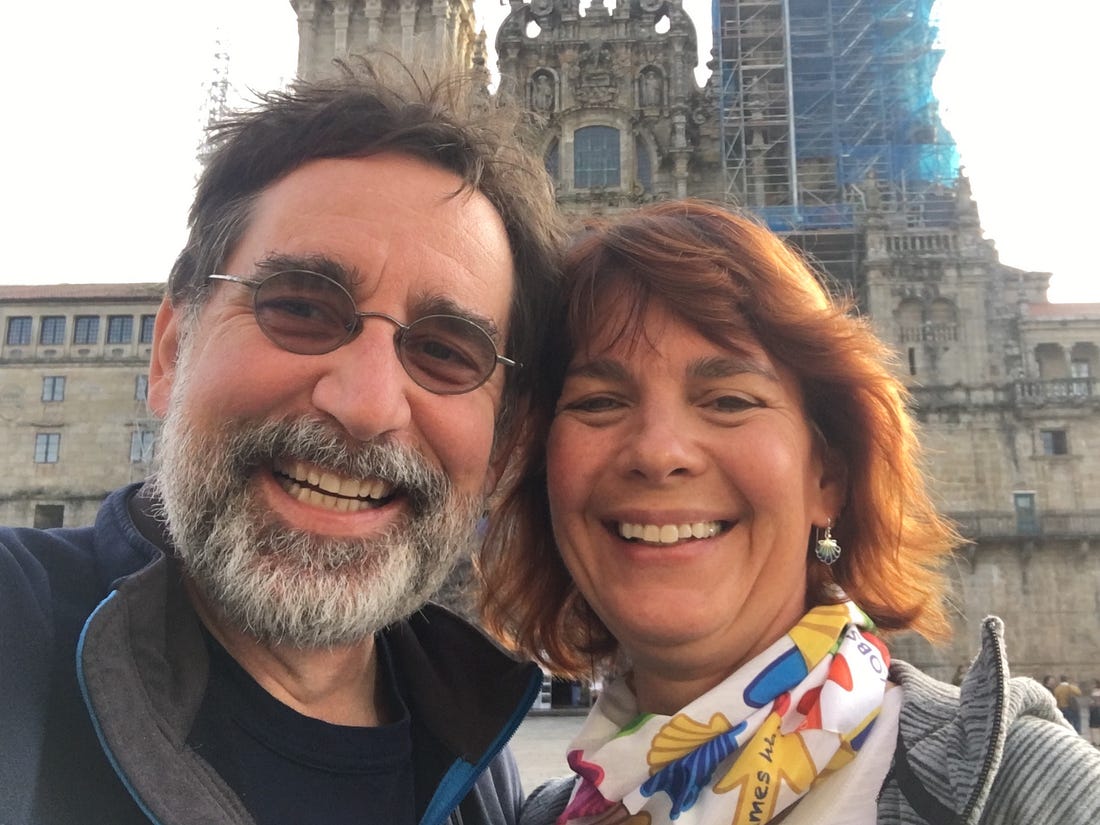
Ten years ago today Peri and I completed our first 500-mile pilgrim walk across Spain on the Francés route of the Camino de Santiago. It changed our lives. This is not hyperbole, it’s just a stone-cold fact. Peri has written a memoir of our experience—Every Scene By Heart. The following is my brief reflection on those blessed days ten years ago.
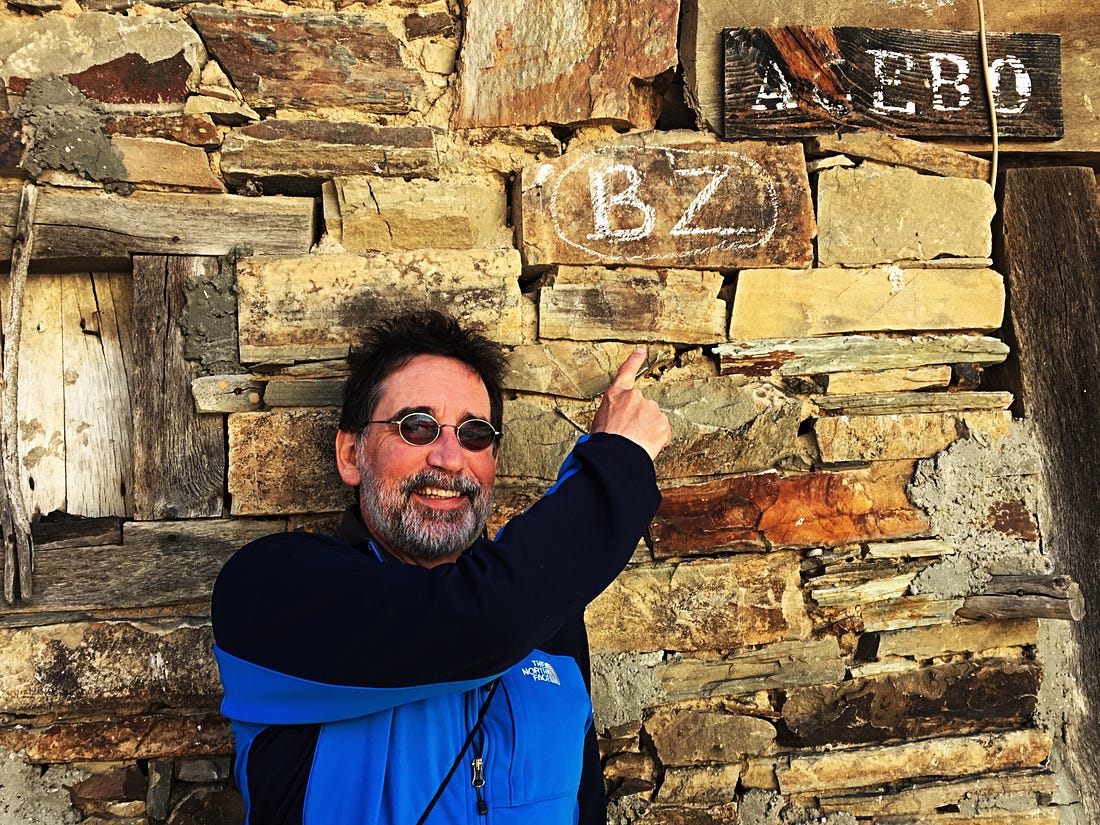
Finding my initials in El Acebo, population 37.
It was a long walk across Spain—the best days of our lives. We knew it while we were doing it. Even when we were beset with blisters and worn down by fatigue, we would turn to one another and say, “This is the best thing we’ve ever done.” While walking thousand-year-old paths made holy by the feet of millions of pilgrims, we found respite “far from the madding crowd” of modernity. For forty days and forty nights our lives were reduced to the blessed simplicity of walking from town to town, from church to church, from shelter to shelter, always moving a bit closer to Santiago. We didn’t dart here and there, back and forth in a frenzy; we didn’t speed through the world in cars, trains, and planes; we just moved steadily westward, no faster than foot-speed. And with the simplicity and the slowing down came that which we miss most in our high-speed, high-tech, high-stress age: Peace.
We had come to the Camino to escape the quadrennial madness that falls upon America during presidential elections. We had come to the Camino for our first sabbatical in thirty-five years of ministry. We had come to the Camino in hope of finding healing for our overwrought souls. And on the Camino we found all we were looking for and more. It’s not often that a much-anticipated experience exceeds our expectations, but the Camino de Santiago was better than we had dared to hope. It was a gift from God; a five-hundred mile walk deep into the grace of Christ.
As it became known that we planned to walk the Camino, people who had already had their own Camino contacted us; they were as eager to tell us of their experience as we were to gain what advice we could. Over time I noticed that these Camino veterans tended to say the same three things in their own way:
It’s harder than you think.
You will love it.
It will change you.
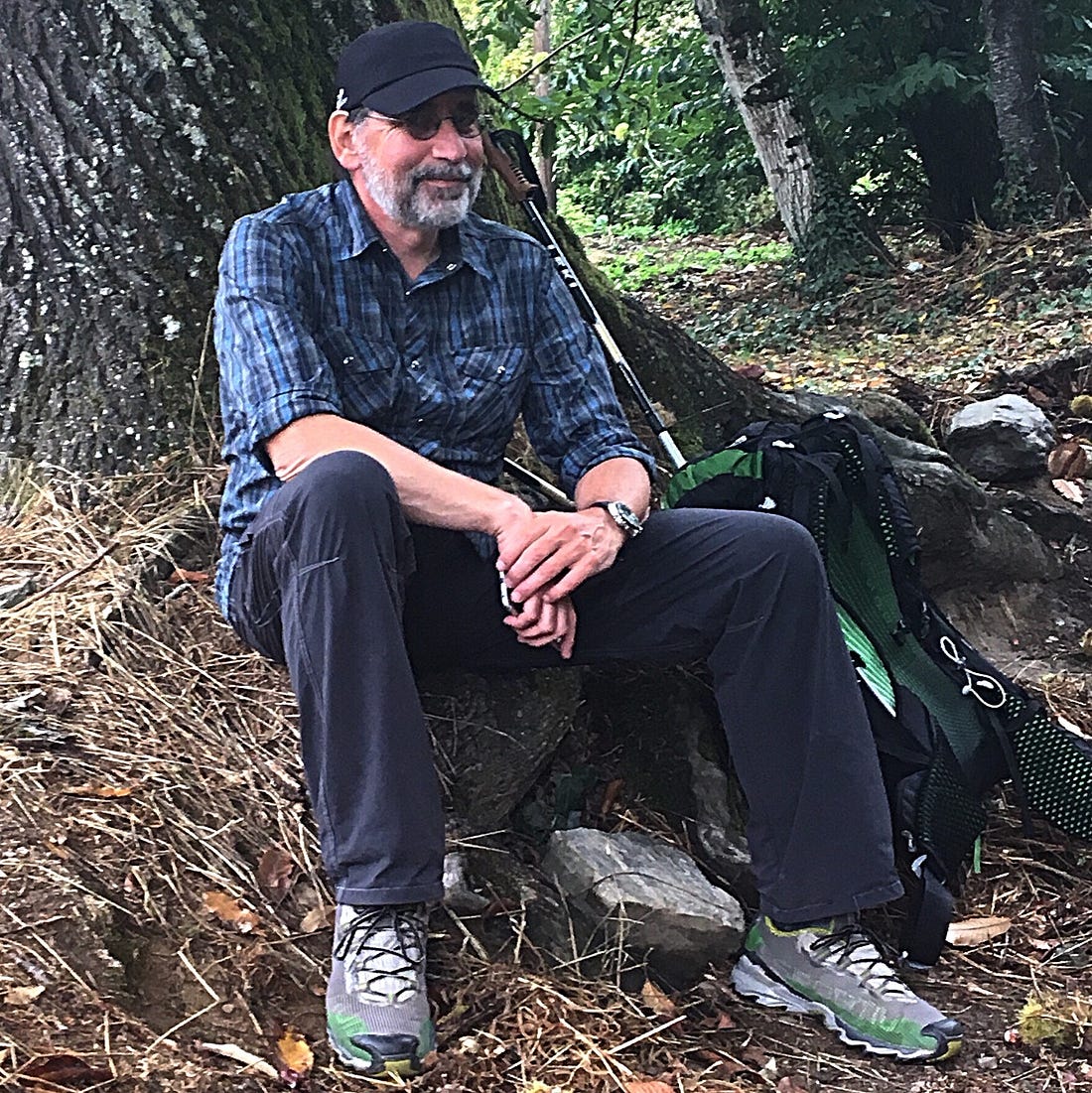
Taking a break near the village of Trabadelo, population 321.
Today, ten years after our arrival in Santiago, I can say that all three prophecies were precisely true. It was harder than I anticipated—as Peri’s memoir makes clear. And I did love it. Even when I had seventeen blisters I was aware that I loved the privilege of being a pilgrim on this wonderful journey. And, most importantly, I know the Camino has changed me. I found a peace on the Camino that I’m still consciously aware of today.
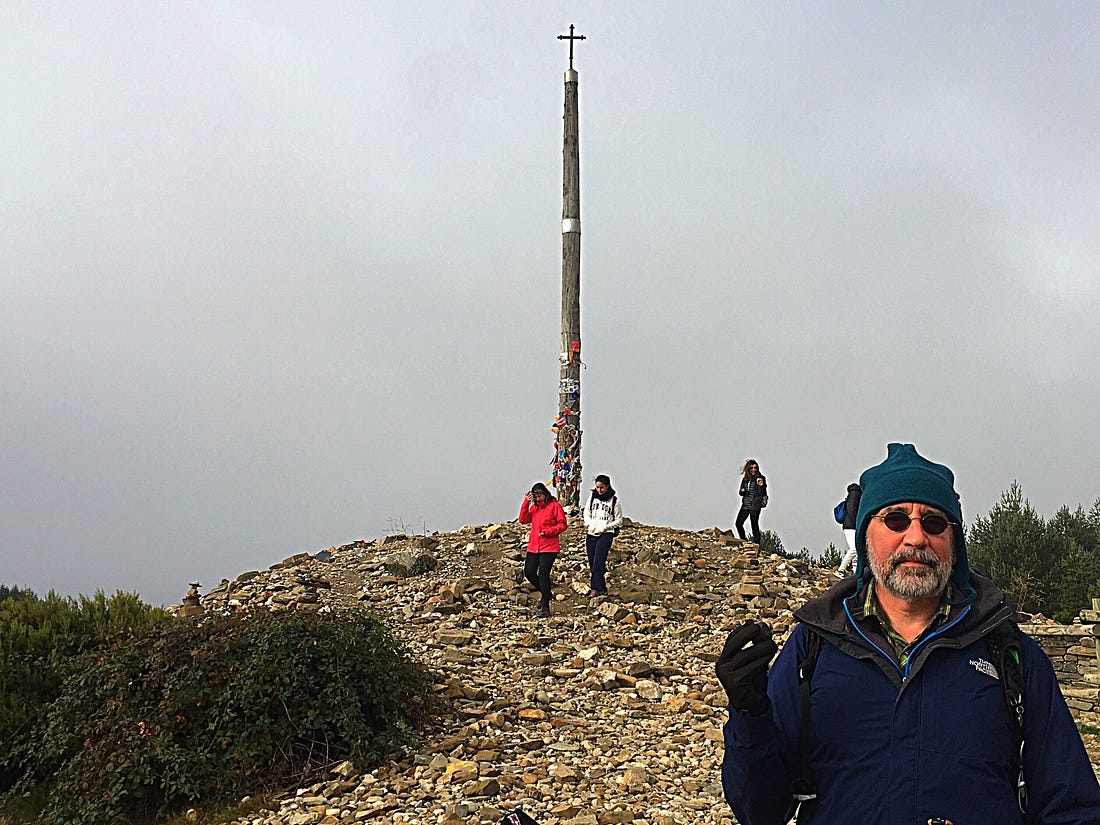
Over those five-hundred miles I shed a layer of skin—a layer that was too easily blistered by anxiety. At Cruz de Ferro I laid down a burden I have not retrieved—I left it at the base of an iron cross and there it remains.
At Cruz de Ferro, where pilgrims lay down a small stone they have carried on the Camino, representing something they want to let go of.
Those long walks through the lovely mountains of the Pyrenees, the vineyards of Navarra, the plains of the Meseta, and the wooded hills of Galicia brought me to a new place of calm and contentedness. This was an answer to prayer. The Camino was a forty-day, five-hundred-mile prayer, and with the Amen offered in the Cathedral of Santiago I found a new depth of the peace of God which surpasses all understanding. Thank you, Camino. Thank you, Peri. Thank you, Jesus.
One of the scribes came to Jesus and asked, “Which is the first of all the commandments?” Jesus replied, “The first is this: … ‘You shall love the Lord with all your heart, with all your soul, with all your mind, and with all your strength.’ The second is like it: ‘You shall love your neighbor as yourself.’” —Mark 12:28–31
In this homily, Father Richard Rohr considers Jesus’s response to the question, “Which is the first of all the commandments?”:
I don’t think any of us really know how to love God with all our heart, soul, mind, and strength. We might want to love like that, but how do we put all the parts of ourselves together and actually do it? It takes our whole lives to figure out what Jesus’s words might even mean. Then Jesus says, “You must love your neighbor as you love yourself” (Mark 12:31). Do any of us do that? Do we really love other people? Do we really give them as much attention as we give to ourselves? I don’t think so.
Imagine how different the world would be if we just obeyed that one commandment to love our neighbor as we love ourselves. It would be the most mighty political and social upheaval imaginable. The world would be radically different if human beings really treated other people as they would like to be treated. We can take this as a simple rule of thumb: What would I want from that person right now? What would be helpful for me to receive?Well, there’s the commandment—our obligation to do for others!
It’s so simple that we can see why we put all our attention on the Ten Commandments, or the hundreds of other regulations culture and religion place on us. It’s much easier to worry about things that keep us “pure,” so to speak, but are of little consequence.
I think the scribe is asking a very good question. After all is said and done, it comes down to loving God and loving our neighbor—and that implies loving ourselves. If I said this without quoting Jesus, I could be accused of oversimplifying or ignoring some of the important commandments. Thank God, Jesus said it first. He taught that it’s all about love. In the end, that’s all we’re all going to be judged for. Did we love? Did we love life? Did we love ourselves? Did we love God? Did we love our neighbor? Concentrating on love takes just about our whole lifetime, so we won’t have much time left over to worry about what other people are doing or not doing. Our job is to love God, love ourselves, and love our neighbor.
==================
Sacred Service
Monday, October 26, 2026
Interspiritual teacher Mirabai Starr centers Jesus’s teaching to love one’s neighbor as oneself in his Jewish tradition:
The second-century Talmudic master Rabbi Akiva said that the entire essence of the Torah could be summed up by Leviticus 19:18 “Love your neighbor as yourself.” There is a famous story in the Talmud about Rabbi Hillel, another spiritual genius of this lineage. A Gentile came to a rabbi named Shammai and said that he would convert to Judaism if Shammai could teach him the entire Torah while standing on one foot. Infuriated, the rabbi chased the man away. Hillel, however, balanced on one leg and said, “That which is hateful to you, do not do to your neighbor. That is the whole Torah; the rest is commentary. Now go and study it.” The Gentile converted on the spot.
While Judaism takes it on faith that the ultimate Divine Being transcends all attributes and defies all description, it also affirms that God is intimately concerned with the human predicament. If human beings are made in God’s image and if His nature is one of infinite compassion, then efforts to act with kindness and to defend the persecuted are as vital to spiritual life as are prayer and Torah study. To love God is to love each other and to see each other as having been created in Her image, just as we ourselves have been….
Mercy is the root that blossoms into living acts of chesed (lovingkindness) and tzedakah (righteousness). Tzedakah can be confused with charity. But it is not about grand gestures of beneficence. If we are spiritually attuned, giving becomes a natural outflow of our recognition of the interdependence of all life. To withhold what we have from others is to violate the gifts the Holy One has given to us. Not only that, but acts of tzedakah are said to sanctify God: our righteousness makes the Holy One holy!
Jesus’s teaching invites us to express who we are by how we act:
Jesus reminded his Jewish followers that the most important of all the Holy One’s prescriptions are “to love God with all your heart and all your soul and all your strength” and “to love your neighbor as yourself.” Following these two commandments requires a balance between reaching upward toward the divine mystery and manifesting our commitment to the sacred in each other.
In the Sermon on the Mount, Christ calls his disciples “the salt of the earth.” By carrying his message of love to all they touch, they will serve to bring out the true flavor of the spiritual life and preserve what is best in the human experience. Sacred service in the name of love, he promises, is worth far more than worldly fame and material fortune. The divine commission is to stand up in our righteousness and radiate our light to the world.
============
Individual Reflection
Of the three (God, neighbor, yourself), which one do you quietly leave out?
Group Discussion — choose one:
Rohr says we fuss over purity because it costs less than love. What’s your version of that?
Starr says withholding what we’ve been given violates the gift. What are you holding back, and from whom?
Hillel’s answer fit on one foot. Why do we keep needing more legs to stand on?
Joanna Arellano-Gonzalez, co-founder of the Coalition for Spiritual & Public Leadership, reflects on the influence of empire thinking:
John Dominic Crossan, in God and Empire, names the four cornerstones of empire as political, economic, military, and ideological power. While the first three subject marginalized people to crushing realities, ideological power is the most nefarious. It shapes, controls, and distorts the minds and spirits of both oppressor and oppressed….
We have been indoctrinated by the forces the American Empire rests upon—taught to value profit over people and individualism over interdependence. Embodying these values leads to greater disembodiment of God’s love. Our Inner Empire must be dismantled and rebuilt so we can respond with fiercer clarity and love as Christians.
The four cornerstones of the Inner Empire are supremacy, privilege, hatred, and fear. These four cornerstones lead to the dehumanization of others and the self.
Supremacy captures the belief in our own inherent superiority over others. Privilege points to unearned advantages we protect or ignore at the expense of others. Hatred names active hostility toward others (or parts of ourselves). Lastly, fear fuels self-protection. When we fear losing control, status, or safety, we build walls inside ourselves, like the walls of Jericho, impenetrable to danger, but also impenetrable to authentic love.
Knowing that these cornerstones corrode the soul, what can restore the soul?
In Matthew 21:42, Jesus quotes a Psalm from his Hebrew tradition that says, “The stone that the builders rejected has become the cornerstone” (Psalm 118:22). Arellano-Gonzalez writes:
Jesus … embodies the cornerstones and models that we need in our daily lives. We need to follow his blueprint.
We can rebuild our foundation with the four cornerstones of humility, responsibility, compassion, and connection. These four practices help restore our sense of humanity toward others and ourselves….
Humility allows us to see one another as equal, with deep reverence and openness to all and the environment. It reminds us we are stardust amongst the infinite cosmos.
Responsibility teaches us to be accountable for our actions and stewards of one another and the land.
Compassion promotes empathy, love, and benevolence, which help us tap into God’s tenderness for the world.
Connection is the strongest cornerstone. It teaches us about radical solidarity, belonging, and courage. Connection invites us to action. We recognize that when one injustice happens against one group of people, it happens to us all because of our sacred interconnectedness.
Have the courage to shake the foundations of your spiritual world. When you examine and create awareness around your entitlement, your privilege, and your position of power in communities, you can ultimately rediscover your true understanding of self, others, God, and the planet.
To create the world we want to see, we need to start with ourselves.We must dismantle the Inner Empires we’ve built—brick by brick, belief by belief. The empire within must fall so that solidarity, justice, and love can rise. (Editorial addition by Ray Watson: But can we do that work ourselves in our own strength without starting with the foundational relationship with the Cornerstone, Jesus? I need Jesus to help me because I am not capable in my own strength/weakness. I must seek first the relationship that is foundational to all others. Hold me, Abba. Mold me with your love so I can love…)
Reference: Joanna Arellano-Gonzalez, “Dismantling Your Inner Empire,” the Mendicant, (Center for Action and Contemplation), Fall, 2025.
Image credit and inspiration: Bradley Pritchard Jones, untitled (detail), 2023, photo, Ynys Llanddwyn, Wales. Unsplash. Click here to enlarge image. Like old stones slowly returning to the hillside, the structures of empire fade while the way of Jesus, rooted like the land itself, remains.
John Chaffee’s Five On Friday, 10-23-2026
1. “Do not let me hear Of the wisdom of old men, but rather of their folly, Their fear of fear and frenzy, their fear of possession, Of belonging to another, or to others, or to God.” – T.S. Eliot in The Four Quartets
How interesting…
T.S. Eliot calls it “folly” to fear belonging to someone, to others, or to God.
I guess some might avoid belonging to a person because it is hard to have someone who constantly mirrors back to you how you’re experienced in the world.
I guess some might avoid belonging to a group because it will involve some degree of conformity and accountability. It requires agreed-upon practices, habits, and interactions. This isn’t all bad. Think of the Ten Commandments. I wouldn’t want to be part of a community that doesn’t at least hold up a basic moral standard.
I guess some might avoid belonging to God because it means they’re no longer the final moral authority over their lives. I don’t remember who said it; perhaps it was Lawrence Kohlberg, but the statement goes, “One does not achieve moral maturation until they bend the knee to something larger than themselves.”
No one’s path is exactly the same as someone else’s.
There is no point in comparing our journey with someone else’s.
3. “It cannot be denied that too often the weight of the Christian movement has been on the side of the strong and the powerful and against the weak and oppressed—this, despite the gospel.” – Howard Thurman, Author of Jesus and the Disinherited
This is brilliant. Howard Thurman was a titan of insight and wisdom.
This past week, I taught my college students about the Biblical Prophets. It was a riveting conversation.
What made it so interesting?
Well, I hope I expanded their understanding of the Prophets.
Previously, I think most students saw the Prophets as people who announced doom and gloom for anyone who didn’t turn back and follow Yahweh’s ways.
Taking cues from Abraham Joshua Heschel, I said, “The Prophets exist to resensitize a desensitized world to injustice. To the Prophets, minor infractions are utter desolations, because even minor sins crack the foundation of everything, and after a time, even minor cracks can build up to the wholesale collapse of an entire society. The Prophets constantly rail against the structures that are for how they might crush, oppress, and sacrifice people beneath their status quo.”
I probably should mention that this class was held within the Philly prison system. All of my students are inmates. 2/3 of my students are not even Christian… AND YET, I would say they have a powerfully strong understanding of morality and justice.
When class ended, two students said our class on the Prophets was their favorite class so far this semester.
Howard Thurman was absolutely prophetic when he said the above quote.
This one hits right at the core of my self-understanding as an Enneagram 5.
Enneagram 5s, when they are asleep to themselves and on autopilot, often shift to talking about information rather than being vulnerable. Enneagram 5s are more likely to live in their heads and less likely to live in their bodies or hearts.
Spiritual maturity is not in knowing much, but in loving much.
Brian McLaren is releasing a science fiction trilogy. It is a new genre for him, but I find it quite interesting.
The basic premise is that Earth is on the verge of collapse, or, more likely, is already coming up against its own Armageddon because of the greed of oligarchs, the abuse of the environment, and rampant dehumanization of people into consumers. As a result, a contingent was chosen to go and populate Mars. The whole story is a powerful way to ask, “If we could start over, what kind of world could we create?”
The book is neither utopian nor dystopian, but it asks the hopeful question of what is possible moving forward.
In one chapter, it touches on the topic of suicide, saying that suicide is statistically a much higher cause of death than all armed conflict, war, and natural disasters combined. After looking it up myself, I was surprised to find out this is true in our real world today.
Then, one of the characters says the line above… “When people cease to care, people die.” When apathy takes over, lives are lost. Since this is the case, we must fight apathy at all times and do our best to care.
In CAC’s virtual gathering, “How Can We Reclaim Jesus from Empire?” Brian McLaren shares how his faith has changed since he embraced the historical Jesus of the Gospels.
In the last couple of hundred years, wave after wave of theologians and Christian thinkers and activists have tried to free Jesus from our theological straightjackets and rediscover him in his historical and political setting. When you do that, you realize the core message of Jesus was not, “Here are the four steps to go to heaven when you die.” Jesus’s core message was, “The kingdom of God is at hand.”
“At hand” means within reach and available now. That’s revolutionary!
So few see this, in part because of misguided traditions of teaching and in part because of confusing translations.
Our English word kingdom comes from a Greek word basilea, which means empire. It’s the same word. So, Jesus shows up in a historical moment when the empire of Caesar in Rome is dominating the Mediterranean world. Jesus says, “Hey everybody! The empire of Caesar is a dirty little neighborhood within a much bigger kingdom—the empire of God. Stop framing your lives in that small, ugly, distorted frame of earthly human empire. Deconstruct all your Rome-dominated assumptions. Learn a whole new way of seeing the world because the empire of God is all around us and within reach!”
Sadly, too many Christians have done the reverse. They have shrunk God into the image of a human emperor. They see God as a supreme, dominating, authoritarian autocrat. They don’t see how Jesus is taking the language of empire and flipping it on its head.
What do empires do? They kill people. What does Jesus do? He dies as a nonviolent witness against empire.
What do empires do? They torture and imprison people. Jesus heals people and sets them free.
What do empires do? Empires forcefully relocate people. Jesus goes to people where they are and meets them where they are.
What do empires do? They create domination hierarchies: These people are over these people, who are over these people, who are over these people. What does Jesus do? He takes the role of the servant and washes people’s feet. He leads from below, kneeling at their feet. What a stark reversal of human domination systems.
Yes, Jesus talks about God being a father, but is Jesus’s father a Roman patriarchal father? No, God is the opposite: a merciful parent who doesn’t punish a disobedient son, but rather welcomes him home and throws a party to celebrate.
Suddenly, when you see this, you see everything in a new light. Jesus doesn’t legitimize human nation-states and their dominating systems of top-down control. In word and deed, Jesus exposes and inverts the whole pyramid.
He points to something bigger and more beautiful. Shouldn’t we do the same?
Reference: Adapted from Brian McLaren with Randy Woodley and Edith Woodley, “How Can We Reclaim Jesus from Empire?” (Center for Action and Contemplation, July 10, 2026). Unavailable.
Image credit and inspiration: Bradley Pritchard Jones, untitled (detail), 2023, photo, Ynys Llanddwyn, Wales. Unsplash. Click here to enlarge image. Like old stones slowly returning to the hillside, the structures of empire fade while the way of Jesus, rooted like the land itself, remains.
I delivered this homily to the Church of the Magdalen. I’ve retained the personal nature of speaking to 20 people I know very well, seasoned Jesus-followers whose example I note. So in a sense, readers are overhearing a family discussion, but as the shoe fits, please wear it.
Today, Today, mind you, the Lord Jesus asks us, us, mind you,
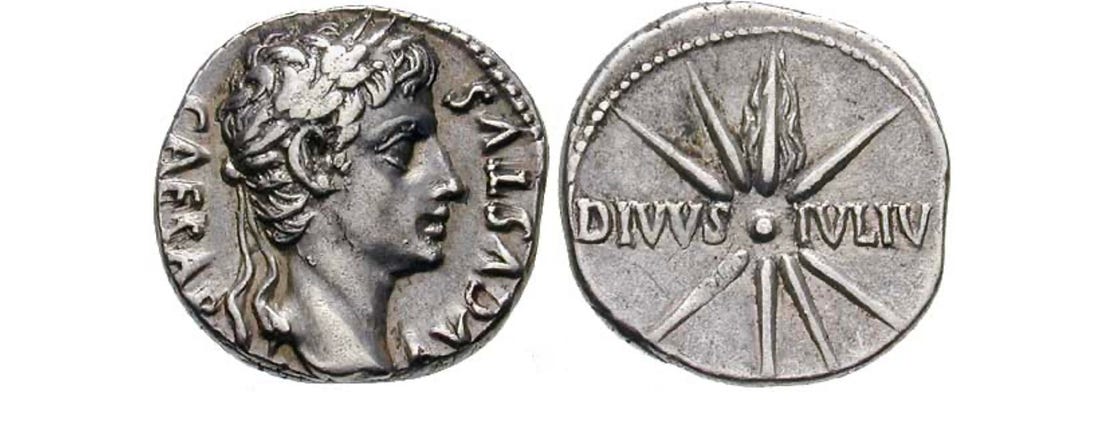
Whose image, whose icon, whose likeness, whose face is on the Coin?
What caption, what inscription, what slogans and titles does our Coin bear?
Come to think of it, what is our Coin (uppercase C)? the Coin we carry and has our allegiance?
As our Lord looks up from our Coin we make eye contact, and he says,
“Render to God what is God’s.”
And because it’s you, dear friends and siblings, I see him break into a broad, warm smile.
CAESAR’S IMAGE
The first part is too easy, too familiar.
We know the image of Caesar is empire, domination, and control. Caesar’s image is on our currency, our flags, our anthems, our hand-on-heart pledges, Caesar speaks from our capitol buildings and in our tax assessments. Caesar knows you … by number, as number. Caesar tells you what to render and renders it from you. to pay for your water, your electricity, your highways, schools, (thank you), to pay for Caesar’s death rows, deportations, and genocides, (damn it).
And today, today, mind you, self-anointed prophets insist we vote and bow to their chosen Caesars, even anointing them with the name “Cyrus” to justify their blasphemies.
THE TRUE IMAGE
BUT, but, but! That’s just coin. The reality is far more radical, more beautiful, more joyous.
All of today’s readings, today’s message from heaven, lift our eyes to the One true Image of God, to behold the glory of God in the face of Jesus Christ.
PROCLAIMED IN THE PSALMS
The Psalmist proclaims the beautiful Gospel of the Coming One— the Lord who is great and greatly to be praised, whose compelling image we receive and proclaim and sing and declare…
His Psalm, our song, is not raised to some tribal God of the elect de jour, our Lord does not serve any nation’s political expansion, or exclusive religious movement like “Christian” nationalism, that crave dominance.
The Psalmist says our Lord is good news for everyone, for all the earth, for the whole world, for the families of the peoples in every nation!
When they hear he is coming as Judge, they do not cower in dread. The heavens are glad, the earth rejoices, Creation exults
Precisely because it isJesus coming to judge the earth Because, finally, we have a ruler whose reign is mercy and whose judgments are equity for everyone,
The image on his banner is the Cross where the scales of justice always render a verdict of God’s peace on all the earth and divine goodwill to all people.
PREVIEWED IN THE PROPHETS
This same Lord the Psalms proclaim, the Prophets also preview.
Isaiah offers Emperor Cyrus as a mere shadow of a far greater Reality. However dimly, Cyrus blindly prefigures the Image of God we now behold in Christ.
Cyrus, who does not know God, is anointed as a gesture to the Messiah who does know God, comes from God, was with God from eternity, and is the Image and Likeness of God.
Those local, temporary, political exploits of Cyrus are fulfilled in Christ on a cosmic, universal scale that delivers us all from the Empire of Darkness.
Let’s give ear to the fulfillment, Today, today, mind you,
Jesus is God’s anointed, Jesus subdues nations, Jesus strips the prince of darkness of power, Jesus breaks open the gates of Hades to conquer death, and the gates of His fair city will never be shut.
Jesus goes before us to level mountains of injustice, he breaks in pieces the iron bars of bondage, and he has and is and will deliver us, us, mind you, his treasure and his riches and his inheritance, retrieving—rendering—from darkness everyone, everyone.
Jesus is Lord, and there is no other, Jesus is Lord, and you do know him, from the rising of the sun to its going down, there is just no one like him, not even the false image of Jesus that false prophets of Caesar parade before us.
Youknow the Jesus of the Psalms, the Prophets, and the Gospels, and every shadow is washed out in the Light of his glory.
The Epistle picks up the image or face of Christ, the icon of God proclaimed in the Psalms, prefigured in the prophets, and locates it … where?
PORTRAYED IN HIS PEOPLE
Today, today, mind you, the Image of Christ is reflected in the people called by his name.
The Thessalonians and the Magdalenes are and are becoming the icon, the image of the Image of God— the face of Christ in the world, for the life of the world…
Listen to Paul describe you, as he describes himself and his Lord:
I always give thanks to God for all of you, always mentioning you in our prayers, constantly remembering your work of faith, your labor of love, your steadfast hope,in our Lord Jesus Christ.
The Magdalene image of Christ bears and shares the message of the gospel, In word, yes, and in the power of the Holy Spirit,
So, when I look for the image, I see the imitators, an example to all the believers, and not only in Macedonia and Achaia.
No, you lot have sounded forth in Mexico, Canada, and the United States, you’ve traversed Europe and the UK and touched hearts in the Middle East, you’ve ventured from Southeast Asia, and lived your peace in far-off Islands. What continent has Sister Gillian not mentored from her home? (maybe Antarctica?)
What a strange, eclectic little collection of Maggies, in whose faces I see the Image of the Image of God, in whose hearts and hugs I’ve encountered Jesus.
WALK THIS WORLD AS THE PARDON OF GOD
Our friend Peri, reflecting on Francis of Assisi, leaves us with this commission to bear the image and render our lives to Christ:
Walk the world as the pardon of God Always affirm the Christ you see in others Let your faces and your words radiate the radically inclusive welcome of Jesus. Be the image you bear and who bears you.
Lord, make us an instrument of your peace. Where there is hatred, let us sow love; where there is injury, pardon; where there is doubt, faith; where there is despair, hope; where there is darkness, light; where there is sadness, joy.
O Divine Master, grant that we may not so much seek to be consoled as to console; to be understood as to understand; to be loved as to love.
For it is in giving that we receive; it is in pardoning that we are pardoned; and it is in dying that we are born to eternal life. Amen.
A serious accident can change a person’s financial circumstances almost overnight. Beyond the immediate medical expenses, individuals who suffer permanent disabilities may face years of rehabilitation, reduced earning potential, ongoing care requirements, and significant changes to their living arrangements. These consequences can affect not only the injured person but also their family members and long-term financial security.
Permanent disabilities may result from motor vehicle collisions, workplace incidents, medical complications, or other traumatic events. While the physical effects of these injuries are often the most visible, the financial consequences can be equally significant and may continue for decades.
Understanding the full economic impact of a permanent disability is essential for developing a sustainable financial plan. When an injury results from another party’s legally actionable conduct, accurately documenting these losses may also be important when evaluating potential compensation.
What Constitutes a Permanent Disability?
A permanent disability generally refers to a lasting physical, neurological, or cognitive impairment that affects a person’s ability to perform certain activities. The severity of these limitations can vary considerably depending on the nature of the injury and the individual’s medical condition.
Examples of injuries that may cause permanent disabilities include:
Spinal cord injuries resulting in paralysis or reduced mobility.
Traumatic brain injuries affecting memory, concentration, or coordination.
Amputations involving the loss of a limb.
Severe orthopedic injuries causing permanent movement restrictions.
Significant vision or hearing loss.
Permanent nerve damage.
Serious burns causing functional limitations.
Neurological injuries affecting speech or motor control.
Some individuals with permanent disabilities can continue working and living independently with appropriate accommodations. Others require extensive assistance with daily activities.
Financial planning should therefore reflect the person’s actual limitations rather than relying solely on the diagnosis.
The Immediate Financial Impact of a Serious Accident
The first financial challenges often emerge during emergency treatment and hospitalization.
Depending on the severity of the injury, initial expenses may include ambulance transportation, diagnostic imaging, surgery, intensive care, medication, and specialist consultations.
At the same time, the injured person may be unable to work, creating a sudden reduction in household income.
Family members may also need to take time away from employment to assist with medical appointments or provide temporary care.
These immediate expenses can place substantial pressure on household finances, particularly when the injury requires prolonged hospitalization or multiple surgical procedures.
Long-Term Medical Treatment and Rehabilitation
Permanent disabilities frequently require medical care long after the initial accident.
Ongoing treatment may involve:
Specialist medical appointments.
Physical therapy.
Occupational therapy.
Neurological rehabilitation.
Pain management.
Prescription medications.
Follow-up surgical procedures.
Diagnostic testing.
Medical equipment maintenance.
Some individuals require periodic treatment throughout their lives, while others experience changing needs as they age.
For example, a person with a spinal cord injury may initially require intensive rehabilitation but later face recurring expenses associated with mobility equipment, personal assistance, and prevention of secondary medical complications.
Estimating these expenses accurately is an important component of long-term financial planning.
The Financial Consequences of Limb Amputations
Amputations can create substantial long-term expenses because recovery often involves more than the initial surgery.
Individuals may require rehabilitation, prosthetic fitting, mobility training, and ongoing medical evaluations.
Prosthetic devices may need to be adjusted, repaired, or replaced as the person’s physical condition and activity requirements change.
Additional expenses may include:
Prosthetic limbs and replacement components.
Specialized rehabilitation programs.
Mobility aids.
Residual limb care.
Home accessibility improvements.
Adaptive transportation equipment.
Vocational retraining.
When an amputation results from another party’s legally actionable negligence, the cost of future prosthetic devices and rehabilitation may become relevant to a compensation claim.
Individuals researching amputation lawyers serving Sacramento may wish to understand how medical experts and financial professionals evaluate the lifetime expenses associated with serious limb injuries.
Recoverable damages depend on establishing liability, causation, and the extent of legally recognized losses.
Lost Income During Recovery
One of the most immediate financial consequences of a disabling injury is the inability to earn income during recovery.
Some individuals miss several weeks of work, while others remain unable to return to employment for months or longer.
Lost income may include wages, salary, and other earnings that can be established through appropriate documentation.
Relevant evidence may include:
Pay statements.
Employment contracts.
Tax returns.
Employer records.
Business financial statements.
Medical documentation supporting work restrictions.
For self-employed individuals, calculating lost income may be more complicated because earnings can fluctuate and business expenses must be considered.
Accurate financial records can help distinguish actual economic losses from unsupported estimates.
Reduced Future Earning Capacity
Lost wages and reduced earning capacity are related but distinct concepts.
Lost wages generally concern income the injured person has already missed.
Reduced earning capacity concerns the injury’s effect on the person’s ability to earn income in the future.
For example, a construction worker who suffers a permanent spinal injury may be unable to return to physically demanding employment.
Even if the individual can transition to a different occupation, the new position may offer lower compensation or fewer opportunities for advancement.
Evaluating future earning capacity may require examining:
Age and expected working years.
Education and professional qualifications.
Previous employment history.
Medical restrictions.
Available alternative occupations.
Potential retraining requirements.
Expected changes in earnings over time.
Vocational and economic experts may assist with these assessments when they become relevant to litigation.
The Cost of Career Changes and Retraining
Permanent disabilities may prevent individuals from continuing in their previous occupations, particularly when those jobs involve substantial physical activity.
Vocational rehabilitation can help injured individuals identify alternative employment opportunities that are compatible with their functional abilities.
However, transitioning to a new career may involve additional expenses.
These may include educational programs, professional certifications, assistive technology, transportation adjustments, and periods of reduced income during training.
Not everyone can return to employment after a catastrophic injury. The feasibility of retraining depends on the person’s medical condition, abilities, and realistic job opportunities.
Home Modifications and Accessibility Expenses
A permanent disability may require significant changes to the injured person’s home.
For individuals with mobility limitations, ordinary residential features such as stairs, narrow doorways, and conventional bathrooms may create substantial obstacles.
Potential modifications include:
Wheelchair ramps.
Wider doorways.
Accessible bathrooms.
Roll-in showers.
Stair lifts.
Residential elevators.
Modified kitchen counters.
Specialized beds and transfer equipment.
Some homes can be adapted relatively easily, while others may require extensive renovations.
In certain circumstances, relocating to a more accessible property may be more practical than modifying an existing residence.
Occupational therapists and accessibility specialists can help identify suitable improvements based on the individual’s needs.
Transportation Challenges and Vehicle Modifications
Transportation is another important consideration for people with permanent disabilities.
Some individuals can continue driving with adaptive equipment, while others require accessible vehicles or assistance from caregivers.
Potential expenses may include:
Wheelchair-accessible vehicles.
Hand controls.
Vehicle lifts.
Modified seating systems.
Specialized transportation services.
Transportation to recurring medical appointments.
Vehicles and adaptive equipment may require maintenance or replacement over time.
These recurring expenses should be considered when evaluating the financial consequences of a long-term disability.
The Cost of Personal Care Assistance
Some individuals with permanent disabilities require help with everyday activities such as bathing, dressing, preparing meals, or moving between a bed and wheelchair.
Personal care assistance may be provided by family members, professional caregivers, or a combination of both.
The financial consequences depend on the amount and type of assistance required.
For example, someone who needs occasional help with household tasks may face relatively limited expenses compared with an individual who requires continuous supervision or extensive daily care.
Care requirements may also change over time as the injured person ages or develops additional medical needs.
The Hidden Financial Impact on Family Members
Permanent disabilities often affect household finances beyond the injured person’s direct expenses.
Family members may reduce their working hours, change employment arrangements, or leave jobs to provide caregiving assistance.
Other indirect consequences may include:
Increased transportation expenses.
Childcare costs.
Changes in housing arrangements.
Additional household assistance.
Reduced retirement contributions.
Unexpected travel for specialized treatment.
Not every indirect expense is recoverable in a legal claim, but these costs remain important when developing a household financial plan.
Understanding Economic and Non-Economic Damages
When a permanent disability results from legally actionable conduct, compensation may involve economic and non-economic damages.
Economic damages are measurable financial losses, such as medical expenses, lost income, and necessary future care.
Non-economic damages may involve physical pain, emotional distress, and reduced enjoyment of life.
Economic Damages
Non-Economic Damages
Medical treatment expenses
Physical pain and suffering
Lost wages
Emotional distress
Reduced earning capacity
Loss of enjoyment of life
Rehabilitation costs
Loss of independence
Necessary assistive equipment
Other legally recognized personal harms
Qualifying future care expenses
Effects on daily activities and quality of life
The damages available depend on the type of claim, applicable law, and supporting evidence.
When Permanent Disabilities Result From Police Misconduct
Although many permanent disabilities arise from traffic accidents or other negligence-related incidents, some injuries occur during encounters with law enforcement.
Allegations may involve excessive force, unlawful seizures, or other violations of protected rights.
These claims differ from ordinary negligence cases because they may involve federal constitutional standards and specialized defenses.
For example, an excessive force claim arising from an arrest or investigative seizure is generally evaluated under the Fourth Amendment’s objective reasonableness standard.
Individuals researching Moseley Collins police misconduct lawyers may want to understand how constitutional claims are investigated and how permanent injuries affect the evaluation of potential damages.
However, the existence of a severe injury does not automatically establish that an officer acted unlawfully.
Liability depends on the circumstances of the encounter and the applicable legal standards.
Federal Civil Rights Claims and Compensation
42 U.S.C. Section 1983 provides a mechanism for pursuing certain civil claims involving violations of federally protected rights by individuals acting under color of state law.
When a legally actionable violation causes permanent injury, potential damages may include medical expenses, lost earnings, and other compensable harm.
However, establishing a Section 1983 claim requires more than demonstrating that an injury occurred during a police encounter.
The claimant must establish the relevant constitutional or federal rights violation and the defendant’s legally sufficient connection to the harm.
Specialized legal doctrines, including qualified immunity in applicable cases, may affect the litigation.
Permanent Disabilities Following Motor Vehicle Accidents
Motor vehicle collisions are another potential cause of permanent disabilities.
High-impact crashes may result in spinal cord injuries, traumatic brain injuries, severe fractures, amputations, or other long-lasting impairments.
Depending on the circumstances, liability may involve negligent drivers, employers, vehicle owners, or other legally responsible parties.
Individuals seeking information about serious collision claims may review moseleycollins.com/car-accident.html to learn more about legal issues associated with motor vehicle accidents.
In California, accident compensation may also be affected by comparative negligence, insurance coverage, and the availability of evidence establishing fault.
California’s Comparative Negligence System
California generally follows a pure comparative negligence system.
Under this approach, an injured person’s compensation may be reduced according to their percentage of responsibility for an accident.
For example, suppose an injured driver establishes $500,000 in legally recognized damages but is found 25% responsible for the collision.
The recoverable amount may be reduced to $375,000.
This system can become particularly important in multi-vehicle collisions and accidents involving disputed responsibility.
Comparative negligence principles do not apply identically to every type of claim, so the relevant legal framework must be evaluated individually.
Insurance Coverage and Financial Recovery
Insurance coverage can significantly influence the practical financial consequences of a serious accident.
Depending on the circumstances, potentially relevant coverage may include:
Automobile liability insurance.
Uninsured motorist coverage.
Underinsured motorist coverage.
Health insurance.
Disability insurance.
Workers’ compensation benefits.
Other applicable policies.
Different insurance programs serve different purposes and may contain limitations, exclusions, or reimbursement requirements.
For example, an automobile liability policy may have limits that are substantially lower than the total damages associated with a catastrophic injury.
Understanding available coverage is therefore important when evaluating financial recovery options.
Why Future Expenses Require Careful Calculation
One of the greatest challenges in permanent disability cases is estimating expenses that have not yet occurred.
Future costs may depend on changes in medical treatment, equipment replacement, personal assistance, and the individual’s expected lifespan.
For example, a person who requires a wheelchair may need several replacements over time.
Similarly, an individual with an amputation may require periodic prosthetic adjustments and replacement devices.
Financial projections should consider reasonable medical expectations rather than assuming that current expenses will remain unchanged indefinitely.
The Role of Life Care Planning
A life care plan is a structured assessment of an injured person’s anticipated medical, rehabilitation, equipment, and support needs.
It may be developed with input from physicians, rehabilitation specialists, nurses, and other qualified professionals.
A comprehensive plan may address:
Expected medical treatment.
Rehabilitation requirements.
Prescription medications.
Assistive equipment.
Home modifications.
Personal care assistance.
Transportation needs.
Future specialist evaluations.
These plans can help families prepare financially and may also provide relevant evidence when future care costs become disputed in litigation.
How Economic Experts Evaluate Lifetime Losses
Economic experts may assist with calculating the financial consequences of permanent disabilities.
Their work may involve estimating lost future earnings, evaluating the present value of future expenses, and considering relevant economic assumptions.
For example, a person who becomes permanently unable to work at age 30 may experience a substantially different lifetime earnings loss than someone nearing retirement.
However, age alone does not determine damages.
Employment history, education, medical restrictions, expected career progression, and other individual factors may also be relevant.
The Importance of Preserving Medical and Financial Records
Accurate documentation is essential when evaluating the economic consequences of a permanent disability.
Useful records may include:
Hospital bills.
Medical treatment summaries.
Rehabilitation invoices.
Prescription receipts.
Equipment purchase records.
Employment documentation.
Tax returns.
Home modification estimates.
Caregiving expense records.
Professional assessments of future needs.
These materials can help establish both the immediate financial impact and reasonably anticipated future losses.
Maintaining organized documentation can also make it easier for families to review insurance benefits and manage ongoing expenses.
Understanding Legal Filing Deadlines
Legal claims generally must be pursued within specified time periods.
Many ordinary personal injury actions in California are subject to a two-year statute of limitations under Code of Civil Procedure Section 335.1.
However, exceptions and specialized rules may affect particular cases.
Claims involving government entities may be subject to administrative claim presentation requirements and shorter deadlines.
Federal civil rights claims arising in California generally borrow the state’s personal injury limitations period, while federal law governs important questions concerning when a claim accrues.
Because filing deadlines can differ according to the nature of the claim, timely legal evaluation is important.
Building a Sustainable Financial Plan After Permanent Disability
Beyond potential litigation, individuals and families should consider developing a comprehensive financial strategy.
Important planning steps may include:
Assess current expenses. Identify immediate medical bills, household obligations, and ongoing treatment costs.
Estimate future needs. Work with qualified professionals to evaluate anticipated care, equipment, and accessibility expenses.
Review available benefits. Examine insurance coverage, disability benefits, and other potentially available resources.
Evaluate employment options. Consider vocational rehabilitation or alternative work arrangements when medically appropriate.
Prepare for caregiving needs. Determine whether professional assistance or family support will be necessary.
Maintain financial records. Document medical expenses, lost income, and other relevant costs.
Review the plan periodically. Adjust financial projections as medical needs and personal circumstances change.
A sustainable plan should balance immediate financial obligations with long-term medical and personal needs.
Final Thoughts
Permanent disabilities following serious accidents can create financial consequences that extend far beyond the initial hospitalization.
Ongoing medical treatment, rehabilitation, lost earning capacity, personal care assistance, transportation adjustments, and home modifications may place substantial demands on household finances.
When a permanent disability results from legally actionable negligence or a civil rights violation, compensation may help address certain economic and non-economic losses. However, establishing liability and accurately calculating future damages often requires extensive documentation and specialized analysis.
Understanding the full financial impact of an injury is essential for making informed decisions about treatment, employment, insurance, and long-term care.
By preserving relevant records, evaluating available financial resources, and seeking qualified medical, financial, or legal guidance when appropriate, individuals and families can better prepare for the challenges associated with permanent disabilities and work toward greater long-term financial stability.
Theologian Kat Armas celebrates how early Christians would have heard the gospel call to dignity and belonging, in contrast to the empire’s insistence on conquerors and those conquered:
In the empire’s world, belonging was a double-edged blade. To be counted, to have a name that meant anything beyond yourself, you had to be willing to shed your own skin, to carve yourself into a shape that mirrored the empire’s desires. Conformity to the empire’s will was a way of survival, a bitter peace won through the erasure of identity. There was no space for wild diversity, no room for the vast and beautiful spectrum of human existence.
But then this voice, this gospel, cuts through the air: “There is neither Greek nor Jew, circumcised nor uncircumcised, barbarian, Scythian, slave nor free …” (Colossians 3:11). These labels—Greek, Jew, slave, free—were more than words; they were walls built around souls, barriers defining who could rise, who was condemned to serve. But with Colossians’ bold proclamation, the empire’s iron categories tremble. In Christ, even the outsider is welcomed. No longer must anyone bow to belong; this new kin-dom dismantles the lie that peace requires our silence….
The way of Jesus stands in stark contrast. This gospel takes the empire’s most despised and remakes them, offering not only belonging but belovedness. The reach of Christ’s love goes to the most forsaken corners of the imagination and brings forth kin. Here, we find a love that turns the feared into family.
In this new kin-dom, there is no lower rank, no conquest hiding under the guise of unity. Jew and Greek, slave and free, barbarian and Scythian all gather at the same table, each honored as they are.
Armas emphasizes how this movement of God supported both diversity and belonging:
When Colossians speaks of putting off the old self, of shedding the garments of empire, it calls us into a transformation that is not about adornment but about a fundamental rebirth. In Roman triumphs, victors would strip away their old clothes and don the robes of victory in a ceremony that celebrated the rule of the conqueror. In the empire, proper dress symbolized civilization itself. To be Roman was to be clothed rightly, while those deemed “barbarians” were marked by their supposed lack of refinement, cast as outsiders not just by geography but by appearance, by dress, by body. This belief endured through European colonization and still lingers into our modern minds. To belong in the empire is to dress the part. But the gospel invites us to clothe ourselves instead in compassion, kindness, humility, gentleness, patience, and above all love. This love is no shallow thing—it binds us, mends us, forms a communion where there were once only categories. In this kin-dom, power falls away, and what’s left is a peace so deep that it becomes home, a place where difference can finally breathe. A place of communion, solidarity, and friendship.
A lot of people are talking about the death penalty right now. First, there was the recent botched execution of Christa Pike in Tennessee. She survived two lethal doses of the poison meant to kill her and is still alive, as all executions in Tennessee are halted, at least for now. Then we heard Pete Hegseth announce that the military execution by firing squad of the Fort Hood gunman would be livestreamed, an announcement initially met with enthusiastic support from President Trump. It appears the President has now canceled the livestream, but we can’t let the debate over livestreaming an execution eclipse the larger reality—not only is it wrong to livestream an execution; it’s also wrong to have an execution. The death penalty is a cruel, gruesome, failed experiment in America.
We are one of only a handful of countries still executing people on a regular basis. The United States is usually in the top five countries when it comes to the number of executions in any given year, and we are always in the top 10. The company we keep is China, Iran, Saudi Arabia, Yemen—countries not known for being champions of human rights. When I was born just over 50 years ago (1975), most of the world’s countries still executed people. In my lifetime, most of the world has stopped executing people and found better ways to administer justice. We are one of the outliers.
There is another layer of this that deeply troubles me as a Christian. More than 95 percent of executions in America happen in the “Bible belt”—where Christians are most concentrated. The Bible belt is the death belt. The death penalty has survived in America not in spite of Christians, but because of us—and that should trouble any of us who genuinely love Jesus, the Prince of Peace. It is Christians who are driving the machinery of death—Christian governors, legislators, parole board members, even up to the Supreme Court, where the most pro-death Justices are the ones who profess to be Christians. If Christians decided to abolish the death penalty in America, it would end overnight.
Now, it is also true, and worth noting, that these Bible belt states are also formerly Confederate states. The states that held on to slavery the longest are the same ones that continue to hang on to the death penalty. Where lynchings happened 100 years ago is precisely where executions happen today. That’s all massively important. While some folks insist that we need the death penalty for “the worst of the worst”—folks like the Fort Hood mass shooter set for execution in December. And yet, as you take a closer look at the death penalty, it becomes clear that we are not killing the worst of the worst, but the poorest of the poor and disproportionately people of color. What determines who gets killed is not the atrocity of the crime, but arbitrary things like the resources of the defendant (there are no rich people on death row), the race of the victim, and where the crime was committed.
Jeffrey Dahmer didn’t get the death penalty. Charles Manson died of natural causes in prison. Harvard-educated Ted Kaczynski didn’t get it. Race and resources play a major role in who dies and who lives, and even the Supreme Court recognized that when they halted executions in 1972, calling it “arbitrary and capricious.” Justice Stewart famously compared the randomness of the death penalty to being “struck by lightning.” Less than 1 percent of murders end with an execution of the perpetrator—and it is certainly true that the “lightning” hits people of color a lot more than white folks. Nevertheless, let’s dig a little deeper on why I think the death penalty is not just a moral crisis but a spiritual one.
I want to suggest that the death penalty, and Christians’ fidelity to it, is a theological and spiritual crisis.
When you look at the research and polls, when people are asked if they can quote a passage from the Bible, at the top of that list is “An eye for an eye, and a tooth for a tooth” (Exodus 21:24). Unsurprisingly, when President Trump was asked what Bible verse has shaped his character and thinking, he cited this one. (It’s also worth remembering that during his first term, Trump carried out federal executions at a rate we haven’t seen in over 100 years).
It is literally one of the most well-known Bible verses in the world—and, I believe, one of the most abused and misunderstood. The ancient law, older than Scripture itself, is known as “lex talionis.” It is where our idea of “proportional retaliation” originated. This framework for justice allowed for reciprocal harm—a victim has the right to harm the perpetrator who hurt them. But the ground rules were clear—it had to be an exact exchange. If someone broke your left arm, you could break their left arm, but not their right. If someone gouged your eye out, you could gouge out their eye, but not both eyes. And you certainly couldn’t burn down their house or do them harm in other ways. Scholars point out that the whole purpose was to stop the spiral of violence from building. We know how violence escalates. We might think of lex talionis as “an eye for an eye… but no more.” It was meant to limit violence, not license it.
Deep down, we all know we can do better. Our parents taught us, “Two wrongs don’t make a right.” If someone actually gouged your eye out, not many of us would suggest that the best version of justice is to gouge their eye out. We don’t rape people who rape to show that rape is wrong. And yet in the case of murder, we still hold out this logic—that we can kill to show that killing is wrong.
This is where Jesus shines so brightly. He challenges this version of justice head-on. “You’ve heard it said, ‘An eye for an eye’… but I tell you.” He knew the prevailing logic of his time—“Moses told you this… but I tell you.” As one who believes Jesus didn’t come to abolish the Old Testament but to fulfill it, this all makes total sense. Stopping the spiral of violence was a good place to start, but refusing to resort to violence at all is divine. Jesus makes it clear—just because something is legal doesn’t make it right. Just because we can harm someone back doesn’t mean we should. He shows us how to engage with evil without mirroring it. As Scripture says, we do not repay evil with evil, but we overcome evil with good (Romans 12, 1 Peter 3). This is why the death penalty is so problematic. It is a direct betrayal of the redemptive love we see in Christ.
At the heart of the Gospel of Jesus is the deep conviction that no one is beyond redemption. Where sin abounds, grace abounds. Mercy triumphs over judgment. That’s what the Bible says. And it is worth remembering that Moses murdered someone. David murdered Uriah to cover up his rape of Bathsheba. The apostle Paul oversaw the torturous execution of Stephen. If murderers are beyond redemption, then we can rip out most of the Bible, because it was written by them. The Bible is a love story, a grace story—one of the central themes is that God is good even when we are not.
One of the things I am quite proud of as someone who was raised Methodist is the powerful statement of the United Methodist Church on capital punishment:
“The death penalty denies the power of Christ to redeem, restore, and transform all human beings.”
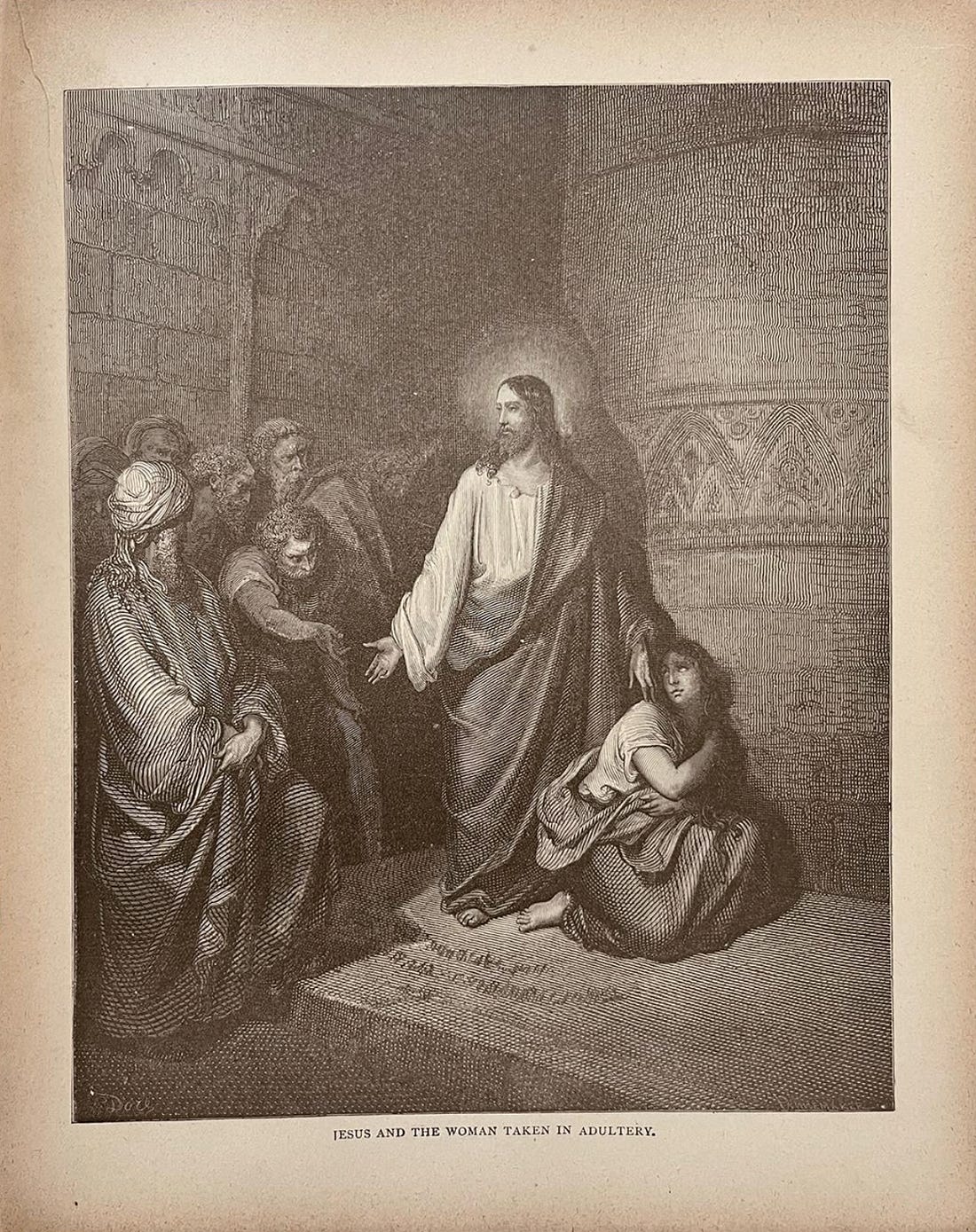
There is the iconic story of Jesus interrupting an execution of a woman caught in adultery, as he says: “Let the one who is without sin cast the first stone.” It is Jesus who blesses the merciful and promises that in as much as we forgive, we will be forgiven. And of course he didn’t just preach it—he lived it up to his last breath as he pleaded for forgiveness for the people who were killing him. If Christ refused to kill, so should we.
The early Christians got it. For the first few hundred years, they were a steady voice for life on all fronts, which included the death penalty. Cyprian, one of the third-century bishops, insisted that it is always wrong to kill, regardless of whether the person taking a life is a criminal, or a governor, or a President. His words: “… Murder, considered a crime when people commit it singly, is transformed into a virtue when they do it en masse.” He found it utterly absurd that we would denounce murder done by an individual but sanctify it when it is done by the state.
My friend Sr. Helen Prejean often says, “Sometimes the question isn’t whether someone deserves to die, but whether we deserve to kill.” After all, weren’t we all deserving of death, but given the gift of life by the love and grace of God?
Let us also make it clear—every one of the people killed by Nidal Malik Hasan, and all those injured and traumatized by his violence, are also made in the image of God, and they deserve justice. To be against the death penalty is not to be against justice. It is not to be numb to the pain of the victims and their families or to say that murder shouldn’t have consequences. But real justice, God’s justice, Biblical justice, is restorative. The best translation of the biblical concept of justice, always connected to “righteousness,” is restorative justice.
Rather than asking, “What did they do wrong, and what punishment do they deserve?” restorative justice asks a different set of questions: ”What harm was done, and how do we heal the wounds?” The death penalty does not heal the wounds of violence; it just creates new wounds. It mirrors the evil. It creates a whole new set of victims. Violence is the disease, not the cure. It is long past time to stop killing to show that killing is wrong. The death penalty raises the question not just of who Nidal Malik Hasan is, but who we are—and who we want to be.
Here’s the good news—enthusiasm around the death penalty is hitting a record low. We are finally seeing polls with a majority of Americans wanting alternatives to the death penalty. On average, a new state abolishes the death penalty every two years. And when it comes to new death sentences, one of the most important data points regarding the death penalty’s future, the numbers are the lowest they have been in decades. In 2025, only 23 people were sentenced to death. Compare that to 325 in 1986.
A generation from now, we will look back on the death penalty like we look back at slavery—with shame and horror, with many of our grandchildren asking how Christians used the Bible to defend such a thing. So this is a time for courage. It does not take courage to say slavery is wrong generations after we abolished it. But it took courage to say slavery was wrong when many people thought it was acceptable, even God-ordained. This is a time for courage. We just have to convince our fellow Christians to be a little more “pro-life.” They really are the only folks keeping this failed experiment alive.
Shane Claiborne is the author of Executing Grace, an activist, and founder of Red Letter Christians.
Theologian Kat Armas celebrates how early Christians would have heard the gospel call to dignity and belonging, in contrast to the empire’s insistence on conquerors and those conquered:
In the empire’s world, belonging was a double-edged blade. To be counted, to have a name that meant anything beyond yourself, you had to be willing to shed your own skin, to carve yourself into a shape that mirrored the empire’s desires. Conformity to the empire’s will was a way of survival, a bitter peace won through the erasure of identity. There was no space forwild diversity, no room for the vast and beautiful spectrum of human existence.
But then this voice, this gospel, cuts through the air: “There is neither Greek nor Jew, circumcised nor uncircumcised, barbarian, Scythian, slave nor free …” (Colossians 3:11). These labels—Greek, Jew, slave, free—were more than words; they were walls built around souls, barriers defining who could rise, who was condemned to serve. But with Colossians’ bold proclamation, the empire’s iron categories tremble. In Christ, even the outsider is welcomed. No longer must anyone bow to belong; this new kin-dom dismantles the lie that peace requires our silence….
The way of Jesus stands in stark contrast. This gospel takes the empire’s most despised and remakes them, offering not only belonging but belovedness. The reach of Christ’s love goes to the most forsaken corners of the imagination and brings forth kin. Here, we find a love that turns the feared into family.
In this new kin-dom, there is no lower rank, no conquest hiding under the guise of unity. Jew and Greek, slave and free, barbarian and Scythian all gather at the same table, each honored as they are.
Armas emphasizes how this movement of God supported both diversity and belonging:
When Colossians speaks of putting off the old self, of shedding the garments of empire, it calls us into a transformation that is not about adornment but about a fundamental rebirth. In Roman triumphs, victors would strip away their old clothes and don the robes of victory in a ceremony that celebrated the rule of the conqueror. In the empire, proper dress symbolized civilization itself. To be Roman was to be clothed rightly, while those deemed “barbarians” were marked by their supposed lack of refinement, cast as outsiders not just by geography but by appearance, by dress, by body. This belief endured through European colonization and still lingers into our modern minds. To belong in the empire is to dress the part. But the gospel invites us to clothe ourselves instead in compassion, kindness, humility,gentleness, patience, and above all love. This love is no shallow thing—it binds us,mends us, forms a communion where there were once only categories.In this kin-dom, power falls away, and what’s left is a peace so deep that it becomes home, a place where difference can finally breathe. A place of communion, solidarity, and friendship.
_____________________________________________
Sarah Young Jesus Calling
To live in My Presence consistently, you must expose and expel your rebellious tendencies. When something interferes with your plans or desires, you tend to resent the interference. Try to become aware of each resentment, however petty it may seem. Don’t push those unpleasant feelings down; instead, let them come to the surface where you can deal with them. Ask My Spirit to increase your awareness of resentful feelings. Bring them boldly into the Light of My Presence, so that I can free you from them. The ultimate solution to rebellious tendencies is submission to My authority over you. Intellectually you rejoice in My sovereignty, without which the world would be a terrifying place. But when My sovereign will encroaches on your little domain of control, you often react with telltale resentment. The best response to losses or thwarted hopes is praise: The Lord gives and the Lord takes away. Blessed be the name of the Lord. Remember that all good things–your possessions, your family and friends, your health and abilities, your time–are gifts from Me.Instead of feeling entitled to all these blessings, respond to them with gratitude. Be prepared to let go of anything I take from you, but never let go of My hand!
RELATED SCRIPTURE:
Psalm 139:23-24 (NLT) 23 Search me, O God, and know my heart; test me and know my anxious thoughts. 24 Point out anything in me that offends you, and lead me along the path of everlasting life.
Additional insight regarding Psalm 139:23-24: David asked God to search for sin and point it out, even to the level of testing his thoughts. This is exploratory surgery for sin. How are we to recognize sin unless God points it out? Then, when God shows us, we can repent and be forgiven. Make this verse your prayer. If you ask the Lord to search your heart and your thoughts to reveal your sin, you will be continuing on “the path of everlasting life.”
1st Peter 5:6 (NLT) 6 So humble yourselves under the mighty power of God, and at the right time he will lift you up in honor.
Additional insight regarding 1st Peter 5:6: We often worry about our position and status, hoping to get proper recognition for what we do. But Peter advises us to remember that God’s recognition counts more than human praise. God is able and willing to bless us according to his timing. Humbly obey God regardless of present circumstances, and in his good time – either in this life or the next – he will honor you.
Additional insight regarding 1st Peter 5:7: Carrying your worries, stresses, and daily struggles by yourself shows that you have not trusted God fully with your life. It takes humility, however, to recognize that God cares, to admit your need, and to let others in God’s family help you. Sometimes we think that struggles caused by our own sin and foolishness are not God’s concern. But when we turn to God in repentance, he will bear the weight even of those struggles. Letting God have your anxieties calls for action, not passivity. Don’t submit to circumstances but to the Lord, who controls circumstances.
Job 1:21 (NLT) 21 He said, “I came naked from my mother’s womb, and I will be naked when I leave. The Lord gave me what I had, and the Lord has taken it away. Praise the name of the Lord!”
Additional insight regarding Job 1:21: Job did not hide his overwhelming grief. He had not lost his faith in God; instead, his emotions showed that he was human and that he loved his family. God created our emotions, and it is not sinful or inappropriate to express them as Job did. If you have experienced a deep loss, a disappointment, or a heartbreak, admit your feelings to yourself and others, and grieve.
Additional insight regarding Job 1:21: Job had lost his possessions and family in this first of Satan’s tests, but he reacted rightly toward God by acknowledging God’s sovereign authority over everything God had given him. Satan lost this first round. Job passed the test and proved that people can love God for who he is, not for what he gives.
Cherokee theologian Randy Woodley contrasts Western Christianity’s emphasis on salvation through doctrine with the healing work of Jesus:
People who believe themselves to be at the top of a hierarchy must find ways to maintain power. Doctrines can be a handy tool for doing so. If you can convince the masses that a reward awaits them in heaven, you’ve got a way to keep the restive crowds a bit quieter, more compliant. And if you can convince them that they’re actually sinful through and through—and that as sinners, they’ve got to keep themselves in line in order to have a chance at God’s grace—well, you’ve got it made. Your power can continue to expand.
One such doctrine was the belief that all people are born sinful. This is often called the doctrine of original sin … [which] fits nicely with the dominant church’s presumed authority to either grant or withhold salvation….
What Christian theology calls “sin” Native American understandings often describe as imbalance, or broken harmony. These different terms point toward the same spiritual reality. Salvation then, is restoring the harmony and imbalance through healing.
By reducing the idea of salvation to a series of formulas, or disciplines, or prayers, or creeds, the Western church missed the whole point. Salvation … was not something that could be bought with money, power, or obedience to words in a creed. Salvation is about one thing: healing. And not healing for later, in the by and by, but healing for right now.
Even today, many people allow doctrine to determine their idea of salvation rather than understanding salvation as the way God heals us all, including the rest of the community of creation. I would love to see people grasp this important concept: that healing is a much better way to think of God’s greatest gift than salvation is.
Woodley describes how Jesus offers collective healing rather than individual salvation:
When we look at Jesus through the lens of Indigenous and Hebrew understandings rather than imperial American and Roman frameworks, we see that his ministry was fundamentally about restoring wholeness, healing bodies, bringing outcasts back into community, challenging unjust systems, and mending broken relationships…. Healing is the bigger picture of God’s vision that Western Christianity calls “salvation,” and healing is for all of us now.
Perhaps most importantly, healing language better reflects the Creator’s heart for shalom: that comprehensive peace and abundance in which all creation coexists in harmony. Shalom, and the Indigenous visions of harmony, contains a justice and wholeness that extends far beyond individual souls to encompass whole communities, cultures, and the land itself.
The path forward must be about stripping away the imperial distortions to reveal the Jesus who heals rather than conquers, who restores rather than erases, who empowers rather than overpowers. In this understanding, salvation becomes what it was always meant to be: the healing of all things.
We are moving swiftly through these final weeks of Pentecost. Advent is coming.
The lectionary readings raise increasingly pressing questions about what it means to live in politically fraught and conflicted times — while hoping for a better world to come.
Matthew 22:15-22
The Pharisees went and plotted to entrap Jesus in what he said. So they sent their disciples to him, along with the Herodians, saying, “Teacher, we know that you are sincere, and teach the way of God in accordance with truth, and show deference to no one; for you do not regard people with partiality. Tell us, then, what you think. Is it lawful to pay taxes to the emperor, or not?”
But Jesus, aware of their malice, said, “Why are you putting me to the test, you hypocrites? Show me the coin used for the tax.”
And they brought him a denarius.
Then he said to them, “Whose head is this, and whose title?”
They answered, “The emperor’s.”
Then he said to them, “Give therefore to the emperor the things that are the emperor’s, and to God the things that are God’s.”
When they heard this, they were amazed; and they left him and went away.
I paid taxes this week.
I know. It’s not April. This is October. But, since I’m a freelancer, it takes time to organize everything. We always ask for an extension and pay in the autumn.
While struggling through piles of receipts, I was thinking about preaching this weekend on this text: Render to Caesar the things that are Caesar’s, and to God the things that are God’s.
And so, I wrote a check and rendered.
These verses are often quoted to support “good citizen” theology. “Good citizen” theology teaches that we live in different spheres of duty, responsibility, and obligation — state and church, politics and faith, or the sphere of “Caesar” and the sphere of “God.”
It seems, on the surface at least, easy. Pay your taxes, support the government; pray and serve, love your neighbor; honor the king, worship God.
Just when we think we’ve solved the problem of politics and religion, the New Testament throws us a story like Jesus’ argument with his critics, the Pharisees.
In this passage, the Pharisees quiz Jesus, to “entrap” him. Jesus was, most likely, a fellow-traveler to the first-century Jewish movement called the “Pharisees.” He shared much of their theology, rabbinical teaching style, and practices of worship. But for all his similarities with them, there were differences, too. And those differences often emerged in sharp encounters.
The Pharisees were both a theological and political movement. They hated Caesar and Rome — seeing the Romans as unclean and barbaric pagan overlords. But they’d adopted a program of what one scholar calls, “pragmatic survival and accommodation” instead of violent resistance to Rome. As much as they detested Caesar, they really, truly wanted to stay out of trouble with the authorities, waiting out Rome and hoping for better years ahead. Instead of criticizing the political order directly, they emphasized faith and Jewish practice and kept out of Caesar’s way.
When they questioned Jesus, they wanted to pin him down on politics and religion. Getting Jesus on record would serve them well. They could figure out if Jesus sided with their survival strategy. He’d be a good ally both religiously and politically. If he didn’t agree, he might be dangerous. Perhaps he sided with the Zealots or one of the politically revolutionary groups. The Pharisees needed to know that. If he became too popular, he might draw Rome’s ire and threaten the already-tenuous survival of the struggling Jewish community.
Understanding Jesus’ position on taxes was key to defining his politics. Generally, the Pharisees paid taxes as part of their “accommodation” strategy. Better to cough up the cash than go to jail — or worse. But Jesus? What did he do?
And so their question: Is it lawful to pay taxes to the emperor?
In one of his finest no-answer answers, Jesus said: “Give therefore to the emperor the things that are the emperor’s, and to God the things that are God’s.”
His critics were “amazed.” They got it. They understood his point.
It seemed somehow clear to them. Clear enough to turn and walk away.
But it has rarely seemed that clear to us. Over the centuries Christians developed at least five interpretations of Jesus’ “render to Caesar” comment: (1) Caesar and God are separate — pay the tax; (2) Caesar and God are an enigma, an unsolvable puzzle meant as a deflection; (3) Caesar and God are a paradox and we, somehow, must serve both; (4) Caesar and God are at odds — pay your taxes but “with contempt”; or (5) Caesar is under the authority of God and give the state nothing, no matter the consequences.
Take your pick. Each one of these positions has theological oomph — and has been supported and argued over and over and over again in church history.
That makes me wonder: Have we missed the point?
When this story was first written down, sometime between 60 and 80, Roman emperors made a claim to divinity. Indeed, the imperial titles for Caesar included “Dominus et Deus” and “Dominus et Salvator.” Not “Mr. President” or “Your Honor” or even “Your Royal Highness” or “Your Majesty.” But “Lord and God” or “Lord and Savior.” Those were titles held by Caesar.
Jews hated it. This was idolatry. And Christians hated it, too. Christians hated it so much that they stole the titles and gave them to Jesus. No calling Nero their Lord and God. Instead, they proclaimed “Jesus is Lord.”
And the year 60, they were being killed for saying it.
That’s the invisible context of the Caesar tax story. In these early years, every Christian knew their creed: Jesus is Lord. Not Caesar.
The first audience of Matthew’s gospel would have known exactly how it was intended. The story undergirded their creed — Jesus is Lord. Not Caesar. They might have laughed upon hearing or reading it. Caesar thinks everything belongs to him. We don’t think that! Because nothing belongs to Caesar. Everything belongs to God!
The story was written down because it supported what Christians already believed. Not that they were trying to figure out some doctrine of church and state.
They were not worried about taxes. They were worried about Roman authorities throwing them to wild beasts.
They already knew that Caesar was a pretender. That evil was upon the throne. And God? Well, no matter what Caesar did, even if he murdered them, Caesar could never own them. Because God did. Through faith. Through baptism. Through their love of God. Through their solidarity with neighbors. Jesus is Lord!
And that’s it. The first creed was a theological statement. And it was a political statement. The first creed was theo-political. Jesus is Lord. Caesar is not.
In the case of this verse, the long historical argument of state and church in Christian theology is a complexity of our own making. It is complicated because we’ve made it complicated — trying to justify governments and practices and systems of politics that literally have nothing to do with divine intention and the sacred heartbeat of the cosmos.
Jesus is Lord. Caesar is not.
The Pharisees were amazed because it was so clear. So simple. They’d complexified Caesar and God — and Jesus cut to the chase. Give to Caesar what is Caesar’s — to God what is God’s.
It is simple. Everything belongs to God. Simple, yes. But it is very hard to live. The early Christians knew that. Simplicity doesn’t mean it is easy. And we know that, too.
But the simplicity still shines: God. Dominus et Deus. Lord and God. Dominus Mundi. Lord of the Earth. Dominus universum. Lord of the Universe.
Remember the creed — the cry — of the first followers of Jesus: Jesus is Lord!
Not Caesar. Never Caesar.
May we be brave enough to proclaim the same — and courageous enough to live it in our day.
Father Richard Rohr points to the creation of winners and losers as a sure sign that an “empire consciousness” is at work:
There is an overall paradigm that I’ve been calling “empire thinking,” which is a zero-sum game. And in a zero-sum game, one can only win by causing another to lose. Unless that assumption is stated very clearly, we don’t realize how often it’s at work. It will not really be a game where I have a wonderful skill to share or a gift to be highlighted. I just have to defeat the other side. We could also call it the win-lose worldview. I want to say as strongly as I can that the win-lose worldview, the expectations of the zero-sum game, are absolutely dominant in the minds of most people.
This game of winning and losing is a tragic way of defining reality. A zero-sum game demands losers. Surely it isn’t true that the only way we can really “win” in life is to make certain that others lose? It’s amazing how we take some kind of happy delight in this. Just look at the enthusiasm communities have for their sports teams! We like that framing of reality. At this point in our history, we like winners and losers so much that, whereas Descartes said, “I think, therefore, I am,” the American mind now says, “I win, therefore, I am.” That is not an exaggeration. “I win, therefore, I am” is at work in our economics, politics, global policy, social media, religion, and even our personal relationships! We’re not considering the other side of that equation: Whenever we think that way, there have to be losers.
Christianity quickly adopted that interpretation of the gospel, though the four Gospels in no way validated it. After several centuries of persecution by the Roman Empire, most Christians felt quite happy, excited, and even liberated when the Roman emperor Constantine made Christianity the established religion in 313 CE. We moved from the bottom to the top, from the losers to the ultimate winners.
Ascending, top-down religions love a top-down, win-lose worldview. Protect the top, make sure the top is winning, and it just so happens that a lot of other people lose. Unless we’re transformed by grace, we can’t even recognize that we’re doing it. Without grace, we really don’t know how to think in terms of “win-win.”
That type of win-lose thinking is associated with a high degree of Christians today, and it’s not even really our fault. No one ever taught us to think differently. Presenting heaven and hell in the first grade offers a nice, dualistic explanation to keep little children from misbehaving—but does it have much to do with the teachings of Jesus? I don’t think so. But when we frame reality and the whole world that way, that’s the way we frame the gospel.
=============
The Games of Empire
Monday, October 19, 2026
Father Richard considers how the lens of empire shifted the interpretation of the gospel:
Once Christianity became enmeshed with empire, we could no longer talk about the opening line of the Sermon on the Mount, “Blessed are the poor in spirit” (Matthew 5:3). Emperors don’t want people who are poor in spirit. They want loyalists. They want people who salute the flag and follow the rules. They want national security states. Any talk of nonviolence frankly goes underground until the twentieth century. That’s how well empire Christianity buried the gospel message. Empires need clear judgments about up and down, who’s in and who’s out, who’s right and who’s wrong, who’s our enemy and who’s our friend.
Here’s an example of how thoroughly it infected the church. In 1054, with no sense of irony, the bishop of Rome and the patriarch of Constantinople, representing the Latin church and the Greek church traditions, mutually excommunicated one another. Each side effectively called themselves the winner. This was a triumph of dualistic, win-lose thinking. We had the Holy Roman Empire in the West, and the Byzantine Empire in the East, and they basically stopped talking to one another.
The Holy Roman Empire transitioned into the Austro-Hungarian Empire. Similarly, the Spanish Empire brought its version of Western Roman Catholicism to the New World, including my own state of New Mexico.
These empires handed on a reading of the gospel that did not threaten top-down power, war-making, or the accumulation of wealth, but was presumably perfectly aligned with it. That’s why people think I’m a heretic when I critique capitalism. Did you know that until the 1100s, taking interest on a loan was considered material for excommunication? Now, it’s the only name of the game! We are so aligned with our current money-making system that much of Jesus’s teaching, in which he says the top will be bottom and the bottom will be top, doesn’t make a bit of sense to us. (See Matthew 19:30, 20:16.) We don’t agree with it, privately or publicly.
There are, of course, the outliers, those who remained outside of empire. In the Catholic world there were the desert fathers and mothers, the Celts, and the mendicant orders. In the Protestant world, non-imperial Christianity was probably best illustrated by the Anabaptist movement, which led to groups like the Mennonites, the Amish, the Waldensians, the Bruderhof, and even the Quakers (although the Quakers aren’t really Anabaptists).
These forms of Christianity emphasize things like a simple lifestyle, non-participation in war, not taking oaths to governments, and not saluting the flags and systems of this world. These groups were never established by any state whatsoever, nor did they enjoy the privileges that came from being the established religion of the Roman, Spanish, or British Empires. This is actually to their benefit because once you’re established, you have to be careful! Your ability to speak truth will be highly limited. There’s a whole bunch of things you cannot say anymore.
The ache for home lives in all of us, the safe place where we can go as we are and not be questioned. —Maya Angelou
Historian Diana Butler Bass emphasizes the importance of “home” in Scripture and different faith traditions.
Home is a central theme in the world’s great religions: Jews seeking a homeland with God; Christian proclaiming that God dwells within our hearts; Muslims facing home to pray; Buddhists find a true home in enlightenment…. Human beings build temples to shelter God’s presence, we mark sacred places with shrines, and we bury, float, or burn our dead that they might find their way home to God.
The overarching narrative of the Bible is that of humanity searching for home…. Throughout, a spiritual interplay emerges: not only did God create our earthly home, but God is our home…. It is a powerful story, rich in literary ambiguity—the earth, us, home, and God are almost interchangeable characters in this ancient record of humankind’s aching search to dwell….
Specific stories also relate tales of us, home, and God. Perhaps none does so more beautifully than the book of Ruth. Ruth, a Moabite woman married to a Jew, is widowed. Instead of staying in her own homeland after her husband’s death, she pleads with her mother-in-law, Naomi, to be allowed to accompany her to Israel to find a new home:
Where you go, I will go; where you lodge, I will lodge; your people shall be my people, and your God my God. Where you die, I will die— there will I be buried (Ruth 1:16–17)
Home is the relationship between two people, a physical place, and God. This is sacred dwelling. [1]
Butler Bass describes how God dwells with and in us:
Theistic faiths insist that ultimately God is our home. God dwells with us, and we in God. In Judaism, one way of referring to God is shekhinah, meaning the dwelling or settling of the Divine Presence, a word that also is used to describe the nesting of birds. The ancient Hebrew prophet Isaiah spoke of Immanuel, “God with us,” as the promise of shelter and safety for Israel, one of the names that Christians later adopted for Jesus….
The word “dwell” is related to an Old English word for “heresy” or “madness.” Perhaps it is a sort of insanity to believe that God dwells with us. If so, the madness is the long-lingering hope of the human race, the dream to dwell. It is not only a hope, however; it is also hard work, this effort to shelter our souls. Perhaps making a home is both a divine madness and a human one. Ultimately, physical houses go to ruin, but home is an ongoing spiritual promise….
Home, a holy habitation, a sacred space. We do not often stop to consider where we dwell, much less how it shapes us to move about in the world, for either good or ill. But somehow we keep searching for home, looking for a safe haven to reside and return.
References: [1] Diana Butler Bass, Grounded: Finding God in the World; A Spiritual Revolution (HarperOne, 2015), 169, 170.
[2] Butler Bass, Grounded, 190, 191, 192.
Image credit and inspiration: Andrew Wong, untitled (detail), 2022, photo, Penang, Malaysia. Unsplash. Click here to enlarge image. The inner sanctum is always with us, shedding light on who we are, our journey with and to the divine.
“No medicine is more valuable, none more efficacious, none better suited to the cure of all our temporal ills than a friend to whom we may turn for consolation in time of trouble, and with whom we may share our happiness in time of joy.”
My life has absolutely been enriched and made significantly better by having good friends. Adulthood means you may see those friends less often, but it is always great to reconnect and talk about what we both agree matters most.
2.
“If one completes the journey to one’s heart, one will find oneself in the heart of everyone else.”
A common thread in the Christian mystical tradition seems to be the solidarity one feels toward the rest of humanity.
If we look deep enough into ourselves, we will see everyone else, and if we look deep enough into everyone else, we will find ourselves.
In our world today, compassion, empathy, and connection seem increasingly undervalued as we spend more and more time in front of screens. I found it hard to believe that, several months ago, empathy was called a “sin.”
I think the highest and most mature interpretations of the world’s religions will focus on recognizing one another’s shared humanity.
3.
“The Church is an army of peace which sheds no blood.”
The early Church actually patterned its early structures after the Roman military.
From lay people to deacons to priests to archpriests to bishops to archbishops and finally to the Pope, the hierarchy of the early Church (and many denominations now) resembled that of the Roman military. The reason for that was to regionalize who was in charge of which areas.
The major difference, though, was the tactics. The Roman Empire used violence and intimidation to achieve its goals. The early Church, on the other hand, was to use the tools we now call the Fruit of the Spirit…
Love
Joy
Peace
Patience
Kindness
Goodness
Faithfulness
Self-Control
The early Church saw itself as in the midst of a spiritual battle for mankind’s soul. In its day, it saw the way that society valued people according to their utility, the way that it mistreated the poor, the widow, and the orphan, and how it demonized the homeless and the beggar. If you ask me, it is little wonder why the early Church grew so much; it was a tender refuge for people from a brutal world.
Plus, the paradox of being a “Church militant” that advances its mission through virtues rather than vices? I am sure that made many people scratch their heads in curiosity.
4.
“We remember to change the oil in our cars, change the filters in our water dispensers, and change the bag on our vacuums, but we neglect the work of inner housecleaning. We’re unfamiliar with the vast territory of our hearts.”
Chuck has a new book on character coming out that I am very excited to read.
Here, though, he makes a simple analogy: we take better care of our cars, filters, and vacuums than our own inner landscape.
If our souls had a “check engine light,” we might be more inclined to work on it and give it regular checkups. Without such a light, we are prone to going too long without working on ourselves.
I guess it is possible that irritability, sadness, depression, loneliness, and the like are all warning signs that we often overlook or simply push through by means of force of effort. Obviously, this isn’t good, but we may feel like we have to keep pushing no matter what.
It is my opinion, but I think some church folk keep counseling or therapy at a distance because there’s a turf war over who does the internal healing. Is it spirituality or is it psychology?
Or could it be both?
5.
“We do not have to live in a monastery to find our way into the deep healing and liberation that monastic life nurtures and protects.”
Years ago, I heard Jim Finley say that monastery life is finely tuned to cultivate the inner experience of God through all that one does. Whether you’re raking leaves, working in the kitchen, helping visitors, praying, or serving, it doesn’t matter; all of life can be done in a way that keeps God’s presence very apparent.
I liked that.
It makes me wonder how I might better craft and fine-tune my own life so I can experience God’s presence more fully in the midst of everything. (This makes me think of Brother Lawrence’s life.)
I already deactivated social media, and I already live a rather slow pace of life… Perhaps the next step is minimalism: giving away the “stuff” that clutters and unnecessarily fills life?
This CO2- (Church Of 2) is where two guys meet each day to tighten up our Connections with Jesus. We start by placing the daily “My Utmost For His Highest” in this WordPress blog. Then we prayerfully select some matching worship music and usually pick out a few lyrics that fit especially well. Then we just start praying and editing and Bolding and adding comments and see where the Spirit takes us.
It’s been a blessing for both of us.
If you’d like to start a CO2, we’d be glad to help you and your partner get started. Also click the link below to see how others are doing CO2.Odds Monkey
Steve Harvey Introduces Jesus To A Secular Audience
About
Change this text in the admin section of WordPress